
Wine Barrel Market Size and Share
Market Overview
| Study Period | 2021 - 2031 |
|---|---|
| Market Size (2026) | USD 1.29 Billion |
| Market Size (2031) | USD 1.65 Billion |
| Growth Rate (2026 - 2031) | 5.02 % |
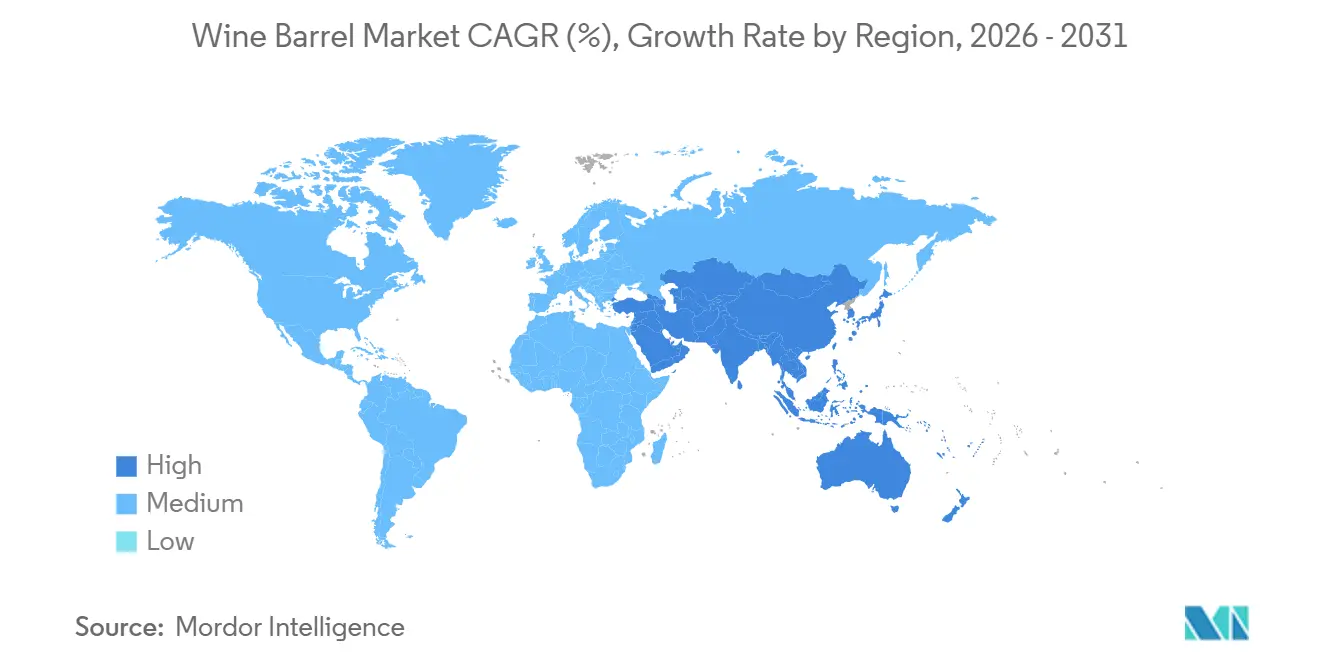
| Fastest Growing Market | Asia-Pacific |
| Largest Market | Europe |
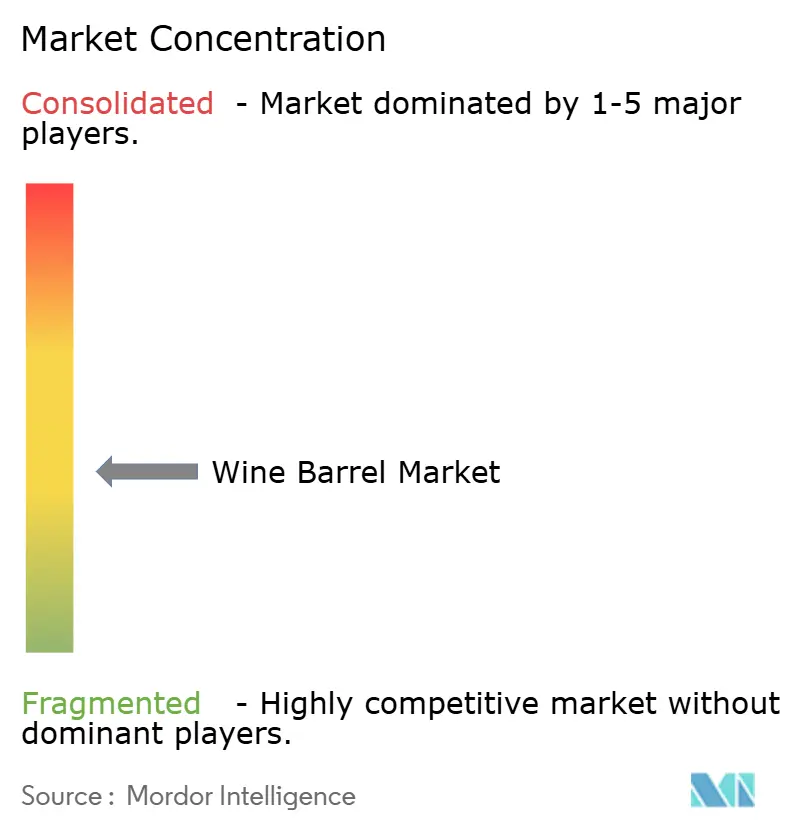
| Market Concentration | Medium |
Major Players *Disclaimer: Major Players sorted in no particular order Image © Mordor Intelligence. Reuse requires attribution under CC BY 4.0. | |
Wine Barrel Market Analysis by Mordor Intelligence
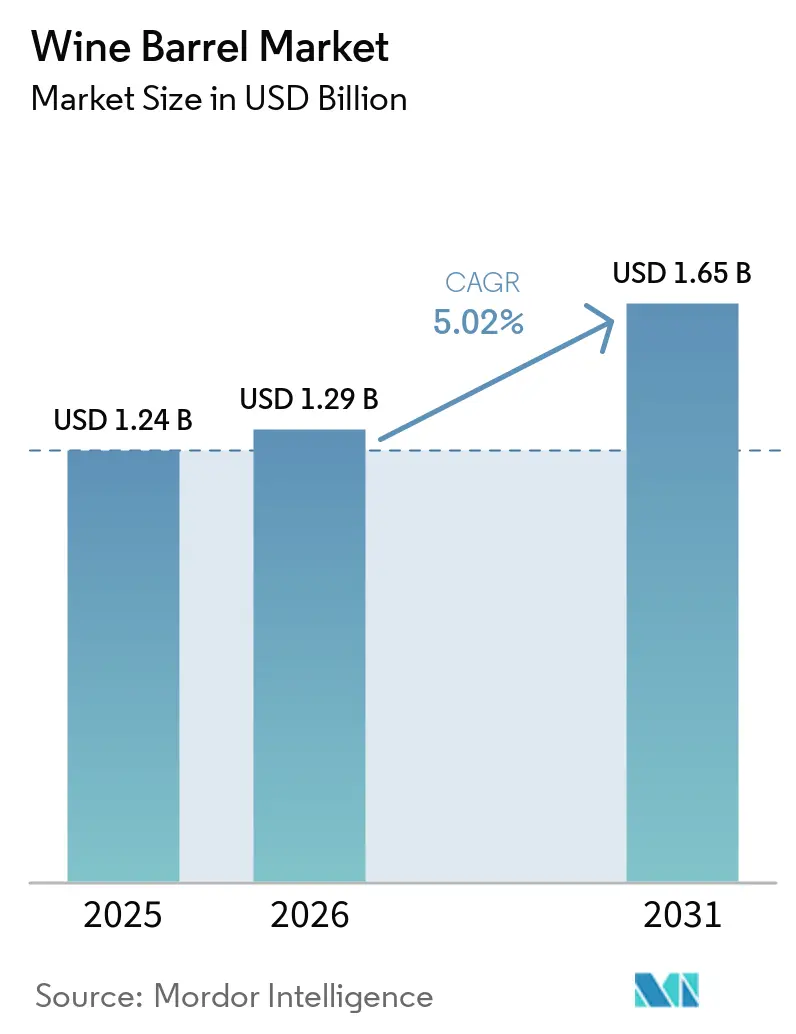
The wine barrel market size was valued at USD 1.24 billion in 2025 and estimated to grow from USD 1.29 billion in 2026 to reach USD 1.65 billion by 2031, at a CAGR of 5.02% during the forecast period (2026-2031). Premium wine producers continue to view barrel selection as a strategic production decision rather than a routine purchase, as barrel choice influences aroma, texture, maturation, and the positioning of the finished wine. Selection criteria increasingly include oak origin, grain, seasoning, and toast level, with requirements varying across red, white, and rosé wine programs. Global wine production remains under pressure, limiting cooperage volumes across several established wine-producing countries and making volume forecasts increasingly dependent on premium demand. World wine production totaled 227 million hectoliters in 2025, 9.4% below the five-year average[1]. However, demand for premium barrels has remained more resilient than overall wine volume demand. Consequently, the wine barrel market favors suppliers that maintain quality, customize barrel specifications, support wineries amid changing harvest conditions, and serve premium producers despite tighter purchasing budgets. This environment also increases the importance of consistent wood sourcing and responsive service, particularly as wineries reduce their supplier base.
Key Report Takeaways
- By wine type, red wine held the largest share of the wine barrel market at 62.87% in 2025, while rosé wine is projected to grow at the fastest CAGR of 7.18% during 2026-2031.
- By wine barrel type, French oak barrels held the largest share of the wine barrel market at 59.45% in 2025 and are projected to grow at the fastest CAGR of 5.47% during 2026-2031.
- By toast level, medium toast held the largest share of the wine barrel market at 56.74% in 2025, while light toast is projected to grow at the fastest CAGR of 6.16% during 2026-2031.
- By geography, Europe accounted for the largest share of the wine barrel market, at 42.16% in 2025, while Asia-Pacific is projected to grow at the fastest CAGR, at 5.42%, during 2026-2031.
Note: Market size and forecast figures in this report are generated using Mordor Intelligence’s proprietary estimation framework, updated with the latest available data and insights as of January 2026.
Market Trends and Insights
Drivers Impact Analysis of Wine Barrel Market*
| Driver | (~) % Impact on CAGR Forecast | Geographic Relevance | Impact Timeline |
|---|---|---|---|
| Premiumization of wine aging and consumption | +1.5% | Europe and North America, with spillover to Asia-Pacific premium tiers | Medium term (2-4 years) |
| Expansion of boutique and craft wineries | +0.8% | North America and the European Union, with early gains in Australia and South America | Medium term (2-4 years) |
| Growth of wine production in the Asia-Pacific | +0.7% | Asia-Pacific, especially India and premium China, with spillover to the Middle East and Africa | Long term (≥ 4 years) |
| Rising demand for customized oak profiles | +0.6% | Global | Short term (≤ 2 years) |
| Digital traceability in oak sourcing and barrel production | +0.3% | European Union and North America | Medium term (2-4 years) |
| Increased adoption of circular barrel reuse programs | +0.4% | Global, led by the European Union and Australia | Medium term (2-4 years) |
| Source: Mordor Intelligence | |||
Premiumization of Wine Aging and Consumption
Wine consumption has become more selective as lower-priced volumes decline across several markets and consumers increasingly choose fewer bottles with clear quality credentials. Higher-value wines require aging decisions that deliver a distinct sensory profile, support a credible quality position, and create a product story that producers can communicate to distributors and visitors. This trend supports demand for new oak among producers that can sustain premium prices through vineyard reputation, direct sales, or established brand loyalty. The Fédération des Tonneliers de France stated that increasingly selective premium consumption creates an opportunity for the cooperage industry, as barrel aging remains a key quality indicator. The wine barrel market benefits when producers prioritize revenue per bottle, cellar quality, and repeat customer demand rather than output volume alone. This approach encourages cooperages to maintain investment in wood quality, consistent seasoning, tasting support, and technical services for winery teams.
Expansion of Boutique and Craft Wineries
Small wineries often use new oak barrels to reinforce their craft positioning, support premium pricing strategies, and differentiate limited releases from larger commercial labels. These producers purchase barrels at a higher rate relative to their output because they produce smaller lots, sell through direct and personal channels, and seek recognizable quality signals. They also have limited ability to substitute oak with lower-cost alternatives without altering the wine’s intended profile or weakening the cellar narrative communicated to customers. New boutique wineries can become incremental buyers as they progress from initial releases to regular production and establish a more stable wine portfolio. Consequently, the wine barrel market can benefit from a broader base of specialized producers, rather than relying solely on high-volume wineries with centralized purchasing. French oak is particularly important for wineries seeking a premium identity, a differentiated tasting-room offering, and a house style centered on barrel-aged wines.
Growth of Wine Production in Asia-Pacific
India’s vineyard area is projected to reach 197,000 hectares in 2025, ranking seventh globally, up from 177,000 hectares in 2019, an expansion of 4.6%[2]. This growth is establishing a future production base in the Nashik and Maharashtra clusters, where winery development can gradually generate recurring demand for cellar inputs. In China, wine imports are projected to decline by 11% to USD 1.4 billion in 2025, while higher average import prices indicate a more premium import mix. These conditions favor fewer purchases of higher-specification barrels, as importers and producers place greater value on quality indicators. The wine barrel market can benefit as Asian producers and importers increasingly emphasize French oak, controlled toast levels, and customized programs. Trade developments that reduce barriers to imported wine could further support the shift toward higher-value wines and increase local consumers’ exposure to barrel-aged wine styles.
Rising Demand for Customized Oak Profiles
Winemakers increasingly request barrels that meet specific sensory and maturation objectives rather than selecting from a limited range of standard products. Producers now consider forest origin, grain tightness, seasoning duration, and toast profile as practical purchasing criteria alongside price and delivery timelines. The Oregon Wine Symposium featured a 2026 session on smart oak strategies and a 2025 trial comparing six oak-aging regimes. The trial assessed flavor, texture, and margin outcomes across barrels, inserts, staves, and blocks, demonstrating that wood treatment has become a commercial as well as a technical decision. In October 2025, Tonnellerie Saury launched its limited-edition L’Écrin barrel for estates seeking deeper aromatic integration. The wine barrel market favors cooperages that can translate winemaking objectives into repeatable barrel specifications and clearly communicate these choices to cellar teams.
Restraints Impact Analysis of Wine Barrel Market*
| Restraint | (~) % Impact on CAGR Forecast | Geographic Relevance | Impact Timeline |
|---|---|---|---|
| High cost of premium oak barrels | -0.8% | Global, most acute in France, the United States, and Southern Hemisphere export markets | Short term (≤ 2 years) |
| Limited availability of cooperage-grade oak | -0.6% | European Union, including France and Eastern Europe, and North America | Long term (≥ 4 years) |
| Substitution by stainless steel, concrete, and oak alternatives | -0.7% | Global, led by New World producers and entry-level wine | Medium term (2-4 years) |
| Climate-related changes in oak quality and seasoning cycles | -0.5% | France and North America | Long term (≥ 4 years) |
| Source: Mordor Intelligence | |||
High Cost of Premium Oak Barrels
French oak prices tripled over the preceding decade, including a 50% increase during the two years through 2025[3]. These higher costs make traditional barrels increasingly difficult to justify for entry-level wines, where producers have limited ability to raise retail prices. As a result, producers must choose between using alternative aging solutions and concentrating barrel expenditure on premium wines that offer higher margins and appeal to customers willing to pay for aging quality. In January 2026, OENEO introduced Twood, a layered-stave French oak barrel designed to use a greater share of the available wood resource. The launch demonstrates that even established cooperages recognize the cost pressures associated with raw materials and the need to serve customers with tighter budgets. The wine barrel market remains stronger in the premium segment; however, affordability continues to limit broader adoption among wineries with lower-priced portfolios.
Limited Availability of Cooperage-Grade Oak
White oak supply is difficult to expand because trees require 80–120 years to reach cooperage maturity and cannot respond quickly to increased barrel demand. Each mature tree produces only 1.5–2 barrels, limiting short-term supply responsiveness and making the efficient use of available timber critical. The U.S. Forest Service found that 70% of eastern U.S. timberland containing white oak faced at least one sustainability threat. The most widespread concern was a shortage of younger trees entering mature size classes, which threatens future supply even when current harvest availability appears stable. The Fédération des Tonneliers de France also reported reduced availability of stave-grade oak in France. Consequently, the wine barrel market faces a persistent input supply risk, as forest conditions, harvesting restrictions, climate pressures, and seasoning cycles constrain the availability of cooperage-grade wood.
*Our forecasts treat driver/restraint impacts as directional, not additive. The impact forecasts reflect baseline growth, mix effects, and variable interactions.
Wine Barrel Market Segment Analysis
By Wine Type:
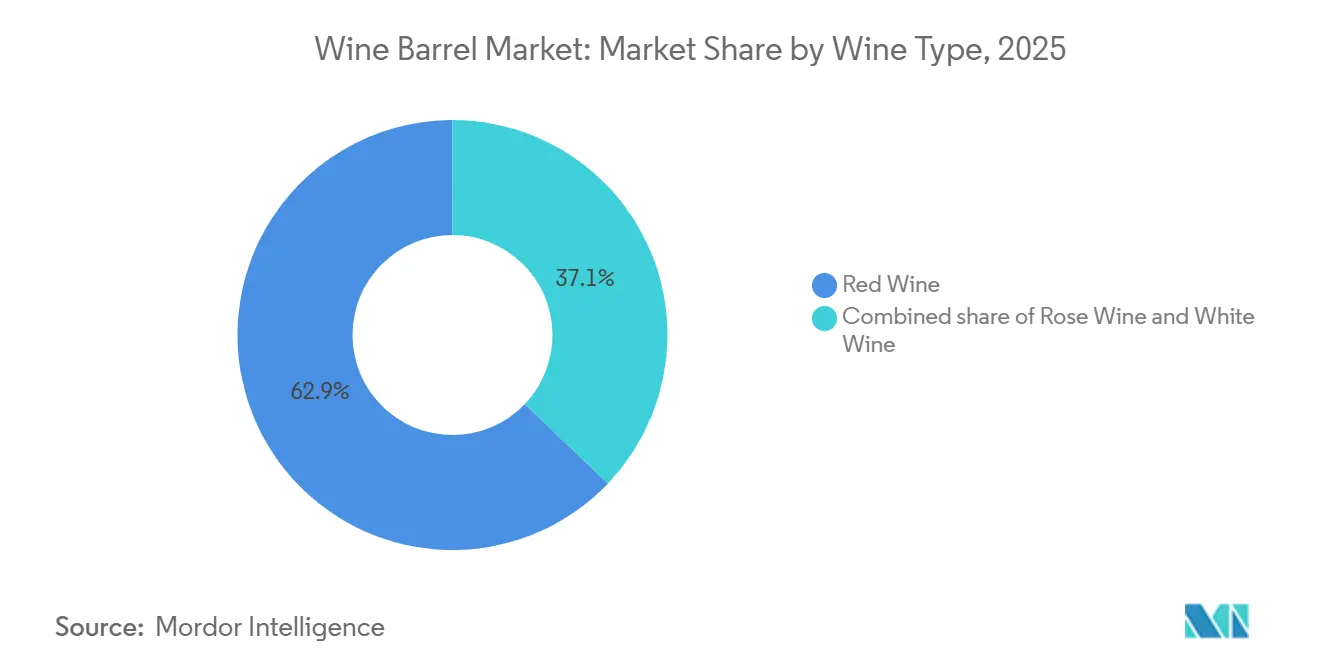
Red Wine Leads Demand, While Rosé Expands FasterRed wine accounted for 62.87% of the wine barrel market share in 2025, supported by the frequent use of new oak in premium wine production. Cabernet Sauvignon, Syrah, and Merlot-based wines use barrels to develop tannin structure and enable controlled oxygen exposure. Producers in Bordeaux, Tuscany, Rioja, and Napa Valley often incorporate new oak into their aging programs. Barrel selection varies by vineyard, vintage conditions, and the intended cellar-aging period. Replacement cycles may range from one to two vintages for wines requiring a strong oak influence. White wine ranked second, driven by premium Chardonnay and oak-fermented Chenin Blanc. Producers use barrel selection to enhance texture while preserving varietal character. The wine barrel industry remains closely linked to red wine, as red wine styles generally withstand longer aging periods and more pronounced wood contact. Red wine producers also use barrels from different origins and with varying toast levels to differentiate individual labels. This approach creates recurring purchasing requirements as producers seek consistent results across successive vintages.
Rosé wine is projected to grow at a CAGR of 7.18% during 2026-2031, making it the fastest-growing wine type. Producers are investing in dedicated rosé programs that aim to add complexity without overpowering delicate aromas. Barrel fermentation and aging can help create more structured premium rosé expressions. Producers can calibrate barrel treatment to preserve color, fruit character, and a lighter mouthfeel. This application is more selective than the oak treatment used for many red wines. The category’s growth creates opportunities for lighter-toast barrels and shorter aging programs. The wine barrel market size for rosé is expanding as wineries develop wines for higher price points and longer shelf life. Cooperages can address this demand by offering barrels that minimize aggressive oak flavors and preserve freshness. The wine barrel industry can also use rosé programs to build relationships with producers updating their product portfolios. Demand will depend on whether these producers position rosé as a premium wine rather than a seasonal, high-volume product.

By Wine Barrel Type:
French Oak Remains the Premium ReferenceFrench oak barrels are projected to account for 59.45% of the wine barrel market share in 2025, maintaining their leading position. Their tight grain and controlled aromatic contribution make them well suited for wines intended for extended aging. Producers can adjust vanilla, spice, toast, and caramel notes through their choice of toast level. French oak is widely used in high-value appellations, where barrel aging supports the desired wine style. It also provides winemakers with a recognized specification for communicating premium quality to buyers. The segment’s strength reflects the concentration of barrel investments in premium wines. American oak holds the second-largest share and provides a more pronounced coconut and vanilla profile. It remains important for Rioja and value-focused wine production in California and Chile. Other barrel types include oak from Hungary, Slovenia, and Croatia, as well as acacia and chestnut options. These alternatives serve producers seeking different aromatic profiles, costs, or regional sourcing options.
French oak barrels are forecast to grow at a CAGR of 5.47% during 2026-2031, the fastest rate among barrel types. This trend indicates that premium demand can support the largest barrel category even as overall volumes decline. Producers may concentrate spending on French oak as lower-priced wines shift toward alternative aging methods. This trend favors cooperages that can maintain reliable supply and improve the efficiency of their wood-use practices. European Union PDO frameworks may reinforce demand where regional regulations specify aging requirements and permitted barrel practices. OENEO’s Twood design uses double-layered staves to improve French oak utilization while retaining the relevant oak species. This product approach may help producers manage supply constraints without moving away from the premium oak category. The French oak segment’s wine barrel market size can benefit from this balance between recognized quality and improved wood yield. However, cooperages must demonstrate that alternative construction methods meet producer expectations for aging performance. Their commercial success will also depend on wineries’ acceptance of new construction methods within established cellar practices.
By Toast Level:
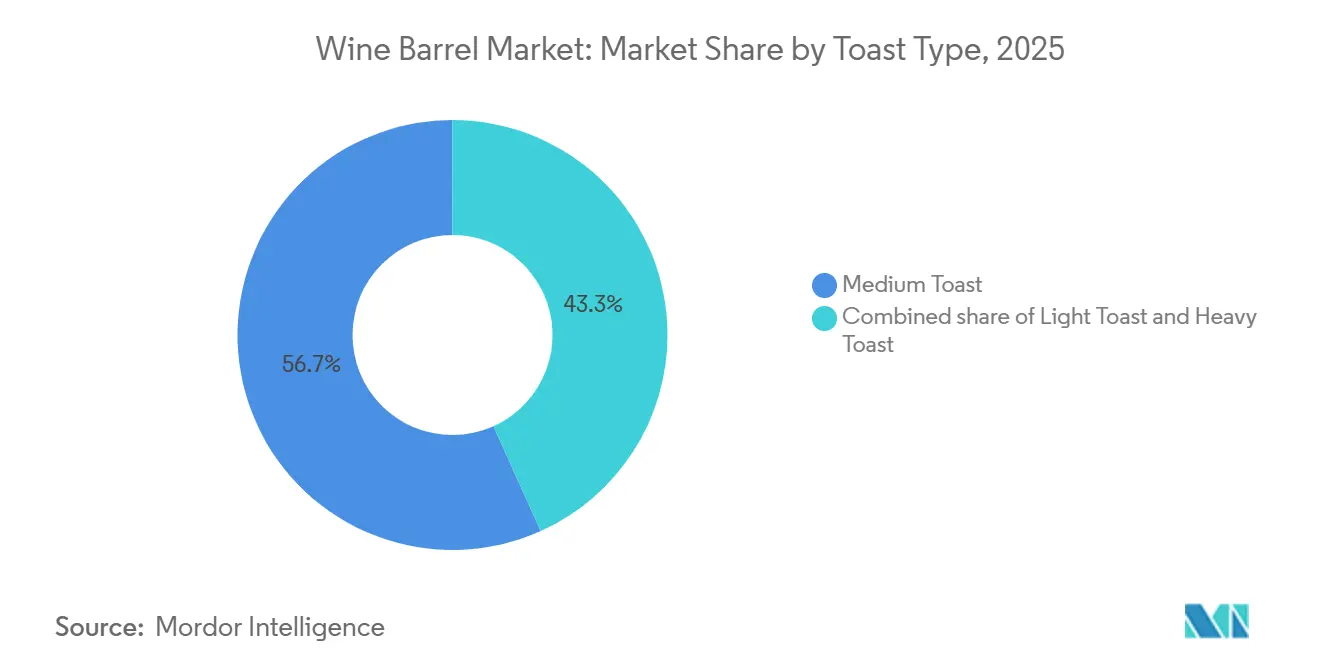
Medium Toast Holds the Broadest Use, While Light Toast Gains GroundMedium toast accounted for 56.74% of wine barrel revenue in 2025, making it the largest toast-level category. It provides a balanced profile that preserves fruit characteristics while adding oak-derived complexity. Producers use medium-toast barrels across a broad range of red and white wines because they deliver familiar, adaptable results. Medium toast can introduce secondary notes without overwhelming the base wine. Its widespread use also simplifies cellar planning for wineries that produce multiple wine styles within the same facility. Heavy toast maintained a smaller but durable role in the casks of full-bodied red wines and spirits. Its coffee, dark chocolate, and smoky notes suit styles that require a more pronounced barrel influence. Medium toast's leading position reflects producers' need for predictable results across commercial wine programs. It also allows wineries to use a core specification across multiple labels and vintages, reducing the practical risk of year-to-year variations in sensory outcomes.
Light toast is projected to grow at a CAGR of 6.16% during 2026-2031, the fastest rate among toast-level categories. This category supports wine styles that prioritize freshness and a clearer expression of origin. Light toast can add structure and support tannin integration while limiting strong lactone and phenol notes. It allows producers to use oak without making it the dominant flavor component. Light toast is particularly relevant when winemakers want barrels to frame the wine rather than define it. The Oregon Wine Symposium trial demonstrated that toast calibration can affect margins as well as sensory outcomes. The wine barrel market is responding to producers seeking more precise control over this balance. Light toast may be especially relevant for Pinot Noir, premium rosé, and modern white wine programs. Its growth also benefits cooperages that offer detailed toast curves rather than a limited range of standard options. This capability can serve as a meaningful differentiator when winemakers require repeatable results across multiple barrels.
Geography Analysis
Europe Wine Barrel Market
Europe is projected to hold a 42.16% share of the wine barrel market in 2025, maintaining its position as the largest regional market. France, Italy, and Spain form the core production base for regional barrel demand, supported by dense winery networks and long-established aging traditions. The European Union is expected to produce 136 million hectoliters of wine in 2025, supporting this substantial installed base. France, Italy, and Spain are projected to account for 109 million hectoliters of this output collectively. Premium appellations in Burgundy, Champagne, Tuscany, and Rioja continue to drive demand for high-specification barrels, as their wines depend on controlled maturation processes and established quality practices. The Fédération des Tonneliers de France is expected to report sales of 485,871 barrels by its 67 member cooperages in FY 2025/26, representing a 14% decline. Exports are projected to fall by 16.1%, increasing pressure on smaller cooperages and reinforcing the need to prioritize premium customers. Therefore, European demand combines a large, established base with uneven conditions across premium appellations and more volume-dependent wine-producing areas.
APAC Wine Barrel Market
Asia-Pacific is forecast to grow at a CAGR of 5.42% during 2026-2031, the fastest rate among regions in the wine barrel market. India’s 197,000 hectares of vineyards provide a long-term demand base for domestic wine production. Although China’s wine import market is smaller in value terms, higher average import prices support premium wine categories. Australia is projected to produce 11.3 million hectoliters of wine in 2025, up 8.8% from the previous year. Premium Australian Shiraz and Chardonnay programs continue to support demand for French oak barrels and refined toast profiles. These markets differ in terms of maturity, consumer preferences, and local production conditions; however, each can increase demand for tailored barrel programs. The wine barrel market benefits most when production growth aligns with premiumization rather than volume expansion alone. Regional growth will therefore depend on how wineries convert expanding vineyard capacity and premium wine imports into sustained demand for barrel-aged wines.
The Americas and MEA Wine Barrel Market
North America is expected to remain the second-largest regional market, with the United States serving as a major wine producer and export destination for French cooperages. U.S. wine production is projected to reach 20 million hectoliters in 2025, down 5.3% from 2024. This decline reduces near-term order visibility for suppliers and makes barrel purchases more dependent on the financial position of individual wineries. Premium wineries can continue purchasing barrels when direct sales and strong brand positioning protect margins and support investments in quality. Argentina is projected to produce 10.8 million hectoliters of wine in 2025, while Brazil is expected to produce 2.8 million hectoliters following 80.6% growth. South Africa is projected to produce 10.2 million hectoliters in 2025, up 16.2%, strengthening the Middle East and Africa’s contribution to market demand. Regional demand therefore depends on premium winery performance, harvest conditions, and the rate at which emerging producers adopt barrel aging. Demand may recover unevenly, as producers face varying exposure to tariffs, export markets, inventory levels, and changing consumer preferences.
Competitive Landscape
The wine barrel market exhibits medium concentration, with no single producer holding sufficient share to set prices across the sector or dictate purchasing terms for most wineries. TFF Group and OENEO are the largest listed cooperage groups in the premium category; however, regional suppliers remain important. A large number of family-owned cooperages compete through craftsmanship, local relationships, specialized production, and the ability to respond directly to individual cellar requirements. In March 2026, TFF completed the acquisition of the remaining 45% interest in Tonnellerie Rémond. The acquisition gave TFF full ownership of the Burgundy-based ultra-premium cooperage and brought a specialized producer closer to its broader sourcing network.
OENEO operates through Seguin Moreau, Millet, Galileo, and Boisé within its winemaking business, providing a broad range of cooperage and oak-treatment capabilities. Its Twood launch in January 2026 addressed the need to use French oak more efficiently without moving away from a product associated with premium cellar programs. The product uses layered stave construction and targets premium wines produced with more limited budgets or greater concerns regarding raw material availability. This strategy combines cost control with efforts to maintain quality expectations, particularly among producers seeking French oak characteristics at a more manageable cost. The wine barrel market remains competitive because innovation must be supported by reliable wood sourcing, technical assistance, and producer confidence in barrel-aging results.
Circular barrel services are becoming more formalized within the competitive landscape as customers seek alternatives to purchasing new barrels. Charlois Group launched Oaking in June 2025, combining new barrel production, refurbishment, re-toasting, and end-of-life recycling. The platform integrates Kelvin Cooperage, Graf Brothers, and Oakwood Cooperage across several stages of the cask life cycle. It provides customers with a managed solution for extending cask life, matching barrels to different uses, and handling used barrels after the initial aging period. Digital traceability can further strengthen customer confidence in oak origin, barrel handling, and production records when wineries require greater supplier documentation. Research in sustainable food systems has reported reduced audit times following the adoption of blockchain-based traceability systems. These services create opportunities for differentiation without requiring suppliers to dominate overall barrel volumes or compete solely on initial barrel prices.
Wine Barrel Industry Leaders
-
TFF Group
-
Independent Stave Company
-
OENEO SA
-
Demptos
-
Nadalié
- *Disclaimer: Major Players sorted in no particular order
Wine Barrel Market Companies Covered in this Report
- TFF Group
- OENEO SA
- Independent Stave Company
- Demptos
- Nadalié
- World Cooperage
- Tonnellerie Radoux
- Tonnellerie Saury
- Tonnellerie Ermitage
- Taransaud
- Seguin Moreau
- Tonnellerie Sylvain
- Tonnellerie de Mercurey
- G. & P. Garbellotto S.p.A.
- Canton Cooperage
- The Barrel Mill
- A.P. John Coopers
- Bouchard Cooperages
- StaVin Inc.
- Tonnellerie Damy
Recent Industry Developments in Wine Barrel Market
- March 2026: TFF Group completed its acquisition of the remaining 45% minority stake in Tonnellerie Rémond, gaining 100% ownership of the Burgundy-based ultra-premium cooperage. The transaction, accelerated from its contractual 2028 deadline, strengthens TFF Group’s position in the grand cru barrel segment and formalizes the wood-sourcing and production synergies developed since its initial 55% acquisition in 2022.
- June 2025: Charlois Group formally launched Oaking, a circular barrel platform that integrates Kelvin Cooperage, Graf Brothers, and Oakwood Cooperage into a full-lifecycle cask management system. The platform covers new barrel production, refurbishment, re-toasting, and end-of-life recycling.
- June 2025: Independent Stave Company, through its newly formed subsidiary, Kentucky Cooperage Investments, acquired Brown-Forman's Louisville cooperage for USD 13.66 million. The acquisition includes a 16-acre site and follows ISC's earlier purchase of Brown-Forman's Alabama cooperage. These transactions reflect ISC's strategy to consolidate industry real estate amid a period of contraction in the cooperage industry.
Global Wine Barrel Market Report Scope
Segmentation Overview
| Red Wine |
| White Wine |
| Rose Wine |
| French Oak Barrels |
| American Oak Barrels |
| Others |
| Light Toast |
| Medium Toast |
| Heavy Toast |
| North America | United States |
| Canada | |
| Mexico | |
| Rest of North America | |
| Europe | Germany |
| United Kingdom | |
| Italy | |
| France | |
| Spain | |
| Netherlands | |
| Belgium | |
| Sweden | |
| Poland | |
| Rest of Europe | |
| Asia-Pacific | China |
| India | |
| Japan | |
| Australia | |
| Singapore | |
| Rest of Asia-Pacific | |
| South America | Brazil |
| Argentina | |
| Colombia | |
| Rest of South America | |
| Middle East and Africa | South Africa |
| Saudi Arabia | |
| Rest of Middle East and Africa |
| By Wine Type | Red Wine | |
| White Wine | ||
| Rose Wine | ||
| By Wine Barrel Type | French Oak Barrels | |
| American Oak Barrels | ||
| Others | ||
| By Toast Level | Light Toast | |
| Medium Toast | ||
| Heavy Toast | ||
| By Geography | North America | United States |
| Canada | ||
| Mexico | ||
| Rest of North America | ||
| Europe | Germany | |
| United Kingdom | ||
| Italy | ||
| France | ||
| Spain | ||
| Netherlands | ||
| Belgium | ||
| Sweden | ||
| Poland | ||
| Rest of Europe | ||
| Asia-Pacific | China | |
| India | ||
| Japan | ||
| Australia | ||
| Singapore | ||
| Rest of Asia-Pacific | ||
| South America | Brazil | |
| Argentina | ||
| Colombia | ||
| Rest of South America | ||
| Middle East and Africa | South Africa | |
| Saudi Arabia | ||
| Rest of Middle East and Africa | ||
Key Questions Answered in the Report
What is the projected value of the wine barrel market by 2031?
The wine barrel market is projected to reach USD 1.65 billion by 2031, with a 5.02% CAGR during 2026-2031. Growth depends on continued premium wine investment despite lower production volumes in several mature producing countries.
Which wine type uses the most barrels?
Red wine held the largest share at 62.87% in 2025 because premium red wine programs commonly use new oak aging. Barrels can support tannin development, controlled oxygen exposure, and a more structured aging profile for these wines.
Which barrel type is growing fastest?
French oak barrels are projected to grow at a 5.47% CAGR through 2031 and held 59.45% share in 2025. Their position reflects their established role in premium wine programs and their suitability for longer aging.
Which toast profile is growing fastest?
Light toast is projected to grow at a 6.16% CAGR during 2026-2031 as producers seek subtler oak expression. It can add structure while allowing fruit character and a sense of origin to remain prominent.