
White Tea Market Size and Share
Market Overview
| Study Period | 2022 - 2032 |
|---|---|
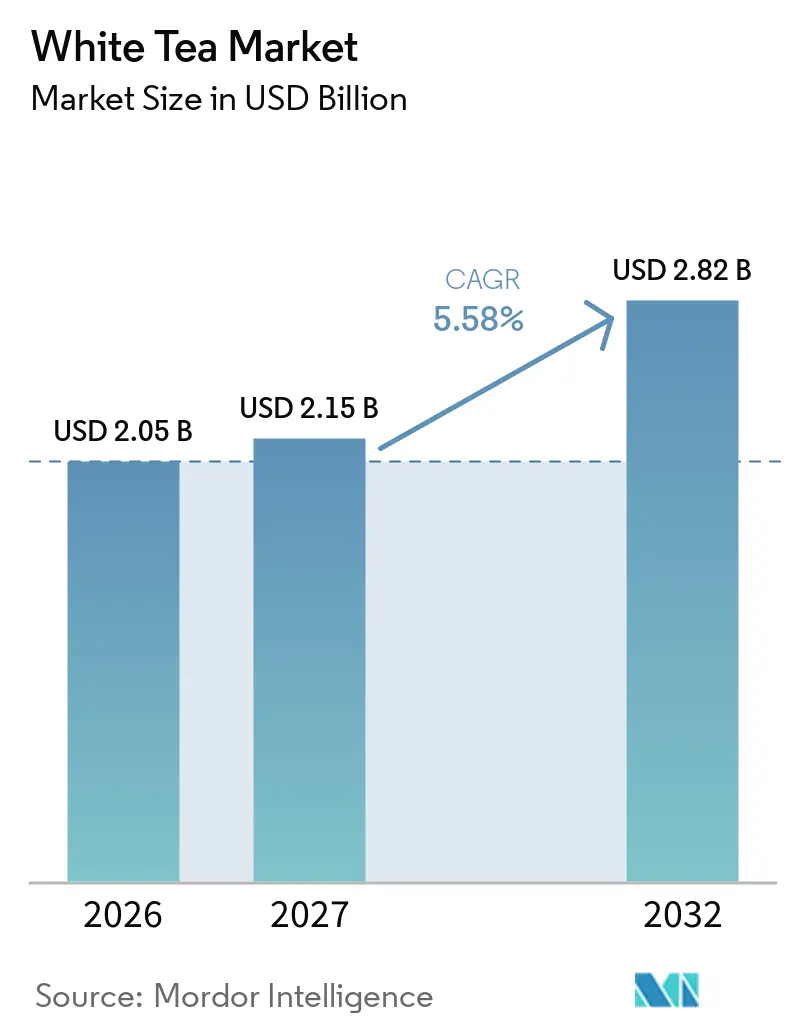
| Market Size (2027) | USD 2.15 Billion |
| Market Size (2032) | USD 2.82 Billion |
| Growth Rate (2027 - 2032) | 5.58 % |
| Fastest Growing Market | Asia-Pacific |
| Largest Market | Asia-Pacific |
| Market Concentration | Low |
Major Players *Disclaimer: Major Players sorted in no particular order Image © Mordor Intelligence. Reuse requires attribution under CC BY 4.0. | |
White Tea Market Analysis by Mordor Intelligence
The white tea market size is expected to grow from USD 2.05 billion in 2026 to USD 2.15 billion in 2027 and is forecast to reach USD 2.82 billion by 2032 at 5.58% CAGR over 2027-2032. Demand is supported by interest in beverages with limited processing and clearly stated ingredients. White tea retains a distinct production profile because withering and drying avoid the rolling and pan-firing used for many other tea types. The market is also being shaped by premium formats, convenient packaging, and traceable sourcing. Supply remains exposed to seasonal picking labor and weather conditions in key Chinese producing areas, which can limit the availability of higher grades. The market consequently has opportunities in trusted education, entry-level formats, and direct sourcing, while producers need to protect quality and availability as demand becomes more diversified across gifting, home consumption, cafés, workplaces, and online channels.
Key Report Takeaways
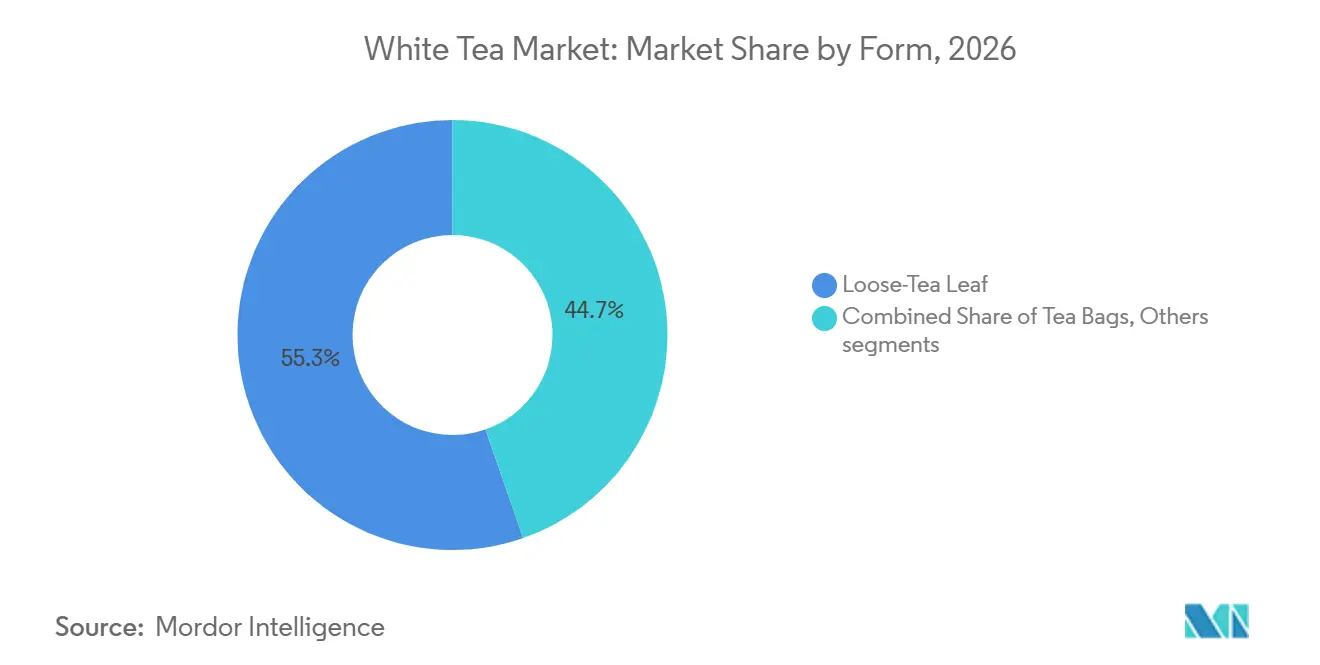
- By form, loose-leaf tea held 55.34% of the white tea market share in 2026, while tea bags are projected to grow at a 6.81% CAGR through 2032.
- By nature, conventional tea accounted for 85.37% of the white tea market share in 2026, while organic tea is forecast to expand at a 6.69% CAGR through 2032.
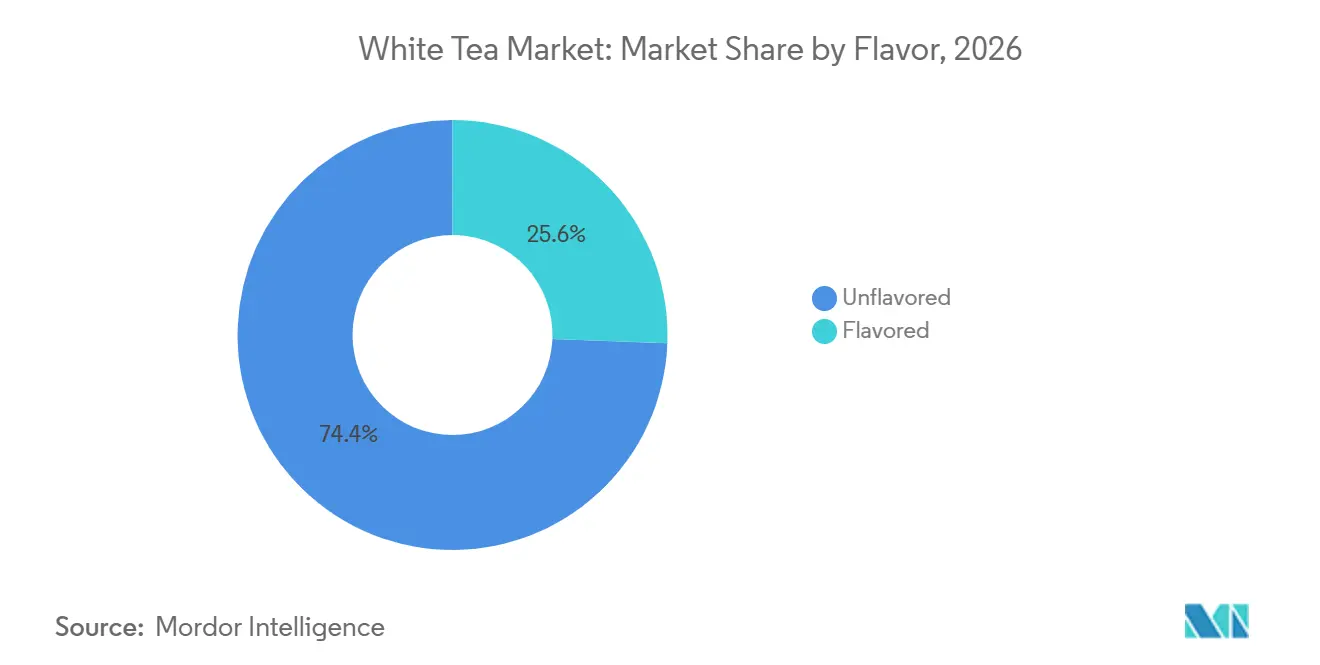
- By flavor, unflavored tea captured 74.38% of 2026 value, while flavored tea is projected to record a 7.01% CAGR through 2032.
- By distribution channel, off-trade held 80.27% of 2026 value, while on-trade is forecast to grow at a 6.77% CAGR through 2032.
- By geography, Asia-Pacific held 38.71% of 2026 value and is projected to expand at a 6.92% CAGR through 2032.
Note: Market numbers in this report are based on Mordor Intelligence's proprietary estimation framework, which combines nine months of actuals with Q4 projections for base year 2026.
Global White Tea Market Trends and Insights
Drivers Impact Analysis*
| Driver | (~) % Impact on CAGR Forecast | Geographic Relevance | Impact Timeline |
|---|---|---|---|
| Consumer preference for natural, minimally processed beverages | +1.2% | Global | Medium term (2-4 years) |
| Awareness of tea polyphenols and antioxidants | +0.9% | North America, Europe, Asia-Pacific | Medium term (2-4 years) |
| Demand for premium and specialty tea | +1.1% | North America, Europe, Asia-Pacific | Short term (≤ 2 years) |
| Interest in wellness-oriented and functional beverages | +0.8% | North America, Europe, Asia-Pacific | Short term (≤ 2 years) |
| Expansion of specialty tea outlets | +0.7% | Asia-Pacific, North America | Medium term (2-4 years) |
| Demand for organic and sustainably sourced tea | +0.6% | Europe, North America, Asia-Pacific export markets | Long term (≥ 4 years) |
| Source: Mordor Intelligence | |||
Growing Consumer Preference for Natural and Minimally Processed Beverages
Consumers are increasingly shifting toward beverages with simple ingredients, natural origins, and minimal processing as health-conscious consumption habits influence purchasing decisions. White tea benefits from this shift because it typically undergoes limited processing, involving withering and drying, while retaining its delicate flavor and naturally occurring antioxidants. Its positioning as a lightly processed tea variety appeals to consumers seeking alternatives to sugary and heavily formulated beverages. The growing interest in organic products further supports demand for premium white tea varieties with transparent sourcing and minimal ingredient additions. According to the Organic Trade Association, U.S. organic beverage sales increased by 7.2% to reach USD 10.2 billion in 2025, reflecting continued demand for beverages featuring clean ingredients and wellness benefits[1]. This shift encourages manufacturers to expand organic white tea offerings and develop minimally processed blends to meet evolving consumer preferences.
Rising Awareness of the Health Benefits Associated With Tea Polyphenols and Antioxidants
Growing scientific interest in tea polyphenols and antioxidants is strengthening consumer awareness of tea's potential health benefits and supporting demand for white tea. White tea contains naturally occurring polyphenols, including catechins, which are studied for their antioxidant properties and potential role in supporting cardiovascular health. Its minimal processing also helps preserve a range of naturally occurring compounds, making it attractive to consumers seeking premium beverages with perceived wellness benefits. According to a 2025 survey of 1,015 British adults reviewed by the Tea Advisory Panel, 84% of respondents did not associate tea consumption with improved heart health, while 83% did not link it with lowering blood pressure, highlighting both the potential health relevance of tea and the existing consumer awareness gap[2]. This creates opportunities for white tea producers to strengthen product positioning through transparent sourcing, educational marketing, and premium offerings.
Increasing Demand for Premium and Specialty Tea Varieties
Consumers are increasingly exploring premium and specialty tea varieties as they seek distinctive flavors, authentic origins, superior quality, and more personalized drinking experiences. White tea benefits from this trend because its delicate flavor, limited processing, and association with traditional Chinese tea craftsmanship position it within the premium tea category. Interest in single-origin teas, artisanal production, organic offerings, and traceable sourcing further encourages consumers to explore higher-value varieties beyond conventional black tea. According to the 2025 State of the Tea Industry Survey published by World Tea News, premium and specialty loose-leaf teas ranked among the leading product trends, cited by 15% of respondents[3]. This shift creates opportunities for white tea producers to differentiate products through harvest-specific selections, distinctive regional origins, premium packaging, and curated tea collections.
Growing Consumer Interest in Wellness-Oriented and Functional Beverages
Growing interest in beverages that support relaxation, mindful consumption, and healthier lifestyle choices is encouraging consumers to explore alternatives to sugar-heavy soft drinks and highly formulated beverages. White tea's delicate flavor, light processing, and versatility in both hot and cold preparations further support its appeal among wellness-conscious consumers. According to EY's 2026 Consumer Beverage Survey, 52% of surveyed U.S. consumers were willing to pay more for beverages that support their health and wellness goals. This willingness to pay a premium creates opportunities for white tea manufacturers to develop organic varieties, ready-to-drink formulations, and blends featuring complementary botanical ingredients.
Restraints Impact Analysis*
| Restraint | (~) % Impact on CAGR Forecast | Geographic Relevance | Impact Timeline |
|---|---|---|---|
| High costs of selective harvesting and processing | -0.9% | Global, particularly Fujian, China, and Sri Lanka | Medium term (2-4 years) |
| Limited availability of premium-quality white tea leaves | -0.7% | Global | Short term (≤ 2 years) |
| High retail prices compared with conventional tea | -0.8% | South America, Middle East and Africa, emerging Asia-Pacific markets | Long term (≥ 4 years) |
| Limited consumer awareness in emerging markets | -0.6% | South America, Middle East and Africa, South and Southeast Asia | Medium term (2-4 years) |
| Source: Mordor Intelligence | |||
High Costs of Selective Harvesting and Processing
White tea production involves relatively high harvesting and processing costs because it often relies on carefully selecting young buds and tender leaves during specific harvest periods. The delicate plant material requires gentle handling to minimize damage and preserve the tea's appearance, aroma, and quality. Unlike some other tea varieties, white tea typically undergoes limited processing, but maintaining consistent quality requires skilled labor, controlled withering, and careful drying. Seasonal availability and dependence on suitable growing conditions can further constrain supply and increase procurement costs. These expenses contribute to higher production costs, which are often reflected in retail prices.
Limited Consumer Awareness and Familiarity With White Tea in Emerging Markets
Limited consumer awareness and familiarity with white tea in emerging markets can restrict market penetration and slow category growth. In many markets, consumers are more accustomed to established tea varieties, particularly black tea and green tea, which benefit from stronger cultural familiarity and wider retail availability. White tea's relatively subtle flavor, premium positioning, and higher price points may make it less appealing to consumers unfamiliar with its characteristics and preparation methods. Limited product visibility in supermarkets, traditional retail outlets, and foodservice establishments can further reduce opportunities for first-time purchases. Additionally, insufficient awareness of white tea's origins, processing methods, and differences from other tea varieties may hinder informed purchasing decisions.
*Our forecasts treat driver/restraint impacts as directional, not additive. The impact forecasts reflect baseline growth, mix effects, and variable interactions.
Segment Analysis
By Form: Tea Bags Expand Premium Convenience
Loose-leaf tea held 55.34% of the white tea market share in 2026. Its leading position reflects Gongfu tea ceremonies in China, specialist retail, and premium household occasions where consumers value repeated infusions from intact leaves. Loose-leaf products also allow sellers to communicate cultivar, origin, harvest period, grade, and the visual quality of the leaf more clearly than pre-portioned formats. These attributes support gifting, premium hospitality use, and advice-led specialist sales, where preparation can be part of the purchase experience. The white tea market therefore continues to rely on loose leaf as an important reference point for quality.
Tea bags are forecast to grow at a 6.81% CAGR through 2032. This format suits offices, travel, and other occasions where loose-leaf preparation is not practical, while preserving a familiar way to brew tea. Whole-leaf pyramid bags aim to preserve more of the infusion experience in a sealed single-serve format and reduce the practical barrier for first-time buyers. Dilmah and Vahdam have identified this approach as relevant to office-oriented strategies. Ready-to-drink and instant products remain smaller formats, but cold-brew white tea has gained attention among younger urban consumers in East Asia.

By Nature: Organic Tea Gains From Certification and Traceability
Conventional tea accounted for 85.37% of the white tea market share in 2026. This reflects the fact that certified organic production remains a smaller part of the broader tea supply base, even where growers are improving field documentation. Conventional products also have established farming, processing, and export systems that provide the scale needed for mainstream retail assortments. Their scale makes them central to the category’s everyday retail availability and gives buyers a wider range of price points. Producers will still face increasing buyer scrutiny on residue management, traceability, and farm practices.
Organic tea is projected to expand at a 6.69% CAGR through 2032. Jinggu County held 121 organic garden certifications covering 250,000 mu by 2025. Producers can use these certifications to document inputs, farming systems, and chain-of-custody practices for export customers. Organic certification can improve access to European retail channels and help exporters document their sourcing practices. The white tea industry is using certification as both a market-access requirement and a premium product attribute.
By Flavor: Flavored Products Broaden Entry Points
Unflavored tea captured 74.38% of 2026 value in the white tea market. It is concentrated in specialist stores, luxury hospitality, direct-to-consumer gifting, and other channels where origin purity is a core part of the offer. These consumers often seek a delicate cup profile, clear cultivar information, and the ability to compare harvests or styles from different producing areas. Unflavored products can also support higher-value storytelling around processing and place of origin without relying on added ingredients. Their large share shows that traditional preferences remain important even as formats change.
Flavored tea is projected to grow at a 7.01% CAGR through 2032. The format can make white tea more accessible in Western markets and in Southeast Asian tea-drinking settings that already favor flavored beverages. Flavored teas ranked third among consumer trends in the 2025 State of the Tea Industry Survey, at 14%, and fruit was the most cited preference. The Republic of Tea presented regenerative organic teas and flavored premium blends at the 2025 Summer Fancy Food Show. This approach lets brands serve distinct flavor preferences, create approachable entry products, and retain separate unflavored collections for established customers.
By Distribution Channel: Off-Trade Provides Reach While On-Trade Builds Trial
Off-trade channels accounted for 80.27% of 2026 white tea market value. Supermarkets, hypermarkets, specialist stores, and online sellers give the category broad access beyond tea houses. Online retail is particularly useful for discovery, gifting, and communicating detailed origin information through product pages, images, and brewing guidance. It also permits small producers to reach buyers without extensive physical distribution and to test demand in new locations. The white tea market benefits when product pages explain grade, brewing method, source, and serving format in clear terms.
On-trade channels are forecast to grow at a 6.77% CAGR through 2032. Tea houses and cafés create a setting for guided trial, which is important for a category that remains unfamiliar to many consumers and for flavors that need explanation. Dilmah plans up to 10 premium tea bars in India by FY2030 with an initial investment above USD 1 million. David's Tea also announced Canadian store renovation and new locations in 2025. These venues can improve product awareness, guide preparation, and support higher-margin service occasions.
Geography Analysis
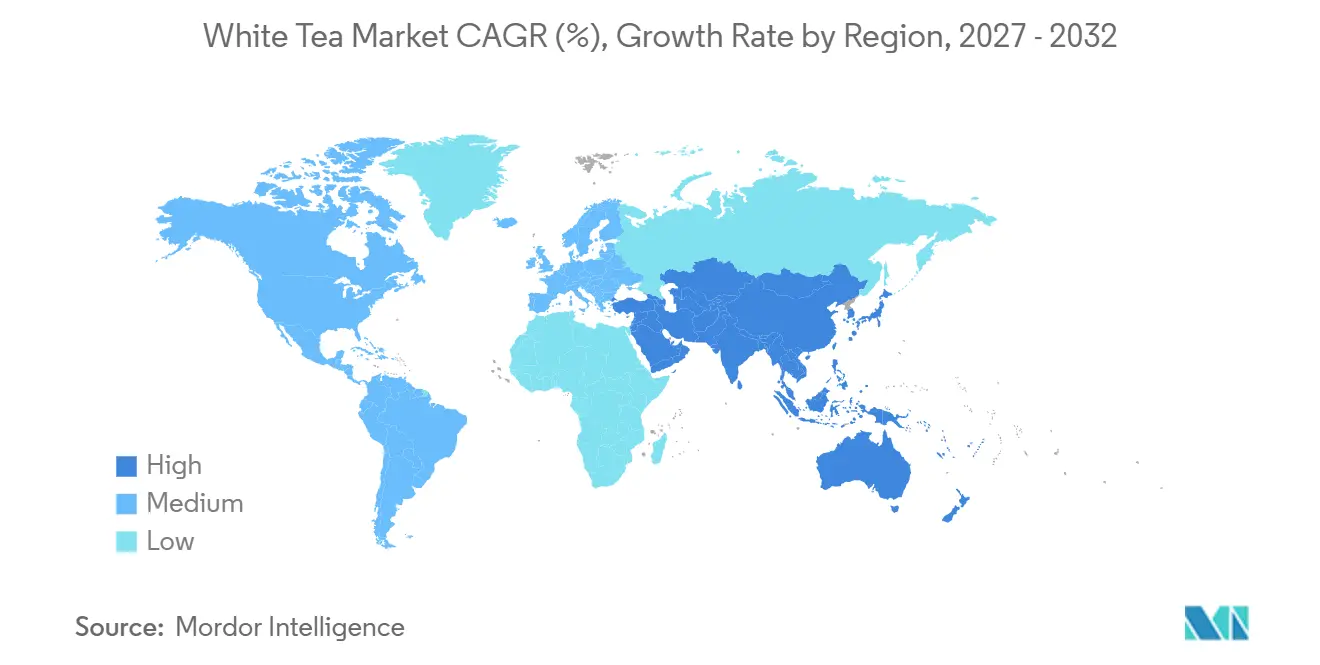
Asia-Pacific held 38.71% of the white tea market share in 2026 and is projected to grow at a 6.92% CAGR through 2032. China remains the main production center and the core consumption base, with Fujian’s Fuding district retaining particular importance for premium grades. Fuding white tea was listed as a Globally Important Agricultural Heritage System by the Food and Agriculture Organization in September 2025. The geographic concentration also means that seasonal labor availability and harvest weather can have an outsized effect on the supply of higher grades. Zhejiang’s government released a 2025 policy framework that targets USD 500 million in annual tea exports and 80,000 mu of internationally certified plantations by 2027.
India is developing more direct-to-consumer and specialty café routes for premium tea. Vahdam Teas reported FY2025 revenue of INR 265 crore, stated as USD 31 million, and said 95% of its revenue came from international markets. This demonstrates how Indian brands can combine domestic sourcing narratives with export-focused digital and retail distribution. Australia and South Korea provide additional opportunities as specialty tea formats enter markets with established coffee consumption. White tea retailers in these countries need to make the product easy to try, understand, and prepare without specialist equipment. The region’s combination of producing areas, domestic demand, and export infrastructure makes it central to the white tea market.
North America and Europe are high-value regions where health, certification, and premium retail shape demand. International Trade Centre data states that voluntary sustainability standards covered 68% of tea sold in Europe, raising expectations for traceability and certification. In these markets, documentation can be as important to a retailer as product quality because it supports responsible sourcing requirements. Canada remains a relevant secondary opportunity because of its diverse consumer base and renewed DAVIDsTEA retail investment. In the Middle East, luxury hotels and tea lounges provide an entry point for premium white tea, while South America and Africa remain earlier-stage areas where e-commerce and cafés may generate trial before broad mass-retail adoption. These conditions make local partnerships and appropriately sized product packs important for white tea market expansion.
Competitive Landscape
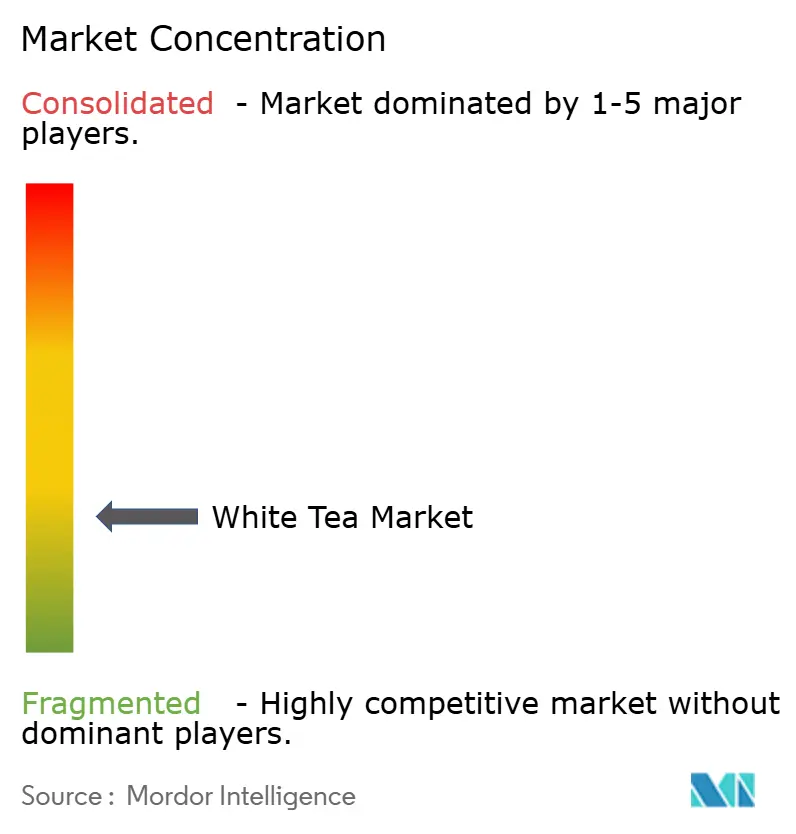
The white tea market has a fragmented competitive structure across regions, formats, and price tiers. It includes legacy exporters such as Dilmah and Zhejiang Tea Group, direct-to-consumer brands such as Vahdam Teas and The East India Company Limited, and specialty brands such as Rare Tea Company and The Republic of Tea. Organic-focused brands including Numi Organic Tea and Goodricke Group add further choice for certified products. No player is identified as having dominant worldwide share across loose leaf, tea bags, organic products, flavored blends, online retail, and hospitality channels. This structure leaves room for differentiated operators, but it makes broad consolidation difficult and gives consumers many origin and price options.
Leading companies use provenance, certification, direct sales, and hospitality partnerships to distinguish their offers. Dilmah used its 2025 Windsor Forest launch and an Emirates Airline masterclass to reinforce luxury positioning. Vahdam expanded its physical availability through Costco UK alongside existing Walmart, Costco US, and Target distribution. The Republic of Tea paired regenerative organic tea with premium flavored collections at a 2025 trade event. These moves show how the white tea market is being developed across specialist and broader retail channels, rather than relying on a single distribution model.
Opportunities remain in aged white tea, scaled organic supply for European retail, and whole-leaf tea bags that combine quality with convenience. Brands are also testing blends with ingredients such as ashwagandha, reishi, and lion’s mane for wellness-oriented buyers. Documentation requirements in European supply chains can favor businesses with direct sourcing and certification, particularly where retailers request evidence from farm through finished pack.
White Tea Industry Leaders
-
Dilmah Ceylon Tea Company PLC
-
Goodricke Group Limited
-
Rare Tea Company Limited
-
Botaniex, Inc.
-
Zhejiang Teaworld Food Co.,Ltd.
- *Disclaimer: Major Players sorted in no particular order
Recent Industry Developments
- March 2026: The Republic of Tea launched White Jasmine Sparkling Tea, combining organic white tea sourced from China's Fujian province with fragrant jasmine blossoms. The launch expanded the company's portfolio into the sparkling tea category, catering to consumers seeking premium, tea-based beverage alternatives.
- July 2025: HOJO Online Speciality Tea Shop introduced its freshly harvested 2025 Yunnan white tea, providing consumers access to specialty teas from different micro-lots. The offering strengthened its premium tea portfolio by highlighting harvest-specific characteristics, regional origin, and variations in flavor and quality.
- April 2025: SONNENTOR announced the launch of organic White Peony (Bai Mu Dan) white tea in Japan, with availability planned from May 2025 through specialty retail stores and online channels. The launch expanded the company's organic tea offerings and improved access to a traditional Chinese white tea variety among Japanese consumers.
Global White Tea Market Report Scope
White tea is a minimally processed tea made from the young leaves and unopened buds of the Camellia sinensis plant, which are typically harvested and gently withered and dried to preserve their delicate flavor, natural aroma, and characteristic light color. The white tea market is segmented by form, nature, flavor, distribution channel and geography. Based on the form, the market is segmented into loose-leaf tea, tea bags, and others. Based on nature, the market is segmented into conventional, and organic. Based on, flavor, the market is segmented into unflavored, and flavored. Based on distribution channel, the market is segmented into off-trade, and on-trade. By geography, the market is segmented into North America, Europe, Asia-Pacific, South America, and Middle-East and Africa. For each segment, the market sizing and forecasting have been done in value terms (USD billion).
| Loose-Leaf Tea |
| Tea Bags |
| Others |
| Conventional |
| Organic |
| Flavored |
| Unflavored |
| Off-Trade | Supermarkets/Hypermarkets |
| Convenience Stores | |
| Online Retail Stores | |
| Other Distribution Channels | |
| On-Trade |
| North America | United States |
| Canada | |
| Mexico | |
| Rest of North America | |
| Europe | Germany |
| United Kingdom | |
| Italy | |
| France | |
| Spain | |
| Rest of Europe | |
| Asia-Pacific | China |
| India | |
| Japan | |
| Australia | |
| South Korea | |
| Rest of Asia-Pacific | |
| South America | Brazil |
| Argentina | |
| Rest of South America | |
| Middle East and Africa | South Africa |
| Saudi Arabia | |
| United Arab Emirates | |
| Rest of Middle East and Africa |
| By Form | Loose-Leaf Tea | |
| Tea Bags | ||
| Others | ||
| By Nature | Conventional | |
| Organic | ||
| By Flavor | Flavored | |
| Unflavored | ||
| By Distribution Channel | Off-Trade | Supermarkets/Hypermarkets |
| Convenience Stores | ||
| Online Retail Stores | ||
| Other Distribution Channels | ||
| On-Trade | ||
| By Geography | North America | United States |
| Canada | ||
| Mexico | ||
| Rest of North America | ||
| Europe | Germany | |
| United Kingdom | ||
| Italy | ||
| France | ||
| Spain | ||
| Rest of Europe | ||
| Asia-Pacific | China | |
| India | ||
| Japan | ||
| Australia | ||
| South Korea | ||
| Rest of Asia-Pacific | ||
| South America | Brazil | |
| Argentina | ||
| Rest of South America | ||
| Middle East and Africa | South Africa | |
| Saudi Arabia | ||
| United Arab Emirates | ||
| Rest of Middle East and Africa | ||
Key Questions Answered in the Report
What is the forecast growth rate for white tea through 2032?
The category is forecast to grow at a 5.58% CAGR from 2027 to 2032, reaching USD 2.82 billion by 2032.
Which white tea format is growing fastest?
Tea bags are the fastest-growing form, with a projected 6.81% CAGR through 2032.
Why is Asia-Pacific important for white tea producers?
Asia-Pacific held 38.71% of 2026 value and is forecast to grow at 6.92% through 2032.
Is organic white tea gaining demand?
Organic tea is projected to grow at a 6.69% CAGR through 2032, supported by a broader base of certified tea supply.
What limits adoption in emerging economies?
High retail prices, seasonal supply constraints, and low familiarity limit trial in several emerging markets.