
Wet Scrubber Market Size and Share
Market Overview
| Study Period | 2021 - 2031 |
|---|---|
| Market Size (2026) | USD 1.46 Billion |
| Market Size (2031) | USD 2.21 Billion |
| Growth Rate (2026 - 2031) | 8.60 % |
| Fastest Growing Market | Asia-Pacific |
| Largest Market | Asia-Pacific |
| Market Concentration | Low |
Major Players *Disclaimer: Major Players sorted in no particular order Image © Mordor Intelligence. Reuse requires attribution under CC BY 4.0. | |
Wet Scrubber Market Analysis by Mordor Intelligence
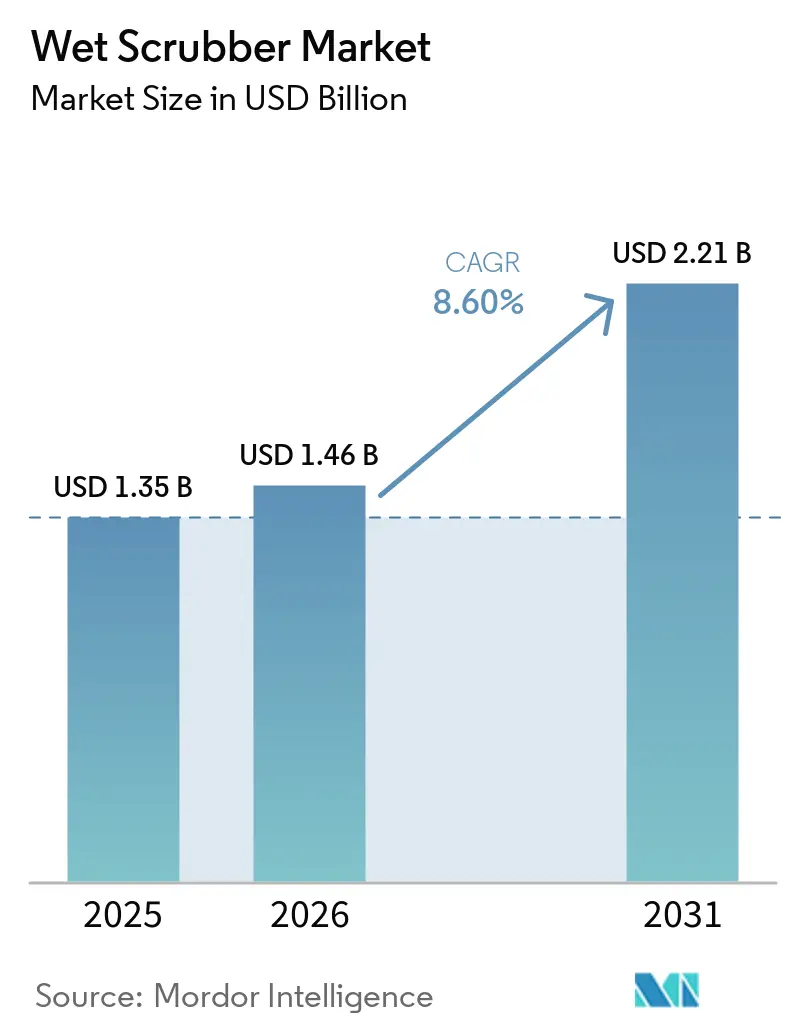
The Wet Scrubber Market size is projected to expand from USD 1.35 billion in 2025 and USD 1.46 billion in 2026 to USD 2.21 billion by 2031, at a CAGR of 8.60% between 2026 and 2031. The global wet scrubber market is supported by tighter controls on sulfur oxides, acid gases, and particulate emissions across industrial plants and shipping routes. Permit reviews under the revised EU Industrial Emissions Directive can bring capital decisions forward for operators with older equipment.[1] Marine operators also face a wider need to choose between compliant low-sulfur fuel and approved exhaust gas cleaning systems following the Mediterranean SOx Emission Control Area designation. Capacity additions in Asia-Pacific and the Middle East are widening the addressable base for new installations, while aging systems in North America and Europe support replacement work. Suppliers are responding with modular equipment, closed-loop water handling, and monitoring tools that can extend service relationships after the original installation.
Key Report Takeaways
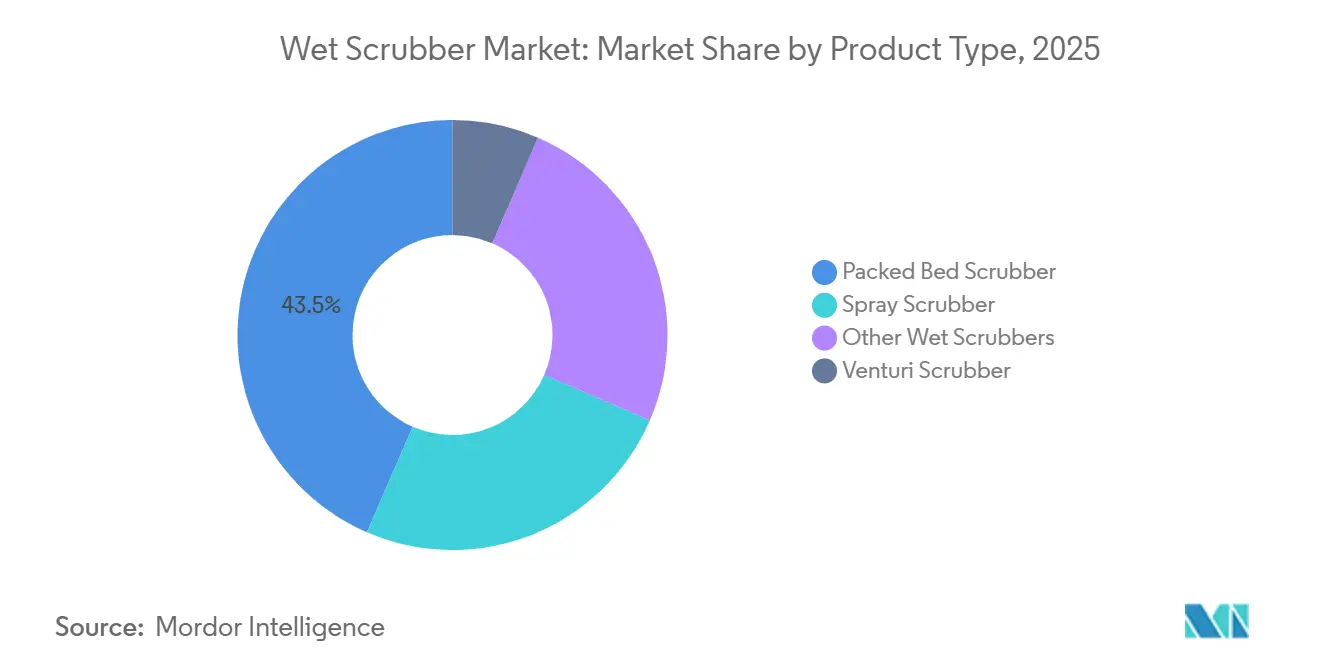
- By product type, packed bed wet scrubbers held 43.5% of the global wet scrubber market share in 2025, while venturi scrubber systems are forecast to grow at a 9.1% CAGR through 2031.
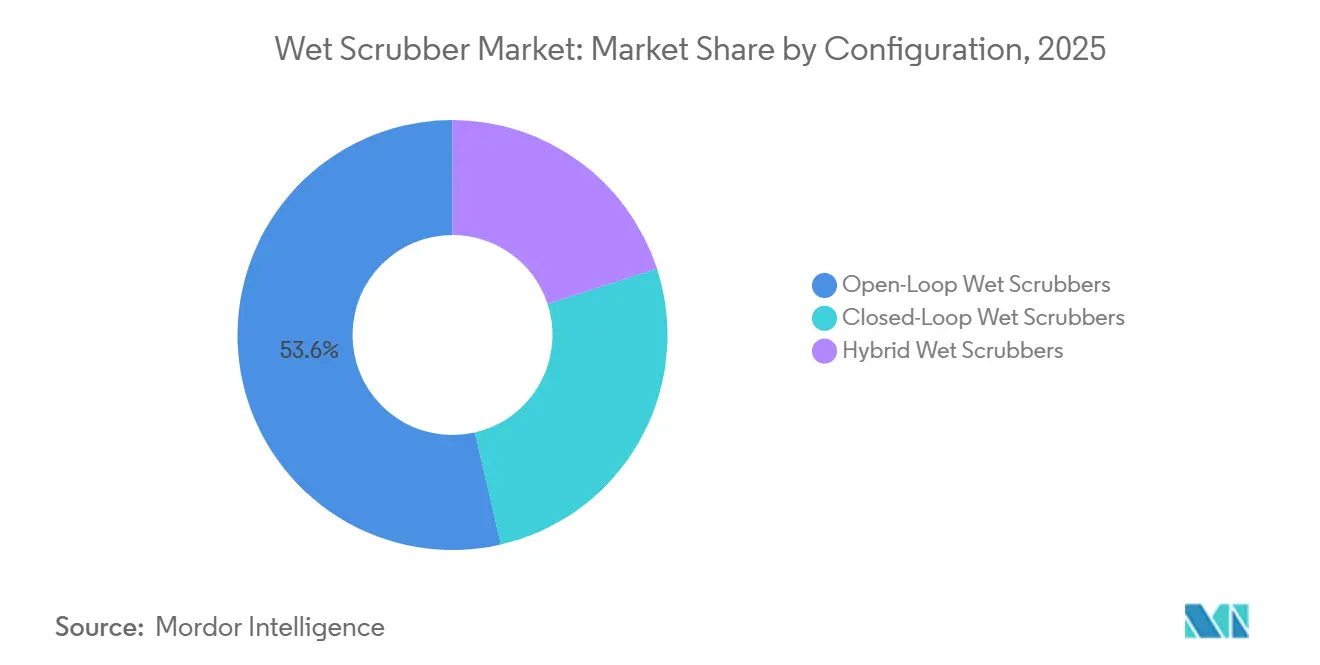
- By configuration, open-loop systems held 53.6% of the global wet scrubber market share in 2025, while hybrid wet scrubbers are forecast to expand at a 9.8% CAGR through 2031.
- By end-use industry, power generation accounted for 25.6% of the global wet scrubber market size in 2025 and is projected to advance at a 9.3% CAGR through 2031.
- By geography, Asia-Pacific accounted for 34.8% of the global wet scrubber market size in 2025 and is forecast to grow at a 9.9% CAGR through 2031.
Note: Market size and forecast figures in this report are generated using Mordor Intelligence’s proprietary estimation framework, updated with the latest available data and insights as of January 2026.
Global Wet Scrubber Market Trends and Insights
Drivers Impact Analysis*
| Driver | (~) % Impact on CAGR Forecast | Geographic Relevance | Impact Timeline |
|---|---|---|---|
| Tighter SOx, Acid-Gas, and Particulate Limits | +2.8% | Global, concentrated in North America, Europe, and Asia-Pacific | Medium term (2-4 years) |
| Industrial Capacity Expansion in Asia-Pacific and the Middle East | +2.0% | China, India, Indonesia, Vietnam, Saudi Arabia, and the UAE | Long term (≥ 4 years) |
| Marine Fuel-Cost Arbitrage Under IMO Sulfur Compliance | +1.2% | Global marine routes, including Mediterranean, North Sea, and Baltic routes | Short term (≤ 2 years) |
| Multi-Pollutant Control in High-Temperature and High-Dust Processes | +0.9% | Asia-Pacific cement and metals, plus global waste-to-energy and refining | Medium term (2-4 years) |
| Retrofit and Replacement Demand Across the Installed Base | +0.7% | North America and Europe | Medium term (2-4 years) |
| Digital Monitoring, Closed-Loop Water Treatment, and Predictive Maintenance | +0.4% | Global, with early adoption in North America and Europe | Long term (≥ 4 years) |
| Source: Mordor Intelligence | |||
Tightening SOx, Acid-Gas, and Particulate Emission Limits
Regulatory requirements remain the largest source of demand for the global wet scrubber market. Directive 2024/1785 brought revised industrial-emissions rules into force in August 2024 and requires member states to apply the updated framework. Common Waste Gas Management and Treatment Systems conclusions require existing installations to meet relevant obligations by December 2026. In the United States, the 2024 technology review for lime manufacturing and the 2025 coke oven batteries review reinforced control requirements for affected facilities. Operators that defer compliance work until a permit deadline may create a concentrated demand period for equipment and installation services. The global wet scrubber market therefore favors suppliers that can offer standardized modules and established contractor support.
Industrial Capacity Expansion in Asia-Pacific and the Middle East
New power, refining, metals, and process-industry projects create a durable installation base for the global wet scrubber market. In March 2026, Thermax Babcock & Wilcox Energy Solutions secured an INR 1,600 crore boiler-package contract for a 1×800 MW ultra-supercritical plant in Madhya Pradesh, including emission-compliant systems. Power projects of this scale require integrated flue-gas management and can create demand for associated water-treatment equipment. Middle Eastern refineries processing heavier, higher-sulfur feedstocks can require large gas-treatment systems with long engineering cycles. Expanding capacity in China, India, Indonesia, Vietnam, Saudi Arabia, and the UAE also widens demand beyond replacement projects. The global wet scrubber market benefits when emission controls are specified at the design stage rather than added after commissioning.
Marine Fuel-Cost Arbitrage Under IMO Sulfur Compliance
Marine fuel rules continue to shape demand for exhaust gas cleaning systems in the global wet scrubber market. The Mediterranean Sea became a SOx Emission Control Area on May 1, 2025, applying a 0.10% sulfur limit to fuel oil used by ships in the area.[2] This rule expands the routes on which operators must use compliant fuel or an approved equivalent compliance method. The commercial case for a scrubber depends on fuel spreads, vessel utilization, route patterns, and local washwater requirements. These factors differ across fleets, so demand is strongest among operators with frequent exposure to controlled waters. The global wet scrubber market also gains from vessel renewal programs that specify equipment capable of operating across several regulatory jurisdictions.
Digital Monitoring, Closed-Loop Water Treatment, and Predictive Maintenance
Digital functions are becoming more relevant to the value proposition of the global wet scrubber market. A 2026 study of scrubber washwater monitoring reported 98% recall for anomaly detection during transient startup and shutdown conditions. Connected transmitters can support remote diagnostics, automated reagent dosing, and maintenance planning. These functions are useful where compliance records must be accessible and operating interruptions are costly. Closed-loop treatment systems also give operators more control over liquid handling in locations with strict discharge conditions. Manufacturers that supply both equipment and monitoring software can strengthen their long-term service role.
Restraints Impact Analysis*
| Restraint | (~) % Impact on CAGR Forecast | Geographic Relevance | Impact Timeline |
|---|---|---|---|
| Water Consumption, Scarcity, and Effluent Treatment Burden | -0.6% | India, Australia, the Middle East, and the U.S. Southwest | Medium term (2-4 years) |
| High Pressure Drop, Pumping Energy, and Total Cost of Ownership | -0.5% | Global, particularly Europe and South Asia | Medium term (2-4 years) |
| Washwater Discharge Restrictions and Regulatory Fragmentation | -0.4% | European coastal states and port-state jurisdictions | Medium term (2-4 years) |
| Substitution by Dry, Semi-Dry, Fuel-Switching, and Alternative-Fuel Solutions | -0.7% | Water-scarce locations and marine applications | Long term (≥ 4 years) |
| Source: Mordor Intelligence | |||
Water Consumption, Scarcity, and Effluent Treatment Burden
Water constraints limit some project opportunities for the global wet scrubber market. A 2025 study found that managing purge fractions is central to the economics and environmental performance of water-recycling systems in acid-processing settings. Higher blowdown can reduce acid accumulation, but it raises water use and wastewater disposal costs. Inland facilities can face greater constraints because they do not have coastal discharge access. Indian power and industrial sites in water-deficit states may need zero-liquid-discharge systems, adding treatment infrastructure to a scrubber project. These conditions support recirculating designs but can extend procurement, permitting, and engineering work.
Substitution by Dry, Semi-Dry, Fuel-Switching, and Alternative-Fuel Solutions
Dry and semi-dry alternatives constrain the global wet scrubber market where water access is limited. Spray-dryer absorbers, circulating dry scrubbers, and activated coke systems can be considered for greenfield sites with restricted liquid use. In shipping, fuel switching and catalytic controls offer another route to comply with selected emissions obligations. In July 2026, Wärtsilä received an order for ammonia-fueled auxiliary engines with SCR NOx reducers for 2 midsize LPG and liquid-ammonia carriers. DNV also introduced a new requirement for selective catalytic reduction systems on May 1, 2026. Wet systems remain relevant where an exhaust stream requires removal of soluble gases, fine particulate, heavy metals, HCl, HF, and sulfur dioxide in a coordinated treatment process.
*Our forecasts treat driver/restraint impacts as directional, not additive. The impact forecasts reflect baseline growth, mix effects, and variable interactions.
Segment Analysis
By Product Type: Packed Bed Scrubbers Lead Demand and Venturi Systems Grow Fastest
Packed bed wet scrubbers held a 43.5% of the global wet scrubber market share in 2025. Chemical processing, semiconductor fabrication, and pharmaceutical production use these systems, where acid-gas removal and corrosion resistance are important. The U.S. Environmental Protection Agency states that wet scrubbers can remove more than 90% of soluble gaseous pollutants under appropriate operating conditions. Structured or random packing increases gas-liquid contact and supports the treatment of HCl, HF, SO2, and ammonia. Semiconductor wet-cleaning and etching activities can generate acid fumes that need dedicated control systems. Pharmaceutical and specialty chemical operations also value systems that support documented, repeatable performance. These requirements help maintain a premium position for purpose-built packed-bed equipment within the global wet scrubber market.
Venturi scrubbers are forecast to expand at a 9.1% CAGR through 2031. Their high-energy contact mechanism is suited to high-dust and high-temperature exhaust streams. Cement kilns, metal smelters, and waste-to-energy plants can produce sticky, abrasive, or reactive material that may foul packed media. A venturi throat can therefore be the preferred first-stage control approach for these facilities. Spray towers retain demand for acid-mist control, odor control in food and beverage processing, and flue-gas pre-cooling where a low pressure drop is needed. Fluidized-bed designs that combine particulate capture and gas absorption can address chemical and vapor-deposition applications. Product selection in the global wet scrubber industry depends on the pollutant mix, gas temperature, particulate characteristics, and the required maintenance interval.

By Configuration: Open-Loop Systems Remain Largest While Hybrid Designs Gain Ground
Open-loop systems commanded a 53.6% of the global wet scrubber market share in 2025. They have been widely used in marine settings and in industrial locations with ample water availability. Their operating model uses incoming liquid to absorb pollutants before treated effluent is managed under applicable local requirements. This approach can reduce initial complexity for operators with suitable operating profiles. Closed-loop systems use recirculated alkaline liquid and require management of blowdown. They are relevant where port calls, discharge rules, or water-handling conditions make direct discharge less practical. Configuration choices increasingly depend on operating location as much as equipment cost.
Hybrid wet scrubbers are forecast to grow at a 9.8% CAGR through 2031. They can switch between open-loop and closed-loop modes based on local operating requirements. In July 2026, Wärtsilä confirmed propulsion solutions, including hybrid exhaust scrubber systems, for 9 Grimaldi Group ferry newbuilds. The project demonstrates the appeal of flexible equipment for vessels traveling across multiple jurisdictions. Operators with open-loop-only fleets may face a narrower set of operating choices where discharge expectations become stricter. Hybrid specifications can therefore support replacement and retrofit work after the initial purchase decision. The global wet scrubber market is shifting toward configurations that reduce compliance uncertainty for operators.
By End-Use Industry: Power Generation Leads in Share and Growth
Power generation held a 25.6% of the global wet scrubber market size in 2025 and is projected to grow at a 9.3% CAGR through 2031. Existing coal fleets require flue-gas desulfurization retrofits, while new ultra-supercritical projects need emissions controls as part of their design. China’s GB 13223 framework supports low-emission requirements for covered power units. India maintains flue-gas desulfurization obligations for large thermal plants. These requirements create demand for scrubber systems, reagent handling, and associated water treatment. Chemical and petrochemical facilities also use multi-stage systems to manage acid gases, solvent vapors, and fine particulate from reactors, distillation equipment, and storage vents. This combination gives the global wet scrubber industry a broad base across utility and process applications.
Cement, metals and mining, and refining represent important application groups with different technical requirements. Cement plants often need venturi-based pretreatment because exhaust streams contain high dust loads. Refinery units can require wet gas scrubbing for sulfur dioxide emissions from fluid catalytic cracking and fluid coker operations. In December 2025, Babcock & Wilcox received a USD 40 million contract for wet gas scrubbing equipment at a Canadian petroleum refinery. Marine applications support demand as controlled shipping areas expand. Waste-to-energy installations can require engineered, multi-stage systems because their exhaust streams contain several pollutants. Pharmaceutical and semiconductor facilities add recurring validation and service work for specialist suppliers.
Geography Analysis
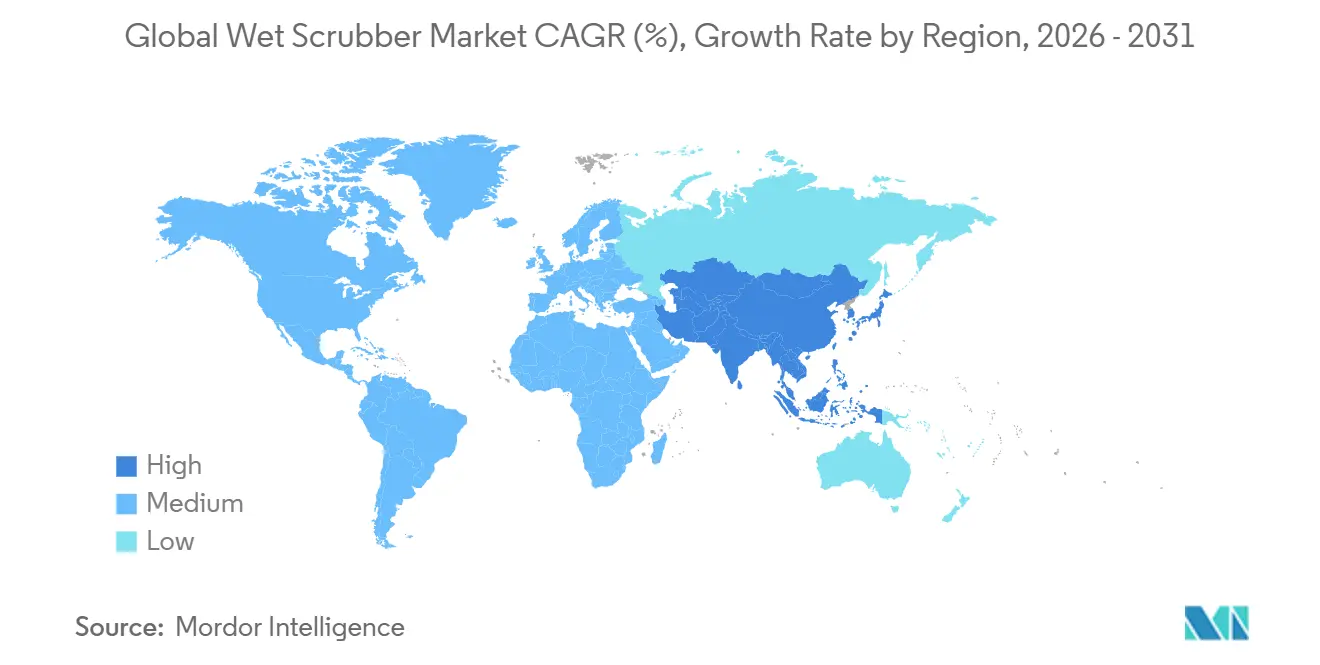
Asia-Pacific held 34.8% of the global wet scrubber market share in 2025 and is forecast to grow at a 9.9% CAGR through 2031. China’s industrial emissions framework supports demand across power, steel, and cement facilities. India’s thermal power fleet sustains a pipeline for flue-gas desulfurization and related water-treatment infrastructure. Japan and South Korea concentrate demand in high-efficiency systems with stronger monitoring requirements. Vietnam, Indonesia, and Thailand add greenfield industrial and power projects that need initial equipment installation. Asia-Pacific remains the main geographic demand center for the global wet scrubber market.
Europe held the second-largest regional share in 2025. The revised Industrial Emissions Directive supports a continuing cycle of permit review and equipment upgrades. European demand is more concentrated in retrofit, modernization, monitoring, chemical operations, waste-to-energy, and marine projects than in new coal capacity. The Mediterranean ECA has increased the relevance of compliant operating solutions for ships serving European routes. Poland retains a larger coal fleet than many neighboring markets, which supports conventional flue-gas control demand. The global wet scrubber market in Europe is shaped by compliance calendars, installed-base upgrades, and lifecycle service requirements.
North America benefits from EPA-led compliance investment across chemicals, lime, coke ovens, and refining. The 2025 Babcock & Wilcox refinery contract illustrates continuing spending on sulfur-dioxide control in Canada. Mexico adds demand through petrochemical and cement activity. South America is smaller and is led by metals, mining, pulp, and paper applications in Brazil and Chile. The Middle East and Africa are growing outside Asia-Pacific because of downstream petrochemical capacity and South African mining activity. These regions provide project opportunities where new industrial capacity is paired with stricter air-quality requirements.
Competitive Landscape
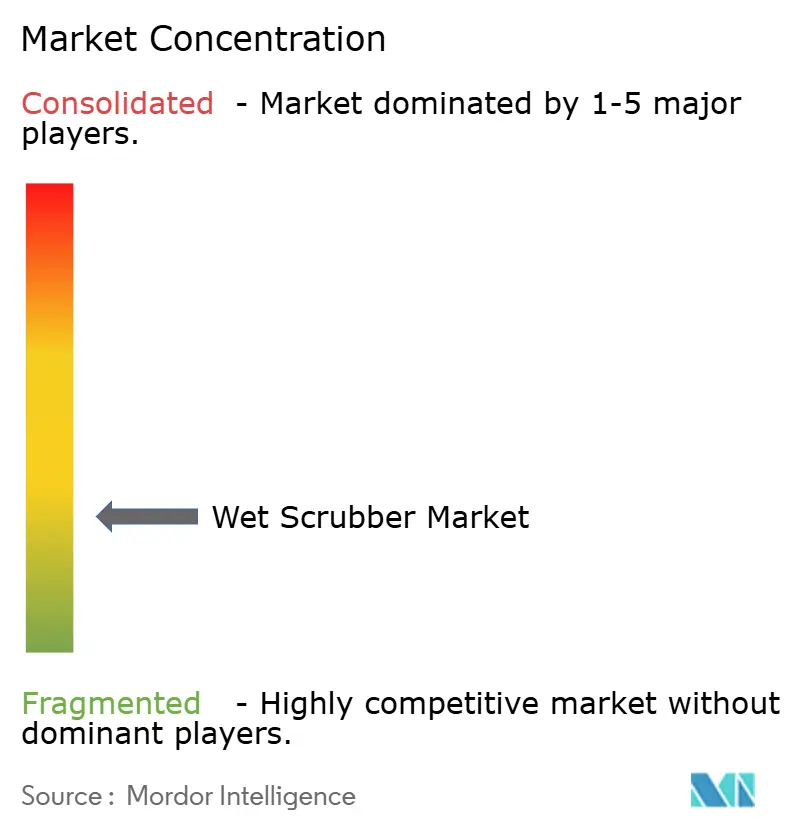
The global wet scrubber market is fragmented across applications and geographies. Alfa Laval, Wärtsilä, ANDRITZ, Babcock & Wilcox, and GEA Group compete through technology breadth, engineering capabilities, and lifecycle service. CECO Environmental, Thermax, Bionomic Industries, Tri-Mer, and regional fabricators compete with more specialized configurations. Customers increasingly prefer suppliers that can simplify compliance documentation and warranty coordination across related environmental equipment. This preference increases the value of portfolios that cover gas treatment, water treatment, monitoring, and adjacent emissions-control systems. The global wet scrubber market remains open to specialists where process conditions require custom designs.
GEA presented its Spray Drying Absorption technology for waste-to-energy flue-gas treatment at IFAT 2026. The move shows how suppliers are expanding across wet and dry treatment options to address a wider project scope. Wärtsilä supplied CCS-ready 27.5 MW scrubbers for 3 container vessels in a 2024 retrofit project. This approach can position equipment for later carbon-capture integration. Wärtsilä’s 2026 Grimaldi order also shows the role of hybrid systems in new vessel specifications. These investments shift competition beyond removal efficiency alone.
Digital integration and service depth increasingly differentiate suppliers in the global wet scrubber market. Monitoring tools can provide operating records, diagnostic support, and maintenance planning. Equipment suppliers with installed monitoring systems may have a stronger role in later upgrades and service contracts. Modular, skid-mounted packed-bed systems remain relevant for mid-sized pharmaceutical and specialty chemical customers in emerging markets. These buyers often need application-specific equipment but may not require the scale of a large utility project. No combined market-share figure for the leading companies was provided, so the evidence does not support a precise concentration ranking beyond a fragmented competitive structure.
Wet Scrubber Industry Leaders
-
Alfa Laval AB
-
Wärtsilä Oyj Abp
-
Babcock & Wilcox Enterprises, Inc.
-
ANDRITZ AG
-
CECO Environmental Corp.
- *Disclaimer: Major Players sorted in no particular order
Recent Industry Developments
- July 2026: Wärtsilä booked an order to supply its Wärtsilä 25 Ammonia auxiliary engine with an SCR NOx reducer for 2 new 51,350 m³ midsize LPG and liquid-ammonia carriers for Navigator Amon Shipping.
- July 2026: Wärtsilä confirmed propulsion solutions, including hybrid exhaust scrubber systems, for 9 newbuild ferry vessels for the Grimaldi Group fleet
- March 2026: Thermax subsidiary TBWES secured an INR 1,600 crore boiler-package contract for a 1×800 MW ultra-supercritical thermal power plant in Madhya Pradesh.
Global Wet Scrubber Market Report Scope
A wet scrubber is an air pollution control device that uses a liquid, typically water or a chemical solution, to remove harmful dust, gases, and chemicals from industrial exhaust streams.
The global wet scrubber market is segmented by product type, configuration, end-use industry, and geography. By product type, the market is segmented into packed bed scrubbers, venturi scrubbers, spray scrubbers, and other wet scrubbers. By configuration, the market is segmented into open-loop wet scrubbers, closed-loop wet scrubbers, and hybrid wet scrubbers, By end-use industry, the market is segmented into power generation, chemical and petrochemical, cement, refining, pulp and paper, metals and mining, waste-to-energy and waste incineration, marine and shipping, food and beverage, pharmaceutical, semiconductor and electronics, oil and gas, and other industries. The report also covers the market size and forecasts for the global wet scrubber market across 26 countries in the key regions. For each segment, market sizing and forecasts are provided in terms of value (USD).
| Packed Bed Scrubber |
| Venturi Scrubber |
| Spray Scrubber |
| Other Wet Scrubbers |
| Open-Loop Wet Scrubbers |
| Closed-Loop Wet Scrubbers |
| Hybrid Wet Scrubbers |
| Power Generation |
| Chemical and Petrochemical |
| Cement |
| Refining |
| Pulp and Paper |
| Metals and Mining |
| Waste-to-Energy and Waste Incineration |
| Marine and Shipping |
| Food and Beverage |
| Pharmaceutical |
| Semiconductor and Electronics |
| Oil and Gas |
| Other Industries |
| North America | United States |
| Canada | |
| Mexico | |
| Europe | Germany |
| France | |
| Italy | |
| Spain | |
| United Kingdom | |
| Poland | |
| Russia | |
| Rest of Europe | |
| Asia-Pacific | China |
| India | |
| Japan | |
| South Korea | |
| Australia | |
| Indonesia | |
| Vietnam | |
| Thailand | |
| Rest of Asia-Pacific | |
| South America | Brazil |
| Argentina | |
| Chile | |
| Rest of South America | |
| Middle East and Africa | Saudi Arabia |
| United Arab Emirates | |
| Egypt | |
| South Africa | |
| Morocco | |
| Rest of Middle East and Africa |
| By Product Type | Packed Bed Scrubber | |
| Venturi Scrubber | ||
| Spray Scrubber | ||
| Other Wet Scrubbers | ||
| By Configuration | Open-Loop Wet Scrubbers | |
| Closed-Loop Wet Scrubbers | ||
| Hybrid Wet Scrubbers | ||
| By End-Use Industry | Power Generation | |
| Chemical and Petrochemical | ||
| Cement | ||
| Refining | ||
| Pulp and Paper | ||
| Metals and Mining | ||
| Waste-to-Energy and Waste Incineration | ||
| Marine and Shipping | ||
| Food and Beverage | ||
| Pharmaceutical | ||
| Semiconductor and Electronics | ||
| Oil and Gas | ||
| Other Industries | ||
| By Geography | North America | United States |
| Canada | ||
| Mexico | ||
| Europe | Germany | |
| France | ||
| Italy | ||
| Spain | ||
| United Kingdom | ||
| Poland | ||
| Russia | ||
| Rest of Europe | ||
| Asia-Pacific | China | |
| India | ||
| Japan | ||
| South Korea | ||
| Australia | ||
| Indonesia | ||
| Vietnam | ||
| Thailand | ||
| Rest of Asia-Pacific | ||
| South America | Brazil | |
| Argentina | ||
| Chile | ||
| Rest of South America | ||
| Middle East and Africa | Saudi Arabia | |
| United Arab Emirates | ||
| Egypt | ||
| South Africa | ||
| Morocco | ||
| Rest of Middle East and Africa | ||
Key Questions Answered in the Report
What is the projected size of the global wet scrubber market by 2031?
The global wet scrubber market is forecast to reach USD 2.21 billion by 2031, from USD 1.46 billion in 2026, at an 8.60% CAGR.
Which wet scrubber product type had the largest share in 2025?
Packed bed wet scrubbers led with 43.5% share in 2025. Their position reflects use in chemical, semiconductor, and pharmaceutical operations that need reliable treatment of soluble acid gases.
Which wet scrubber configuration is growing the fastest?
Hybrid wet scrubbers are forecast to grow at a 9.8% CAGR through 2031. They offer operators a choice between open-loop and closed-loop operating modes as route and discharge conditions change.
Why does power generation lead wet scrubber demand?
Power generation held 25.6% share in 2025 and is forecast to grow at 9.3% CAGR. Existing coal fleets need flue-gas desulfurization upgrades, and new large plants need emission controls from the design stage.
Which region is expected to grow fastest through 2031?
Asia-Pacific is forecast to grow at a 9.9% CAGR through 2031 after holding 34.8% share in 2025. The region combines retrofit needs in large industrial economies with new power and process capacity.