
Web3 Marketing Services Market Size and Share
Market Overview
| Study Period | 2020 - 2031 |
|---|---|
| Market Size (2026) | USD 2.45 Billion |
| Market Size (2031) | USD 5.62 Billion |
| Growth Rate (2026 - 2031) | 18.06 % |
| Fastest Growing Market | Asia-Pacific |
| Largest Market | North America |
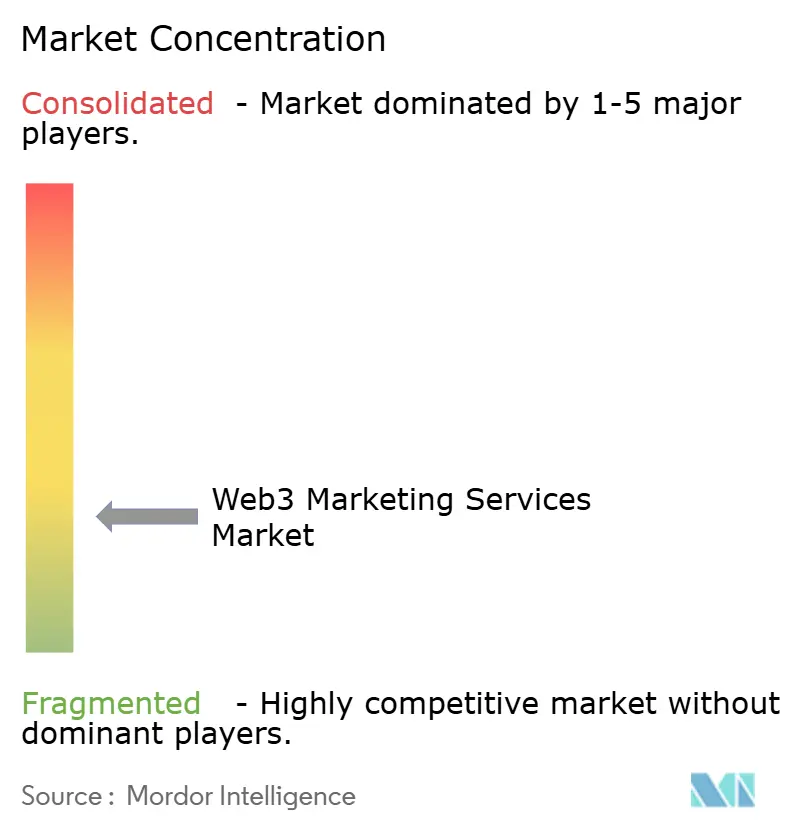
| Market Concentration | Low |
Major Players *Disclaimer: Major Players sorted in no particular order Image © Mordor Intelligence. Reuse requires attribution under CC BY 4.0. | |
Web3 Marketing Services Market Analysis by Mordor Intelligence
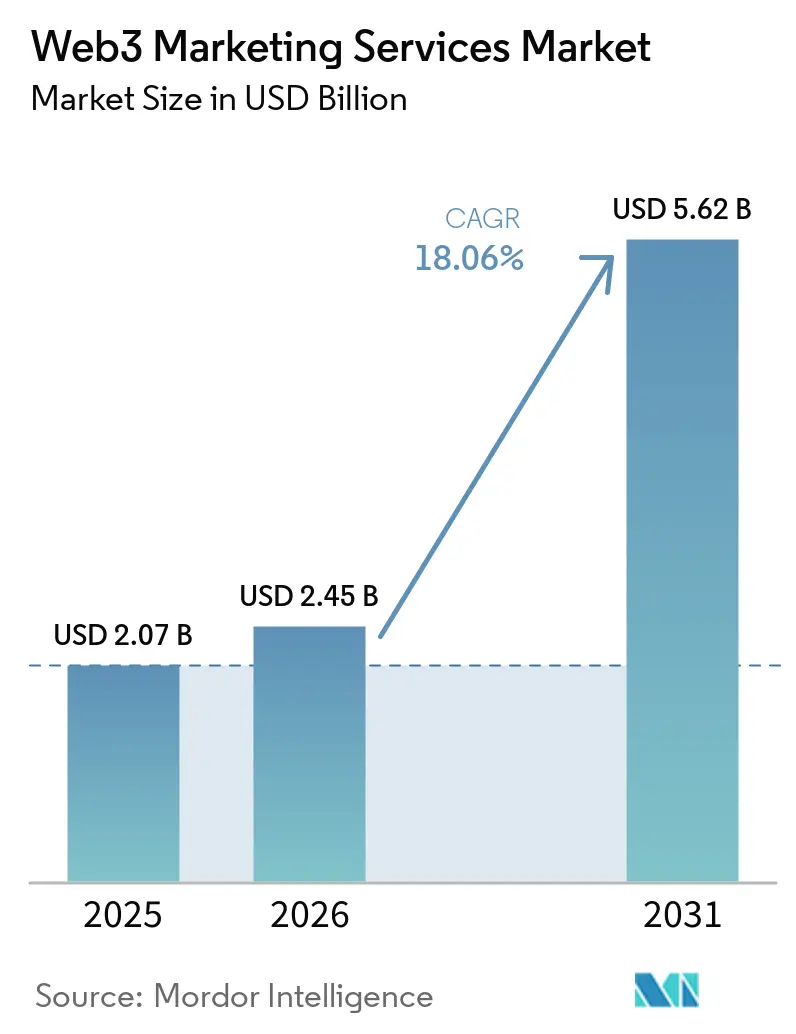
The Web3 marketing services market size was valued at USD 2.07 billion in 2025 and is estimated to grow from USD 2.45 billion in 2026 to reach USD 5.62 billion by 2031, at a CAGR of 18.06% during the forecast period (2026-2031). Protocols, decentralized applications, and token projects need ways to reach pseudonymous wallet holders whose activity is not visible through cookie-based advertising systems. This requirement supports continued demand for agencies that can connect on-chain and off-chain channels. On-chain analytics and more established agency capabilities now make it possible to connect a campaign with a smart contract interaction. Community trust has become closely linked to token liquidity and protocol adoption, making sustained engagement a core budget need. Enterprise brands are also committing more funds to Web3 channels, while their compliance and measurement expectations create opportunities for agencies that can combine technical knowledge with established brand controls.
Key Report Takeaways
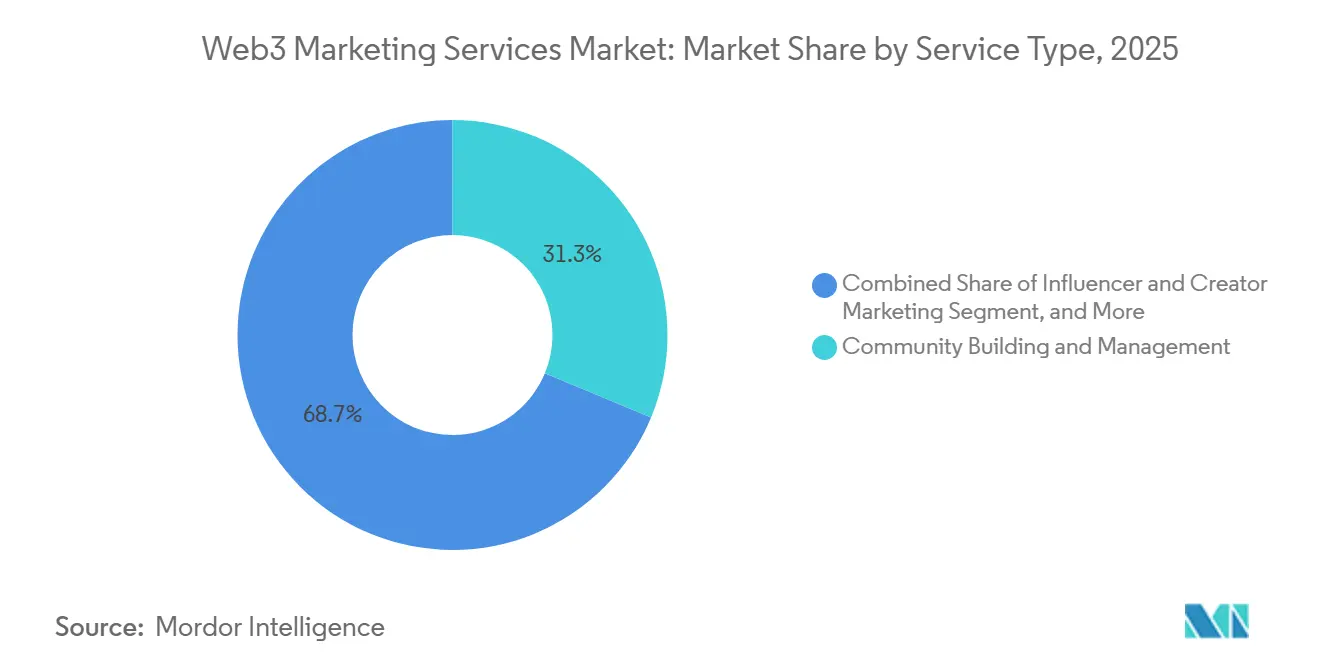
- By service type, community building and management held 31.26% of the Web3 marketing services market share in 2025, while Influencer and creator marketing is projected to expand at a CAGR of 22.34% through 2031.
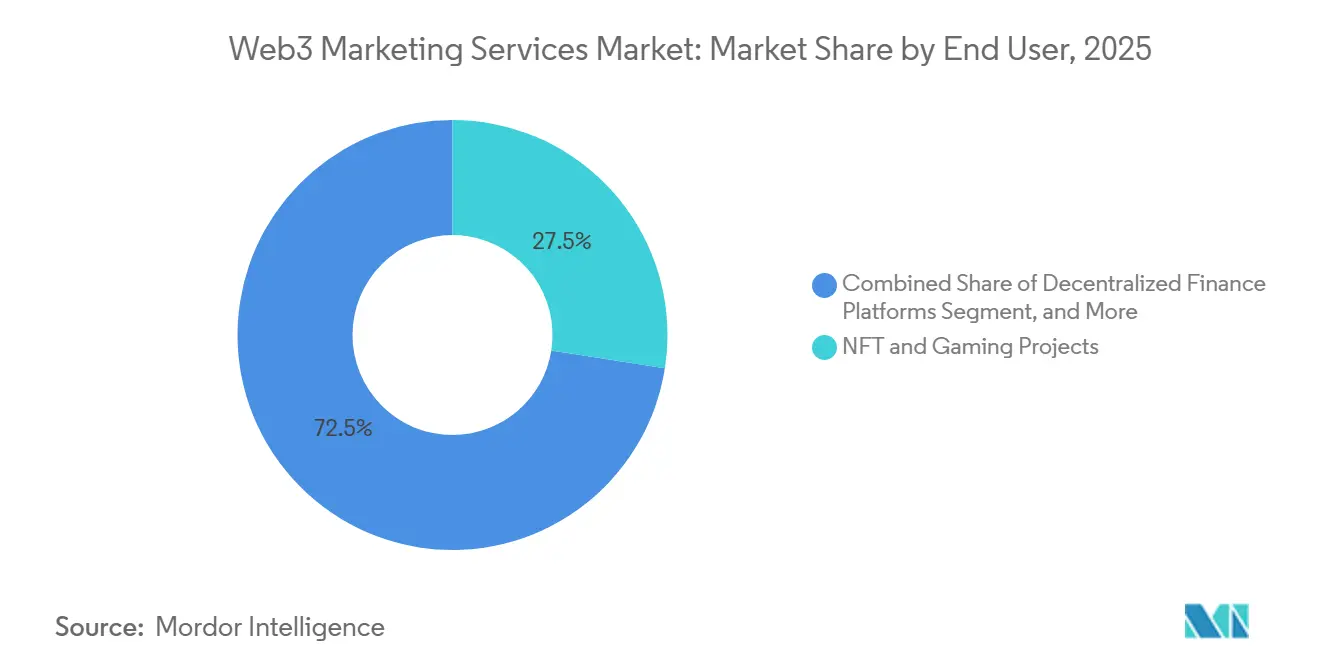
- By end user, NFT and Gaming Projects held 27.48% of revenue in 2025, while traditional enterprises and consumer brands are projected to expand at a CAGR of 23.19% through 2031.
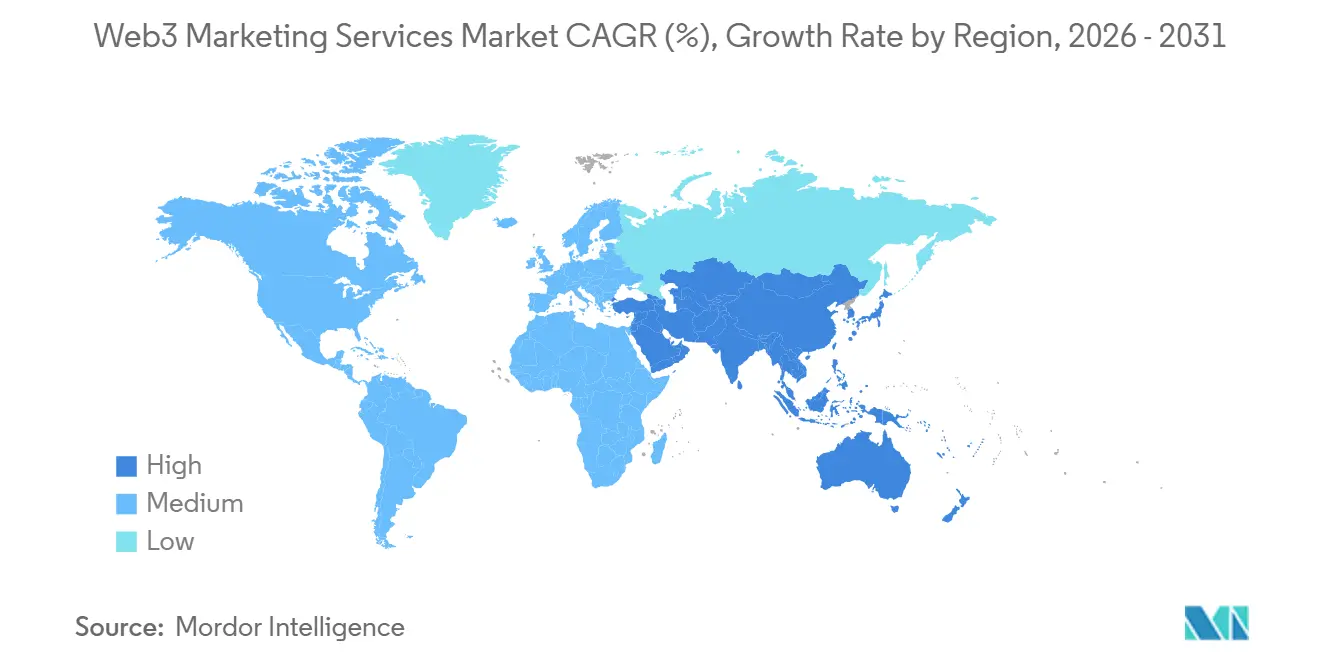
- By geography, North America accounted for 36.72% of revenue in 2025, while Asia-Pacific is projected to expand at a CAGR of 21.56% through 2031.
Note: Market size and forecast figures in this report are generated using Mordor Intelligence’s proprietary estimation framework, updated with the latest available data and insights as of January 2026.
Market Trends and Insights
Drivers Impact Analysis of Web3 Marketing Services Market*
| Driver | (~) % Impact on CAGR Forecast | Geographic Relevance | Impact Timeline |
|---|---|---|---|
| Rising Crypto-Native Brand Budget Allocation | +4.2% | Global | Short term (≤ 2 years) |
| Growth of Wallet-Based Audience Targeting | +3.2% | North America and Europe, with spillover to Asia-Pacific | Medium term (2-4 years) |
| Expansion of On-Chain Attribution and Analytics | +2.9% | Global, with early adoption in North America and Europe | Medium term (2-4 years) |
| Token-Gated Community Monetization | +2.1% | Global, particularly Asia-Pacific and North America | Medium term (2-4 years) |
| Compliance-First Web3 Growth Specialist Demand | +1.6% | North America, Europe, and Singapore | Long term (≥ 4 years) |
| Metaverse and Virtual Event Brand Activation | +1.2% | Global, led by Asia-Pacific and North America | Long term (≥ 4 years) |
| Source: Mordor Intelligence | |||
Rising Crypto-Native Brand Budget Allocation
Protocol treasuries and decentralized autonomous organizations have moved from irregular promotion spending toward formal marketing budgets, which gives agencies a clearer basis for retainer work and multi-period planning in the Web3 marketing services market. Aave governance records included a USD 750,000 allocation for events and sponsorships in 2025, while Arbitrum governance considered a USD 1.5 million events and brand activation allocation for the same cycle.[1]Aave Governance, “Aave Grants and Events Sponsorship Budget 2025,” Aave Governance Forum, governance.aave.com Both examples place marketing resources within a public governance process instead of treating promotion as a last-minute launch expense. Token holders can review the proposed use of funds, so agencies must explain how each campaign supports practical protocol objectives. Wallet acquisition costs, changes in total value locked, and referral conversions are examples of measures that can be presented for community review. An agency that can connect these measures to clear on-chain outcomes has a stronger basis for selection than one that provides only creative work or standard engagement totals.
Growth of Wallet-Based Audience Targeting
Wallet-based targeting allows campaigns to reach users with verified on-chain activity instead of audiences inferred from browser behavior, making it an important acquisition tool in the Web3 marketing services market. Addressable reported that its data covered more than 23 million matched wallet owners across 7 blockchains and more than 450 on-chain metrics. In June 2026, it reported that a top-3 global crypto exchange generated more than 3,200 quality application installs through a wallet-targeted campaign. The reported result shows why the cost per verified wallet connection can be more meaningful than the cost per click when the intended audience already uses crypto products. Wallet identifiers can be matched to social media profiles, allowing agencies to retarget crypto-active audiences on mainstream channels without relying on cookie-based tracking. Agencies can also define audiences by protocol interactions, token holdings, or governance activity, giving them a capability that general digital agencies may not readily reproduce.
Expansion of On-Chain Attribution and Analytics
On-chain attribution links campaign exposure to wallet connections and, later, to smart contract activity, allowing the Web3 marketing services market to assess results through transactions rather than page events alone. Traditional Web analytics can lose visibility once a user begins interacting with a smart contract, limiting the usefulness of standard digital reporting for protocol teams. Purpose-built systems can connect campaign exposure, wallet connection, and an on-chain transaction across decentralized finance and NFT activity. This lets clients compare community, creator, and paid campaigns using metrics such as wallet age, balance thresholds, and prior decentralized finance interactions. Agencies that build these tools into client reporting can provide evidence that is closer to the action a protocol wants users to take. As attribution tools become more available, the gap may widen between agencies that can explain wallet-level outcomes and those that report only impressions or engagement totals.
Token-Gated Community Monetization
Token-gated access makes community membership verifiable across Web3 applications and less dependent on a single platform's rules. Shopify stated that token-gated commerce can offer NFT holders perks and gated drops for brands that use this approach. In the Web3 marketing services market, these programs can link loyalty activity to an on-chain credential rather than a conventional customer relationship management record. The credentials remain with the holder and can be checked when a connected wallet seeks access to an experience or community function. Jupiter used its JUP token in 2025 to support tiered access and real-time validation of holdings through wallet-connected tools. This approach can support governance participation and organic advocacy, while on-chain behavior creates a body of data that agencies can use to refine later audience segmentation and campaign targeting.
Restraints Impact Analysis of Web3 Marketing Services Market*
| Restraint | (~) % Impact on CAGR Forecast | Geographic Relevance | Impact Timeline |
|---|---|---|---|
| Platform and Ad Network Policy Volatility | -3.1% | Global, most acute in North America and Europe | Short term (≤ 2 years) |
| Attribution Gaps Across Wallet and Off-Chain Journeys | -2.5% | Global | Medium term (2-4 years) |
| Budget Pullback After Token and NFT Demand Cooling | -1.9% | North America and Asia-Pacific | Short term (≤ 2 years) |
| Regulatory Sensitivity Around Crypto Promotions | -1.5% | North America and Europe, including the EU MiCA jurisdiction | Long term (≥ 4 years) |
| Source: Mordor Intelligence | |||
Platform and Ad Network Policy Volatility
Changes to platform advertising rules can disrupt live crypto campaigns and pose immediate operational risk for agencies. Google, Meta, and TikTok each changed policies for crypto and digital asset advertising at least once between 2024 and mid-2026, requiring agencies to revisit account conditions, audience lists, and creative approvals. The Federal Trade Commission's Endorsement Guides set disclosure expectations for social media endorsements, including endorsements that use AI-generated content.[2]U.S. Federal Trade Commission, “Guides Concerning Use of Endorsements and Testimonials in Advertising,” Federal Trade Commission, ftc.gov Agencies must therefore manage platform rules and disclosure obligations simultaneously, often for clients who prefer performance-based fees. This adds work that may be difficult to recover through pricing and can make campaign delivery less predictable. It can also shift spending toward crypto-native ad networks and community distribution, reducing the opportunity for agencies dependent on a single mainstream platform.
Attribution Gaps Across Wallet and Off-Chain Journeys
A campaign can pass through several systems before a user completes an on-chain action, and those systems do not naturally use a shared identifier. A person may view a display ad, visit a landing page, connect a wallet, and execute a token swap, with each stage producing data in a separate environment. This limitation affects the Web3 marketing services market because strong impressions, clicks, or Discord joins may not result in verifiable wallet activity. Clients without wallet-level reporting can struggle to distinguish broad engagement from meaningful on-chain conversion. Agencies face retention pressure when another provider can show stronger on-chain evidence from a comparable campaign, especially in community management and influencer work. Enterprise clients may also delay longer commitments until they can assess auditable return on investment across off-chain promotion and wallet-based conversion.
*Our forecasts treat driver/restraint impacts as directional, not additive. The impact forecasts reflect baseline growth, mix effects, and variable interactions.
Web3 Marketing Services Market Segment Analysis
By Service Type:
Community Engagement Holds the Largest Revenue PositionCommunity Building and Management accounted for 31.26% of the Web3 marketing services market share in 2025. For protocols and token projects, active participants, governance turnout, and Discord engagement can indicate token liquidity and protocol adoption. This makes community activity a primary part of brand strategy rather than a supporting communication function. NFT-Based Engagement and Loyalty services, along with Token-Based Campaigns and Incentives Programs, occupied the middle of the service mix. These offerings can serve as promotional tools and product features simultaneously. An NFT loyalty credential, for example, can promote a brand while giving the recipient a verifiable on-chain asset. Web3 Advertising and Performance Marketing is generally used by protocols that prioritize measurable wallet acquisition during earlier product stages. Public relations, content production, and search engine optimization remain supporting services across client types.
Influencer and Creator Marketing is projected to expand at a CAGR of 22.34% from 2026 to 2031. Protocols often use creators because mainstream advertising channels may not reach crypto-native audiences with the same level of relevance. Coin Bureau acquired a strategic stake in KOLLAB in 2025, reflecting its interest in combining crypto media discovery with creator campaign execution. The KOLLAB reported more than 250 curated creator relationships and a reach of nearly 50 million crypto users globally. Creator programs are also shifting toward performance-linked agreements that include disclosure requirements. This can replace flat-fee arrangements when paid promotion standards become more visible to clients and regulators. The Web3 marketing services industry favors agencies that can activate international KOL networks while meeting brand-safety and contracting expectations. These capabilities matter most where clients seek measurable results and access to trusted crypto communities.



By End User:
Enterprise Demand Expands Beyond Crypto-Native ClientsNFT and Gaming Projects held 27.48% of end-user revenue in 2025. Gaming projects create recurring demand because play-to-earn features, in-game token economies, and NFT marketplace functions need different types of promotion. Community onboarding, competitive player acquisition, and secondary marketplace liquidity each require distinct campaign activity. This can create mandates that cover several service types rather than a single launch campaign. Decentralized Finance Platforms formed the second-largest end-user group in the source material. Their governance-based marketing budgets place greater emphasis on the quality of wallet acquisition than on raw audience reach. This preference supports agencies that can use on-chain attribution. Web3 Infrastructure Providers often rely on developer-focused work such as hackathons, grants, and technical content series.
Traditional Enterprises and Consumer Brands are projected to expand at a CAGR of 23.19% through 2031. Their increasing use of Web3 tools contributes to a broader client base for the Web3 marketing services market. LG Electronics announced in June 2026 that it was developing an Arbitrum-based layer-2 advertising network with an initial pilot involving a Japanese advertising agency. The planned system records ad inventory and viewer interactions on-chain. Lotte Group's marketing subsidiary, Daehong Communications, launched a tokenized voucher ecosystem on Aptos in 2025. It onboarded more than 500,000 consumers and minted more than 1 million real-world vouchers without requiring direct wallet interaction. These examples show why enterprise clients may bring larger retainers and longer contracts than crypto-native projects. They also require brand-safety controls, compliance processes, and links with legacy customer relationship management systems that many specialist agencies have not yet established.
Geography Analysis
North America Web3 Marketing Services Market
North America accounted for 36.72% of the Web3 marketing services market share in 2025. The region benefits from concentrated crypto capital markets, funded protocols, and established on-chain attribution infrastructure. The United States remained the largest national market in the region. Blockchain venture investment, retail crypto ownership, and extensive KOL networks on X and YouTube supported demand across community, advertising, and analytics services. Canada added demand from a fintech-adjacent blockchain ecosystem where compliance-focused growth work is relevant. Mexico created a separate opportunity for community-building services designed for Spanish-language audiences. Together, these factors helped North America retain a leading position in the Web3 marketing services market.
APAC Web3 Marketing Services Market
Asia-Pacific is projected to expand at a CAGR of 21.56% from 2026 to 2031. South Korea is a high-intensity retail crypto setting, where Financial Intelligence Unit-registered won-denominated exchanges, including Upbit and Bithumb, concentrate retail liquidity. Korean-language KOL work and Kakao channel campaigns can carry higher prices when audience quality is verified. Japan has structured oversight under the Financial Services Agency, which makes compliant crypto advertising a specialized activity. Singapore's Digital Token Service Provider regime under the Financial Services and Markets Act took effect on June 30, 2025.[3]Monetary Authority of Singapore, “Digital Token Service Provider Regime Under the Financial Services and Markets Act,” Monetary Authority of Singapore, mas.gov.sg The regime addressed requirements for Singapore-incorporated firms serving overseas clients and reinforced the city-state's role as a regional hub where compliance affects agency positioning.
EMEA and South America Web3 Marketing Services Market
Europe is mature but has been reshaped by compliance requirements under the European Union's Markets in Crypto-Assets Regulation. The framework separated agencies with crypto-asset service provider-ready campaign infrastructure from those without. Germany and France supported continental demand, while the United Kingdom retained a separate Financial Conduct Authority financial promotions framework. This creates a dual-compliance environment for agencies operating across European markets. In South America, Brazil has created a developing opportunity through smartphone use, retail crypto activity supported by Pix payments, and increasing decentralized finance activity. The Middle East and Africa remained at an earlier stage, although Dubai and Abu Dhabi attracted protocol headquarters and demand for English- and Arabic-language KOL and public relations services. South Africa remained an anchor for the developing sub-Saharan ecosystem, making regional language and compliance knowledge important for the Web3 marketing services market.

Competitive Landscape
The Web3 marketing services market is fragmented, with no agency commanding a decisive share of revenue across all service categories. Agencies compete through community management, KOL activation, on-chain analytics, performance marketing, and compliance-aware public relations. A broad service list alone is less valuable than proof of results in a particular service line or geography. Verifiable on-chain campaign results can be particularly important because protocol clients can review wallet connections, transactions, and governance activity. Coinbound reported that it had delivered more than 1,400 campaigns for more than 900 clients since 2018. NinjaPromo also used a subscription model, serving more than 200 international clients. These firms provide reference points for repeatable delivery, but the available information does not establish a combined market share for the largest players.
A gap remains between enterprise brand governance and Web3 technical execution. Pure-play crypto agencies may lack the controls required by large consumer brands, while conventional agencies may not have practical knowledge of wallet targeting, token mechanics, or on-chain reporting. Launch-focused agencies face added pressure as NFT and gaming clients mature and enterprise demand gains importance. Coin Bureau's 2025 investment in KOLLAB signaled a shift by a crypto media business toward agency capabilities. This type of combination can bring audience discovery and campaign execution closer together. Adtech providers that combine targeting and attribution may also reduce client reliance on agency intermediaries. The Web3 marketing services market, therefore, rewards agencies that can demonstrate technical performance and meet stronger client governance expectations.
LG Electronics' June 2026 work on a blockchain advertising network illustrated a strategic move by an infrastructure-level participant. The company planned to record ad placements and viewer interactions through an Arbitrum-based system after a pilot with a Japanese advertising agency. Daehong Communications also used Aptos for its tokenized voucher ecosystem, combining a consumer promotion program with on-chain issuance. The project showed how a marketing subsidiary could extend Web3 activity beyond a one-time NFT release. Aave and Arbitrum governance activity provided another example because publicly visible budget proposals make campaign spending subject to community review.[4]Arbitrum Foundation, “Arbitrum Events and Brand Activation Budget Proposal 2025,” Arbitrum Forum, forum.arbitrum.foundation These moves favor specialists who can report campaign activity in ways that brands, protocol teams, and community voters can assess. The competitive structure remains dispersed because the available company data does not show concentration at a level sufficient to identify a dominant group.
Web3 Marketing Services Industry Leaders
Coinbound, LLC
Lunar Strategy B.V.
MarketAcross Ltd.
NinjaPromo Ltd.
ICODA
- *Disclaimer: Major Players sorted in no particular order
Web3 Marketing Services Market Companies Covered in this Report
- Coinbound, LLC
- Lunar Strategy B.V.
- Blockchain Marketing Ninja
- MarketAcross Ltd.
- ReBlonde Ltd.
- Coinpresso
- NinjaPromo Ltd.
- ICODA
- Solus Agency
- Coinband
- Blockwiz
- CryptoVirally
- CryptoPR
- FINPR
- Buzz Dealer
- GuerrillaBuzz
- Flexe.io
- Hype Partners Ltd.
- Omni Agency
- Crynet
- Proleo.io

Recent Industry Developments in Web3 Marketing Services Market
- June 2026: TheBlock and CryptoPR announced a strategic partnership to strengthen global blockchain communication and adoption, combining theBlock's editorial reach with CryptoPR's institutional blockchain advisory presence across Dubai, New York, and Hong Kong. The partnership targets enterprise clients and governmental entities navigating the transition into blockchain and digital assets.
- June 2026: LG Electronics confirmed the development of a layer-2 blockchain-based advertising network built on Arbitrum's technology stack, designed to log ad inventory placements and viewer interactions directly on-chain. An initial pilot was conducted with an unnamed Japanese advertising agency, with LG indicating plans to evaluate commercial rollout later in 2026, a signal that consumer electronics OEMs are embedding Web3 attribution infrastructure into core advertising operations.
- April 2026: Stratosphere acquired Movimentum in a cash-and-equity transaction, consolidating Movimentum's established CoinMarketCap and Binance Square marketing expertise with Stratosphere's broader Web3 ecosystem consulting capabilities under a unified brand. The acquisition expanded Stratosphere's go-to-market execution capacity across growth strategy, brand positioning, and multi-region campaign delivery.
- January 2026: Museigen.io and Blocksky Inc., the latter backed by SBI Group and Gaiax, formed a strategic alliance to scale Web3 marketing campaigns across Asia, with Blocksky's Watch-to-Earn advertising platform serving as the technical backbone for performance-tracked campaigns in Japan, Southeast Asia, and South Korea. The alliance targets regional GTM campaigns and real-world Web3 adoption at the enterprise level.


Global Web3 Marketing Services Market Report Scope
The Web3 Marketing Services Market comprises revenue generated from professional marketing, branding, community engagement, and customer acquisition services designed specifically for organizations operating within or leveraging the Web3 ecosystem. These services help businesses promote decentralized products, services, and digital assets by utilizing blockchain-enabled engagement models, token economies, decentralized communities, and Web3-native digital channels to build awareness, drive user adoption, and foster long-term community participation.
The Web3 Marketing Services Market Report is Segmented by Service Type (Community Building and Management, Token-Based Campaigns and Incentives Programs, NFT-Based Engagement and Loyalty, Web3 Advertising and Performance Marketing, Influencer and Creator Marketing, and Other Service Types), by End User (Web3 Infrastructure Providers, Decentralized Finance Platforms, NFT and Gaming Projects, Traditional Enterprises and Consumer Brands, and Other End Users), and by Geography (North America, South America, Europe, Asia-Pacific, and Middle East and Africa). The Market Forecasts are Provided in Terms of Value (USD).
| Community Building and Management |
| Token-Based Campaigns and Incentives Programs |
| NFT-Based Engagement and Loyalty |
| Web3 Advertising and Performance Marketing |
| Influencer and Creator Marketing |
| Other Service Types |
| Web3 Infrastructure Providers |
| Decentralized Finance Platforms |
| NFT and Gaming Projects |
| Traditional Enterprises and Consumer Brands |
| Other End Users |
| North America | United States |
| Canada | |
| Mexico | |
| South America | Brazil |
| Argentina | |
| Chile | |
| Rest of South America | |
| Europe | Germany |
| United Kingdom | |
| France | |
| Italy | |
| Spain | |
| Rest of Europe | |
| Asia-Pacific | China |
| Japan | |
| India | |
| South Korea | |
| Australia | |
| Rest of Asia-Pacific | |
| Middle East and Africa | United Arab Emirates |
| Saudi Arabia | |
| South Africa | |
| Rest of Middle East and Africa |
| By Service Type | Community Building and Management | |
| Token-Based Campaigns and Incentives Programs | ||
| NFT-Based Engagement and Loyalty | ||
| Web3 Advertising and Performance Marketing | ||
| Influencer and Creator Marketing | ||
| Other Service Types | ||
| By End User | Web3 Infrastructure Providers | |
| Decentralized Finance Platforms | ||
| NFT and Gaming Projects | ||
| Traditional Enterprises and Consumer Brands | ||
| Other End Users | ||
| By Geography | North America | United States |
| Canada | ||
| Mexico | ||
| South America | Brazil | |
| Argentina | ||
| Chile | ||
| Rest of South America | ||
| Europe | Germany | |
| United Kingdom | ||
| France | ||
| Italy | ||
| Spain | ||
| Rest of Europe | ||
| Asia-Pacific | China | |
| Japan | ||
| India | ||
| South Korea | ||
| Australia | ||
| Rest of Asia-Pacific | ||
| Middle East and Africa | United Arab Emirates | |
| Saudi Arabia | ||
| South Africa | ||
| Rest of Middle East and Africa | ||


Key Questions Answered in the Report
What is the Web3 marketing services market size?
The Web3 marketing services market was valued at USD 2.07 billion in 2025 and is estimated to reach USD 5.62 billion by 2031, at a CAGR of 18.06% from 2026 to 2031.
What services accounted for the largest revenue share in Web3 marketing?
Community Building and Management led service revenue with a 31.26% share in 2025.
Which Web3 marketing service is projected to expand the fastest?
Influencer and Creator Marketing is projected to expand at a CAGR of 22.34% through 2031.
Which end user is expected to drive the fastest demand?
Traditional Enterprises and Consumer Brands are projected to expand at a CAGR of 23.19% through 2031.
Which region held the largest share of Web3 marketing services revenue?
North America held 36.72% of global revenue in 2025.
Why is on-chain attribution important for Web3 campaigns?
It helps link campaign activity to wallet connections and smart contract interactions, which can provide more auditable performance evidence.
Page last updated on:





