
Waterborne Silicone Market Size and Share
Market Overview
| Study Period | 2022 - 2032 |
|---|---|
| Market Size (2027) | USD 1.87 Billion |
| Market Size (2032) | USD 2.64 Billion |
| Growth Rate (2027 - 2032) | 7.17 % |
| Fastest Growing Market | Asia-Pacific |
| Largest Market | Asia-Pacific |
| Market Concentration | Medium |
Major Players *Disclaimer: Major Players sorted in no particular order Image © Mordor Intelligence. Reuse requires attribution under CC BY 4.0. | |
Waterborne Silicone Market Analysis by Mordor Intelligence
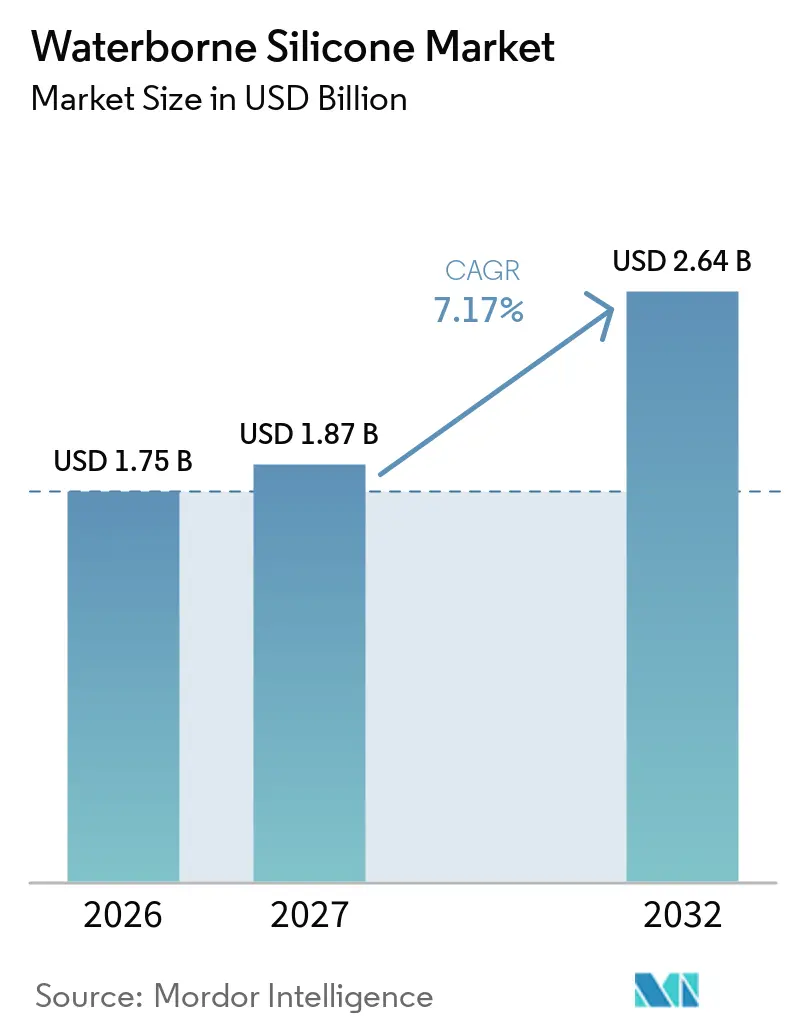
The Waterborne Silicone Market size was valued at USD 1.75 billion in 2026 and is estimated to grow from USD 1.87 billion in 2027 to reach USD 2.64 billion by 2032, at a CAGR of 7.17% during the forecast period (2027-2032). The waterborne silicone market is being shaped by tighter limits on volatile organic compounds (VOCs) across major coatings markets. Updated U.S. aerosol coating standards, revised European Union Ecolabel criteria, and Chinese VOC requirements are increasing the need for low-emission formulations. Construction activity, electronics production, and automotive applications are widening demand for protective and waterproofing materials. Product development is also improving cure speed, heat resistance, and compatibility with organic resins. Suppliers with integrated siloxane capacity, validated formulations, and local production are better placed to serve the waterborne silicone market as compliance deadlines approach.
Key Report Takeaways
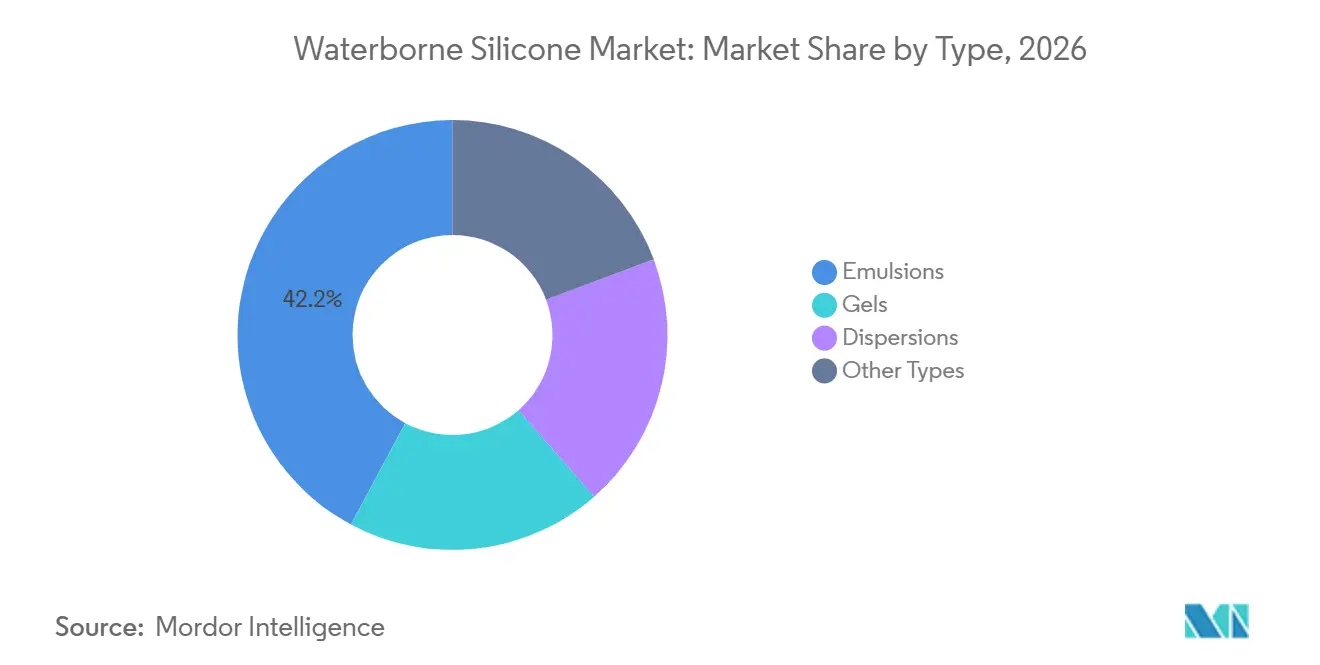
- By type, emulsions held 42.18% of the waterborne silicone market share in 2026 and are forecast to advance at a 7.85% CAGR through 2032.
- By application, paints and coatings held 36.65% of the waterborne silicone market share in 2026 and are forecast to advance at an 8.10% CAGR through 2032.
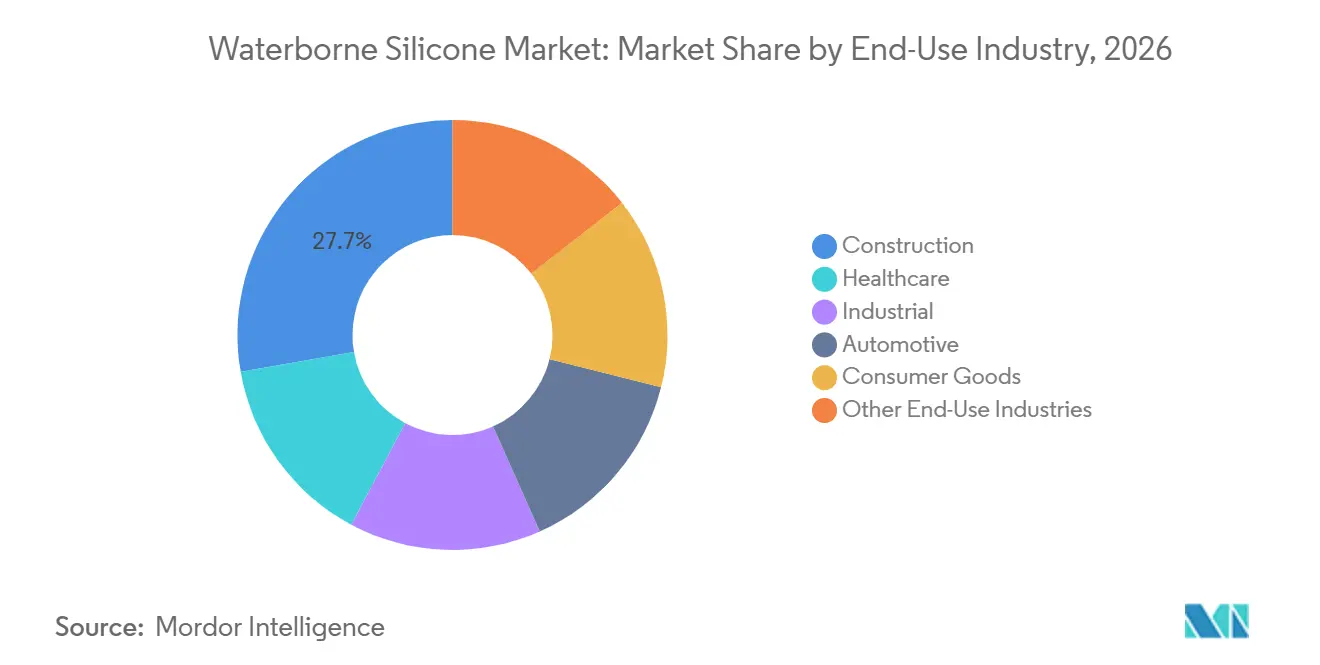
- By end-use industry, construction held 27.73% of the waterborne silicone market share in 2026, while healthcare is forecast to advance at an 8.42% CAGR through 2032.
- By geography, Asia-Pacific held 40.54% of the waterborne silicone market share in 2026 and is forecast to advance at an 8.21% CAGR through 2032.
Note: Market numbers in this report are based on Mordor Intelligence's proprietary estimation framework, which combines nine months of actuals with Q4 projections for base year 2026.
Global Waterborne Silicone Market Trends and Insights
Drivers Impact Analysis*
| Driver | (~) % Impact on CAGR Forecast | Geographic Relevance | Impact Timeline |
|---|---|---|---|
| Tightening VOC and Low-Emission Compliance Requirements | +2.1% | Global | Short term (≤ 2 years) |
| Sustainable Construction and Infrastructure Investment | +1.8% | APAC core, spillover to MEA | Medium term (2–4 years) |
| Automotive and Electronics Demand for Durable Protective Materials | +1.3% | North America & EU, APAC | Medium term (2–4 years) |
| Formulation Advances in Waterborne Silicone Systems | +0.8% | Global | Long term (≥ 4 years) |
| Emulsifier-Free Rapid-Cure Waterborne Resins | +0.5% | Global, with early gains in Japan and North America | Long term (≥ 4 years) |
| Source: Mordor Intelligence | |||
Tightening VOC and Low-Emission Compliance Requirements
The U.S. Environmental Protection Agency finalized amendments to aerosol coatings VOC standards in January 2025. The amendments updated product-weighted reactivity limits and required electronic compliance reporting[1]. An interim final rule moved the compliance deadline to January 17, 2027, while maintaining a defined reformulation timetable. The European Commission adopted revised Ecolabel criteria for decorative paints, varnishes, and related products in December 2025. Those criteria set VOC limits that support waterborne chemistry in a broad set of architectural applications. These actions make low-emission formulations an access requirement for many products in the waterborne silicone market.
Sustainable Construction and Infrastructure Investment
India maintained capital expenditure of INR 11.1 trillion (approximately USD 127–132 billion) in its 2025-26 budget, equal to 3.4% of gross domestic product. The budget supports road, urban, and energy projects that use sealants, waterproof coatings, and protective materials[2]. China continues to support demand through metro systems, high-speed rail stations, and industrial zones. These projects need concrete protection, joint sealants, and facade coatings that meet environmental requirements. Green building programs, including Green Rating for Integrated Habitat Assessment (GRIHA), are strengthening material specifications in the Asia-Pacific.
Automotive and Electronics Demand for Durable Protective Materials
Electric vehicle battery packs and power electronics need materials that provide insulation and moisture protection during thermal cycling. Waterborne silicone systems can address these requirements while reducing VOC emissions from coating operations. Momentive markets CoatOSil P905 for waterborne high-temperature-resistant coatings, with heat resistance up to 600 °C. Consumer electronics producers are also using waterborne conformal coatings to limit manufacturing emissions without sacrificing moisture resistance. Outdoor 5G equipment adds demand for ultraviolet-stable and moisture-resistant sealing materials. These uses create a wider performance base for the waterborne silicone market.
Formulation Advances in Waterborne Silicone Systems
Suppliers are reducing the performance gap between waterborne and solvent-borne silicone systems. Wacker Chemie AG introduced SILRES HP 2000 LV in March 2025 for epoxy-polysiloxane topcoats. The lower-volatiles hardener is intended to reduce occupational exposure and help industrial applicators meet low-emission requirements. Shin-Etsu Chemical Co., Ltd. presented the phenyl-type KRW-6002 at the 2025 Paint & Coating Expo. The product offers compatibility with organic resins and heat resistance up to 250 °C. These developments support use in applications where performance requirements had previously limited waterborne adoption. They also give formulators more options when replacing solvent-borne systems in the waterborne silicone market.
Restraints Impact Analysis*
| Restraint | (~) % Impact on CAGR Forecast | Geographic Relevance | Impact Timeline |
|---|---|---|---|
| Premium Raw-Material and Processing Costs | -1.4% | Global | Short term (≤ 2 years) |
| Compatibility and Cure-Performance Limitations | -0.9% | Global | Medium term (2–4 years) |
| Surfactant Migration and Recoatability Risks | -0.4% | North America & EU | Long term (≥ 4 years) |
| Source: Mordor Intelligence | |||
Premium Raw-Material and Processing Costs
Silicon metal costs vary with energy costs at smelters in China and Norway. These changes affect siloxane and emulsion pricing across the silicone supply chain. Personal care and healthcare grades require Good Manufacturing Practice (GMP) controls that add processing costs. Wacker Chemie AG commissioned a 15,000-square-meter silicone-emulsions complex in Panagarh, India, in March 2026, which follows European Federation for Cosmetic Ingredients (EFfCI) GMP guidelines. Waterborne silicone can therefore carry a price premium in regions without strong environmental mandates. These limits are used in price-sensitive construction and industrial applications across South America, the Middle East, and parts of Sub-Saharan Africa, limiting the waterborne silicone market in the short term.
Compatibility and Cure-Performance Limitations
Waterborne silicone systems can be difficult to blend with acrylic, alkyd, and polyurethane binders. Differences in pH stability, surface tension, and crosslinking can reduce formulation stability during mixing or application. Multi-coat systems can also have different open times and cure windows, which increases delamination risk. Validation can take 12-18 months before a formulation reaches commercial use. Research on blood-contacting silicone devices also shows that multifunctional waterborne coatings require advanced polymer design. Surfactant migration can cause water trails and lower recoatability in exterior coatings, which preserves a role for solvent-borne alternatives in specification-driven work and slows the waterborne silicone market.
*Our forecasts treat driver/restraint impacts as directional, not additive. The impact forecasts reflect baseline growth, mix effects, and variable interactions.
Segment Analysis
By Type: Emulsions Support Broad Formulation Use
Emulsions accounted for 42.18% of type-segment revenue in 2026 and are projected to advance at a 7.85% CAGR through 2032. Their use spans architectural coatings, personal care products, and industrial waterproofing systems. Particle-size control helps formulators adjust water beading, scratch resistance, and ultraviolet stability for different surfaces. This flexibility supports use across multiple formulation requirements. Momentive offers CoatOSil SE 620 for interior and exterior waterborne architectural paints. The product is a low-VOC functional silicone emulsion for regulated coating applications. Wacker Chemie AG supplies nonionic and solvent-free reactive polysiloxane emulsions through its SILRES BS range. These materials serve masonry coatings, silicone-resin emulsion paints, and interior additives in the waterborne silicone market.
Dispersions serve specialized protective-coating requirements, including high-temperature, anticorrosion, and leather-finishing applications. Evonik Industries AG's SILIKOPURE is a waterborne silicone-modified polyurethane dispersion for flexible coatings on leather, wood, plastic, rubber, and metal. Gels remain relevant in personal care and biomedical uses where sensory performance and biocompatibility matter. Elkem ASA introduced SILBIONE LSR Select EC 70 in October 2025 for wearable diagnostic devices and flexible electronics. The material met ISO 10993-5 cytotoxicity and ISO 10993-10 skin-sensitization testing requirements. These qualification standards act as a gateway for healthcare-oriented grades. They can also support premium positioning for validated silicone formats. The waterborne silicone industry continues to use different physical forms to match end-use requirements.

By Application: Paints and Coatings Combine Scale and Growth
Paints and coatings accounted for 36.65% of application revenue in 2026 and are projected to advance at an 8.10% CAGR through 2032. The segment benefits from low-VOC reformulation across institutional, industrial, and maintenance coating lines. Silicone-modified waterborne binders offer exterior durability, thermal resistance, and water beading. BASF started a dispersions production line in Dilovası, Türkiye, in October 2025. The line serves architectural coatings and construction-material customers in Türkiye, the Middle East, and Northwest Africa. KCC CORPORATION launched SL8311, SL8511, and SL8611 silicone waterproof coatings for exterior building applications. SL8311 carries a 10-year performance warranty, supporting its position in lifecycle-focused projects.
Adhesives and sealants are used for construction joints and automotive assembly. VOC requirements are encouraging a shift from traditional solvent-borne variants toward silicone-modified waterborne products. Henkel AG & Co. KGaA launched Loctite MS 9650 in December 2025 for automotive display and body applications. Its low-VOC formulation bonds glass, metal, painted surfaces, and plastics. Personal care applications are expanding through water-soluble and cold-process-compatible silicone formulations. Shin-Etsu Chemical Co., Ltd. introduced KF-6070W and KF-6080W in 2025 for hair care and skin care formulators. The products offer 24-month storage stability and compatibility with common surfactants. This application mix broadens the waterborne silicone industry and expands the waterborne silicone market beyond protective coatings.
By End-Use Industry: Construction Provides Revenue and Healthcare Adds Growth
Construction accounted for 27.73% of end-use revenue in 2026. Sealants, waterproofing membranes, exterior facade coatings, and concrete protection are the principal uses. India's infrastructure programs support demand for construction chemicals across road, urban, and energy projects. China supports demand through green-building programs and urban renewal activity. Automotive and industrial users require protective coatings for metal components, electronic assemblies, and equipment. Consumer goods manufacturers also use silicone as release coatings and surface modifiers in packaging, appliances, and household products. These end uses help sustain the waterborne silicone market across manufacturing centers in Asia-Pacific and Europe.
Healthcare is projected to advance at an 8.42% CAGR through 2032. Demand includes coatings for catheters, surgical instruments, wearable diagnostics, and drug-eluting implants. An August 2025 study reported waterborne silicone-based hydrogel coatings with antibacterial, antithrombogenic, and mechanical properties for blood-contacting medical devices. This combination is important for devices that need several functions from one coating system. ISO 10993 frameworks govern material qualification for many medical uses. Compliance requirements narrow the supplier base to companies with validated materials. They also support premium pricing within this part of the waterborne silicone industry. Healthcare demand links performance testing directly with material selection in the waterborne silicone market.
Geography Analysis
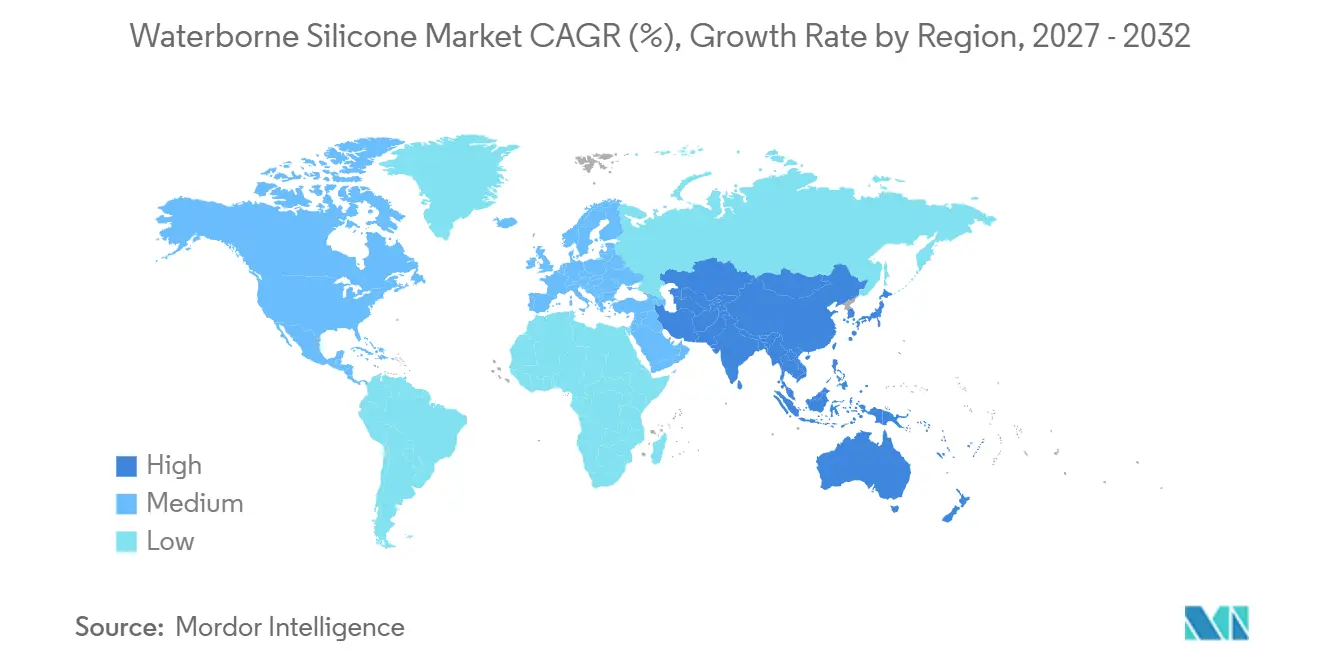
Asia-Pacific accounted for 40.54% of the market share in 2026 and is projected to advance at an 8.21% CAGR through 2032. China supports regional demand through its coatings manufacturing capacity, VOC reduction activity, and use of waterborne silicones in personal care. India is an important growth market because public infrastructure spending supports sealants and protective coatings. Wacker Chemie AG's Panagarh expansion provides local production capacity for GMP-certified silicone emulsions. Japan and South Korea maintain demand for validated grades used in electronics, automotive, and personal care applications.
North America is shaped by U.S. VOC standards and green-building requirements. The January 2025 aerosol coatings rule and the January 2027 compliance deadline are increasing near-term demand for validated low-emission systems. Major research and development operations of Dow, Momentive, and Evonik Industries AG support the region's role in formulation development for the waterborne silicone market. Europe is guided by REACH, the Decopaint Directive, and revised EU Ecolabel criteria. These rules support adoption in industrial maintenance, automotive original equipment manufacturer (OEM) coatings, and exterior facade protection. Germany, France, Italy, and the United Kingdom account for a large share of European demand. Elkem completed its Roussillon, France, expansion in 2025, improving regional siloxane availability.
South America has demand centered on Brazil and Argentina, where infrastructure construction and personal care production support consumption. Waterborne formulations are gaining relevance as brand owners respond to environmental requirements. The Middle East and Africa demand is led by the Gulf Cooperation Council construction activity. Saudi Arabia's Vision 2030 projects support the use of high-performance building and protective materials. BASF identifies Sub-Saharan Africa as a market for construction-driven dispersions demand. The price premium over solvent-borne alternatives remains a barrier where VOC rules are less stringent. As a result, use is concentrated in premium and export-oriented applications. This limits the near-term reach of the waterborne silicone market in lower-compliance regions and slows its broader regional development.
Competitive Landscape
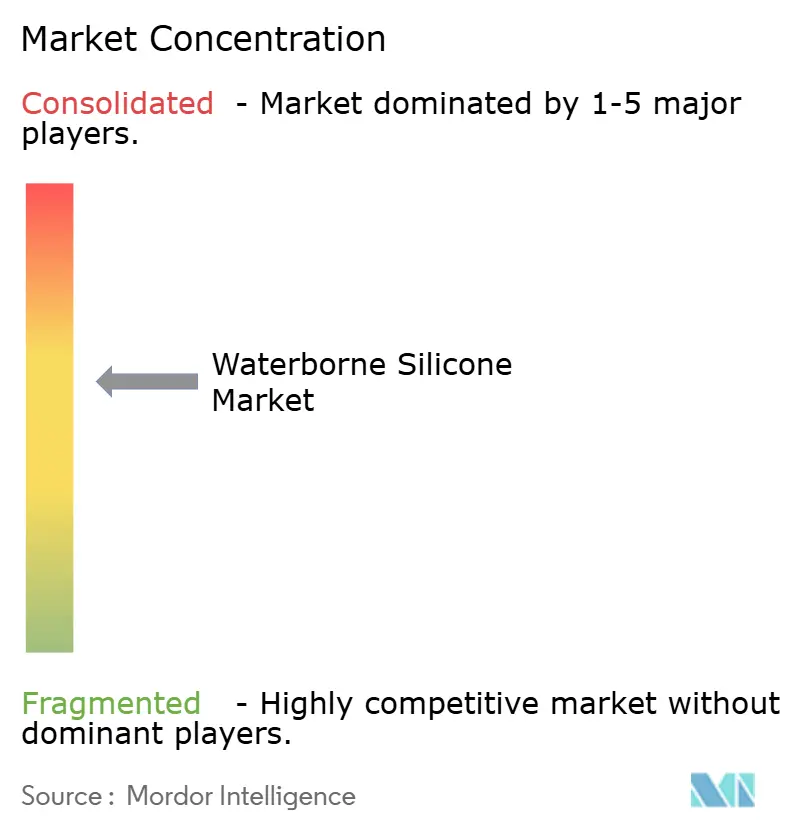
The waterborne silicone market is moderately concentrated, with the top five players including Dow, Wacker Chemie AG, Momentive, Shin-Etsu Chemical Co., Ltd., and Elkem ASA. BRB International B.V., DyStar Singapore Pte Ltd, Evonik Industries AG, KCC CORPORATION, and Siltech Corporation serve specialized applications and distribution channels. Control of siloxane supply supports cost management and formulation development. This advantage is difficult for downstream-only formulators to match. Product qualification, application testing, and local supply also influence supplier selection. These factors keep competition in the waterborne silicone market centered on performance and supply reliability rather than price alone.
Elkem ASA announced an agreement in February 2026 to sell most of its Silicones division to Bluestar, its largest shareholder. The transaction includes a silicone supply chain with 2025 sales volume of 443,000 metric tons. The deal changes ownership of capacity in China, France, and Norway. It may affect supply security and pricing decisions for customers in Western markets. Wacker Chemie AG's 2026 Panagarh expansion is another strategic move that strengthens the regional availability of certified silicone emulsions. BASF's Dilovası production line is a further example of suppliers adding regional capacity for low-VOC dispersions.
Emulsifier-free waterborne platforms are an area of product differentiation. Shin-Etsu Chemical Co., Ltd.'s KRW-6000 Series provides rapid curing and silicone films without conventional emulsifiers. The phenyl-type KRW-6002 adds compatibility with organic resins and heat resistance up to 250 °C. Healthcare-grade formulations are also protected by long qualification periods and regulatory review. DyStar Singapore Pte Ltd became wholly owned by Zhejiang Longsheng Group in June 2025, following the acquisition of the remaining 37.57% stake. The ownership change could influence distribution and pricing for its Masil silicone-emulsions portfolio. Suppliers are also using formulation screening and predictive tools to reduce development time. These capabilities can help customers address migration behavior and compatibility issues in the waterborne silicone market.
Waterborne Silicone Industry Leaders
-
Dow
-
Wacker Chemie AG
-
Momentive
-
Shin-Etsu Chemical Co., Ltd.
-
Elkem ASA
- *Disclaimer: Major Players sorted in no particular order
Recent Industry Developments
- May 2026: Industrial Coatings and Dispersions (ICD) presented its PerformaSil water-based silicone emulsions and latexes at the American Coatings Show 2026. The portfolio supports the waterborne silicone market by providing water-repellent, weather-resistant solutions for architectural, roofing, façade, and protective coatings.
- March 2026: Wacker Chemie AG commissioned a new silicone-emulsion production complex at its Panagarh site in India, expanding its manufacturing capacity for Good Manufacturing Practice (GMP)-certified silicones used in cosmetics and personal care. The investment supports the waterborne silicone market by increasing regional supply capacity for silicone emulsions and meeting rising demand from personal-care manufacturers.
Global Waterborne Silicone Market Report Scope
Waterborne silicones are silicone-based formulations dispersed or emulsified in water to provide properties such as flexibility, water repellency, surface modification, and thermal stability. They offer an alternative to solvent-based silicone systems by reducing reliance on organic solvents in various industrial and consumer applications.
The Waterborne Silicone Market is segmented by type, application, end-use industry, and geography. By type, the market is segmented into emulsions, dispersions, gels, and other types. By application, the market is segmented into paints and coatings, adhesives and sealants, personal care, and other applications. By end-use industry, the market is segmented into construction, automotive, healthcare, consumer goods, industrial, and other end-use industries. The report also covers the market size and forecasts for waterborne silicone across 15 countries. For each segment, the market sizing and forecasts have been done on the basis of value (USD).
| Emulsions |
| Dispersions |
| Gels |
| Other Types |
| Paints and Coatings |
| Adhesives and Sealants |
| Personal Care |
| Other Applications |
| Construction |
| Automotive |
| Healthcare |
| Consumer Goods |
| Industrial |
| Other End-Use Industries |
| Asia-Pacific | China |
| India | |
| Japan | |
| South Korea | |
| ASEAN Countries | |
| Rest of Asia-Pacific | |
| North America | United States |
| Canada | |
| Mexico | |
| Europe | Germany |
| United Kingdom | |
| France | |
| Italy | |
| NORDIC Countries | |
| Rest of Europe | |
| South America | Brazil |
| Argentina | |
| Rest of South America | |
| Middle East and Africa | Saudi Arabia |
| South Africa | |
| Rest of Middle East and Africa |
| By Type | Emulsions | |
| Dispersions | ||
| Gels | ||
| Other Types | ||
| By Application | Paints and Coatings | |
| Adhesives and Sealants | ||
| Personal Care | ||
| Other Applications | ||
| By End-Use Industry | Construction | |
| Automotive | ||
| Healthcare | ||
| Consumer Goods | ||
| Industrial | ||
| Other End-Use Industries | ||
| By Geography | Asia-Pacific | China |
| India | ||
| Japan | ||
| South Korea | ||
| ASEAN Countries | ||
| Rest of Asia-Pacific | ||
| North America | United States | |
| Canada | ||
| Mexico | ||
| Europe | Germany | |
| United Kingdom | ||
| France | ||
| Italy | ||
| NORDIC Countries | ||
| Rest of Europe | ||
| South America | Brazil | |
| Argentina | ||
| Rest of South America | ||
| Middle East and Africa | Saudi Arabia | |
| South Africa | ||
| Rest of Middle East and Africa | ||
Key Questions Answered in the Report
What is the size of the waterborne silicone market?
The waterborne silicone market size was valued at USD 1.75 billion in 2026 and is estimated to grow from USD 1.87 billion in 2027 to reach USD 2.64 billion by 2032, at a CAGR of 7.17% during the forecast period (2027-2032).
What is driving demand for waterborne silicone products?
VOC rules, infrastructure investment, and demand for durable protective materials in automotive and electronics applications support adoption.
Which product type leads waterborne silicone demand?
Emulsions led with a 42.18% share in 2026 and are projected to advance at a 7.85% CAGR through 2032.
Which application is projected to advance fastest through 2032?
Paints and coatings are projected to advance at an 8.10% CAGR through 2032.