
Vitrimer Resins Market Size and Share
Market Overview
| Study Period | 2022 - 2032 |
|---|---|
| Market Size (2027) | USD 41.73 Million |
| Market Size (2032) | USD 102.47 Million |
| Growth Rate (2027 - 2032) | 19.68 % |
| Fastest Growing Market | Asia-Pacific |
| Largest Market | Europe |
| Market Concentration | Medium |
Major Players *Disclaimer: Major Players sorted in no particular order Image © Mordor Intelligence. Reuse requires attribution under CC BY 4.0. | |
Vitrimer Resins Market Analysis by Mordor Intelligence
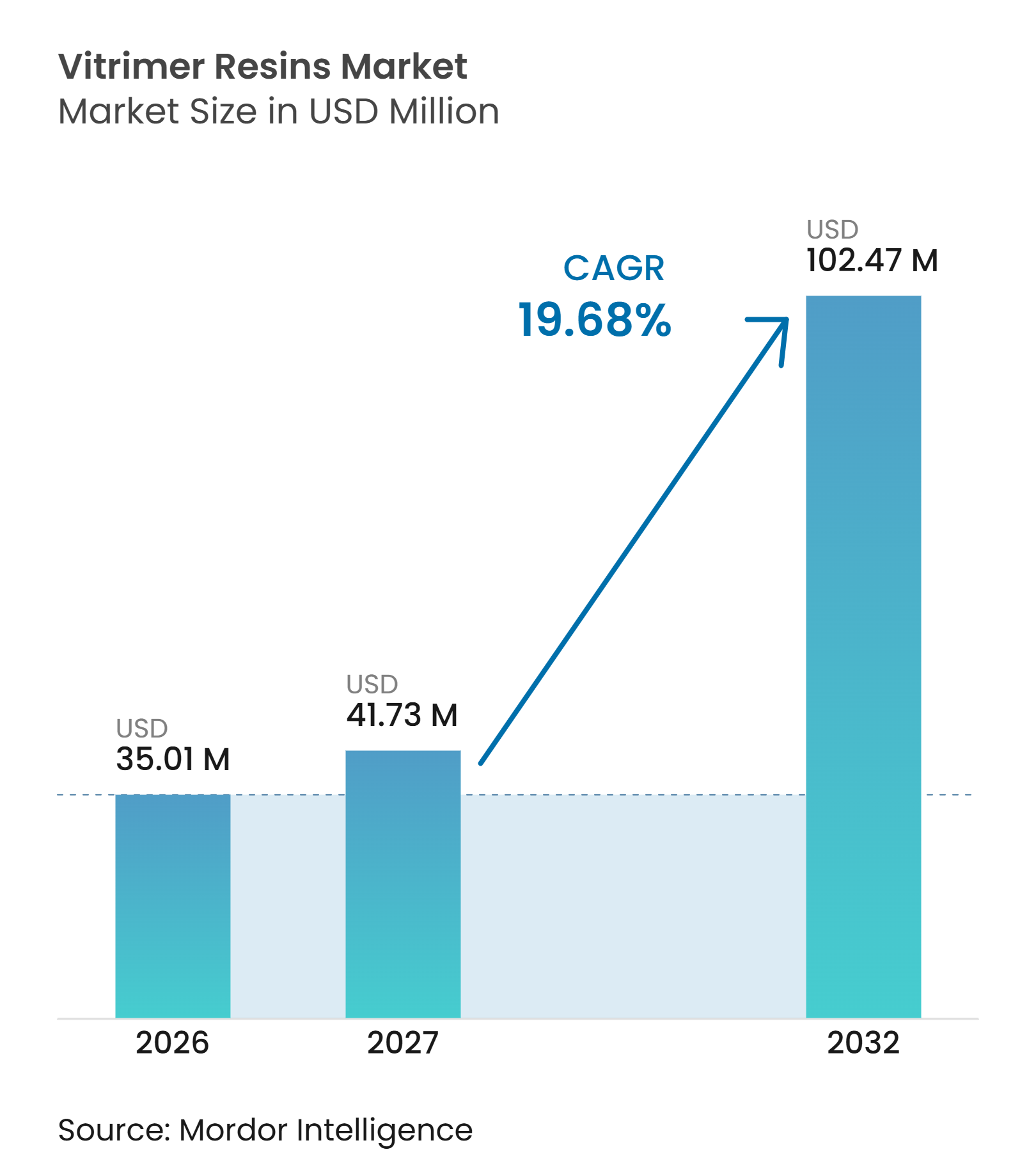
The Vitrimer Resins market size was valued at USD 35.01 million in 2026 and is estimated to grow from USD 41.73 million in 2027 to USD 102.47 million by 2032, at a CAGR of 19.68% during the forecast period (2027-2032). The vitrimer resins market is transitioning from material validation to initial commercial use, driven by manufacturer demand for composite materials that retain structural performance while offering a defined end-of-life recovery route. Recycling requirements for wind turbine blades represent the clearest near-term driver of demand, while broader circularity regulations are increasing the cost of relying on conventional thermoset composites. The value proposition extends beyond the resin itself, as recoverable glass and carbon fibers can be reused in subsequent manufacturing cycles. Suppliers compatible with established infusion, prepreg, and resin transfer molding processes are likely to face fewer barriers to adoption than those requiring a complete process redesign. Cost, application qualification requirements, and the lack of dedicated vitrimer test standards continue to limit the pace of adoption in safety-critical applications.
Key Report Takeaways
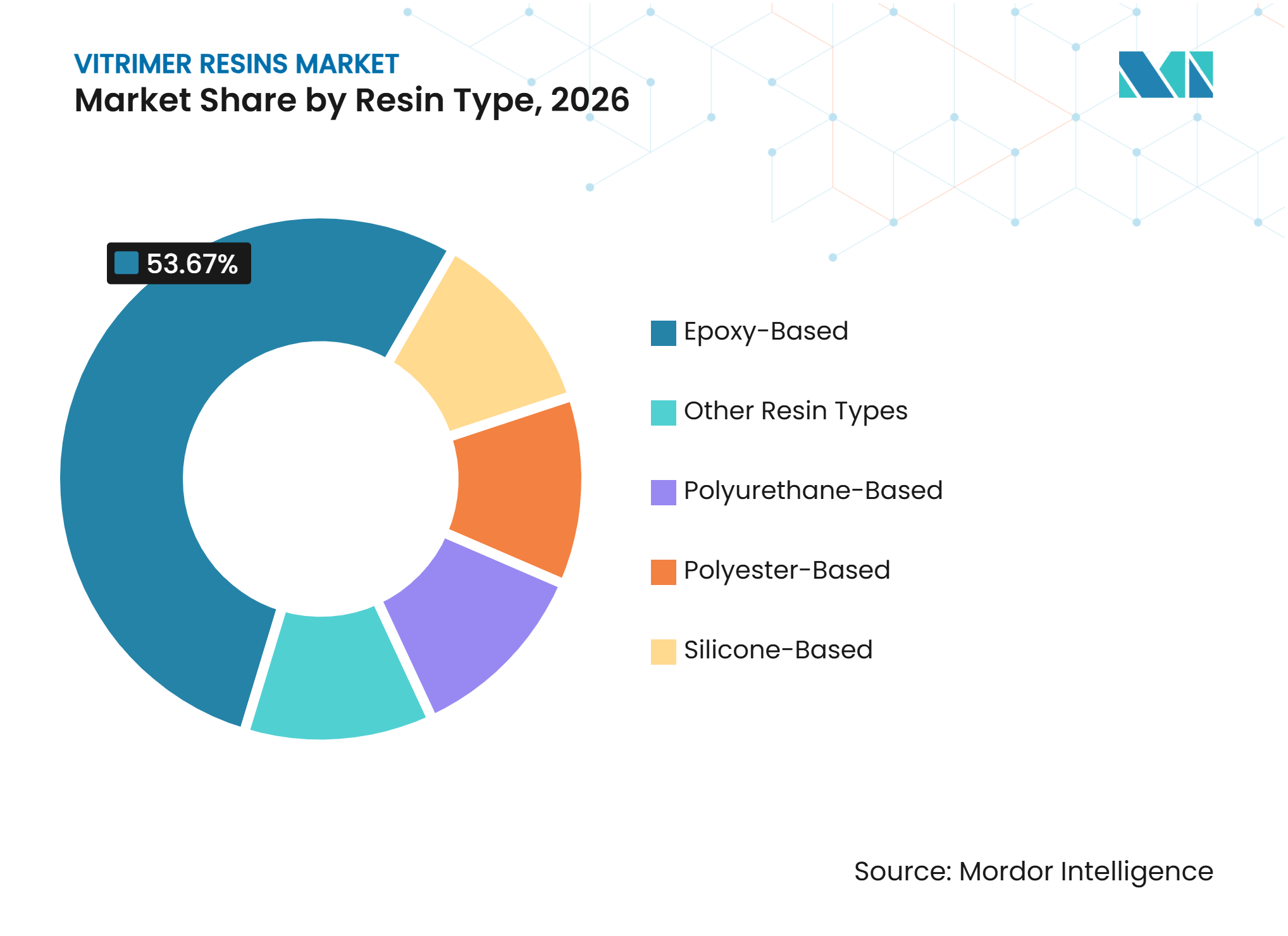
- By resin type, epoxy-based resins held 53.67% of the Vitrimer Resins market share in 2026, while polyurethane-based resins are forecast to grow at a CAGR of 20.14% through 2032.
- By processing form, liquid resin and hardener systems accounted for 62.45% of the Vitrimer Resins market share in 2026, while pultrusion resins are forecast to grow at a CAGR of 20.67% through 2032.
- By application, composites held 39.34% of the Vitrimer Resins market share in 2026, while coatings are forecast to grow at a CAGR of 21.85% through 2032.
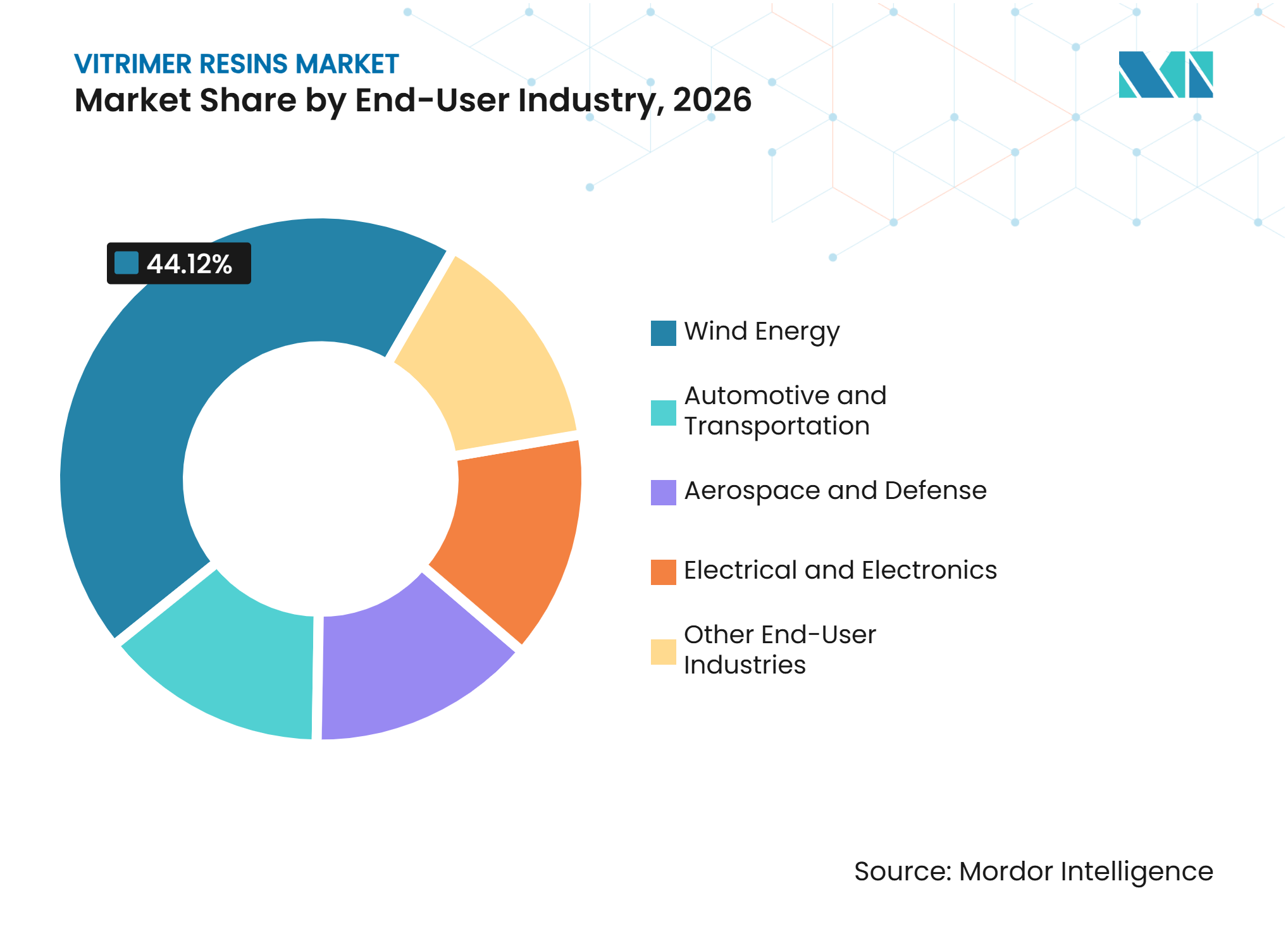
- By end-user industry, wind energy held 44.12% of the Vitrimer Resins market share in 2026, while automotive and transportation are forecast to grow at a CAGR of 22.71% through 2032.
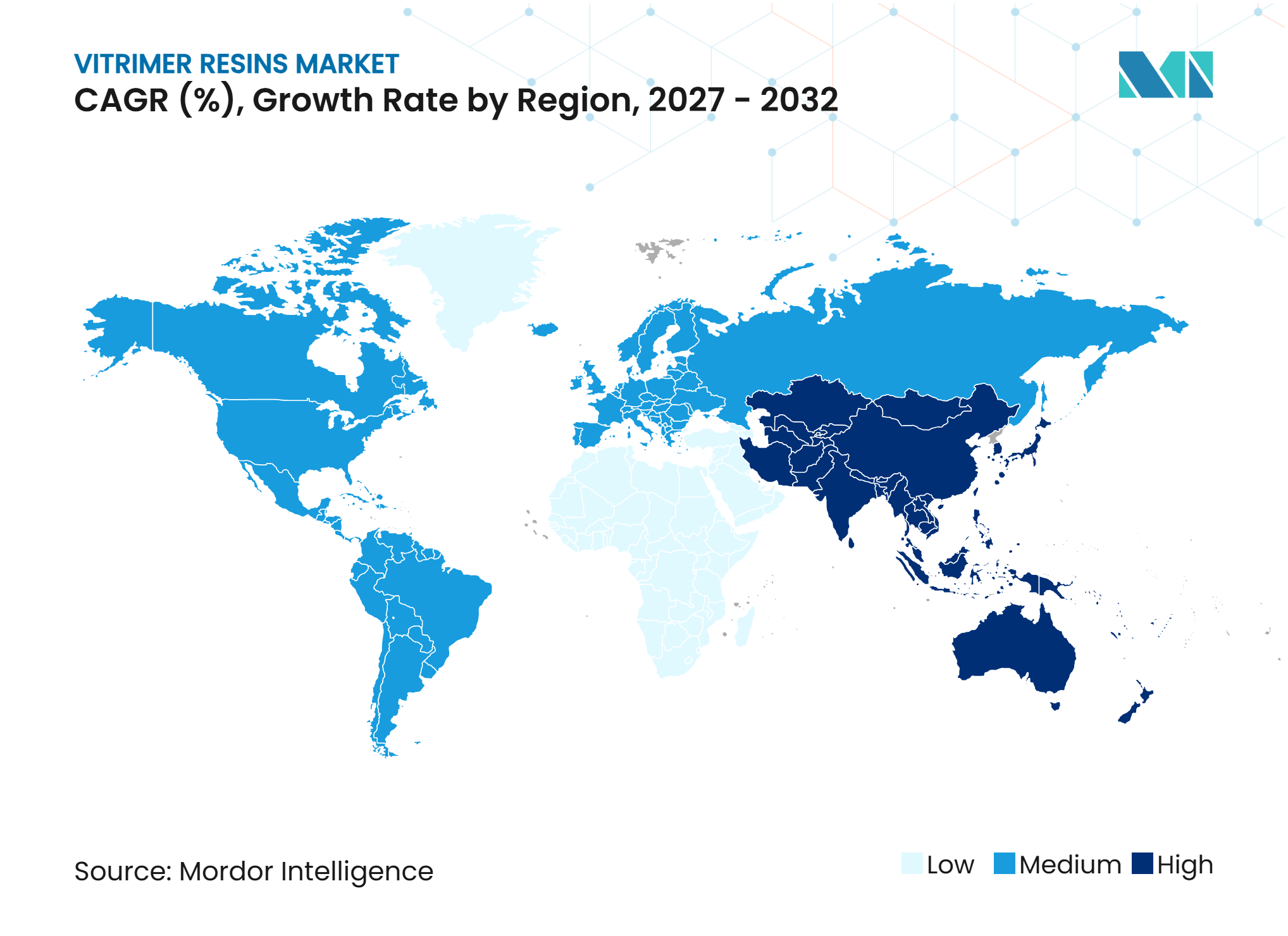
- By geography, Europe held 40.76% of the Vitrimer Resins market share in 2026, while Asia-Pacific is forecast to grow at a CAGR of 22.32% through 2032.
Note: Market numbers in this report are based on Mordor Intelligence's proprietary estimation framework, which combines nine months of actuals with Q4 projections for base year 2026.
Market Trends and Insights
Drivers Impact Analysis of Vitrimer Resins Market*
| Drivers | (~) % Impact on CAGR Forecast | Geographic Relevance | Impact Timeline |
|---|---|---|---|
| Wind Turbine Blade Recycling Requirements | +6.0% | Europe, Asia-Pacific (APAC) core markets, including China, India, and Taiwan, with spillover to North America | Short term (≤ 2 years) |
| Demand for Recoverable Carbon and Glass Fibers | +4.5% | Global, led by Europe and APAC | Medium term (2-4 years) |
| Circularity Requirements for Thermoset Composites | +3.5% | Europe primary, North America secondary | Medium term (2-4 years) |
| Adoption of Reprocessable Thermoset Manufacturing | +3.0% | Global, with early gains in Germany, the United Kingdom, Taiwan, and China | Short term (≤ 2 years) |
| Qualification Through Existing Composite Equipment | +2.0% | Global, particularly Europe and North America | Short term (≤ 2 years) |
| Source: Mordor Intelligence | |||
Wind Turbine Blade Recycling Requirements
End-of-life obligations for wind turbine blades are changing the commercial case for recyclable thermosets in the vitrimer resins market. WindEurope has called for a Europe-wide ban on landfilling decommissioned blades, placing greater emphasis on materials that support recovery rather than disposal. In August 2025, RWE's Sofia offshore wind farm in the United Kingdom began using RecyclableBlade technology at commercial scale. The project used 150 recyclable blades across 50 of the site's 100 turbines, supplied from Siemens Gamesa's Hull facility[1]. This deployment provides a practical procurement reference for recyclable resin systems in a large offshore project and strengthens the case for solutions that meet blade performance requirements without altering established manufacturing workflows.
Demand for Recoverable Carbon and Glass Fibers
The recoverability of reinforcement fibers provides the vitrimer resins market with an economic rationale that extends beyond resin disposal. Closed-loop systems can recover glass and carbon fibers for use in automotive parts, electrical housings, and consumer goods. A 2025 study reported that a vitrimer-based carbon-fiber composite retained more than 98% of carbon-fiber tensile strength and modulus after recycling, supporting repeat manufacture of the composite. This performance helps explain why recovered fiber can hold more value than shredded thermoset waste. The commercial benefit depends on reliable fiber quality, traceability, and a recycling process that can operate at industrial scale. As these conditions improve, resin suppliers can compete on both the quality of recovered material and the initial properties of the matrix.
Circularity Requirements for Thermoset Composites
European policy is extending circularity expectations across products that use durable composite materials. The Ecodesign for Sustainable Products Regulation work plan addresses sustainability requirements for selected product groups, including recyclability, recycled content, and product information. These requirements raise the importance of documented material recovery options for electrical equipment, automotive components, and other products that may fall within future product scopes. The European Composites Industry Association (EuCIA) has also highlighted the large amount of composite waste available for recycling in Europe relative to the limited level of current recycling activity. ISO 14021 and ISO 22450 provide buyers with recognized frameworks for assessing recycled-content claims and end-of-life product information. The vitrimer resins market therefore benefits when buyers require materials with a clear and certifiable recycling pathway.
Adoption of Reprocessable Thermoset Manufacturing
Reprocessable thermoset manufacturing can reduce material losses that arise during composite fabrication. Conventional thermoset operations can generate scrap that cannot be remolded into usable feedstock. Vitrimer prepregs and liquid systems can enable production waste to be recovered and remolded, improving raw material utilization. Mallinda launched Vitrimax VHM in January 2025 and stated that its commercial manufacturing had reached a 200-L reactor scale for 2.1-ton batches. Westlake Epoxy also introduced its EpoVIVE recyclable rotor blade technology, designed to operate on existing resin transfer molding, prepreg, and infusion lines. These developments place drop-in processing compatibility at the center of supplier selection in the vitrimer resins market.
Restraints Impact Analysis of Vitrimer Resins Market*
| Restraints | (~) % Impact on CAGR Forecast | Geographic Relevance | Impact Timeline |
|---|---|---|---|
| High Cost of Dynamic Hardeners and Specialty Precursors | -3.5% | Global, most acute in cost-sensitive APAC supply chains | Short term (≤ 2 years) |
| Qualification and Certification Cycles in Safety-Critical Applications | -2.5% | North America and Europe, especially aerospace and automotive structures | Long term (≥ 4 years) |
| Creep Near the Topology-Freezing Temperature | -1.0% | Global, relevant to structural aerospace and high-temperature uses | Medium term (2-4 years) |
| Source: Mordor Intelligence | |||
High Cost of Dynamic Hardeners and Specialty Precursors
Dynamic crosslinking chemistry depends on specialty components such as disulfide, imine, and boronic ester exchange networks. These inputs are produced in relatively limited quantities, which restricts supply competition and keeps prices above those of standard amine or anhydride curing agents. In 2025, Specific Polymers introduced an R&D formulation sales initiative for bio-sourced cystamine and disulfide-containing epoxy building blocks[2]. The offering supports laboratory and pilot work, but does not indicate commodity-scale availability. The price premium is significant in China and India, where large domestic epoxy capacity supports price-driven purchasing decisions. This makes cost reduction and scale-up necessary for the vitrimer resins market to displace conventional resin systems in applications without immediate regulatory pressure.
Qualification and Certification Cycles in Safety-Critical Applications
Aerospace and structural automotive applications offer high-value demand but require lengthy validation before materials can enter production. The TOSCA project, running from January 2025 through December 2027, is developing epoxy vitrimer processing chains for aerostructures, including automated fiber placement, curing, rework, and maintenance. While this work can provide a foundation for future qualifications, certification under European Union Aviation Safety Agency (EASA) or Federal Aviation Administration (FAA) requirements may extend well beyond project completion. A 2025 study found that epoxy vitrimer carbon-fiber laminates can achieve fracture toughness comparable to conventional epoxy composites while providing self-healing during mode-II crack growth. However, this material evidence does not eliminate the need for application-specific aging, durability, and safety data. The absence of dedicated ISO and ASTM tests for bond-exchange kinetics and topology-freezing temperature adds cost and time to each qualification package.
*Our forecasts treat driver/restraint impacts as directional, not additive. The impact forecasts reflect baseline growth, mix effects, and variable interactions.
Vitrimer Resins Market Segment Analysis
By Resin Type:
Epoxy Holds the Broadest Installed-Base AdvantageEpoxy-based formulations held 53.67% of the vitrimer resins market share in 2026. Their position reflects decades of industrial familiarity and a large installed base of composite equipment configured for epoxy processing. Epoxy vitrimers can use transesterification, disulfide exchange, and imine metathesis to adjust glass-transition temperature, exchange rate, and reprocessing conditions. This chemistry range allows formulators to modify performance without rebuilding the entire resin backbone. The TOSCA project is advancing epoxy vitrimer processing routes for aerospace structures, keeping epoxy visible in the qualification pipeline. The vitrimer resins market will continue to favor epoxy where manufacturers need a path that aligns with current equipment and established handling practices.
Polyurethane-based formulations are projected to grow at a 20.14% CAGR through 2032. Their opportunity comes from the established use of polyurethane in automotive parts, insulation, and footwear, where end-of-life recovery remains difficult. Research published in 2025 described polyurethane vitrimers with imine networks that achieved tensile strength and modulus competitive with thermosetting polyurethane while enabling chemical recycling and self-healing. Polyester-based vitrimers are drawing attention for bio-based formulations that can use polyethylene terephthalate (PET)-derived inputs. Silicone-based systems remain relevant to high-temperature electronics and specialty coatings. These smaller resin families give customers more options when epoxy cannot meet temperature, flexibility, or feedstock requirements. Their adoption will depend on the same cost, certification, and process-fit factors that shape the wider vitrimer resins market.



By Processing Form:
Liquid Systems Lead While Pultrusion Expands Structural UsesLiquid resin and hardener systems accounted for 62.45% of the vitrimer resins market share in 2026. Liquid infusion and hand-layup methods remain widely used in wind blade production, the largest current application for these materials. These systems offer a direct entry point because they fit existing plant layouts and operating methods. Liquid infusion resins are also relevant to large wind blades and marine structures that use vacuum-assisted resin infusion. The process form is therefore closely linked to the commercial adoption of recyclable blade systems. Suppliers that can demonstrate stable flow, cure behavior, and material recovery on current lines can lower the switching burden for blade manufacturers.
Pultrusion resins are projected to expand at a 20.67% CAGR through 2032, the fastest rate among processing forms. Continuous-fiber vitrimer profiles are being assessed for construction products, infrastructure profiles, and wind blade spar caps. A 2025 review noted that vitrimer pultrusion could support lightweight structural products designed for circularity, although curing kinetics and die design still require optimization. ATSP Innovations is evaluating vitrimer processing across compression molding, pultrusion, infusion, and prepreg routes. This work indicates that use cases may extend beyond liquid systems as manufacturers validate consistent output. It also preserves an opening for suppliers that can address the combination of rapid curing, structural performance, and reprocessability required for continuous production.
By Application:
Composites Provide Current Output While Coatings Gain MomentumComposites accounted for 39.34% of the vitrimer resins market share in 2026. Wind blades, aerospace structures, and automotive panels provide the most direct applications for materials that combine repairability and recyclability. ISOVOLTA has developed glass-fiber vitrimer prepreg sheets for electrical insulation and aerospace interior panels, demonstrating how a supplier can translate resin development into application-specific products. The application case is strongest where composite waste is costly or difficult to manage, and where a repair option can preserve the service life of a high-value part. These conditions make composites the primary output base of the vitrimer resins market even as suppliers enter related product categories.
Coatings are forecast to grow at a 21.85% CAGR through 2032. The U.S. Department of Energy VitriEdge project has assessed Mallinda's Vitrimax T130 for wind turbine blade leading-edge erosion repair. Research published in 2026 described healable coating approaches for repairing erosion damage in wind energy applications. A coating that can be reactivated by focused heating could reduce blade maintenance needs and extend asset life. Adhesives and sealants also benefit from reversible vitrimer chemistry. Huntsman introduced a reformulated ARALDITE epoxy adhesive range in September 2025 that removed intentionally added bisphenol A (BPA) and substances classified as Carcinogenic, Mutagenic, or Reprotoxic (CMR) under EU Classification, Labeling and Packaging (CLP) regulation. These adjacent applications provide the vitrimer resins market with additional routes to commercialization that do not require full qualification of structural components.
By End-User Industry:
Wind Energy Leads While Automotive and Transportation Grow FastestWind energy held 44.12% of the vitrimer resins market share in 2026. Large composite blades create a clear need for material recovery because conventional blade disposal remains difficult. The Sofia project demonstrated commercial deployment of recyclable rotor blades at an operating offshore wind farm. Wind projects also rely on repeatable manufacturing, which makes process-compatible resin systems particularly attractive. As decommissioning quantities increase, recycling infrastructure and resin design will need to evolve together. This relationship leaves wind energy as the primary output anchor for the vitrimer resins market.
Automotive and transportation are projected to grow at a 22.71% CAGR through 2032. Original Equipment Manufacturer (OEM) carbon-footprint commitments, updates to European end-of-life vehicle policy, and lightweighting needs for electric vehicles are increasing attention on recyclable structural composites. A 2025 study reported imine-based vitrimer composites with a tensile strength of 48.5 MPa and a Young's modulus of 1.83 GPa, while retaining more than 98% of their properties in a closed-loop process. Aerospace and defense remain slower-moving but valuable opportunities due to stringent qualification requirements. Electrical and electronic applications can draw on vitrimer performance for high-voltage insulation, where repairability may offer a distinct advantage. These end uses diversify demand, but they will not reduce the importance of qualification cycles in the vitrimer resins market.

Geography Analysis
Europe
Europe held 40.76% of the vitrimer resins market share in 2026. The region benefits from regulatory pressure, established wind manufacturing capability, and active materials development. The EU Ecodesign for Sustainable Products Regulation work plan incorporates recyclability, recycled content, and product information into a broader product-policy framework. WindEurope's support for restricting the landfilling of blades adds further pressure to improve end-of-life routes for composite structures. In August 2025, RWE and Siemens Gamesa installed recyclable blades at the Sofia offshore wind farm in United Kingdom waters. Specific Polymers in France and ISOVOLTA in Austria reflect the region's activity in dynamic building blocks and vitrimer prepregs. EuCIA's European Circular Composites Alliance is seeking dedicated waste codes and policy support for recycled composite materials. These compliance factors give Europe an advantage in establishing the rules and reference projects that shape resin procurement.
Asia-Pacific
Asia-Pacific is expected to record a 22.32% CAGR from 2027 to 2032. China could retire more than 30,000 turbines by 2030, representing 44.73 GW of capacity and an estimated 947,900 metric tons of wind-related solid waste. This prospective waste stream makes blade recovery both a resource-management issue and a sustainability commitment. In 2025, SWANCOR and Adani New Industries signed an MOU for a proposed recyclable wind farm in India. The agreement covers certification, testing, and recycling technology services. The initiative could connect Taiwan-origin technology for recyclable resin to India's wind energy expansion. Mitsubishi Chemical Group also received International Sustainability and Carbon Certification (ISCC) for its BiOpreg plant-derived resin prepreg in February 2025, signaling demand for certified composite materials in the region. The vitrimer resins market size in Asia-Pacific will depend on whether recovery services, recognized certification, and local manufacturing capacity advance in tandem.
North America, South America, and the Middle East and Africa
North America represents an early commercial and research market for vitrimer resins. Westlake Epoxy introduced its EpoVIVE portfolio in 2025, focusing on recyclable composite solutions for wind and other applications. Mallinda's January 2025 commercial launch of Vitrimax VHM positions it as a dedicated vitrimer supplier near automotive and unmanned aircraft supply chains. South America remains at an earlier stage, although Brazil and Argentina have growing wind sectors that could face blade end-of-life requirements as decommissioning quantities rise. The Middle East and Africa are linked to Saudi Arabia's Vision 2030 clean-energy buildout and South Africa's growing wind portfolio. Current quantities remain smaller than in Europe and Asia-Pacific. The vitrimer resins market share in these regions will be shaped by whether renewable-energy procurement includes end-of-life requirements and recovery infrastructure from the outset.
Competitive Landscape
Market Concentration
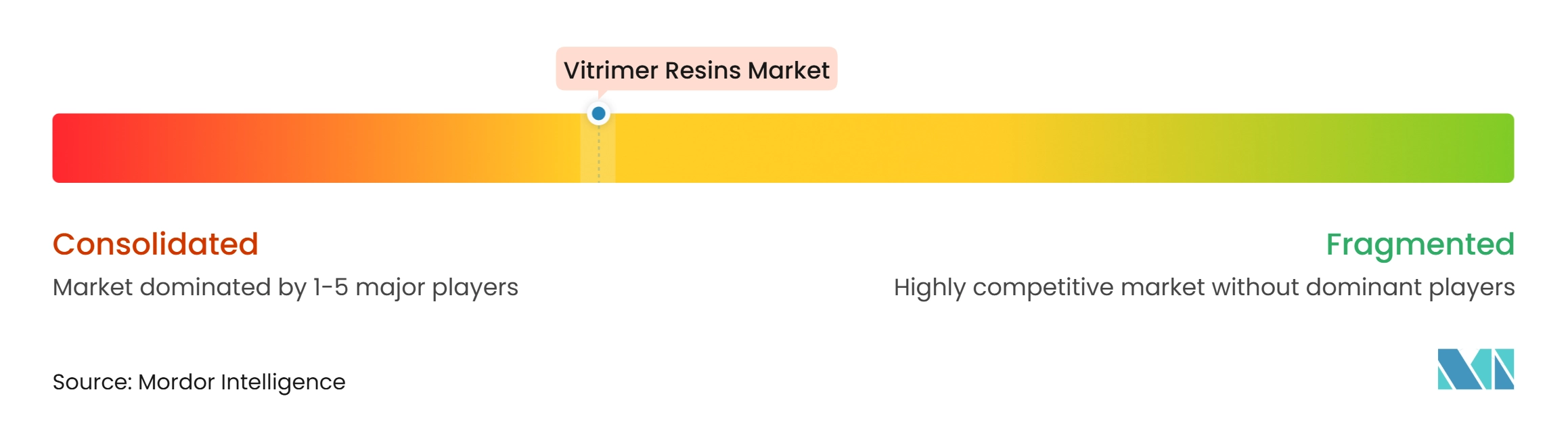
The vitrimer resins market is moderately consolidated. Mallinda, ATSP Innovations, and Specific Polymers hold proprietary dynamic-chemistry approaches but operate at a smaller scale than large chemical suppliers. Competition among these players centers on processing behavior, fiber recovery, and the ability to tailor resins for specific applications. In wind applications, SWANCOR has established a strong commercial reference through the Sofia deployment with RWE and Siemens Gamesa. Aditya Birla Chemicals has also developed recyclable epoxy systems compatible with established blade-production methods.
Westlake Corporation, Covestro, and Huntsman are expanding their existing product portfolios rather than committing exclusively to dedicated vitrimer platforms. Westlake Epoxy's EpoVIVE portfolio addresses the demand for recyclable composites while maintaining compatibility with established processing methods. Huntsman's September 2025 ARALDITE launch removed intentionally added BPA and CMR-classified substances from selected adhesive grades, aligning product reformulation with European chemical requirements. ISOVOLTA has developed application-specific capabilities in vitrimer prepregs following its 2022 acquisition of Gurit's aerospace prepreg business. Its focus on electrical insulation and aerospace interiors reduces direct competition with broad-scale resin suppliers by tying the material to customer qualification requirements.
Opportunities remain in pultrusion vitrimer systems, wind blade leading-edge coatings, and hydrogen pressure-vessel liners, with no supplier having established a scaled position across these applications. CRRC's internal work on the chemistry of recyclable blade resin suggests that vertically integrated end users may want more control over qualification timing. Mallinda's August 2026 patent for vitrimer compositions with adjustable viscosity, pot life, and flame retardancy illustrates how pure-play suppliers are using intellectual property to differentiate their offerings.
Vitrimer Resins Industry Leaders
-
SWANCOR ADVANCED MATERIALS CO., LTD.
-
Aditya Birla Chemicals Ltd.
-
MALLINDA
-
Huntsman International LLC
-
Westlake Corporation
- *Disclaimer: Major Players sorted in no particular order
Vitrimer Resins Market Companies Covered in this Report
- Aditya Birla Chemicals Ltd.
- Arkema
- ATSP Innovations
- BASF
- Covestro AG
- CRRC Corporation Limited
- Gurit Holding AG
- Huntsman International LLC
- ISOVOLTA AG
- MALLINDA
- Mitsubishi Chemical Corporation
- Siemens Gamesa Renewable Energy, S.A.U.
- Specific Polymers
- SWANCOR ADVANCED MATERIALS CO., LTD.
- Westlake Corporation
Recent Industry Developments in Vitrimer Resins Market
- September 2026: CRRC Corporation Ltd. (Times New Material) completed a 110-meter wind turbine blade in Sheyang, Jiangsu Province, using vitrimer resins with reversible chemical bonds that enable a debondable infusion process, achieving greater than 95% recovery of key raw materials. The blade is targeted at high-capacity offshore turbines, supporting Corporate Sustainability Reporting Directive (CSRD)-aligned reporting for international markets.
- September 2025: Huntsman Advanced Materials launched a reformulated range of ARALDITE epoxy adhesives, free from intentionally added BPA and CMR-classified substances, in accordance with the EU's CLP regulation. Initial availability covered six ARALDITE product grades in Europe, with additional products launched from October 2025.
Global Vitrimer Resins Market Report Scope
Vitrimers are a class of polymers that combine the mechanical and chemical robustness of traditional thermosets with the reprocessability and reshaping capabilities of thermoplastics. Unlike conventional thermosets, which are permanently cross-linked and cannot be reprocessed after curing, vitrimers contain dynamic covalent bonds that allow the polymer network to rearrange under specific conditions, such as elevated temperature, while maintaining its integrity.
The vitrimer resins market is segmented by resin type, processing form, application, end-user industry, and geography. By resin type, the market is segmented into epoxy-based, polyurethane-based, polyester-based, silicone-based, and other resin types. By processing form, the market is segmented into liquid resin and hardener systems, liquid infusion resins, pultrusion resins, and others. By application, the market is segmented into composites, adhesives and sealants, coatings, and other applications. By end-user industry, the market is segmented into automotive and transportation, aerospace and defense, wind energy, electrical and electronics, and other end-user industries. The report also covers market sizes and forecasts for the vitrimer resins across 15 countries in major regions. The market sizes and forecasts are provided in terms of value (USD).
Segmentation Overview
| Epoxy-Based |
| Polyurethane-Based |
| Polyester-Based |
| Silicone-Based |
| Other Resin Types |
| Liquid Resin and Hardener Systems |
| Liquid Infusion Resins |
| Pultrusion Resins |
| Others |
| Composites |
| Adhesives and Sealants |
| Coatings |
| Other Applications |
| Automotive and Transportation |
| Aerospace and Defense |
| Wind Energy |
| Electrical and Electronics |
| Other End-User Industries |
| Asia-Pacific | China |
| India | |
| Japan | |
| South Korea | |
| ASEAN Countries | |
| Rest of Asia-Pacific | |
| North America | United States |
| Canada | |
| Mexico | |
| Europe | Germany |
| United Kingdom | |
| France | |
| Italy | |
| NORDIC Countries | |
| Rest of Europe | |
| South America | Brazil |
| Argentina | |
| Rest of South America | |
| Middle East and Africa | Saudi Arabia |
| South Africa | |
| Rest of Middle East and Africa |
| By Resin Type | Epoxy-Based | |
| Polyurethane-Based | ||
| Polyester-Based | ||
| Silicone-Based | ||
| Other Resin Types | ||
| By Processing Form | Liquid Resin and Hardener Systems | |
| Liquid Infusion Resins | ||
| Pultrusion Resins | ||
| Others | ||
| By Application | Composites | |
| Adhesives and Sealants | ||
| Coatings | ||
| Other Applications | ||
| By End-User Industry | Automotive and Transportation | |
| Aerospace and Defense | ||
| Wind Energy | ||
| Electrical and Electronics | ||
| Other End-User Industries | ||
| By Geography | Asia-Pacific | China |
| India | ||
| Japan | ||
| South Korea | ||
| ASEAN Countries | ||
| Rest of Asia-Pacific | ||
| North America | United States | |
| Canada | ||
| Mexico | ||
| Europe | Germany | |
| United Kingdom | ||
| France | ||
| Italy | ||
| NORDIC Countries | ||
| Rest of Europe | ||
| South America | Brazil | |
| Argentina | ||
| Rest of South America | ||
| Middle East and Africa | Saudi Arabia | |
| South Africa | ||
| Rest of Middle East and Africa | ||
Key Questions Answered in the Report
What is current market size of Vitrimer Resins Market?
The Vitrimer Resins market size was valued at USD 35.01 million in 2026 and is estimated to grow from USD 41.73 million in 2027 to USD 102.47 million by 2032, at a CAGR of 19.68% during the forecast period (2027-2032).
Which processing form is growing fastest for vitrimer resins?
Pultrusion resins are forecast to expand at a 20.67% CAGR through 2032 as continuous-fiber applications develop.
Which application is expected to grow fastest?
Coatings are projected to record a 21.85% CAGR through 2032, supported by potential use in wind blade erosion repair.
Which region is expected to grow the fastest?
Asia-Pacific is expected to expand at a 22.32% CAGR through 2032, supported by wind-turbine decommissioning needs and regional initiatives for recyclable materials.