
Vietnam Third-party Logistics Market Size and Share
Market Overview
| Study Period | 2021 - 2032 |
|---|---|
| Forecast Data Period | 2027 - 2032 |
| Base Year Market Size (2026) | USD 4.74 Billion |
| Market Size (2027) | USD 5.11 Billion |
| Market Size (2032) | USD 7.37 Billion |
| Growth Rate (2027 - 2032) | 7.59 % |
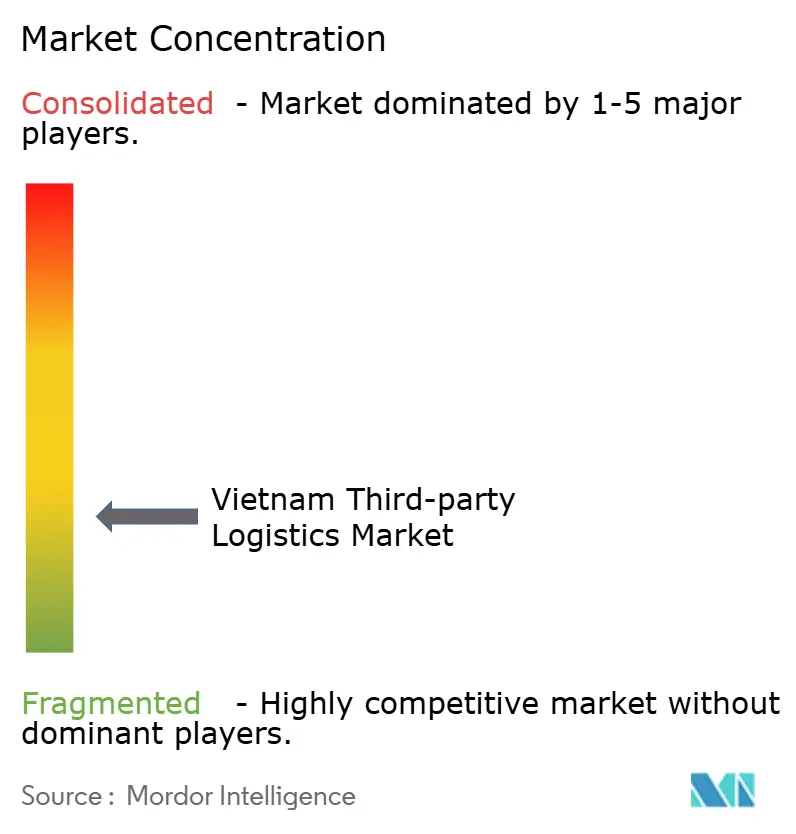
| Market Concentration | Low |
Major Players *Disclaimer: Major Players sorted in no particular order Image © Mordor Intelligence. Reuse requires attribution under CC BY 4.0. | |
Vietnam Third-party Logistics Market Analysis by Mordor Intelligence
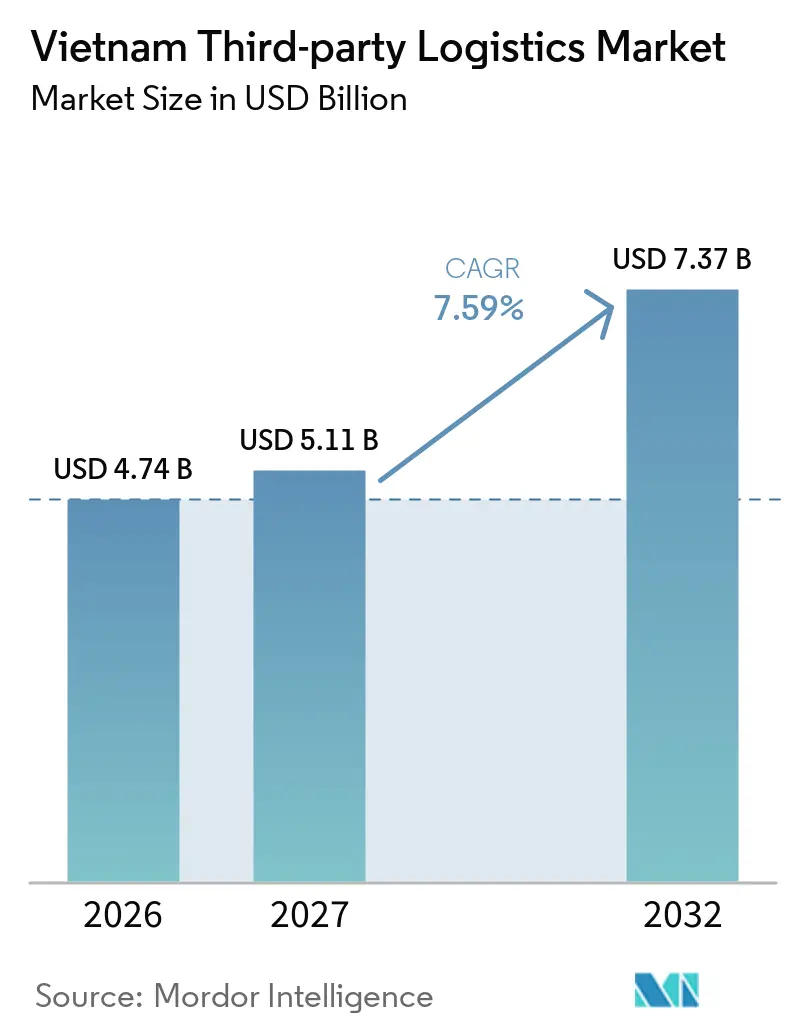
The Vietnam third-party logistics market was valued at USD 4.74 billion in 2026 and is estimated to reach USD 5.11 billion in 2027 and USD 7.37 billion by 2032, registering a CAGR of 7.59% during 2027–2032.
Manufacturing investment, international trade, and the expansion of e-commerce are supporting demand for outsourced transportation, warehousing, freight forwarding, and distribution services. Logistics providers are increasingly combining these services to manage shipments across factories, distribution centers, border crossings, and seaports. As supply chains become more complex, service reliability, shipment visibility, and the ability to coordinate multiple transport modes are becoming important competitive factors. These conditions are supporting demand for integrated logistics services alongside conventional freight transportation.
Key Report Takeaways
- By service, domestic transportation management accounted for 62.45% of the Vietnam third-party logistics market share in 2026, while value-added warehousing and distribution is projected to register a CAGR of 9.26% during 2027–2032.
- By end-use application, manufacturing accounted for 36.87% of the Vietnam third-party logistics market size in 2026, while retail and e-commerce are projected to register a CAGR of 8.98% during 2027–2032.
- By logistics model, asset-light accounted for 46.23% of the Vietnam third-party logistics market share in 2026, while hybrid is projected to register a CAGR of 9.13% during 2027–2032.
- By geography, Southern Vietnam accounted for 46.13% of the Vietnam third-party logistics market size in 2026, while Northern Vietnam is projected to register a CAGR of 8.34% during 2027–2032.
Note: Market numbers in this report are based on Mordor Intelligence's proprietary estimation framework, which combines nine months of actuals with Q4 projections for base year 2026.
Vietnam Third-party Logistics Market Trends and Insights
Drivers Impact Analysis*
| Driver | (~) % Impact on CAGR Forecast | Geographic Relevance | Impact Timeline |
|---|---|---|---|
| Export Manufacturing Growth Increasing Integrated Logistics Demand | +1.8% | National, particularly northern and southern industrial corridors | Medium term (2–4 years) |
| E-commerce Expansion Accelerating Fulfillment and Delivery Outsourcing | +1.5% | National, particularly Ho Chi Minh City, Hanoi, and Da Nang | Short term (up to 2 years) |
| Digital Customs Improving Cross-Border Logistics Integration Efficiency | +0.9% | National, including Lao Cai, Lang Son, and Mong Cai | Medium term (2–4 years) |
| Enterprise Outsourcing Expanding Warehousing and Transport Demand | +0.8% | Industrial areas in Binh Duong, Dong Nai, and Hung Yen | Medium term (2–4 years) |
| Cold-Chain Requirements Increasing Specialized Logistics Service Adoption | +0.7% | Southern Vietnam and the Mekong Delta, with opportunities in Central Vietnam | Long term (4 years or more) |
| Energy Projects Driving Complex Project Logistics Requirements | +0.5% | National, particularly central coastal and northern provinces | Long term (4 years or more) |
| Source: Mordor Intelligence | |||
Export Manufacturing Growth Increasing Integrated Logistics Demand
Manufacturing investment is supporting demand for outsourced logistics across Vietnam. The National Statistics Office reported that realized foreign direct investment (FDI) reached USD 27.62 billion in 2025, with manufacturing and processing accounting for 82.8% of disbursed FDI[1]. These investments generate demand for inbound raw-material transportation, factory-side logistics, inventory management, and export distribution. Electronics, machinery, automotive components, and other manufactured goods may require coordinated transport, specialized handling, and reliable connections to airports and seaports. The market therefore benefits from providers that can combine domestic transportation with warehousing, customs coordination, and international freight services.
E-commerce Expansion Accelerating Fulfillment and Delivery Outsourcing
Vietnam's expanding e-commerce sector is creating demand for order fulfillment, inventory management, parcel distribution, and returns handling. Vietnam’s online retail market continues to expand rapidly, reflecting stronger consumer adoption of digital shopping channels and rising demand for faster, more reliable fulfilment[2]. This growth is increasing the need for scalable warehousing, last-mile delivery, and technology-enabled logistics networks across the country. As online transactions expand, retailers and marketplace sellers need logistics networks capable of processing smaller orders, handling changing demand, and delivering to customers across urban and regional markets. These requirements support the use of outsourced fulfillment centers, transport networks, and distribution services.
Digital Customs Improving Cross-Border Logistics Integration Efficiency
Vietnam's customs modernization program is creating opportunities to improve cross-border shipment processing. On June 1, 2026, the customs authorities began piloting a centralized clearance model at Customs Sub-Department Region III in Hai Phong[3]. The pilot includes digital handling of customs documentation and aims to streamline the processing of import and export shipments. More standardized document submission can help logistics providers coordinate customs procedures with transportation schedules and reduce avoidable administrative handling.
Enterprise Outsourcing Expanding Warehousing and Transport Demand
Manufacturers, retailers, and importers can use 3PL providers to access transportation networks and warehouse capacity without developing and managing all the required infrastructure themselves. Outsourcing can be particularly useful for companies entering new regions, managing seasonal demand, or serving several production and distribution locations. Providers that combine storage, inventory management, domestic transport, and freight forwarding can simplify coordination across the supply chain.
Restraints Impact Analysis*
| Restraint | (~) % Impact on CAGR Forecast | Geographic Relevance | Impact Timeline |
|---|---|---|---|
| Fragmented Transport Networks Reducing Service Consistency and Scale | -1.2% | National, particularly interprovincial routes in Central Vietnam and the Mekong Delta | Medium term (2–4 years) |
| Skilled Labor Shortages Constraining Logistics Technology Adoption | -1.0% | National, particularly Hai Phong and the northern industrial corridor | Short term (up to 2 years) |
| Inland Bottlenecks Disrupting Multimodal Logistics Network Efficiency | -0.8% | Hanoi–Hai Phong corridor and Cai Mep road connectivity | Medium term (2–4 years) |
| Compliance Costs Pressuring Smaller Logistics Service Providers | -0.5% | National, particularly smaller domestic operators | Short term (up to 2 years) |
| Source: Mordor Intelligence | |||
Fragmented Transport Networks Reducing Service Consistency and Scale
Vietnam's logistics network combines road, inland waterway, rail, air, and maritime transportation, but the availability and efficiency of connections differ by location. Gaps in supporting infrastructure, congestion around industrial areas, and uneven access to inland logistics facilities can increase travel times and complicate shipment planning. These conditions make it more difficult for 3PL providers to maintain consistent service levels across routes, particularly when shipments involve several transport modes or locations outside the main industrial corridors. The country's logistics costs were estimated at approximately 16–17% of GDP in the Vietnam Logistics Report 2025, highlighting the continuing importance of improving transport and supply-chain efficiency.
Skilled Labor Shortages Constraining Logistics Technology Adoption
The adoption of warehouse management systems, transport management systems, automated handling equipment, and digital customs tools requires workers who can operate these systems and respond to operational exceptions. Where suitably trained staff are difficult to recruit, logistics providers may face higher training costs, slower technology implementation, and inconsistent use of digital processes. These challenges can be more significant for smaller operators that have limited resources for employee development and systems integration.
*Our forecasts treat driver/restraint impacts as directional, not additive. The impact forecasts reflect baseline growth, mix effects, and variable interactions.
Segment Analysis
By Service: Domestic Transportation Management Leads While Value-Added Warehousing Expands
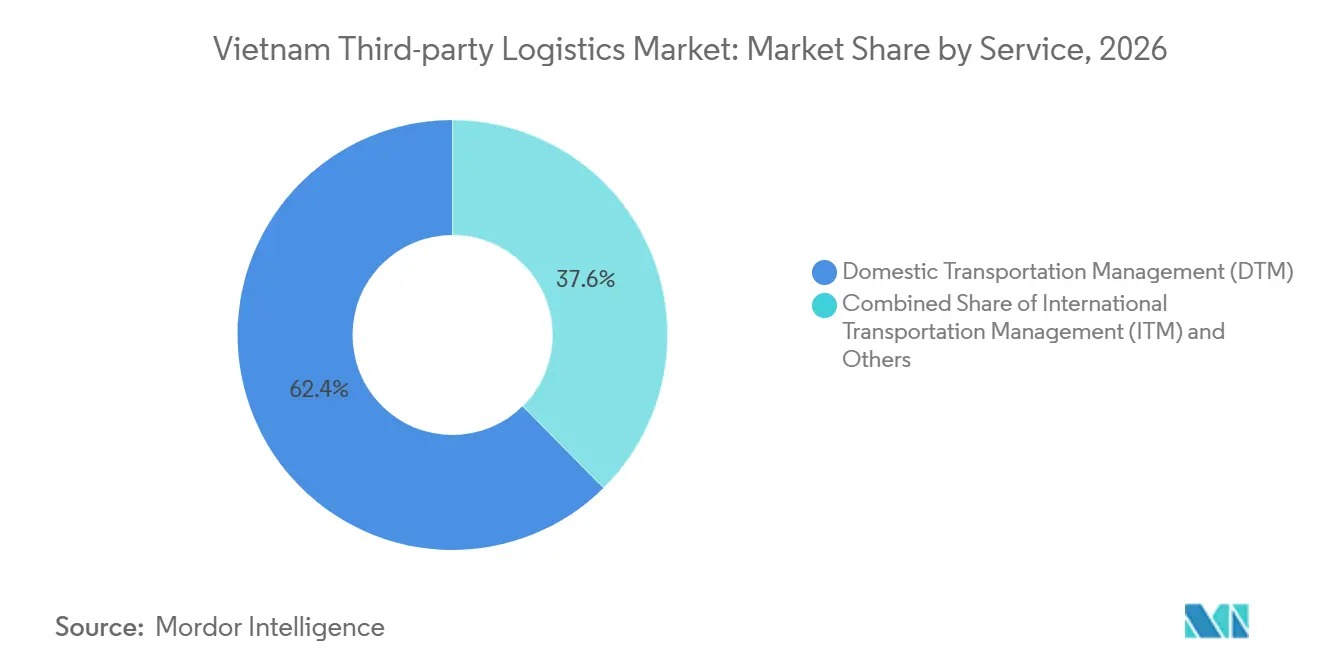
Domestic transportation management accounted for 62.45% of the Vietnam third-party logistics market share in 2026. Its leading position reflects the importance of moving goods between manufacturing facilities, suppliers, warehouses, distribution centers, and ports. Road transportation remains important for domestic freight movements, while international freight forwarding and customs coordination support cross-border supply chains. Businesses increasingly seek providers that can coordinate transport with inventory handling and distribution, particularly when goods pass through several facilities before reaching customers.
The value-added warehousing and distribution segment is projected to register at a CAGR of 9.26% during 2027–2032. Manufacturers and retailers require more than storage alone, creating opportunities for order picking, packing, labeling, inventory management, and distribution coordination. In September 2025, Kuehne+Nagel and the LEGO Group opened a regional distribution center in Dong Nai to support distribution across Asia-Pacific. The facility provides an example of how warehousing can be integrated with customs clearance, sea freight, and regional distribution services.

By End-Use Application: Manufacturing Leads While Retail and E-commerce Accelerate
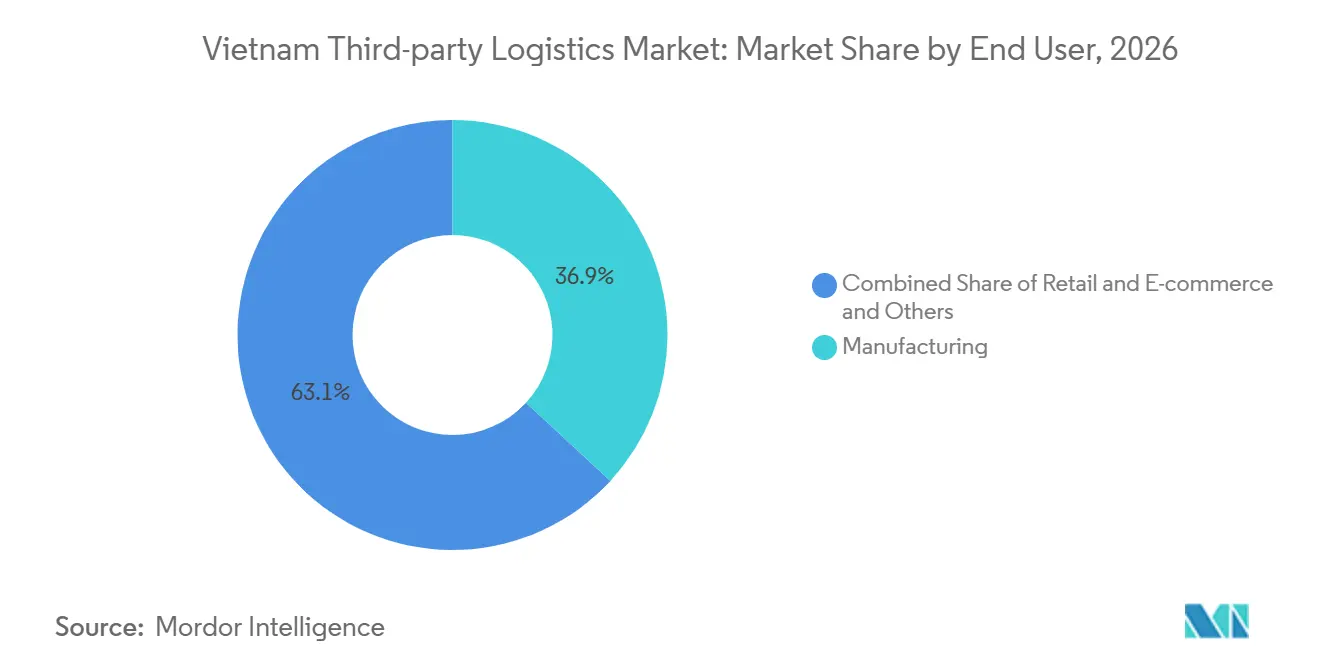
Manufacturing accounted for 36.87% of the Vietnam third-party logistics market size in 2026. The country's industrial base creates demand for inbound raw-material movements, production-related logistics, inventory storage, and finished-goods distribution. Industrial clusters in Southern and Northern Vietnam connect manufacturers with suppliers, domestic customers, and export gateways. Multinational manufacturers can use 3PL providers to coordinate logistics across multiple facilities and international trade lanes, while domestic producers can outsource transportation and warehousing to reduce operational complexity.
Retail and e-commerce are projected to register a CAGR of 8.98% during 2027–2032. Online retail growth supports demand for fulfillment facilities, inventory visibility, order processing, and last-mile distribution. Retailers and marketplace sellers require flexible logistics arrangements to accommodate changing order volumes and delivery expectations. In addition, healthcare, food and beverages, consumer goods, and automotive supply chains create demand for specialized handling and distribution services.
By Logistics Model: Asset-Light Leads While Hybrid Gains Ground
The asset-light model accounted for 46.23% of the Vietnam third-party logistics market share in 2026. Under this model, providers coordinate transportation and logistics services while relying substantially on subcontracted carriers, leased facilities, or third-party capacity. This approach can reduce upfront capital requirements and allow operators to expand their service coverage without owning every vehicle or warehouse. It is particularly relevant to logistics providers managing shipments across multiple regions or transport modes.
The hybrid model is projected to register a CAGR of 9.13% during 2027–2032. Hybrid operations combine owned or controlled assets with external capacity, allowing providers to retain control over critical activities while using subcontractors to manage fluctuations in demand. For example, an operator may maintain its own distribution facilities or core vehicle fleet while outsourcing selected long-haul movements. In January 2026, ITL Logistics received 40 Isuzu Euro 5 trucks to expand and modernize its domestic transportation fleet.
Geography Analysis
Southern Vietnam accounted for 46.13% of the Vietnam third-party logistics market in 2026. The region benefits from Ho Chi Minh City's commercial base, manufacturing activity in surrounding provinces, and access to the Cai Mep–Thi Vai port cluster. Industrial and consumer demand supports domestic transportation, warehousing, distribution, and international freight forwarding. The region's established logistics network also makes it an important location for companies seeking to integrate manufacturing operations with export and domestic distribution channels.
Investment in Southern Vietnam's port and logistics infrastructure is supporting additional capacity. In April 2026, Gemadept Corporation and CMA CGM held the groundbreaking ceremony for Phase 2 of Gemalink Deep-Sea Port at Cai Mep–Thi Vai. The project is expected to increase the port's total capacity to more than 3 million TEU annually when completed, with operations planned for the fourth quarter of 2027. This development is expected to strengthen port capacity and support future cargo flows.
Northern Vietnam is projected to register a CAGR of 8.34% during 2027–2032. Electronics manufacturing, industrial investment, and connections between Hanoi, Hai Phong, and northern industrial provinces support demand for outsourced logistics. In July 2026, DHL Supply Chain broke ground on its North Logistics Campus in Hung Yen[4]. The project covers more than 82,500 m², with the first phase planned to provide approximately 41,180 m² of warehouse space and completion expected in the first half of 2027. In May 2026, Saigon Newport Corporation inaugurated the Tan Cang–Lach Huyen Logistics Center in Hai Phong, adding an integrated logistics facility to the northern port network.
Competitive Landscape
The Vietnam third-party logistics market is fragmented and includes international logistics groups, domestic transport and logistics providers, and port-linked operators. International participants include DHL Supply Chain, Kuehne+Nagel, DSV, CEVA Logistics, and Nippon Express Holdings. Domestic and regional companies include ITL Corporation, Gemadept Corporation, Saigon Newport Corporation, Viettel Post, and Vietnam Post Logistics. These providers compete across transportation, warehousing, freight forwarding, contract logistics, and distribution. Their competitive positions depend on network coverage, customer relationships, operational capabilities, and the ability to coordinate domestic services with international supply chains.
Strategic partnerships and service integration are important competitive factors. In March 2026, Gemadept Corporation and CJ Logistics agreed to optimize their logistics and shipping operations, with the restructuring separating their principal operational focus areas. In September 2025, Kuehne+Nagel and the LEGO Group opened their Dong Nai regional distribution center, integrating warehousing and regional distribution with transportation and customs services. In July 2026, Vietnam Post Logistics and DSV Contract Logistics Vietnam renewed their cooperation agreement for business-to-business supply-chain services. These developments illustrate different approaches to expanding service capabilities and strengthening customer relationships.
Investment in specialized facilities, transportation capacity, and integrated logistics networks is another area of competition. In March 2025, LOTTE Global Logistics held a groundbreaking ceremony for its Dong Nai cold-chain center in Nhon Trach Industrial Park. In January 2026, ITL Logistics received 40 Isuzu Euro 5 trucks, while CEVA Logistics announced a new Hanoi–Chicago air cargo charter in June 2026. These investments and service expansions address different logistics requirements, including temperature-controlled storage, domestic distribution, and international air cargo.
Vietnam Third-party Logistics Industry Leaders
-
Indo Trans Logistics Corporation (ITL)
-
Gemadept Corporation
-
DHL Supply Chain
-
DSV
-
Kuehne+Nagel
- *Disclaimer: Major Players sorted in no particular order
Recent Industry Developments
- July 2026: Vietnam Post Logistics and DSV Contract Logistics Vietnam renewed their cooperation agreement for business-to-business supply-chain services.
- July 2026: DHL Supply Chain broke ground on its North Logistics Campus in Hung Yen. The project covers more than 82,500 m², with Phase 1 expected to provide approximately 41,180 m² of warehouse space in the first half of 2027.
- June 2026: CEVA Logistics announced a new Hanoi–Chicago air cargo charter operating 3 times per week to support freight movements between Vietnam and the United States.
- May 2026: Saigon Newport Corporation inaugurated the Tan Cang–Lach Huyen Logistics Center in Hai Phong. The center strengthens the company's integrated logistics network around the northern deep-water port cluster.
Vietnam Third-party Logistics Market Report Scope
| Domestic Transportation Management (DTM) | Roadways |
| Railways | |
| Airways | |
| Waterways | |
| International Transportation Management (ITM) | Roadways |
| Railways | |
| Airways | |
| Waterways | |
| Value-Added Warehousing and Distribution (VAWD) |
| Automotive |
| Energy and Utilities |
| Manufacturing |
| Life Sciences and Healthcare |
| Technology and Electronics |
| Retail and E-commerce |
| Consumer Goods and FMCG |
| Food and Beverages |
| Others |
| Asset-Light |
| Asset-Heavy |
| Hybrid |
| Northern Vietnam |
| Central Vietnam |
| Southern Vietnam |
| By Service | Domestic Transportation Management (DTM) | Roadways |
| Railways | ||
| Airways | ||
| Waterways | ||
| International Transportation Management (ITM) | Roadways | |
| Railways | ||
| Airways | ||
| Waterways | ||
| Value-Added Warehousing and Distribution (VAWD) | ||
| By End-Use Application | Automotive | |
| Energy and Utilities | ||
| Manufacturing | ||
| Life Sciences and Healthcare | ||
| Technology and Electronics | ||
| Retail and E-commerce | ||
| Consumer Goods and FMCG | ||
| Food and Beverages | ||
| Others | ||
| By Logistics Model | Asset-Light | |
| Asset-Heavy | ||
| Hybrid | ||
| By Region | Northern Vietnam | |
| Central Vietnam | ||
| Southern Vietnam | ||
Key Questions Answered in the Report
What is the projected value of the Vietnam third-party logistics market by 2032?
The Vietnam third-party logistics market is projected to reach USD 7.37 billion by 2032, increasing from USD 5.11 billion in 2027 at a CAGR of 7.59% during 2027–2032.
Which service has the largest share of Vietnam's 3PL market?
Domestic transportation management held 62.45% of the market in 2026, reflecting the importance of domestic freight movements between industrial facilities, warehouses, distribution centers, and ports.
Which 3PL service is projected to grow fastest in Vietnam?
Value-added warehousing and distribution is projected to register a CAGR of 9.26% during 2027–2032, supported by demand for integrated warehousing, inventory management, order processing, and distribution services.
How is e-commerce influencing logistics demand in Vietnam?
E-commerce is increasing demand for outsourced fulfillment, inventory management, order processing, parcel distribution, and returns handling. Online retailers and marketplace sellers require logistics networks that can accommodate changing order volumes and delivery requirements.
Which region leads Vietnam's third-party logistics market?
Southern Vietnam held 46.13% of the market in 2026, supported by Ho Chi Minh City's commercial activity, manufacturing centers in surrounding provinces, and access to the Cai Mep–Thi Vai port cluster.
What are the main constraints affecting Vietnam's 3PL market?
Fragmented transport networks, uneven infrastructure connectivity, shortages of suitably trained logistics personnel, and the cost of adopting technology can constrain service consistency and operational efficiency.