
Vietnam Liquid Packaging Cartons Market Size and Share
Market Overview
| Study Period | 2021 - 2032 |
|---|---|
| Forecast Data Period | 2027 - 2032 |
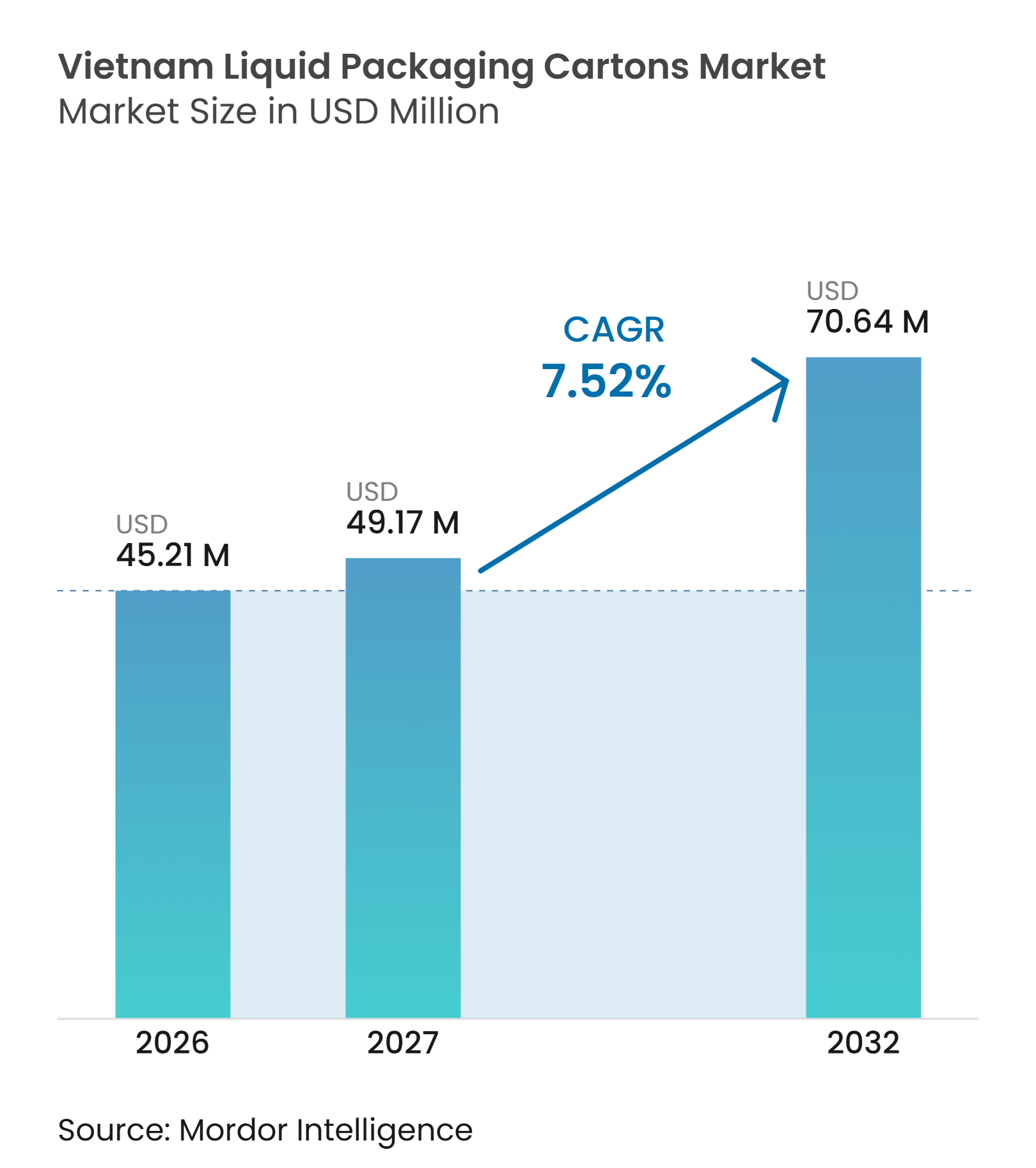
| Base Year Market Size (2026) | USD 45.21 Million |
| Market Size (2027) | USD 49.17 Million |
| Market Size (2032) | USD 70.64 Million |
| Growth Rate (2027 - 2032) | 7.52 % |
| Market Concentration | Low |
Major Players *Disclaimer: Major Players sorted in no particular order Image © Mordor Intelligence. Reuse requires attribution under CC BY 4.0. | |
Vietnam Liquid Packaging Cartons Market Analysis by Mordor Intelligence
The Vietnam liquid packaging cartons market size is projected to expand from USD 45.21 million in 2026 to USD 70.64 million by 2032, registering a CAGR of 7.52% from 2027 to 2032. Demand is supported by the need to distribute milk and other liquid foods without dependable refrigeration outside the largest cities, where shelf-stable products can reach consumers through conventional logistics routes. Dairy consumption, school milk procurement, and the growth of modern retail are driving carton volumes, especially in small formats that suit daily consumption and institutional distribution. Investment by global packaging suppliers is shortening supply lead times and expanding the choice of aseptic formats available to local beverage producers, thereby improving new-product planning. However, imported liquid packaging board and limited recycling capacity for aluminum-polymer layers may increase costs for smaller converters and complicate compliance planning. The Vietnam liquid packaging cartons market therefore depends on whether new capacity and collection systems keep pace with demand from food and beverage brands.
Key Report Takeaways
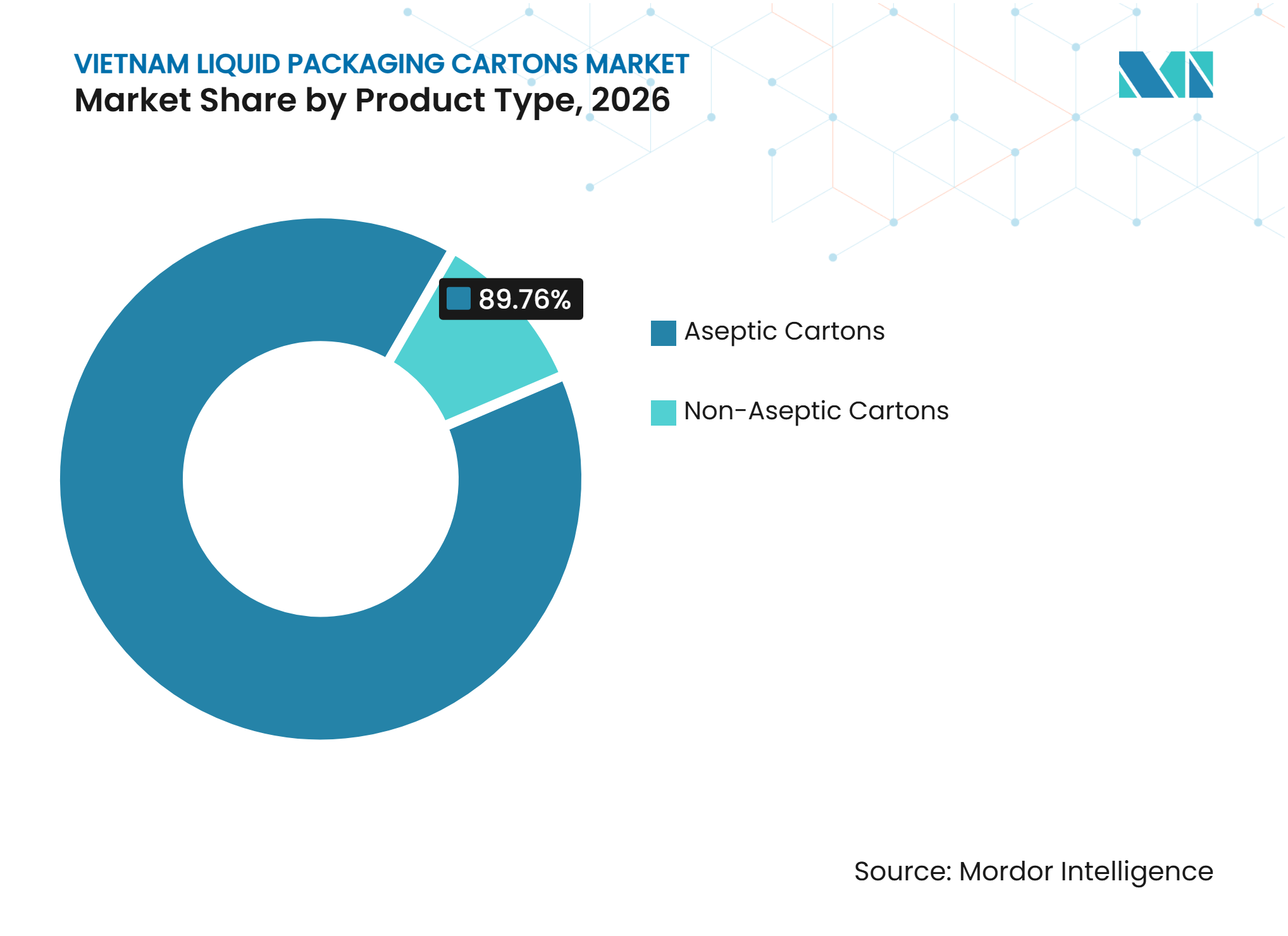
- By product type, aseptic cartons held 89.76% of the Vietnam liquid packaging cartons market share in 2026 and are projected to expand at an 8.27% CAGR through 2032.
- By application, milk accounted for 47.83% of the Vietnam liquid packaging cartons market size in 2026, while energy and functional drinks are projected to record the highest CAGR at 8.32% through 2032.
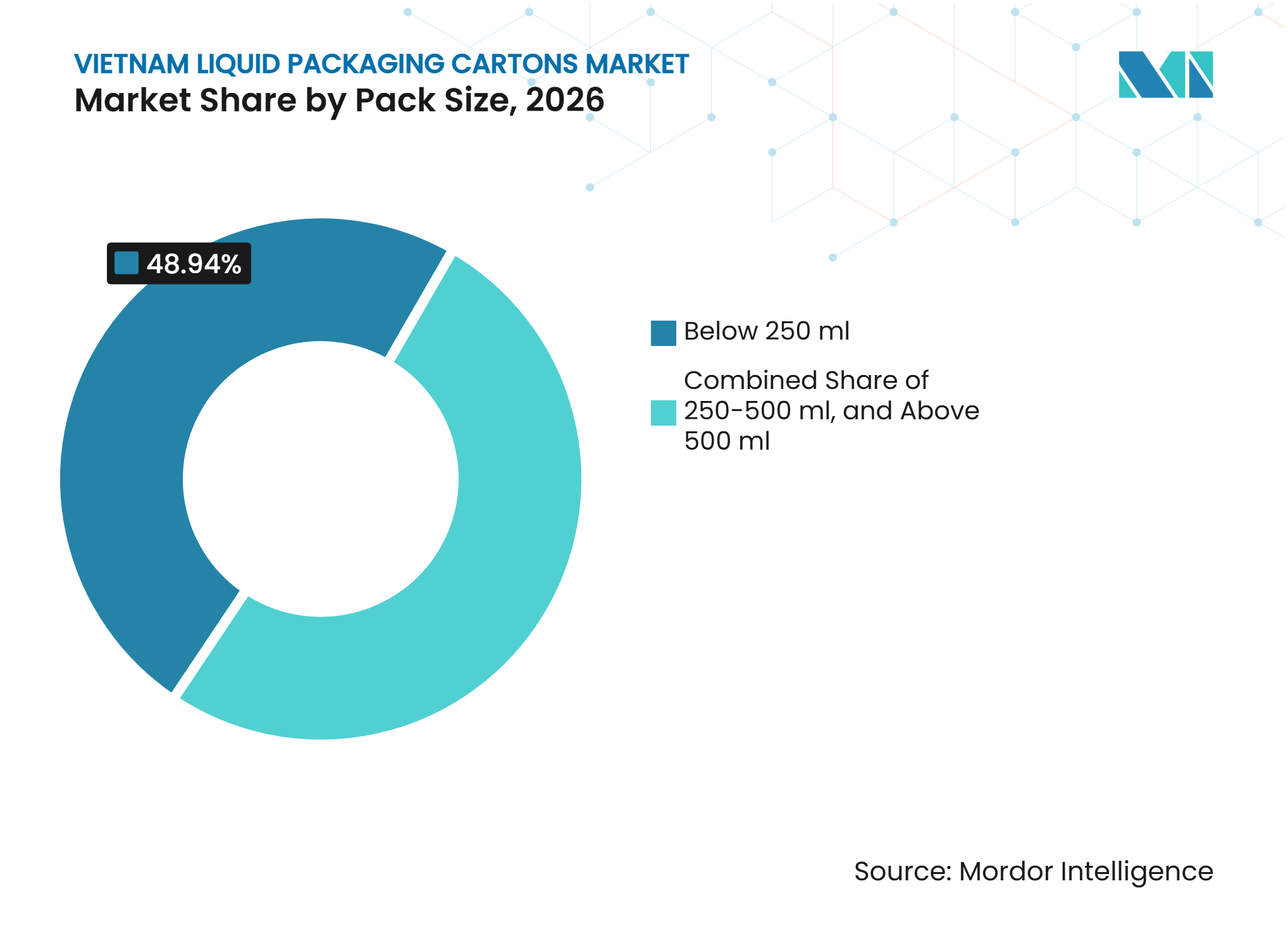
- By pack size, below-250-ml cartons held 48.94% of the Vietnam liquid packaging cartons market share in 2026, while 250-500-ml cartons are projected to expand at an 8.13% CAGR through 2032.
Note: Market numbers in this report are based on Mordor Intelligence's proprietary estimation framework, which combines nine months of actuals with Q4 projections for base year 2026.
Market Trends and Insights
Drivers Impact Analysis of Vietnam Liquid Packaging Cartons Market*
| Driver | (~) % Impact on CAGR Forecast | Geographic Relevance | Impact Timeline |
|---|---|---|---|
| Rising Dairy and School-Milk Consumption | +2.1% | National, with concentrated impact in Bac Ninh, Quang Ninh, and Ho Chi Minh City | Medium term (2-4 years) |
| Shelf-Stable Distribution Beyond Cold-Chain Hubs | +1.6% | National, with elevated relevance in central and northern Vietnam | Long term (≥ 4 years) |
| Modern Retail and E-Commerce Pack-Multiplication | +1.3% | Ho Chi Minh City, Hanoi, and tier-2 cities | Medium term (2-4 years) |
| Plastic Substitution and EPR-Led Packaging Reassessment | +0.9% | National, with early gains in Binh Duong and Dong Nai | Medium term (2-4 years) |
| Vietnam-Based Capacity Expansion and Shorter Lead Times | +0.7% | Binh Duong and Dong Nai | Long term (≥ 4 years) |
| Regionalization of ASEAN Beverage and Food Exports | +0.5% | ASEAN-wide, centered on Ho Chi Minh City and Hai Phong export hubs | Long term (≥ 4 years) |
| Source: Mordor Intelligence | |||
Rising Dairy and School-Milk Consumption
Vietnam’s dairy sector generated VND 133,042 billion in revenue in 2025, equivalent to USD 5.12 billion, and dairy exports rose 18.6% to USD 354.1 million. Fresh milk output reached 1,672,526 thousand liters in 2025, a 1.9% increase from 2024.[1] The Ministry of Industry and Trade targets per-capita milk consumption of 40 liters by 2030, compared with current consumption of 24-27 liters.[2] Quang Ninh allocated VND 321 billion, equivalent to USD 12.3 million, for its 2026 school-milk program, which supplies 180 ml per child on each school day. Bac Ninh began a separate 2025-2030 program that covers 817 schools, giving carton suppliers a visible base of contracted demand.[3] These programs favor the Vietnam liquid packaging cartons market because their standardized portions align with below-250-ml aseptic packs.
Shelf-Stable Distribution Beyond Cold-Chain Hubs
The Vietnam liquid packaging cartons market benefits from uneven refrigerated infrastructure across the country. Southern Vietnam holds the great majority of the country’s cold storage capacity, while central provinces and rural northern areas have fewer facilities. Aseptic cartons allow dairy, juice, and liquid-food producers to distribute products at room temperature without relying on a continuous refrigerated chain. This creates access to towns and rural areas that chilled products cannot serve efficiently. The format also reduces spoilage risk over long transport routes and helps producers plan distribution beyond Ho Chi Minh City and Hanoi. The Vietnam liquid packaging cartons market is therefore supported by a structural need for ambient products, rather than only by consumer preference.
Modern Retail and E-Commerce Pack-Multiplication
Vietnam’s retail market reached USD 269 billion in 2025, while e-commerce sales totaled USD 32 billion and grew by more than 20% from the preceding year. Organized retail encourages multi-pack purchases and gives packaged beverages more stable shelf visibility than traditional wet markets. E-commerce also rewards packs that protect products in transit and display nutrition and safety information clearly. These conditions favor cartons for dairy, plant-based drinks, and functional beverages where branded presentation matters. The expansion of these channels increases the number of buying occasions for a household, rather than simply replacing an existing package. This supports the Vietnam liquid packaging cartons market as brands adjust pack configurations for stores, delivery platforms, and convenience outlets.
Plastic Substitution and EPR-Led Packaging Reassessment
Vietnam’s extended producer responsibility framework requires eligible producers and importers to meet packaging recycling duties or contribute to the Vietnam Environmental Protection Fund. Decree 05/2025/ND-CP took effect on January 6, 2025, clarifying requirements under the environmental protection framework. The paper packaging recycling target is 20%, while enterprises with annual revenue below VND 30 billion are exempt. Larger beverage brands must now consider collection, reporting, and recycling costs when selecting packaging materials. Cartons can benefit where paper fiber is a meaningful part of the pack, although their full environmental performance still depends on collection and processing of the PolyAl fraction. These compliance factors are encouraging investment in carton-compatible filling lines across the Vietnam liquid packaging cartons market.
Restraints Impact Analysis of Vietnam Liquid Packaging Cartons Market*
| Restraint | (~) % Impact on CAGR Forecast | Geographic Relevance | Impact Timeline |
|---|---|---|---|
| Imported Liquid Packaging Board and Barrier-Resin Exposure | -1.2% | National, particularly smaller converters without long-term contracts | Short term (≤ 2 years) |
| PolyAl Collection and Recycling Bottlenecks | -0.8% | National, with gaps outside Ho Chi Minh City | Long term (≥ 4 years) |
| High Filling-System Switching Costs for Smaller Producers | -0.5% | National, particularly regional food and beverage manufacturers | Medium term (2-4 years) |
| PET Price and On-the-Go Format Competition | -0.4% | Ho Chi Minh City and other urban corridors | Short term (≤ 2 years) |
| Source: Mordor Intelligence | |||
Imported Liquid Packaging Board and Barrier-Resin Exposure
Vietnam does not have significant domestic production of liquid packaging board, which is the multi-layer fiber substrate used in aseptic cartons. Local converters therefore rely on imports from Europe, Japan, and South Korea for key material inputs. A price increase in packaging paper can quickly affect converter margins because food and beverage supply agreements commonly fix prices for long periods. Aluminum and polyethylene barrier layers add further exposure to international commodity costs. Smaller converters are more affected because they have less purchasing scale and fewer long-term procurement agreements. This constraint can slow reinvestment in the Vietnam liquid packaging cartons market when input costs rise faster than customer prices.
PolyAl Collection and Recycling Bottlenecks
Liquid cartons combine paperboard, polymer, and aluminum, and the aluminum-polymer fraction requires processing beyond conventional paper recycling. Vietnam lacks aluminum recycling plants that can process PolyAl into rolled aluminum for reuse. Tetra Pak has expanded carton collection points through stores, schools, and communities, indicating that collection networks are developing. Coverage remains limited outside major urban areas, however, and this raises compliance costs for smaller brands. Producers must also explain disposal routes to consumers when local collection points are not readily available. The Vietnam liquid packaging cartons market needs broader collection and processing capacity if cartons are to meet the environmental expectations associated with EPR.
*Our forecasts treat driver/restraint impacts as directional, not additive. The impact forecasts reflect baseline growth, mix effects, and variable interactions.
Vietnam Liquid Packaging Cartons Market Segment Analysis
By Product Type:
Aseptic Formats Lead Current Demand and Future ExpansionAseptic cartons held 89.76% of the Vietnam liquid packaging cartons market size in 2026 and are projected to expand at an 8.27% CAGR through 2032. Their position reflects the practical advantage of room-temperature distribution in areas with limited cold storage. Large dairy producers use ultra-high-temperature milk formats to reach consumers without a refrigerated supply chain. Aseptic packs also fit the distribution needs of juice, ready-to-drink coffee, plant-based beverages, and fortified children’s drinks. Their large base and faster growth indicate continued expansion of existing consumption occasions rather than a shift away from the format. The Vietnam liquid packaging cartons industry remains centered on aseptic technology because it combines filling safety, long shelf life, and national distribution reach.
Non-aseptic cartons occupy the remaining share and are mainly used for chilled dairy products in urban supermarket channels. These products depend on stronger cold-chain coverage in Ho Chi Minh City and Hanoi, which narrows their addressable consumer base. Tetra Pak’s Binh Duong expansion added 15 packaging formats to its aseptic portfolio, including options intended for new beverage categories. This manufacturing capability allows brands to develop new products without changing carton suppliers or filling partners. The PolyAl issue is more relevant for aluminum-barrier aseptic packs, but larger brands are better positioned to manage associated EPR obligations. Smaller specialty beverage producers may find the cost of switching filling systems and meeting recycling requirements harder to absorb.



By Application:
Milk Provides Scale While Functional Drinks Drive GrowthMilk accounted for 47.83% of Vietnam liquid packaging cartons market size in 2026. The category is supported by school-milk programs, mass-market ambient milk portfolios, and the limited reach of affordable fresh-milk distribution outside major cities. Vietnam produced 1,672,526 thousand liters of fresh milk in 2025, while domestic raw milk met only 38-40% of processing demand. This supply structure favors processed and shelf-stable milk products. Milk gives filling operations a reliable volume base and supports recurring demand for small cartons. The application remains central to the Vietnam liquid packaging cartons market because it serves both everyday consumption and public nutrition programs.
Energy and functional drinks are projected to grow at an 8.32% CAGR through 2032, the highest rate among the applications provided. Consumers are showing greater interest in fitness, wellness, and beverages with specified functional benefits. Dantri reported that Vietnam’s functional nutrition beverage category is projected to grow at an 8.4% CAGR from 2024 to 2027. Cartons can help position these drinks as differentiated products while providing a protected shelf-stable format. Juices and plant-based beverages also add product diversity, including Vinamilk’s August 2025 launch of Kombucha HAYĐẤY. Other liquid food and dairy applications provide stable, volume-led demand that improves converter utilization.
By Pack Size:
Small Cartons Dominate While Mid-Size Packs Gain GroundBelow-250-ml cartons captured 48.94% of Vietnam liquid packaging cartons market value in 2026. School-milk specifications of 110-180 ml, single-serve dairy habits, and the importance of convenience stores and school canteens underpin this lead. The format also matches high-frequency, low-value shopping patterns common in smaller cities and rural areas. Small packages make a single purchase more affordable and reduce the need for home refrigeration after opening. Producers benefit from predictable volume when school programs use standardized carton sizes. This supports a broad installed base for the Vietnam liquid packaging cartons market across daily dairy consumption channels.
The 250-500-ml segment is projected to grow at an 8.13% CAGR through 2032. Working adults are moving toward larger portable formats, while energy and functional drinks are commonly sold in 330-500-ml sizes. Tetra Pak introduced formats at its expanded Binh Duong facility that address 500-ml on-the-go packs and 1,000-ml multi-serve formats. Above-500-ml cartons serve household and food-service occasions and could gain relevance as organized retail penetrates more locations. Larger packs reduce packaging material per liter, but they can increase transaction value for branded producers. The mix is therefore becoming broader without displacing the small formats used in schools and convenience channels.

Geography Analysis
Southern Vietnam
Southern Vietnam is the leading supply base for liquid packaging cartons, centered on Ho Chi Minh City, Binh Duong, and Dong Nai. Tetra Pak’s Binh Duong facility has capacity of more than 30 billion packs annually and serves Vietnam together with 7 other Asia-Pacific markets. More than 55% of its output is allocated to Vietnamese customers, and local delivery times are 7-10 days. Industrial parks, established logistics routes, and port connections support a concentration of carton manufacturing and food processing. Oji plans to open a JPY 16 billion, USD 103.88 million, carton plant in Dong Nai in March 2028. The investment will strengthen local supply and add a second large-scale manufacturing cluster. Southern Vietnam also combines production capacity with the country’s highest concentration of modern retail and organized food and beverage operations.
Northern Vietnam
Northern Vietnam is a growing consumption center for the Vietnam liquid packaging cartons market, led by Hanoi, Bac Ninh, Quang Ninh, and Hai Phong. Quang Ninh committed VND 321 billion, equivalent to USD 12.3 million, in 2026 for school milk covering more than 200,000 children in preschool and primary institutions. The program runs through 2030 and creates recurring procurement for small aseptic cartons. Bac Ninh’s 2025-2030 school-milk program covers 817 schools, providing another source of stable demand. School procurement gives dairy processors greater visibility into required pack volumes and delivery schedules. The region’s weaker cold chain continues to favor ambient cartons over chilled alternatives. Hai Phong’s logistics and manufacturing role can further support packaged-food distribution across the northern corridor.
Central Vietnam and Rural Corridors
Central Vietnam and rural corridors across the northern highlands and Mekong Delta represent longer-term whitespace for the Vietnam liquid packaging cartons market. Cold storage remains concentrated in the south, leaving central provinces more dependent on ambient distribution. This gives aseptic packs a practical role in reaching dispersed consumers and managing long transport distances. Modern retail is expanding outside the main metropolitan areas, which increases shelf access for packaged liquid food and beverages. Tetra Pak and Doveco commissioned Vietnam’s first Tetra Recart line in Son La in July 2025, with capacity of up to 6,000 cartons per hour for vegetables, legumes, and sauces. This widens the role of paper-based cartons beyond drinks and could support agricultural processing in regions with large crop output. Deeper retail penetration and stronger collection systems will determine how quickly these mixed geographies convert their potential into carton demand.
Competitive Landscape
Market Concentration
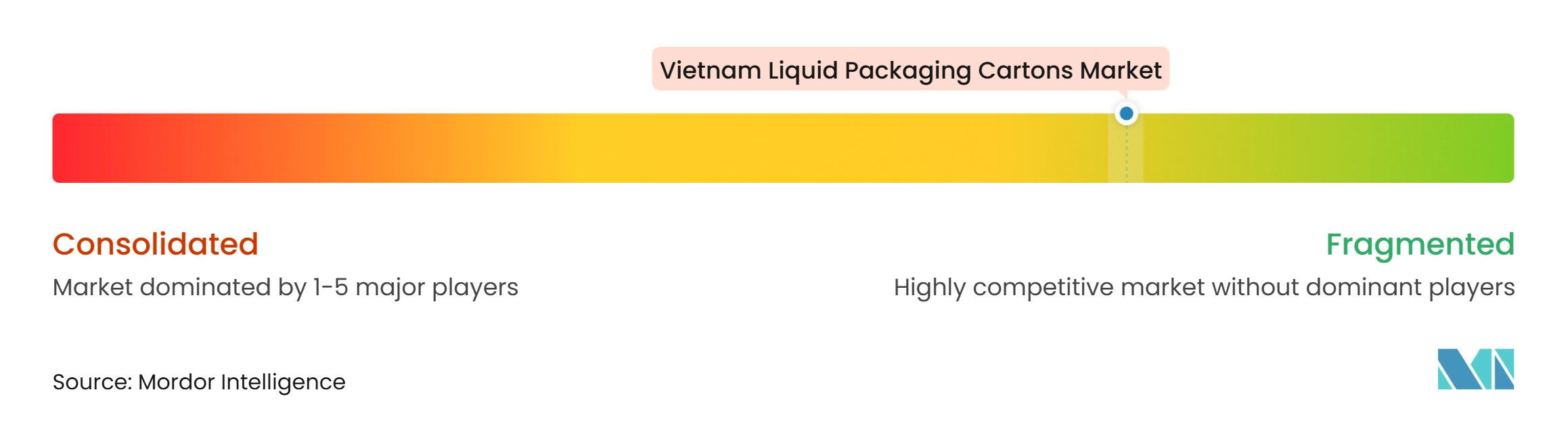
The Vietnam liquid packaging cartons market is concentrated in the technically demanding aseptic tier and more fragmented among non-aseptic and downstream converters. Tetra Pak is the main local production anchor because its Binh Duong site combines carton supply with filling equipment, maintenance, and package development. The site received a EUR 97 million (USD 115 million) second-line investment in July 2025, bringing total investment to EUR 217 million (USD 256 million. The expansion more than doubled annual capacity from 12 billion to over 30 billion packs and added 15 packaging formats. Its 7-10-day delivery period improves responsiveness for Vietnamese food and beverage customers. The company’s local manufacturing base makes it difficult for smaller import-led suppliers to compete on service reliability.
SIG is using material innovation to compete with established aluminum-barrier formats. Its SIG Terra alu-layer-free aseptic cartons recorded 24% year-over-year sales growth in 2025. The company has also introduced an aseptic 1-liter carton without an aluminum layer, reflecting buyer interest in material designs that can ease recycling challenges. This approach is relevant where brands need to address EPR obligations and communicate environmental progress. Greatview remains a price-oriented alternative in several Asian markets, but its corporate disruption creates uncertainty around its near-term commercial position. Oji’s planned Dong Nai facility will provide local beverage producers with another supply option when it begins operations in 2028.
Competition is increasingly based on filling-line compatibility, short lead times, package formats, and recycling support rather than on carton supply alone. Mid-size packs for functional beverages and ready-to-drink coffee are a clear area for product development. Larger brands can use local supplier relationships to introduce new packs faster, while smaller producers may face switching costs and higher compliance burdens. Tetra Pak and Doveco’s Tetra Recart line also shows how carton suppliers are entering adjacent processed-food applications. Recycling-linked solutions could become a stronger differentiator as EPR implementation advances. The competitive structure is therefore shaped by a small number of technology providers with extensive systems capabilities. The Vietnam liquid packaging cartons industry is likely to retain this concentrated aseptic structure while expanding into more applications and pack sizes.
Vietnam Liquid Packaging Cartons Industry Leaders
-
Tetra Pak International S.A.
-
SIG Group AG
-
Greatview Aseptic Packaging Company Limited
-
LAMI PACKAGING (KUNSHAN) CO., LTD.
-
IPI S.r.l.
- *Disclaimer: Major Players sorted in no particular order
Vietnam Liquid Packaging Cartons Market Companies Covered in this Report
- Tetra Pak International S.A.
- SIG Group AG
- Elopak ASA
- Greatview Aseptic Packaging Company Limited
- Oji Holdings Corporation
- IPI S.r.l.
- LAMI PACKAGING (KUNSHAN) CO., LTD.
- NewJF Technology Co., Ltd.
- Nippon Paper Industries Co., Ltd.
- Stora Enso Oyj
- Billerud AB (publ)
- Shandong Bihai Packaging Materials Co., Ltd.
- Southern Packaging Group Ltd.
- TidePak Aseptic Packaging Material Co., Ltd.
- Ecolean AB
Recent Industry Developments in Vietnam Liquid Packaging Cartons Market
- October 2026: Oji Group commenced construction of a USD 110 million aseptic carton packaging facility in Dong Nai, Vietnam, with an annual production capacity of approximately eight billion carton packs and operations expected to begin in 2028. It strengthens domestic manufacturing capacity, enhances supply chain capabilities, and supports growing demand for aseptic liquid food and beverage packaging.
- August 2026: Vietnamese beverage and liquid food converters accelerated packaging redesigns following the enforcement of the European Union's Packaging and Packaging Waste Regulation (EU 2025/40). It drives export-oriented manufacturers to adopt certified sustainable paperboard and recyclable mono-material carton structures to preserve access to European retail markets.
- May 2026: SIG expanded its "Recycle for Good" school-based collection program into Bac Ninh province to recover post-consumer milk cartons across preschools and primary schools. It strengthens local collection infrastructure, converts used cartons into recycled paper and PolyAl products, and supports Vietnam's circular economy goals.
- May 2026: Tetra Pak showcased its advanced processing and aseptic carton packaging solutions, including Tetra Brik Aseptic, Tetra Prisma Aseptic, and Tetra Top, at Vietnam Dairy 2026. It promotes innovative packaging formats, extended product shelf life, food safety, and the adoption of sustainable packaging across dairy and plant-based beverage applications.
Vietnam Liquid Packaging Cartons Market Report Scope
The Vietnam Liquid Packaging Cartons Market encompasses the manufacturing and supply of paperboard-based packaging solutions designed for the safe storage, transportation, and distribution of liquid beverages and food products. These cartons provide product protection, extended shelf life, and convenient handling while supporting efficient packaging and distribution. The market includes packaging solutions designed to maintain product freshness, prevent contamination, and meet evolving food safety and sustainability requirements.
The Vietnam Liquid Packaging Cartons Market Report is Segmented by Product Type (Aseptic Cartons, and Non-Aseptic Cartons), Applications (Milk, Juices, Plant Based Beverages, Dairy Products Excluding Milk, Energy and Functional Drinks, Liquid Food, and Other Applications), and Pack Size (Below 250 ml, 250-500 ml, and Above 500 ml). The Market Forecasts are Provided in Terms of Value (USD).
Segmentation Overview
| Aseptic Cartons |
| Non-Aseptic Cartons |
| Milk |
| Juices |
| Plant Based Beverages |
| Dairy Products (Excluding Milk) |
| Energy and Functional Drinks |
| Liquid Food |
| Other Applications |
| Below 250 ml |
| 250-500 ml |
| Above 500 ml |
| By Product Type | Aseptic Cartons |
| Non-Aseptic Cartons | |
| By Applications | Milk |
| Juices | |
| Plant Based Beverages | |
| Dairy Products (Excluding Milk) | |
| Energy and Functional Drinks | |
| Liquid Food | |
| Other Applications | |
| By Pack Size | Below 250 ml |
| 250-500 ml | |
| Above 500 ml |
Key Questions Answered in the Report
What is the size of the Vietnam liquid packaging cartons market?
The Vietnam liquid packaging cartons market is projected to expand from USD 45.21 million in 2026 to USD 70.64 million by 2032, at a CAGR of 7.52% from 2027 to 2032.
Which product type leads Vietnam's liquid packaging cartons demand?
Aseptic cartons lead with 89.76% share in 2026 and are projected to grow at an 8.27% CAGR through 2032.
Which application has the largest demand for liquid cartons in Vietnam?
Milk accounted for 47.83% of market value in 2026, supported by ambient distribution and provincial school-milk programs.
Which application is growing fastest through 2032?
Energy and functional drinks are projected to expand at an 8.32% CAGR through 2032.
Why are aseptic cartons important for food and beverage distribution in Vietnam?
They keep products shelf-stable at room temperature, helping producers reach areas where cold storage and refrigerated transport remain limited.
What limits growth for carton packaging suppliers in Vietnam?
Key challenges include dependence on imported liquid packaging board, exposure to barrier-material costs, and limited PolyAl collection and recycling infrastructure.