
Vietnam Freight Forwarding Market Size and Share
Market Overview
| Study Period | 2021 - 2032 |
|---|---|
| Forecast Data Period | 2027 - 2032 |
| Base Year Market Size (2026) | USD 4.68 Billion |
| Market Size (2027) | USD 5 Billion |
| Market Size (2032) | USD 6.89 Billion |
| Growth Rate (2027 - 2032) | 6.59 % |
| Market Concentration | Low |
Major Players *Disclaimer: Major Players sorted in no particular order Image © Mordor Intelligence. Reuse requires attribution under CC BY 4.0. | |
Vietnam Freight Forwarding Market Analysis by Mordor Intelligence
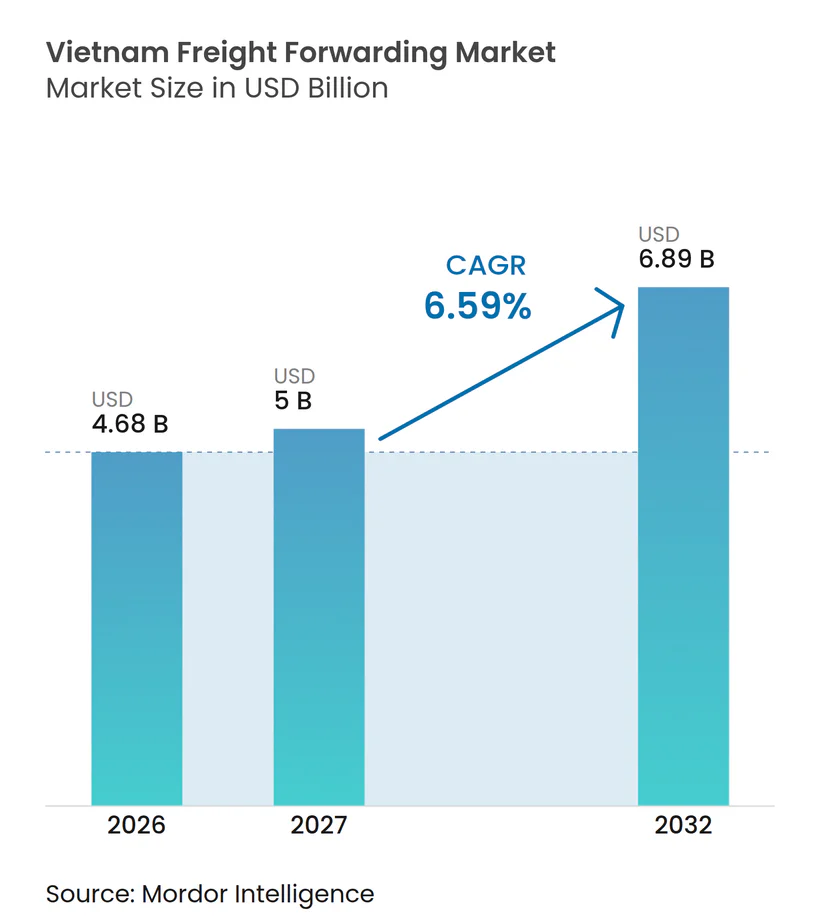
The Vietnam freight forwarding market size is valued at USD 4.68 billion in 2026 and is estimated to grow from USD 5 billion in 2027 to reach USD 6.89 billion by 2032, at a CAGR of 6.59% during the forecast period (2027-2032).
Vietnam's expanding manufacturing base, international trade integration, and investment in transport infrastructure are supporting demand for freight forwarding services. Exporters increasingly require customs clearance, bonded warehousing, shipment visibility, and coordinated multimodal transport. Electronics, medical devices, industrial equipment, and consumer goods create different requirements for cargo security, handling, and transit reliability. Infrastructure development is expanding the potential service network, while congestion, road transport constraints, and fragmented carrier operations continue to challenge efficiency. Competition is increasingly shaped by international network access, specialized handling capabilities, digital integration, and the ability to coordinate shipments across transport modes.
Key Report Takeaways
- By mode of transport, ocean freight forwarding accounts for 76.39% of the Vietnam freight forwarding market size in 2026, while air freight forwarding is projected to register a CAGR of 8.41% through 2032.
- By enterprise size, large enterprises account for 69.12% of the Vietnam freight forwarding market share in 2026, while small and medium enterprises are projected to register a CAGR of 7.21% through 2032.
- By forwarder model, traditional asset-light forwarders account for 64.81% of the Vietnam freight forwarding market size in 2026, while digital-first and online platforms are projected to register a CAGR of 8.43% through 2032.
- By end-user industry, the industrial and manufacturing segment accounts for 36.93% of the Vietnam freight forwarding market share in 2026, while healthcare and pharmaceuticals are projected to register a CAGR of 8.64% through 2032.
- By geography, Southern Vietnam accounts for 49.21% of the Vietnam freight forwarding market size in 2026, while Central Vietnam is projected to register a CAGR of 7.82% through 2032.
Note: Market numbers in this report are based on Mordor Intelligence's proprietary estimation framework, which combines nine months of actuals with Q4 projections for base year 2026.
Vietnam Freight Forwarding Market Trends and Insights
Drivers Impact Analysis*
| Driver | (~) % Impact on CAGR forecast | Geographic relevance | Impact timeline |
|---|---|---|---|
| Manufacturing FDI Expanding Export Logistics Demand | +1.8% | Global, with core gains in Northern and Southern Vietnam | Medium term (2–4 years) |
| E-Commerce Growth Increasing Cross-Border Shipment Volumes | +1.3% | Southern Vietnam, with spillover to Northern Vietnam | Short term (≤ 2 years) |
| Logistics Hub Investment Strengthening Multimodal Connectivity | +1.0% | National, with early gains in Hai Phong, Ho Chi Minh City, and Danang | Long term (≥ 4 years) |
| Air Cargo Growth Increasing Time-Critical Shipment Demand | +0.9% | Northern Vietnam and Southern Vietnam | Medium term (2–4 years) |
| China-ASEAN Diversification Increasing Freight Flow Complexity | +0.9% | Asia-Pacific, with spillover to China-Vietnam corridors | Medium term (2–4 years) |
| Digital Marketplaces Expanding SME Access to Logistics | +0.7% | National, with early uptake in Ho Chi Minh City and Hanoi | Short term (≤ 2 years) |
| Source: Mordor Intelligence | |||
Manufacturing FDI Expanding Export Logistics Demand
Vietnam's manufacturing investment and export activity support demand for international freight forwarding, inbound component movements, and outbound finished-goods distribution. Disbursed foreign direct investment reached USD 23.6 billion during January–November 2025, increasing 8.9% year over year[1]. Manufacturing and processing remain important destinations for foreign investment. As production networks become more complex, exporters need reliable carrier access, customs expertise, shipment tracking, and suitable storage arrangements. Electronics, industrial equipment, and other high-value products can also require more stringent cargo security and handling procedures than conventional general cargo. Vietnam's participation in international trade agreements and its integration into regional supply chains further support demand for cross-border forwarding services.
E-Commerce Growth Increasing Cross-Border Shipment Volumes
Vietnam's e-commerce market reached an estimated USD 31 billion in 2025, with growth of approximately 25.5%, according to the country's logistics authorities in February 2026. Expanding online sales increase the need for cross-border transportation, customs documentation, shipment tracking, and coordinated delivery services. Smaller exporters may require consolidated shipments rather than full-container bookings, creating opportunities for less-than-container-load forwarding and digital logistics platforms. On September 15, 2025, Vietnam SuperPort and Vietnam Post Logistics, together with Visa and other partners, launched a Logistics Marketplace Platform that integrates logistics services, shipment visibility, documentation, and financial services for small and medium-sized enterprises. Such platforms can lower access barriers for smaller businesses and improve the coordination of international shipments.
Logistics Hub Investment Strengthening Multimodal Freight Connectivity
Vietnam's logistics development strategy, approved on October 9, 2025, identifies infrastructure development, regional connectivity, digital transformation, and service quality as priorities for the country's logistics sector. Port, airport, warehouse, and inland transport investments can expand the range of routing options available to exporters. On April 25, 2026, APM Terminals and Hateco announced an agreement to develop, build, and operate a new container terminal at Lien Chieu Port in Danang, with planned investment exceeding USD 1.7 billion and estimated capacity of more than 5.7 million TEUs annually at full development. The terminal remains a future capacity opportunity rather than an operational facility. Its eventual contribution to forwarding services will depend on commissioning, inland connectivity, customs efficiency, and the development of supporting logistics networks.
Air Cargo Growth Increasing Time-Critical Shipment Demand
Vietnam's airports handled approximately 1.8 million tons of cargo in 2025, setting a record, while the national airport network processed 920,900 tons during the first half of 2026. Noi Bai International Airport accounted for 550,400 tons during those six months, or nearly 60% of national airport cargo volume. These flows support demand for forwarding services that coordinate air capacity, customs clearance, and onward distribution. Electronics, medical equipment, and other high-value goods can benefit from shorter transit times when inventory availability or production schedules are sensitive to delays. Air forwarding also complements ocean freight by providing an alternative for urgent shipments. However, its commercial appeal depends on airfreight rates, available capacity, cargo characteristics, and the urgency of delivery.
Restraints Impact Analysis*
| Restraint | (~) % Impact on CAGR forecast | Geographic relevance | Impact timeline |
|---|---|---|---|
| Fragmented Carrier Networks Reducing Backhaul Utilization Efficiency | -1.2% | National, concentrated in inland and secondary corridors | Medium term (2–4 years) |
| Driver Shortages Increasing Compliance and Operating Costs | -1.1% | National, acute in Northern and Southern Vietnam logistics corridors | Short term (≤ 2 years) |
| Port and Border Congestion Delaying Freight Movements | -1.0% | Cai Mep-Thi Vai, Noi Bai, and the Lao Cai border area | Short term (≤ 2 years) |
| Data Interoperability Gaps Limiting End-to-End Visibility | -0.7% | National, with greater effects on China-Vietnam corridors | Medium term (2–4 years) |
| Source: Mordor Intelligence | |||
Fragmented Carrier Networks Reducing Backhaul Utilization Efficiency
Vietnam's logistics sector includes approximately 45,000 enterprises, including around 5,000 international freight forwarding companies. The large provider base creates competition across transport, customs, consolidation, and warehousing services. Where freight demand is uneven across routes, carriers may struggle to secure return loads, reducing vehicle utilization and increasing the cost of individual movements. Smaller forwarders can also face less favorable procurement terms and limited access to consistent capacity during peak periods. Established carrier relationships, shipment consolidation, and digital freight matching can help mitigate these challenges. However, differences in systems, service standards, and information sharing can make it difficult to coordinate fragmented transport networks efficiently.
Driver Shortages Increasing Compliance and Operating Costs
Vietnam's transport regulations restrict commercial vehicle drivers to a maximum of 10 driving hours per day and 48 hours per week, with the relevant requirements taking effect on January 1, 2025[2]. These limits can affect route planning, driver scheduling, and delivery times, particularly for long-distance road movements. Forwarders dependent on road transport may need to coordinate additional drivers, allow more time for inland legs, and improve scheduling with carriers. Rail and coastal shipping can provide alternatives for suitable shipments, although availability and transit requirements differ by corridor. Congestion at ports and border crossings can compound scheduling challenges, while incomplete data exchange makes delays harder to anticipate and communicate to customers.
*Our forecasts treat driver/restraint impacts as directional, not additive. The impact forecasts reflect baseline growth, mix effects, and variable interactions.
Segment Analysis
By Mode of Transport: Ocean Freight Anchors Volume While Air Supports Urgent Cargo
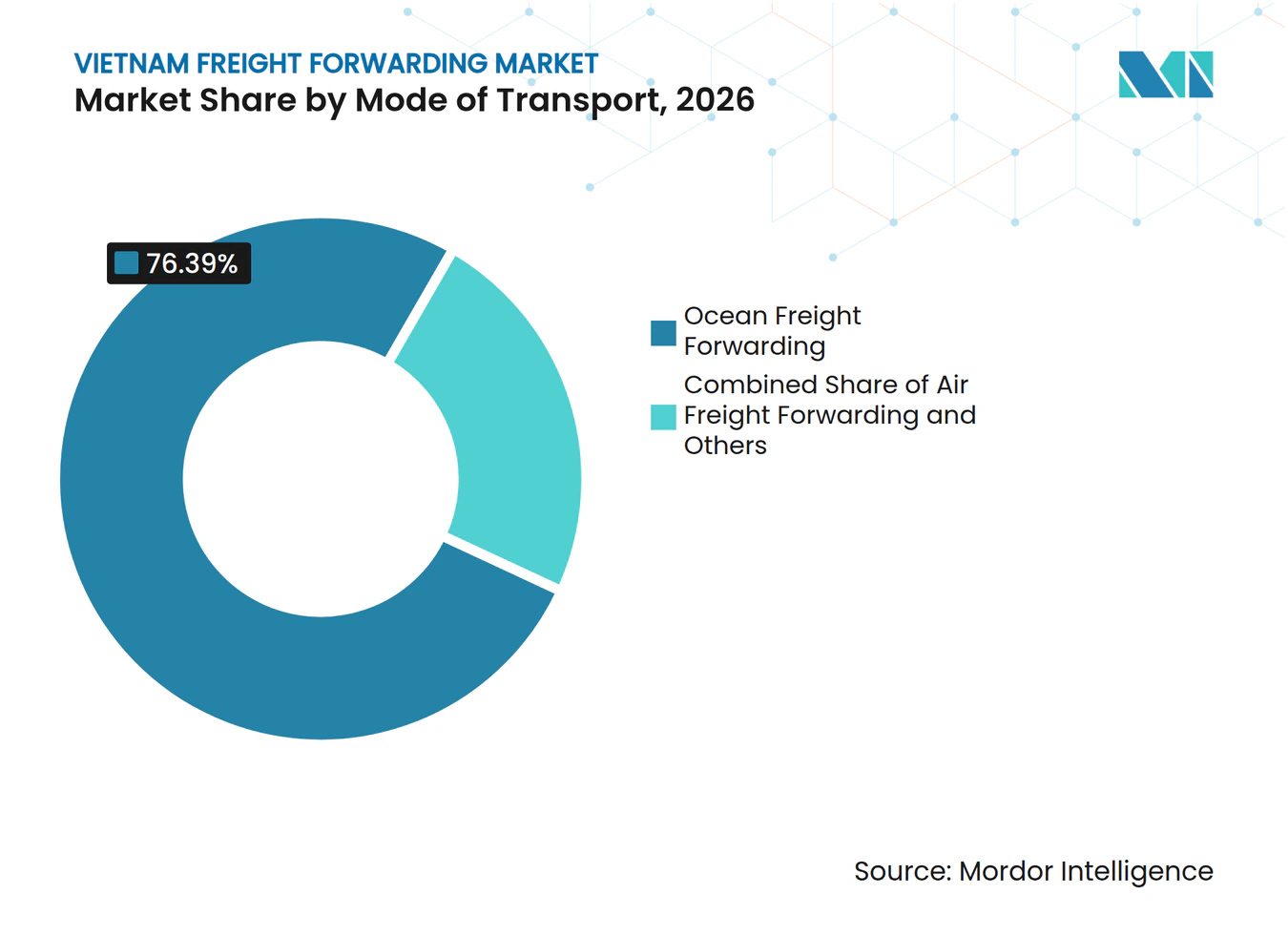
Ocean freight forwarding accounts for 76.39% of the Vietnam freight forwarding market share in 2026. Its position reflects Vietnam's export-oriented manufacturing base and the suitability of container shipping for large-volume international cargo. Full container load services support manufacturers with regular shipment volumes, while less-than-container load services enable smaller exporters to consolidate cargo. Port access, sailing schedules, container availability, customs coordination, and inland transport connections influence the reliability of ocean forwarding. The development of additional terminal capacity can expand routing options over time, although congestion and landside constraints may continue to affect shipment performance.
CAGR for air freight forwarding is projected at 8.41% from 2027 to 2032, making it the fastest-growing transport mode in the segmentation. Air forwarding serves shipments for which transit time, cargo value, or inventory requirements justify higher transportation costs. Electronics, medical equipment, and urgent industrial components can benefit from coordinated air capacity and customs services. On June 5, 2026, NX Group launched its NX Ocean Fast Track service, covering Haiphong-to-Los Angeles shipments and offering a faster ocean freight alternative to conventional services. This illustrates how forwarding providers are developing differentiated transport options for shippers balancing cost and delivery speed. Road, rail, and inland-waterway services remain important for domestic collection, distribution, and multimodal connections.



By Enterprise Size: Large Enterprise Contracts Anchor Volume While SMEs Add Digital Demand
Large enterprises account for 69.12% of the Vietnam freight forwarding market size in 2026. Multinational manufacturers and major exporters often require integrated freight forwarding, customs clearance, bonded warehousing, shipment tracking, and international distribution. These requirements favor providers with established carrier relationships, cross-border networks, and the ability to coordinate multiple service stages. On September 10, 2025, Kuehne+Nagel and the LEGO Group opened a regional distribution centre in Dong Nai to support the LEGO Group's Vietnamese manufacturing operations and regional distribution. The facility opened with 10,200 m² of space, with further expansion planned for 2026. Such arrangements demonstrate how logistics providers can embed forwarding and distribution services within major customers' supply chains.
CAGR for small and medium enterprises is projected at 7.21% from 2027 to 2032. Digital booking, consolidated shipments, online quotations, and simplified documentation can make international forwarding more accessible to smaller businesses. The Logistics Marketplace Platform launched by Vietnam SuperPort and Vietnam Post Logistics in September 2025 combines digital order processing, shipment visibility, logistics access, and financial services. These capabilities can help smaller exporters access formal logistics networks without independently coordinating every stage of international shipping. Providers that offer transparent pricing and flexible shipment sizes can compete for this demand, although smaller customers may remain more sensitive to freight rates and changes in export volumes.
By Forwarder Model: Traditional Relationships Face Platform-Based Price Transparency
Traditional asset-light forwarders account for 64.81% of the Vietnam freight forwarding market share in 2026. Their business model relies on carrier procurement, customs expertise, shipment consolidation, and coordination across transport providers rather than ownership of every transport asset. Local knowledge and established customer relationships remain important for shipments requiring documentation support, specialized handling, or multiple service providers. However, asset-light forwarders must maintain reliable carrier access and service quality while managing exposure to freight-rate changes. The ability to coordinate transport partners and communicate shipment status can be as important as the quoted freight rate.
CAGR for digital-first and online platforms is projected at 8.43% from 2027 to 2032. Digital quotations, booking interfaces, shipment visibility, and automated documentation can reduce administrative work and improve the customer experience. In March 2025, Samsung SDS presented enhancements to its Cello Square logistics platform, including AI-supported estimated departure and arrival predictions, early detection of shipment disruptions, and generative AI-based market reports[3]. These developments illustrate the growing role of data analytics in forwarding services. Hybrid providers that combine physical logistics capabilities with digital tools can serve customers seeking both operational control and online visibility. Integration with carriers, customs processes, and customer systems remains essential for delivering these benefits consistently.
By End-User Industry: Manufacturing Remains the Core While Healthcare Gains Momentum
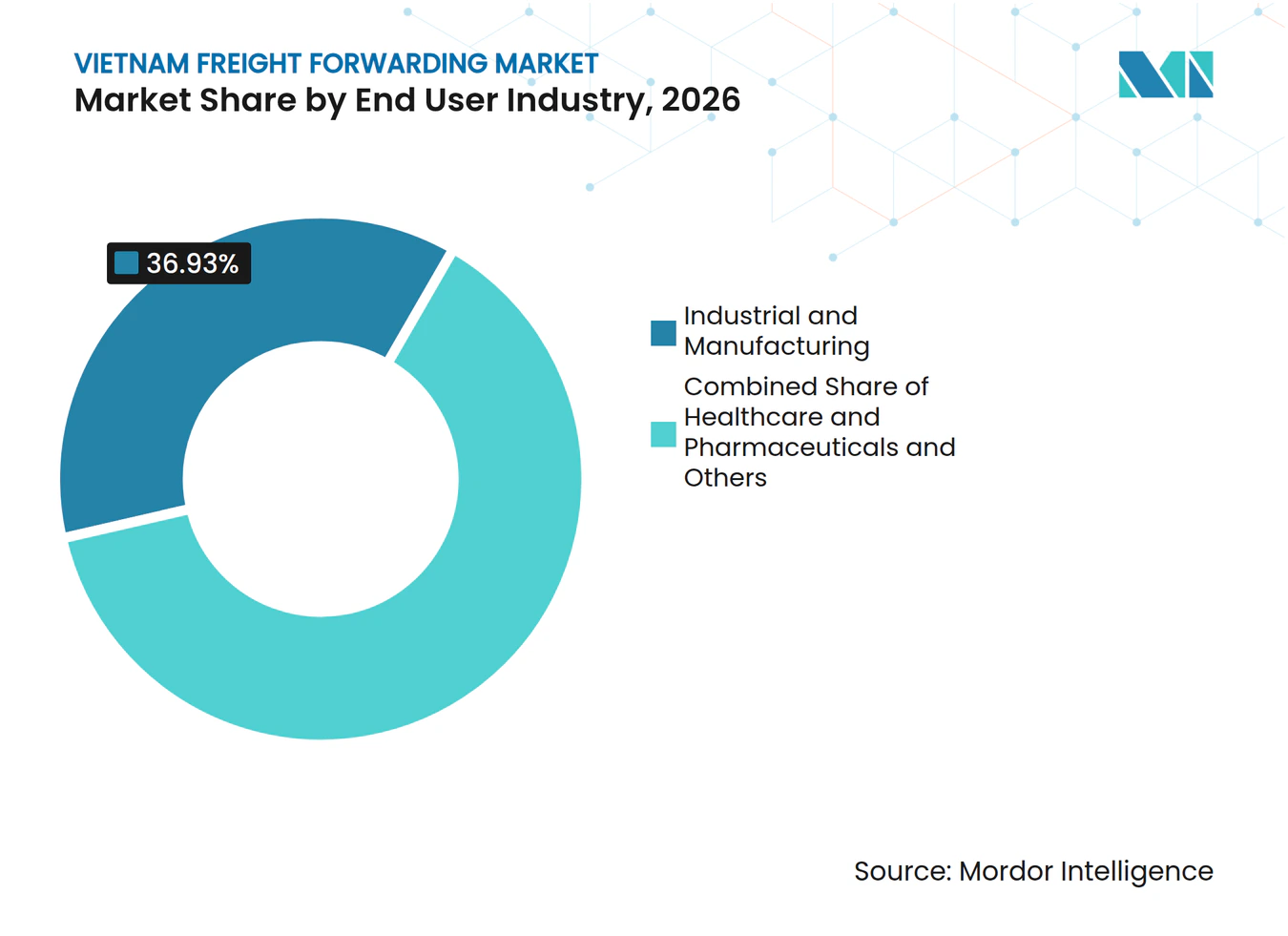
The industrial and manufacturing segment accounts for 36.93% of the Vietnam freight forwarding market size in 2026. Electronics, textiles, footwear, furniture, and industrial components generate demand for inbound materials, export transportation, customs clearance, and distribution. Manufacturing customers may require regular container capacity, reliable sailing schedules, and coordinated inland collection. High-value and sensitive products can also require additional security and handling controls. Retail, e-commerce, automotive, chemicals, and other industrial activities contribute further demand through imports, exports, and distribution networks. The mix of cargo types creates opportunities for forwarders to differentiate their services by shipment size, complexity, and required handling standards.
CAGR for healthcare and pharmaceuticals is projected at 8.64% from 2027 to 2032. Pharmaceutical products, medical equipment, and sensitive healthcare cargo may require controlled temperatures, humidity management, secure storage, and documented handling procedures. In May 2025, NX Group brought Phase II of its Dinh Vu Logistics Center into operation in Hai Phong. The facility includes bonded warehousing, a container freight station, and temperature- and humidity-controlled storage designed for products such as medical equipment and electronics. This investment illustrates the importance of specialized logistics infrastructure for sensitive cargo. Food and beverage exports can also require cold-chain coordination, while energy and industrial projects can create demand for specialized project cargo services.

Geography Analysis
Southern Vietnam accounts for 49.21% of the market in 2026. The region benefits from the manufacturing base around Ho Chi Minh City and access to major maritime gateways, including the Cai Mep-Thi Vai port cluster. Its industrial activity supports demand for container forwarding, customs services, consolidation, warehousing, and inland distribution. The region's concentration of export-oriented businesses also makes service reliability and container availability commercially important. In November 2025, DHL Global Forwarding announced an expansion of its Vietnamese Container Freight Station network. Its Ho Chi Minh City facility increased from 4,600 m² to 6,800 m², while its Hai Phong facility reached 4,000 m². The expansion demonstrates investment in handling capacity across key gateways.
Northern Vietnam is an important manufacturing and air-cargo region, supported by electronics production, industrial estates, and connections with China. Noi Bai International Airport handled 550,400 tons of cargo during the first half of 2026, accounting for nearly 60% of cargo across Vietnam's airport network during that period[4]. Hai Phong also supports maritime forwarding and bonded logistics for exporters in northern industrial zones. In May 2025, NX Group opened Phase II of its Dinh Vu Logistics Center in Hai Phong, adding warehouse space and controlled storage capabilities. Northern forwarders can benefit from combining air and ocean services with road and rail connections, although cross-border procedures and inland transport reliability remain important considerations.
CAGR for Central Vietnam is projected at 7.82% from 2027 to 2032, the fastest regional growth rate. The region's development potential is linked to industrial activity, port investment, and efforts to improve connectivity with domestic and international trade routes. In April 2026, APM Terminals and Hateco announced an agreement to develop the Lien Chieu container terminal in Danang. The project has planned investment exceeding USD 1.7 billion and an estimated capacity of more than 5.7 million TEUs annually at full development. The project could expand forwarding opportunities as terminal capacity and supporting transport links develop. The pace of market growth will depend on project execution, the establishment of inland logistics networks, and the ability to attract sufficient cargo volumes.
Competitive Landscape
Market Concentration
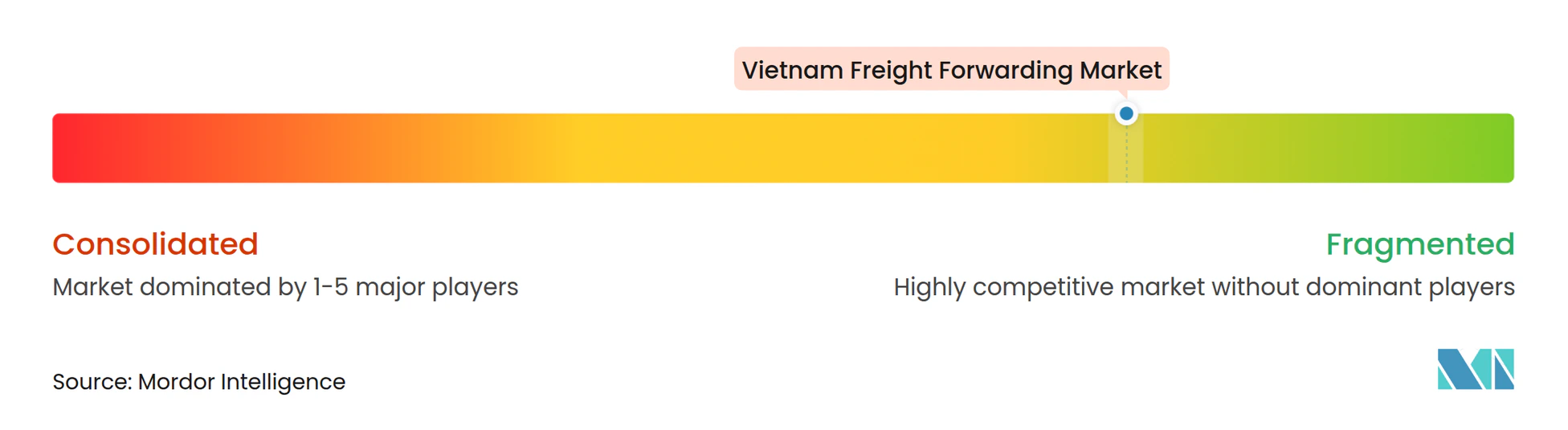
The Vietnam freight forwarding market is fragmented, with global logistics groups competing alongside domestic providers. DHL Group, A.P. Moller-Maersk, Kuehne+Nagel, DSV, and NX Group compete through international networks, carrier relationships, and integrated logistics services. Vietnamese providers, including ITL, Transimex, Bee Logistics, Vietfracht, and Gemadept, draw on local market knowledge and domestic transport or port-related capabilities. Competition varies by cargo type, route, customer size, and service requirements. Providers can differentiate themselves through reliable capacity, customs expertise, specialized handling, and coordinated inland transport rather than price alone.
Infrastructure and integrated customer contracts remain important competitive tools. In November 2025, DHL Global Forwarding expanded its Container Freight Station capacity in Ho Chi Minh City and Hai Phong, strengthening cargo consolidation and handling capabilities. In September 2025, Kuehne+Nagel and the LEGO Group opened their Dong Nai regional distribution centre, integrating transport, customs, bonded warehousing, and regional distribution. These developments illustrate how international providers can embed forwarding services within customer supply chains. Specialized healthcare logistics, high-value cargo handling, and multimodal coordination offer further opportunities for differentiation.
Digital integration and partnerships are also influencing competition. In March 2025, Samsung SDS presented AI-based shipment predictions and disruption-monitoring capabilities for its Cello Square platform. In March 2026, CJ Logistics and Gemadept announced a strategic optimization of their logistics and shipping operations, with the aim of focusing each business on its respective strengths. The companies' subsequent restructuring announcement in April 2026 further clarified the intended separation of logistics and shipping operations. These developments highlight the importance of operational specialization, local infrastructure, and technology. Forwarders that combine domestic execution with international network access and compatible digital systems are better positioned to address complex customer requirements.
Vietnam Freight Forwarding Industry Leaders
-
Indo Trans Logistics Corporation (ITL)
-
Bee Logistics Corporation
-
DHL Global Forwarding
-
DSV
-
Kuehne+Nagel
- *Disclaimer: Major Players sorted in no particular order
Recent Industry Developments
- April 2026: CJ Logistics announced a restructuring of its Vietnamese logistics and shipping businesses, including a plan to obtain full ownership of the logistics business and separate the shipping operations. The change is intended to strengthen its focus on contract logistics and operational efficiency.
- April 2026: APM Terminals and Hateco announced an agreement with Danang City to develop, build, and operate a new container terminal at Lien Chieu Port. The project involves planned investment exceeding USD 1.7 billion and an estimated annual handling capacity of more than 5.7 million TEUs at full development.
- March 2026: Gemadept and CJ Logistics announced a strategic optimization of their logistics and shipping operations. The arrangement aims to strengthen Gemadept's port-logistics ecosystem and CJ Logistics' distribution-centre-led logistics business.
- January 2026: Kuehne+Nagel announced an expansion of Schwalbe's Vietnamese export distribution centre to nearly 20,000 m², marking 10 years of collaboration and strengthening the facility's role in serving international markets.
Vietnam Freight Forwarding Market Report Scope
| Ocean Freight Forwarding | Full Container Load (FCL) |
| Less-Than-Container Load (LCL) | |
| Road Freight Forwarding | Full Truck Load (FTL) |
| Less-Than-Truck Load (LTL) | |
| Air Freight Forwarding | |
| Rail Freight Forwarding | |
| Multimodal and Intermodal Forwarding |
| Small and Medium Enterprises |
| Large Enterprises |
| Traditional Asset-Light Forwarders |
| Digital-First / Online Platforms |
| Hybrid Asset-Enabled Forwarders |
| Industrial and Manufacturing |
| Retail and E-commerce |
| Healthcare and Pharmaceuticals |
| Oil, Gas and Energy |
| Food and Beverages |
| Automotive |
| Chemicals |
| Other End-Users |
| Northern Vietnam |
| Central Vietnam |
| Southern Vietnam |
| By Mode of Transport | Ocean Freight Forwarding | Full Container Load (FCL) |
| Less-Than-Container Load (LCL) | ||
| Road Freight Forwarding | Full Truck Load (FTL) | |
| Less-Than-Truck Load (LTL) | ||
| Air Freight Forwarding | ||
| Rail Freight Forwarding | ||
| Multimodal and Intermodal Forwarding | ||
| By Enterprise Size | Small and Medium Enterprises | |
| Large Enterprises | ||
| By Forwarder Model | Traditional Asset-Light Forwarders | |
| Digital-First / Online Platforms | ||
| Hybrid Asset-Enabled Forwarders | ||
| By End-User Industry | Industrial and Manufacturing | |
| Retail and E-commerce | ||
| Healthcare and Pharmaceuticals | ||
| Oil, Gas and Energy | ||
| Food and Beverages | ||
| Automotive | ||
| Chemicals | ||
| Other End-Users | ||
| By Region | Northern Vietnam | |
| Central Vietnam | ||
| Southern Vietnam | ||
Key Questions Answered in the Report
How large is the Vietnam freight forwarding market?
The market was valued at USD 4.68 billion in 2026 and is estimated to reach USD 5.00 billion in 2027 and USD 6.89 billion by 2032.
Which transport mode leads the market?
Ocean freight forwarding leads with 76.39% of market revenue in 2026, supported by containerized manufacturing exports and international maritime connections.
Which transport mode is growing fastest?
Air freight forwarding is projected to register an 8.41% CAGR from 2027 to 2032, supported by demand for time-sensitive and high-value shipments.
Which enterprise group accounts for the largest market share?
Large enterprises account for 69.12% of market revenue in 2026, reflecting demand for integrated forwarding, customs, warehousing, and international distribution.
Which end-user industry is expected to grow fastest?
Healthcare and pharmaceuticals is projected to register an 8.64% CAGR from 2027 to 2032, supported by demand for specialized handling and controlled storage.
Why is Central Vietnam important for logistics providers?
Central Vietnam is projected to register a 7.82% CAGR from 2027 to 2032. Planned port development and improved connectivity could expand its role in international freight forwarding.