
Vietnam Fourth-Party Logistics Market Size and Share
Market Overview
| Study Period | 2021 - 2032 |
|---|---|
| Forecast Data Period | 2027 - 2032 |
| Base Year Market Size (2026) | USD 0.97 Billion |
| Market Size (2027) | USD 1.07 Billion |
| Market Size (2032) | USD 1.69 Billion |
| Growth Rate (2027 - 2032) | 9.51 % |
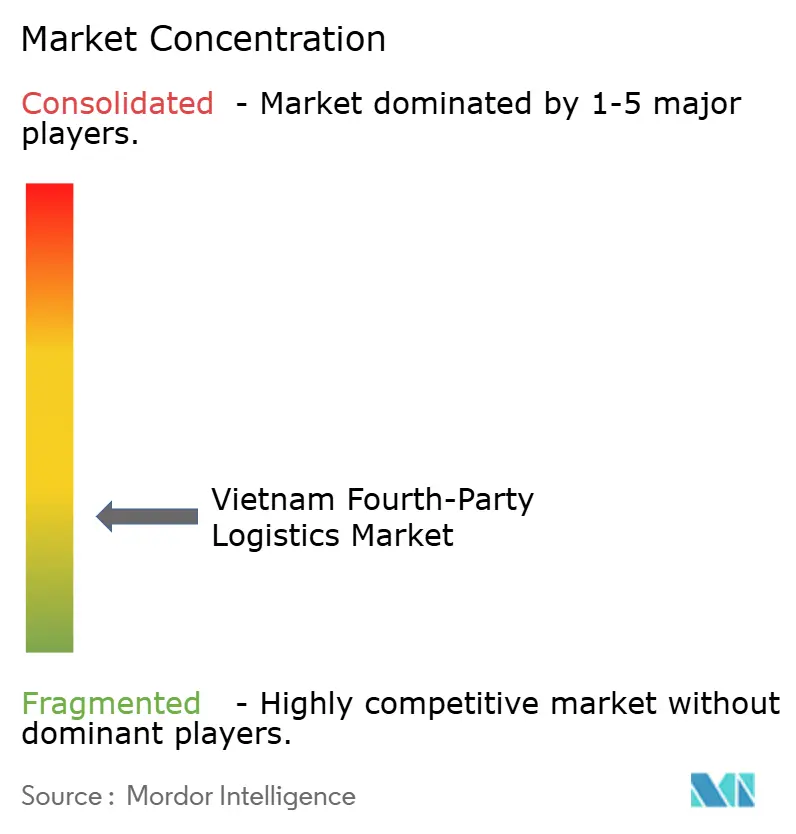
| Market Concentration | Low |
Major Players *Disclaimer: Major Players sorted in no particular order Image © Mordor Intelligence. Reuse requires attribution under CC BY 4.0. | |
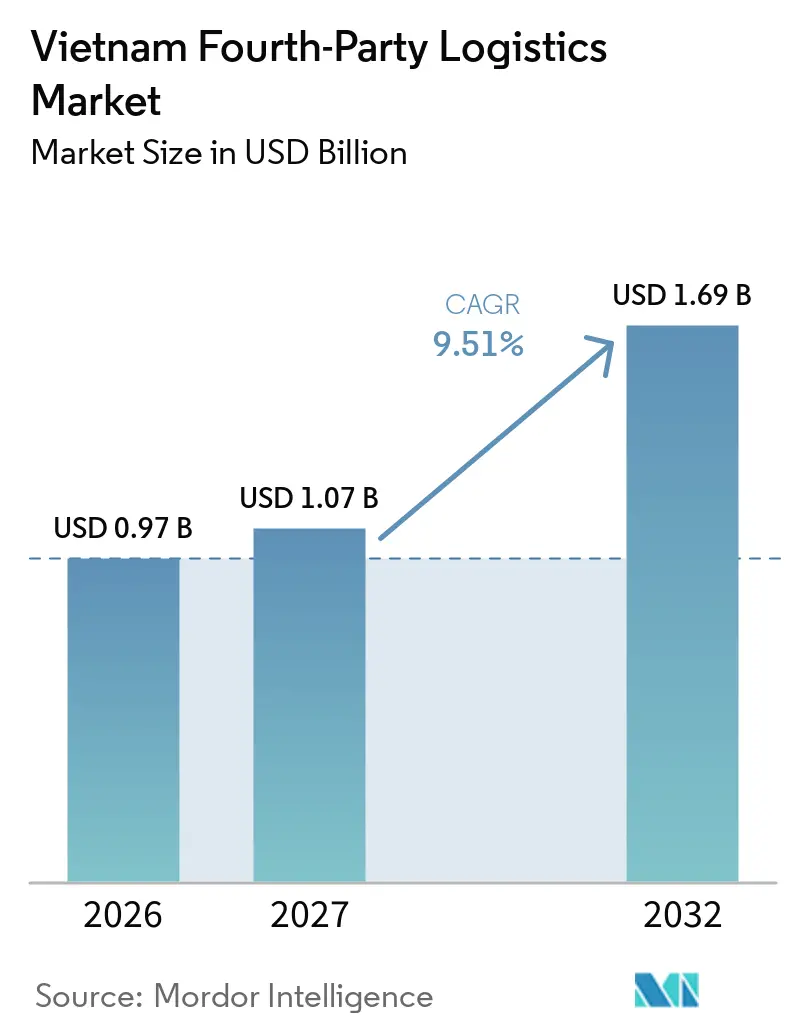
Vietnam Fourth-Party Logistics Market Analysis by Mordor Intelligence
The Vietnam fourth-party logistics (4PL) market is valued at USD 0.97 billion in 2026 and is estimated to grow from USD 1.07 billion in 2027 to USD 1.69 billion by 2032, registering a CAGR of 9.51% during the forecast period 2027–2032.
Demand is supported by Vietnam's manufacturing base, export-oriented supply chains, and the need to coordinate transportation, warehousing, customs clearance, and distribution across multiple logistics providers. The country's realized foreign direct investment reached USD 27.62 billion in 2025. This investment activity supports demand for coordinated supply chain services, particularly among manufacturers managing international sourcing and distribution networks. The government approved Decision No. 2229/QĐ-TTg in October 2025, establishing Vietnam's logistics development strategy for 2025–2035, with a vision to 2050. The strategy targets greater logistics outsourcing, wider adoption of digital transformation solutions, improved workforce capabilities, and modern logistics infrastructure. These priorities create opportunities for 4PL providers that integrate data, coordinate multiple service providers, and improve supply chain visibility.
Key Report Takeaways
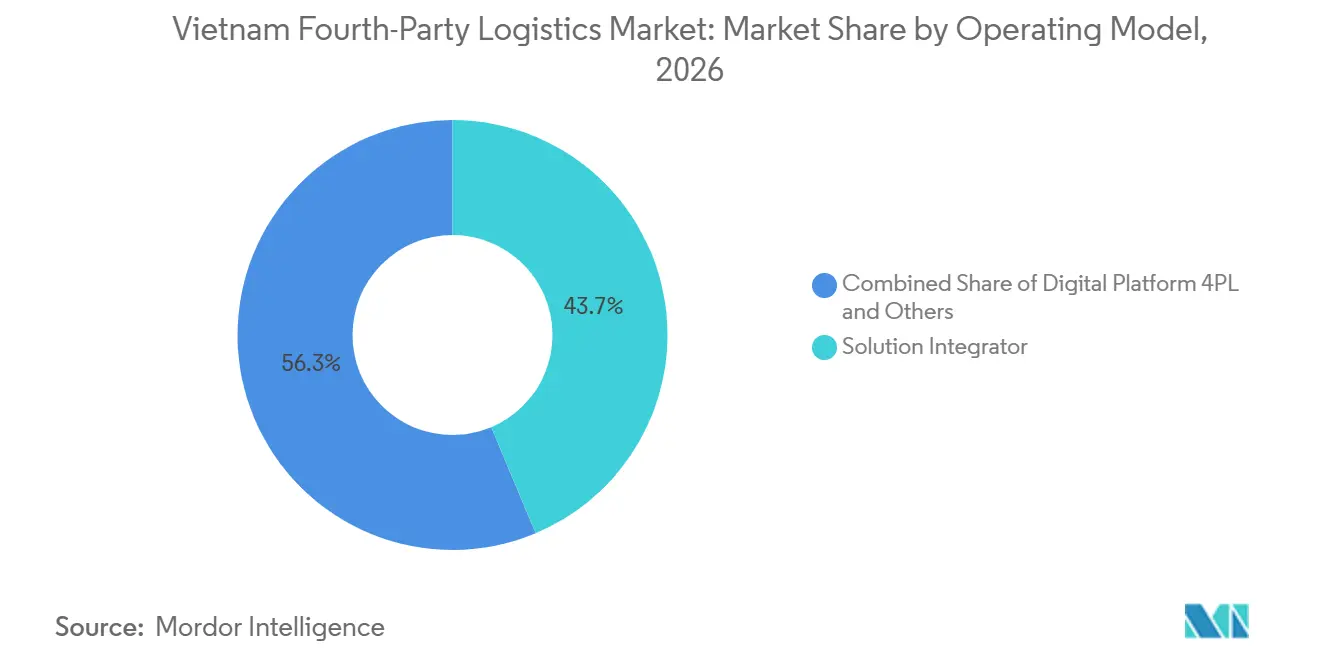
- By operating model, solution integrators account for 43.67% of the Vietnam fourth-party logistics market share in 2026. Digital platform 4PL is projected to register a CAGR of 10.34% during 2027–2032.
- By end-user industry, industrial manufacturing accounts for 32.56% of the Vietnam fourth-party logistics market size in 2026. Retail and e-commerce are projected to register a CAGR of 11.49% during 2027–2032.
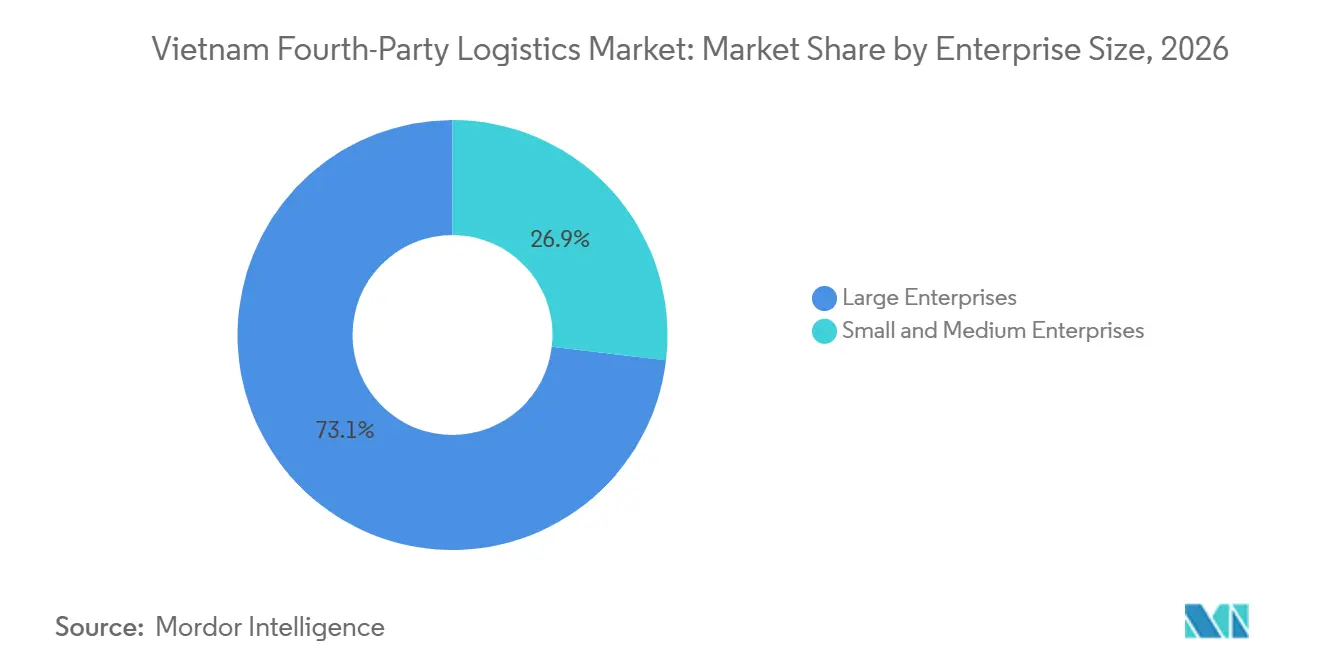
- By enterprise size, large enterprises account for 73.12% of the Vietnam fourth-party logistics market share in 2026. Small and medium enterprises are projected to register a CAGR of 10.96% during 2027–2032.
- By geography, Southern Vietnam accounts for 43.68% of the Vietnam fourth-party logistics market size in 2026. Central Vietnam is projected to register a CAGR of 10.43% during 2026–2031.
Note: Market numbers in this report are based on Mordor Intelligence's proprietary estimation framework, which combines nine months of actuals with Q4 projections for base year 2026.
Vietnam Fourth-Party Logistics Market Trends and Insights
Drivers Impact Analysis*
| Driver | (~) % Impact on CAGR Forecast | Geographic Relevance | Impact Timeline |
|---|---|---|---|
| Logistics Outsourcing Increasing Integrated Supply Chain Demand | +2.5% | National, particularly major manufacturing and export corridors | Short term (≤2 years) |
| Manufacturing Relocation Expanding Multi-Country Coordination Requirements | +2.2% | Northern and Southern Vietnam manufacturing clusters | Medium term (2–4 years) |
| Omnichannel Growth Increasing Complex Fulfillment Orchestration Demand | +1.8% | Major urban and e-commerce centers | Short term (≤2 years) |
| Government Support Encouraging Advanced Logistics Service Adoption | +1.3% | National | Medium term (2–4 years) |
| Fragmented Capacity Increasing Supply Chain Orchestration Needs | +1.0% | National, including developing logistics markets | Medium term (2–4 years) |
| Export Compliance Increasing Carbon and Customs Data Demand | +0.9% | Export-oriented manufacturing and port corridors | Long term (≥4 years) |
| Source: Mordor Intelligence | |||
Logistics Outsourcing Increasing Integrated Supply Chain Demand
Vietnam's logistics development strategy for 2025–2035 targets a logistics outsourcing rate of 70–80%, reflecting the government's intention to encourage wider use of professional logistics services. This policy direction creates opportunities for 4PL providers to coordinate transportation, warehousing, customs procedures, and distribution across multiple service providers. Manufacturers with complex sourcing and export networks can benefit from centralized performance monitoring, carrier management, and shipment visibility. The opportunity depends on whether shippers choose to transfer coordination responsibilities to independent integrators rather than manage individual logistics contracts internally.
Manufacturing Relocation Expanding Multi-Country Coordination Requirements
Vietnam's manufacturing activity creates demand for coordinated inbound materials, factory inventory, customs documentation, and outbound distribution. Manufacturers operating across several Asian sourcing markets need to align supplier schedules with production requirements and export commitments. Fourth-party logistics providers can support these operations by integrating multiple carriers and logistics partners into a common planning and monitoring structure. The country's role in international manufacturing networks therefore provides a structural opportunity for providers with cross-border coordination capabilities, reliable local partners, and technology that connects shipment and inventory information.
Omnichannel Growth Increasing Complex Fulfillment Orchestration Demand
Expanding online sales increase the need to coordinate inventory allocation, fulfillment, delivery, and returns across marketplaces and logistics partners. Fourth-party logistics providers can help retailers consolidate operational data and manage service performance across different channels. Demand is likely to be strongest among businesses with multiple distribution points, diverse delivery requirements, and high shipment volumes. The market opportunity will depend on providers' ability to integrate retailer systems and maintain reliable last-mile service coverage.
Government Support Encouraging Advanced Logistics Service Adoption
Vietnam approved Decision No. 2229/QĐ-TTg in October 2025, setting a national direction for logistics development through 2035 and beyond[1]. The strategy includes targets for digital transformation adoption, professional workforce development, logistics outsourcing, and modern logistics centers. These measures support an environment in which logistics operators have greater incentives to improve data management, service integration, and operating efficiency. Implementation will determine the pace of adoption, as technology investment, workforce readiness, and coordination between logistics providers remain important considerations.
Restraints Impact Analysis*
| Restraint | (~) % Impact on CAGR Forecast | Geographic Relevance | Impact Timeline |
|---|---|---|---|
| Skilled Talent Shortages Limiting Advanced Planning Capabilities | -1.4% | National, particularly outside major logistics centers | Short term (≤2 years) |
| Legacy Systems Hindering Integrated Data Exchange Efficiency | -1.1% | National, especially among smaller logistics operators | Medium term (2–4 years) |
| Shipper Data Reluctance Restricting End-to-End Visibility | -0.7% | National | Medium term (2–4 years) |
| Regional Infrastructure Gaps Reducing Network Optimization Efficiency | -0.8% | Developing logistics corridors | Long term (≥4 years) |
| Source: Mordor Intelligence | |||
Skilled Talent Shortages Limiting Advanced Planning Capabilities
Fourth-party logistics operations require personnel who can combine transportation planning, data analysis, customs knowledge, and supplier coordination. A shortage of employees with these combined capabilities can constrain the implementation of advanced control towers and integrated supply chain services. Providers may need to invest in internal training and recruitment before taking responsibility for complex customer accounts. Differences in workforce availability between major logistics centers and less-developed locations can also affect service consistency and the cost of expanding operations.
Legacy Systems Hindering Integrated Data Exchange Efficiency
Fourth-party logistics providers depend on reliable information exchange among carriers, warehouses, customs brokers, manufacturers, and retailers. Incompatible software, manual documentation, and inconsistent data standards can prevent real-time visibility across these partners. Smaller operators may also face financial and technical constraints when upgrading their systems. These limitations can increase implementation time, require additional manual reconciliation, and reduce the effectiveness of centralized planning. Providers must therefore combine technology integration with partner onboarding, data governance, and standardized operating procedures.
*Our forecasts treat driver/restraint impacts as directional, not additive. The impact forecasts reflect baseline growth, mix effects, and variable interactions.
Segment Analysis
By Operating Model: Solution Integrators Lead as Digital Platforms Expand
Solution integrators account for a 43.67% share of the Vietnam fourth-party logistics market in 2026. Their position reflects the need among complex shippers to coordinate transportation providers, warehouses, customs brokers, and distribution partners through a single management structure. These services are relevant to manufacturers with international sourcing networks and multiple export destinations. Solution Integrators can centralize performance monitoring and exception management while allowing customers to retain existing relationships with individual logistics operators.
Digital platform 4PL is projected to register a CAGR of 10.34% during 2027–2032. Cloud-based control towers, system interfaces, and automated reporting can improve shipment visibility and reduce manual coordination. In February 2026, Samsung SDS showcased its Cello Square digital logistics capabilities at Manifest 2026, highlighting control-tower monitoring and technology-enabled supply chain management[2]. Platform adoption will depend on integration with local service providers, the availability of accurate data, and the ability to support customers' existing operating systems.

By End-User Industry: Manufacturing Anchors Demand as E-Commerce Expands
Industrial manufacturing accounts for 32.56% of the Vietnam fourth-party logistics market size in 2026. Manufacturers often need to coordinate component sourcing, factory inventory, customs documentation, and finished-goods distribution across multiple suppliers and transport providers. These requirements make integrated supply chain management relevant to businesses operating across several production locations and international markets. Fourth-party logistics services can help align inbound materials with production schedules and coordinate outbound deliveries against customer requirements.
Retail and e-commerce is projected to register a CAGR of 11.49% during 2027–2032. The expansion of online commerce increases the need for inventory visibility, fulfillment coordination, delivery monitoring, and returns management. Retailers with several sales channels can benefit from centralized oversight of different logistics partners. Adoption will depend on fulfillment complexity, integration costs, and the reliability of last-mile networks.
By Enterprise Size: Large Enterprises Lead as SME Access Improves
Large enterprises account for 73.12% of the Vietnam fourth-party logistics market share in 2026. Large shippers commonly operate extensive supplier networks and require coordination across transport modes, customs processes, warehouses, and distribution channels. They may also require integration between logistics systems and enterprise resource planning platforms. These requirements create opportunities for 4PL providers to deliver dedicated coordination, performance monitoring, and network optimization services.
Small and medium enterprises are projected to register at a CAGR of 10.96% during 2027–2032. Digital platforms can make shipment visibility, documentation, logistics coordination, and access to partner services more accessible to smaller businesses. In September 2025, Vietnam SuperPort and Vietnam Post Logistics, together with Visa and other partners, launched the Logistics Marketplace Platform to support SMEs with digital order-to-payment processes, shipment visibility, and access to logistics and financial services[3]. The extent to which this development translates into 4PL adoption will depend on onboarding requirements, service pricing, and integration with existing business processes.
Geography Analysis
Southern Vietnam accounts for 43.68% of the market in 2026. Ho Chi Minh City, the surrounding manufacturing clusters, and the Cai Mep–Thi Vai deep-sea port complex support the region's role in international trade and distribution. The concentration of export-oriented manufacturers creates demand for coordinated transport, customs procedures, warehousing, and shipping arrangements. In April 2026, Gemadept and CMA CGM held the groundbreaking ceremony for Phase 2 of Gemalink Deep-Sea Port. The expansion is expected to increase the port's annual capacity to more than 3 million TEU upon completion, strengthening the region's infrastructure for international cargo flows.
Northern Vietnam is an important manufacturing and distribution region, connecting industrial areas around Hanoi and neighboring provinces with Hai Phong Port and Noi Bai International Airport. Manufacturers operating across international sourcing networks need coordinated inbound shipments, factory replenishment, customs processes, and export distribution. In July 2026, DHL Supply Chain broke ground on its DHL North Logistics Campus in Hung Yen. The project represents an investment of EUR 63 million (USD 74.03 million)[4]. Its planned logistics facilities are intended to strengthen the company's operating footprint and support supply chain requirements in Northern Vietnam.
Central Vietnam is projected to register a CAGR of 10.43% during 2027–2032. The region offers opportunities for logistics coordination as industrial activity, port connectivity, and regional distribution requirements develop. However, the availability of integrated logistics facilities and reliable service-provider networks can vary by location. Fourth-party logistics providers can help businesses coordinate available transport and warehousing resources, although infrastructure gaps may constrain efficiency. The pace of market development will depend on industrial investment, regional connectivity, logistics facility development, and the ability of providers to establish dependable partner networks.
Competitive Landscape
The Vietnam fourth-party logistics market is fragmented and includes international logistics integrators, domestic logistics companies, and technology-enabled service providers. DHL Group, DSV, A.P. Moller–Maersk, and Kuehne+Nagel have international networks and supply chain management capabilities that can support customers with cross-border sourcing and distribution requirements. Their ability to coordinate transport, warehousing, customs processes, and regional distribution can be relevant to multinational customers operating in Vietnam.
Technology integration is an important competitive consideration because customers require timely information across multiple logistics partners. Digital platforms can support shipment monitoring, booking, performance reporting, and exception management. In February 2026, Samsung SDS showcased its Cello Square platform at Manifest 2026, highlighting digital logistics and control-tower capabilities. Domestic operators can complement these capabilities through local operating knowledge, physical infrastructure, and established regional relationships.
Strategic partnerships and operational specialization are also shaping the competitive environment. In March 2026, Gemadept and CJ Logistics announced a restructuring of their logistics and shipping joint-venture operations, with Gemadept focusing on shipping and CJ Logistics taking responsibility for 3PL services. In October 2025, Vietnam Post Logistics announced a partnership with Phenikaa-X to develop smart warehouse systems using autonomous robotics and AI-enabled warehouse management.
Vietnam Fourth-Party Logistics Industry Leaders
-
DHL Group
-
DSV
-
A.P. Moller - Maersk
-
Indo Trans Logistics Corporation (ITL)
-
Gemadept Corporation
- *Disclaimer: Major Players sorted in no particular order
Recent Industry Developments
- July 2026: Vietnam Post Logistics and DSV Contract Logistics Vietnam held a contract renewal ceremony on July 13, 2026, continuing their collaboration in B2B supply chain services.
- April 2026: Gemadept and CMA CGM held the groundbreaking ceremony for Phase 2 of Gemalink Deep-Sea Port, with planned annual capacity exceeding 3 million TEU after completion.
- March 2026: Gemadept and CJ Logistics announced a restructuring of their logistics and shipping joint-venture operations, assigning shipping operations to Gemadept and 3PL operations to CJ Logistics.
- September 2025: Kuehne+Nagel and the LEGO Group opened a regional distribution center in Dong Nai to support distribution from LEGO's Vietnam manufacturing operations to Asia-Pacific markets.
Vietnam Fourth-Party Logistics Market Report Scope
| Lead Logistics Provider (LLP) |
| Solution Integrator |
| Digital Platform 4PL |
| FMCG |
| Retail and E-commerce |
| Fashion and Lifestyle |
| Technology and Electronics |
| Refrigerated and Pharma |
| Automotive and Mobility |
| Industrial Manufacturing |
| Others |
| Small and Medium Enterprises |
| Large Enterprises |
| Northern Vietnam |
| Central Vietnam |
| Southern Vietnam |
| By Operating Model | Lead Logistics Provider (LLP) |
| Solution Integrator | |
| Digital Platform 4PL | |
| By End-User Industry | FMCG |
| Retail and E-commerce | |
| Fashion and Lifestyle | |
| Technology and Electronics | |
| Refrigerated and Pharma | |
| Automotive and Mobility | |
| Industrial Manufacturing | |
| Others | |
| By Enterprise Size | Small and Medium Enterprises |
| Large Enterprises | |
| By Region | Northern Vietnam |
| Central Vietnam | |
| Southern Vietnam |
Key Questions Answered in the Report
What is the projected size of the Vietnam fourth-party logistics market by 2032?
The Vietnam fourth-party logistics market is projected to reach USD 1.69 billion by 2032, from USD 1.07 billion in 2027, at a CAGR of 9.51% during 2027–2032.
Which operating model leads the Vietnam fourth-party logistics market?
Solution integrators hold a 43.67% market share in 2026.
Which end-user industry is projected to grow fastest?
Retail and e-Commerce is projected to record a CAGR of 11.49% during 2026–2031.
Why do large enterprises use fourth-party logistics services?
Large enterprises may use 4PL services to coordinate multiple logistics providers, improve shipment visibility, integrate enterprise systems, and manage supply chain performance across locations. Large Enterprises hold a 73.12% market share in 2026.
Which region accounted for the largest market share in 2025?
Southern Vietnam account for 43.68% of the market in 2026.
What are the main barriers to 4PL adoption in Vietnam?
Key barriers include shortages of personnel with advanced logistics and data-management skills, incompatible information systems, limited data sharing, and differences in regional logistics infrastructure.