
Vietnam Cold Chain Logistics Market Size and Share
Market Overview
| Study Period | 2021 - 2032 |
|---|---|
| Forecast Data Period | 2027 - 2032 |
| Base Year Market Size (2026) | USD 3.38 Billion |
| Market Size (2027) | USD 3.65 Billion |
| Market Size (2032) | USD 5.26 Billion |
| Growth Rate (2027 - 2032) | 7.59 % |
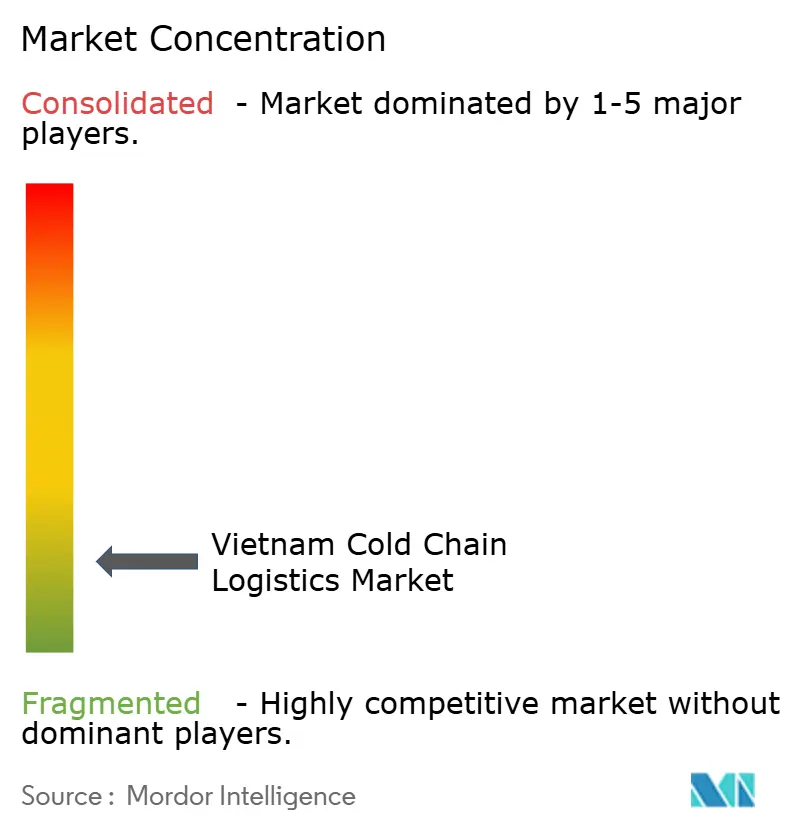
| Market Concentration | Low |
Major Players *Disclaimer: Major Players sorted in no particular order Image © Mordor Intelligence. Reuse requires attribution under CC BY 4.0. | |
Vietnam Cold Chain Logistics Market Analysis by Mordor Intelligence
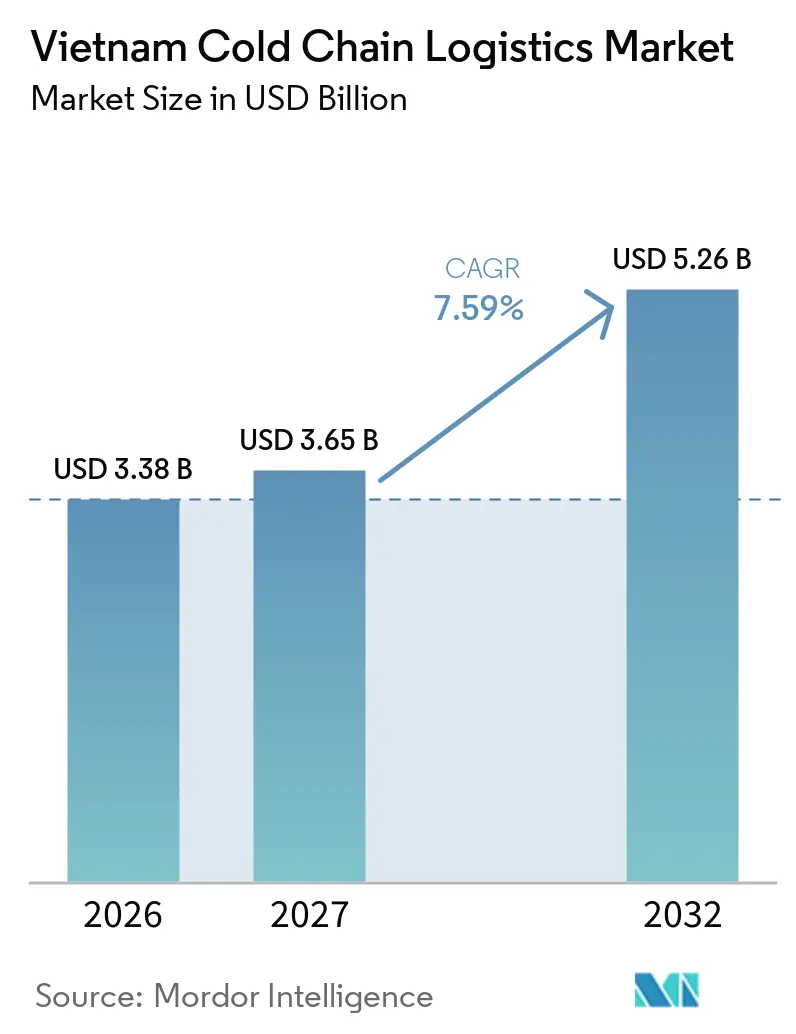
The Vietnam cold chain logistics market size is valued at USD 3.38 billion in 2026 and is estimated to grow from USD 3.65 billion in 2027 to reach USD 5.26 billion by 2032, at a CAGR of 7.59 % during the forecast period 2027-2032.
Demand is supported by seafood exports, agricultural trade, organized retail, and healthcare distribution, all of which require temperature-controlled storage and transportation. Southern Vietnam remains a key logistics center because of its concentration of food-processing facilities, agricultural production, industrial zones, and port infrastructure. Investment is increasingly focused on storage automation, energy efficiency, and temperature monitoring to improve operating performance and product integrity. Vietnam's cold chain logistics industry serves a broad range of temperature-sensitive products, from frozen seafood and meat to fresh produce, vaccines, and clinical trial materials. Exporters require reliable temperature control across processing, storage, inland transportation, and international shipping. Healthcare customers also require validated facilities, calibrated monitoring equipment, and documented handling procedures.
Key Report Takeaways
- By temperature type, frozen accounts for 43.67% of the Vietnam cold chain logistics market share in 2026, while deep-frozen / ultra-low is projected to register a CAGR of 9.23% during 2027–2032.
- By automation level, conventional facilities account for 88.35% of the Vietnam cold chain logistics market size in 2026, while automated cold stores are projected to register a CAGR of 8.61% during 2027–2032.
- By application, fish and seafood account for 36.72% of the Vietnam cold chain logistics market share in 2026, while vaccines and clinical trial materials are projected to register a CAGR of 8.92% during 2027–2032.
- By geography, Southern Vietnam accounts for 45.18% of the Vietnam cold chain logistics market size in 2026, while Central Vietnam is projected to register a CAGR of 9.29% during 2027–2032.
Note: Market numbers in this report are based on Mordor Intelligence's proprietary estimation framework, which combines nine months of actuals with Q4 projections for base year 2026.
Vietnam Cold Chain Logistics Market Trends and Insights
Drivers Impact Analysis*
| Driver | (~) % Impact on CAGR Forecast | Geographic Relevance | Impact Timeline |
|---|---|---|---|
| Seafood Exports Increasing Temperature-Controlled Logistics Demand | +2.0% | Southern Vietnam and the Mekong Delta, with connections to other export corridors | Medium term (2–4 years) |
| Agricultural Exports Expanding Perishable Supply Chain Volumes | +1.2% | Mekong Delta, Northern Vietnam, and Central Vietnam | Medium term (2–4 years) |
| Modern Retail Growth Strengthening Chilled Distribution Requirements | +0.8% | Ho Chi Minh City, Hanoi, Da Nang, Can Tho, and Bien Hoa | Short term (≤2 years) |
| Pharmaceutical Demand Increasing Specialized Cold-Chain Service Needs | +1.0% | Hanoi, Ho Chi Minh City, and nationwide healthcare distribution networks | Long term (≥4 years) |
| E-Commerce Growth Accelerating Temperature-Controlled Last-Mile Deliveries | +0.6% | Major cities and surrounding urban areas | Short term (≤2 years) |
| Traceability Requirements Driving Digital Temperature Monitoring Adoption | +0.4% | Export corridors and domestic distribution networks | Medium term (2–4 years) |
| Source: Mordor Intelligence | |||
Seafood Exports Increasing Temperature-Controlled Logistics Demand
Vietnam's seafood industry generates recurring demand for freezing, refrigerated storage, and reefer transportation near processing facilities and export gateways. Vietnam's seafood exports reached approximately USD 11.3 billion in 2025[1]. This trade supports demand for facilities that preserve product quality between processing and international shipment. The cold chain logistics market benefits from the need to maintain consistent temperatures across storage, inland transportation, and port handling. However, demand remains exposed to export volumes, destination-market requirements, and changes in the product mix.
Agricultural Exports Expanding Perishable Supply Chain Volumes
Vietnam's fruit, vegetable, and other agricultural exports create demand for pre-cooling, refrigerated storage, and controlled transportation. Perishable goods can lose quality during collection, consolidation, and transit when temperature management is inconsistent. Cold chain providers can reduce these risks by connecting production areas with packing facilities, storage centers, and export gateways. In September 2025, Toan Phat Logistics, Kawanishi Warehouse, and MOL Logistics announced a strategic alliance to develop an integrated logistics hub combining irradiation, cold storage, and port connectivity. The development illustrates the importance of coordinating specialized handling services for agricultural and seafood exports.
Modern Retail Growth Strengthening Chilled Distribution Requirements
Supermarkets, convenience stores, and other organized retail formats require consistent replenishment of chilled dairy, meat, ready-to-eat meals, and fresh produce. These product categories require temperature-controlled storage and delivery, often alongside frozen and ambient goods. Cold chain operators can serve these requirements through multi-temperature facilities, coordinated distribution routes, and digital monitoring. Expansion beyond the largest urban markets can increase the need for regional storage and distribution points. Service quality will depend on reliable transport coverage, inventory planning, and the ability to maintain appropriate temperatures across delivery routes.
Pharmaceutical Demand Increasing Specialized Cold-Chain Service Needs
Vaccines, biologics, and clinical trial materials require stricter temperature control and traceability than many conventional pharmaceutical products. Their distribution can involve validated storage areas, calibrated monitoring equipment, alarm management, and documented handling procedures. These requirements create opportunities for specialized cold chain providers serving hospitals, pharmaceutical distributors, laboratories, and healthcare manufacturers. In 2025, Vietnam Airlines supported domestic vaccine transportation through the national immunization network. The development of specialized facilities and reliable temperature-controlled transport can help improve healthcare distribution, although the scale of commercial demand depends on pharmaceutical production, imports, and healthcare procurement.
Restraints Impact Analysis*
| Restraint | (~) % Impact on CAGR Forecast | Geographic Relevance | Impact Timeline |
|---|---|---|---|
| High Capital Costs Limiting Cold-Chain Capacity Expansion | -1.2% | Nationwide, particularly developing logistics corridors | Long term (≥4 years) |
| Energy Costs Increasing Refrigerated Storage Operating Expenses | -0.8% | Nationwide, especially large refrigerated facilities | Medium term (2–4 years) |
| Fragmented Transport Networks Reducing Cold-Chain Service Consistency | -0.7% | Central Vietnam, the Mekong Delta, and North–South routes | Medium term (2–4 years) |
| Supply-Demand Imbalances Lowering Return-Load Utilization Efficiency | -0.5% | Nationwide, particularly refrigerated trucking corridors | Medium term (2–4 years) |
| Source: Mordor Intelligence | |||
High Capital Costs Limiting Cold-Chain Capacity Expansion
Cold storage development requires substantial investment in land, buildings, refrigeration equipment, insulation, backup systems, and handling infrastructure. Automated facilities can require additional expenditure on robotic handling, intelligent racking, and warehouse management systems. These costs can make projects difficult to justify where utilization is uncertain, or customers are dispersed. Operators may prioritize established industrial and export corridors where demand is more predictable, leaving some regional markets with fewer modern facilities. Investment decisions therefore depend on expected throughput, access to suitable locations, energy costs, and long-term customer contracts.
Energy Costs Increasing Refrigerated Storage Operating Expenses
Refrigeration and ventilation create substantial operating requirements, particularly in facilities handling deep-frozen products. Electricity consumption can place pressure on margins when utilization is low or equipment is inefficient. Modern facilities can mitigate some of these costs through efficient refrigeration systems, improved insulation, automation, and renewable-energy installations. In March 2025, Yokorei completed a cold storage facility in Long An featuring rooftop solar power and energy-efficient equipment. Such investments illustrate the options available to operators seeking to manage energy use. However, their financial benefits depend on facility design, operating conditions, and energy prices.
*Our forecasts treat driver/restraint impacts as directional, not additive. The impact forecasts reflect baseline growth, mix effects, and variable interactions.
Segment Analysis
By Temperature Type: Frozen Leads as Specialized Low-Temperature Storage Expands
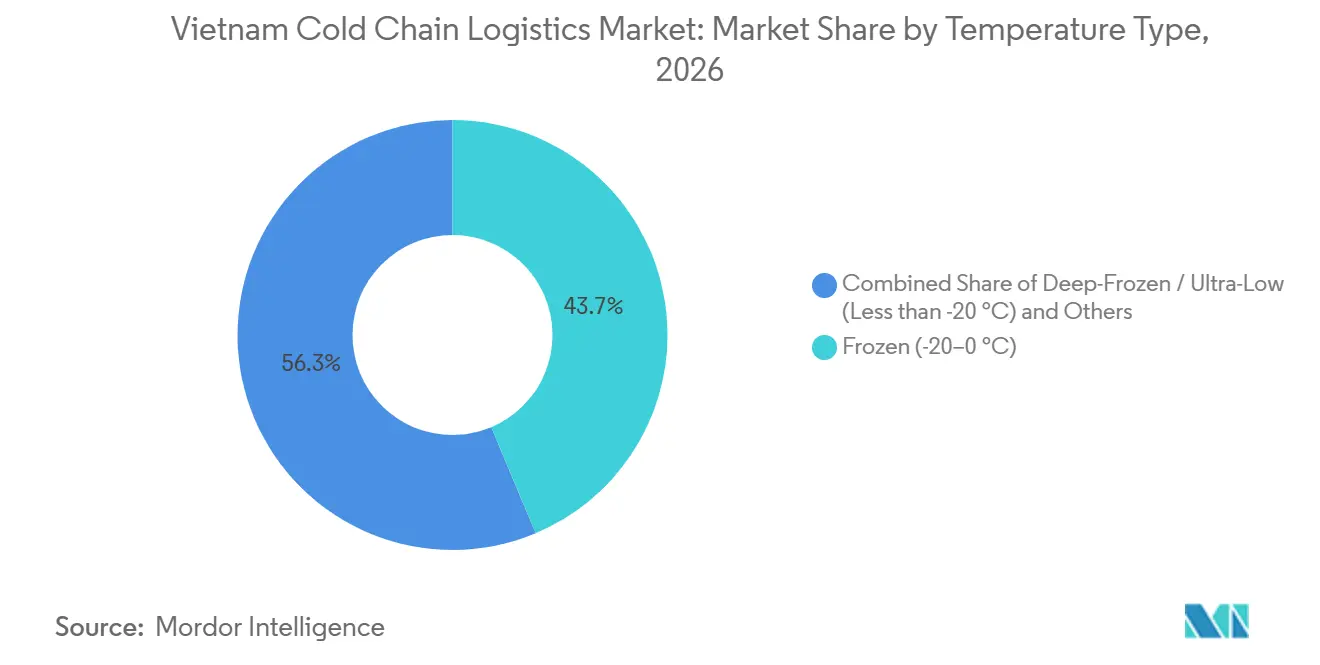
Frozen account for 43.67% of the Vietnam cold chain logistics market share in 2026. Demand is supported by seafood processing, frozen meat and poultry, and processed food distribution. These products require storage and transport conditions that preserve quality throughout domestic distribution and export shipment. Frozen facilities are particularly relevant to seafood-processing clusters and logistics corridors serving international markets. Their utilization depends on export demand, seasonal production, processing capacity, and access to refrigerated transportation.
Deep-frozen / ultra-low is projected to register at a CAGR of 9.23% during 2027–2032. This segment serves products requiring temperatures below -20 °C, including certain high-value seafood and specialized healthcare products. More demanding temperature ranges require suitable refrigeration equipment, insulation, monitoring, and operating procedures. Chilled facilities continue to serve fresh produce, dairy, and other refrigerated products, while ambient facilities handle goods that do not require temperature-controlled storage. These different requirements create opportunities for operators offering specialized facilities and multi-temperature distribution services.

By Automation Level: Conventional Facilities Dominate as Automated Storage Expands
Conventional facilities account for 88.35% of the Vietnam cold chain logistics market size in 2026. Existing warehouses continue to serve a substantial share of demand for frozen foods, seafood, meat, and other temperature-sensitive products. Manual and semi-automated processes remain relevant where throughput, facility design, and investment budgets do not justify full automation. The segment's leading position reflects the established facility base, although the level of automation varies across individual operators and locations.
Automated cold stores are projected to register at a CAGR of 8.61% during 2027–2032. In December 2025, New Era Cold Storage commenced operations in Tay Ninh with an automated storage and retrieval system. The facility was reported to have 110,000 pallet positions, robotic handling, and a multi-tier racking system. Automation can improve storage density, reduce manual handling, and support inventory accuracy in low-temperature environments. However, the economic benefits depend on throughput, system reliability, maintenance requirements, and the cost of capital.
By Application: Fish and Seafood Leads as Healthcare Logistics Expands
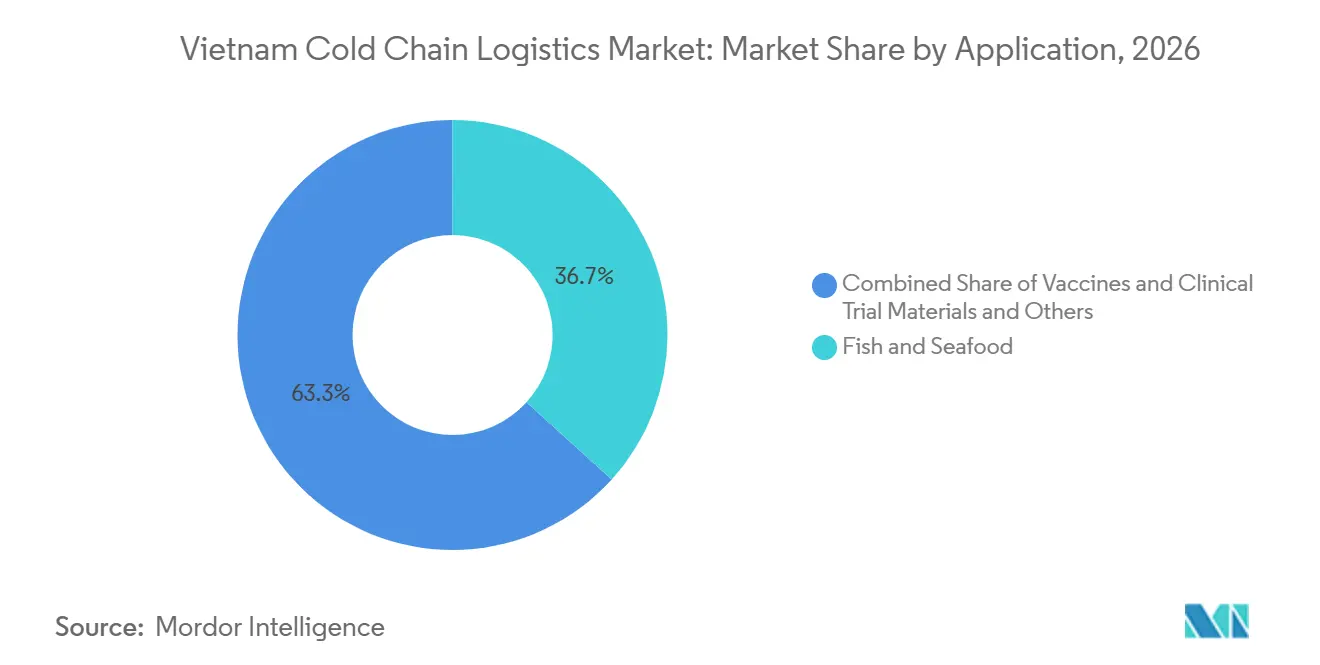
Fish and seafood account for 36.72% of the Vietnam cold chain logistics market share in 2026. Seafood processing and exports require freezing, storage, reefer transportation, and coordination with port operations. Facilities near processing clusters can reduce handling distances and help maintain product quality before shipment. The segment's demand depends on export performance, production cycles, product mix, and the availability of suitable cold storage and transport capacity.
Vaccines and clinical trial materials are projected to register at a CAGR of 8.92% during 2027–2032. These products require controlled handling, documented temperature conditions, and reliable distribution procedures. Growth opportunities depend on healthcare procurement, pharmaceutical imports and production, clinical research activity, and the development of specialized logistics services. Fruits and vegetables require pre-cooling and refrigerated distribution, while meat and poultry and dairy and frozen desserts rely on consistent storage and transport temperatures. Ready-to-eat meals, chemicals, specialty materials, flowers, and horticultural products have distinct handling requirements that may support more specialized cold chain services.
Geography Analysis
Southern Vietnam accounts for 45.18% of the market in 2026, supported by the Mekong Delta's agricultural and seafood production and access to ports serving international trade. Ho Chi Minh City and neighboring provinces provide demand from retailers, food processors, importers, and exporters. In May 2026, LOTTE Global Logistics opened its Dong Nai Cold Chain Center in the Nhon Trach Industrial Park[2]. The facility adds cold chain storage and distribution capacity for import-export cargo and domestic logistics operations.
Northern Vietnam supports food distribution, pharmaceutical logistics, manufacturing, and port-linked trade. Hanoi provides a major consumption and healthcare distribution center, while Hai Phong connects industrial activity with maritime freight. In July 2026, DHL Supply Chain broke ground on its DHL North Logistics Campus in Hung Yen, with an announced investment of VND 1.9 trillion (USD 74.03 million)[3].
Central Vietnam is projected to register a CAGR of 9.29% during 2027–2032. The region offers opportunities for storage and distribution services that connect coastal cities with agricultural production in the Central Highlands. Its future development depends on the growth of food processing, retail distribution, healthcare demand, and transport connectivity. Additional regional facilities could reduce dependence on long-distance refrigerated transportation, but investment viability will depend on customer volumes, utilization, energy costs, and reliable connections to wider logistics networks.
Competitive Landscape
The Vietnam cold chain logistics market is fragmented and includes international logistics groups, specialist cold storage operators, port-linked providers, and domestic warehouse and transport companies. Competition is shaped by facility locations, temperature ranges, storage capacity, food-safety procedures, energy efficiency, and access to refrigerated transportation. International operators can serve customers with cross-border distribution needs, while domestic providers may benefit from local customer relationships and access to regional production clusters.
Infrastructure investment and specialized operating capabilities are important sources of differentiation. In December 2025, New Era Cold Storage commenced operations at an automated facility in Tay Ninh, demonstrating investment in high-density, automated storage. In May 2026, LOTTE Global Logistics opened its Dong Nai Cold Chain Center, adding another facility serving temperature-controlled distribution. Yokorei's Long An project illustrates a different investment approach through refrigeration technology and energy-efficiency measures.
Digital monitoring and temperature traceability are also important to the competitive landscape. In August 2025, Maersk's Asia-Pacific market update discussed reefer visibility tools and digital monitoring for temperature-sensitive cargo[4]. Such systems can help customers monitor cargo conditions during transport and access shipment records. Providers also compete through service reliability, handling procedures, and the ability to coordinate storage and transport.
Vietnam Cold Chain Logistics Industry Leaders
-
ABA Cooltrans
-
Transimex Corporation
-
Lineage
-
Nichirei TBA Logistics Vietnam
-
Konoike Vinatrans Logistics
- *Disclaimer: Major Players sorted in no particular order
Recent Industry Developments
- May 2026: LOTTE Global Logistics opened its Dong Nai Cold Chain Center in Vietnam, adding cold chain storage and distribution capacity.
- April 2026: Gemadept and CMA CGM held the groundbreaking ceremony for Phase 2 of Gemalink Deep-Sea Port. The project supports port capacity expansion but is not itself a cold storage facility.
- March 2026: LOTTE Global Logistics signed a memorandum of understanding with Tan Long Group, Vietnam's largest agricultural and livestock products distributor, to collaborate on upgrading cold chain supply networks, securing local systems and infrastructure, and identifying new business opportunities across Vietnam's logistics and distribution sector.
- December 2025: New Era Cold Storage (NECS) commenced operations in Tay Ninh with a 110,000-pallet capacity under a fully automated deep-freeze model operated by 15 robots and a 19-tier intelligent racking system.
Vietnam Cold Chain Logistics Market Report Scope
| Chilled (0–5 °C) |
| Frozen (-20–0 °C) |
| Ambient |
| Deep-Frozen / Ultra-Low (Less than -20 °C) |
| Conventional Facilities |
| Automated Cold Stores (AS/RS, Robotics) |
| Fruits and Vegetables |
| Meat and Poultry |
| Fish and Seafood |
| Dairy and Frozen Desserts |
| Bakery and Confectionery |
| Ready-to-Eat Meals |
| Pharmaceuticals and Biologics |
| Vaccines and Clinical Trial Materials |
| Chemicals and Specialty Materials |
| Other Perishables |
| Northern Vietnam |
| Central Vietnam |
| Southern Vietnam |
| By Temperature Type | Chilled (0–5 °C) |
| Frozen (-20–0 °C) | |
| Ambient | |
| Deep-Frozen / Ultra-Low (Less than -20 °C) | |
| By Automation Level (Storage) | Conventional Facilities |
| Automated Cold Stores (AS/RS, Robotics) | |
| By Application | Fruits and Vegetables |
| Meat and Poultry | |
| Fish and Seafood | |
| Dairy and Frozen Desserts | |
| Bakery and Confectionery | |
| Ready-to-Eat Meals | |
| Pharmaceuticals and Biologics | |
| Vaccines and Clinical Trial Materials | |
| Chemicals and Specialty Materials | |
| Other Perishables | |
| By Region | Northern Vietnam |
| Central Vietnam | |
| Southern Vietnam |
Key Questions Answered in the Report
What is the projected size of the Vietnam cold chain logistics market by 2032?
The market is projected to reach USD 5.26 billion by 2032, from USD 3.65 billion in 2027, at a CAGR of 7.59% during 2027–2032.
Which temperature segment has the largest market share?
Frozen segment account for 43.67% of the market in 2026.
Which temperature segment is projected to grow fastest?
Deep-frozen / ultra-low is projected to register a CAGR of 9.23% during 2027–2032.
Why is Southern Vietnam important for cold chain logistics?
Southern Vietnam accounts for 45.18% of the market in 2026. Its agricultural and seafood production, industrial clusters, consumer markets, and port connections support demand for temperature-controlled storage and transportation.
What is driving pharmaceutical cold chain demand in Vietnam?
Vaccines, biologics, and clinical trial materials require controlled temperatures, monitoring, and documented handling. These requirements create opportunities for specialized storage and transportation services.
How is automation changing refrigerated storage in Vietnam?
Automated cold stores are projected to register a CAGR of 8.61% during 2027–2032. Automated systems can improve storage density, inventory accuracy, and handling efficiency, although adoption depends on capital costs and throughput.