
Vietnam 3PL Warehousing Market Size and Share
Market Overview
| Study Period | 2021 - 2032 |
|---|---|
| Forecast Data Period | 2027 - 2032 |
| Base Year Market Size (2026) | USD 1.09 Billion |
| Market Size (2027) | USD 1.18 Billion |
| Market Size (2032) | USD 1.72 Billion |
| Growth Rate (2027 - 2032) | 7.81 % |
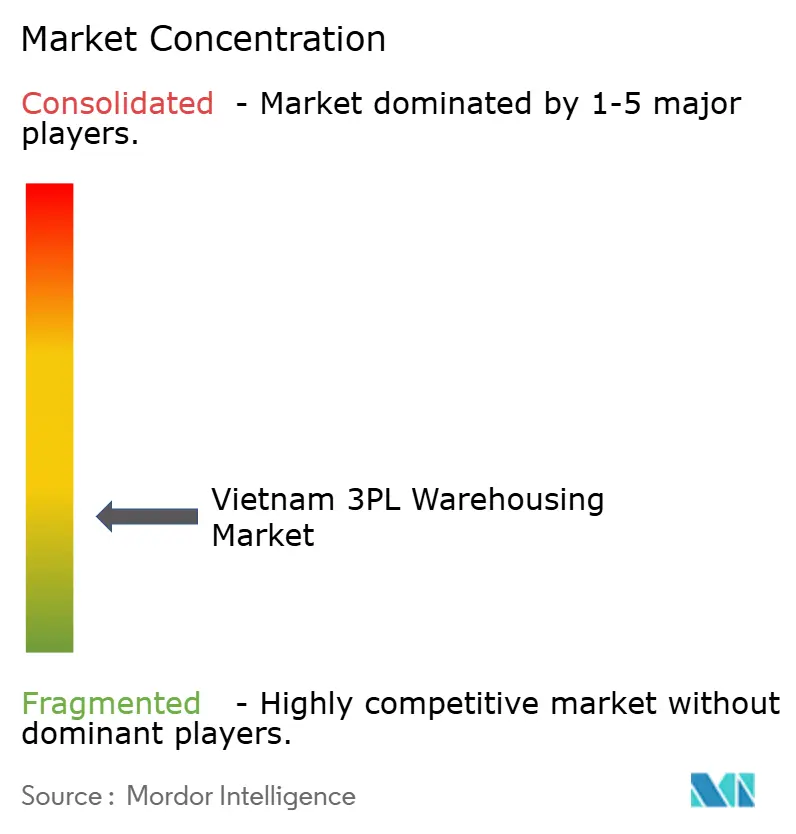
| Market Concentration | Low |
Major Players *Disclaimer: Major Players sorted in no particular order Image © Mordor Intelligence. Reuse requires attribution under CC BY 4.0. | |
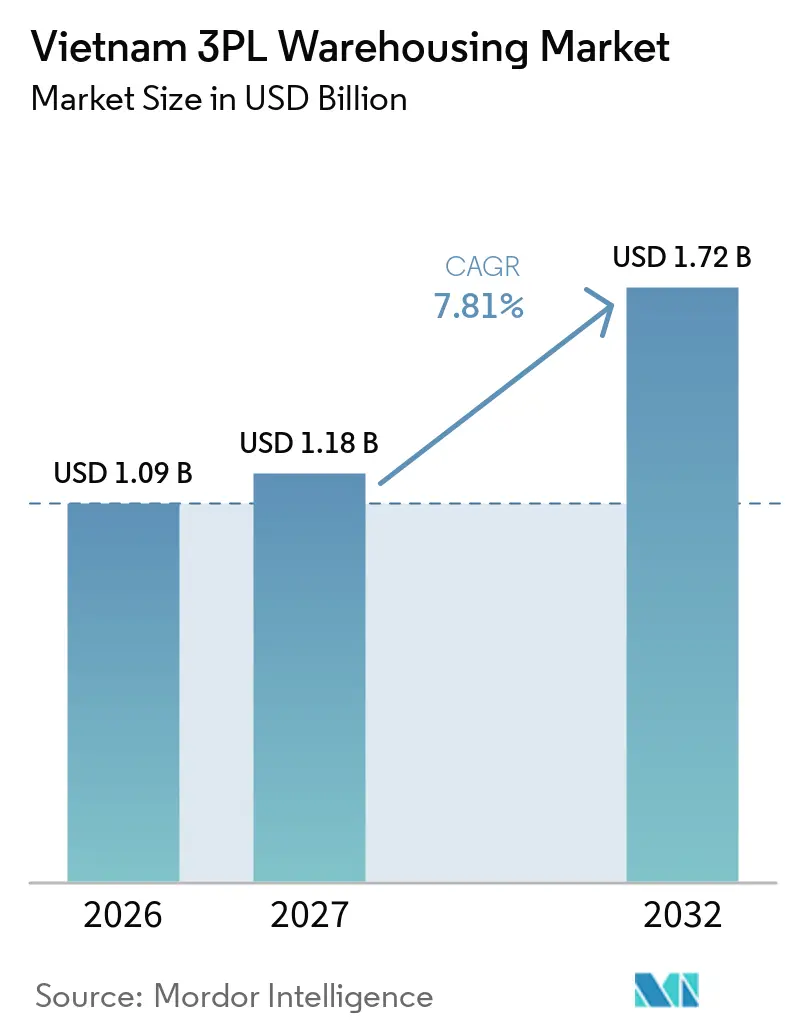
Vietnam 3PL Warehousing Market Analysis by Mordor Intelligence
The Vietnam 3PL warehousing market size was valued at USD 1.09 billion in 2026, and is estimated to grow from USD 1.18 billion in 2027 to reach USD 1.72 billion by 2031, at a CAGR of 7.81% during the forecast period (2027-2032).
Export-oriented manufacturing supports demand for bonded storage, cross-docking, inventory management, and distribution services near industrial parks and seaports. E-commerce is increasing the demand for facilities that combine order processing, labeling, packaging, and returns management. Logistics providers are investing in modern warehouse capacity, while land availability, development costs, and shortages of experienced warehouse personnel can constrain expansion. Vietnam's national logistics strategy, approved in October 2025, also emphasizes modern logistics infrastructure, regional connectivity, digital transformation, and higher-value logistics services.
Key Report Takeaways
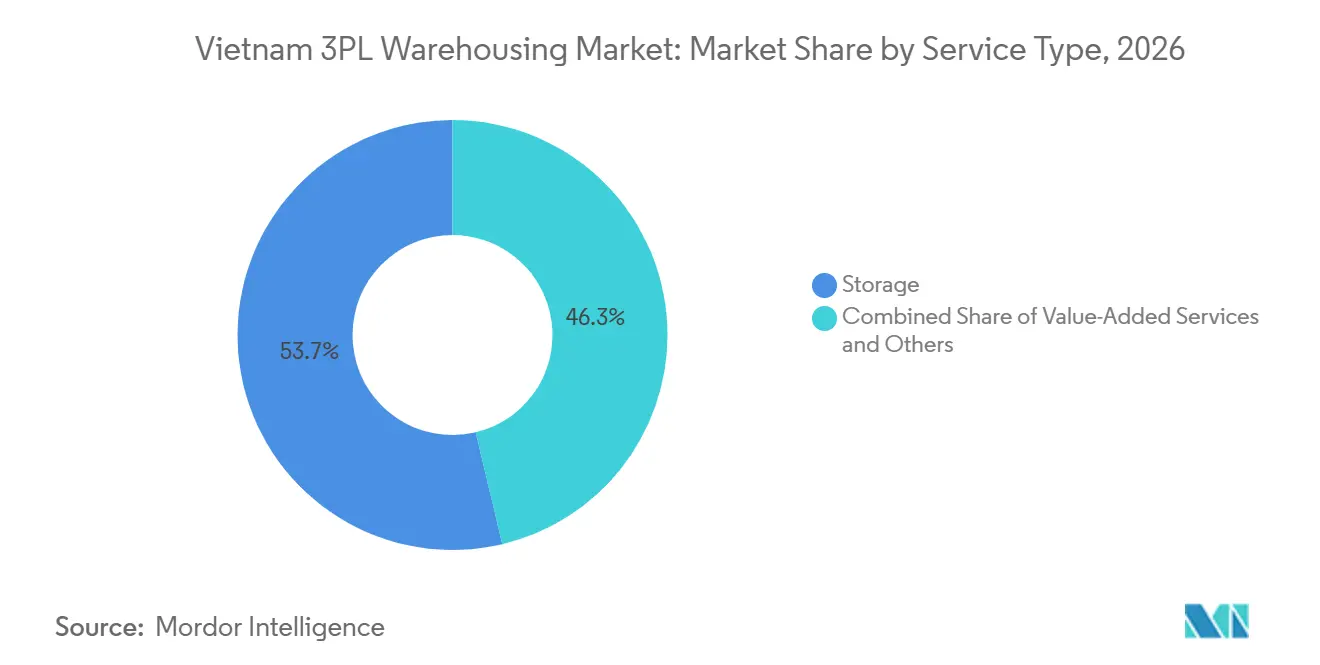
- By service type, storage accounted for 53.72% of the Vietnam 3PL warehousing market share in 2026, while value-added services and others are projected to register a CAGR of 10.26% during 2027–2032.
- By warehouse type, general shared / multi-client warehousing accounted for 55.29% of the Vietnam 3PL warehousing market size in 2026, while bonded warehousing is projected to register a CAGR of 9.27% during 2027–2032.
- By temperature control, non-temperature-controlled warehousing accounted for 82.34% of the Vietnam 3PL warehousing market share in 2026, while temperature-controlled warehousing is projected to register a CAGR of 10.39% during 2027–2032.
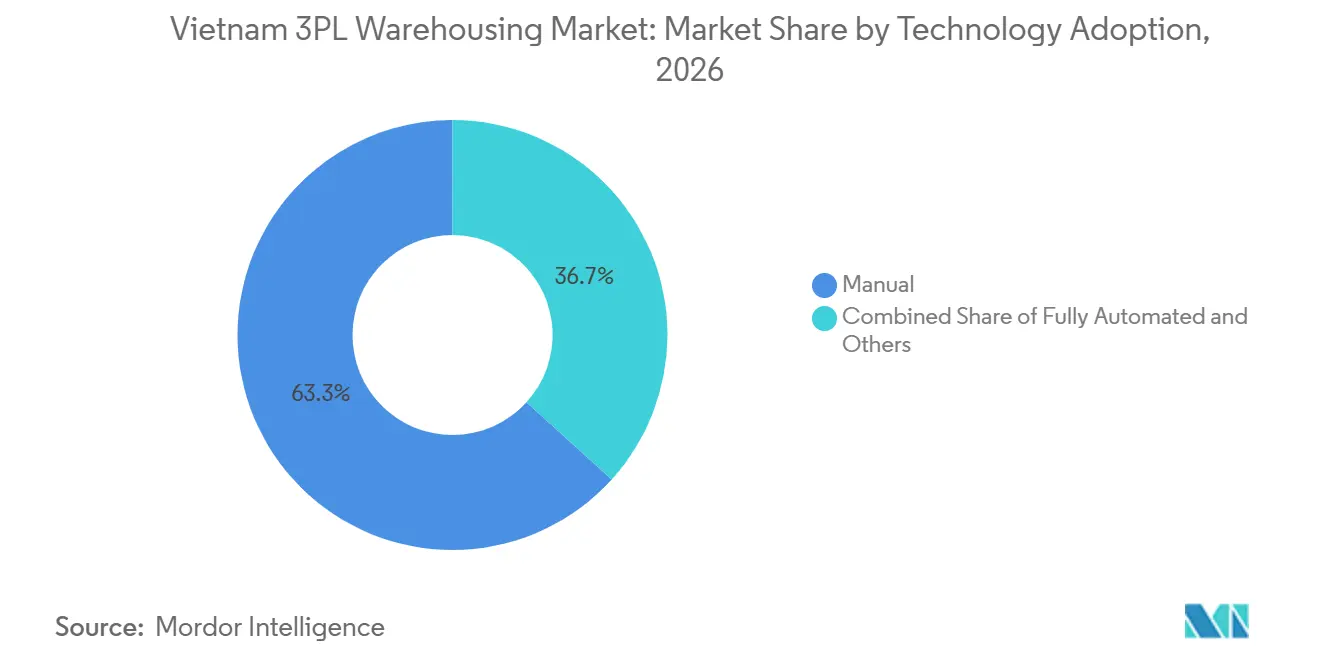
- By technology adoption, manual operations accounted for 63.28% of the Vietnam 3PL warehousing market size in 2026, while fully automated warehousing is projected to register a CAGR of 11.43% during 2027–2032.
- By end-user industry, manufacturing accounted for 34.87% of the Vietnam 3PL warehousing market share in 2026, while retail and e-commerce are projected to register a CAGR of 9.11% during 2027–2032.
- By region, Southern Vietnam accounted for 55.32% of the Vietnam 3PL warehousing market size in 2026, while Central Vietnam is projected to register a CAGR of 9.34% during 2027–2032.
Note: Market numbers in this report are based on Mordor Intelligence's proprietary estimation framework, which combines nine months of actuals with Q4 projections for base year 2026.
Vietnam 3PL Warehousing Market Trends and Insights
Drivers Impact Analysis*
| Driver | (~) % Impact on CAGR Forecast | Geographic Relevance | Impact Timeline |
|---|---|---|---|
| Export Manufacturing Growth Increasing Warehousing Demand | +2.1% | Northern Vietnam, Southern Vietnam | Medium term (2-4 years) |
| E-Commerce Expansion Accelerating Fulfillment Space Requirements | +1.8% | Southern Vietnam, Northern Vietnam, Central Vietnam | Short term (≤ 2 years) |
| Logistics Hub Investment Supporting Modern Warehouse Development | +1.1% | Northern Vietnam, Central Vietnam | Medium term (2-4 years) |
| Cold-Chain Demand Expanding Specialized Storage Capacity | +0.9% | Southern Vietnam, Central Vietnam, national | Long term (≥ 4 years) |
| Rising Outsourcing, Increasing Integrated Warehousing Service Adoption | +0.7% | National | Medium term (2-4 years) |
| Automation Investment Improving Warehouse Productivity and Accuracy | +0.6% | Southern Vietnam, Northern Vietnam | Long term (≥ 4 years) |
| Source: Mordor Intelligence | |||
Export Manufacturing Growth Increasing Warehousing Demand
Vietnam's manufacturing sector generates demand for warehousing that supports imported production inputs, finished goods, and export distribution. Manufacturers require storage, inventory control, cross-docking, and coordination between production facilities and transport networks. Industrial activity in northern and southern Vietnam supports demand for facilities near industrial parks, highways, and seaports. Third-party logistics providers can serve these requirements through shared warehousing, dedicated contract logistics, and value-added services, particularly in industrial corridors connecting manufacturing clusters with major trade gateways.
E-commerce Expansion Accelerating Fulfillment Space Requirements
E-commerce is increasing demand for warehouses that support order picking, packaging, sorting, returns processing, and dispatch. These operations require efficient layouts, inventory visibility, and the ability to process high order volumes within short turnaround times. Logistics providers can combine bulk storage with fulfillment and distribution activities to support retailers and online marketplaces. Investment in automated sorting infrastructure further highlights the importance of throughput and order-processing efficiency, particularly in northern and southern Vietnam.
Logistics Hub Investment Supporting Modern Warehouse Development
Investment in modern logistics facilities is increasing warehouse capacity near industrial and transport corridors. In July 2026, DHL Supply Chain broke ground on the DHL North Logistics Campus in Hung Yen Province, involving an investment of VND 1.9 trillion (USD 76 million) and a campus spanning more than 82,500 m²[1]. Phase 1 is planned to provide approximately 41,180 m² of warehouse space in the first half of 2027. The development is intended to serve customers across manufacturing, automotive, retail, consumer goods, healthcare, and life sciences. Its contribution to operational capacity will depend on the project's completion and commissioning.
Cold-chain Demand Expanding Specialized Storage Capacity
Pharmaceuticals, seafood, and fresh food require temperature-controlled storage, monitoring, and specialized handling. In March 2025, Lotte Global Logistics announced a cold-chain logistics hub project in Dong Nai Province targeting pharmaceutical and food industry customers. In December 2025, Igarashi Vietnam broke ground on a high-tech cold storage and dry warehouse complex at Long Hau Industrial Park, with its first phase involving more than VND 621 billion (USD 24.84 million) and planned capacity of 21,000 pallets[2]. These developments indicate investment in specialized storage, although their contribution to available capacity depends on completion and commissioning.
Restraints Impact Analysis*
| Restraint | (~) % Impact on CAGR Forecast | Geographic Relevance | Impact Timeline |
|---|---|---|---|
| Land Scarcity Increasing Industrial Warehouse Occupancy Costs | -1.2% | Southern Vietnam, Northern Vietnam | Short term (≤ 2 years) |
| Connectivity Gaps Limiting Efficient Regional Distribution Networks | -0.8% | Central Vietnam, rural provinces | Medium term (2-4 years) |
| Skilled Labor Shortages Constraining Warehouse Technology Adoption | -0.6% | National | Long term (≥ 4 years) |
| Fragmented Standards Limiting Service Consistency Across Regions | -0.4% | National | Medium term (2-4 years) |
| Source: Mordor Intelligence | |||
Land Scarcity Increasing Industrial Warehouse Occupancy Costs
Access to suitable land can constrain warehouse development near major industrial areas, consumption centres, and transport corridors. High land and construction costs can increase the capital required to develop modern facilities and raise occupancy costs for tenants. Smaller logistics providers may find it difficult to secure sites that meet customer requirements for location, floor space, and transport access. Multi-client facilities, long-term customer contracts, and efficient space utilization can help providers manage these constraints.
Connectivity Gaps Limiting Efficient Regional Distribution Networks
The efficiency of warehousing networks depends on connections between industrial parks, ports, highways, airports, and consumer markets. Differences in infrastructure quality and logistics-service availability can increase transport costs for facilities serving secondary markets. Providers must consider regional demand, transport reliability, and customer proximity when selecting warehouse locations. Improvements in regional connectivity will depend on infrastructure project execution and coordination among transport, industrial, and logistics developments.
*Our forecasts treat driver/restraint impacts as directional, not additive. The impact forecasts reflect baseline growth, mix effects, and variable interactions.
Segment Analysis
By Service Type: Value-Added Services Are Expanding Alongside Storage
Storage accounted for 53.72% of the Vietnam 3PL warehousing market share in 2026. It remains a core service for manufacturers, retailers, importers, and distributors that require inventory holding capacity. Shared and multi-client operations allow providers to serve customers with different volume profiles from the same facility, offering flexibility to businesses that do not require dedicated warehouse space.
Value-added services and others, including kitting and labeling, are projected to register a CAGR of 10.26% during 2027–2032. Demand for packaging, product preparation, returns processing, and other warehouse-based activities supports the expansion of these services. Providers can combine storage with order fulfillment and inventory management to meet customers' broader supply chain requirements and strengthen integration with distribution operations.

By Warehouse Type: Bonded Facilities Support Cross-Border Supply Chains
General shared / multi-client warehousing accounted for 55.29% of the Vietnam 3PL warehousing market size in 2026. These facilities provide access to storage and related services without requiring each customer to operate a dedicated site. The model can accommodate customers with varying inventory volumes and service requirements while allowing warehouse operators to serve multiple businesses from a common facility.
Bonded warehousing is projected to register a CAGR of 9.27% during 2027–2032. Bonded facilities can support importers, exporters, and manufacturers that need to store eligible goods under customs supervision before completing applicable customs procedures. Maersk opened its first own-licensed bonded warehouse in northern Vietnam at SLP Park in Nam Dinh Vu Industrial Park, Hai Phong[3]. The facility connects warehousing with broader logistics services and supports inventory management for import and export operations.
By Temperature Control: Specialized Capacity Addresses Product Requirements
Non-temperature-controlled warehousing accounted for 82.34% of the Vietnam 3PL warehousing market share in 2026. These facilities serve manufacturing inputs, finished goods, consumer products, and general merchandise that do not require specialized temperature management. Their broad applicability across industrial and commercial sectors supports their substantial share of the market.
Temperature-controlled warehousing is projected to register a CAGR of 10.39% during 2027–2032. Demand is supported by products that require controlled storage conditions, including pharmaceuticals, seafood, and fresh food. The Lotte Global Logistics project announced in Dong Nai in March 2025, and the Igarashi Vietnam cold storage development initiated in December 2025, illustrate investment in specialized facilities. Their contribution to available capacity depends on project completion and operational readiness.
By Technology Adoption: Automation Grows From a Low Base
Manual operations accounted for 63.28% of the Vietnam 3PL warehousing market share in 2026. Manual processes remain relevant where warehouse volumes, operating requirements, or investment capacity do not justify extensive automation. These facilities can support a broad range of storage and handling activities, although their productivity and accuracy depend on staff capabilities, operating procedures, and inventory controls.
Fully automated warehousing is projected to register a CAGR of 11.43% during 2027–2032. Automated sorting, storage, and retrieval systems, and digital warehouse controls can improve throughput and inventory accuracy in suitable operations. In October 2025, Frasers Property Vietnam broke ground on a planned automated sorting centre for SPX Express in Hung Yen Province, designed to process up to 7 million parcels per day once operational. Adoption across conventional warehouses will depend on investment costs, operating volumes, customer requirements, and technical capabilities.
By End User Industry: Manufacturing Remains the Largest Demand Base
Manufacturing accounted for 34.87% of the Vietnam 3PL warehousing market size in 2026. Manufacturers use third-party warehouses to manage production inputs, finished goods, imported materials, and export orders. Demand is supported by the need to coordinate inventory with factory operations and transport networks, particularly in industrial areas connected to major ports and trade corridors.
Retail and e-commerce are projected to register a CAGR of 9.11% during 2027–2032. Retailers and online marketplaces require storage, order fulfillment, returns management, and distribution support. Growing demand for faster order processing and inventory visibility creates opportunities for providers that integrate warehousing with packaging, sorting, and transport. Demand will vary according to order volumes, inventory turnover, and the service requirements of individual customers.
Geography Analysis
Southern Vietnam accounted for 55.32% of the market in 2026. Ho Chi Minh City and the surrounding industrial areas in Dong Nai, Binh Duong, and other southern provinces serve manufacturing, retail, import, and export requirements. Access to industrial parks, seaports, and major consumer markets supports demand for storage and distribution services. Large facilities can handle bulk inventory and regional distribution, while urban logistics sites support shorter delivery cycles. The announced Lotte Global Logistics project in Dong Nai and the Igarashi Vietnam development at Long Hau Industrial Park illustrate investment in cold-chain infrastructure, although additional operational capacity depends on project completion.
Northern Vietnam is an important warehousing location because of its manufacturing base, industrial parks, and access to Hai Phong Port and Noi Bai International Airport. Hanoi, Hai Phong, Hung Yen, and surrounding industrial areas support demand for storage, bonded warehousing, and distribution services. In July 2026, DHL Supply Chain broke ground on its North Logistics Campus in Hung Yen, with Phase 1 planned to provide approximately 41,180 m² of warehouse space in the first half of 2027. In October 2025, Frasers Property Vietnam also broke ground on SPX Express's planned automated sorting centre in Hung Yen[4]. These projects expand the pipeline of modern logistics infrastructure, with operational contributions dependent on completion and commissioning.
Central Vietnam is projected to register a CAGR of 9.34% during 2027–2032, making it the fastest-growing region in the ME forecast. Da Nang and surrounding areas can serve regional manufacturing, trade, and distribution requirements. Investment opportunities depend on the development of transport connections, industrial activity, and the availability of suitable warehouse sites. The national logistics strategy approved in October 2025 supports the development of modern logistics infrastructure and stronger regional connectivity. Central Vietnam's ability to attract additional warehousing investment will depend on customer demand, transport links, and the development of facilities suited to regional requirements.
Competitive Landscape
The Vietnam 3PL warehousing market is fragmented and includes international logistics integrators, regional operators, and domestic providers. Competition is shaped by facility location, warehouse quality, service integration, technology, and the ability to serve industry-specific requirements. International providers can leverage established networks and standardized operating systems, while domestic companies can compete through local market knowledge, customer relationships, and regional distribution capabilities. Customers increasingly need providers that can combine warehousing with inventory management, customs support, and distribution services.
Investment in modern facilities is one way providers are strengthening their competitive positions. DHL Supply Chain broke ground on its North Logistics Campus in Hung Yen in July 2026, while Yusen Logistics opened its Hung Yen Logistics Centre in the same month. Yusen's facility includes approximately 18,600 m² of warehouse floor space and around 21,600 pallet positions. Maersk's bonded warehouse in Hai Phong also illustrates the integration of storage with trade-related logistics services. These developments support competition around location, capacity, and the ability to serve customers with specific handling and customs requirements.
Providers also compete through specialized warehousing, automation, and strategic cooperation. The planned SPX Express sorting centre highlights investment in high-volume parcel handling, while the Igarashi Vietnam project demonstrates investment in temperature-controlled storage. In March 2026, CJ Logistics and Gemadept announced an optimization of their strategic cooperation. The arrangement should be described as a restructuring of strategic collaboration rather than a complete acquisition of Gemadept's 3PL business. Across the market, differentiation depends on providers' ability to match warehouse capabilities with customer requirements, maintain inventory accuracy, and deliver reliable services across regional distribution networks.
Vietnam 3PL Warehousing Industry Leaders
-
CJ Logistics Corporation
-
DHL Group
-
Transimex Corporation
-
ITL Corporation
-
U&I Logistics Corporation
- *Disclaimer: Major Players sorted in no particular order
Recent Industry Developments
- July 2026: Yusen Logistics opened its Hung Yen Logistics Centre, its seventh logistics centre in Vietnam. The facility includes approximately 18,600 m² of warehouse floor space and around 21,600 pallet positions, including general, bonded, and air-conditioned storage.
- July 2026: DHL Supply Chain broke ground on the DHL North Logistics Campus in Hung Yen Province. The project involves VND 1.9 trillion (USD 76 million) in investment and a campus exceeding 82,500 m². Phase 1 is planned to provide approximately 41,180 m² of warehouse space in the first half of 2027.
- March 2026: CJ Logistics and Gemadept announced an optimization of their logistics and shipping cooperation. The revised arrangement is intended to strengthen the companies' respective shipping and logistics activities and support further logistics development. The announcement concerns a strategic restructuring and should not be described as a full acquisition of Gemadept's 3PL business.
- December 2025: Igarashi Vietnam broke ground on a high-tech cold storage and dry warehouse complex at Long Hau Industrial Park. The first phase involves more than VND 621 billion (USD 24.84 million), with a planned capacity of 21,000 pallets and partial robotic automation.
Vietnam 3PL Warehousing Market Report Scope
| Storage |
| Distribution and Inventory Management |
| Value-Added Services and Others (Kitting, Labelling) |
| General Shared / Multi-client Warehousing |
| Dedicated Contract Warehousing |
| Bonded Warehousing |
| Non-Temperature Controlled |
| Temperature Controlled |
| Manual |
| Semi-automated |
| Fully Automated |
| Manufacturing |
| Consumer Goods |
| Food and Beverage |
| Retail and E-commerce |
| Healthcare and Pharma |
| Other End-user Industries |
| Northern Vietnam |
| Central Vietnam |
| Southern Vietnam |
| By Service Type | Storage |
| Distribution and Inventory Management | |
| Value-Added Services and Others (Kitting, Labelling) | |
| By Warehouse Type | General Shared / Multi-client Warehousing |
| Dedicated Contract Warehousing | |
| Bonded Warehousing | |
| By Temperature Control | Non-Temperature Controlled |
| Temperature Controlled | |
| By Technology Adoption | Manual |
| Semi-automated | |
| Fully Automated | |
| By End User Industry | Manufacturing |
| Consumer Goods | |
| Food and Beverage | |
| Retail and E-commerce | |
| Healthcare and Pharma | |
| Other End-user Industries | |
| By Region | Northern Vietnam |
| Central Vietnam | |
| Southern Vietnam |
Key Questions Answered in the Report
What is the projected growth rate for Vietnam's 3PL warehousing?
The Vietnam 3PL warehousing market is projected to register a CAGR of 7.81% from 2027 to 2032.
Which service is growing fastest in Vietnam 3PL warehousing?
Value-added services and others, including kitting and labeling, are projected to register a CAGR of 10.26% during 2027–2032.
Value-added services and others, including kitting and labeling, are projected to register a CAGR of 10.26% during 2027–2032.
Bonded warehousing supports importers, exporters, and manufacturers that need to store eligible goods under customs supervision before completing applicable customs procedures.
What is driving cold-chain warehouse investment in Vietnam?
Pharmaceuticals, seafood, and fresh food require temperature-controlled storage, monitoring, and specialized handling. These requirements support investment in cold-chain facilities.
Which region leads the 3PL warehousing demand in Vietnam?
Southern Vietnam accounted for 55.32% of the market in 2026, supported by manufacturing activity, consumption centres, industrial parks, and access to transport infrastructure.
How are logistics providers using automation in Vietnam?
Providers are adopting digital warehouse systems, automated sorting, and other technologies to improve inventory accuracy, throughput, and fulfillment efficiency. Adoption varies according to warehouse volumes, customer requirements, investment costs, and technical capabilities.