
Video Marketing Software Market Size and Share
Market Overview
| Study Period | 2020 - 2031 |
|---|---|
| Market Size (2026) | USD 18.53 Billion |
| Market Size (2031) | USD 46.38 Billion |
| Growth Rate (2026 - 2031) | 20.21 % |
| Fastest Growing Market | Asia-Pacific |
| Largest Market | North America |
| Market Concentration | Medium |
Major Players *Disclaimer: Major Players sorted in no particular order Image © Mordor Intelligence. Reuse requires attribution under CC BY 4.0. | |
Video Marketing Software Market Analysis by Mordor Intelligence
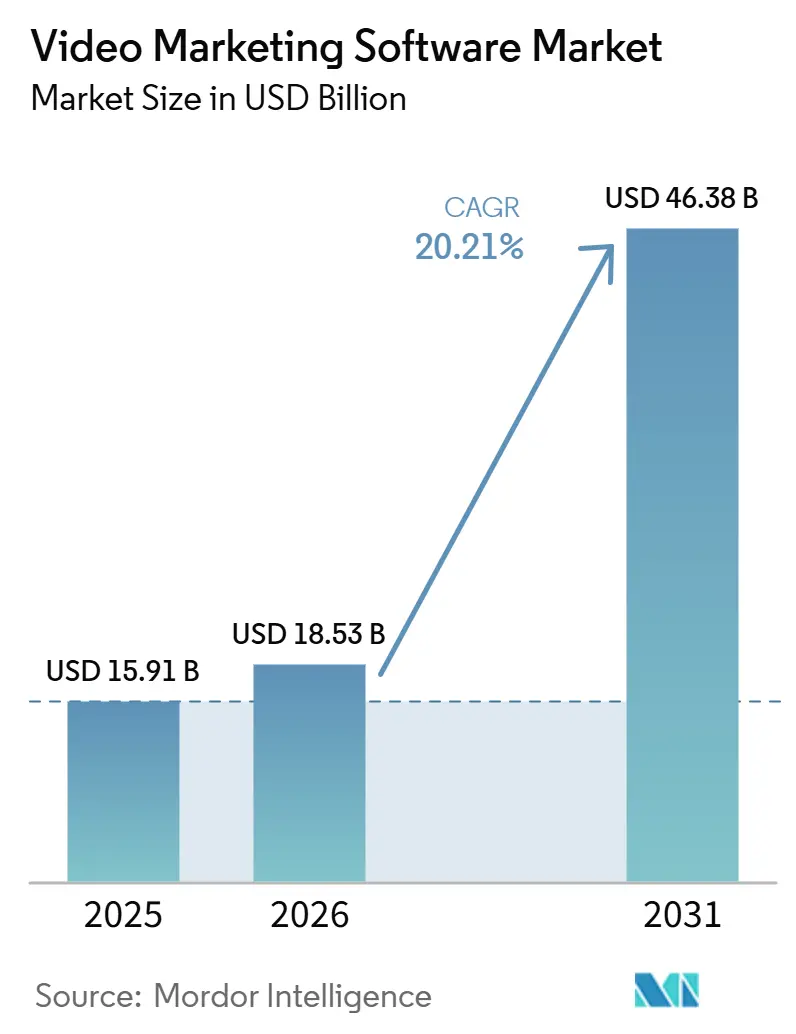
The video marketing software market size was valued at USD 15.91 billion in 2025 and estimated to grow from USD 18.53 billion in 2026 to reach USD 46.38 billion by 2031, at a CAGR of 20.21% during the forecast period (2026-2031). The video marketing software market is expanding because enterprises now treat video as a revenue-linked format that can be tracked more clearly through analytics, campaign response, and CRM-connected buyer actions. The video marketing software market is also benefiting from AI-led content creation, which is reducing production time, widening the number of teams that can use video, and pushing adoption beyond large marketing departments into sales, training, and support functions. Competitive activity in the video marketing software market is shifting toward broader platforms that combine creation, hosting, analytics, governance, and workflow support, because buyers want fewer disconnected tools and stronger proof of business outcomes. A major opening in the video marketing software market is emerging around governance, rights control, approval workflows, and brand safety, since organizations are producing more video than their internal review systems can handle. The video marketing software market is also seeing new opportunity in cloud-native deployment, multilingual output, and internal enterprise use cases, which is widening the addressable buyer base inside each organization.
Key Report Takeaways
- By component, platform held 67.29% of the video marketing software market revenue in 2025, while services is projected to expand at a 22.97% CAGR through 2031.
- By deployment, cloud accounted for 70.41% of the video marketing software market revenue in 2025 and is expected to remain the fastest-growing deployment model at a 22.12% CAGR through 2031.
- By organization size, large enterprises captured 68.55% of revenue in 2025, while SMEs are projected to record the highest CAGR at 22.51% through 2031 in the video marketing software market.
- By application, marketing campaigns and demand generation represented 58.79% of the video marketing software market revenue in 2025, while customer support, training and onboarding is expected to advance at a 21.82% CAGR through 2031.
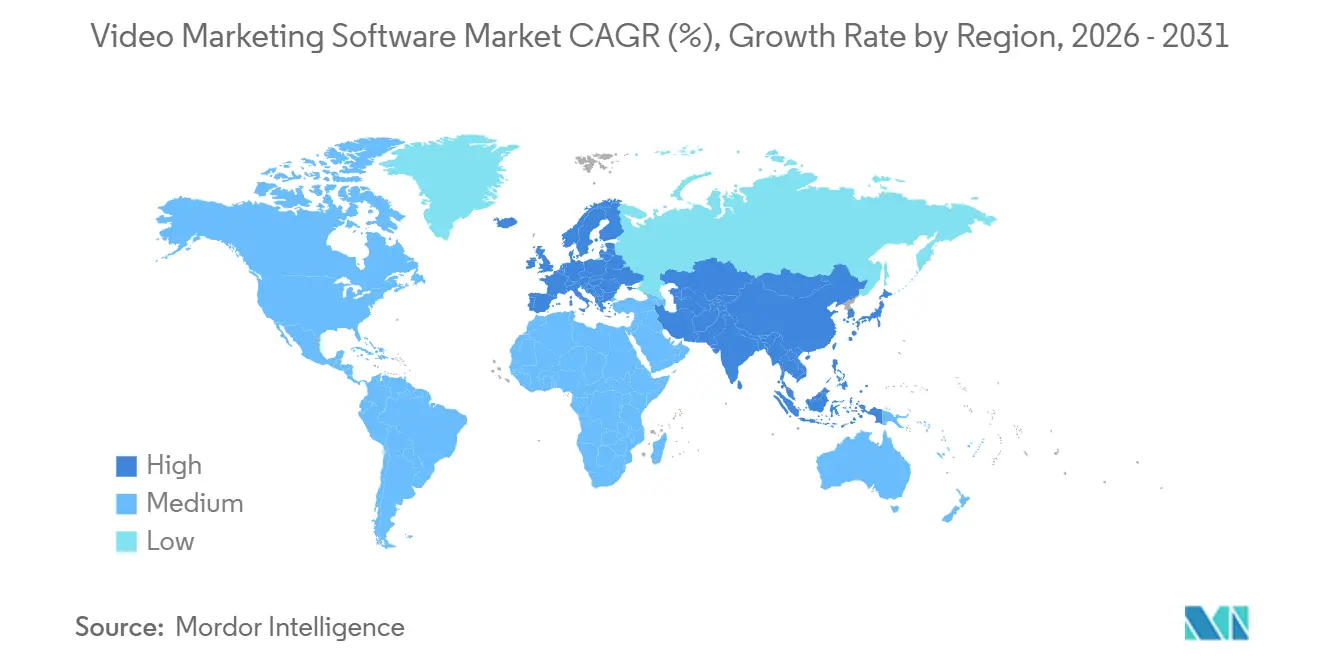
- By geography, North America held 36.12% of revenue in 2025, while Asia-Pacific is projected to register the highest CAGR at 21.45% through 2031.
Note: Market size and forecast figures in this report are generated using Mordor Intelligence’s proprietary estimation framework, updated with the latest available data and insights as of January 2026.
Market Trends and Insights
Drivers Impact Analysis of Video Marketing Software Market*
| Driver | (~) % Impact on CAGR Forecast | Geographic Relevance | Impact Timeline |
|---|---|---|---|
| AI-Personalized Video Outreach Improves Conversion Rates | +4.2% | Global, concentrated in North America and Europe | Short term (≤ 2 years) |
| Short-Form and Shoppable Video Expands Revenue Use Cases | +3.8% | Global, led by Asia-Pacific and North America | Short term (≤ 2 years) |
| CRM-Embedded Video Analytics Strengthens Attribution | +3.0% | North America and Europe | Medium term (2-4 years) |
| Creator-Led Sales Enablement Reduces Sales Cycle Friction | +2.5% | North America, Europe, Asia-Pacific | Medium term (2-4 years) |
| First-Party Video Measurement Supports Privacy-First Marketing | +1.8% | North America and Europe | Medium term (2-4 years) |
| AI Localization Scales Multilingual Campaign Output | +1.5% | Asia-Pacific, Europe, Middle East and Africa | Long term (≥ 4 years) |
| Source: Mordor Intelligence | |||
AI-Personalized Video Outreach Improves Conversion Rates
Personalized AI-generated video has moved from testing to practical use because enterprises now expect higher response rates from every outreach touchpoint in the video marketing software market. A randomized experiment covering more than 21,000 consumers found that AI-personalized avatar videos generated click-through rates that were 9.4 percentage points higher than personalized image ads and 6.5 percentage points higher than generic video alternatives. The same body of evidence also showed that marketers were already using generative AI to produce multiple video ad variants, which shortened testing cycles and made rapid iteration easier across campaigns. This matters for the video marketing software market because faster testing lets teams connect creative changes with response outcomes more quickly, which makes video spend easier to defend inside enterprise budget reviews. As output quality becomes more similar across tools, advantage is likely to shift toward platforms that control strong first-party behavioral data and can use that data to personalize video more precisely inside the video marketing software market .
Short-Form and Shoppable Video Expands Revenue Use Cases
Short-form video is no longer limited to awareness, because commerce features are turning video into a direct purchase path and expanding revenue-linked use cases across the video marketing software market. YouTube expanded native shopping in Shorts globally in January 2026, widening the shoppable video opportunity beyond a narrow set of social commerce platforms into a broader digital advertising environment. China has already shown the scale of this shift, as the country’s short-video advertising market grew 16.7% year over year in 2024. This trend is important for the video marketing software market because shoppable formats bring discovery, engagement, conversion, and revenue reporting into a much tighter sequence than traditional campaign structures. Vendors that can support in-video checkout tracking, creator attribution, and GMV-linked reporting are better placed as these revenue use cases expand across the video marketing software market.
CRM-Embedded Video Analytics Strengthens Attribution
The video marketing software market has long faced an attribution problem because engagement data usually sat in video tools while revenue outcomes stayed inside CRM systems. That separation is narrowing, as shown by the April 2026 expansion of the Vidyard partnership with Clari and Salesloft, which brought video engagement signals such as watch time, replays, and CTA clicks closer to revenue workflows. Reported customer outcomes from that announcement included up to 5x improvement in prospecting response rates, up to 4x more meetings booked, and up to 2x faster deal cycles. A related June 2026 integration from MNTN also moved Connected TV attribution data into HubSpot workflows, which reinforced the broader direction of measurable pipeline linkage for video-led campaigns. As more platforms connect video behavior to pipeline creation and sales actions, the video marketing software market is moving away from a pure creation category and toward a revenue intelligence layer with higher switching costs.
Creator-Led Sales Enablement Reduces Sales Cycle Friction
Creator-led communication is gaining importance because enterprise buyers respond better when content feels credible, targeted, and connected to a real subject matter voice in the video marketing software market. LinkedIn’s 2025 B2B Marketing Benchmark found that 55% of B2B marketers already used influencer or creator marketing on LinkedIn, and the brands using these programs outperformed non-users on engagement, revenue growth, and lead generation. Vidyard’s benchmark data also showed that B2B organizations using video reported 27% higher marketing-qualified lead rates, while 28% of B2B sales teams using video reported increased pipeline volume and 27% shorter deal cycles. This supports the view that the video marketing software market is benefiting not only from content volume growth, but also from better alignment between who delivers the message and how that message moves deals forward. The strongest results are likely to come from creator programs built around domain expertise instead of broad influencer reach, which raises the value of platforms that can segment performance by creator role, audience type, and buyer seniority in the video marketing software market.
Restraints Impact Analysis of Video Marketing Software Market*
| Restraint | (~) % Impact on CAGR Forecast | Geographic Relevance | Impact Timeline |
|---|---|---|---|
| Content Governance Complexity Slows Enterprise Rollouts | -1.5% | Global, concentrated in North America and Europe | Medium term (2-4 years) |
| Fragmented Tool Stacks Create Data and Workflow Silos | -1.2% | Global | Short term (≤ 2 years) |
| High Creative Production and Review Costs Limit Adoption | -0.8% | Emerging markets, mid-market globally | Short term (≤ 2 years) |
| Cross-Channel Attribution Gaps Weaken ROI Visibility | -0.5% | Global | Long term (≥ 4 years) |
| Source: Mordor Intelligence | |||
Content Governance Complexity Slows Enterprise Rollouts
Enterprise AI video adoption is moving faster than internal governance systems, which is creating a drag on implementation speed in the video marketing software market. Approval latency from legal, compliance, brand, and regional teams was reported to add 7 to 14 days to campaign launches, which directly reduces the time advantage that AI-generated content is supposed to deliver. This burden becomes heavier in regulated sectors such as financial services, pharmaceuticals, and healthcare, where disclosure standards and review requirements are stricter across every distribution channel. The February 2026 update to the C2PA framework also added pressure by setting stronger content-origin expectations that many enterprise teams are still adapting to operationally. The result for the video marketing software market is that governance tooling, audit trails, and approval-chain automation are becoming part of product evaluation much earlier in enterprise buying cycles.
Fragmented Tool Stacks Create Data and Workflow Silos
The video marketing software market is also constrained by tool sprawl, because many teams use separate systems for creation, hosting, analytics, distribution, and CRM activation. Wistia’s 2026 State of Video Report found that teams with larger video technology stacks were reporting more fragmented workflows and more manual handoffs instead of smoother operations. That pattern matters because productivity loss is only one part of the issue, while the bigger problem is that disconnected engagement and attribution data make closed-loop reporting much harder.[1] Without a clear path from video engagement to sales or pipeline outcomes, finance teams are less likely to approve larger platform budgets in the video marketing software market. Vendors that can unify creation, hosting, analytics, and activation inside one platform are better positioned, although building that breadth requires investment levels that many smaller players in the video marketing software market may struggle to sustain.
*Our forecasts treat driver/restraint impacts as directional, not additive. The impact forecasts reflect baseline growth, mix effects, and variable interactions.
Video Marketing Software Market Segment Analysis
By Component:
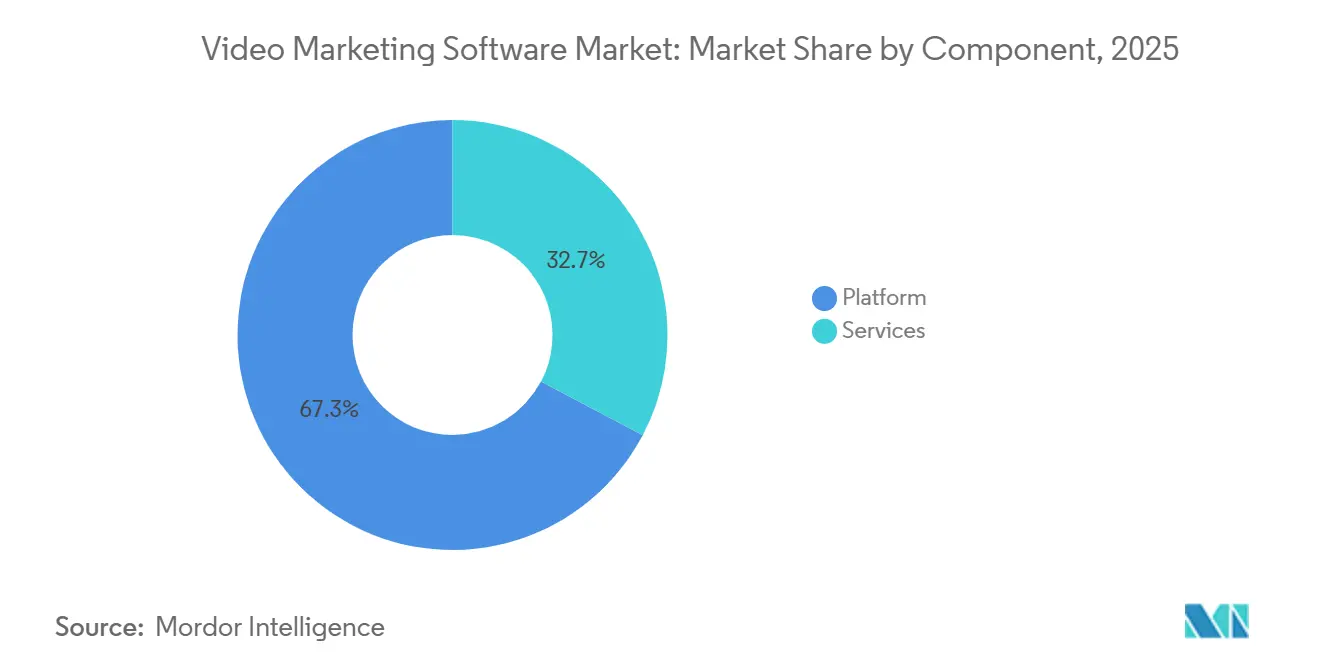
Platform Leads Revenue While Services Drives the Fastest ExpansionThe platform segment held 67.29% of revenue in 2025, which made it the largest component in the video marketing software market and reflected buyer preference for consolidated environments. Enterprises have favored platforms because they want content management, analytics, distribution, personalization, and integration functions inside one operating layer instead of across multiple tools. That preference is becoming stronger as video programs expand into more teams, since each added workflow increases the value of a single interface and a shared reporting structure. The video marketing software market size for platform-based offerings remained higher because large buyers usually selected solutions that could support multi-user governance, campaign execution, and cross-system data movement in one contract. Vidyard’s Video Agent API launch in December 2025 showed this direction clearly, because personalized video generation could be triggered from any application in a wider technology stack rather than from a narrow standalone workflow.
The services segment is projected to record the highest CAGR at 22.97% through 2031, which shows that implementation help is rising along with software adoption in the video marketing software market. Buyers increasingly need assistance with AI deployment, CRM integration, analytics setup, workflow redesign, and team onboarding, and those tasks are not always easy for internal marketing teams to manage alone. Services demand is also rising because adoption now involves more functions than campaign production, including support, sales, training, and internal communications workflows that must fit into existing enterprise systems. Vidyard’s growing relationship with HubSpot agencies and its recognition as a HubSpot 2026 Essential App for Sales reflected how partner ecosystems can help scale implementation and renewal support around the platform itself.[2] This points to a broader pattern in the video marketing software industry, where AI features attract initial interest, but service capacity often determines whether those features deliver repeatable business value after deployment.
By Deployment:
Cloud Becomes the Default While On-Premises Stays Relevant in Regulated EnvironmentsCloud deployment accounted for 70.41% of revenue in 2025 and is also projected to grow at the fastest 22.12% CAGR through 2031, which confirms that cloud delivery has become the operating baseline for the video marketing software market. Cloud systems are favored because they allow easier scaling, faster feature releases, lower infrastructure management burden, and simpler rollout across global teams working across many regions and departments. They also make AI-led enhancements more practical, since captioning, editing, localization, analytics, and personalization features can be updated continuously without large internal system changes. Vimeo’s 2025 rollout of European data residency for video files and transcripts addressed a long-standing cloud concern around sovereignty and storage control for enterprise customers. Brightcove’s 2026 roadmap also showed how accessibility, AI support, and multilingual tooling are increasingly being delivered through cloud-native product releases rather than slower enterprise infrastructure cycles.
On-premises deployment still matters in sectors where internal security policies restrict third-party cloud access to sensitive communications, training material, or regulated documentation. Defense, healthcare, and financial services remain the clearest examples, because those organizations often require stronger local control over content movement, user access, and storage practices. Even so, this segment is under pressure because hybrid architectures are offering a more flexible path that preserves stronger data control while still giving buyers access to cloud-led feature development. That means the video marketing software market share for pure on-premises models is likely to stay narrower than cloud, even in environments where compliance remains a central issue. The broader direction suggests that vendors able to support hybrid migration smoothly, rather than forcing a full architectural shift, are better placed as enterprise security standards evolve across the video marketing software industry.
By Organization Size:
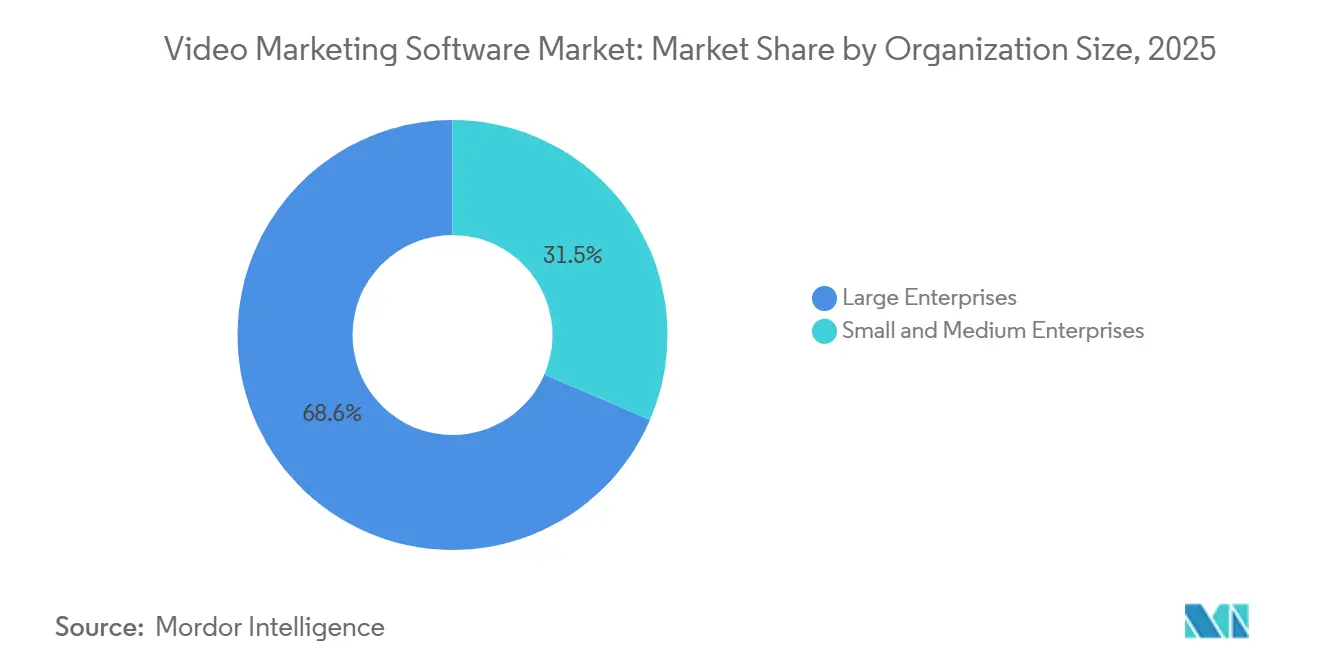
Large Enterprises Hold the Revenue Base While SMEs Expand FasterLarge enterprises captured 68.55% of revenue in 2025, which gave them the leading position in the video marketing software market because they could support complex deployments and multi-year platform adoption. These organizations usually have larger campaign volumes, bigger technology budgets, established CRM systems, and dedicated teams that can manage video operations at scale. They also have more use cases inside one company, including demand generation, sales outreach, onboarding, internal communication, and support content, which makes enterprise-wide rollout more economical. The video marketing software market share remained concentrated in large enterprises because they were better positioned to absorb governance, compliance, and integration work that often comes with broad adoption. Their scale also made advanced analytics and attribution more useful, because a larger number of users and campaigns created better conditions for performance benchmarking across the organization.
SMEs are projected to expand at a 22.51% CAGR through 2031, which makes them the fastest-growing organization size segment in the video marketing software market. This acceleration reflects a sharp change in production economics, as AI-powered workflows cut the cost and time needed to create usable business video. Wistia reported that AI-powered platforms reduced average per-video production costs by an estimated 91%, from USD 4,500 per finished minute to USD 400, which widened access for smaller marketing budgets. InVideo’s subscription structure, which bundled access to multiple leading generative AI models from a starting price of USD 25 per month, further illustrated how the lower end of the market was being redrawn. That shift is pushing the video marketing software market toward self-serve tiers, lighter onboarding, and faster time to value, as established vendors try to capture SME demand before AI-native entrants gain stronger loyalty at the lower end.
By Application:
Marketing Keeps the Largest Base While Training and Onboarding Gain SpeedMarketing campaigns and demand generation held 58.79% of revenue in 2025, which made them the largest application area in the video marketing software market because performance visibility was already stronger there than in most other workflows. Mature marketing teams were already using video within lead generation, campaign testing, landing pages, and audience targeting, so adoption in this segment had a clearer budget path and stronger measurement routines. This area also benefits from data accumulation, since every campaign adds more performance information that can improve targeting, personalization, and creative optimization inside the same platform. The video marketing software market size for this application stayed ahead because decision makers could more easily connect video activity to lead flow and campaign outcomes than they could in newer internal use cases. Sales enablement and outreach continued to attract investment as CRM-embedded video tools improved, while internal communications and employee engagement remained smaller but increasingly relevant as hybrid work practices continued.
Customer support, training and onboarding is projected to grow at a 21.82% CAGR through 2031, which makes it the fastest-growing application in the video marketing software market. Kaltura’s Avatar Video Production Studio launch in May 2026 directly addressed this segment by converting enterprise knowledge into avatar-led onboarding experiences in minutes and claiming a production time reduction of 90% against traditional workflows. The growth case is strengthened by workforce realities, because globally distributed teams and higher turnover in customer-facing roles make repeatable asynchronous training more practical than instructor-led delivery alone. As enterprises look for consistency, speed, and easier update cycles in knowledge transfer, video is becoming a more natural format for onboarding and support content. This change widens the video marketing software market beyond marketing budgets alone and increases the number of internal buyers that vendors can target inside the same account.
Geography Analysis
North America Video Marketing Software Market
North America held 36.12% of revenue in 2025, which made it the largest regional contributor to the video marketing software market and reflected the region’s mature marketing technology foundation. The United States has a dense concentration of enterprise CRM deployments, SaaS buyers, and vendor headquarters, which creates faster feedback loops between product releases and customer adoption. This operating environment has helped make video engagement data a normal input into sales and marketing workflows, rather than a separate reporting stream that sits outside core decision systems. The expanded April 2026 Vidyard partnership with Clari and Salesloft, along with the June 2026 HubSpot integration announced by MNTN, showed how North American vendor partnerships were deepening attribution and workflow use cases in the video marketing software market. Canada added emerging video-first sales technology, while Mexico remained earlier stage but supported by growing digital advertising activity.
APAC Video Marketing Software Market
Asia-Pacific is projected to register the fastest CAGR at 21.45% through 2031, which makes it the leading growth geography in the video marketing software market. The regional growth mix stands out because it combines mobile-first viewing, creator-commerce ecosystems, rapid AI adoption, and rising digital marketing budgets across several major economies. China provides an important baseline, with its short-video advertising market reaching 16.7% year-over-year growth in 2024. AVIA projected that user-generated and social video revenues in Asia-Pacific would expand by 2030, which reinforced the regional role of creator-led platforms in the screen economy.[3] India’s expanding platform innovation also supported the region, including InVideo’s February 2026 partnership expansion with Google Cloud for enterprise-grade AI filmmaking pipelines.
EMEA and South America Video Marketing Software Market
Europe remained a mature but operationally complex part of the video marketing software market, with Germany, the United Kingdom, and France showing steady enterprise adoption tied to B2B technology investment and employee communication demand. South America represented a mid-tier growth opportunity led by Brazil and Argentina, although infrastructure limits and economic volatility continued to slow wider rollout. The Middle East and Africa remained earlier stage, with Saudi Arabia and the UAE pushing digital transformation activity, while Nigeria and South Africa anchored emerging adoption on the African continent. Together, these regions contributed less near-term revenue than North America or Asia-Pacific, but they widened the long-term expansion path for the video marketing software market beyond already developed enterprise centers.
Competitive Landscape
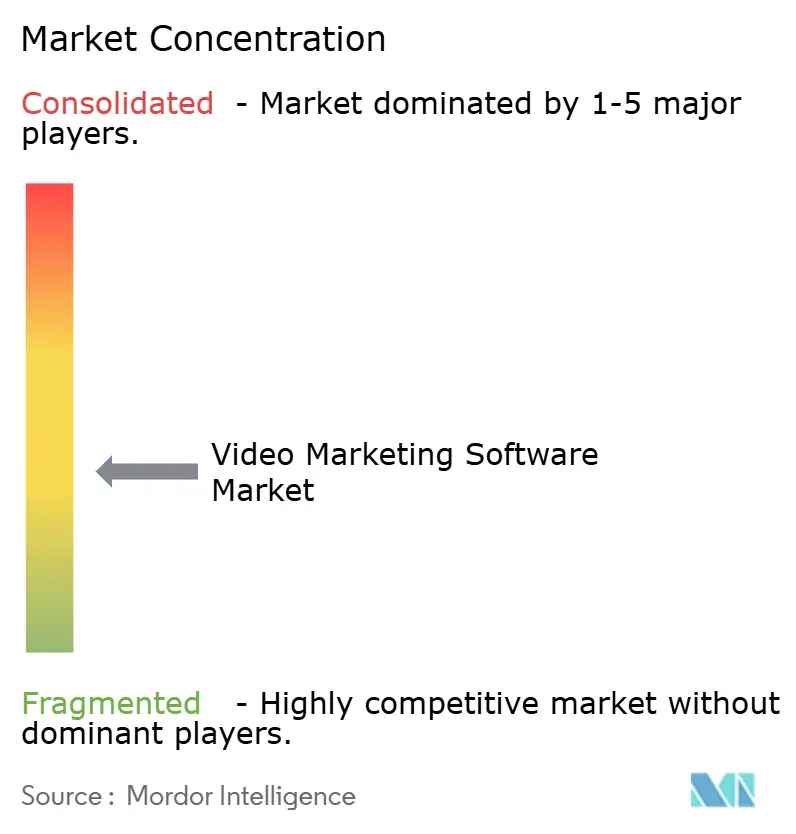
The video marketing software market is moderately fragmented, with established vendors such as Brightcove, Kaltura, Vimeo, and Vidyard competing alongside AI-native entrants that are trying to move faster on creation, automation, and lower-cost delivery. No single vendor controlled a majority of global revenue in the source draft, which means competition is being shaped more by product breadth, workflow depth, and integration quality than by one dominant pricing leader. The strongest incumbent response has centered on AI feature releases and platform expansion, because buyers now expect editing assistance, personalization, analytics, and governance support as standard parts of enterprise video systems. Brightcove’s February 2026 roadmap committed to eight new AI capabilities, including contextual advertising, automated video intelligence, and expanded language support across more than 90 languages.[4] Its May 2026 launch of AI Contextual Ads and Smart Ad Breaks also showed how incumbents were extending AI beyond production and into monetization-related workflow value.
Acquisition and platform integration are becoming important competitive tools because many vendors want to shorten the time needed to add AI capacity in the video marketing software market. The source draft noted that Brightcove absorbed proprietary AI technology from Bending Spoons, which reflected a wider pattern of buying or integrating capability instead of building every layer internally. That approach can speed up product expansion, but it also increases execution pressure because acquired tools still need to work smoothly inside enterprise workflows. Kaltura’s April 2026 native integrations with Adobe Experience Manager, WordPress, and Drupal showed another route to competitive differentiation, where vendors reduce adoption friction by fitting into systems customers already use every day. Vidyard’s partnership expansion with Clari and Salesloft also showed how revenue workflow positioning can raise the perceived value of video engagement data beyond content production alone.
Two open areas stand out in the video marketing software market, governance tooling for enterprise and mid-market buyers, and cross-channel shoppable video infrastructure that ties content directly to conversion reporting. Cloudinary’s June 2026 Image to Video launch illustrated how adjacent digital asset management players are entering this space by offering governed workflows that turn approved image libraries into enterprise-ready video output. Pressure is especially strong in the SME tier, where AI-native subscriptions can lower entry cost and weaken loyalty to older platforms if incumbents do not respond with simpler plans and faster onboarding. As a result, the video marketing software market is likely to stay competitive across both enterprise and SME layers, with incumbents defending installed bases through integration and governance while newer players compete through usability, speed, and pricing.
Video Marketing Software Industry Leaders
-
Contentflow GmbH
-
Dacast, Inc.
-
Restream, Inc.
-
Vidyard Inc.
-
Vidello Ltd.
- *Disclaimer: Major Players sorted in no particular order
Video Marketing Software Market Companies Covered in this Report
- Brightcove Inc.
- BombBomb, LLC
- Cincopa LTD
- Cloudinary Ltd.
- Contentflow GmbH
- Dacast, Inc.
- Hippo Video Inc.
- InVideo, Inc.
- Kaltura, Inc.
- Panopto, Inc.
- Powtoon Ltd.
- Restream, Inc.
- Scribie, Inc.
- StoryTEQ B.V.
- TwentyThree A/S
- Vidello Ltd.
- Vidyard Inc.
- Vimeo.com, Inc.
- Wistia, Inc.
- Wowza Media Systems, LLC
Recent Industry Developments in Video Marketing Software Market
- July 2026: Edge226, an AI-powered cross-channel performance marketing platform, acquired AnyClip Ltd., an AI-powered video intelligence company. The deal combines AnyClip's Visual Intelligence Platform, which analyzes, tags, and packages video content at scale, with Edge226's demand-side infrastructure, targeting outcome-driven advertising across CTV, mobile, desktop, and in-app environments.
- July 2026: Wistia launched its Model Context Protocol (MCP) server, enabling marketing and product teams to manage their entire video library, including search, publish, analytics, and caption management, via natural language prompts in Claude, Cursor, or ChatGPT. More than 300 accounts connected within the server's first days.
- June 2026: Cloudinary launched Image to Video, a native enterprise capability that automatically generates high-quality videos from approved static image libraries within Cloudinary's unified asset management, moderation, and multi-CDN distribution framework. The release is available as an add-on for existing Cloudinary Video customers.
- June 2026: MNTN announced a first-of-its-kind integration with HubSpot, bringing Connected TV attribution data directly into CRM workflows and enabling B2B advertisers to tie TV campaigns to pipeline creation, MQLs, and SQLs.
Global Video Marketing Software Market Report Scope
The Video Marketing Software Market includes software platforms and associated services that enable organizations to create, manage, host, distribute, personalize, optimize, and analyze video content for marketing, sales, customer engagement, training, and communication across digital channels. These solutions offer capabilities such as video content management, hosting, analytics, personalization, lead capture, customer engagement tracking, campaign optimization, and omnichannel video distribution. Organizations use these solutions to improve brand awareness, drive demand generation, enhance sales effectiveness, strengthen customer relationships, and improve internal communications. The market is driven by the increasing adoption of video as a primary digital engagement channel, growing demand for personalized content experiences, rising digital marketing investments, and the need to measure customer engagement across multiple touchpoints.
The Video Marketing Software Market Report is Segmented by Component (Platform and Services), Deployment (Cloud and On-Premises), Organization Size (Large Enterprises, and Small and Medium Enterprises), Application (Marketing Campaigns and Demand Generation, Sales Enablement and Outreach, Customer Support, Training and Onboarding, and Internal Communications and Employee Engagement), and Geography (North America, South America, Europe, Asia-Pacific, Middle East, and Africa). The Market Forecasts are Provided in Terms of Value (USD).
| Platform |
| Services |
| Cloud |
| On-Premises |
| Large Enterprises |
| Small and Medium Enterprises |
| Marketing Campaigns and Demand Generation |
| Sales Enablement and Outreach |
| Customer Support, Training and Onboarding |
| Internal Communications and Employee Engagement |
| North America | United States |
| Canada | |
| Mexico | |
| South America | Brazil |
| Argentina | |
| Rest of South America | |
| Europe | Germany |
| United Kingdom | |
| France | |
| Italy | |
| Spain | |
| Russia | |
| Rest of Europe | |
| Asia-Pacific | China |
| Japan | |
| India | |
| South Korea | |
| Australia and New Zealand | |
| Rest of Asia-Pacific | |
| Middle East | Saudi Arabia |
| United Arab Emirates | |
| Turkey | |
| Rest of Middle East | |
| Africa | South Africa |
| Nigeria | |
| Rest of Africa |
| By Component | Platform | |
| Services | ||
| By Deployment | Cloud | |
| On-Premises | ||
| By Organization Size | Large Enterprises | |
| Small and Medium Enterprises | ||
| By Application | Marketing Campaigns and Demand Generation | |
| Sales Enablement and Outreach | ||
| Customer Support, Training and Onboarding | ||
| Internal Communications and Employee Engagement | ||
| By Geography | North America | United States |
| Canada | ||
| Mexico | ||
| South America | Brazil | |
| Argentina | ||
| Rest of South America | ||
| Europe | Germany | |
| United Kingdom | ||
| France | ||
| Italy | ||
| Spain | ||
| Russia | ||
| Rest of Europe | ||
| Asia-Pacific | China | |
| Japan | ||
| India | ||
| South Korea | ||
| Australia and New Zealand | ||
| Rest of Asia-Pacific | ||
| Middle East | Saudi Arabia | |
| United Arab Emirates | ||
| Turkey | ||
| Rest of Middle East | ||
| Africa | South Africa | |
| Nigeria | ||
| Rest of Africa | ||
Key Questions Answered in the Report
What is the 2026 size of the video marketing software market?
The video marketing software market stands at USD 18.53 billion in 2026 and is projected to reach USD 46.38 billion by 2031 at a CAGR of 20.21%.
What is driving growth in video marketing software adoption?
The strongest growth factors are AI-personalized outreach, shoppable short-form video, tighter CRM attribution, and broader use across sales, training, and support.
Which component leads revenue in this space?
Platform led with 67.29% of revenue in 2025, while services is projected to grow faster at a 22.97% CAGR through 2031.
Why is cloud deployment ahead of on-premises models?
Cloud held 70.41% of revenue in 2025 and is also the fastest-growing model at 22.12% CAGR, supported by scalability, faster updates, and expanding compliance features.
Which customer group is expanding fastest?
SMEs are projected to grow at a 22.51% CAGR through 2031 as AI tools reduce production cost and make professional video more affordable.
Which region offers the strongest growth outlook?
Asia-Pacific is forecast to grow the fastest at a 21.45% CAGR through 2031, supported by mobile-first usage, creator-commerce ecosystems, and growing AI platform adoption.