
Vessel Battery Energy Storage Systems Market Size and Share
Market Overview
| Study Period | 2021 - 2031 |
|---|---|
| Market Size (2026) | USD 138.20 Million |
| Market Size (2031) | USD 253.41 Million |
| Growth Rate (2026 - 2031) | 12.89 % |
| Fastest Growing Market | Europe |
| Largest Market | Europe |
| Market Concentration | Medium |
Major Players *Disclaimer: Major Players sorted in no particular order Image © Mordor Intelligence. Reuse requires attribution under CC BY 4.0. | |
Vessel Battery Energy Storage Systems Market Analysis by Mordor Intelligence
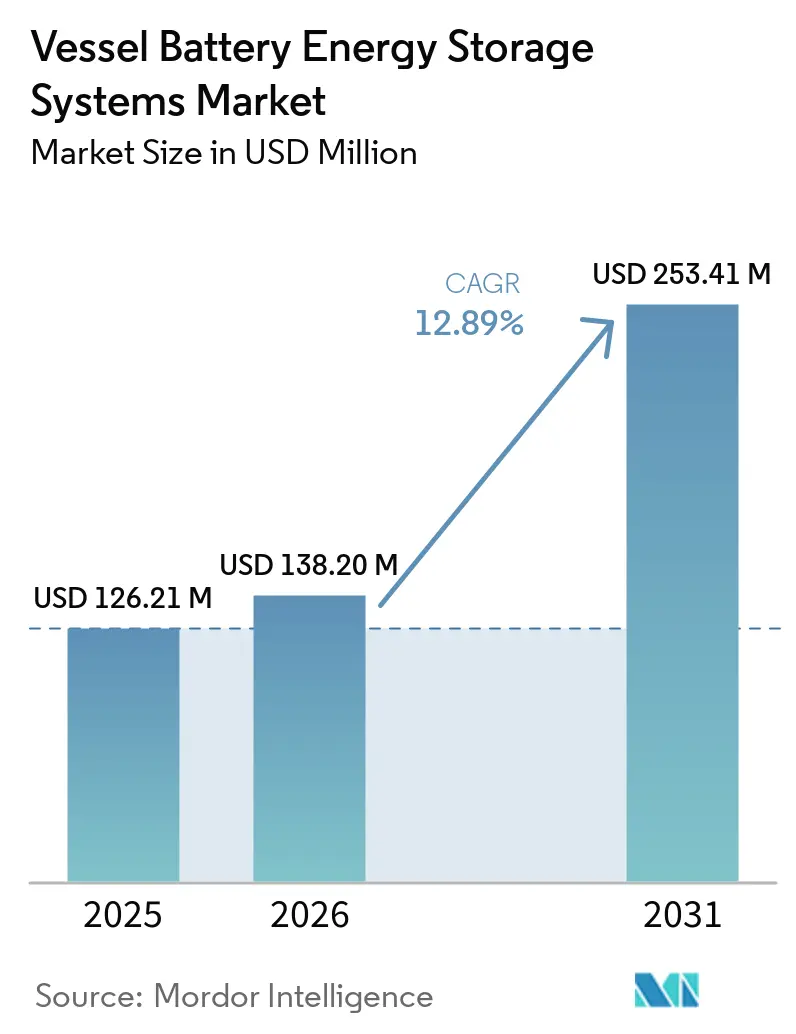
The Vessel Battery Energy Storage Systems Market size is expected to increase from USD 126.21 million in 2025 to USD 138.20 million in 2026 and reach USD 253.41 million by 2031, growing at a CAGR of 12.89% over 2026-2031. The vessel battery energy storage systems market is expanding as battery-assisted propulsion moves from a compliance response toward a way to reduce operating costs on suitable routes. Lower cell costs, emissions rules, and rising investment in shore power support demand across vessel classes. Operators are increasingly standardizing proven battery designs across new vessels, which can reduce engineering work on later orders. Autonomous vessel programs also raise the need for redundant onboard power systems that can support reliable operations and certification. The vessel battery energy storage systems market still depends on charging investment outside established Northern European routes, where limited port capacity can delay deployments.
Key Report Takeaways
- By chemistry, NMC held 79.1% by value in 2025, while LFP is forecast to expand at a 15.8% CAGR through 2031.
- By installation configuration, newbuild installations held 75.2% of the vessel battery energy storage systems market in 2025, while retrofits are forecast to grow at a 15.6% CAGR through 2031.
- By vessel type, passenger ships accounted for 43.6% in 2025 and are forecast to grow at a 13.9% CAGR through 2031.
- By application, hybrid power systems held 33.9% of the vessel battery energy storage systems market in 2025, while main propulsion systems are forecast to grow at a 14.2% CAGR through 2031.
- By geography, Europe accounted for 70.8% of the vessel battery energy storage systems market share in 2025 and is forecast to grow at a 14.1% CAGR through 2031.
Note: Market size and forecast figures in this report are generated using Mordor Intelligence’s proprietary estimation framework, updated with the latest available data and insights as of January 2026.
Market Trends and Insights
Drivers Impact Analysis of Vessel Battery Energy Storage Systems Market*
| Driver | (~) % Impact on CAGR Forecast | Geographic Relevance | Impact Timeline |
|---|---|---|---|
| Rising Demand for Hybrid and Electric Vessels to Reduce Emissions | +3.20% | Global, concentrated in Europe and Asia-Pacific | Short term (≤ 2 years) |
| Stringent Environmental Regulations Driving Adoption of Clean Energy Solutions | +2.80% | Europe (FuelEU Maritime), Global (IMO MARPOL Annex VI) | Medium term (2-4 years) |
| Technological Advancements in Marine Battery Systems are Improving Efficiency | +2.00% | Global; development led by Europe and China | Medium term (2-4 years) |
| Increasing Investments in Renewable Energy Integration for Maritime Operations | +1.40% | Asia-Pacific and Europe; spill-over to MEA | Long term (≥ 4 years) |
| Growing Demand for Shore Power and Port Electrification is Supporting Vessel Battery Adoption | +1.50% | Europe and North America; early-stage in South America and MEA | Medium term (2-4 years) |
| Expansion of Autonomous and Digitally Connected Vessels is Increasing Demand for Reliable Onboard Energy Storage | +1.00% | Japan, Norway, China; spill-over to global | Long term (≥ 4 years) |
| Source: Mordor Intelligence | |||
Rising Demand for Hybrid and Electric Vessels Drives Battery System Volume
Hybrid and all-electric propulsion have become more attractive for short-haul routes with frequent operating cycles. The vessel battery energy storage systems market benefits when battery cycling can reduce total operating costs rather than only support compliance. Wärtsilä received its third successive electric propulsion order for a Molslinjen high-speed ferry at Incat Tasmania in January 2026. The repeated selection shows that operators can standardize a proven architecture across related vessels. This approach reduces the engineering effort needed for follow-on ships and can shorten procurement decisions. It also supports wider battery deployment among ferry operators that have predictable routes and charging access[1].
Stringent Environmental Regulations Accelerate Clean Energy Adoption
Regulation has made emissions performance a current operating issue that supports the vessel battery energy storage systems market in European and international trades. The IMO approved its Net-Zero Framework at MEPC 83 in April 2025, combining a global marine-fuel greenhouse gas intensity standard with an emissions pricing mechanism. The framework is anticipated to enter into force in 2027. FuelEU Maritime has applied fully since January 1, 2025, and requires verified 2025 greenhouse gas intensity data by January 31, 2026. Penalties for noncompliance apply from May 1, 2026. Battery-assisted operations can lower attained greenhouse gas intensity and may create bankable or transferable compliance surplus units when performance exceeds the regulation’s requirements.
Technological Advancements Improve Marine Battery Performance and Lifecycle Economics
LFP chemistry, modular system design, and battery management systems are improving the operating case for marine batteries in the vessel battery energy storage systems market. Corvus Energy launched its cobalt-free Blue Whale NxtGen LFP system in December 2025. The system has a projected 15-year operating life, a 1C charge and discharge rate, and a fourth-generation battery management system with cybersecurity standards. Its modular design allows cell replacement without replacing the full system. That feature can reduce concern about stranded assets as battery technology evolves. ABS and Siemens Energy are also developing thermal-runaway simulation capability, showing that safety verification is becoming an important factor alongside energy performance[2].
Shore Power and Port Electrification Reshape Vessel Battery Utility
Shore power allows vessels to rely on planned charging at port rather than carry battery capacity for extended independent operation. The vessel battery energy storage systems market benefits when charging access is predictable along a defined route. Portsmouth International Port became the United Kingdom’s first multi-berth, multi-user shore power facility, supported by GBP 19.8 million in funding from the UK Department for Transport, and its first commercial vessel connection occurred in 2025. ICO, part of the NYK Group, began operating Belgium’s first commercial shore power facility for RoRo vessels at Zeebrugge in June 2026. Iberdrola completed an onshore power supply connection at Spain’s Port of Pasaia in May 2026. These facilities make charging access more predictable and strengthen the commercial case for battery-electric and hybrid vessels on defined routes[3].
Restraints Impact Analysis of Vessel Battery Energy Storage Systems Market*
| Restraint | (~) % Impact on CAGR Forecast | Geographic Relevance | Impact Timeline |
|---|---|---|---|
| High Initial Cost of Battery Energy Storage Systems for Vessels | -2.80% | Global; most acute among smaller operators and developing-market fleets | Short term (≤ 2 years) |
| Limited Charging Infrastructure in Ports and Marine Routes | -2.00% | Global excluding Northern Europe and East Asia; pronounced in MEA and South America | Medium term (2-4 years) |
| Safety Concerns Related to Battery Thermal Management and Fire Risks | -1.50% | Global | Short term (≤ 2 years) |
| Short Lifecycle and Performance Degradation In Harsh Marine Environments | -1.00% | Global; most pronounced in tropical, ice-class, and high-vibration offshore environments | Long term (≥ 4 years) |
| Source: Mordor Intelligence | |||
High Initial Capital Cost Constrains Adoption Beyond Lead-Operator Segments
Initial investment remains a barrier for smaller shipping companies, fishing fleets, and operators in lower-income trade regions. An Aalborg University analysis found that a baseline electric ferry produced EUR 3.28 million in 10-year total cost of ownership, compared with EUR 2.48 million for a diesel-electric equivalent. The study found parity only at higher daily route utilization. Marine-certified systems include vibration protection, safety enclosures, and class-certification requirements that add cost. High-frequency short-sea ferry routes can therefore reach a workable economic threshold earlier than offshore or low-utilization cargo applications. This cost divide shapes the vessel battery energy storage systems market by favoring early users who can build experience and cost advantages[4].
Inadequate Port Charging Infrastructure Limits Battery-Dependent Route Expansion
All-electric and high-battery hybrid vessels require reliable charging capacity at both ends of a route. This condition is not yet available across most global port networks. Major charging installations require dedicated cables, switchgear, and local power capacity. Brazil’s Port of Pecém is developing the country’s first shore power system in 2026, showing that the infrastructure base in South America remains at an early stage. Gaps in charging infrastructure limit the routes on which operators can commit to all-electric vessel specifications. In the vessel battery energy storage systems market, these gaps preserve diesel-backup hybrid systems and limit average onboard capacity outside mature charging corridors.
*Our forecasts treat driver/restraint impacts as directional, not additive. The impact forecasts reflect baseline growth, mix effects, and variable interactions.
Vessel Battery Energy Storage Systems Market Segment Analysis
By Chemistry:
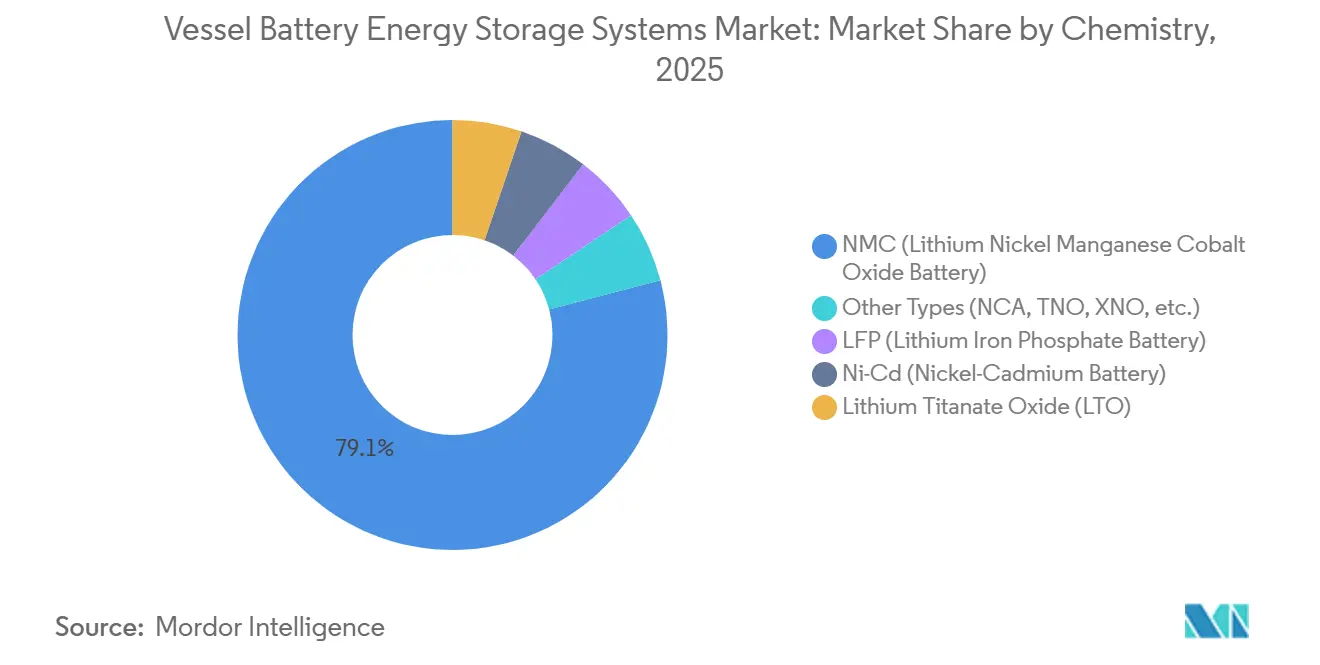
LFP Momentum Challenges NMC’s Energy Density PremiumNMC held 79.1% of the vessel battery energy storage systems market by value in 2025 because its energy density supports designs with tight space and weight limits. LFP is forecast to grow at a 15.8% CAGR from 2026 to 2031, the fastest rate among chemistry types. Its thermal stability can reduce fire-risk certification complexity, while Chinese manufacturers have supported a declining LFP cell cost curve. A Singapore Maritime Institute assessment of 7 vessel types identified LFP as suitable for ferries, offshore support vessels, and fishing vessels because of their cycling patterns and safety requirements. The vessel battery energy storage systems industry is balancing NMC’s space advantage against LFP’s safety and lifecycle attributes.
Ni-Cd remains relevant in military applications that require operation across extreme temperatures, while LTO serves short-turnaround ferries and harbor tugs where rapid charging can justify a cost premium. ISO 18962:2026, published in January 2026, sets installation and operating requirements for swappable ship batteries. The standard supports modular designs in the vessel battery energy storage systems market and may enable chemistry upgrades during a vessel’s working life without a full system replacement. Corvus Energy and BYD Energy Storage signed a strategic cooperation agreement in May 2026 to develop high-rate LFP marine systems. The agreement shows that a major marine battery supplier is pursuing LFP development while NMC suppliers seek to sustain their position in space-constrained applications

By Installation Configuration:
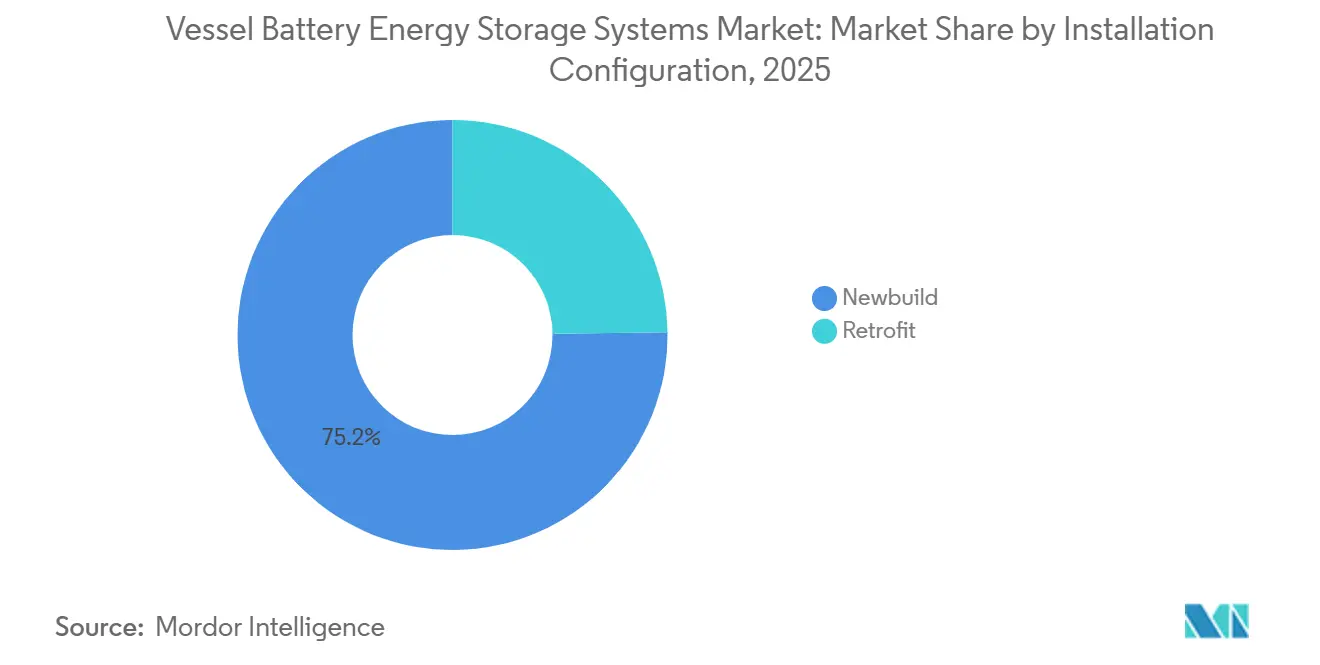
Retrofit Segment Emerges as Structural Growth DriverNewbuild installations held 75.2% of the vessel battery energy storage systems market in 2025 because new vessels can be designed around battery bays and electrical systems from the beginning. Retrofits are forecast to grow at a 15.6% CAGR from 2026 to 2031 as operators add packs during planned dry-docking periods rather than wait for vessel replacement. This allows aging diesel-electric fleets to improve greenhouse gas intensity performance. It also helps operators manage regulatory requirements while preserving the use of existing hulls. The vessel battery energy storage systems industry is finding a wider route into fleets that are not ready for newbuild procurement.
Retrofit projects require careful integration with existing electrical architecture, vessel layout, and class requirements. Wasaline’s Aurora Botnia received a 10.4 MWh LFP retrofit in early 2026, lifting total onboard capacity to 12.6 MWh with DNV class approval. The project demonstrated that large battery upgrades can be completed with limited operational downtime. Everllence and WE Tech Solutions were discussing a pilot covering up to 33 vessels for Power Take-Off and Variable Frequency Drive upgrades during scheduled dry dockings. This installation route is particularly relevant for cargo and fishing fleets that operate for long periods before replacement.
By Vessel Type:
Passenger Ships Define Market Scale and Forward DirectionPassenger ships accounted for 43.6% of the vessel battery energy storage systems market share in 2025 and are forecast to grow at a 13.9% CAGR through 2031. Ferries and hybrid cruise vessels benefit from fixed routes, predictable daily cycles, and charging facilities developed with passenger terminals. Ferry programs remain in an early-to-middle phase of deployment in many regions. Leclanché installed 4 MWh of Navius MRS-3 systems aboard a hybrid ocean cruise vessel in October 2025, its first deep-sea cruise deployment, to support EU Emissions Trading System compliance. Passenger operations provide a practical setting for battery systems because route schedules and charging needs are easier to plan.
Cargo ships form the second-largest vessel group, although their batteries often serve auxiliary loads and at-berth emissions reduction rather than main propulsion. This limits average battery capacity per cargo vessel. Naval vessels have a separate case because silent operation can support adoption regardless of commercial fuel economics. Bibby Marine’s eCSOV is planned with a 25 MWh Corvus Blue Whale LFP system that can support 24 hours of fully electric operation. Fishing vessels, tugs, workboats, and inland craft can also benefit from near-port operations that simplify charging logistics.
By Application:
Main Propulsion Signals the Transition Beyond Supplemental HybridizationHybrid power systems led the vessel battery energy storage systems market with 33.9% share in 2025. Load leveling, peak shaving, and diesel reduction remain the main commercial uses across a broad range of vessel types. Main propulsion systems are forecast to grow at a 14.2% CAGR through 2031 as fully electric propulsion proves viable on routes up to 20 nautical miles. Falling costs for high-capacity systems also support this shift. The vessel battery energy storage systems market is moving from supplemental battery use toward battery-primary propulsion on routes with suitable charging capacity.
Battery-powered main propulsion depends on high-capacity port connections and short, predictable route profiles. Scandlines placed its Baltic Whale fully electric freight ferry into service in March 2026 with a 10 MWh Leclanché LFP battery system and a dedicated charging connection for rapid turnaround. Auxiliary power units remain a lower-risk entry point for operators that are cautious about propulsion batteries. Emergency power supply systems serve naval and critical maritime applications with high reliability requirements. Renewable integration can complement these uses where vessel operating patterns and port infrastructure support the power arrangement.
Geography Analysis
Europe Vessel Battery Energy Storage Systems Market
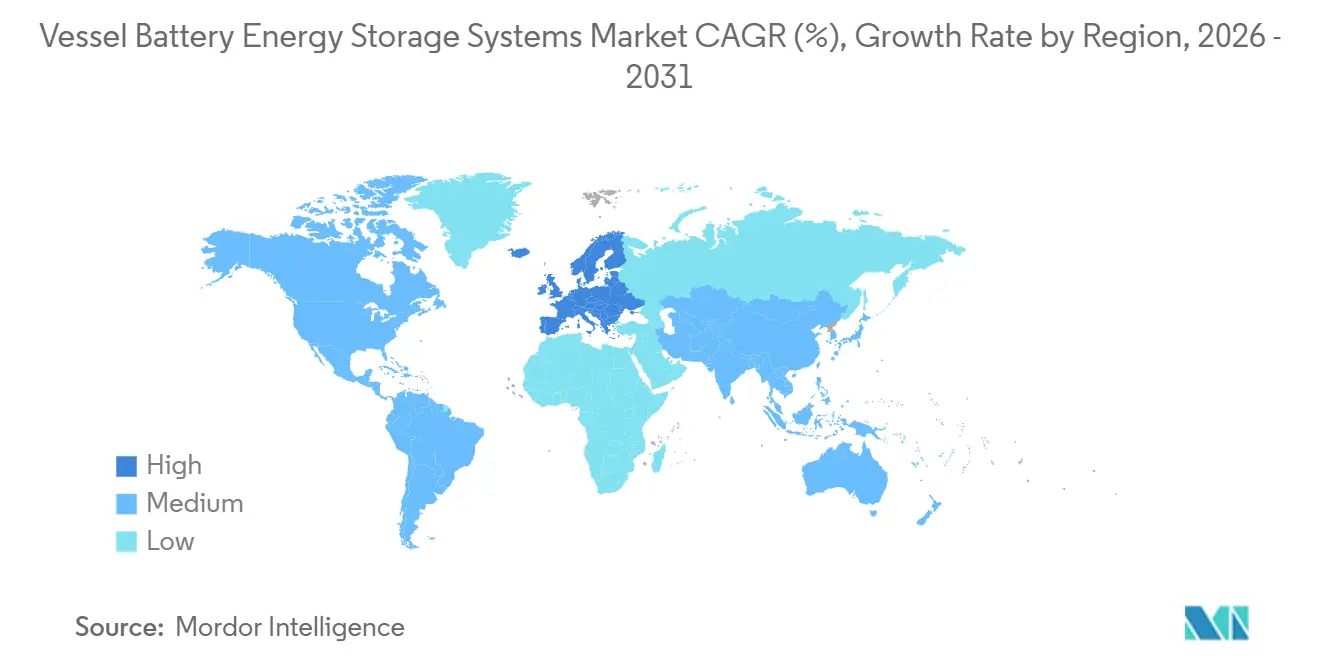
Europe held 70.8% of vessel battery energy storage systems market share in 2025 and is forecast to grow at a 14.1% CAGR through 2031. Its lead reflects emissions regulation, established ferry electrification corridors, and marine battery suppliers in Norway, Germany, Sweden, and the Netherlands. Germany’s HADAG fleet is deploying 3 fully electric harbor ferries in Hamburg, each with a 3.8 MWh Lehmann Marine CUBE LFP system. Scandinavia has demonstrated large installed capacity through the Aurora Botnia retrofit and the Baltic Whale freight operation. Active ferry replacement programs and the EU shore power requirement for passenger and container ships from 2030 provide continued demand support.
APAC Vessel Battery Energy Storage Systems Market
Asia-Pacific is the most technically active growth region in the vessel battery energy storage systems market. China commissioned a 10,000-ton-class pure-electric intelligent container ship in April 2026 with 20,000 kWh of battery storage and integrated autonomous navigation. The vessel also uses high-voltage shore power and battery-container swapping. Japan’s MEGURI2040 program secured government certification for 4 autonomous vessels in 2026, and MOL connected multiple ships in real time to land-based Fleet Operation Centers. These developments place reliable battery-backed power quality at the center of autonomous vessel operations.
The Americas and MEA Vessel Battery Energy Storage Systems Market
North America is advancing through state-procured ferry programs and defense interest in battery-electric vessel systems. Washington State Ferries’ hybrid-electric newbuilds use 13.2 MWh battery systems through an ABB and Corvus Energy partnership. BC Ferries’ Summit Class vessels are designed for up to 70 MWh per vessel. South America remains at an earlier stage because charging infrastructure is still being developed, while the Middle East and Africa are also early in adoption despite interest from Saudi Arabia and the United Arab Emirates.
Competitive Landscape
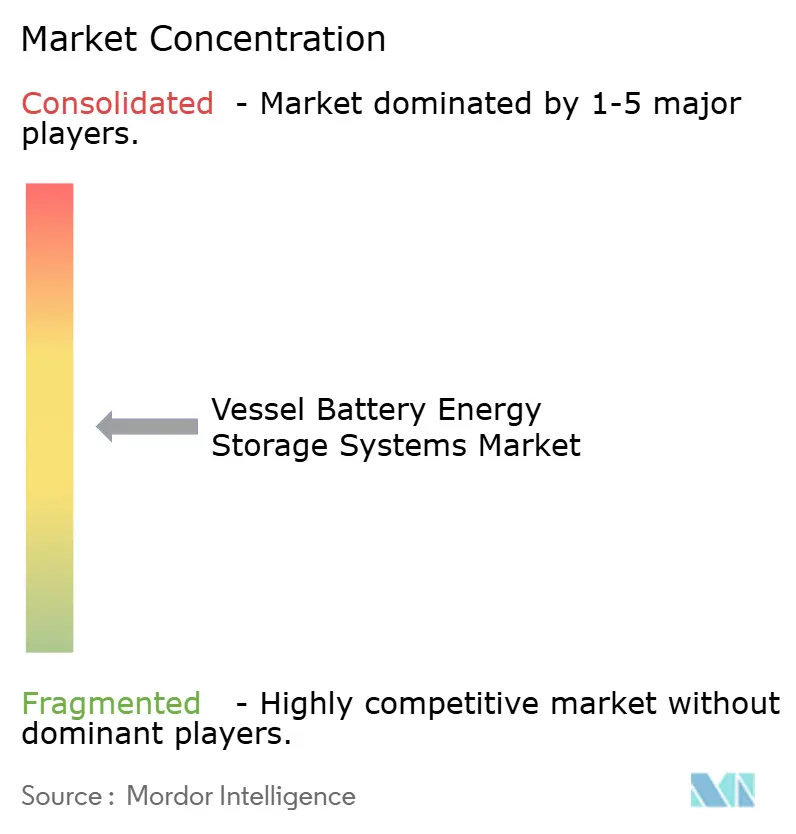
The vessel battery energy storage systems market is moderately concentrated at the system-integration level. Corvus Energy, ABB Marine & Ports, Wärtsilä, and Kongsberg Maritime hold the highest installed-capacity positions. Leclanché, Lehmann Marine, EST-Floattech, and Echandia Marine compete in ferry, inland vessel, and workboat applications. Corvus Energy states that more than 50% of vessels using zero-emission technology globally run its battery systems. This installed base supports broad class-certification experience and battery-management data that smaller suppliers may find difficult to match.
Competition is also changing as Chinese cell manufacturers expand toward marine system integration. CATL and Maersk signed a global strategic partnership in October 2025 covering maritime electrification, ports, and warehousing. Corvus Energy’s agreement with BYD pairs Chinese cell technology with European marine integration experience. Medium-capacity retrofits of 1–5 MWh for cargo and fishing vessels outside Northern Europe remain an opening where suppliers have not established ferry-level certification and service coverage. The vessel battery energy storage systems market rewards suppliers that can offer battery-management analytics and predictive maintenance.
Several recent moves show how leading suppliers are building positions through technology partnerships and delivery contracts. Corvus Energy and BYD are working on high-rate LFP systems through their May 2026 cooperation agreement. Wärtsilä’s third Molslinjen electric propulsion order shows the value of repeat fleet programs. Kongsberg Maritime received a contract from Cochin Shipyard in May 2026 for 4 full-electric Svitzer tugs, each using a 4.8 MWh battery pack.
Vessel Battery Energy Storage Systems Industry Leaders
-
Corvus Energy Holding AS
-
Wärtsilä Oyj Abp
-
ABB Ltd
-
Siemens Energy AG
-
EST-Floattech B.V.
- *Disclaimer: Major Players sorted in no particular order
Vessel Battery Energy Storage Systems Market Companies Covered in this Report
- ABB Ltd
- AYK Energy
- BorgWarner Inc.
- Corvus Energy Holding AS
- EAS Batteries GmbH
- Echandia Marine AB
- ePropulsion Europe SLU
- EST-Floattech B.V.
- EVE Energy Co., Ltd.
- Kongsberg Gruppen ASA
- KREISEL Electric GmbH
- Leclanché SA
- Lehmann Marine GmbH
- Saft Groupe S.A.S.
- Siemens Energy AG
- Sunlight Group
- Wärtsilä Oyj Abp
- ZEM AS
Recent Industry Developments in Vessel Battery Energy Storage Systems Market
- June 2026: ICO, part of the NYK Group, commenced operation of Belgium’s first commercial shore power facility for RoRo vessels at the Port of Zeebrugge, validated using an NYK pure car and truck carrier, and enabling renewable electricity at berth.
- May 2026: Kongsberg Maritime secured a contract from Cochin Shipyard to supply integrated electrical and automation technology for 4 of Svitzer’s next-generation full-electric TRAnsverse tugs, each powered by a 4.8 MWh battery pack, with options for 4 additional units.
- May 2026: Corvus Energy and BYD Energy Storage signed a Strategic Cooperation Agreement to co-develop high-rate LFP marine battery systems, covering joint research and development, certification, and large-scale deployment of next-generation marine battery solutions.
- April 2026: China’s first 10,000-ton-class pure-electric intelligent container ship commenced commercial operations with 20,000 kWh of battery storage, zero-carbon emissions, and a dual-mode charging system combining high-voltage shore power and rapid container swapping.
Global Vessel Battery Energy Storage Systems Market Report Scope
Vessel Battery Energy Storage Systems (BESS) are rechargeable battery-based energy storage systems installed on marine vessels to store electrical energy and supply it to the vessel's propulsion, onboard electrical systems, and auxiliary equipment as needed. These systems typically consist of battery cells/modules, a Battery Management System (BMS), Power Conversion System (PCS), thermal management, safety systems, and associated control equipment. Vessel BESS can be used for fully electric propulsion, hybrid propulsion, peak-load management, engine load optimization, regenerative energy storage, and reducing fuel consumption and emissions.
The Vessel Battery Energy Storage Systems Market is segmented by chemistry, installation, vessel type, application, and geography. By chemistry, the market is segmented into NMC, LFP, Ni-Cd, LTO, and other chemistries. By installation, the market is segmented into newbuild and retrofit. By vessel type, the market is segmented into cargo, passenger, naval, fishing, offshore support, and other vessel types. By application, the market is segmented into APUs, main propulsion, emergency power, renewable integration, and hybrid power. The report also covers the market size and forecasts for the global Vessel Battery Energy Storage Systems Market across 26 countries in key regions. For each segment, the market sizing and forecasts are provided on the basis of value (USD).
Segmentation Overview
| NMC (Lithium Nickel Manganese Cobalt Oxide Battery) |
| LFP (Lithium Iron Phosphate Battery) |
| Ni-Cd (Nickel-Cadmium Battery) |
| Lithium Titanate Oxide (LTO) |
| Other Types (NCA, TNO, XNO, etc.) |
| Newbuild |
| Retrofit |
| Cargo Ships |
| Passenger Ships |
| Naval Vessels |
| Fishing Vessels |
| Offshore Support Vessels |
| Others |
| Auxiliary Power Units |
| Main Propulsion Systems |
| Emergency Power Supply |
| Renewable Energy Integration |
| Hybrid Power Systems |
| North America | United States |
| Canada | |
| Mexico | |
| Europe | Germany |
| France | |
| Italy | |
| Spain | |
| United Kingdom | |
| Poland | |
| Russia | |
| Rest of Europe | |
| Asia-Pacific | China |
| India | |
| Japan | |
| South Korea | |
| Australia | |
| Indonesia | |
| Vietnam | |
| Thailand | |
| Rest of Asia-Pacific | |
| South America | Brazil |
| Argentina | |
| Chile | |
| Rest of South America | |
| Middle East and Africa | Saudi Arabia |
| United Arab Emirates | |
| Egypt | |
| South Africa | |
| Morocco | |
| Rest of Middle East and Africa |
| By Chemistry | NMC (Lithium Nickel Manganese Cobalt Oxide Battery) | |
| LFP (Lithium Iron Phosphate Battery) | ||
| Ni-Cd (Nickel-Cadmium Battery) | ||
| Lithium Titanate Oxide (LTO) | ||
| Other Types (NCA, TNO, XNO, etc.) | ||
| By Installation Configuration | Newbuild | |
| Retrofit | ||
| By Vessel Type | Cargo Ships | |
| Passenger Ships | ||
| Naval Vessels | ||
| Fishing Vessels | ||
| Offshore Support Vessels | ||
| Others | ||
| By Application | Auxiliary Power Units | |
| Main Propulsion Systems | ||
| Emergency Power Supply | ||
| Renewable Energy Integration | ||
| Hybrid Power Systems | ||
| By Geography | North America | United States |
| Canada | ||
| Mexico | ||
| Europe | Germany | |
| France | ||
| Italy | ||
| Spain | ||
| United Kingdom | ||
| Poland | ||
| Russia | ||
| Rest of Europe | ||
| Asia-Pacific | China | |
| India | ||
| Japan | ||
| South Korea | ||
| Australia | ||
| Indonesia | ||
| Vietnam | ||
| Thailand | ||
| Rest of Asia-Pacific | ||
| South America | Brazil | |
| Argentina | ||
| Chile | ||
| Rest of South America | ||
| Middle East and Africa | Saudi Arabia | |
| United Arab Emirates | ||
| Egypt | ||
| South Africa | ||
| Morocco | ||
| Rest of Middle East and Africa | ||
Key Questions Answered in the Report
What is driving demand for vessel battery energy storage systems?
Emissions rules, lower battery costs, shore power investment, and short-haul electric and hybrid vessel programs are supporting demand.
How large is the vessel battery energy storage systems market?
The market is estimated at USD 138.2 million in 2026 and is forecast to reach USD 253.41 million by 2031 at a 12.89% CAGR.
Which battery chemistry leads marine applications?
NMC led with 79.1% share in 2025, while LFP is expected to be the fastest-growing chemistry at a 15.8% CAGR through 2031.
Why are passenger vessels important for battery deployment?
Passenger vessels held 43.6% share in 2025 because their fixed routes and planned charging schedules support battery operations.
What limits wider use of battery-electric vessels?
High initial investment, limited charging infrastructure, safety requirements, and performance degradation in harsh marine conditions can slow adoption.
Why are retrofit battery systems growing?
Retrofits are forecast to grow at a 15.6% CAGR because operators can install systems during dry docking and improve existing fleet emissions performance.