
Used Lead-Acid Battery Handling Market Size and Share
Market Overview
| Study Period | 2022 - 2032 |
|---|---|
| Market Size (2027) | USD 137.91 Million |
| Market Size (2032) | USD 183.34 Million |
| Growth Rate (2027 - 2032) | 5.86 % |
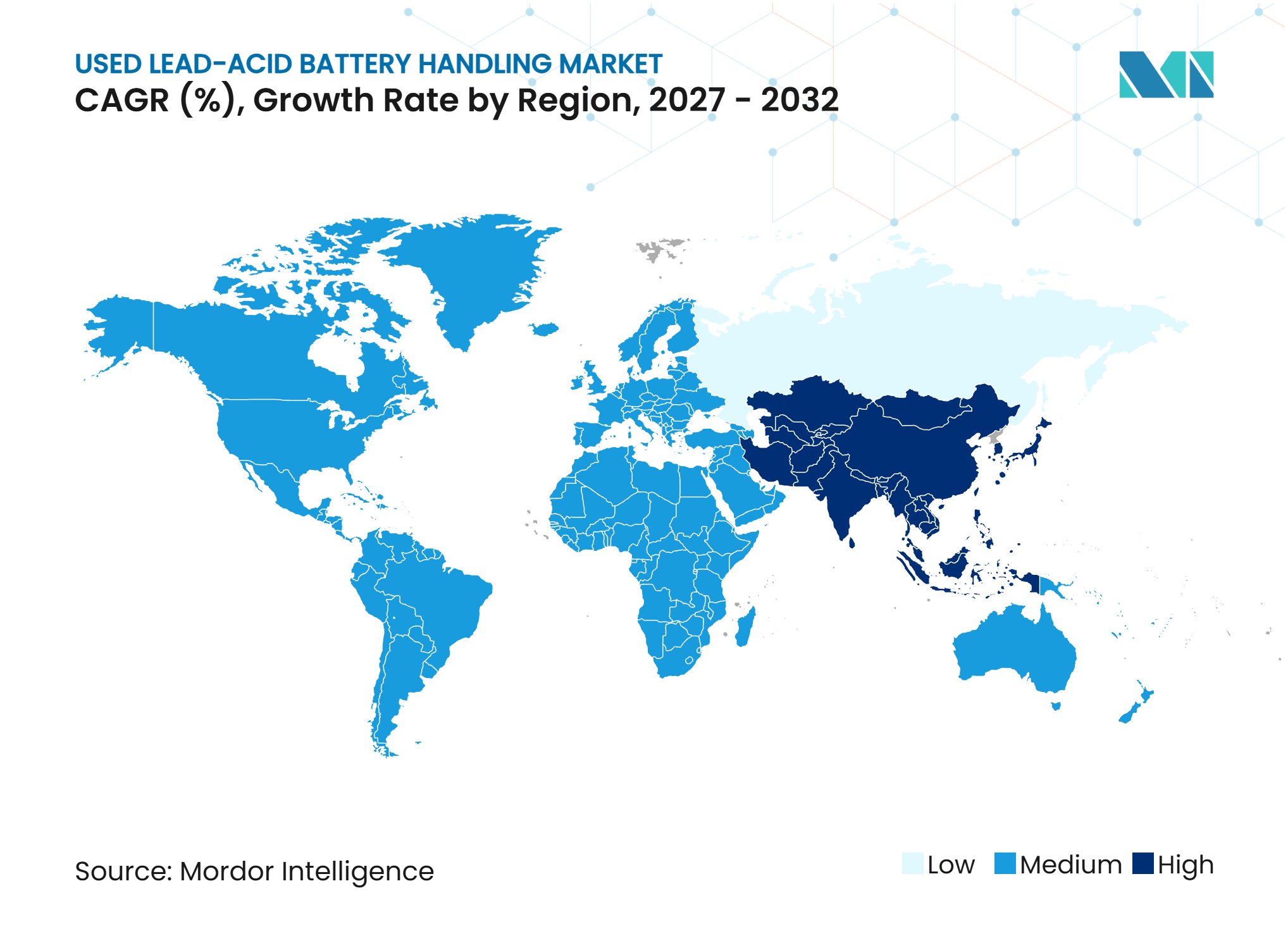
| Fastest Growing Market | Asia-Pacific |
| Largest Market | Asia-Pacific |
| Market Concentration | Medium |
Major Players *Disclaimer: Major Players sorted in no particular order Image © Mordor Intelligence. Reuse requires attribution under CC BY 4.0. | |
Used Lead-Acid Battery Handling Market Analysis by Mordor Intelligence
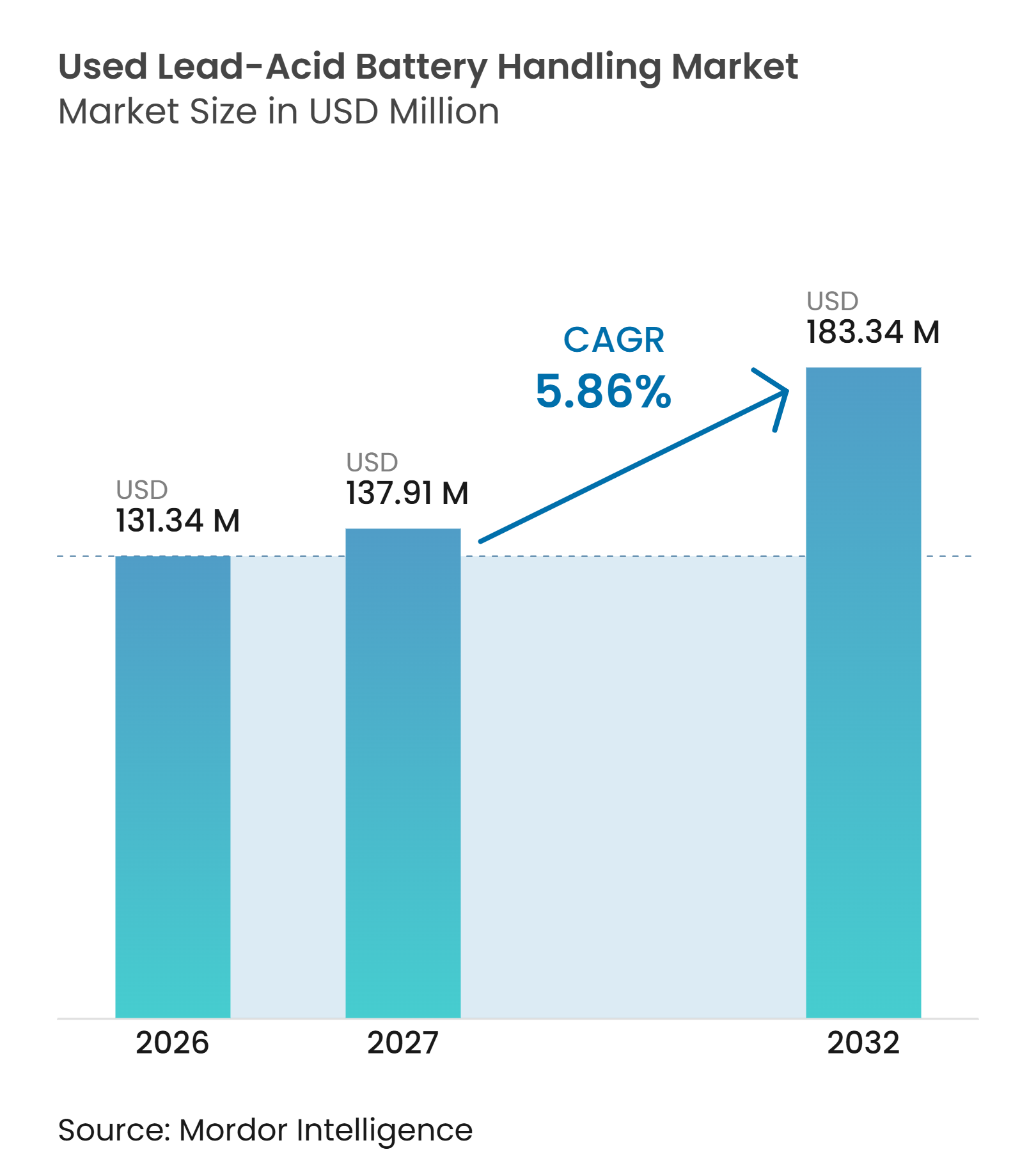
The used lead-acid battery handling market size was valued at USD 131.34 million in 2026 and is estimated to grow from USD 137.91 million in 2027 to reach USD 183.34 million by 2032, at a CAGR of 5.86% during the forecast period (2027-2032). The Used Lead-Acid Battery Handling Market covers collection, lifting, sorting, transport, storage, and pre-recycling preparation of spent batteries from automotive, industrial, and stationary power uses. Extended producer responsibility rules are making documented handling a required service rather than an optional activity in several major jurisdictions. This change shifts volumes from informal channels toward registered collection, logistics, and recycling operators. Investment is increasingly focused on traceability, safer storage, and automated movement inside facilities. Lead-price swings and informal buying networks remain material limits on formal collection activity.
Key Report Takeaways
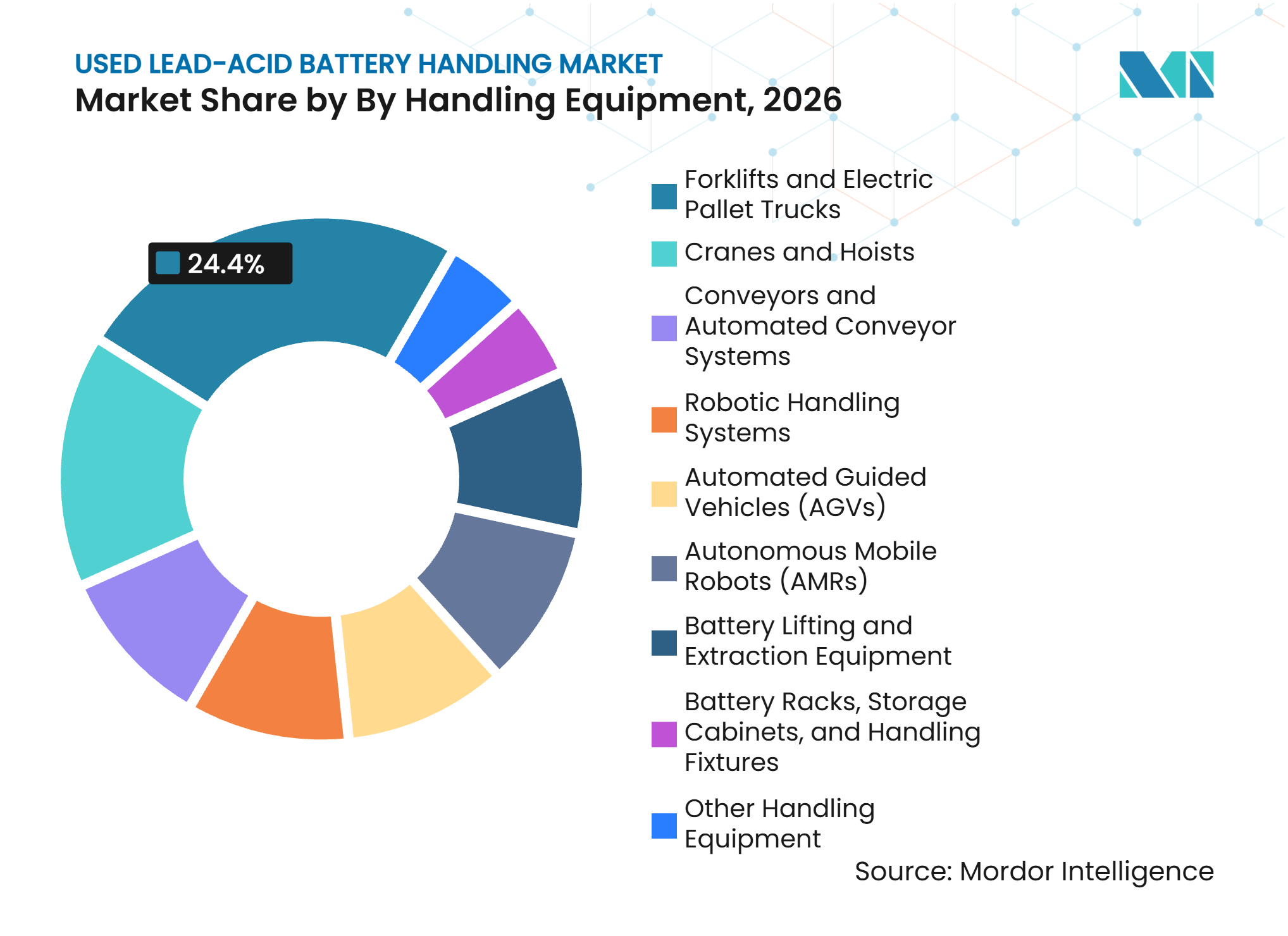
- By handling equipment, forklifts and electric pallet trucks led with 24.4% revenue share in 2026, while autonomous mobile robots are forecast to expand at a 7.1% CAGR through 2032.
- By source, passenger vehicles held 48.1% revenue share in 2026, while renewable energy and off-grid systems are projected to grow at a CAGR of 6.1% through 2032.
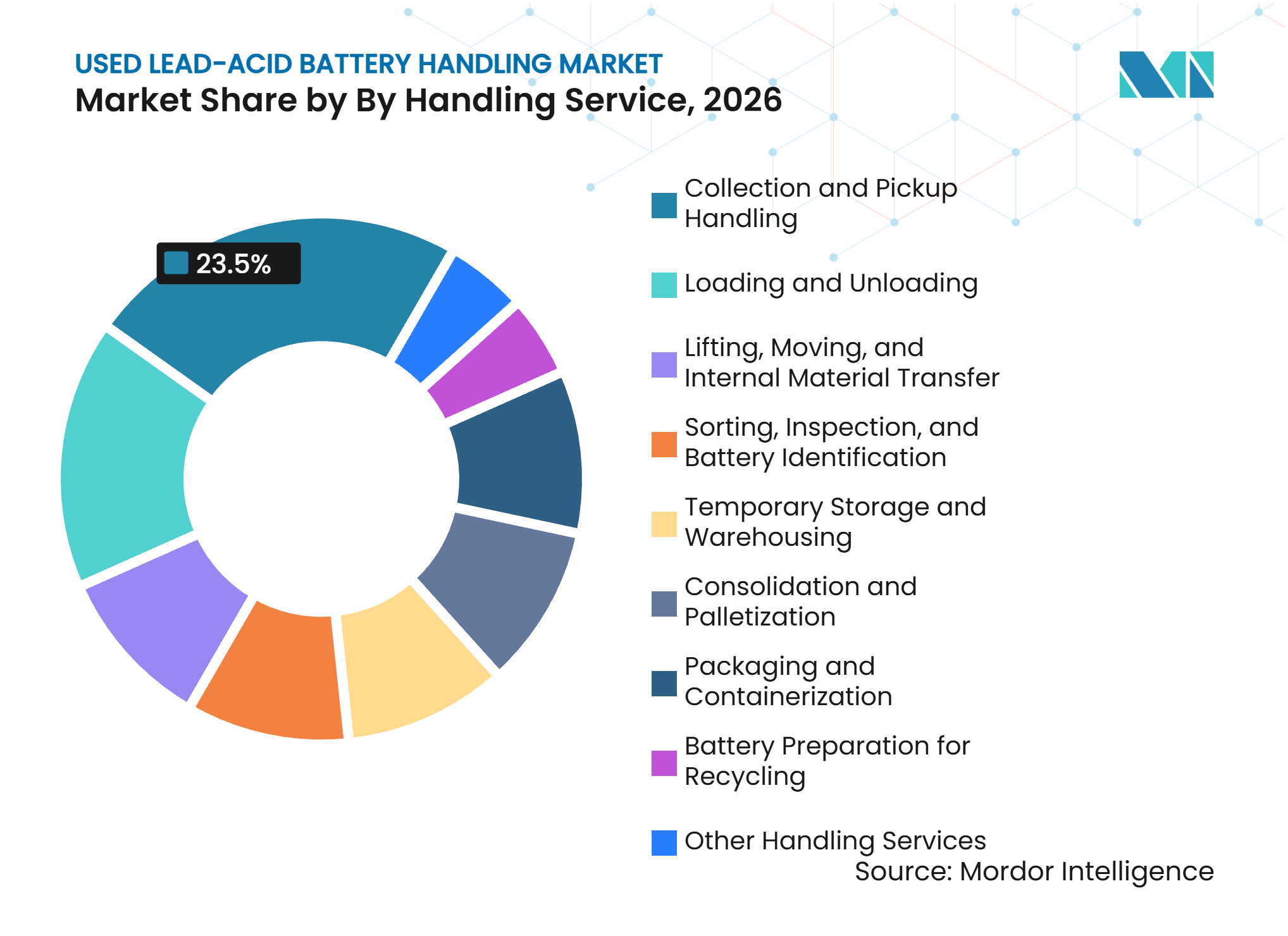
- By handling service, collection and pickup held 23.5% revenue share in 2026, while sorting, inspection, and battery identification are forecast to grow at a 6.7% CAGR through 2032.
- By automation level, manual handling held 52.6% revenue share in 2026, while fully automated handling is forecast to grow at a 7.6% CAGR through 2032.
- By end user, lead-acid battery recycling companies held 34.7% revenue share in 2026, while waste management and environmental service providers are forecast to grow at a 6.9% CAGR through 2032.
- By geography, Asia-Pacific held 39.2% revenue share in 2026 and is forecast to expand at a 6.2% CAGR through 2032.
Note: Market numbers in this report are based on Mordor Intelligence's proprietary estimation framework, which combines nine months of actuals with Q4 projections for base year 2026.
Market Trends and Insights
Drivers Impact Analysis of Used Lead-Acid Battery Handling Market*
| Driver | % Impact on CAGR Forecast | Geographic Relevance | Impact Timeline |
|---|---|---|---|
| Regulatory Push for Formal Collection and Environmentally Sound Management | +1.3% | Global, concentrated in EU, India, North America | Short term (≤ 2 years) |
| Stable Automotive SLI Replacement Feedstock | +1.0% | Global, highest volumes in North America, Europe, APAC | Medium term (2-4 years) |
| Backup Power and Telecom Battery Retention | +0.8% | Africa, South Asia, Southeast Asia (high telecom VRLA density) | Medium term (2-4 years) |
| Secondary Lead Cost and Carbon Advantage | +0.7% | North America, Europe (established closed secondary lead loops) | Long term (≥ 4 years) |
| Digital Traceability and Producer-Responsibility Data Infrastructure | +0.9% | EU core, spill-over to India and APAC | Short term (≤ 2 years) |
| Permit-Constrained Regional Recycling Capacity Creating Localized Handling Demand | +0.6% | North America western states, Southeast Asia | Medium term (2-4 years) |
| Source: Mordor Intelligence | |||
Regulatory Push for Formal Collection and Environmentally Sound Management
Regulatory action is expanding demand for certified handling services in the Used Lead-Acid Battery Handling Market. The EU Batteries Regulation applies extended producer responsibility requirements from August 18, 2025, and sets a 75% recycling efficiency target for lead-acid batteries from December 31, 2025.[1] Colombia established a national framework for used lead-acid battery collection and management through Resolución 0799 de 2025. These measures place end-of-life responsibilities on producers and require more documented movement of batteries. Certified operators can therefore compete for contracts that informal networks cannot readily serve.
Stable Automotive Starting, Lighting, and Ignition (SLI) Replacement Feedstock
Automotive replacement cycles provide the most predictable high-volume feedstock stream for the Used Lead-Acid Battery Handling Market. Global Starting, Lighting, and Ignition (SLI) battery production reached 460 million units in 2025, and the aftermarket replacement channel represented 69% of segment revenue. Replacement demand continues even when new-vehicle sales change because batteries installed in the vehicle fleet must still be replaced. A 3-to-5-year replacement cycle gives collection operators visibility into future returns. Lead battery volumes are expected to return to 1.9% growth in 2026 after replacement shipments declined 1.6% in 2025. This steady stream supports route planning, contracted pickup, and aggregation capacity. It also keeps automotive sources central to formal collection systems.
Digital Traceability and Producer-Responsibility Data Infrastructure
Digital traceability is changing which operators can participate in formal battery supply chains. The EU rules require battery markings and build toward battery passport information that supports reporting through the handling chain. GPS-tracked fleets, digital weighbridges, and data platforms allow handling events to be recorded consistently. These systems make it easier for established operators to demonstrate compliance in program bids. Smaller collectors must fund systems and processes that were not previously necessary. The Used Lead-Acid Battery Handling Market, therefore, rewards operational capability alongside physical collection reach.
Permit-Constrained Regional Recycling Capacity Creating Localized Handling Demand
Permitting constraints can create local demand for certified collection and handling capacity. North America has a secondary lead deficit of 177,000 metric tons each year, which increases reliance on imported lead and highlights the limits of domestic recycling capacity. Facilities that have permits and documented logistics networks can become important outlets for batteries in their service areas. Longer approval processes also raise the value of existing compliant operations. Collection routes tend to be built around the limited number of facilities that can receive and process material. This can improve utilization of professional transport and storage services. It also makes permit compliance a practical factor in local competition.
Restraints Impact Analysis of Used Lead-Acid Battery Handling Market*
| Restraint | % Impact on CAGR Forecast | Geographic Relevance | Impact Timeline |
|---|---|---|---|
| Lead, Sulfuric Acid, and Spill-Exposure Compliance Costs | -0.5% | North America, EU (highest compliance cost burden) | Short term (≤ 2 years) |
| Informal Collection and Leakage from Formal Channels | -0.8% | Africa, South and Southeast Asia, Latin America | Medium term (2-4 years) |
| Lead-Price Volatility and Working-Capital Risk | -0.4% | Global, more acute in Asian secondary lead markets | Short term (≤ 2 years) |
| Lithium-Ion Substitution in Selected New-Equipment Applications | -0.3% | Global, concentrated in new telecom and data center installations | Long term (≥ 4 years) |
| Source: Mordor Intelligence | |||
Informal Collection and Leakage from Formal Channels
Informal collection limits the volume that enters registered handling systems. Informal buyers can offer higher purchase prices when they do not carry the same safety, documentation, storage, and transport costs. This practice can divert batteries before they reach contracted routes or licensed facilities. The problem is most pronounced where collection is fragmented and enforcement capacity is limited. Regulations can improve documentation, but they do not immediately change the economics faced by local collectors. Formal operators must therefore combine compliance with practical pickup coverage and attractive commercial terms. The Used Lead-Acid Battery Handling Market remains exposed to this leakage in developing collection networks.
Lead-Price Volatility and Working-Capital Risk
Lead-price volatility affects the working capital available to collectors, logistics providers, and secondary smelters. The London Metal Exchange (LME) cash lead price averaged USD 2,017 per tonne in the first half of 2025. Battery procurement costs can remain high even when the value of recovered lead weakens. Smelters may then reduce operating activity and purchase fewer batteries. This weakens demand for pickup, transfer, and storage services that depend on regular facility intake. Mid-sized operators are particularly exposed when inventory must be financed for longer periods. These conditions can delay investment in additional handling infrastructure.
*Our forecasts treat driver/restraint impacts as directional, not additive. The impact forecasts reflect baseline growth, mix effects, and variable interactions.
Used Lead-Acid Battery Handling Market Segment Analysis
By Handling Equipment:
Forklifts Support Daily Facility MovementForklifts and electric pallet trucks accounted for 24.4% of the Used Lead-Acid Battery Handling Market size in 2026. Their position reflects their use across receiving docks, sorting floors, and consolidation areas. A typical Starting, Lighting, and Ignition (SLI) battery weighs 15-25 kg, while industrial batteries can exceed 60 kg. These loads require stable lifting equipment, controlled movement, and careful placement. Cranes and hoists serve heavier work at secondary lead facilities.
Autonomous mobile robots are projected to grow at a 7.1% CAGR through 2032. These systems can move material through hazardous areas with sensor-guided navigation and repeatable routes. An IEEE study reported 98.3% classification accuracy for a system combining vision and weight-based inference across battery chemistries. Automated handling also produces records that can support traceability requirements. Battery racks, storage cabinets, and fixtures remain necessary for compliant temporary storage.



By Source:
Automotive Returns Remain the Core Supply StreamPassenger vehicles held 48.1% of the Used Lead-Acid Battery Handling Market share in 2026. Vehicle batteries create a rolling return stream because the replacement cycle is generally 3-5 years. The automotive aftermarket represented 69% of lead battery segment revenue in 2025. Commercial vehicles, industrial equipment, and forklifts also contribute heavier units that require professional handling. UPS, telecom, data center, marine, aviation, and defense batteries have demanding transport and handling requirements.
Renewable energy and off-grid systems are forecast to grow at a 6.1% CAGR through 2032. India has deployed more than 1 million solar home lighting systems, including systems that use lead-acid storage. This installed base will create end-of-life batteries as units retire. Formal collection is gaining relevance as producer-responsibility programs extend into distributed energy systems. A University of Twente project reports recovery of up to 99% of battery materials in second-life work.
By Handling Service:
Collection Maintains the Largest RoleCollection and pickup represented 23.5% of the used lead-acid battery handling market size in 2026. It is the first commercial step in the handling chain, and links dispersed generators with aggregation facilities. Automotive service centers, scrap dealers, industrial sites, and telecom locations require different pickup patterns. Loading, unloading, and internal transfer operate alongside route collection. Temporary storage, palletization, packaging, and containerization add value where facilities must satisfy storage rules.
Sorting, inspection, and battery identification are forecast to grow at a 6.7% CAGR through 2032. This service is becoming more important because formal programs require better records on battery condition, chemistry, and origin. Automated classification can support more consistent intake decisions. The IEEE research on automated sorting provides an example of the technology direction, rather than a replacement for facility controls.[2] Providers that combine sorting with reporting can offer a more complete service to producer programs.

By Automation Level:
Manual Systems Continue to Serve Distributed NetworksManual handling held 52.6% of the Used Lead-Acid Battery Handling Market share in 2026. Labor-based collection remains practical where returns are dispersed, and capital budgets are limited. Hand trucks, battery dollies, and spill-containment kits remain common tools in collection and transfer work. This approach suits smaller sites and variable pickup volumes. Semi-automated systems form a middle option for operators to improve throughput.
Fully automated handling is forecast to grow at a 7.6% CAGR through 2032. Robotic systems can improve repeatability and limit worker exposure in defined processing tasks. A peer-reviewed study found that a configured robotic cell could match the productivity of 5.5 workers, with payback periods as short as 1.33 years under its tested assumptions.[3] Automated equipment also creates machine-generated records for audit trails. Its adoption is strongest where throughput and facility layout justify the investment.
By End User:
Recyclers Remain the Primary BuyersLead-acid battery recycling companies held 34.7% of Used lead-acid battery handling market size in 2026. These companies purchase collection, transfer, sorting, and preparation services to secure consistent feedstock. Secondary lead smelters and producers often require the heaviest specialized equipment. Battery manufacturers are also extending their role into recycling capacity. Automotive service centers and dealers remain important collection points in take-back networks.
Waste management and environmental service providers are forecast to grow at a 6.9% CAGR through 2032. Their permitting, fleet management, and compliance documentation align with the needs of producer-responsibility schemes. These operators can offer GPS-tracked collection and documented handover processes. Industrial and commercial users with large Valve-Regulated Lead-Acid (VRLA) banks increasingly need certified end-of-life services. This broadens the customer base beyond specialist recyclers.
Geography Analysis
Asia-Pacific accounted for 39.2% of Used lead-acid battery handling market size in 2026 and is projected to grow at a 6.2% CAGR through 2032. China uses a centralized approval approach for battery recycling companies. Liaoning Province issued revised 2025 guidelines that limit temporary storage by individual collectors to 30 days and 3 tons.
North America and Europe have mature recycling systems that are undergoing capacity and compliance changes. North America imports 177,000 metric tons of lead annually because domestic secondary lead output does not meet demand. Clarios has announced plans under its USD 6 billion American Energy Manufacturing Strategy to add recycling and critical-mineral-processing capacity. It also announced its acquisition of Ecobat’s German and Austrian recycling operations in August 2025. These developments support investment in established facilities and systems.
South America, the Middle East, and Africa represent smaller current markets with formalization needs. Colombia’s 2025 resolution establishes a dedicated national system for collection and management of used lead-acid batteries. In Africa, the March 2025 ProBaMet conference in Abuja brought together 170 stakeholders and issued circularity guidelines for safer battery recycling. Telecom, data center, and defense battery replacement cycles support the need for formal collection in the Middle East.
Competitive Landscape
Market Concentration
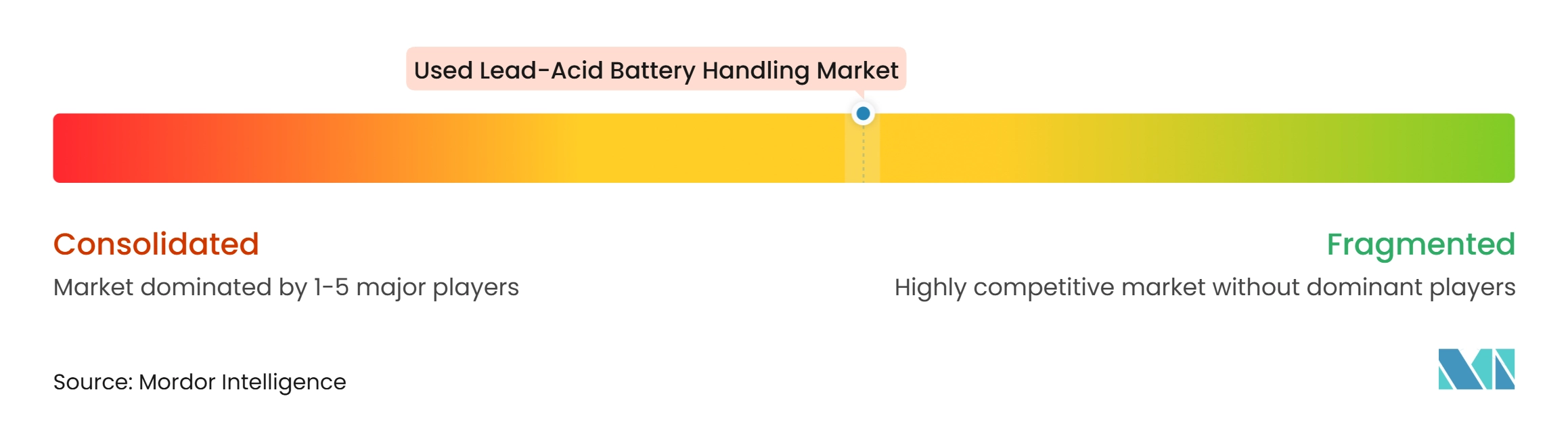
The Used Lead-Acid Battery Handling Market is moderately consolidated at the facility-operator level and remains fragmented across local collection and logistics. Clarios is a major integrated operator and states that it recycles 8,000 batteries per hour across its network. Its strategy treats recovery capacity as a supply-chain capability rather than a standalone commodity service. Clarios announced a USD 6 billion American Energy Manufacturing Strategy that includes capacity, automation, and critical-mineral processing initiatives. Its acquisition of Ecobat facilities in Germany and Austria added lead and polypropylene recovery operations in Europe.
Battery manufacturers and recyclers are also building more integrated positions. ACE Green Recycling is pursuing technology licensing for lead and lithium battery recycling projects. Its agreement with Mel Metal covers a 6,000 MT per year lead-acid operation in Armenia with expansion options. The company’s approach uses hydrometallurgical technology for lead recovery rather than traditional smelting. These moves show how capacity ownership, technology access, and traceability systems can all shape competitive positions.
Competitive advantage depends on compliant routes, permitted storage, reliable feedstock access, and secure processing outlets. Data-enabled handling is becoming more important as producer programs require records at each transfer point. Large operators can spread the costs of fleet tracking, weighing, and reporting systems across more volume. Regional aggregators retain value because they control local collection relationships.
Used Lead-Acid Battery Handling Industry Leaders
-
Ecobat
-
Clarios
-
Exide Industries Ltd.
-
Gravita India Ltd.
-
East Penn Manufacturing Company
- *Disclaimer: Major Players sorted in no particular order
Used Lead-Acid Battery Handling Market Companies Covered in this Report
- ACE Green Recycling, Inc.
- Amara Raja Energy & Mobility Limited
- Aqua Metals, Inc.
- Call2Recycle, Inc.
- Campine NV
- Clarios, LLC.
- Ecobat, LLC
- EnerSys
- East Penn Manufacturing Company
- Enva Group Limited
- Exide Industries Limited
- Gopher Resource, LLC
- Gravita India Limited
- Hunan Jiangye Electromechanical Science & Technology Co., Ltd.
- Mettherm Inc.
- Pondy Oxides and Chemicals Limited
- Raw Materials Company Inc.
- The Doe Run Company
- Tianneng Power International Limited
- Umicore SA
Recent Industry Developments in Used Lead-Acid Battery Handling Market
- August 2025: Clarios confirmed the acquisition of Ecobat’s three lead battery recycling facilities in Freiberg and Braubach, Germany, and Arnoldstein, Austria, substantially expanding Clarios’ European recycling footprint with proven lead and polypropylene recovery technology.
- August 2025: Colombia’s Ministry of Environment issued Resolución 0799 de 2025, formally establishing a national regulatory system for collection and management of used lead-acid batteries.
- May 2025: Clarios revealed plans to invest up to USD 1 billion in a critical minerals processing and recovery plant in the United States, with Indiana, Texas, and Utah under active site assessment.
- February 2025: ACE Green Recycling secured technology licensing agreements with Armenia’s Mel Metal for a 6,000 MT per year lead-acid recycling operation, with expansion options.
Global Used Lead-Acid Battery Handling Market Report Scope
Used lead-acid battery handling refers to the equipment, systems, and services involved in the collection, lifting, movement, sorting, storage, consolidation, packaging, and preparation of spent lead-acid batteries for recycling or further processing. These activities support the safe transfer of used batteries from collection points, automotive service centers, industrial facilities, backup power installations, and other sources to recycling facilities and secondary lead smelters. Handling operations use equipment such as forklifts, electric pallet trucks, cranes, hoists, conveyors, robotic handling systems, automated guided vehicles (AGVs), autonomous mobile robots (AMRs), and specialized battery lifting and extraction equipment. These solutions are designed to manage the weight, dimensions, and potential leakage of used batteries while reducing manual handling risks, preventing damage, and supporting efficient material movement. Given the presence of lead and corrosive sulfuric acid in lead-acid batteries, appropriate handling practices, storage arrangements, and containment measures are essential for worker safety and environmental protection.
The Global Used Lead-Acid Battery Handling Market is segmented by handling equipment, source, handling service, automation level, end user, and geography. By handling equipment, the market is segmented into forklifts and electric pallet trucks, cranes and hoists, conveyors and automated conveyor systems, robotic handling systems, automated guided vehicles (AGVs), autonomous mobile robots (AMRs), battery lifting and extraction equipment, battery racks, storage cabinets and handling fixtures, and other handling equipment. By source, the market is segmented into passenger vehicles, commercial vehicles, industrial equipment and forklifts, UPS, telecom and data centers, renewable energy and off-grid systems, and marine, aviation and defense applications. By handling service, the market is segmented into collection and pickup handling, loading and unloading, lifting, moving and internal material transfer, sorting, inspection and battery identification, temporary storage and warehousing, consolidation and palletization, packaging and containerization, battery preparation for recycling, and other handling services. By automation level, the market is segmented into manual battery handling, semi-automated battery handling, and fully automated battery handling. By end user, the market is segmented into lead-acid battery recycling companies, secondary lead smelters and lead producers, battery manufacturers, automotive service centers and battery dealers, scrap collectors and aggregators, industrial and commercial battery users, waste management and environmental service providers, and other end users. The report also covers the market size and forecasts for the global used lead-acid battery handling market across 26 countries in key regions. For each segment, market sizing and forecasts are provided on the basis of value (USD).
Segmentation Overview
| Forklifts and Electric Pallet Trucks |
| Cranes and Hoists |
| Conveyors and Automated Conveyor Systems |
| Robotic Handling Systems |
| Automated Guided Vehicles (AGVs) |
| Autonomous Mobile Robots (AMRs) |
| Battery Lifting and Extraction Equipment |
| Battery Racks, Storage Cabinets, and Handling Fixtures |
| Other Handling Equipment |
| Passenger Vehicles |
| Commercial Vehicles |
| Industrial Equipment and Forklifts |
| UPS, Telecom and Data Centers |
| Renewable Energy and Off-Grid Systems |
| Marine, Aviation and Defense Applications |
| Collection and Pickup Handling |
| Loading and Unloading |
| Lifting, Moving, and Internal Material Transfer |
| Sorting, Inspection, and Battery Identification |
| Temporary Storage and Warehousing |
| Consolidation and Palletization |
| Packaging and Containerization |
| Battery Preparation for Recycling |
| Other Handling Services |
| Manual Battery Handling |
| Semi-automated Battery Handling |
| Fully Automated Battery Handling |
| Lead-Acid Battery Recycling Companies |
| Secondary Lead Smelters and Lead Producers |
| Battery Manufacturers |
| Automotive Service Centers and Battery Dealers |
| Scrap Collectors and Aggregators |
| Industrial and Commercial Battery Users |
| Waste Management and Environmental Service Providers |
| Other End Users |
| North America | United States |
| Canada | |
| Mexico | |
| Europe | Germany |
| France | |
| Italy | |
| Spain | |
| United Kingdom | |
| Poland | |
| Russia | |
| Rest of Europe | |
| Asia-Pacific | China |
| India | |
| Japan | |
| South Korea | |
| Australia | |
| Indonesia | |
| Vietnam | |
| Thailand | |
| Rest of Asia-Pacific | |
| South America | Brazil |
| Argentina | |
| Chile | |
| Rest of South America | |
| Middle East and Africa | Saudi Arabia |
| United Arab Emirates | |
| Egypt | |
| South Africa | |
| Morocco | |
| Rest of Middle East and Africa |
| By Handling Equipment | Forklifts and Electric Pallet Trucks | |
| Cranes and Hoists | ||
| Conveyors and Automated Conveyor Systems | ||
| Robotic Handling Systems | ||
| Automated Guided Vehicles (AGVs) | ||
| Autonomous Mobile Robots (AMRs) | ||
| Battery Lifting and Extraction Equipment | ||
| Battery Racks, Storage Cabinets, and Handling Fixtures | ||
| Other Handling Equipment | ||
| By Source | Passenger Vehicles | |
| Commercial Vehicles | ||
| Industrial Equipment and Forklifts | ||
| UPS, Telecom and Data Centers | ||
| Renewable Energy and Off-Grid Systems | ||
| Marine, Aviation and Defense Applications | ||
| By Handling Service | Collection and Pickup Handling | |
| Loading and Unloading | ||
| Lifting, Moving, and Internal Material Transfer | ||
| Sorting, Inspection, and Battery Identification | ||
| Temporary Storage and Warehousing | ||
| Consolidation and Palletization | ||
| Packaging and Containerization | ||
| Battery Preparation for Recycling | ||
| Other Handling Services | ||
| By Automation Level | Manual Battery Handling | |
| Semi-automated Battery Handling | ||
| Fully Automated Battery Handling | ||
| By End User | Lead-Acid Battery Recycling Companies | |
| Secondary Lead Smelters and Lead Producers | ||
| Battery Manufacturers | ||
| Automotive Service Centers and Battery Dealers | ||
| Scrap Collectors and Aggregators | ||
| Industrial and Commercial Battery Users | ||
| Waste Management and Environmental Service Providers | ||
| Other End Users | ||
| By Geography | North America | United States |
| Canada | ||
| Mexico | ||
| Europe | Germany | |
| France | ||
| Italy | ||
| Spain | ||
| United Kingdom | ||
| Poland | ||
| Russia | ||
| Rest of Europe | ||
| Asia-Pacific | China | |
| India | ||
| Japan | ||
| South Korea | ||
| Australia | ||
| Indonesia | ||
| Vietnam | ||
| Thailand | ||
| Rest of Asia-Pacific | ||
| South America | Brazil | |
| Argentina | ||
| Chile | ||
| Rest of South America | ||
| Middle East and Africa | Saudi Arabia | |
| United Arab Emirates | ||
| Egypt | ||
| South Africa | ||
| Morocco | ||
| Rest of Middle East and Africa | ||
Key Questions Answered in the Report
What is the projected value of the used lead-acid battery handling market by 2032?
The market is projected to reach USD 183.34 million by 2032, growing at a 5.86% CAGR from 2027 to 2032.
Which region leads used lead-acid battery handling?
Asia-Pacific leads with a 39.2% share in 2026 and is projected to grow at a 6.2% CAGR through 2032.
Which source generates the largest volume of used lead-acid batteries?
Passenger vehicles lead the source segment with a 48.1% share in 2026, supported by routine Starting, Lighting, and Ignition (SLI) battery replacement cycles.
What is driving formal battery collection services?
Producer-responsibility and traceability rules in the EU, India, and Colombia are increasing the need for documented collection and management.
Which handling service is expected to grow fastest?
Sorting, inspection, and battery identification are projected to grow at a 6.7% CAGR through 2032.
Which end users are growing fastest for handling services?
Waste management and environmental service providers are projected to grow at a 6.9% CAGR through 2032.