
Market Overview
| Study Period | 2020 - 2031 |
|---|---|
| Forecast Data Period | 2026 - 2031 |
| Base Year Market Size (2025) | USD 4.61 Billion |
| Market Size (2026) | USD 4.85 Billion |
| Market Size (2031) | USD 6.26 Billion |
| Growth Rate (2026 - 2031) | 5.24 % |
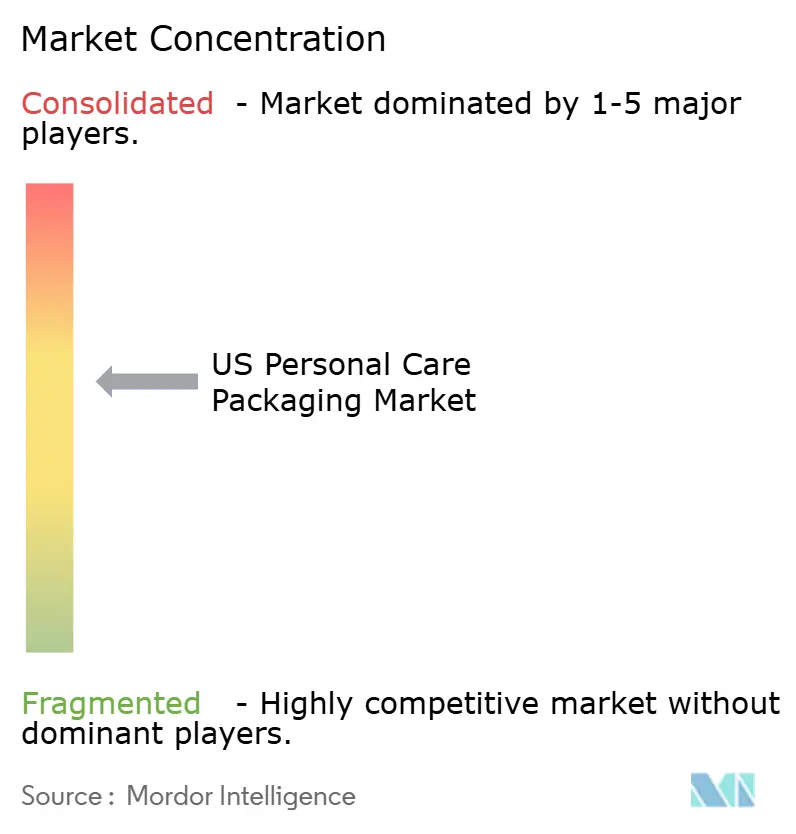
| Market Concentration | Medium |
Major Players *Disclaimer: Major Players sorted in no particular order Image © Mordor Intelligence. Reuse requires attribution under CC BY 4.0. | |
US Personal Care Packaging Market Analysis by Mordor Intelligence
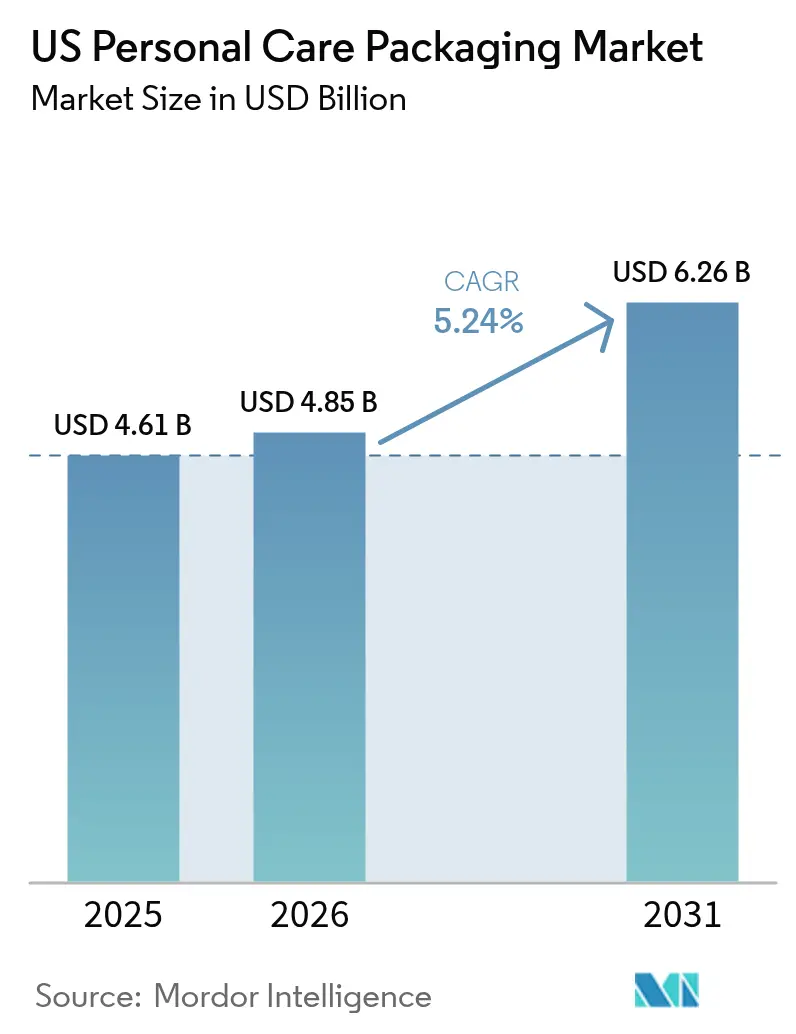
The US Personal Care Packaging Market size was valued at USD 4.61 billion in 2025 and estimated to grow from USD 4.85 billion in 2026 to reach USD 6.26 billion by 2031, at a CAGR of 5.24% during the forecast period (2026-2031). Persistent PFAS phase-outs, mounting sustainability mandates and the social-media driven quest for eye-catching packs are reshaping material selection and design philosophies. Tight state rules Minnesota’s 2025 ban on intentionally added PFAS in cosmetics among them push converters to explore new barrier chemistries and upgrade recycling infrastructure.[1] Regional spending patterns amplify these shifts: households in the West devote USD 1,038 each year to personal-care items, well above the USD 908 national average, which explains the region’s early uptake of premium, sustainable formats. Brand owners also intensify vertical integration to lock in packaging innovation capacity, a trend underscored by Amcor’s all-stock combination with Berry Global in April 2025, expected to generate USD 650 million in synergies and more than USD 3 billion in cash flow by 2028. Together, these forces support steady value growth, SKU proliferation and rising demand for refill-ready designs across the US personal care packaging market.
Key Report Takeaways
- By material type, plastic held 50.12% US personal care packaging market share in 2025; paper and paperboard is projected to rise at a 9.12% CAGR through 2031.
- By product type, bottles captured 37.65% of the US personal care packaging market size in 2025, while pouches are expected to climb at an 10.78% CAGR.
- By application, skin care accounted for 41.35% of the US personal care packaging market size in 2025; sun care is advancing at a 8.66% CAGR between 2026 and 2031.
- By sustainability attribute, recyclable mono-material packs represented 46.42% of the market in 2025; refillable/reusable systems are forecast to post a 12.35% CAGR.
Note: Market size and forecast figures in this report are generated using Mordor Intelligence’s proprietary estimation framework, updated with the latest available data and insights as of 2026.
Market Trends and Insights
Drivers Impact Analysis of US Personal Care Packaging Market*
| Driver | (~) % Impact on CAGR Forecast | Geographic Relevance | Impact Timeline |
|---|---|---|---|
| Rising Disposable Income Fuels Pack Demand | +1.2% | National, most pronounced in the West and Northeast | Medium term (2-4 years) |
| Instagram-Ready Aesthetics Accelerate Premiumization | +0.8% | Nationwide, especially in large urban centers | Short term (≤ 2 years) |
| E-commerce Drives Ship-Ready Protective Formats | +1.0% | Country-wide, with early traction in the West and South | Short term (≤ 2 years) |
| Subscription and Refill Models Favor Durable Solutions | +0.6% | National, led by premium-price segments | Long term (≥ 4 years) |
| Growth in TSA-size travel packs for on-the-go consumers | +0.4% | Nationwide, strongest around major airports | Medium term (2-4 years) |
| Smart/IoT-enabled packs enhance engagement and traceability | +0.3% | Nationwide, skewed toward tech-savvy demographics | Long term (≥ 4 years) |
| Source: Mordor Intelligence | |||
Rising Disposable Income Fuels Pack Demand
Personal-care outlays reached USD 908 per household in 2024 and climb even higher in the West, where annual spending averaged USD 1,038.[2] Steady wage gains translate into greater SKU variety, premium pack finishes and niche formulations, which in turn boost unit-volume requirements across the US personal care packaging market. Glass and metal formats benefit the most because consumers associate them with quality and sustainability.
Instagram-Ready Aesthetics Accelerate Premiumization
Design now doubles as a marketing channel, prompting brands to invest in striking shapes, embossing and custom colorways that photograph well. Glass jars and brushed-aluminum aerosols outperform conventional HDPE bottles because they align with eco-messaging and visual storytelling on social platforms. L’Oréal’s partnership with IBM to train AI on sustainable formulations underscores how tech convergence supports both look and function.[3]
E-commerce Drives Ship-Ready Protective Formats
Direct-to-consumer channels require packs that survive long parcel journeys yet deliver an engaging unboxing moment. Reinforced pouches, inverted tubes and tamper-evident pumps address leak, crush and pilfer concerns without inflating freight costs. Brands that master tight cube utilization and mono-material secondary packs cut emissions and shipping fees while winning repeat purchases.
Subscription and Refill Models Favor Durable Solutions
Recurring delivery programs encourage investment in sturdier containers, notably aluminum and glass, which withstand repeated cycles. Ball Corporation’s collaboration with Meadow on fully recyclable aluminum cans highlights the pivot toward closed-loop durability.[4] Smart tags embedded in refill cartridges also trigger automatic reorders, deepening brand loyalty.
Restraints Impact Analysis of US Personal Care Packaging Market*
| Restraint | (~) % Impact on CAGR Forecast | Geographic Relevance | Impact Timeline |
|---|---|---|---|
| High R&D and Tooling Costs Limit Innovation | -0.9% | Nationwide, hitting smaller producers hardest | Medium term (2-4 years) |
| State-Level PFAS Rules Add Compliance Burden | -0.7% | Nationwide, but rules vary by state | Short term (≤ 2 years) |
| Fluctuating recycled-resin prices and inconsistent quality | -0.5% | Nationwide, with manufacturing hubs most exposed | Short term (≤ 2 years) |
| Reverse-logistics hurdles for refill and return programs | -0.4% | Nationwide, eased somewhat in dense urban areas | Medium term (2-4 years) |
| Source: Mordor Intelligence | |||
High R&D and Tooling Costs Limit Innovation
Developing a new blow-mold or precision pump can exceed USD 1 million per line. Small converters struggle to fund multiple trials, particularly when bio-based resins demand specialized machinery and extended qualification. Patent filings for collapsible applicators illustrate the complexity as well as the capital intensity behind differentiated dispensing technology.
State-Level PFAS Rules Add Compliance Burden
California’s SB682 bans PFAS in many consumer products beginning in 2027. In parallel, the FDA withdrew 35 food-contact PFAS notifications in 2025, raising uncertainty for analogous personal-care uses. Maintaining multiple resin blends and barrier coatings for each state erodes supply-chain efficiency and inflates testing costs, slowing the overall growth of the US personal care packaging market.
*Our forecasts treat driver/restraint impacts as directional, not additive. The impact forecasts reflect baseline growth, mix effects, and variable interactions.
US Personal Care Packaging Market Segment Analysis
By Material Type:
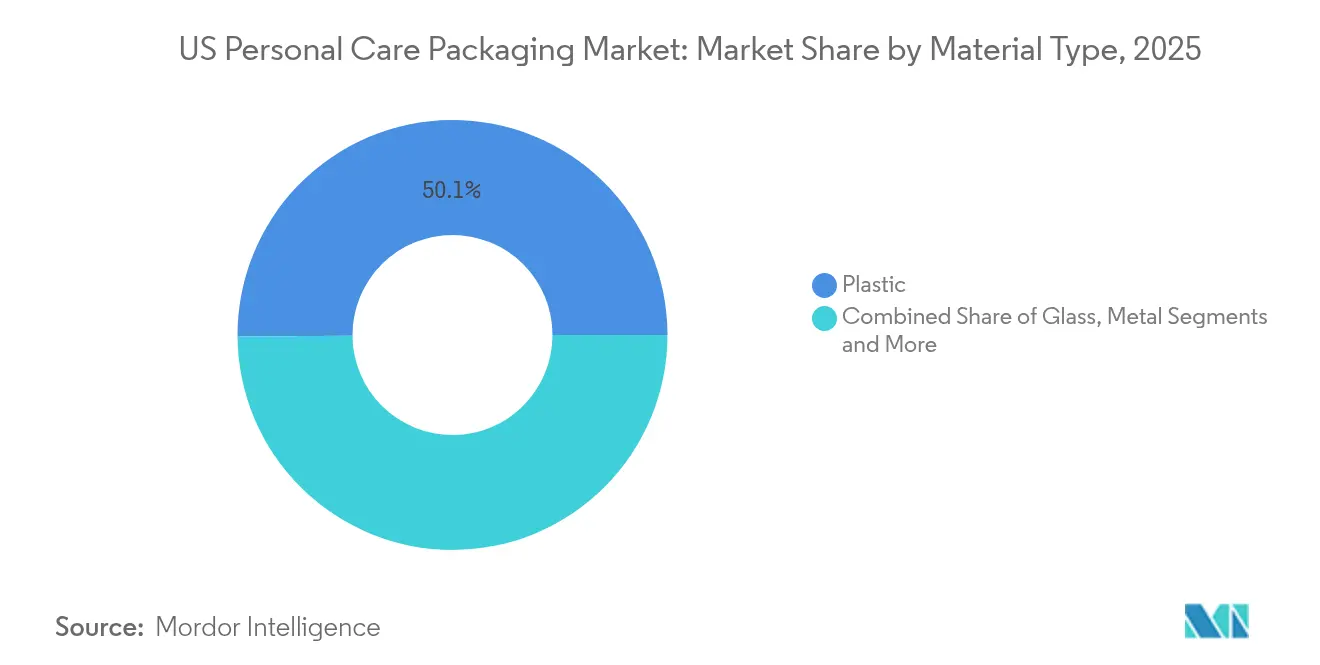
Plastic Holds Ground as Paper Gains PacePlastic retained 50.12% US personal care packaging market share in 2025 thanks to low cost, design flexibility and well-established supply chains. Yet the paper and paperboard segment is projected to log a 9.12% CAGR through 2031, buoyed by PFAS crackdowns and consumer favor for renewable substrates. Brands experiment with barrier-coated cartons and molded-fiber jars that pass moisture tests without compromising shelf appeal. Recycled PET integration and pilot chemical recycling plants help plastics defend their lead by easing circularity concerns.
Circular-economy policies push converters to raise post-consumer-resin (PCR) content and build take-back schemes. Simultaneously, glass and metal profit from luxury positioning: prestige skin-care labels deploy heavy-walled flacons and brushed-aluminum sticks to justify price premiums while touting infinite recyclability. Material innovation is also spurred by vertical integration, exemplified by Amcor’s resin-sourcing investments that safeguard PCR supply for the expanding US personal care packaging market.

By Product Type:
Bottles Rule but Pouches AccelerateBottles commanded 37.65% of the US personal care packaging market size in 2025 due to familiarity, shelf impact and versatility across lotions, shampoos and body washes. However, flexible pouches are projected to log an 10.78% CAGR, propelled by e-commerce cube-efficiency and lower material usage. Reclosable spouts and stand-up formats bolster consumer convenience, while ultra-thin films curb shipping weight.
Tubes, sticks and precision pumps cater to targeted applications think SPF sticks for sun-care or airless pumps for retinol serums where dosing accuracy matters more than unit cost. Folding cartons gain ground as brands migrate to mono-material paper solutions that simplify curbside recycling. Across all formats, NFC chips and QR codes elevate packs into engagement hubs, a key differentiator in the crowded US personal care packaging market.
By Application:
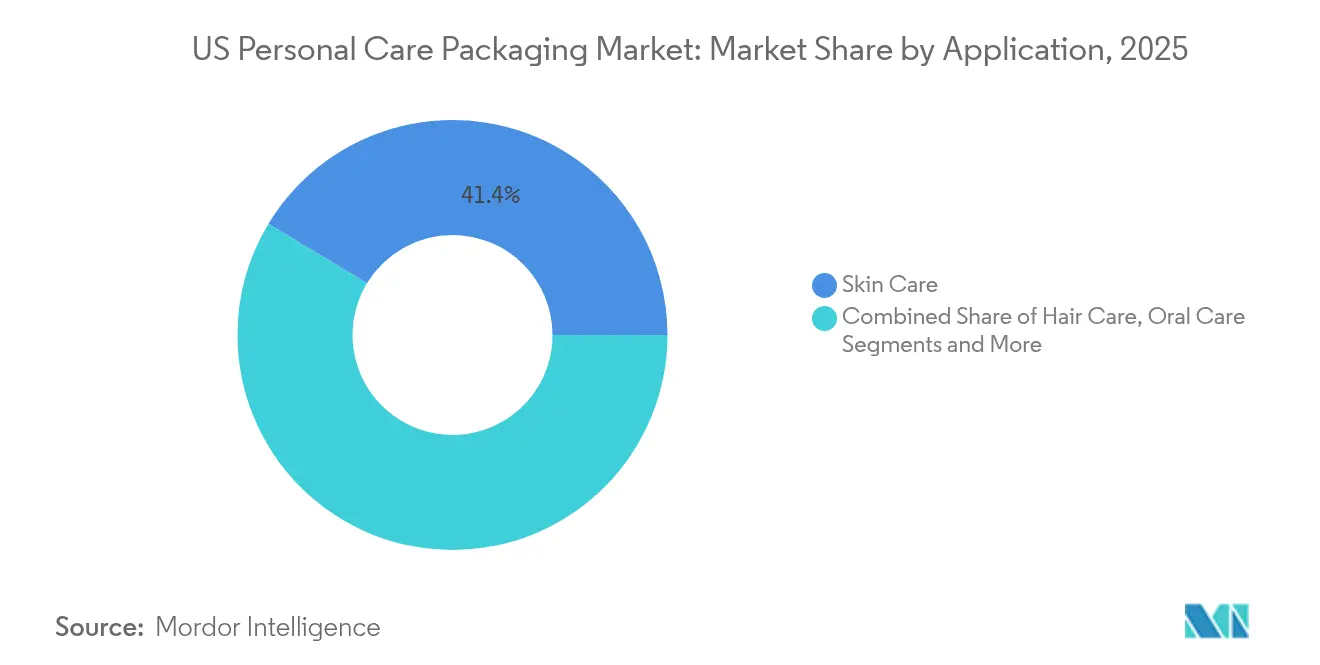
Skin Care Dominant, Sun Care FastestSkin-care lines accounted for 41.35% of the US personal care packaging market size in 2025, reflecting category maturity, regimen layering and broad age appeal. Jar-in-box sets, UV-protective frosted glass and airless pumps maintain high throughput across co-packers. Meanwhile, sun-care is forecast to grow at a 8.66% CAGR as outdoor recreation rebounds and broad-spectrum claims proliferate. Lightweight, sachet-style minis also fuel trial purchases.
Hair-care holds steady with pouch-based refill programs and oversized pump bottles, both designed to cut plastic intensity per use. Oral-care and color cosmetics innovate through recyclable tube-heads and refillable palettes, respectively. Each niche spurs bespoke barrier and dispensing needs, keeping the US personal care packaging market diversified.
By Sustainability Attribute:
Recyclable Leads, Refillable SurgesRecyclable mono-materials held a 46.42% share in 2025 as extended-producer-responsibility laws reward designs that flow into existing MRFs. Converters chase drop-in barriers that omit PFAS yet preserve shelf life, ensuring these solutions scale quickly. In parallel, refillable systems are poised for a 12.35% CAGR. Aluminum deodorant shells and glass serum bottles paired with PCR PET refill pods illustrate how luxury aesthetics mesh with waste-reduction goals.
Post-consumer-recycled content faces feedstock gaps, but chemical depolymerization projects around the Gulf Coast promise future supply security. Compostable PLA or PHA films remain niche, mainly due to cost and limited municipal infrastructure, yet ongoing R&D hints at broader adoption post-2030. Such momentum underlines the long-term evolution trajectory of the US personal care packaging market.
Geography Analysis
The South accounted for 35.74% of US personal care packaging market share in 2025, supported by favorable labor costs, robust resin supply lines along the Gulf Coast and a sprawling consumer base stretching from Texas to Florida. Migration into Sun Belt metros sustains household formation and, by extension, demand for value-priced personal-care SKUs, reinforcing high-volume bottle and closure demand in the region.
The West is the fastest-growing regional cluster with a 7.45% CAGR through 2031. Elevated household incomes, averaging USD 1,038 spent annually on personal-care products, fuel willingness to pay for low-impact packs, including molded-fiber jars and elegantly frosted glass bottles. California’s sweeping EPR statutes and PFAS bans further nudge brands toward advanced mono-material laminates and chemical-free barrier layers. Silicon Valley’s tech culture also accelerates adoption of QR-enabled recycling guidance and refill-tracking apps that sync seamlessly with subscription models, magnifying the region’s influence on nationwide packaging trends.
The Northeast and Midwest maintain steady but moderate expansion. Affluent coastal cities such as New York and Boston underpin demand for prestige packs, whereas the Midwest leverages cost-competitive land and a skilled workforce to attract large-scale capital projects like Kimberly-Clark’s USD 2 billion manufacturing upgrade across Ohio and South Carolina. Both regions benefit from logistical proximity to key FMCG brand owners, streamlining package-to-shelf times and tempering freight emissions for the broader US personal care packaging market.
Regulatory Landscape
Federal and state rules increasingly shape US personal care packaging design and compliance workflows. At the federal level, the FDA is implementing the Modernization of Cosmetics Regulation Act of 2022 (MoCRA), which tightens oversight through facility registration (renewed biennially), cosmetic product listing (with annual updates), and mandatory serious adverse event reporting within 15 business days. MoCRA also removes reliance on a "safety not determined" labeling statement as a substitute for safety substantiation, pushing brand owners and their packaging partners to strengthen documentation across packaging, labeling, and claims support.
At the state level, packaging extended producer responsibility (EPR) and PFAS restrictions add multi-jurisdiction complexity. California finalized SB 54 packaging EPR regulations on May 1, 2026, with producer registration deadlines in June 2026 and program implementation scheduled for January 1, 2027, creating a near-term trigger for packaging data collection, recyclability assessments, and supplier disclosures. Coordination across states including California, Colorado, Oregon, Minnesota, Maryland, and Washington reinforces the need for standardized material choices and substantiated environmental marketing. FTC Green Guides scrutiny is also influencing how "recyclable" and other sustainability claims are presented on packs.
Competitive Landscape
The market exhibits moderate consolidation, with the combined Amcor–Berry Global entity now commanding a formidable footprint across bottles, closures and flexible laminates. Synergy capture of USD 650 million over three years will enhance its bargaining power with resin suppliers and technology licensors. Meanwhile, TricorBraun’s 2025 purchase of Veritiv Containers broadened its North American distribution network and fortified service levels for mid-sized beauty brands.
Technology adoption stands out as a differentiator. AptarGroup deploys AI-enabled vision systems to certify 100% closure integrity, while Silgan’s smart-dispense pumps embed RFID tags to monitor fill volumes and authenticate refills at point of sale. Smaller specialists such as Virospack leverage niche expertise in droppers and luxury glass to win high-margin orders following its January 2025 stake in Eurovetrocap.
Sustainability credentials also dictate share gains. Amcor has pledged to incorporate 30% recycled content across global operations by 2030 and published a detailed decarbonization roadmap outlining scope-1, -2 and -3 targets. Localized PCR sourcing, bio-based varnishes and lightweighting programs are now table stakes rather than differentiators, pressuring laggards and energizing innovators throughout the US personal care packaging market.
US Personal Care Packaging Industry Leaders
-
HCP Packaging Co. Ltd
-
Silgan Holdings Inc.
-
Berry Global Group, Inc.
-
Albea Services SA
-
APC Packaging
- *Disclaimer: Major Players sorted in no particular order
US Personal Care Packaging Market Companies Covered in this Report
- Albéa Services SA
- HCP Packaging Co. Ltd
- Berry Global Group Inc.
- Silgan Holdings Inc.
- DS Smith PLC
- Graham Packaging Company
- Kaufman Container
- AptarGroup Inc.
- Amcor PLC
- Cosmopak USA LLC
- APC Packaging
- Rieke Corp (Trimas)
- Berlin Packaging LLC
- Glenroy Inc.
- TricorBraun
- Quadpack
- ProAmpac
- WestRock Company
- Gerresheimer AG
- Sonoco Products Co.
- International Paper Co.
Market Opportunities and Future Outlook
State packaging EPR programs and PFAS phase-outs are creating design-for-compliance opportunities in mono-material, refill-ready, and data-transparent packs. With seven US states having enacted packaging EPR laws as of 2026, producers face reporting and fee structures that reward simpler material structures and clearer end-of-life pathways. This opens whitespace for standardized dispensers, closures, and secondary packs that can be deployed nationally with fewer state-by-state variants.
The same compliance push also favors packaging systems that pair compliant materials with traceability tools, including QR-enabled recycling guidance and refill tracking, to support both disclosure needs and consumer communication. On the supply side, investments that expand domestic capability in high-growth formats and shorten lead times can support new program rollouts by personal care brands. Empire State Development announced in March 2026 an USD 0.8 million modernization project for Ultrapak, LLC in Dunkirk, New York, adding advanced printing technology to increase domestic production and reduce reliance on offshore manufacturing, aligning with faster SKU cycles and customization needs. In flexible packaging, American Packaging Corporation approved an expansion of its Story City, Iowa Center of Excellence for state-of-the-art pouching capability, announced July 2025, with construction completion scheduled by end-September 2026. That expansion reinforces capacity for e-commerce-optimized pouches and refill packs that reduce material use and shipping inefficiency.
Recent Industry Developments in US Personal Care Packaging Market
- June 2026: Albéa Services SA announced the launch of its Signature dip-in packaging collection, produced at the Bottanuco facility, to shorten development cycles for beauty brands. Faster-to-market, standardized component sets support rapid SKU proliferation while keeping the design space open for sustainability and refill cues.
- February 2026: Silgan highlighted integration of its ERA dispensing system into the DNA airless pump range at Paris Packaging Week 2026, emphasizing recyclability within polyolefin streams and refill-ready use cases. The move strengthens Silgan's positioning in premium skin care dispensing, where packaging performance, product protection, and end-of-life compatibility increasingly influence sourcing decisions.
- December 2024: Berry Global partnered with La Rosee to develop a refillable mono-material polypropylene deodorant stick, citing a 62% weight reduction versus standard alternatives. Mono-material refill architectures such as this help brands simplify recycling pathways and support refill programs without shifting consumers away from familiar rigid formats.
US Personal Care Packaging Market Report Scope and Research Methodology
Market Definition and Coverage
For this study, the US personal care packaging market covers the value of packaging used to pack and deliver personal care products sold in the United States, across common formats and materials used for retail and professional channels.
Scope exclusions: This sizing excludes packaging used mainly for pharmaceuticals, food and beverages, and household cleaning, even if similar pack formats are used.
Segments Covered in This Report
- By Material Type
- Plastic
- Glass
- Metal
- Paper and Paperboard
- By Product Type
- Bottles
- Tubes and Sticks
- Pumps and Dispensers
- Pouches
- Folding Cartons
- Others
- By Application
- Skin Care
- Hair Care
- Oral Care
- Makeup and Color Cosmetics
- Deodorants and Fragrances
- Depilatories
- Others
- By Sustainability Attribute
- Recyclable (mono-material)
- Post-consumer-recycled (PCR) Content
- Refillable / Reusable
- Compostable / Bio-based
Data Sources, Market Sizing, and Validation
Desk Research
Desk research was used to set the fact base and to avoid building the model on soft assumptions. We reviewed US packaging and personal care demand indicators from public sources such as the US Census Bureau, the US International Trade Commission trade statistics, the Bureau of Labor Statistics (inflation and price series), and the US Environmental Protection Agency and state-level packaging compliance pages for policy signals.
To connect demand with packaging requirements, we also used company filings and investor presentations, association websites, and reputable press coverage that tracks format shifts like pumps, pouches, and refill packs. When needed, paid subscriptions that cover company financials and intelligence, patent databases, and an import and export shipment-level database were used to sense-check capacity moves, material mix, and trade flows. These desk sources are not exhaustive, and we also used additional public references to collect and clarify specific data points during the work.
Primary Interviews and Surveys
Primary work focused on interviews and short surveys with packaging converters, material suppliers, brand and contract manufacturing teams, and channel specialists who track pack format decisions. Since this is a US-only market, we used a spread of respondents across major consumption and manufacturing pockets, then used follow-ups to confirm ASP logic, sustainability-driven specification changes, and near-term demand signals that were not clear in public sources.
Distribution of primary research fieldwork respondents
| Company type | Respondent position |
|---|---|
| Top tier: 31% | CXOs: 12% |
| Mid tier: 53% | Functional/Unit leaders: 28% |
| Smaller Players: 16% | Managers: 60% |
Market-Sizing & Forecasting
Market sizing starts from a top-down rebuild of the US personal care demand pool, then translates that demand into packaging value using format and material intensity assumptions. The model is built around application-led demand, and then split across packaging formats and materials to reach a value total that can be checked and explained.
Key inputs include personal care consumption direction by category, mix shifts between bottles, tubes, pumps, and pouches, and the pace of premiumization that changes pack complexity and unit pricing. We also track resin and paperboard price direction, lightweighting, and PCR content adoption, since these can move costs. Trade and capacity signals are reviewed as well, to understand whether supply is tightening or loosening. Results are then corroborated using selective bottom-up approximations, such as sampled ASP multiplied by estimated volume for a few high-share formats, combined with channel checks with converters. Where gaps remain, we use conservative ranges and narrow them during interview validation.
For the forecast, we use scenario analysis supported by expert views on refill growth, sustainability compliance timing, and likely price pass-through patterns by material. Where a short-term shock appears in the inputs, we adjust and re-test the assumptions so the final forecast remains traceable to a small set of clear drivers.
Data Validation & Update Cycle
Validation is done through several practical checks so the final number does not depend on one data series. We compare outputs against independent signals like category demand direction, material price movement, and converter sentiment, and then we inspect large variances by format and application to identify which assumption is driving the gap.
Before sign-off, the model is reviewed in steps, first at the input level, and then at the total and segment roll-up level, followed by a final review pass focused on consistency across time. If an anomaly cannot be explained, respondents are re-contacted and the assumption is reworked rather than forced into the model. Reports are refreshed annually, with interim updates when material events materially change demand, pricing, or regulation, and a final pre-delivery check is completed so clients receive the most current view.
Mordor Intelligence's US Personal Care Packaging Market Size Compared Against Other Published Estimates
Published market values for US personal care packaging do not always align, even when the topic name looks the same, because the underlying scope and pricing logic can change from one publisher to another. Differences usually come from what packaging formats are counted, how sustainability-driven redesign is treated in pricing, and which year is used as the starting point.
Some published figures appear to use a broader packaging pool that can unintentionally pull in adjacent beauty, home, or general packaging revenue through wide format definitions and long-range growth assumptions. In Mordor Intelligence, the value is counted only for packaging tied to personal care applications in the United States, and it is then built up across defined materials and formats with ASP updates that are rechecked through converter and brand-side interviews.
Benchmark comparison
| Source | Market Size | Gaps in Research Methodology |
|---|---|---|
| Mordor Intelligence | USD 4.85 B (2026) | |
| Industry Publisher A | USD 6.91 B (2025) | Uses a different base year and likely a wider definition of personal care packaging that can blend in adjacent beauty packaging revenue, which lifts the starting value before forecasting. |
| Industry Publisher B | USD 6.50 B (2024) | Anchors the estimate in an earlier year with limited clarity on format and application cutoffs, so price inflation and format-mix changes can be embedded differently than an application-led roll-up. |
Taken together, the spread in the table is mainly explained by year selection and how tightly the packaging counted is linked to personal care end-use. By keeping the model tied to clear application demand signals and format-level ASP checks, the estimate stays easier to reproduce and to audit during updates.
Key Questions Answered in the Report
What is the current value of the US personal care packaging market?
The market is valued at USD 4.85 billion in 2026 and is projected to grow to USD 6.26 billion by 2031.
Which material is gaining the most ground against conventional plastics?
Paper and paperboard solutions are registering a 9.12% CAGR, outpacing every other substrate due to rising PFAS bans and consumer demand for recyclable fiber packs.
Why are pouches growing faster than bottles?
Pouches optimize shipping space, use less material and fit e-commerce logistics, which drives their 10.78% CAGR through 2031.
How will state PFAS regulations influence future packaging choices?
Bans in states such as Minnesota and California are accelerating the shift toward PFAS-free barrier chemistries, forcing brands to reformulate and adopt alternative substrates sooner than planned.
What role does e-commerce play in the sector’s growth?
Online sales amplify the need for ship-ready, protective and right-sized packs, adding roughly 1 percentage point to the overall market CAGR.
Which sustainability attribute is expanding fastest?
Refillable and reusable systems are advancing at a 12.35% CAGR as subscription services and premium positioning make durable containers financially viable.