
Unna Boot Market Size and Share
Market Overview
| Study Period | 2020 - 2031 |
|---|---|
| Market Size (2026) | USD 155 Million |
| Market Size (2031) | USD 198.80 Million |
| Growth Rate (2026 - 2031) | 5.09 % |
| Fastest Growing Market | Asia-Pacific |
| Largest Market | North America |
| Market Concentration | Medium |
Major Players *Disclaimer: Major Players sorted in no particular order Image © Mordor Intelligence. Reuse requires attribution under CC BY 4.0. | |
Unna Boot Market Analysis by Mordor Intelligence
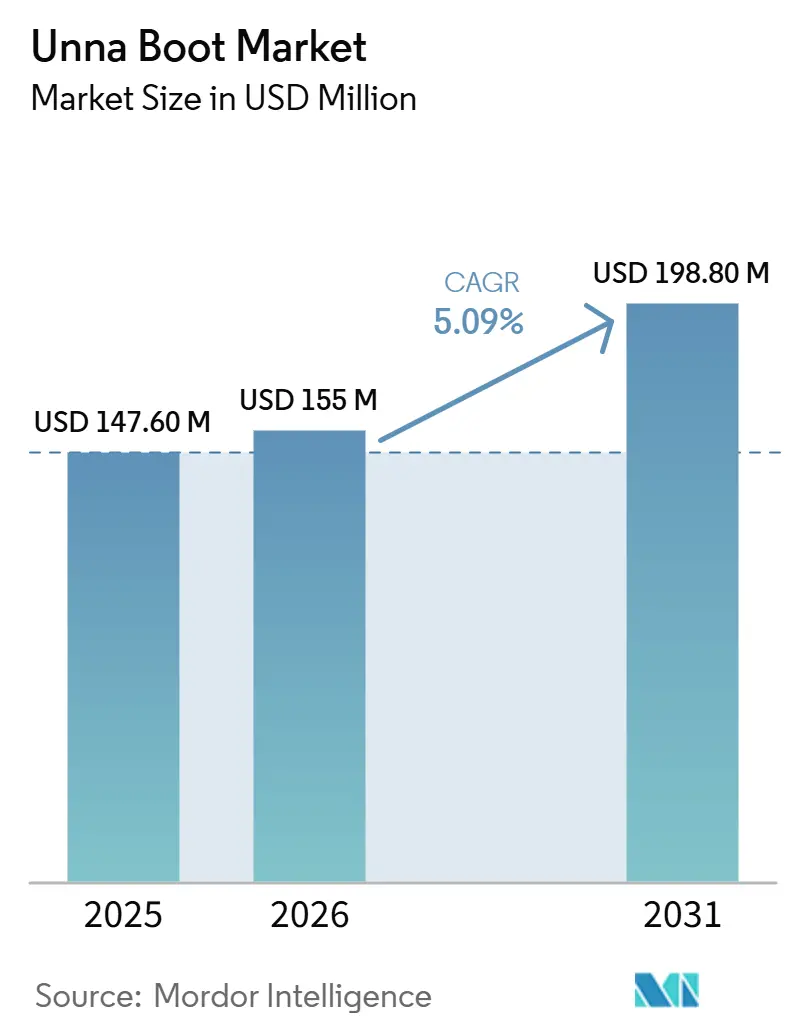
The Unna Boot Market size is projected to expand from USD 147.60 million in 2025 and USD 155 million in 2026 to USD 198.80 million by 2031, registering a CAGR of 5.09% between 2026 to 2031.
Demand remains stable because clinicians continue to rely on inelastic compression for venous and lymphatic disorders, yet growth is moderated by hospitals substituting elastic multilayer kits and bioengineered dressings that qualify for higher outpatient reimbursement. Rising diabetes prevalence, an aging population, and guideline-backed use of compression for venous leg ulcers (VLUs) sustain baseline volumes, while the January 2024 CMS lymphedema benefit broadens payment for wraps and indirectly lifts paste-bandage utilization in edema control[1]. CMS now reimburses skin substitutes at about USD 127.14 per cm², drawing some procedures away from pure compression but also positioning Unna boots as the mandatory first-line therapy before escalation. Meanwhile, e-commerce distributors accelerate direct-to-patient sales, expanding access in rural North America and urban Asia-Pacific, where clinic density is low.
Key Report Takeaways
- By material, zinc oxide-only formulations led with 49.80% of Unna boot market share in 2025, whereas zinc + calamine blends are projected to expand at a 6.10% CAGR through 2031.
- By product format, impregnated gauze rolls commanded 61.30% of the Unna boot market size in 2025, while short-stretch two-layer systems are expected to show the fastest trajectory at 6.35% CAGR.
- By indication, VLUs accounted for 68.93% revenue in 2025; lymphedema applications are expected to advance at a 6.76% CAGR on the back of the new CMS coverage limits.
- By end user, hospitals retained 53.12% share in 2025, yet home health and long-term care settings are forecast to post the highest 7.15% CAGR to 2031.
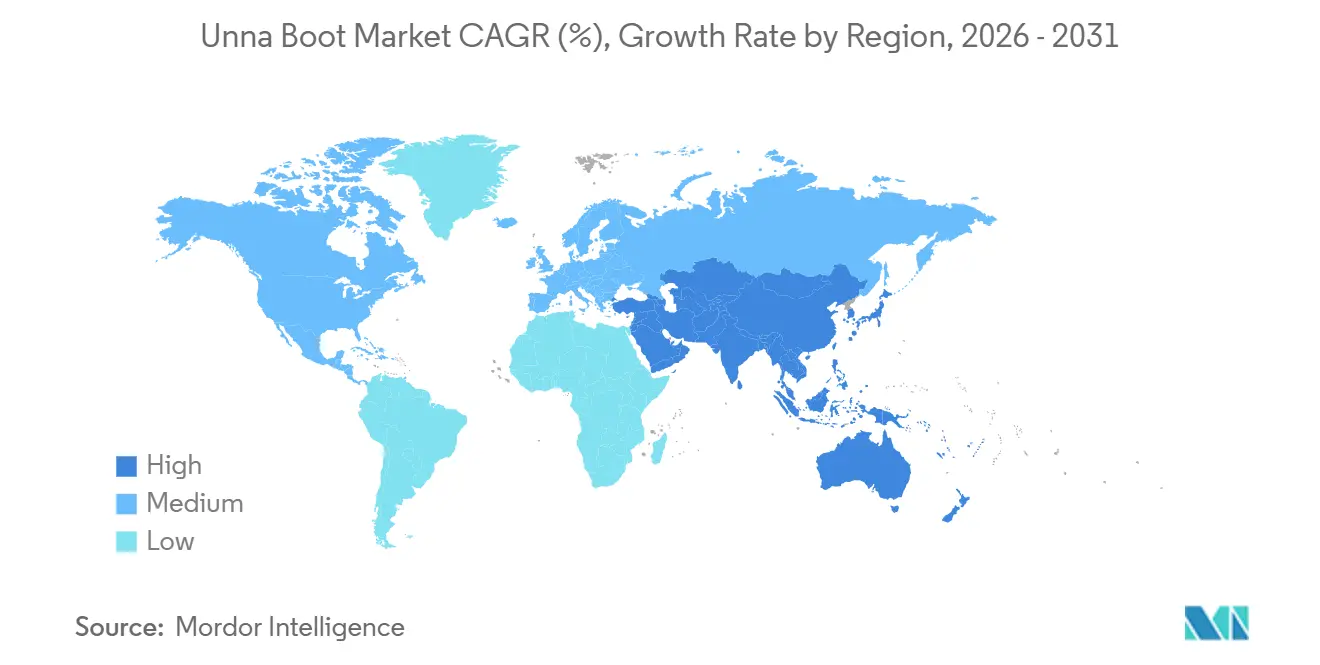
- By geography, North America dominated with 48.95% value in 2025, whereas Asia-Pacific is projected to register the quickest 6.97% CAGR because of the region’s diabetes burden.
Note: Market size and forecast figures in this report are generated using Mordor Intelligence’s proprietary estimation framework, updated with the latest available data and insights as of January 2026.
Market Trends and Insights
Drivers Impact Analysis of Unna Boot Market*
| Driver | (~) % Impact on CAGR Forecast | Geographic Relevance | Impact Timeline |
|---|---|---|---|
| Rising chronic venous disease and VLU burden | +1.2% | Global, the highest incidence in North America and Europe | Long term (≥ 4 years) |
| Aging populations and diabetes | +1.5% | Asia-Pacific, North America | Long term (≥ 4 years) |
| Guideline-backed compression role | +0.8% | Global, strongest in guideline-driven North America and Europe | Medium term (2-4 years) |
| Shift to outpatient and home-based care | +1.3% | North America, Europe, and early adoption in urban Asia-Pacific | Medium term (2-4 years) |
| HCPCS reimbursement (A6456) | +0.7% | Primarily the United States | Short term (≤ 2 years) |
| E-commerce retail access | +0.6% | Global, but fastest in North America and urban Asia-Pacific | Medium term (2-4 years) |
| Source: Mordor Intelligence | |||
Rising Chronic Venous Disease And VLU Burden
Chronic venous insufficiency affects 5%-10% of adults, and VLUs recur in up to 70% of cases, ensuring repeat compression prescriptions [2]. China’s 2025 guidelines reiterate compression as first-line therapy at 30-50 mmHg, a range Unna boots can consistently deliver. Yet comparative data show multilayer systems heal ulcers faster than traditional paste bandages, pushing purchasing teams to weigh cost against relative efficacy. The Canadian consensus published in 2025 similarly endorses compression but remains modality-neutral, permitting formulary managers to opt for elastic wraps if training costs for paste application are high. Consequently, manufacturers must pair aggressive unit pricing with education to defend share in the Unna boot market.
Aging Populations And Diabetes Increasing Compression Needs
Global diabetes cases are projected to climb from 589 million in 2024 to 852.5 million by 2050, with 23.7% prevalence among those aged 65-99. The CDC logged 40.1 million U.S. adults with diabetes in March 2026, raising the pool of patients at risk for lower-limb edema. Asia-Pacific absorbs 30.39% of the worldwide diabetes-related economic burden, equating to USD 1.0 trillion in China and USD 1.6 trillion in India during 2020-2050. Informal caregiving exceeds 90% of costs in South Asia, favoring easy-to-apply two-layer kits over labor-intensive paste rolls. Rural U.S. prevalence hits 12.3%, making e-commerce channels critical for product reach where clinic density is sparse. These demographics collectively underpin a solid long-run volume floor for the Unna boot market.
Guideline-Backed Role Of Compression In VLU Care
Bodies such as the Wound, Ostomy and Continence Nurses Society and the European Wound Management Association enshrine compression as standard care, but fail to specify inelastic versus elastic delivery. A 2024 Cochrane review confirmed compression doubles healing relative to no compression but could not rank individual systems, leaving buyers free to choose the lowest-cost option. U.S. primary-care guidelines highlight Unna boots at roughly USD 10 per dressing, framing them as budget-friendly. However, multilayer kits have demonstrated quicker closure in head-to-head trials, shifting hospital formularies unless paste suppliers can counter with training support and throughput gains. Therefore, clinical endorsement sustains overall demand while procurement neutrality intensifies price competition inside the Unna boot market.
Shift To Outpatient And Home-Based Wound Care
CMS raised 2025 home health base rates by 0.5% and plans new social-determinant data from 2027, signaling deeper investment in chronic wound services outside hospitals. Physician fee alignment for advanced dressings in 2026 reduces office-based payment gaps, prompting clinics to push more care into the home setting, where two-layer Unna-style kits shave application time from 15 to 7 minutes. CPT 29581/29584 reimburses skilled application visits, offering agencies an incremental revenue stream. Yet payers also demand weekly monitoring, stressing caregiver capacity in rural regions. Manufacturers able to bundle quick-apply products with tele-nursing tools may capture the fastest-growing slice of the Unna boot market.
Restraints Impact Analysis of Unna Boot Market*
| Restraint | (~) % Impact on CAGR Forecast | Geographic Relevance | Impact Timeline |
|---|---|---|---|
| Patient adherence issues with inelastic wraps | -0.9% | Global, acute in-home care and among the elderly | Medium term (2-4 years) |
| Contraindication in arterial or mixed ulcers | -0.4% | Global, higher arterial comorbidity in aging North America and Europe | Long term (≥ 4 years) |
| Shift toward hosiery/elastic multilayer systems | -0.7% | North America and Europe | Medium term (2-4 years) |
| Advanced wound modalities displacing compression | -0.8% | North America and Europe | Medium term (2-4 years) |
| Source: Mordor Intelligence | |||
Patient Adherence Challenges with Inelastic Wraps
A lymphedema cohort study reported only 39.13% sustained use of compression, mainly because of discomfort and application difficulty[3]. Qualitative work across Manchester, Melbourne, and Gran Canaria cited dexterity limits, memory lapses, and negative body image, hurdles more pronounced with rigid zinc paste casts than self-applied elastic wraps. Adjustable wraps matched inelastic bandaging on edema control yet scored higher on comfort, guiding purchasing teams toward elastic substitutes. Heat retention further hurts adherence in tropical climates, reducing potential in Southeast Asia and Africa.
Not Suitable For Arterial Or Mixed-Etiology Ulcers
Compression is contraindicated at an ankle-brachial pressure index below 0.5; diabetes-related calcification can mask low perfusion, elevating ischemic risk if Unna boots are applied without vascular screening. While specialty centers sometimes compress at ABPI 0.42 under close watch, such oversight is rare in home care. Required Doppler assessments add cost and delay, pushing frontline clinicians toward dressings not dependent on arterial status. Broadening community access to handheld Dopplers could soften this drag on the Unna boot market but remains uneven globally.
*Our forecasts treat driver/restraint impacts as directional, not additive. The impact forecasts reflect baseline growth, mix effects, and variable interactions.
Unna Boot Market Segment Analysis
By Material:
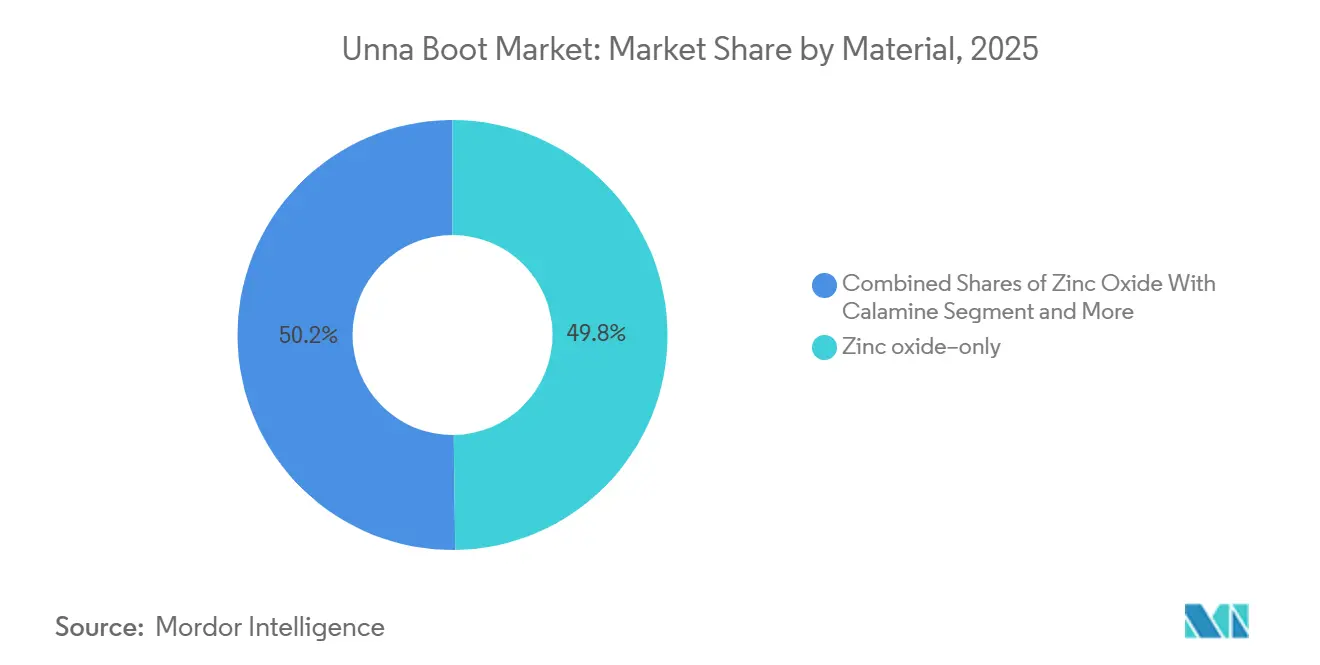
Calamine Blends Gain TractionZinc oxide-only dressings commanded 49.80% of the Unna boot market share in 2025, reflecting decades of clinical familiarity and clear HCPCS fit. Calamine-enriched variants are projected to deliver a 6.10% CAGR, the fastest within this segmentation, as clinicians target pruritus relief in patients with venous dermatitis. North American wound clinics increasingly list Medline’s Unna-Z with Calamine and Andover Healthcare’s CoFlex TLC Calamine, both priced 15%-25% above basic paste. Despite the premium, formulary adoption rises where patient-reported comfort is a performance metric.
Europe and North America exhibit the highest conversion, whereas price-sensitive Asia-Pacific facilities still rely on basic zinc oxide. Lack of ISO standards on calamine purity may prompt regulators to tighten specifications, potentially squeezing small importers. Should that occur, consolidated vendors with validated supply chains could capture incremental Unna boot market size growth even in cost-constrained regions.

By Product Format:
Two-Layer Systems Simplify ApplicationTraditional impregnated gauze rolls held 61.30% revenue in 2025, but two-layer short-stretch kits are expected to expand at 6.35% CAGR. Hartmann’s TwoPress 2 Lite and UrgoK2 Lite generate consistent 30-50 mmHg working pressure with half the nurse time needed for paste, aligning with outpatient throughput goals. Hospitals continue to favor rolls for their lower unit cost, yet home-health agencies lean toward kits that reduce clinical revisit frequency.
Ancillary stockinette products record modest growth, primarily in high-exudate cases where garment protection is vital. Paste-bandage bundles maintain relevance in teaching hospitals that prioritize individualized pressure control, but this niche will narrow without compelling cost savings.
By Indication:
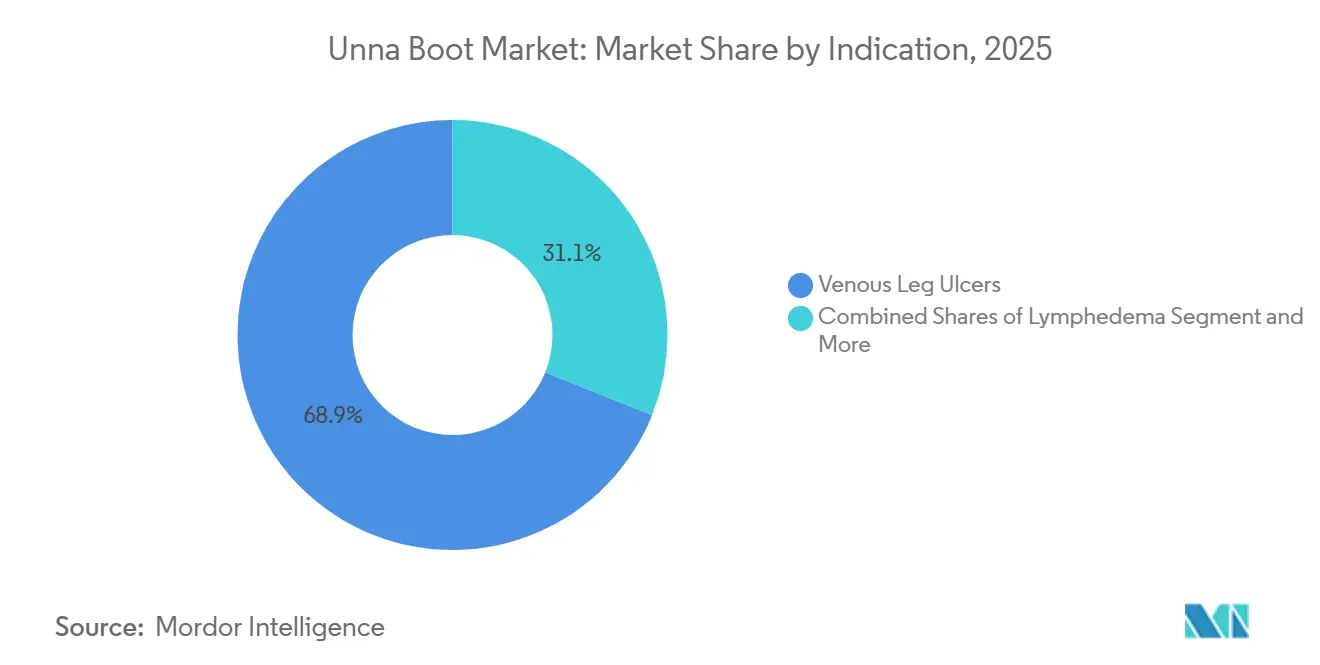
Lymphedema Accelerates Post-BenefitVLUs represented 68.93% revenue in 2025, anchoring the Unna boot market. Lymphedema, aided by CMS wrap coverage, now shows the steepest climb at a 6.76% CAGR. Agencies can bill CPT 29581 for each skilled application, a financial trigger favoring paste where limb shape complicates hosiery use.
Traumatic edema and sports sprains provide sporadic boosts but lack recurring volume. Dermatologic uses, including eczema with exudate, remain a small slice, although calamine blends offer symptomatic relief. Capturing share in lymphedema demands new trials that quantify edema reduction versus adjustable wraps; absent evidence, payers may default to cheaper elastic solutions, tempering upside for the Unna boot industry.
By End User:
Home Health Gains ShareHospitals contributed 53.12% of global revenue in 2025, yet home health and long-term care facilities are projected to deliver the strongest 7.15% CAGR to 2031. CMS’s 0.5% 2025 base-rate bump and social-determinant reporting mandate encourage agencies to manage chronic wounds in community settings. Cardinal Health’s Advanced Diabetes Supply network illustrates the pivot, shipping compression kits alongside glucometers to 500,000 patients. Outpatient wound centers and hospital-owned clinics still drive complex case management and first-time fittings, but confront margin compression as skin substitutes gain separate payment. Vendors that tailor two-layer kits for agency workflows and include QR-code training could secure a disproportionate slice of the expanding Unna boot market size in home care.
Geography Analysis
North America Unna Boot Market
North America accounted for 48.95% of the 2025 global value. The United States benefits from HCPCS A6456 reimbursement, an extensive wound-clinic network, and rising diabetes prevalence documented at 40.1 million adults in 2026. Rural incidence of 12.3% underscores the importance of e-commerce and mail-order distribution for sustained penetration. Canada’s adoption mirrors U.S. clinical patterns but is capped by provincial budget ceilings, while Mexico’s public-sector formularies emphasize low-cost zinc oxide, limiting premium uptake.
Europe Unna Boot Market
Europe follows with steady but slower expansion. National health systems in Germany, the United Kingdom, and France reimburse compression through formularies rather than procedure codes, enabling bulk-discount negotiations that squeeze supplier margins. Eastern European countries present upside through under-penetration, though currency volatility and limited clinic infrastructure pose challenges. Calamine adoption is higher in Western Europe due to payer willingness to fund comfort-enhanced dressings.
APAC Unna Boot Market
Asia-Pacific is projected to register a 6.97% CAGR and close part of the gap with North America by 2031. China and India drive volume as their combined share of the world’s diabetes economic burden crosses 30%. Informal caregiving dominates, so caregiver-friendly two-layer systems are expected to outsell traditional paste in urban centers. Reimbursement is patchy; private insurance in tier-one Chinese cities covers some compression devices, while public schemes often do not. Southeast Asian markets grow from a small base, helped by digital marketplaces that circumvent fractured brick-and-mortar supply chains.
South America and MEA Unna Boot Market
South America and Middle East & Africa remain modest contributors. Brazil and Argentina are the region’s largest buyers but experience price pressure under inflationary conditions. GCC nations purchase premium kits for government hospitals, whereas much of Sub-Saharan Africa relies on low-cost generic zinc paste. Infrastructure gaps, cash-based health spending, and limited vascular assessment capacity restrain broader Unna boot market penetration.
Competitive Landscape
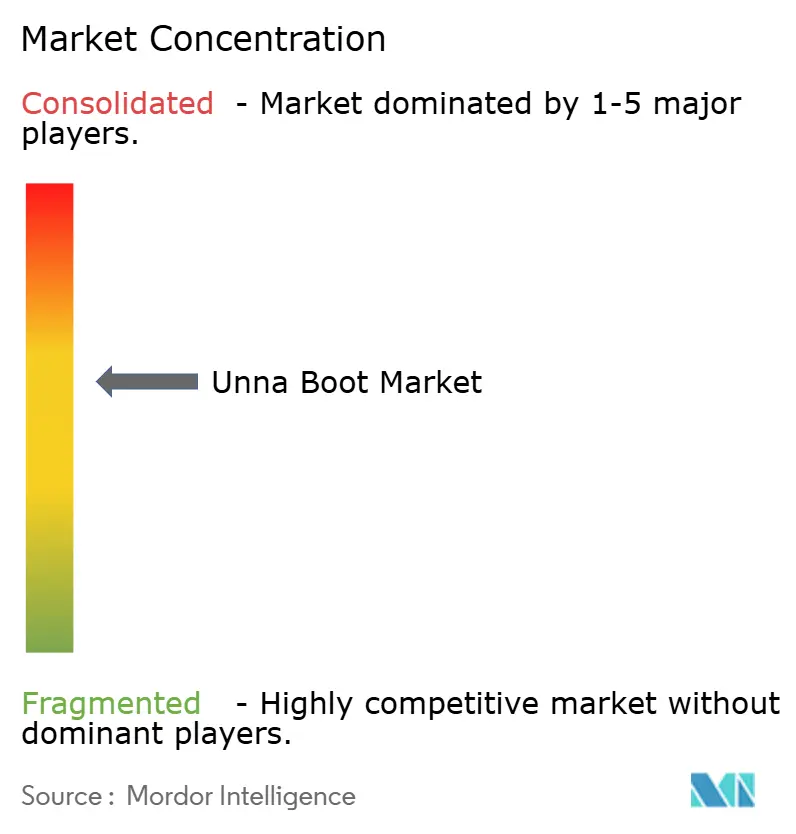
The Unna boot market displays moderate concentration. Essity (BSN medical) leverages its global logistics footprint, yet is investing heavily in advanced foams like Cutimed Sorbion, signaling possible strategic de-emphasis of classic paste. ConvaTec booked USD 753 million in 2025 advanced wound revenue and secured EU approval for ConvaNiox, a nitric-oxide dressing that competes as an antimicrobial-plus-compression hybrid. Cardinal Health’s entry via Advanced Diabetes Supply puts half a million direct-to-patient accounts inside its distribution funnel, enabling bundled offers that can erode small-brand shelf space.
Specialists like Andover Healthcare (a subsidiary of Milliken & Company) and Sion Medical defend share through calamine blends and private-label partnerships with home health agencies. Hartmann’s TwoPress 2 Lite and Urgo Medical’s UrgoK2 Lite capitalize on the two-layer trend, competing on application speed rather than ingredient novelty. E-commerce-only channels, including RestorixHealth, bypass formulary restrictions and introduce price transparency that pressures traditional GPO pricing models.
Digital adjuncts are nascent but promising: QR codes linking to application videos and tele-nurse coaching help home caregivers apply consistent pressure, potentially improving adherence metrics. Quality assurance emerges as a differentiator; absence of calamine purity standards invites low-cost imports, but hospital buyers increasingly request ISO 13485 documentation. Overall, incumbents with broad regulatory footprints and omnichannel distribution stand best positioned to capture incremental Unna boot market size growth during 2026-2031.
Unna Boot Industry Leaders
-
Essity AB
-
ConvaTec Group
-
Cardinal Health
-
Paul Hartmann AG
-
Milliken & Company
- *Disclaimer: Major Players sorted in no particular order
Unna Boot Market Companies Covered in this Report
- ADW Diabetes
- AliMed, LLC
- Cardinal Health
- Coloplast
- Convatec
- DeRoyal Industries
- DeVinE Medical
- Dynarex
- Essity
- Gentell
- GF Health Products
- Lohmann & Rauscher
- McKesson Brands
- Medline Industries
- Medtronic
- Milliken & Company
- Hartmann Group
- Performance Health
- Sion Medical
- Smiths Group
- Solventum Corporation
- Urgo Medical
Recent Industry Developments in Unna Boot Market
- April 2026: Researchers at Mansoura University highlighted the integration of ZnO nanoparticles into woven compression bandages. These nanoparticles provide 95% to 99% bacterial reduction against both gram-positive and gram-negative strains, significantly lowering the risk of secondary infections during long-term wear.
- November 2025: Department of Atomic Energy India, in collaboration with Cologenesis Pvt. Ltd., announced the commercial launch of ColoNoX, an innovative nitric oxide-releasing wound dressing designed to address the critical need for effective diabetic foot ulcer (DFU) treatment in India.
Global Unna Boot Market Report Scope
As per the scope of the report, Unna boot is a specialized, multi-layered compression dressing primarily used to treat and manage venous stasis ulcers, chronic edema, and other lower-leg conditions related to venous insufficiency.
The Unna boot market is segmented by material, product format, indication, end user, and geography. Based on material, the market is segmented into Zinc oxide–only, Zinc oxide with calamine, and other additives (e.g., glycerin/gelatin blends). By product form, the market is segmented into impregnated gauze rolls, paste bandage kits, short-stretch two-layer systems (unna-style), and ancillary wrap/stockinette. By indication, the market is segmented into Venous leg ulcers, lymphedema, traumatic edema/sprains, and dermatitis/eczema with exudate control. By end users, the market is segmented into hospitals, wound care clinics, home health/long-term care, and ambulatory/outpatient centers.
By geography, the market is segmented into North America, Europe, Asia-Pacific, the Middle East & Africa, and South America. The market report also covers the estimated market sizes and trends for 17 countries across major regions globally. For each segment, the market size and forecast are provided in terms of value (USD).
Segmentation Overview
| Zinc Oxide–Only |
| Zinc Oxide with Calamine |
| Other Additives (E.G., Glycerin/Gelatin Blends) |
| Impregnated Gauze Rolls |
| Paste Bandage Kits |
| Short-Stretch Two-Layer Systems (Unna-Style) |
| Ancillary Wrap/Stockinette |
| Venous Leg Ulcers |
| Lymphedema |
| Traumatic Edema/Sprains |
| Dermatitis/Eczema with Exudate Control |
| Hospitals |
| Wound Care Clinics |
| Home Health/Long-Term Care |
| Ambulatory/Outpatient Centers |
| North America | United States |
| Canada | |
| Mexico | |
| Europe | Germany |
| United Kingdom | |
| France | |
| Italy | |
| Spain | |
| Rest of Europe | |
| Asia-Pacific | China |
| India | |
| Japan | |
| South Korea | |
| Australia | |
| Rest of Asia-Pacific | |
| Middle East and Africa | GCC |
| South Africa | |
| Rest of Middle East and Africa | |
| South America | Brazil |
| Argentina | |
| Rest of South America |
| By Material/Composition | Zinc Oxide–Only | |
| Zinc Oxide with Calamine | ||
| Other Additives (E.G., Glycerin/Gelatin Blends) | ||
| By Product Format | Impregnated Gauze Rolls | |
| Paste Bandage Kits | ||
| Short-Stretch Two-Layer Systems (Unna-Style) | ||
| Ancillary Wrap/Stockinette | ||
| By Indication | Venous Leg Ulcers | |
| Lymphedema | ||
| Traumatic Edema/Sprains | ||
| Dermatitis/Eczema with Exudate Control | ||
| By End User | Hospitals | |
| Wound Care Clinics | ||
| Home Health/Long-Term Care | ||
| Ambulatory/Outpatient Centers | ||
| By Geography | North America | United States |
| Canada | ||
| Mexico | ||
| Europe | Germany | |
| United Kingdom | ||
| France | ||
| Italy | ||
| Spain | ||
| Rest of Europe | ||
| Asia-Pacific | China | |
| India | ||
| Japan | ||
| South Korea | ||
| Australia | ||
| Rest of Asia-Pacific | ||
| Middle East and Africa | GCC | |
| South Africa | ||
| Rest of Middle East and Africa | ||
| South America | Brazil | |
| Argentina | ||
| Rest of South America | ||
Key Questions Answered in the Report
What is the forecast size of the Unna boot market in 2031?
The Unna boot market size is projected to reach USD 198.8 million by 2031.
Which segment currently holds the largest share by product format?
Impregnated gauze rolls led with 61.30% of Unna boot market share in 2025.
Which indication is expected to grow the fastest through 2031?
Lymphedema applications are forecast to advance at a 6.76% CAGR through 2031, the quickest among all therapeutic segments.
Which region offers the strongest growth prospects?
Asia-Pacific is anticipated to post a 6.97% CAGR through 2031 due to its expanding diabetes population.