
United States Mobile Crane Market Size and Share
Market Overview
| Study Period | 2020 - 2032 |
|---|---|
| Forecast Data Period | 2027 - 2032 |
| Base Year Market Size (2026) | USD 3.55 Billion |
| Market Size (2027) | USD 3.76 Billion |
| Market Size (2032) | USD 5 Billion |
| Growth Rate (2027 - 2032) | 5.88 % |
| Market Concentration | Medium |
Major Players *Disclaimer: Major Players sorted in no particular order Image © Mordor Intelligence. Reuse requires attribution under CC BY 4.0. | |
United States Mobile Crane Market Analysis by Mordor Intelligence
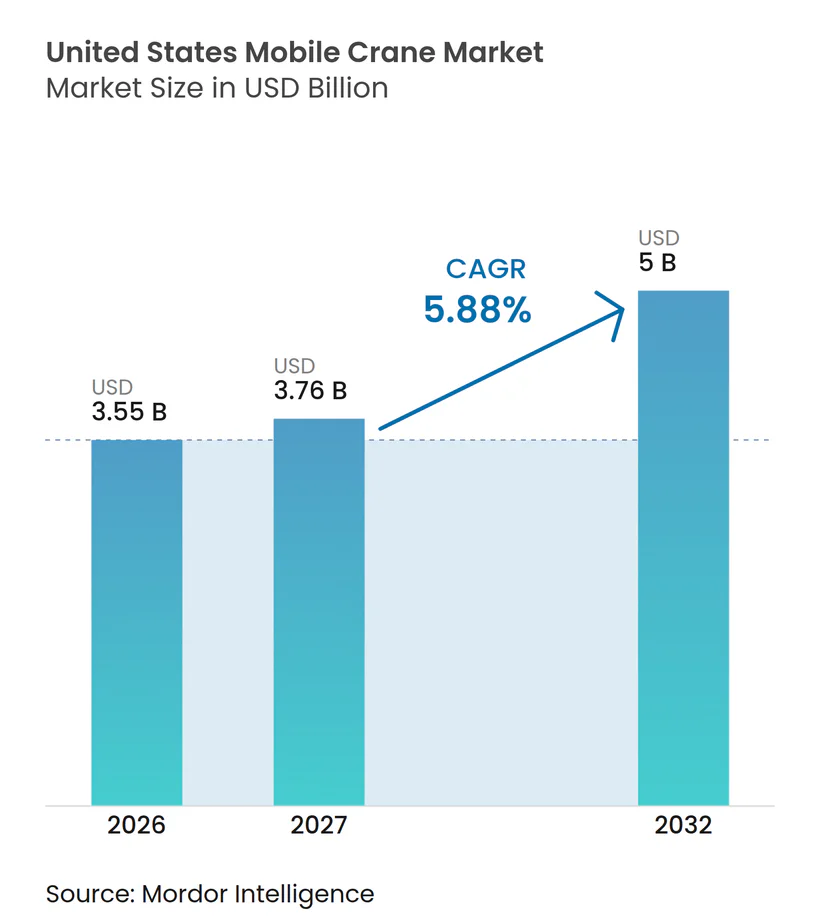
The United States mobile crane market size was valued at USD 3.55 billion in 2026 and is expected to grow from USD 3.76 billion in 2027 to USD 5.00 billion by 2032, at a CAGR of 5.88% during 2027-2032. Federal infrastructure work, renewable energy construction, grid investment, and data center development support demand for lifting equipment and related services across both public and private project pipelines. These project pipelines can overlap in the same states, which places greater value on available fleets, experienced operators, reliable planning support, and timely maintenance. The United States mobile crane market also benefits when customers use specialist providers for equipment, operators, rigging, engineering support, and lift planning rather than owning every asset. Manufacturers and rental providers are responding with higher-capacity equipment, connected fleet tools, broader service coverage, and operating models suited to complex projects and shifting customer schedules. High equipment costs, local transport rules, and the shortage of qualified personnel continue to limit how quickly supply can adjust.
Key Report Takeaways
- By product type, all-terrain cranes held 26.50% of the United States mobile crane market share in 2026 and are forecast to grow at a 6.20% CAGR through 2032.
- By carrier type, self-propelled wheeled units held 48.50% share in 2026, while crawler-mounted units are forecast to grow at a 6.60% CAGR through 2032.
- By terrain type, all terrain held 58.71% share in 2026, while rough terrain is forecast to grow at a CAGR of 7.58% through 2032.
- By application, construction and civil infrastructure held 42.51% share in 2026, while renewable energy is forecast to grow at a CAGR of 8.22% through 2032.
- By end user, crane rental and lift-contracting companies held 35.42% share in 2026, while energy and utility companies are forecast to grow at a CAGR of 7.84% through 2032.
- By lifting capacity, 50 to 150 tons held 46.56% share in 2026, while above 300 tons is forecast to grow at a CAGR of 8.42% through 2032.
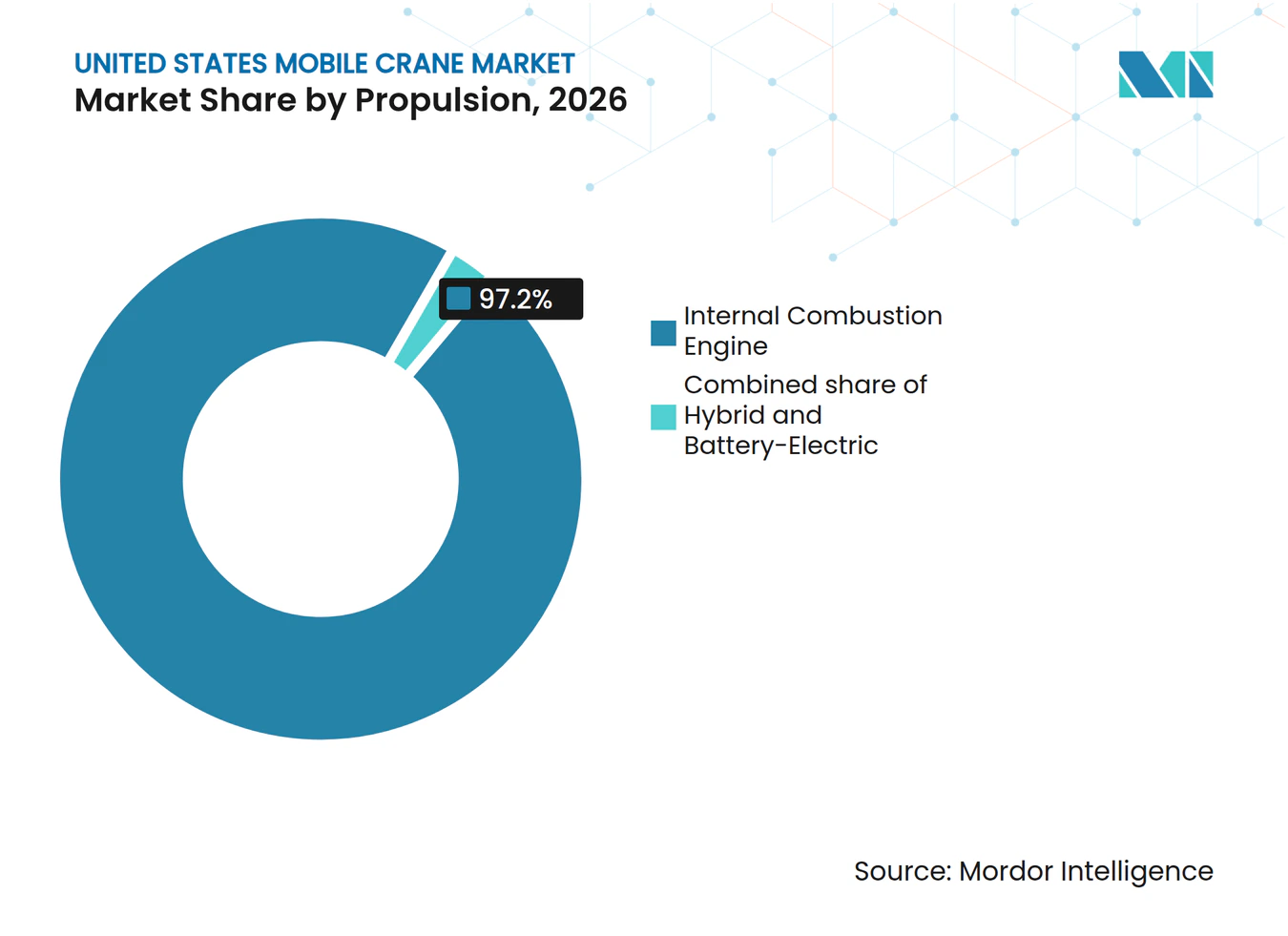
- By propulsion, internal combustion engine held 97.20% share in 2026, while battery-electric is forecast to grow at a 19.72% CAGR through 2032.
- By ownership model, owned fleet held 52.63% share in 2026, while operated rental is forecast to grow at a CAGR of 8.13% through 2032.
- By geography, the South held 38.50% share in 2026 and is forecast to grow at a 6.90% CAGR through 2032.
Note: Market numbers in this report are based on Mordor Intelligence's proprietary estimation framework, which combines nine months of actuals with Q4 projections for base year 2026.
Market Trends and Insights
Drivers Impact Analysis of United States Mobile Crane Market*
| Driver | (~) % Impact on CAGR Forecast | Geographic Relevance | Impact Timeline |
|---|---|---|---|
| United States Infrastructure and Utility Investment Pipeline | +1.8% | Texas, California, Florida, New York, Illinois, Pennsylvania | Medium term (2–4 years) |
| Specialized Lifts for Data Centers and Modular Industrial Construction | +1.4% | South (Texas, Georgia, North Carolina), Midwest (Ohio, Illinois) | Short term (≤ 2 years) |
| Renewable-Energy and Grid Modernization Lift Demand | +1.2% | Texas, Midwest (Iowa, Kansas), Southeast, Great Plains states | Medium term (2–4 years) |
| Rental-Fleet Expansion and Asset-Light Procurement | +0.9% | National; concentrated in South and Midwest | Medium term (2–4 years) |
| Fleet Renewal for Safety, Emissions, and Uptime | +0.7% | National | Medium term (2–4 years) |
| Telematics-Enabled Utilization and Predictive Maintenance | +0.4% | National | Short term (≤ 2 years) |
| Source: Mordor Intelligence | |||
United States Infrastructure and Utility Investment Pipeline
Infrastructure programs are moving beyond planning into construction work that requires equipment at project sites, often after long design, review, and procurement processes. Roads, bridges, water systems, ports, and transmission corridors all require lifting work during excavation, structural assembly, equipment placement, repair, and final commissioning. The Federal Highway Administration continues to administer major programs created by the Bipartisan Infrastructure Law, which supports a long pipeline of transportation projects[1]. Projects that had long design and permitting periods can enter execution within a shorter period, placing pressure on local contractor availability. This pattern can increase fleet utilization in regions with several active public works programs that require overlapping work schedules. It also encourages rental companies to position heavy equipment, trained crews, and maintenance support near areas with reliable project visibility.
Specialized Lifts for Data Centers and Modular Industrial Construction
Data centers require lifting support for steel erection, mechanical equipment, power systems, backup generation equipment, and final-site work. The United States mobile crane market gains from this sequence because different crane configurations can be needed as construction progresses from foundations to commissioning. Modular industrial construction also increases the need for careful placement of large prefabricated sections that may arrive on a tightly managed delivery schedule. Contractors often need an operator, rigging support, lift planning, traffic coordination, and clear safety documentation alongside the equipment. This favors providers that can coordinate specialized work rather than only supply a crane for a limited period. The same locations can require energy infrastructure work as data center capacity expands and local power connections are reinforced.
Renewable-Energy and Grid Modernization Lift Demand
Wind projects require heavy lifting during turbine installation, maintenance, component replacement, and repowering activity. Wind supplied 10.3% of the United States electricity generation in 2026, which illustrates the installed base that requires construction and service work[2]. Grid modernization also creates demand for work at substations, transformer locations, and along transmission corridors that connect new generation. The United States mobile crane market can benefit when wind, grid, and conventional power projects proceed in overlapping areas with shared equipment needs. Equipment suppliers must match lift capacity with site conditions, route planning, weather exposure, and transport constraints. Repowering work can provide follow-on demand where existing wind facilities need component replacement without the development process required for a new site.
Rental-Fleet Expansion and Asset-Light Procurement
Customers increasingly select contracted lifting services when a project requires specialized equipment, trained personnel, and clear operational responsibility. This model can include the crane, operator, rigging, engineering support, site supervision, and practical coordination with the wider construction team. Rental companies are expanding their fleets and local coverage to support national and regional customers that need consistent service across multiple sites. Fleet renewal also improves safety features, operating reliability, and the ability to meet customer requirements on demanding jobs. Connected maintenance tools help operators track equipment condition, plan service work, and reduce the risk that an interruption affects a critical lift. The United States mobile crane market, therefore, rewards providers that combine asset availability with responsive field support and dependable project communication.
Restraints Impact Analysis of United States Mobile Crane Market*
| Restraint | (~) % Impact on CAGR Forecast | Geographic Relevance | Impact Timeline |
|---|---|---|---|
| High Acquisition and Maintenance Cost | -0.7% | National | Long term (≥ 4 years) |
| Skilled Operator and Qualified-Person Shortage | -0.5% | Texas, Florida, Arizona, Colorado | Medium term (2–4 years) |
| State-by-State Permitting and Axle-Load Friction | -0.3% | National; acute in Northeast states | Short term (≤ 2 years) |
| Low Utilization Risk for High-Capacity Fleets | -0.2% | Midwest, Northeast | Long term (≥ 4 years) |
| Source: Mordor Intelligence | |||
High Acquisition and Maintenance Cost
Large mobile cranes require substantial capital commitments before they can generate rental income, and the purchase decision must account for uncertain future project schedules. Modern units also need specialized maintenance, diagnostic tools, replacement parts, and trained technicians who understand manufacturer-specific systems. These requirements make it harder for smaller firms to add high-capacity equipment during a period of strong demand. Utilization can also fall when large equipment is held between major projects or moved across long distances to reach the next assignment. The resulting risk favors businesses with diverse customers, established branches, disciplined maintenance programs, and long-term contracts. It can limit the number of new competitors able to build a comparable fleet while maintaining safe and reliable operating standards.
Skilled Operator and Qualified-Person Shortage
Qualified operators, lift planners, rigging personnel, and evaluators remain essential to safe crane work on every project. OSHA requires employers to ensure operators are trained, certified, and evaluated for assigned equipment and work conditions. The availability of qualified people can determine whether an available crane can be mobilized on schedule and used as planned. Certification backlogs and retirements among experienced operators can extend the time needed to staff new crane deployments. Training programs run by manufacturers and rental firms can only partly offset the gap in the near term. Providers with experienced local teams are better positioned to manage these operating constraints and communicate realistic schedules to customers.
*Our forecasts treat driver/restraint impacts as directional, not additive. The impact forecasts reflect baseline growth, mix effects, and variable interactions.
United States Mobile Crane Market Segment Analysis
By Product Type:
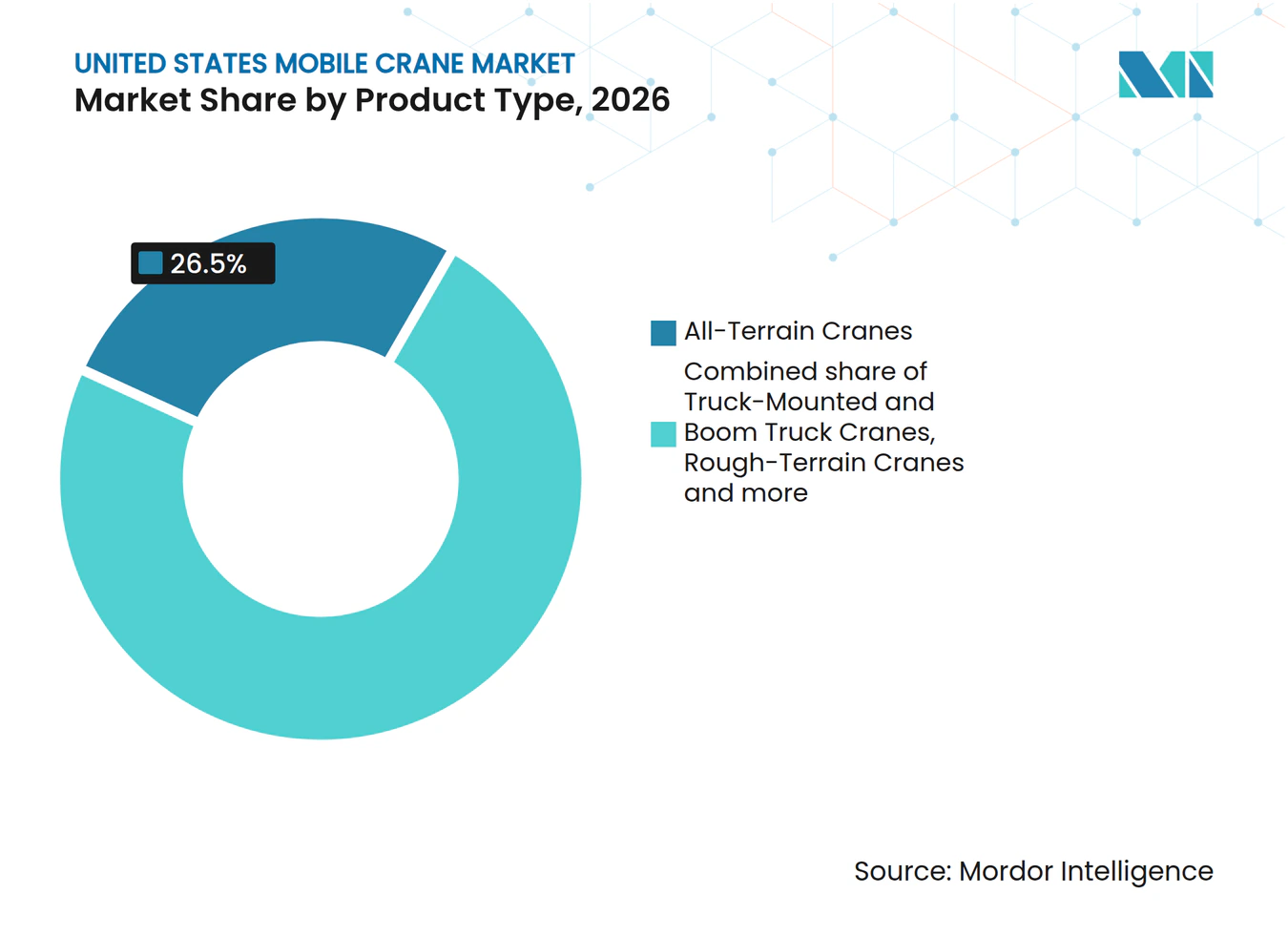
All-Terrain Cranes Lead Mixed-Site WorkAll-terrain cranes held 26.50% of the United States mobile crane market share in 2026 and are forecast to grow at a 6.20% CAGR through 2032, while crawler cranes accounted for about 27.0% combined across telescopic and lattice-boom crawler types. Crawler designs support work where heavy components must be placed with stable positioning and controlled movement. Wind installation, industrial plant construction, and large structural work support demand for this equipment. These projects often require a crane to remain productive at a single site through several construction phases. Rental providers value crawlers when projects need high capacity, detailed lift planning, and experienced operating teams. The equipment is also useful when project schedules leave little room for a replacement unit or an unplanned change in lifting method.
All-terrain cranes provide mobility for projects that require frequent moves between locations and a quick return to public roads. Truck-mounted cranes remain useful for routine construction and utility assignments where practical access is more important than maximum lifting capability. Rough-terrain models serve locations with uneven ground, incomplete site preparation, or restricted internal roads. Telescopic crawler designs can offer heavy-lift capability while reducing some mobilization requirements for complex projects. Product selection depends on load requirements, ground conditions, transport planning, operator skill, and the length of the assignment. These choices allow the United States mobile crane market to serve major construction programs as well as shorter-duration local work.



By Carrier Type:
Crawler-Mounted Equipment Meets Heavy Project RequirementsSelf-propelled wheeled units held 48.50% share in 2026, while crawler-mounted units held 27.00% and are forecast to grow at a 6.60% CAGR through 2032. The crawler-mounted carrier type is suited to projects that need substantial lifting capability and stable placement at the worksite. Infrastructure, energy, and industrial construction can favor this configuration when equipment stays on site for an extended period. Its use reflects the need to manage large components with careful site preparation and clear movement plans. Operators also select it where ground conditions are unsuitable for conventional wheeled equipment or repeated repositioning could disrupt the job. The carrier design can help crews work carefully around difficult loads, constrained spaces, and demanding safety procedures.
Truck-mounted carriers remain important where customers prioritize travel between nearby job sites and straightforward mobilization. Trailer-mounted units serve specialized assignments that can justify their transport arrangements and dedicated site setup. Self-propelled wheeled equipment has a role in urban and industrial areas where mobility, ground pressure, and space limitations matter. These alternatives give rental firms options for different site layouts, work durations, and customer schedules. A diversified carrier fleet helps providers avoid using high-cost equipment when a simpler configuration can complete the work safely. The United States mobile crane market benefits when fleet operators can match carrier selection to the cost, timing, and access conditions of each lift.
By Terrain Type:
All-Terrain Models Serve Mixed-Access SitesAll-terrain held 58.71% share in 2026, while rough terrain is forecast to grow at a CAGR of 7.58% through 2032. All-terrain equipment is widely used because it can travel on roads and operate in semi-developed job environments. This flexibility supports contractors working across commercial, infrastructure, utility, and industrial sites. Rental companies can move these units between different project types with less specialized logistics and less disruption to the job sequence. Their broad use makes them valuable assets in a mixed customer portfolio that includes both planned work and time-sensitive assignments. The equipment can also reduce the need for a customer to arrange separate transport for every change in work location.
Rough-terrain cranes are appropriate for greenfield energy sites, industrial parks, utility corridors, and other areas with limited ground preparation. Paved and urban-access equipment supports dense construction areas where site conditions, staging areas, and access routes are tightly controlled. Unpaved and off-road work requires machines that can operate safely where access roads remain incomplete or ground conditions change. Data center projects can create demand for more than one terrain category as foundations, structural work, equipment placement, and finishing activity progress. Operators must consider ground bearing, weather, traffic management, and the available space for outriggers or tracks before selecting equipment. This range of needs supports product differentiation across the United States mobile crane market.
By Application:
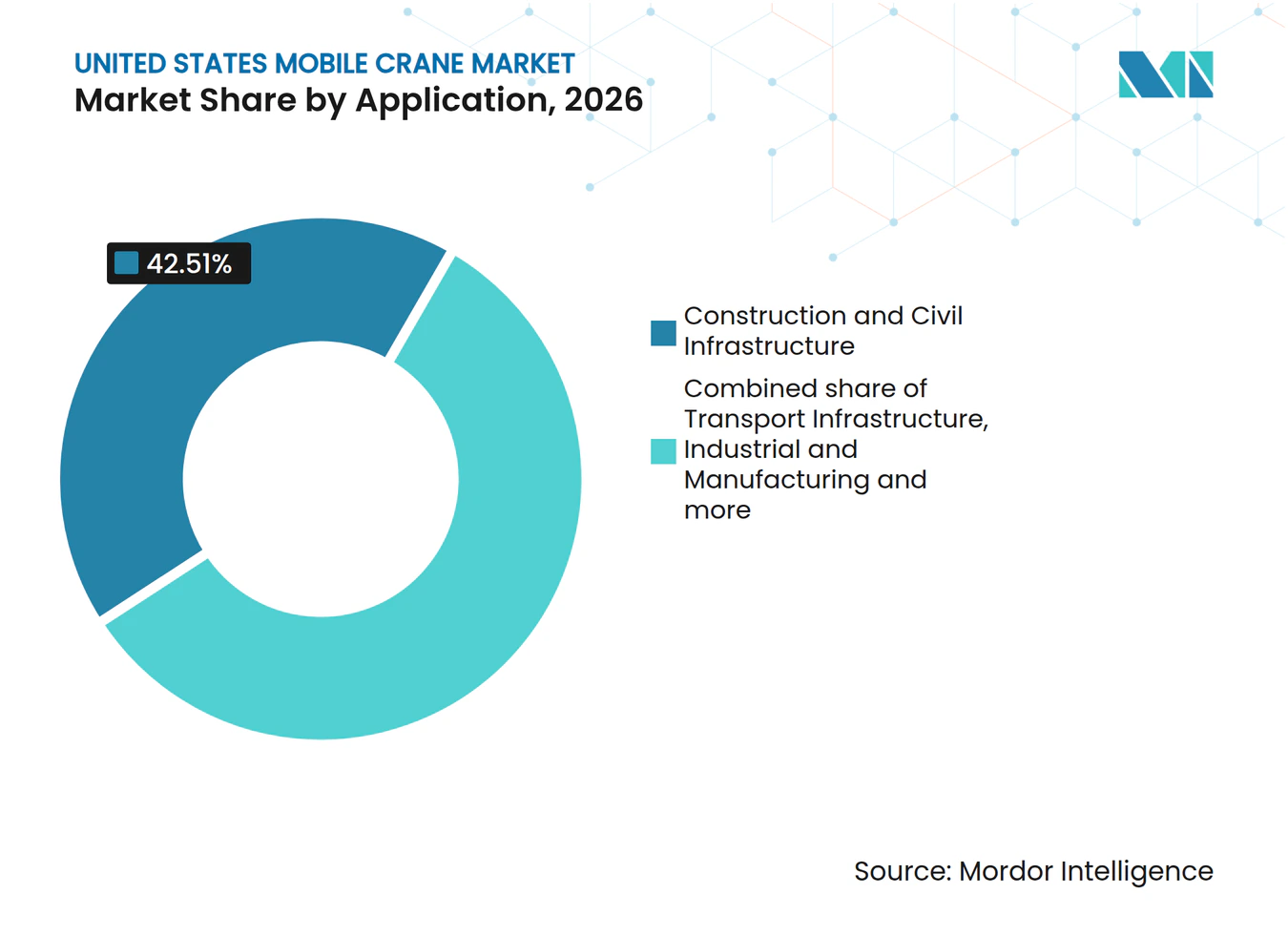
Renewable Energy Broadens Demand Beyond Civil WorkConstruction and civil infrastructure held 42.51% share in 2026, while renewable energy is forecast to grow at a CAGR of 8.22% through 2032. Civil work remains a broad source of demand because lifting is required for bridges, transit, buildings, and transportation upgrades. Renewable energy projects add a specialized need for large components, detailed lift plans, and well-coordinated site activity. The mix gives providers exposure to public and private construction activity rather than a narrow customer base. It also reduces dependence on any single construction category when project schedules or funding timing change. Providers that serve both applications can use their technical knowledge across different work environments while maintaining a more balanced fleet.
Transport infrastructure requires crane work for repairs, replacements, construction staging, and the installation of large structural elements. Industrial and manufacturing sites require equipment for new facilities, planned maintenance, equipment installation, and internal plant changes. Utilities and grid projects support recurring work at generation, transmission, distribution, and storage assets. Marine and port activities involve assignments in which access, safety procedures, weather, and scheduling are closely managed. Disaster recovery can also require rapid equipment deployment after damage to public infrastructure or energy systems. A balanced application mix helps the United States mobile crane market manage changes in individual project pipelines and customer spending patterns.

By End User:
Specialist Providers Retain a Central RoleCrane rental and lift-contracting companies held 35.42% share in 2026, while energy and utility companies are forecast to grow at a 7.84% CAGR through 2032. Rental and lift-contracting providers supply equipment and operating capability to customers that do not maintain a full fleet. Their role is especially important when a project requires engineered lift plans, specialist rigging, and trained staff. Energy and utility customers require equipment for generation, transmission, maintenance, and the placement of large replacement components. This demand often favors providers that understand site rules, weather exposure, outage schedules, and long project timelines. Their specialized service can reduce the coordination burden for customers managing complex construction or maintenance work.
Industrial asset owners use cranes during planned shutdowns, maintenance, facility upgrades, and the replacement of major process equipment. Government and municipal customers require lifting support for transportation projects, water systems, public buildings, and other public works. General and specialty contractors remain major users of conventional building and civil assignments that need temporary lifting capability. Mining and aggregates operators use crane services for plant maintenance, processing equipment, and material-handling infrastructure. Each group has different requirements for scheduling, documentation, crew expertise, and equipment availability. These end-user groups give the United States mobile crane market a broad base of recurring and project-based demand.
By Lifting Capacity:
Higher-Capacity Equipment Gains AttentionThe 50 to 150 tons segment held 46.56% share in 2026, while the above 300 tons segment is forecast to grow at a CAGR of 8.42% through 2032. Mid-range equipment serves a wide set of construction and industrial tasks with a practical balance between lifting capability and mobility. Its flexibility supports recurring work such as structural placement, maintenance, routine equipment changes, and general project activity. Higher-capacity equipment is needed when project components become larger, heavier, or more difficult to place precisely. The difference in use cases encourages fleet operators to maintain a mix of capacities rather than rely on one class of machine. Customers also consider mobilization complexity, site access, and the availability of qualified crews when choosing a capacity range.
Equipment below 50 tons supports work where mobility, shorter setup requirements, and lower operating costs are important. The 151 to 300 tons range serves many heavy civil and industrial lifts without the same operational demands as the largest units. The largest cranes are used for wind components, modular sections, major mechanical systems, and other demanding placements. Manufacturers continue to address gaps between established capacity classes as project requirements change. This enables rental companies to select equipment that better fits the physical requirements of a job without creating avoidable logistics burdens. This product planning gives the United States mobile crane market more options for specialized work and changing customer needs.
By Propulsion:
Alternative Power Moves from a Small BaseInternal combustion engines held 97.20% share in 2026, while battery-electric equipment is forecast to grow at a 19.72% CAGR through 2032. Conventional engines remain important because they provide the power, range, and refueling flexibility needed across many crane applications. Alternative systems are gaining attention where project sites have noise controls, emissions requirements, or access to electrical infrastructure. Hybrid designs can reduce fuel use while retaining support from a conventional power source during demanding work. The pace of adoption will depend on equipment capability, charging access, maintenance support, and the specific requirements of each project. Customers must also assess whether lower-emission equipment can complete planned work without creating new operating constraints.
Urban construction and regulated locations can create early opportunities for lower-emission equipment and quieter operating practices. Manufacturers are publishing electrification plans and introducing connected systems that improve operating visibility and maintenance planning. Heavy lifting continues to require reliable power under variable site conditions, including weather changes and long work cycles. Battery-electric equipment is likely to be more practical first in applications with manageable duty cycles and predictable site access. Hybrid units can provide an intermediate option for customers that want lower fuel use without relying solely on charging availability. These factors make propulsion a developing area within the United States mobile crane market rather than a uniform change across all equipment classes.
By Ownership Model:
Operated Rental Gains RelevanceOwned fleet held 52.63% share in 2026, while operated rental is forecast to grow at a CAGR of 8.13% through 2032. Fleet ownership gives established operators direct control over equipment availability, maintenance planning, and the assignment of assets to long-term customers. It can also create an advantage for companies that can support costly assets through demand cycles and invest in replacement equipment. Operated rental appeals to customers who want specialist expertise along with the crane and a coordinated field team. This model can transfer operational, scheduling, and safety responsibilities to an experienced provider with relevant equipment. It is particularly useful where an internal customer lacks the staff or technical knowledge to manage a complex lift independently.
Bare rental remains relevant for customers who maintain qualified internal operators and can oversee the equipment at their own sites. Lift contracting is used when a specialist takes responsibility for a defined lifting scope and coordinates the associated work. Project fleet solutions can support sites with long, carefully planned construction schedules and consistent equipment requirements. These models allow clients to choose a level of control that matches their technical capability, risk tolerance, and internal workforce. Providers can also tailor commercial terms to the duration and complexity of the project rather than use one standard service model. The United States mobile crane industry is therefore shaped by both asset ownership and service-led delivery models.
Geography Analysis
The Midwest accounted for about 21% of the United States mobile crane market share in 2026. Its manufacturing, energy, and industrial facilities create recurring work for maintenance, facility improvements, equipment replacement, and construction activity across a wide range of customer sites. The region also has established transport links, a broad base of crane fleets, and experienced service providers familiar with industrial operating requirements. This can lower the practical complexity of moving equipment between customer sites and arranging support for time-sensitive work. Data center and infrastructure projects add demand to this established industrial base while creating work that differs from traditional factory maintenance. The region therefore combines recurring industrial demand with construction opportunities that can support fleet utilization across changing project schedules.
The South held 38.50% of the United States mobile crane market share in 2026 and is forecast to grow at a 6.90% CAGR through 2032. Texas supports activity across energy, power infrastructure, wind, industrial construction, data centers, and a large network of related service companies. Florida, Georgia, North Carolina, and Louisiana also contribute project demand through infrastructure, manufacturing, port, aerospace, and other construction-related work. The region draws demand from several end markets rather than relying on one project type or one source of customer spending. This diversity can help rental providers keep equipment active across changing construction schedules and seasonal work patterns. It also creates a need for providers that can deploy equipment quickly across a large geography while supporting local safety, transport, and site requirements.
The Northeast is shaped by dense urban construction, transit work, and detailed local permitting requirements that can affect both planning and site access. These conditions require careful planning for equipment access, transport, staging, operating windows, and coordination with nearby traffic or occupied facilities. The West benefits from infrastructure, port investment, manufacturing construction, and a range of projects that may have challenging terrain or environmental requirements. California can support early use of lower-emission equipment because project requirements place greater focus on air quality and local operating conditions. Together, these regions add specialized work that broadens the geographic base of the United States mobile crane market. They also reward operators that can adapt equipment selection, staffing, and logistics to the different requirements of dense cities, coastal facilities, and remote sites.
Competitive Landscape
Market Concentration
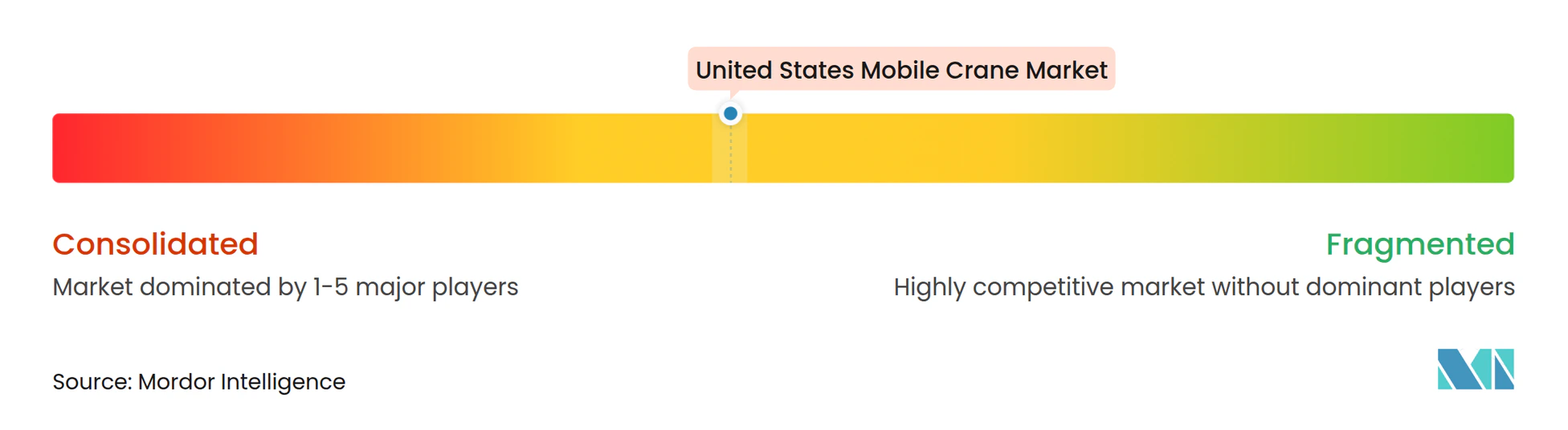
The United States mobile crane market is moderately concentrated and comprises equipment manufacturers, national rental platforms, regional operators, and specialist rigging companies, each with distinct roles in the value chain. Manufacturers compete through lifting capability, product reliability, service networks, equipment technology, and the availability of parts and technical support that can keep equipment ready for field assignments. Rental providers compete through fleet availability, local branch coverage, operator expertise, project planning, and the ability to support complex work without disruption when site conditions or schedules change. Regional firms remain important because local knowledge, established customer relationships, and responsive service can matter at the project level, especially where access rules and customer needs differ from one location to another. This creates a competitive environment where national scale and local execution both have value, rather than a market where equipment ownership alone determines customer choice.
Manitowoc introduced the Grove GMK8700 at CONEXPO 2026, expanding its all-terrain offering with a new high-capacity model and connected crane systems. The same manufacturer also introduced the National Crane NTC80 boom truck at the event, responding to utility, construction, and oil and gas requirements with a customer-informed design. These launches show how product development is addressing both large-project lifts and mobile field work where ease of access, equipment setup, and operator visibility matter. Rental businesses are also renewing fleets and expanding territory through acquisitions and outside investment to deepen their service reach and maintain equipment closer to important customer locations. Such actions can improve their ability to serve multi-state customers that want consistent operating practices, access to different equipment classes, and clear accountability from one provider.
Connected fleet management and maintenance planning are becoming more important competitive capabilities as customers seek predictable project execution and fewer equipment-related delays. Equipment suppliers can strengthen customer relationships when they combine new machines with service support, digital tools, accessible technical guidance, and practical training for field personnel. Rental companies can improve responsiveness by locating different crane types near active construction centers, maintaining close contact with project teams, and planning maintenance around expected utilization. Specialist lift planning remains a differentiator where customers need engineering support, complex site coordination, detailed documentation, and a provider that can explain operating limits clearly. The competitive landscape will continue to favor firms that pair dependable assets with experienced personnel, broad service capabilities, and a record of executing work safely.
United States Mobile Crane Industry Leaders
-
The Manitowoc Company, Inc.
-
Liebherr USA Co.
-
Tadano America Corporation
-
Terex Corporation
-
Link-Belt Cranes
- *Disclaimer: Major Players sorted in no particular order
United States Mobile Crane Market Companies Covered in this Report
- The Manitowoc Company, Inc.
- Liebherr USA Co.
- Tadano America Corporation
- Terex Corporation
- Link-Belt Cranes
- SANY America, Inc.
- XCMG America Corporation
- Zoomlion Heavy Industry North America, Inc.
- Kobelco Construction Machinery USA Inc.
- Hitachi Sumitomo Heavy Industries Construction Crane Co., Ltd.
- Palfinger USA, LLC
- Manitex International, Inc.
- Altec Industries, Inc.
- Elliott Equipment Company
- Broderson Manufacturing Corp.
- Sennebogen LLC
- KATO WORKS CO., LTD.
- Maxim Crane Works, LP
- Bigge Crane and Rigging Co.
- Barnhart Crane & Rigging
- TNT Crane & Rigging, Inc.
- Bay Crane Companies
- Buckner HeavyLift Cranes
- Deep South Crane & Rigging
Recent Industry Developments in United States Mobile Crane Market
- March 2026: Liebherr handed over an LTM 1250-5.1 all-terrain crane to Prillaman's Crane & Rigging at CONEXPO-CON/AGG 2026, the eighth Liebherr crane in the company's fleet.
- March 2026: XCMG debuted three US-tailored cranes at CONEXPO-CON/
- AGG 2026: the XCA275_U all-terrain crane, the XCR130_U rough-terrain crane, and the XCT45_U truck crane.
- March 2026: Manitowoc debuted the Grove GMK8700, an 800-US-ton all-terrain crane, and the National Crane NTC80 boom truck at CONEXPO-CON/AGG 2026.
- March 2026: Link-Belt Cranes launched the 180-ton TCC-1800 telescopic crawler crane, aimed at data center and bridge work, at CONEXPO-CON/AGG 2026.
United States Mobile Crane Market Report Scope
The United States Mobile Crane Market is segmented by product type, carrier type, terrain type, application, end user, lifting capacity, propulsion, ownership model, and region. By Product Type, the market is segmented into Truck-Mounted and Boom Truck Cranes, All-Terrain Cranes, Rough-Terrain Cranes, Telescopic Crawler Cranes, Lattice-Boom Crawler Cranes, and Pick-and-Carry Cranes. By Carrier Type, the market is segmented into Truck-Mounted, Crawler-Mounted, Trailer-Mounted, and Self-Propelled Wheeled. By Terrain Type, the market is segmented into All Terrain, Rough Terrain, Paved/Urban Access, and Unpaved/Off-Road Access. By Application, the market is segmented into Construction and Civil Infrastructure, Transport Infrastructure, Industrial and Manufacturing, Oil and Gas and Petrochemicals, Renewable Energy, Utilities and Grid, Mining and Aggregates, Marine and Port, and Disaster Recovery and Public Works. By End User, the market is segmented into Crane Rental and Lift-Contracting Companies, General and Specialty Contractors, Industrial Asset Owners, Energy and Utility Companies, Government and Municipalities, and Mining and Aggregates Operators. By Lifting Capacity, the market is segmented into Below 50 Tons, 50–150 Tons, 151–300 Tons, and Above 300 Tons. By Propulsion, the market is segmented into Internal Combustion Engine, Hybrid, and Battery-Electric. By Ownership Model, the market is segmented into Owned Fleet, Bare Rental, Operated Rental, Lift Contracting, and Project Fleet Solutions. By Region, the market is segmented into Northeast (New York, Pennsylvania, New Jersey, Massachusetts, and Connecticut), Midwest (Illinois, Ohio, Indiana, Michigan, and Wisconsin), South (Texas, Florida, Georgia, North Carolina, and Louisiana), and West (California, Washington, Oregon, Arizona, and Colorado). Market forecasts are provided in terms of Value (USD) and Volume (Units).
Segmentation Overview
| Truck-Mounted and Boom Truck Cranes |
| All-Terrain Cranes |
| Rough-Terrain Cranes |
| Telescopic Crawler Cranes |
| Lattice-Boom Crawler Cranes |
| Pick-and-Carry Cranes |
| Truck-Mounted |
| Crawler-Mounted |
| Trailer-Mounted |
| Self-Propelled Wheeled |
| All Terrain |
| Rough Terrain |
| Paved/Urban Access |
| Unpaved/Off-Road Access |
| Construction and Civil Infrastructure |
| Transport Infrastructure |
| Industrial and Manufacturing |
| Oil and Gas and Petrochemicals |
| Renewable Energy |
| Utilities and Grid |
| Mining and Aggregates |
| Marine and Port |
| Disaster Recovery and Public Works |
| Crane Rental and Lift-Contracting Companies |
| General and Specialty Contractors |
| Industrial Asset Owners |
| Energy and Utility Companies |
| Government and Municipalities |
| Mining and Aggregates Operators |
| Below 50 Tons |
| 50–150 Tons |
| 151–300 Tons |
| Above 300 Tons |
| Internal Combustion Engine |
| Hybrid |
| Battery-Electric |
| Owned Fleet |
| Bare Rental |
| Operated Rental |
| Lift Contracting |
| Project Fleet Solutions |
| Northeast | New York |
| Pennsylvania | |
| New Jersey | |
| Massachusetts | |
| Connecticut | |
| Midwest | Illinois |
| Ohio | |
| Indiana | |
| Michigan | |
| Wisconsin | |
| South | Texas |
| Florida | |
| Georgia | |
| North Carolina | |
| Louisiana | |
| West | California |
| Washington | |
| Oregon | |
| Arizona | |
| Colorado |
| By Product Type | Truck-Mounted and Boom Truck Cranes | |
| All-Terrain Cranes | ||
| Rough-Terrain Cranes | ||
| Telescopic Crawler Cranes | ||
| Lattice-Boom Crawler Cranes | ||
| Pick-and-Carry Cranes | ||
| By Carrier Type | Truck-Mounted | |
| Crawler-Mounted | ||
| Trailer-Mounted | ||
| Self-Propelled Wheeled | ||
| By Terrain Type | All Terrain | |
| Rough Terrain | ||
| Paved/Urban Access | ||
| Unpaved/Off-Road Access | ||
| By Application | Construction and Civil Infrastructure | |
| Transport Infrastructure | ||
| Industrial and Manufacturing | ||
| Oil and Gas and Petrochemicals | ||
| Renewable Energy | ||
| Utilities and Grid | ||
| Mining and Aggregates | ||
| Marine and Port | ||
| Disaster Recovery and Public Works | ||
| By End User | Crane Rental and Lift-Contracting Companies | |
| General and Specialty Contractors | ||
| Industrial Asset Owners | ||
| Energy and Utility Companies | ||
| Government and Municipalities | ||
| Mining and Aggregates Operators | ||
| By Lifting Capacity | Below 50 Tons | |
| 50–150 Tons | ||
| 151–300 Tons | ||
| Above 300 Tons | ||
| By Propulsion | Internal Combustion Engine | |
| Hybrid | ||
| Battery-Electric | ||
| By Ownership Model | Owned Fleet | |
| Bare Rental | ||
| Operated Rental | ||
| Lift Contracting | ||
| Project Fleet Solutions | ||
| By Region | Northeast | New York |
| Pennsylvania | ||
| New Jersey | ||
| Massachusetts | ||
| Connecticut | ||
| Midwest | Illinois | |
| Ohio | ||
| Indiana | ||
| Michigan | ||
| Wisconsin | ||
| South | Texas | |
| Florida | ||
| Georgia | ||
| North Carolina | ||
| Louisiana | ||
| West | California | |
| Washington | ||
| Oregon | ||
| Arizona | ||
| Colorado | ||
Key Questions Answered in the Report
What is the projected growth rate for the United States mobile crane market?
The United States mobile crane market is forecast to grow at a CAGR of 5.88% from 2027 to 2032, reaching USD 5.00 billion by 2032. The outlook reflects demand from infrastructure, energy, grid, data center, and industrial construction work, alongside a growing preference for specialist lifting services.
Which product type leads demand for mobile cranes in the United States?
All-terrain cranes led the product type segment with 26.50% share in 2026 and are forecast to grow at a 6.20% CAGR through 2032.
Why are mobile cranes needed for renewable energy projects?
Wind installation, repowering, substations, and transmission work require specialized lifting equipment and careful lift planning. Crane providers must also account for site access, component handling, weather, transport arrangements, and the availability of qualified crews that can safely complete the work.
Which application is expected to grow fastest through 2032?
Renewable energy is forecast to grow at a CAGR of 8.22% through 2032, supported by wind and grid-related construction.