
United States HVDC Converter Station Market Size and Share
Market Overview
| Study Period | 2022 - 2032 |
|---|---|
| Forecast Data Period | 2027 - 2032 |
| Base Year Market Size (2026) | USD 663.66 Million |
| Market Size (2027) | USD 711.65 Million |
| Market Size (2032) | USD 996.32 Million |
| Growth Rate (2027 - 2032) | 6.96 % |
| Market Concentration | Medium |
Major Players *Disclaimer: Major Players sorted in no particular order Image © Mordor Intelligence. Reuse requires attribution under CC BY 4.0. | |
United States HVDC Converter Station Market Analysis by Mordor Intelligence
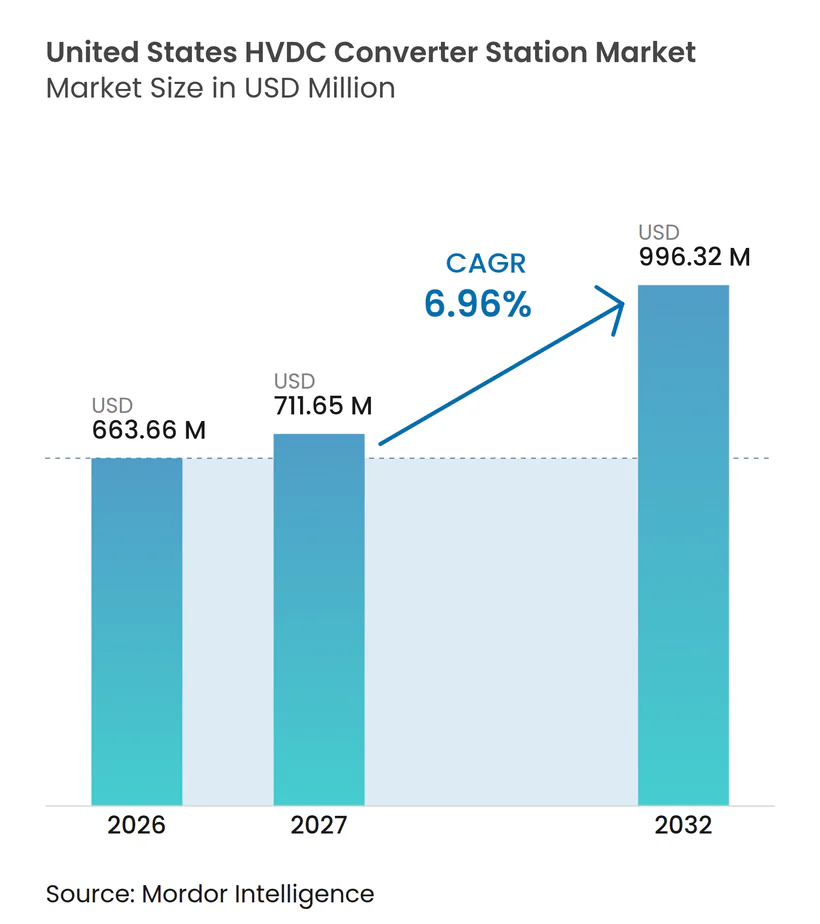
The United States HVDC Converter Station Market size is projected to expand from USD 663.66 million in 2026 and USD 711.65 million in 2027 to USD 996.32 million by 2032, registering a CAGR of 6.96% between 2027 and 2032. The United States HVDC converter station market is supported by the need to move renewable electricity from remote generation areas to major load centers. Rising power demand from data centers and industrial electrification is also increasing the value of controllable long-distance transmission links.[1] Developers are giving more attention to projects that connect separate power systems and support capacity sharing across regional markets.[2] The United States HVDC converter station market therefore depends on equipment availability, early engineering work, and permits obtained well before construction begins. VSC systems are gaining relevance where grid connections are weak, offshore, or require more precise power control.[3] Supply constraints and lengthy multi-state approvals can delay projects even when demand for new transmission capacity is clear.[4]
Key Report Takeaways
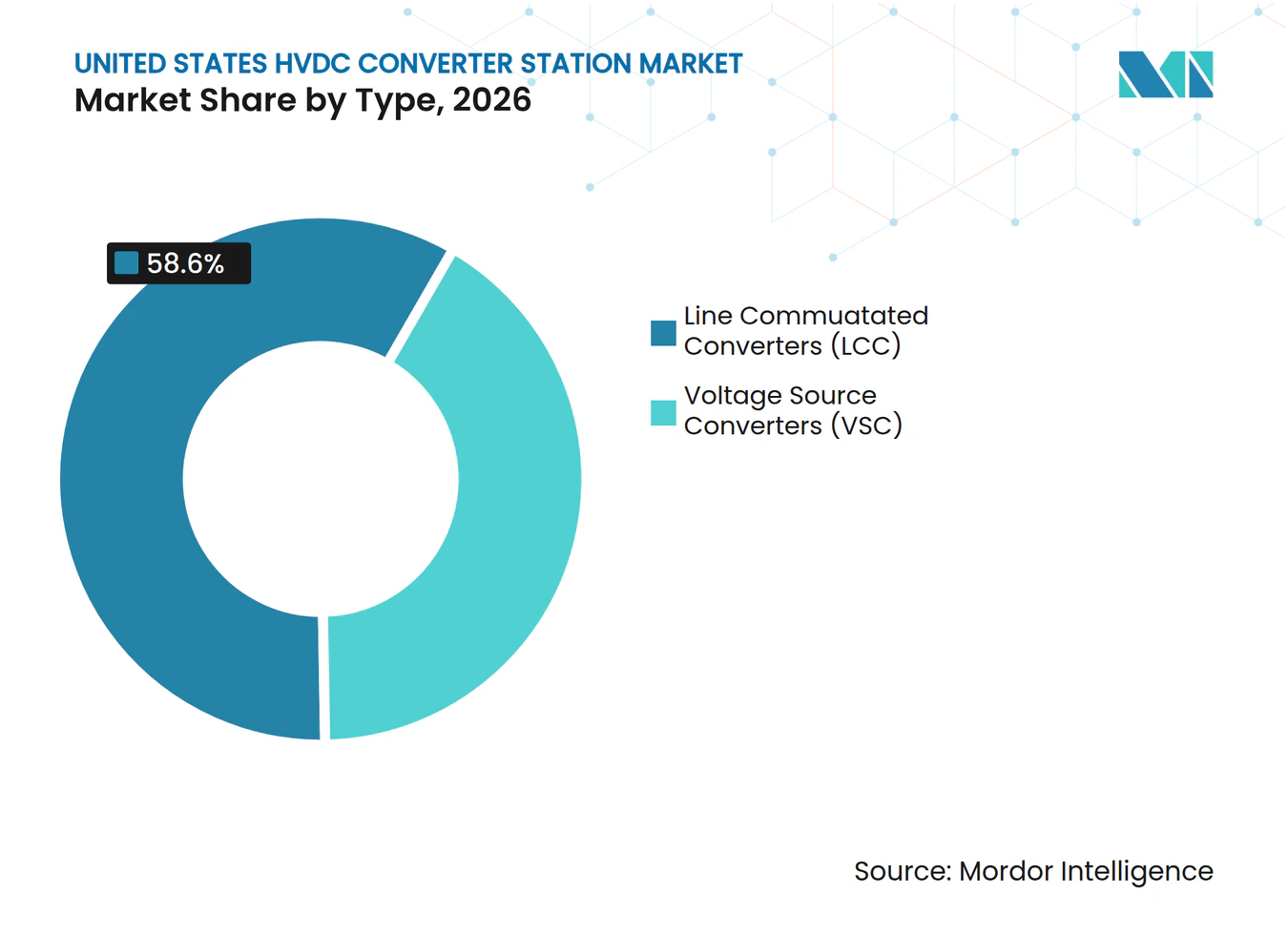
- By type, Line-Commutated Converter (LCC) held 58.6% of the United States HVDC converter station market share in 2026, while Voltage-Source Converter (VSC) is forecast to expand at a 7.9% CAGR through 2032.
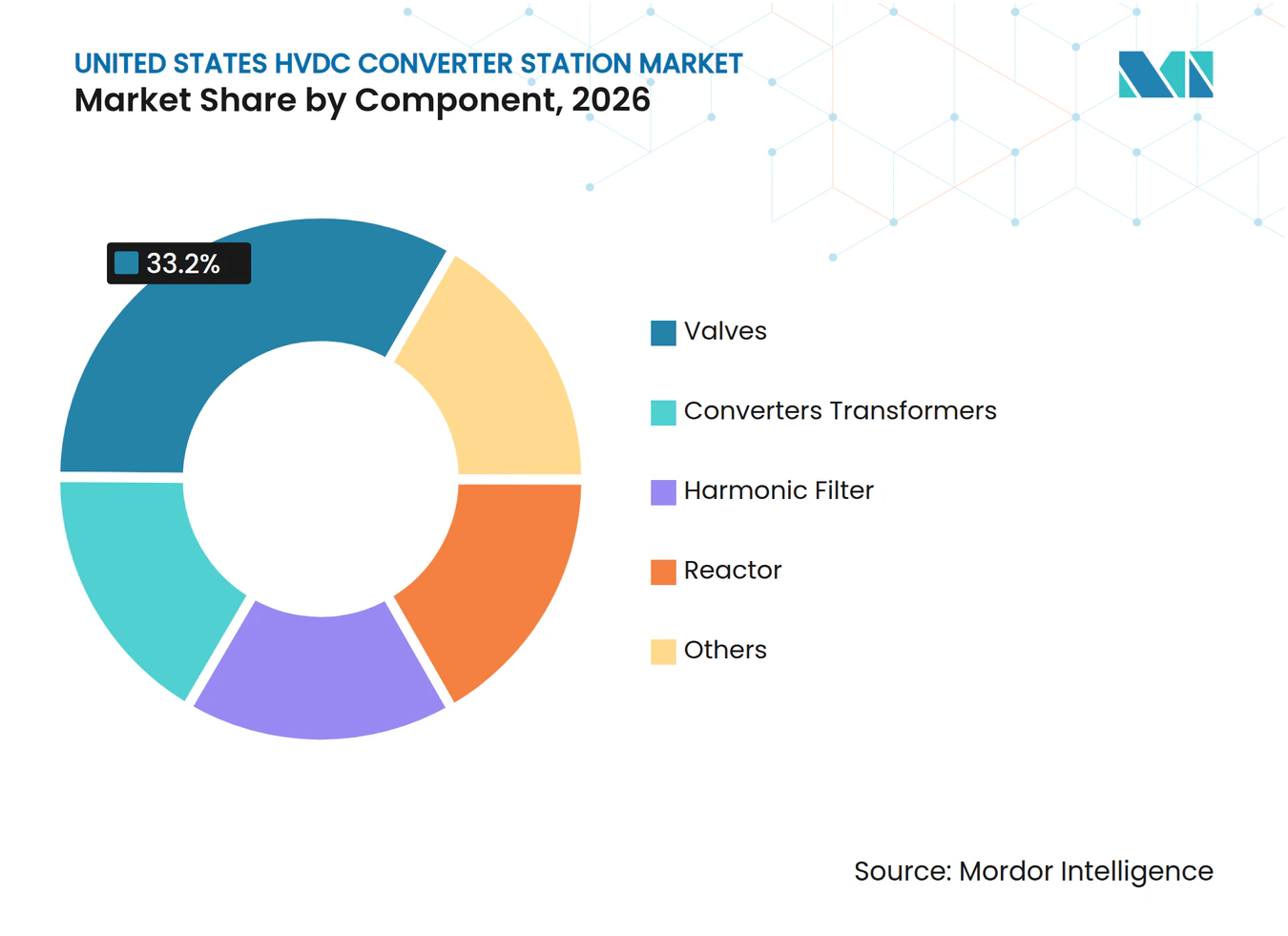
- By component, valves accounted for 33.2% of the United States HVDC converter station market size in 2026 and are forecast to expand at a 7.3% CAGR through 2032.
Note: Market numbers in this report are based on Mordor Intelligence's proprietary estimation framework, which combines nine months of actuals with Q4 projections for base year 2026.
United States HVDC Converter Station Market Trends and Insights
Drivers Impact Analysis*
| Driver | (~) % Impact on CAGR Forecast | Geographic Relevance | Impact Timeline |
|---|---|---|---|
| Long-Distance Renewable Power Transfer | +1.4% | Western Interconnection, Great Plains, MISO-SPP interface | Long term (≥ 4 years) |
| Interregional Grid Congestion and Reliability Needs | +1.0% | MISO-PJM seam, SPP-WECC interface, national NERC-identified gaps | Medium term (2-4 years) |
| Expansion of Offshore Wind and Coastal Transmission | +0.9% | United States Atlantic coast, PJM, ISO-NE, NYISO, Gulf of Mexico | Long term (≥ 4 years) |
| Rising Electricity Demand From Data Centers and Industrial Electrification | +1.2% | Virginia, Texas, Arizona, Georgia, and national demand centers | Short term (≤ 2 years) |
| Asynchronous Interconnection Between U.S. Power Grids | +0.6% | ERCOT boundaries, Eastern-Western Interconnection seam, Quebec-United States border | Medium term (2-4 years) |
| Lower-Cost Modular Converter Designs and HVDC R&D | +0.5% | National research hubs and university partners | Long term (≥ 4 years) |
| Source: Mordor Intelligence | |||
Long-Distance Renewable Power Transfer
The United States HVDC converter station market benefits when renewable resources are far from the cities that use the electricity. HVDC can become economic on long routes because it limits transmission losses and provides direct control over power transfer. Wind and solar resources in the Great Plains are located far from large eastern demand centers, which makes long-distance transmission planning important. The SunZia project uses a 3,000 MW, ±525 kV Voltage Source Converter (VSC) link across 552 miles from New Mexico to Arizona and entered commissioning in late 2025. Converter stations at each end can provide frequency support, reactive power control, and black-start capability that conventional AC substations cannot provide in the same way. State clean-energy targets strengthen the long-term project pipeline because new renewable capacity needs reliable access to distant demand areas.
Rising Electricity Demand from Data Centers and Industrial Electrification
Data centers need large volumes of reliable electricity within short development periods, creating a different transmission requirement from more dispersed load growth. Lawrence Berkeley National Laboratory estimated that data centers could account for 11.8% of United States electricity demand by 2030, compared with nearly 4% in an earlier period. The United States HVDC converter station market can benefit when developers use long-distance links to connect renewable and hydropower resources with major computing centers. Virginia, Texas, Arizona, and Georgia are important locations because they combine large, planned loads with a need for dependable power delivery. Large data center buyers can support transmission project financing when they contract for access to capacity on planned corridors. This arrangement gives project developers a more visible demand base before a line enters service.
Expansion of Offshore Wind and Coastal Transmission
Offshore wind projects require grid connections that can manage large injections of power at coastal substations. The Department of Energy calls for phased offshore transmission development and identifies HVDC interlinks as part of the pathway from 2030. Research from the National Offshore Wind Research Center and NREL examined a coordinated network that could serve 250 GW of Atlantic offshore wind and change onshore power flows substantially. Voltage Source Converter (VSC) equipment is appropriate for these applications because it can control active and reactive power independently. It can also support weak connection points and future multi-terminal configurations. The United States HVDC converter station market has a longer-term opportunity in coastal projects where the technology requirements favor VSC converter stations.
Interregional Grid Congestion and Reliability Needs
Congestion at regional interfaces makes controllable transmission capacity more valuable to system operators and market participants. The North Plains Connector is planned as a 3,000 MW, ±525 kV project that links the Midcontinent Independent System Operator (MISO), Southwest Power Pool (SPP), and Western Electricity Coordinating Council (WECC) regions. It reflects a wider need to share capacity across regions when local resources are constrained. Back-to-back converter stations are also needed at asynchronous boundaries because AC switching cannot directly control power flow between grids that are not synchronized. Electric Reliability Council Of Texas (ERCOT), the Eastern Interconnection, and the Western Interconnection therefore create distinct opportunities for this equipment. Modular converter research can support these applications by reducing equipment footprint and improving the performance of advanced transmission links.
Restraints Impact Analysis*
| Restraint | (~) % Impact on CAGR Forecast | Geographic Relevance | Impact Timeline |
|---|---|---|---|
| Permitting and Multi-Jurisdictional Siting Delays | -0.7% | National, most severe for multi-state projects crossing 3 or more jurisdictions | Long term (≥ 4 years) |
| High Upfront Capital Requirements and Conditional Financing | -0.5% | National, with a disproportionate effect on merchant transmission developers | Medium term (2-4 years) |
| Converter Transformer and Power-Electronics Supply Bottlenecks | -0.4% | Global supply chain, with acute effects on United States projects | Short term (≤ 2 years) |
| Limited Domestic HVDC Engineering and Commissioning Capacity | -0.4% | National, concentrated among fewer than 5 qualified engineering firms | Medium term (2-4 years) |
| Source: Mordor Intelligence | |||
Permitting and Multi-Jurisdictional Siting Delays
Permitting is a persistent constraint on the United States HVDC converter station market because lines and stations often cross several states. The SunZia project required 17 years for route approval and 6 years for construction, showing how development schedules can exceed physical construction schedules. States apply separate approval processes, while merchant HVDC projects do not operate under a single national sitting framework. The Congressional Research Service (CRS) has documented continuing policy discussion on federal transmission permitting authority and the relationship between federal and state roles. Long approval periods force manufacturers and developers to perform early engineering before all regulatory milestones are complete. This raises financing risk because equipment reservations and development expenses may be incurred before a project has a final construction path.
Converter Transformer and Power-Electronics Supply Bottlenecks
Equipment supply limits can postpone converter station delivery even after a project has secured approvals. HVDC stations need customized valves, converter transformers, filters, and control systems that require specialized design and production. Domestic manufacturing capacity remains important because project developers seek lower exposure to delivery risk. Hitachi Energy announced more than USD 1 billion in United States manufacturing investment in September 2025, including USD 457 million for a transformer facility in South Boston, Virginia. The company also committed USD 106 million to expand transformer component production in Alamo, Tennessee, including HVDC-rated bushing capacity up to 800 kV. These investments can reduce constraints over time, although qualified engineering and commissioning capacity will remain essential for project execution.
*Our forecasts treat driver/restraint impacts as directional, not additive. The impact forecasts reflect baseline growth, mix effects, and variable interactions.
Segment Analysis
By Type: VSC Gaining Ground as Grid Complexity Increases
Line-Commutated Converter (LCC) held 58.6% of United States HVDC converter station market share in 2026, supported by established long-distance point-to-point projects. It remains suitable for bulk power routes where the grid is strong and reactive power support can be provided by nearby substations. Grain Belt Express illustrates the continuing relevance of this approach because it is planned as a large transmission project with 5,000 MW capacity. The installed base of long-haul systems also supports ongoing demand for LCC expertise and modernization work. LCC remains a practical choice where the objective is efficient transfer of large volumes of electricity between clearly defined terminals.
VSC is forecast to grow at a 7.9% CAGR through 2032, faster than the overall United States HVDC converter station market. It is used where offshore wind, weak grids, asynchronous connections, or multi-terminal designs require greater operating flexibility. A 2025 technical report by Oak Ridge National Laboratory, Pacific Northwest National Laboratory, and National Renewable Energy Laboratory (NREL) considered scalable hybrid DC-AC grid analysis methods for large inter-area power transfers. Peer-reviewed research also reported improved control performance for VSC-based multi-terminal systems. The United States HVDC converter station industry is therefore moving toward a two-technology market, with LCC used for established bulk corridors and VSC used for more complex connections.



By Component: Valves and Transformers Anchor Converter Station Value
Valves accounted for 33.2% of the United States HVDC converter station market size in 2026 and are forecast to grow at a 7.3% CAGR through 2032. They are central to power conversion and are a major point of technical differentiation in both LCC and VSC systems. In VSC stations, modular multilevel converter valve stacks use large numbers of semiconductor submodules. This requirement concentrates technical capability among a limited group of qualified manufacturers. The Department of Energy selected 4 HVDC projects under its USD 11 million IDEAL HVDC program to develop higher-density switching equipment and lower converter station costs.
Converter transformers are another high-value part of a station and have a direct influence on delivery schedules. Developers increasingly seek earlier transformer procurement because station-specific designs can have long production periods. Harmonic filters, reactors, and other supporting equipment account for the remaining component demand and have a broader group of suppliers. As VSC adoption rises, each installation needs more advanced power electronics content. This shift supports valve suppliers and power electronics specialists within the United States HVDC converter station industry. Federal support for advanced switches also points to interest in building a more capable domestic supply base.

Geography Analysis
The United States HVDC converter station market is organized around the Western Interconnection, the Eastern Interconnection, and ERCOT because these systems set the main transmission boundaries. The Western Interconnection has active project activity through SunZia, a 3,000 MW, ±525 kV Voltage Source Converter (VSC) link that entered commissioning in late 2025. The planned North Plains Connector would link Midcontinent Independent System Operator (MISO), Southwest Power Pool (SPP), and Western Electricity Coordinating Council (WECC) through a 3,000 MW, ±525 kV system. These projects show the need to connect remote resource areas with multiple regional markets. The separation of the Western system from the Eastern grid increases the value of controlled interregional transfer capacity.
The Eastern Interconnection contains Grain Belt Express and other merchant transmission proposals. The Department of Energy completed the final environmental impact statement for Grain Belt Express Phase 1 in July 2025. The planned project includes a ±600 kV, 5,000 MW HVDC line and converter stations at its endpoints. The region also has a separate coastal opportunity because the Atlantic Offshore Wind Transmission Action Plan supports HVDC planning for radial connections and later multi-terminal interlinks. A published breakdown by interconnection is unavailable, but the Eastern system has the broadest combination of inland and coastal project demand.
ERCOT operates separately from the Eastern and Western Interconnections and uses back-to-back HVDC stations for existing connections with neighboring systems. This structure creates a distinct role for converter stations because power exchange needs controlled interfaces between asynchronous grids. Texas also combines substantial data center development with major wind resources, which strengthens the case for future transfer capacity. ERCOT operates under a regulatory structure that differs from interstate transmission systems. That distinction can influence the timing of permitting and cost recovery for new projects. The United States HVDC converter station market can gain from projects that relieve stress on Texas interties while expanding access to firm capacity.
Competitive Landscape
Market Concentration
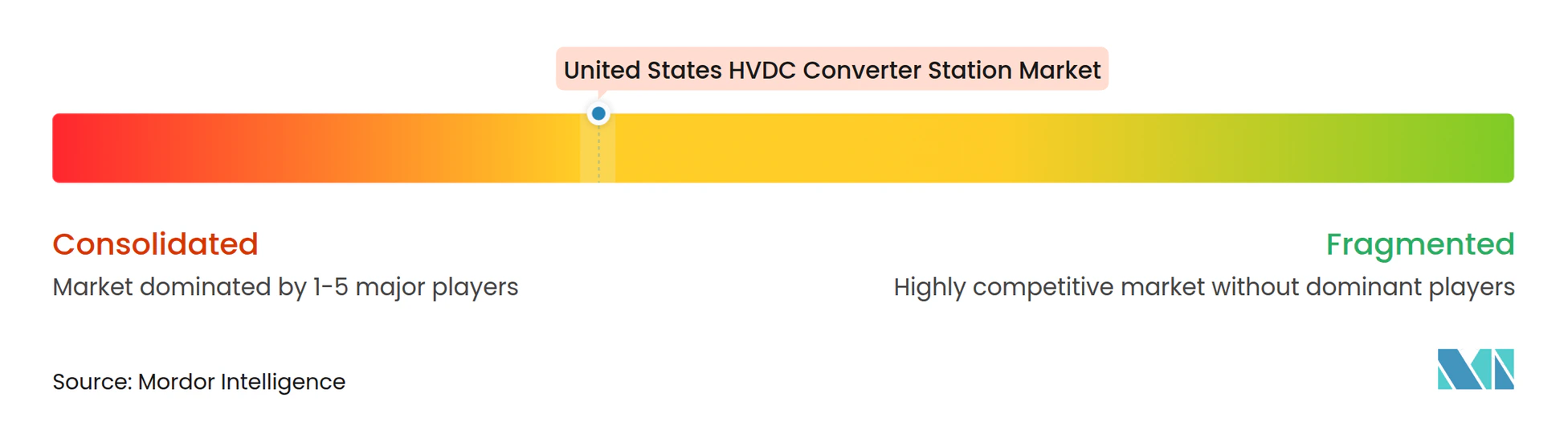
The United States HVDC converter station market is moderately concentrated at the technology supply level. Hitachi Energy, Siemens Energy, GE Vernova, and Mitsubishi Electric are the principal qualified global suppliers for large converter station packages. National Grid selected these 4 companies for its March 2025 HVDC supply chain framework, confirming their capability to deliver major HVDC equipment. The framework does not provide company-level market shares for the United States. Competition therefore centers on proven technology, delivery capacity, engineering depth, and long-term service support. Suppliers also compete for early design roles that can influence equipment specifications before final investment decisions.
Hitachi Energy is using early engineering agreements and manufacturing investment to deepen its position. In October 2025, Hitachi Energy and Grid United executed an Engineering Services Agreement for early-stage North Plains Connector converter station design. The agreement covers technical specifications, harmonic mitigation work, dynamic modeling, and AC-DC interface definitions. In September 2025, the company announced more than USD 1 billion in United States manufacturing investment, including a USD 457 million transformer facility in Virginia. It also announced a USD 106 million expansion at Alamo, Tennessee, for HVDC-rated transformer components. These actions address delivery risk while improving the company’s domestic supply position. The United States HVDC converter station market can benefit when this capacity is available for future projects.
Siemens Energy remains relevant to the United States HVDC converter station market through major planned transmission infrastructure. The Department of Energy’s Grain Belt Express review identifies converter stations at the project terminals, while the project’s broader progress sustains demand for qualified suppliers. GE Vernova is developing a lower-cost HVDC transmission access point substation through a Department of Energy-supported IDEAL HVDC project. Mitsubishi Electric has strengthened its reference position through National Grid’s framework selection. Quanta Services and Kiewit remain important domestic EPC participants in transmission construction, although they are not converter station OEMs. The United States HVDC converter station market also benefits when EPC firms can coordinate construction with specialized equipment suppliers.
United States HVDC Converter Station Industry Leaders
-
Hitachi Energy Ltd
-
Siemens Energy AG
-
GE Vernova Inc.
-
Mitsubishi Electric Corporation
-
Toshiba Energy Systems and Solutions Corporation
- *Disclaimer: Major Players sorted in no particular order
Recent Industry Developments
- October 2025: Hitachi Energy and Grid United executed an Engineering Services Agreement for early-stage converter station design on the North Plains Connector (±525 kV, 3,000 MW, ~420 miles). Scope includes technical specifications for two HVDC converter stations, harmonic mitigation studies, dynamic system modeling, and AC-DC interface definitions for MISO, SPP, and WECC integration.
- September 2025: Hitachi Energy announced more than USD 1 billion in US manufacturing investment, including USD 457 million for a new large power transformer facility in South Boston, Virginia, with more than 825 new jobs and an operational target by the end of 2027, plus expansions at existing facilities in Tennessee and Mississippi. The investment is part of a more than USD 9 billion global program and the largest commitment in the US electrical industry's history by a single HVDC-focused manufacturer.
- August 2025: Hitachi Energy committed USD 106 million to expand transformer bushing manufacturing at its Alamo, Tennessee facility, increasing HVDC-rated dry bushing capacity up to 800 kV. Once complete, the site will be the largest bushings manufacturing facility in North America, directly targeting the US supply bottleneck for HVDC-grade insulation components.
- July 2025: Department of Energy (DOE) Loan Programs Office issued a final Environmental Impact Statement for Grain Belt Express Phase 1, a 542-mile HVDC line (±600 kV, 5,000 MW) between Ford County, Kansas and Monroe County, Missouri, including HVDC converter stations at each terminus. This was a mandatory regulatory milestone for the project's DOE loan consideration.
United States HVDC Converter Station Market Report Scope
This market covers the revenues generated from supplying HVDC converter stations that convert electricity between AC and DC for grid transmission and interconnections, counted at the station and major sub-system level across United States.
The United States HVDC converter station market is segmented by converter type and component. By converter type, the market is segmented into line-commutated converters (LCC) and voltage source converters (VSC). By component, the market is segmented into valves, converter transformers, harmonic filters, reactors, and other components. For each segment, the market sizing and forecasts are provided on the basis of value (USD).
| Line Commuatated Converters (LCC) |
| Voltage Source Converters (VSC) |
| Valves |
| Converters Transformers |
| Harmonic Filter |
| Reactor |
| Others |
| By Type | Line Commuatated Converters (LCC) |
| Voltage Source Converters (VSC) | |
| By Component | Valves |
| Converters Transformers | |
| Harmonic Filter | |
| Reactor | |
| Others |
Key Questions Answered in the Report
What is the forecast for United States HVDC converter stations?
The sector is valued at USD 663.66 million in 2026 and is projected to reach USD 996.32 million by 2032, at a 6.96% CAGR from 2027 to 2032.
Which HVDC converter type is growing faster in the United States?
VSC is projected to grow at a 7.9% CAGR through 2032 because it fits offshore, weak-grid, and multi-terminal applications.
Why are data centers relevant to HVDC development?
Data centers require large and reliable power supplies, which can support new long-distance links between resource areas and high-demand locations.
What component has the largest role in converter station value?
Valves held 33.2% share in 2026 and are forecast to grow at a 7.3% CAGR through 2032.
What delays HVDC transmission projects in the United States?
Multi-state permitting, equipment availability, financing needs, and limited specialized engineering capacity can delay project schedules.
Which companies lead large converter station supply?
Hitachi Energy, Siemens Energy, GE Vernova, and Mitsubishi Electric are the main qualified suppliers for large converter station packages.