
United States Dumpsters Market Size and Share
Market Overview
| Study Period | 2021 - 2032 |
|---|---|
| Forecast Data Period | 2027 - 2032 |
| Base Year Market Size (2026) | USD 1.81 Billion |
| Market Size (2027) | USD 1.88 Billion |
| Market Size (2032) | USD 2.31 Billion |
| Growth Rate (2027 - 2032) | 4.21 % |
| Market Concentration | Medium |
Major Players *Disclaimer: Major Players sorted in no particular order Image © Mordor Intelligence. Reuse requires attribution under CC BY 4.0. | |
United States Dumpsters Market Analysis by Mordor Intelligence
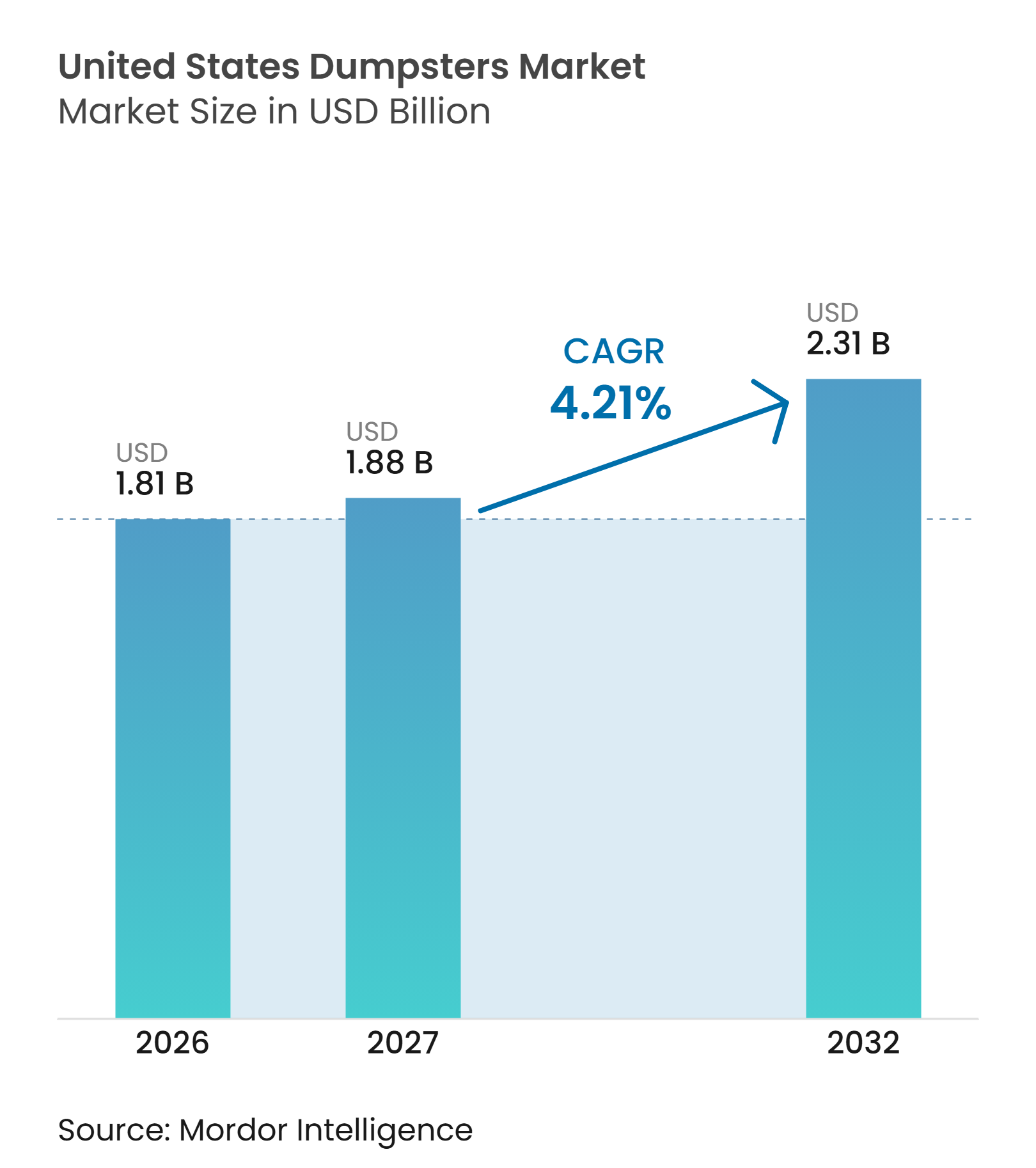
The United States Dumpsters Market size is expected to increase from USD 1.81 billion in 2026 to USD 1.88 billion in 2027 and reach USD 2.31 billion by 2032, growing at a CAGR of 4.21% over 2027-2032.
Construction activity, commercial waste volumes, and requirements for separated waste streams are supporting demand for containers beyond normal fleet replacement. United States construction spending totaled USD 2,164.4 billion in 2025, while public construction reached USD 516.8 billion and increased 3.6% from 2024, maintaining a substantial base of job-site demand for the United States dumpsters market. Federal spending on highways, water, and transit work is expected to keep public projects active through 2027. Container makers are responding through domestic capacity additions, shorter delivery times, and products that meet existing lifting and safety standards. At the same time, volatile steel inputs and digital rental platforms are changing the cost and distribution conditions for the United States dumpsters market.
Key Report Takeaways
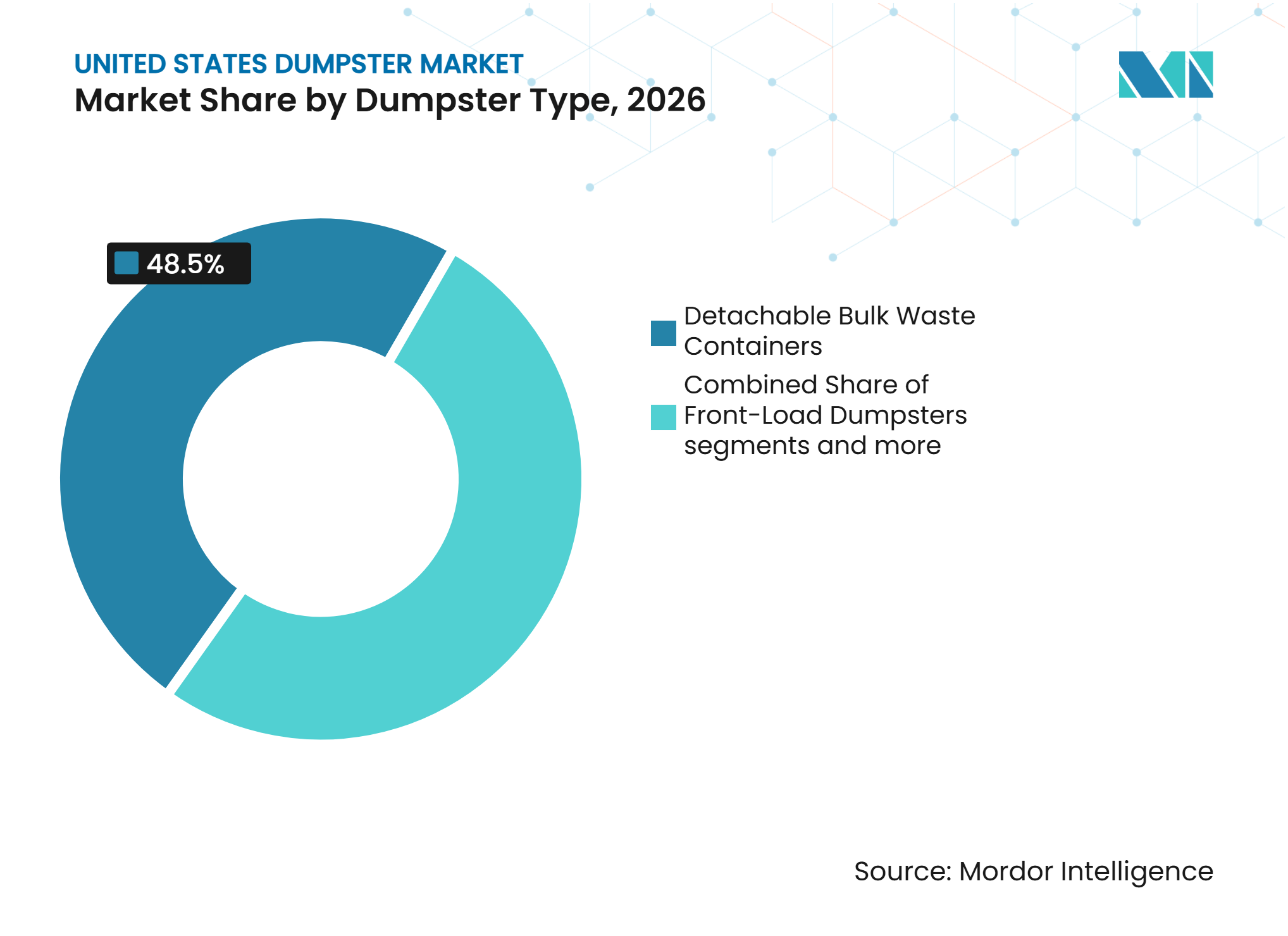
- By dumpster type, detachable bulk waste containers held 48.5% of the United States dumpsters market share in 2026 and are projected to register the highest CAGR at 4.5% through 2032.
- By end-user/buyer, waste collection and hauling companies held 52.6% of the United States dumpsters market size in 2026, while construction, demolition, and infrastructure contractors is projected to register the highest CAGR at 4.5% through 2032.
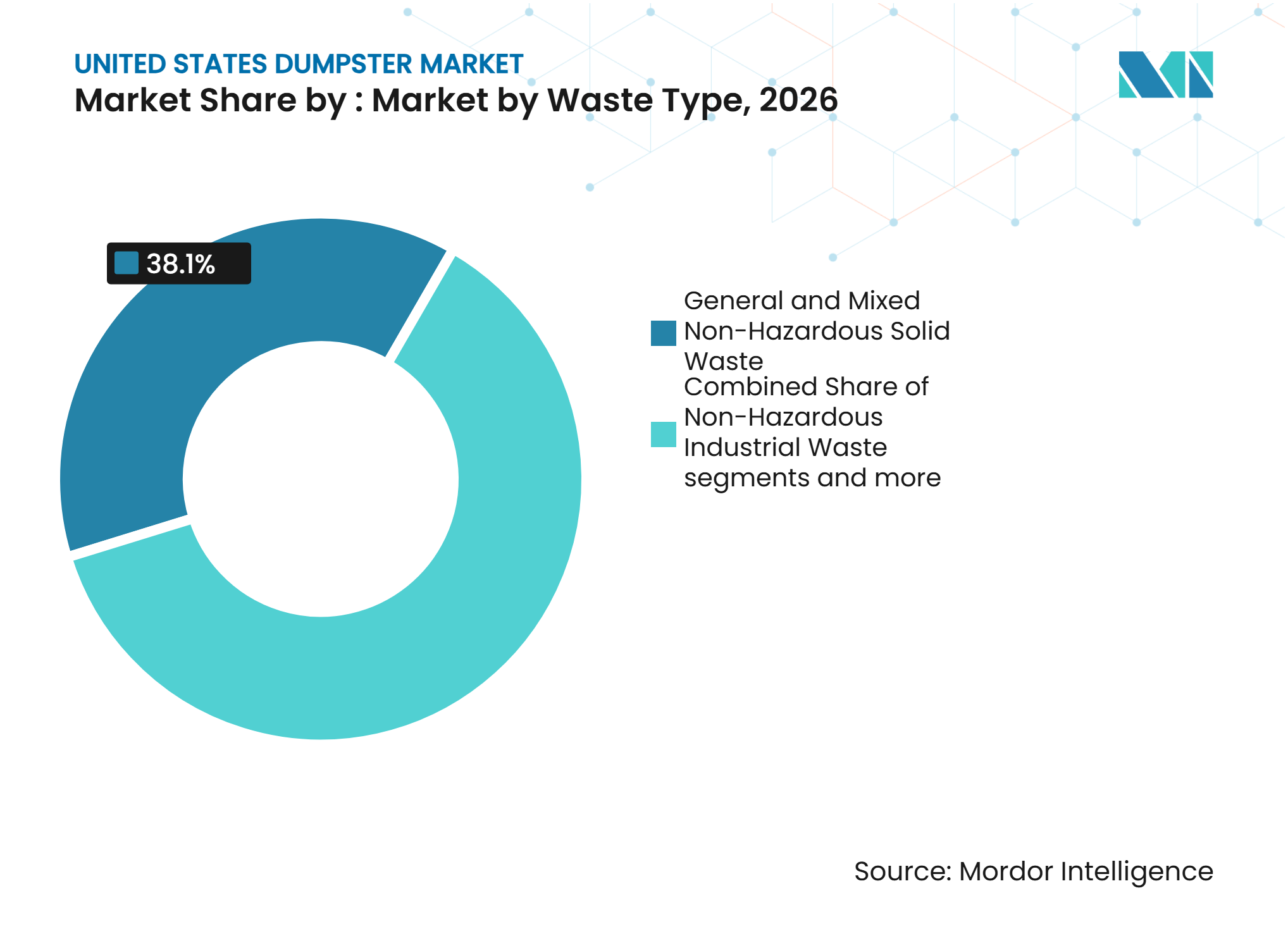
- By waste type, general and mixed non-hazardous solid waste held a 38.1% share in 2026, while organic and green waste is projected to register the highest CAGR at 8.3% through 2032.
- By bin size, 6-to-10 cubic yard containers held a 21.9% share in 2026, while containers above 40 cubic yards are projected to register the highest CAGR at 4.6% through 2032.
Note: Market numbers in this report are based on Mordor Intelligence's proprietary estimation framework, which combines nine months of actuals with Q4 projections for base year 2026.
Market Trends and Insights
Drivers Impact Analysis of United States Dumpsters Market*
| Driver | (~) % Impact on CAGR Forecast | Geographic Relevance | Impact Timeline |
|---|---|---|---|
| Construction and Demolition Waste Intensity | +1.4% | National, with early gains in Sun Belt states and Midwest manufacturing corridors | Short term (≤ 2 years) |
| Commercial and Municipal Container Replacement | +0.9% | National, concentrated in Northeast, Midwest, and Southeast urban centers | Medium term (2-4 years) |
| Organics and Recycling Source-Separation Requirements | +0.7% | Highest in California, Connecticut, Maine, and Maryland | Medium term (2-4 years) |
| Smart-Container and Asset-Tracking Adoption | +0.5% | National, led by major transit and metro systems on both coasts | Long term (≥ 4 years) |
| Direct-to-Consumer Roll-Off Procurement | +0.4% | National, strongest in Sun Belt expansion metros | Short term (≤ 2 years) |
| Localized Domestic Manufacturing and Shorter Lead Times | +0.3% | Southeast, Mid-Atlantic, and Midwest manufacturing hubs | Medium term (2-4 years) |
| Source: Mordor Intelligence | |||
Construction and Demolition Waste Intensity
Construction spending in 2025 totaled USD 2,164.4 billion, with public construction at USD 516.8 billion, up 3.6% from 2024.[1] Transportation construction increased 5.3% during the year, supporting demand at highway and transit sites that need large, removable containers. The United States Environmental Protection Agency reported 600.3 million tons of construction and demolition debris in its latest national data, more than double the municipal solid waste volume. Demolition accounted for 94.5% of that debris volume, while new construction produced 5.5%, linking demand more closely to renovation and teardown work than to new housing starts.[2] As federally supported road and bridge projects progress, work in the Mountain West and Southeast supports use of cable-hoist and hook-lift containers in the 20-to-40 cubic yard range. This activity provides a continuing demand base for the United States dumpster market.
Commercial and Municipal Container Replacement
Waste hauling contracts commonly place front-load fleets on replacement cycles lasting 7 to 12 years. Municipalities moving from manual rear-load collection to automated side-load collection must replace containers that do not fit the revised equipment. ANSI Z245.60 sets dimensional requirements for lifting interfaces, including sleeve positions, pocket heights, and trunnion bar specifications. Republic Services introduced fees for overfilled or contaminated containers in 2023 and reported more than USD 60 million in incremental technology-related revenue in the first year of that program. The program increases the value placed on sealed and properly sized containers by commercial customers. The City of Whittier awarded Athens Services an exclusive franchise in September 2025, creating a citywide transition from the previous two-operator arrangement and a concentrated replacement event.
Organics and Recycling Source-Separation Requirements
Connecticut began enforcing its Commercial Organics Recycling Law in January 2025 for businesses generating 26 or more tons of source-separated organic material annually.[3] Reporting requirements began in March 2025, making container selection relevant to both collection and recordkeeping. Maine enacted LD1065 in June 2025, establishing phased diversion requirements that begin in 2030. Maryland requires qualifying generators of food residuals to collect and divert those materials separately under COMAR 26.04.13. California also requires jurisdictions to provide organic waste collection under SB 1383. These rules favor locked-lid, covered, color-coded, and split-compartment containers for the United States dumpsters market.
Smart-Container and Asset-Tracking Adoption
Smart-container systems use fill-level sensors and radio-frequency identification to show when containers need attention. Bay Area Rapid Transit deployed Sensoneo sensors on dumpsters and roll-on and roll-off containers in 2025 across stations and maintenance facilities. The deployment used CAT-M cellular connectivity to provide current fill-level data to collection teams. BART carried 50.7 million passenger trips in 2024, giving the deployment relevance for large transit systems. Sensor data can reduce unneeded collection runs and permit schedule-on-demand operations instead of fixed pickup intervals. RFID installed in container sidewalls can also support proof-of-service records in municipal contracts. The technology creates an upgrade path for fleet operators in the United States dumpsters market.
Restraints Impact Analysis of United States Dumpsters Market*
| Restraint | (~) % Impact on CAGR Forecast | Geographic Relevance | Impact Timeline |
|---|---|---|---|
| Steel and Resin Cost Volatility | -0.7% | National | Short term (≤ 2 years) |
| Hauler Fleet Standardization and Long Replacement Cycles | -0.5% | National | Long term (≥ 4 years) |
| Container Logistics and Freight Inefficiency | -0.4% | Rural and remote markets, Midwest, and Mountain West | Medium term (2-4 years) |
| Municipal Procurement and Specification Lock-In | -0.3% | Northeast and Midwest urban centers | Long term (≥ 4 years) |
| Source: Mordor Intelligence | |||
Steel and Resin Cost Volatility
Steel is the principal material cost in steel dumpster fabrication. The Producer Price Index for steel mill products averaged 298.4 in 2025 and reached 388.6 in preliminary September 2026 data. Fixed-price supply contracts can leave fabricators exposed when input prices rise after bids are accepted. Wastequip added a 43,000-square-foot steel production facility in Salisbury, North Carolina, in June 2026 to expand its container and compactor manufacturing capacity. Local supply arrangements and internal fabrication can limit some exposure to steel price movements. High-density polyethylene resin also raises costs for plastic organics containers and carts, creating separate pressure for polymer-based products.
Hauler Fleet Standardization and Long Replacement Cycles
Haulers favor containers that operate across mixed truck fleets, which can preserve installed specifications for long periods. ANSI Z245.60 compatibility requirements cover features needed for safe use with front-load and automated side-load collection trucks. Front-load containers in municipal contracts often remain in service for 10 to 15 years. The Solid Waste Association of North America identifies an economically efficient replacement point of 7 years for collection equipment, although local budget decisions can defer replacements. Delayed purchases slow adoption of containers designed for sensors and separated collection. Freight inefficiency in rural and remote areas adds to delivery costs for bulky fabricated units. Municipal bidding rules can also retain established specifications for several contract cycles.
*Our forecasts treat driver/restraint impacts as directional, not additive. The impact forecasts reflect baseline growth, mix effects, and variable interactions.
United States Dumpsters Market Segment Analysis
By Dumpster Type:
Detachable Containers Define Both Volume and GrowthDetachable bulk waste containers held 48.5% of the United States dumpsters market share in 2026 and are projected to expand at a 4.5% CAGR through 2032. The category includes roll-off, hook-lift, cable-hoist, and rail systems used in construction, demolition, and industrial work. Cable-hoist and rail roll-off containers serve transfer stations, large demolition projects, and material recovery facilities. Hook-lift containers allow a single truck to handle different container types, which can reduce capital needs for mid-sized haulers. Temporary job-site collection needs and high-density material streams support the United States dumpsters market size for detachable containers.
Front-load dumpsters are the second-largest type and operate on commercial routes serving retail centers, multifamily properties, and institutions. Rear-load containers remain suitable for dense urban alleys and locations where front-loading equipment cannot work safely. Skip-lift and chain-lift units remain relevant for city-center and transfer applications. Compaction containers address customers seeking fewer collections and lower haul frequency. Wastequip offers the Ultimate Container in 20, 30, and 40 cubic yard configurations with a narrower profile that permits shipping with doors installed. The design is intended to reduce preparation time and delivery costs while maintaining ANSI Z245.30-compatible specifications.



By End-User/Buyer:
Haulers Lead, Contractors AccelerateWaste collection and hauling companies held 52.6% of end-user demand in 2026. These companies buy standardized front-load and rear-load units for route-based fleets and maintain them over extended operating periods. Construction, demolition, and infrastructure contractors are projected to expand at a 4.5% CAGR through 2032. Their purchases focus on temporary detachable containers needed at active job sites. The United States dumpsters market share held by haulers reflects their central role in placing, servicing, and replacing containers.
Dumpster rental and leasing companies expand fleets to serve direct online booking and local delivery models. Sourgum launched services in Nashville in July 2025, connecting customers to local haulers through instant quotes and automated scheduling. Municipalities and public waste authorities remain buyers, but multi-year contracts and competitive bidding can slow adoption of different product designs. Commercial and institutional customers include retail, food service, healthcare, and real estate operators that increasingly need containers for separate streams. Industrial and manufacturing customers, recycling facilities, and material recovery operations support demand for heavy-duty units above 40 cubic yards. Their waste streams include scrap metal, construction aggregates, and industrial process waste.
By Waste Type:
Organics Surge Redefines Container SpecificationsGeneral and mixed non-hazardous solid waste held a 38.1% share by waste type in 2026. It remains present across commercial, municipal, and residential collection routes. Source-separation rules are moving part of this material into dedicated organic and recyclable streams. Construction and demolition waste is the second-largest category. The Environmental Protection Agency reported 600.3 million tons of construction and demolition debris in its latest national data.
Organic and green waste is projected to grow at an 8.3% CAGR from 2027 to 2032. Maryland regulations require qualifying food-residual generators located within 30 miles of a qualifying recycler to collect and divert the material separately. These requirements support the use of covered, lockable, and odor-resistant containers. Recyclable materials such as paper, cardboard, plastic, glass, and metal can use split-compartment units. Wastequip offers the CONFAB Split Dumpster with separate compartments, locking, and dumping functions. Non-hazardous industrial waste and bulky cleanout material continue to serve separate facility-management and periodic cleanout needs in the United States dumpster market.

By Bin Size:
Mid-Range Leads While Oversized Segments Build MomentumThe 6-to-10 cubic yard range held 21.9% of demand in 2026. These containers are widely used for commercial front-load routes serving retail, food service, and multifamily properties. Their installed base reflects regular commercial waste generation across United States cities. The 3-to-6 cubic yard range serves smaller businesses and urban alleys. Containers up to 3 cubic yards support specialized uses, including indoor compactor containers and dense sites where larger units do not fit.
Containers above 40 cubic yards are projected to grow at a 4.6% CAGR from 2027 to 2032. Large demolition work, industrial scrap collection, and job-site material sorting support that expansion. Containers in the 10-to-20 and 20-to-30 cubic yard ranges remain central to residential renovation, cleanouts, and mid-sized remodels. The 30-to-40 cubic yard range serves major construction and demolition work. Marathon Equipment offers OC Octagon compaction containers in 30- and 40-cubic-yard formats with 80,000 lbf compaction force. The equipment is designed to increase payload density and reduce collection frequency for high-volume customers.
Geography Analysis
Northeast
Northeast demand is supported by urban commercial routes, municipal collection contracts, and tighter source-separation requirements. Connecticut began enforcing its Commercial Organics Recycling Law in January 2025 for businesses generating 26 or more tons of source-separated organic material annually. This requirement increases the need for covered, lockable, and clearly designated containers at commercial locations. Municipal procurement can remain deliberate because contracts often specify container dimensions and replacement schedules. These conditions favor suppliers that can meet established lifting-interface and safety requirements.
Southeast and Sun Belt
The Southeast and Sun Belt are key locations for roll-off demand because of construction-intensive activity and expanding metropolitan areas. United States construction spending reached USD 2,164.4 billion in 2025, while public construction increased 3.6% to USD 516.8 billion. Highway, water, and transportation projects support demand for detachable containers at active job sites. Wastequip opened a 43,000-square-foot steel manufacturing facility in Salisbury, North Carolina, in June 2026 to serve Southeast and Mid-Atlantic customers with added container and compactor capacity. Regional production can shorten delivery times for construction, hauling, and waste-service customers.
Midwest and Mountain West
Midwest manufacturing corridors and Mountain West infrastructure projects support demand for heavy-duty roll-off, hook-lift, and cable-hoist containers. Construction and demolition debris totaled 600.3 million tons in the latest national Environmental Protection Agency data. The United States dumpster market size in these areas is supported by demolition, retrofit, industrial scrap, and material-sorting work. Rural delivery distances can raise freight costs for bulky fabricated units, making regional inventory and production capacity important. In wildlife-sensitive Mountain West and Pacific Northwest locations, Toter’s 96-gallon automated bear-resistant carts received Interagency Grizzly Bear Committee certification in March 2025.
Competitive Landscape
Market Concentration
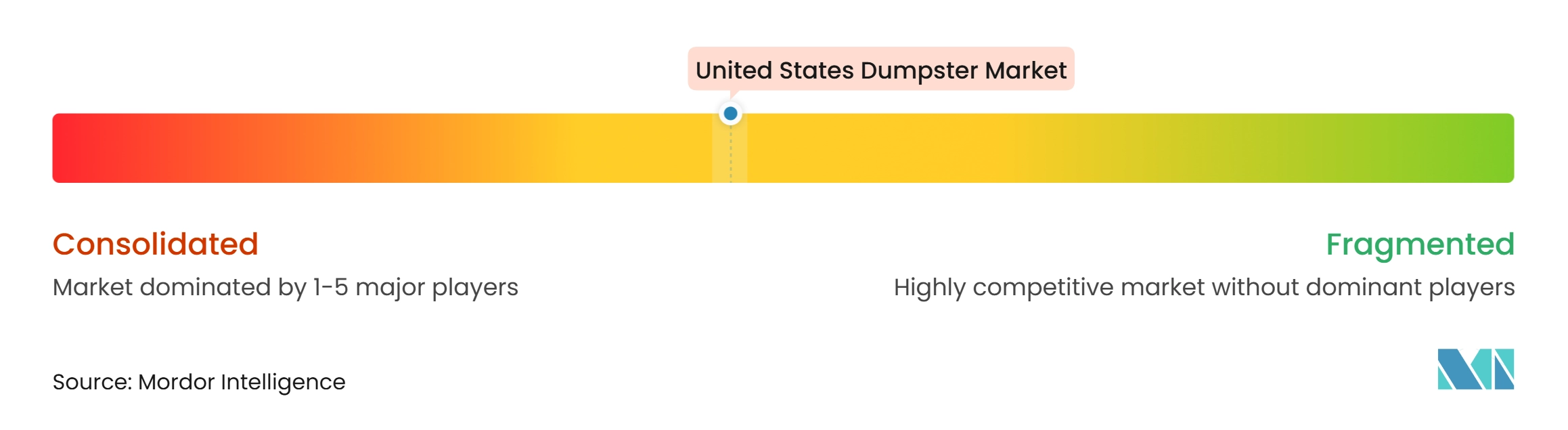
The United States dumpsters market exhibits a medium level of market concentration. Wastequip is one of the leading United States fabricators with products across roll-off, hook-lift, refuse collection vehicles, carts, and steel dumpsters. Its portfolio includes Galbreath, AMREP, Toter, and CONFAB brands, covering several container categories. The company expanded domestic production capacity with the June 2026 opening of its 43,000-square-foot Salisbury steel facility. Its Ultimate Container line uses a shipping-optimized width and is available in 20, 30, and 40 cubic yard configurations. These actions focus on delivery efficiency, domestic capacity, and equipment compatibility. The United States dumpsters market includes competition based on lead time, regional service, customization, and the ability to meet established safety requirements.
Large haulers influence procurement because they operate substantial container fleets. Republic Services used camera technology to identify overfilled containers and reported more than USD 60 million in incremental technology-related revenue in its first year. Its approach raises the importance of container condition and correct capacity selection for commercial customers. These local contract transitions can create substantial placement, replacement, and redistribution needs. Manufacturers benefit when they can supply compatible equipment during these transitions.
Smaller manufacturers compete with regional delivery coverage and tailored fabrication. Marathon Equipment differentiates through its OC Octagon compaction-container design. Rental platforms can shift customer acquisition toward online quotes, transparent pricing, and local-hauler networks. Sourgum’s Nashville launch in July 2025 is an example of this distribution approach. ANSI-compatible designs remain important because lifting interfaces must operate safely with existing fleet equipment. The competitive position of the United States dumpsters market therefore depends on both fabricated-product capability and the service models through which equipment reaches end users.
United States Dumpsters Industry Leaders
-
Wastequip, LLC
-
Iron Container, LLC
-
E-Pak Manufacturing LLC
-
Rehrig Pacific Company
-
Cascade Engineering Inc.
- *Disclaimer: Major Players sorted in no particular order
United States Dumpsters Market Companies Covered in this Report
- Wastequip, LLC
- Iron Container, LLC
- Thompson Fabricating, Inc.
- E-Pak Manufacturing, LLC
- Rehrig Pacific Company
- Cascade Engineering, Inc.
- Otto Environmental Systems North America, Inc.
- SSI SCHAEFER Group
- SULO Group GmbH
- IPL Plastics Inc.
- Durham Manufacturing Company
- American Container Company
- Roll-Offs USA
- Pak-Mor Ltd.
- Marathon Equipment Company
- Perfection Equipment, Inc.
Recent Industry Developments in United States Dumpsters Market
- October 2026: Wastequip published finalized product literature for the Ultimate Container line in 20-, 30-, and 40-cubic-yard configurations, featuring a shipping-optimized narrower width, integrated hook-lift compatibility, and reinforced top-cap corners designed to reduce field damage in high-turnover roll-off operations, with ANSI Z245.30-compatible specifications. The design allows containers to be shipped with doors installed, cutting logistics preparation time and improving delivery efficiency for East Coast customers.
- June 2026: Wastequip opened a 43,000-square-foot steel manufacturing facility in Salisbury, North Carolina, adding front-load dumpster, roll-off container, and compactor production capacity within the existing AMREP operation to serve Southeast and Mid-Atlantic markets with improved lead times and distribution efficiency.
- September 2025: Athens Services was awarded an exclusive franchise agreement in Whittier, California, beginning in November 2025 and covering residential, multifamily, and commercial accounts previously split between 2 operators. New Athens containers were scheduled for delivery in January 2026.
- July 2025: Sourgum launched services in the Nashville, Tennessee, metropolitan area, extending its instant-quote and automated-scheduling roll-off rental platform into the region.
United States Dumpsters Market Report Scope
The United States Dumpsters Market Report is segmented by Dumpster Type (Front-Load Dumpsters, Rear-Load Dumpsters, and more), by End-User/Buyer (Waste Collection and Hauling Companies, and more), by Waste Type (General and Mixed Non-Hazardous Solid Waste, Construction and Demolition (C&D) Waste, and more), and by Bin Size (Up to 3 Cubic Yards, and more). The Market Forecasts are Provided in Terms of Value (USD).
Segmentation Overview
| Front-Load Dumpsters | |
| Rear-Load Dumpsters | |
| Detachable Bulk Waste Containers | Cable-Hoist / Rail Roll-Off Containers |
| Hook-Lift Containers | |
| Skip-Lift / Chain-Lift Containers | |
| Other Detachable Container Configurations | |
| Other Dumpster Types |
| Waste Collection and Hauling Companies | |
| Dumpster Rental and Leasing Companies | |
| Municipalities and Public Waste Authorities | |
| Construction, Demolition and Infrastructure Contractors | |
| Commercial and Institutional Establishments | Retail and Shopping Centers |
| Hospitality, Restaurants and Food Service | |
| Offices and Commercial Buildings | |
| Healthcare and Educational Institutions | |
| Real Estate and Facility Management Companies | |
| Other Commercial and Institutional Establishments | |
| Industrial and Manufacturing Companies | |
| Recycling and Material Recovery Companies | |
| Other Direct Buyers |
| General and Mixed Non-Hazardous Solid Waste |
| Construction and Demolition (C&D) Waste |
| Recyclable Waste (Paper, Cardboard, Plastics, Glass and Metals) |
| Organic and Green Waste (Food, Yard, Landscape and Horticultural Waste) |
| Non-Hazardous Industrial Waste |
| Bulky Waste and Cleanout Materials |
| Other Non-Hazardous Waste |
| Up to 3 Cubic Yards |
| 3 to 6 Cubic Yards |
| 6 to 10 Cubic Yards |
| 10 to 20 Cubic Yards |
| 20 to 30 Cubic Yards |
| 30 to 40 Cubic Yards |
| Above 40 Cubic Yards |
| By Dumpster Type | Front-Load Dumpsters | |
| Rear-Load Dumpsters | ||
| Detachable Bulk Waste Containers | Cable-Hoist / Rail Roll-Off Containers | |
| Hook-Lift Containers | ||
| Skip-Lift / Chain-Lift Containers | ||
| Other Detachable Container Configurations | ||
| Other Dumpster Types | ||
| By End-User/Buyer | Waste Collection and Hauling Companies | |
| Dumpster Rental and Leasing Companies | ||
| Municipalities and Public Waste Authorities | ||
| Construction, Demolition and Infrastructure Contractors | ||
| Commercial and Institutional Establishments | Retail and Shopping Centers | |
| Hospitality, Restaurants and Food Service | ||
| Offices and Commercial Buildings | ||
| Healthcare and Educational Institutions | ||
| Real Estate and Facility Management Companies | ||
| Other Commercial and Institutional Establishments | ||
| Industrial and Manufacturing Companies | ||
| Recycling and Material Recovery Companies | ||
| Other Direct Buyers | ||
| By Waste Type | General and Mixed Non-Hazardous Solid Waste | |
| Construction and Demolition (C&D) Waste | ||
| Recyclable Waste (Paper, Cardboard, Plastics, Glass and Metals) | ||
| Organic and Green Waste (Food, Yard, Landscape and Horticultural Waste) | ||
| Non-Hazardous Industrial Waste | ||
| Bulky Waste and Cleanout Materials | ||
| Other Non-Hazardous Waste | ||
| By Bin Size (Capacity) | Up to 3 Cubic Yards | |
| 3 to 6 Cubic Yards | ||
| 6 to 10 Cubic Yards | ||
| 10 to 20 Cubic Yards | ||
| 20 to 30 Cubic Yards | ||
| 30 to 40 Cubic Yards | ||
| Above 40 Cubic Yards | ||
Key Questions Answered in the Report
What is the projected value of the United States dumpsters market by 2032?
The United States dumpsters market is projected to reach USD 2.31 billion by 2032, from USD 1.81 billion in 2026, at a 4.21% CAGR.
Which dumpster type is expanding the fastest in the United States?
Detachable bulk waste containers are projected to grow at a 4.5% CAGR through 2032 and held a 48.5% share in 2026.
Why are organic waste containers gaining demand?
State requirements for separate collection support demand for covered, lockable, and split-compartment containers for food and yard waste.
Which buyers account for the greatest demand for dumpsters?
Waste collection and hauling companies held 52.6% of end-user demand in 2026, while contractors had the highest projected growth rate at 4.5%.
What container size has the strongest growth outlook?
Containers above 40 cubic yards are projected to grow at a 4.6% CAGR through 2032, supported by demolition and industrial applications.
How do steel prices affect dumpster manufacturers?
Steel is a major fabrication input, and higher price movements can squeeze margins under fixed-price supply agreements.