
United States Current Transformer Market Size and Share
Market Overview
| Study Period | 2022 - 2032 |
|---|---|
| Forecast Data Period | 2027 - 2032 |
| Base Year Market Size (2026) | USD 1.55 Billion |
| Market Size (2027) | USD 1.68 Billion |
| Market Size (2032) | USD 2.57 Billion |
| Growth Rate (2027 - 2032) | 8.86 % |
| Market Concentration | Medium |
Major Players *Disclaimer: Major Players sorted in no particular order Image © Mordor Intelligence. Reuse requires attribution under CC BY 4.0. | |
United States Current Transformer Market Analysis by Mordor Intelligence
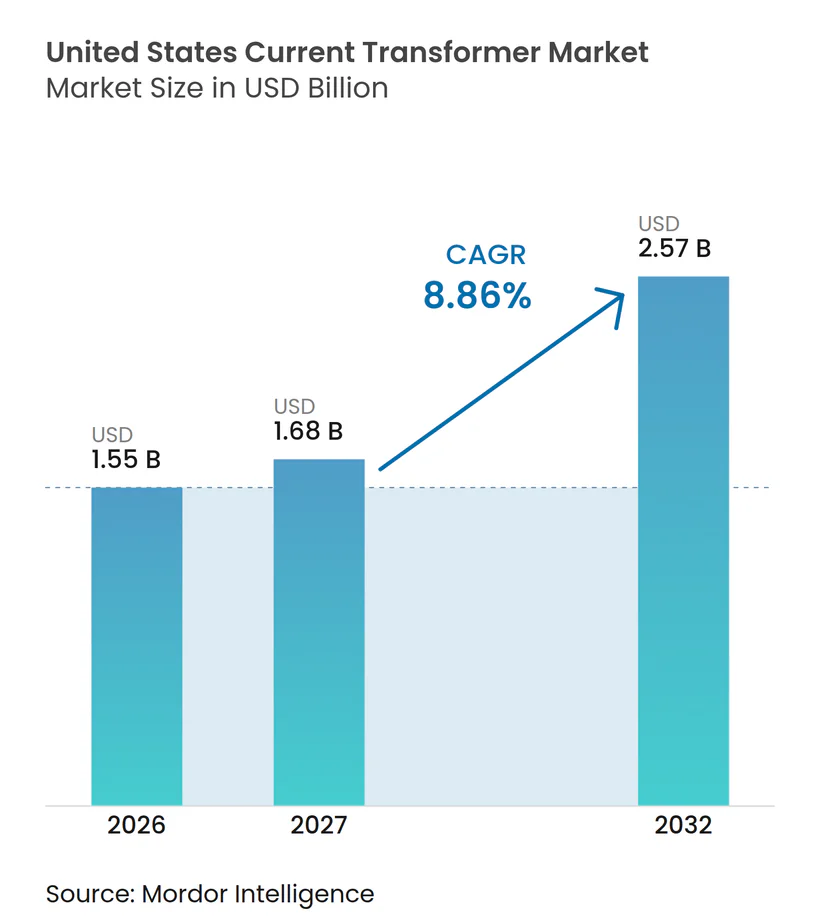
The United States Current Transformer Market size is expected to increase from USD 1.55 billion in 2026 to USD 1.68 billion in 2027 and reach USD 2.57 billion by 2032, growing at a CAGR of 8.86% over 2027-2032. The United States current transformer market is being shaped by replacement needs across aging substations, new generation connections, and higher electricity demand from data centers. The active U.S. interconnection queue contained 2,061 GW of generation and storage capacity at the end of 2025, creating a large pipeline for metering and protection equipment at project connection points.[1] U.S. data center electricity use could reach 6.7% to 12% of national electricity consumption by 2028, which raises demand for accurate measurement across utility and on-site power systems.[2] Suppliers with switchgear, protection, and digital substation portfolios can include current transformers in larger project packages, while smaller specialists compete through custom products and speed of certification. Material availability, calibration capacity, and changing fault-current conditions in renewable-heavy grids will influence procurement decisions during the forecast period.
Key Report Takeaways
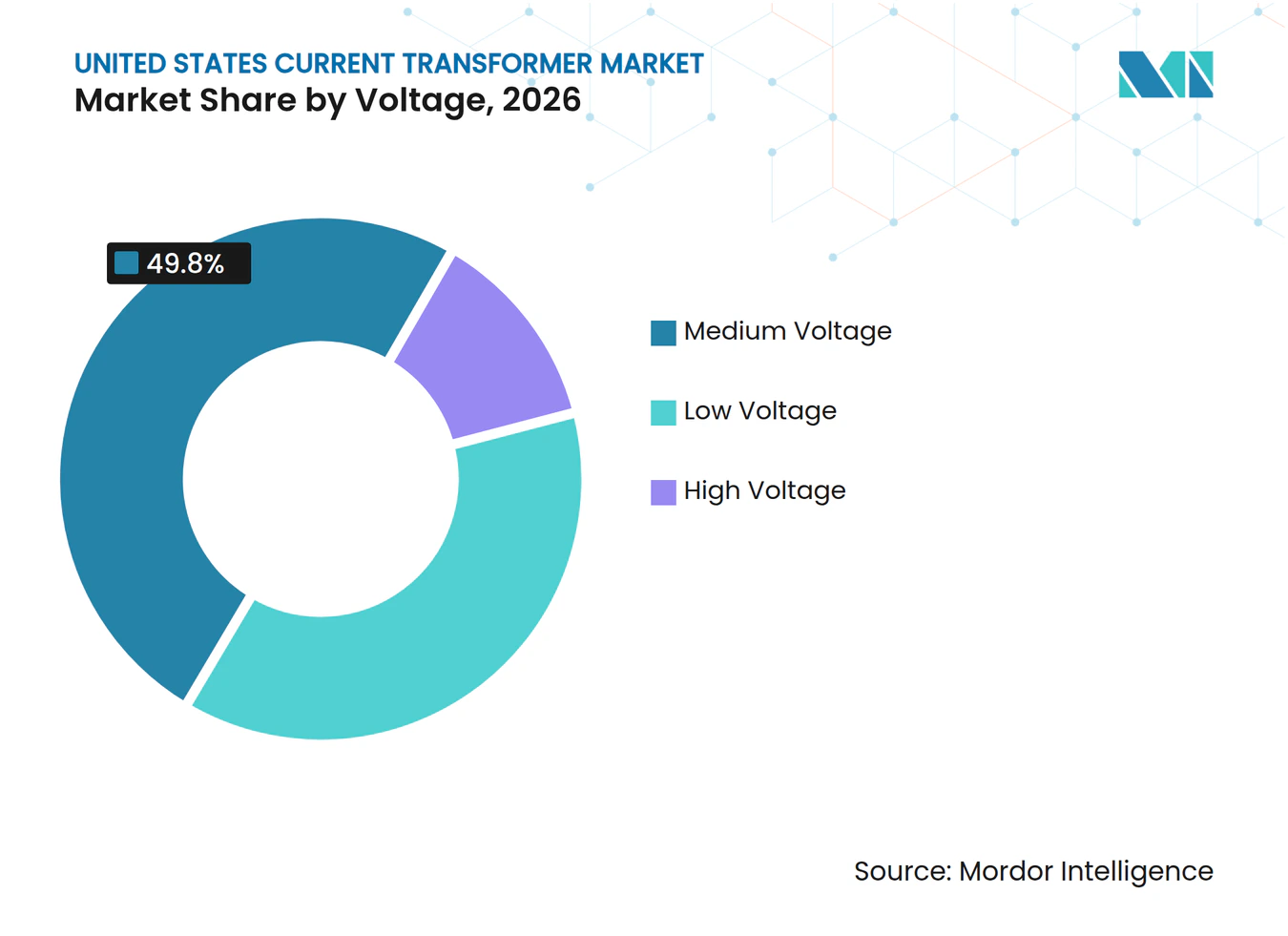
- By voltage, medium voltage held 49.8% of the United States current transformer market share in 2026, while high voltage is forecast to grow at a 9.5% CAGR through 2032.
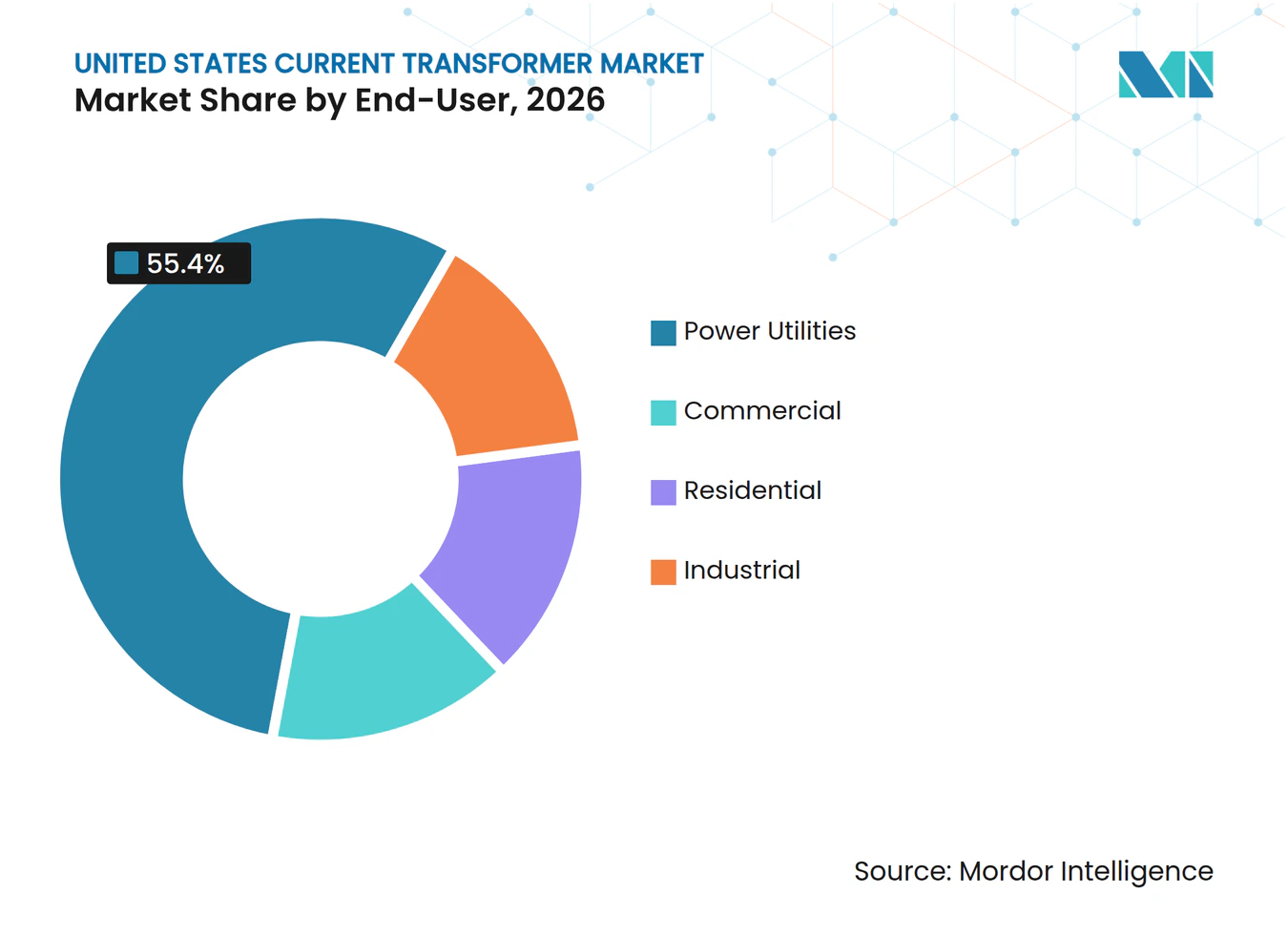
- By end user, power utilities held 55.4% of the United States current transformer market share in 2026 and are forecast to grow at a 9.9% CAGR through 2032.
Note: Market numbers in this report are based on Mordor Intelligence's proprietary estimation framework, which combines nine months of actuals with Q4 projections for base year 2026.
United States Current Transformer Market Trends and Insights
Drivers Impact Analysis*
| Driver | (~) % Impact on CAGR Forecast | Geographic Relevance | Impact Timeline |
|---|---|---|---|
| Grid Modernization and Substation Replacement | +2.8% | National, with intensity in PJM and ERCOT | Medium term (2-4 years) |
| Renewable and Battery Interconnection Metering | +1.9% | ERCOT, Non-ISO West, CAISO | Short term (≤ 2 years) |
| Digital Substations and Advanced Metering Adoption | +1.3% | National, with early gains in California, Arizona, Texas | Medium term (2-4 years) |
| Data Center and Industrial Load Monitoring | +1.4% | National, concentrated in Texas, Virginia, Georgia | Medium term (2-4 years) |
| Retrofit Demand for No-Outage Split-Core Installation | +0.5% | National | Medium term (2-4 years) |
| Wide-Bandwidth Measurement for Inverter-Rich Fault Profiles | +0.4% | CAISO, ERCOT, MISO | Long term (≥ 4 years) |
| Source: Mordor Intelligence | |||
Grid Modernization and Substation Replacement
The United States current transformer market benefits from utility investment in substation replacement and grid modernization. Aging transmission and distribution assets support replacement demand for protection and metering equipment. Current transformer replacements often accompany upgrades to relays, breakers, and control systems at existing substations. These projects can require higher accuracy classes than those installed under older protection practices. FirstEnergy announced a USD 950 million PJM-selected modernization project in Ohio and Pennsylvania during March 2026, covering substation rebuilds and high-voltage line upgrades. Reliability requirements also sustain investment because utilities must maintain safe and dependable system operation while they replace aging assets.
Renewable and Battery Interconnection Metering
The United States current transformer market receives additional demand from renewable generation and battery projects entering utility interconnection processes. The national queue of 2,061 GW at the end of 2025 indicates that large volumes of proposed generation and storage still require connection studies, construction, or both.[3] Interconnection points need current transformers for revenue metering, protection, and control functions. Battery projects also need metering that can accurately distinguish charging and discharging conditions. Cluster processing reduces the time between completed agreements and construction activity for selected projects, which can tighten delivery schedules for equipment manufacturers. Withdrawn projects may still have supported limited equipment demand during feasibility work or partial site development.
Digital Substations and Advanced Metering Adoption
Digital substation programs continue to support conventional current transformer demand in the United States current transformer market. Digital architecture uses process-bus equipment and merging units, but many designs still require high-accuracy conventional current transformers at key measurement points. LADWP began advanced metering deployments in fall 2025, adding a new source of revenue-grade meter infrastructure demand. San Diego Gas & Electric (SDG&E) filed its Smart Meter 2.0 application for a USD 825 million program covering 2024 through 2031. These programs can move high-accuracy measurement requirements from transmission systems into distribution networks. State utility commission schedules give suppliers more visibility over the timing of major meter and supporting equipment purchases.
Data Center and Industrial Load Monitoring
Data center expansion is creating a separate demand stream for the United States current transformer market. Lawrence Berkeley National Laboratory (LBNL) projects that data centers could account for as much as 12% of U.S. electricity consumption by 2028 under its high-growth case. A large campus needs current transformers at utility billing points, medium-voltage feeders, internal distribution panels, and power-quality monitoring locations. Eaton and Siemens Energy formalized a June 2025 collaboration to provide modular power infrastructure for data centers.[4] The collaboration includes medium- and low-voltage equipment, making metering specifications part of the initial site design. Suppliers with established service relationships in Texas, Virginia, and Georgia are positioned to respond to concentrated load growth in those areas.
Restraints Impact Analysis*
| Restraint | (~) % Impact on CAGR Forecast | Geographic Relevance | Impact Timeline |
|---|---|---|---|
| High Retrofit, Certification, and Calibration Costs | -0.8% | National | Medium term (2-4 years) |
| Copper, Electrical-Steel, and Insulation-Material Volatility | -1.0% | Global, affecting all U.S. manufacturers | Long term (≥ 4 years) |
| CT Saturation Under Inverter-Dominated Fault Conditions | -0.5% | CAISO, ERCOT, MISO | Long term (≥ 4 years) |
| Long Utility Qualification Cycles and Limited Calibration Capacity | -0.4% | National | Long term (≥ 4 years) |
| Source: Mordor Intelligence | |||
High Retrofit, Certification, and Calibration Costs
Retrofit costs limit some demand within the United States current transformer market. Replacing an instrument transformer in an energized substation can require either a split-core installation or a planned outage with circuit changes. Split-core options can involve accuracy tradeoffs, while planned outages require coordination among utilities, contractors, and customers. Calibration against recognized standards adds cost and may extend the project schedule. Smaller commercial and industrial users are more sensitive to these costs because their projects have fewer units over which to spread planning expenses. Utility projects are less exposed because qualifying investments can often be recovered through regulated rate structures.
Copper, Electrical-Steel, and Insulation-Material Volatility
Input-cost volatility creates pressure for manufacturers supplying the United States current transformer market. Copper, electrical steel, and insulation materials account for a substantial portion of instrument-transformer manufacturing costs. Fixed-price supply agreements make it difficult for suppliers to recover sudden increases in material prices. Domestic sourcing options can also be limited for specialized electrical steel, which may increase exposure to import availability and trade measures. Larger companies can use scale, establish supply agreements, or hedging methods to manage these risks. Smaller specialists may face thinner margins when they cannot revise prices during a multi-year utility contract.
*Our forecasts treat driver/restraint impacts as directional, not additive. The impact forecasts reflect baseline growth, mix effects, and variable interactions.
Segment Analysis
By Voltage: Medium Voltage Holds the Largest Position, While High Voltage Grows Faster
Medium voltage held 49.8% of the United States current transformer market size in 2026. The segment supports distribution substations, automated feeder systems, advanced metering infrastructure, and industrial facilities using 12 kV to 35 kV switchgear. Large utility metering programs in California, Texas, and New York support replacement demand across this installed base. Distribution projects increasingly require more precise current measurements for billing and system management. Low voltage products serve residential submetering and distributed energy monitoring, where compact designs and simple installation are important. Compliance with International Electrotechnical Commission (IEC) 61869-2 and American National Standards Institute (ANSI) C57.13 remains important across voltage classes because utilities and industrial buyers require qualified products and credible calibration arrangements.
High voltage is projected to grow at a 9.5% CAGR through 2032, exceeding the overall United States current transformer market rate. This segment serves transmission substations and large generation interconnections that require equipment for 115 kV to 765 kV systems. New transmission projects and the replacement cycle for station-class equipment support this demand. Grid operators are also seeking products that can meet modern measurement and protection needs in wide-area monitoring systems. GE Vernova updated its RevenueSense and SUPERBUTE product materials during 2025, including specified Institute of Electrical and Electronics Engineers (IEEE) C57.13 Class 0.15 performance for revenue-metering applications. Suppliers able to meet tighter accuracy specifications can compete for projects where legacy equipment no longer meets updated operating practices.



By End User: Power Utilities Lead in Scale and Growth
Power utilities held 55.4% of United States current transformer market share in 2026. Utilities use current transformers from generation tie lines to distribution feeders because protection, control, and settlement depend on accurate current data. Transmission expansion, grid modernization, advanced metering, and renewable connections are strengthening demand at the same time. New and refurbished substations require current transformers across protection, metering, and control zones. Utility purchasing is often based on approved product lists, reliability records, and proven field support. This creates an advantage for suppliers that have existing utility qualifications and available service coverage.
Power utilities are also projected to grow at a 9.9% CAGR through 2032, making them the fastest-growing end-user group in the United States current transformer market. Industrial customers represent the next large demand group, supported by manufacturing facilities, cogeneration sites, and data center campuses. Commercial customers use current transformers for building energy management, campus monitoring, and utility account submetering. Residential demand remains smaller because utilities usually own the main metering equipment at service connections. Residential batteries and virtual power plant programs can support a later demand layer for smaller metering products. These end-user patterns favor manufacturers that can provide products across high-accuracy utility applications and adaptable low- and medium-voltage installations.

Geography Analysis
The United States current transformer market has its largest demand concentration in the PJM Interconnection territory. The region serves 13 states and Washington, DC, and its dense network of older urban substations supports replacement demand. FirstEnergy’s March 2026 project in Ohio and Pennsylvania involves USD 950 million in planned grid improvements and illustrates the scale of projects entering execution within the territory. Utilities in this region need protection-class and revenue-metering equipment as they rebuild substations and connect new generation. Deferred maintenance also supports medium-voltage replacements across distribution networks.
ERCOT is the fastest-growing state-level area for the United States current transformer market because Texas is adding data center capacity, renewable generation, battery storage, and transmission infrastructure. ERCOT executed interconnection agreements for more than 30 GW in 2025, creating a project pipeline that requires metering and protection at new connection points. West Texas solar and storage sites require high-voltage equipment at grid tie lines, while North Texas data centers require medium-voltage monitoring across new campuses. The Non-Independent System Operator (ISO) West held 567 GW of active queue capacity at the end of 2025, the largest regional total in the country LBNL.GOV. California also adds demand through utility metering programs, including the LADWP rollout and the SDG&E Smart Meter 2.0 proposal.
MISO and the Southeast complete the main geographic demand base for the United States current transformer market. MISO’s wind and storage projects support demand for outdoor-rated equipment that can operate in harsh conditions. The Southeast is supported by data center development in Georgia and industrial electrification linked to automotive and semiconductor investments. These areas can have longer supplier qualification requirements because local utilities may apply testing requirements beyond core ANSI standards. Local service coverage and familiarity with utility processes can improve a supplier’s position during bidding. The geographic pattern therefore favors companies that combine national product capabilities with regional support and qualified field resources.
Competitive Landscape
Market Concentration
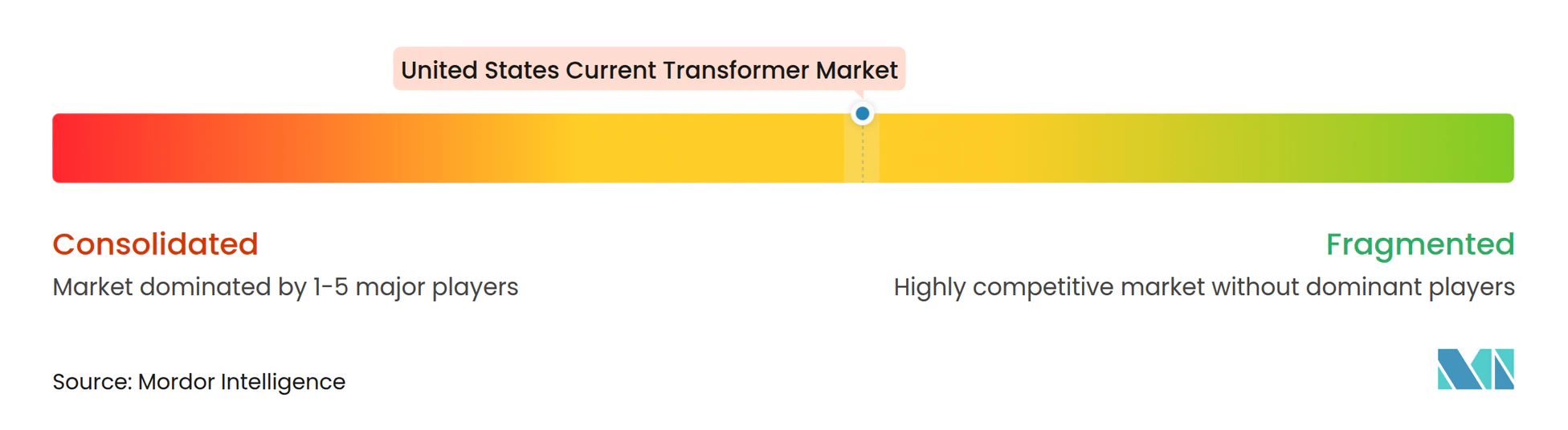
The United States current transformer market is moderately consolidated in high-voltage and large utility applications. ABB, Eaton, GE Vernova, Hitachi Energy, Schneider Electric, and Siemens Energy have broad grid portfolios, domestic service networks, and long-standing utility relationships. AMRAN, Continental Control Systems, CR Magnetics, RITZ, Instrument Transformer Equipment Corporation, Flex-Core, NK Technologies, and Ohio Semitronics serve more specialized low- and medium-voltage requirements. Major suppliers can package current transformers with switchgear, protection relays, and digital control equipment. This packaging approach can simplify procurement for utilities and large industrial customers. It can also raise the importance of installed-base relationships and system compatibility during supplier selection.
Eaton and Siemens Energy formalized a June 2025 collaboration for modular data center power infrastructure, combining generation and electrical distribution equipment. The arrangement places current measurement requirements within a wider equipment specification before construction contracts are awarded. Siemens and Jabil began expanding electrical equipment manufacturing in Virginia during 2026, with a facility that supports domestic medium-voltage equipment output. This investment can reduce lead times for U.S. utility and data center buyers. GE Vernova’s 2025 product updates show continued competition around revenue-metering accuracy and modernized transformer performance. Product qualification, local service, and available manufacturing capacity will remain important competitive factors.
Hitachi Energy introduced AxoniQ in June 2026 for multi-terminal DC transmission applications, addressing the need for equipment that supports changing transmission system designs. The company also extended its EconiQ SF6-free high-voltage portfolio during August 2026. These actions show that suppliers are competing through digital integration, environmental performance, and high-voltage system capability. Specialist companies can remain competitive where customers require custom ratios, compact designs, split-core installation, or rapid certification support. However, their ability to absorb material-cost movements is generally more limited than that of diversified suppliers. The United States current transformer market therefore rewards both broad system capabilities and specialized application expertise.
United States Current Transformer Industry Leaders
-
GE Vernova Inc.
-
Hitachi Energy Ltd.
-
Siemens Energy AG
-
Schneider Electric SE
-
Eaton Corporation plc
- *Disclaimer: Major Players sorted in no particular order
Recent Industry Developments
- September 2026: Schneider Electric USA was granted U.S. Patent 12731727 for an advanced current transformer assembly with an integrated magnetic shield designed to suppress crosstalk in differential sensing configurations, targeting high-density substation automation enclosures where electromagnetic interference is a specification barrier.
- August 2026: Hitachi Energy launched the EconiQ 300 kV and 420 kV circuit breakers and a 420 kV 80 kA live tank circuit breaker at CIGRE 2026 in Paris, extending its SF6-free high-voltage portfolio. TenneT Germany, following a successful EconiQ installation, ordered the 420 kV 80 kA unit, demonstrating commercial traction that signals near-term specification adoption by U.S. transmission utilities targeting SF6 phase-out commitments.
- June 2026: Hitachi Energy unveiled AxoniQ, a comprehensive portfolio for multi-terminal DC systems, addressing MULTI-TERMINAL DIRECT CURRENT (MTDC) interconnection metering requirements that will necessitate new classes of high-accuracy CTs at converter stations. The platform directly expands the addressable U.S. instrument transformer market as HVDC projects advance under DOE grid-resilience funding programs.
- March 2026: FirstEnergy announced a USD 950 million PJM-designated grid modernization project in Ohio and Pennsylvania, including substation rebuilds and high-voltage line upgrades across nearly 200 miles, creating a direct multi-voltage-class CT procurement requirement across numerous upgraded stations.
United States Current Transformer Market Report Scope
A current transformer (CT) is an electrical device used to measure or monitor high electric currents safely. It reduces a large current flowing in a power line to a smaller, proportional current that can be measured by meters or protective relays.
The Current Transformer Market Report is segmented by voltage, end user, and geography. By voltage, the market is segmented into low voltage, medium voltage, and high voltage. By end user, the market is segmented into power utilities, industrial, commercial, and residential. For each segment, the market sizing and forecasts have been provided on the basis of value (USD).
| Low Voltage |
| Medium Voltage |
| High Voltage |
| Power Utilities |
| Industrial |
| Commercial |
| Residential |
| By Voltage | Low Voltage |
| Medium Voltage | |
| High Voltage | |
| By End User | Power Utilities |
| Industrial | |
| Commercial | |
| Residential |
Key Questions Answered in the Report
What is the projected value of the United States current transformer market by 2032?
The United States current transformer market is forecast to reach USD 2.57 billion by 2032, growing at an 8.86% CAGR from 2027. The forecast reflects ongoing demand from grid replacement, transmission connections, advanced metering programs, and large electricity users.
Which voltage category holds the largest position in the United States current transformer market?
Medium voltage leads with a 49.8% share in 2026, supported by distribution substations, feeder automation, and advanced metering applications. Its large installed base gives utilities a continuing need for replacement equipment and more accurate measurement.
Which current transformer voltage category is growing fastest in the United States?
High voltage is forecast to expand at a 9.5% CAGR through 2032, supported by transmission additions and station-class replacement demand. Grid operators also need equipment that meets tighter performance requirements for protection and revenue-metering duties.
Which customers account for the largest share of current transformer demand in the United States?
Power utilities held 55.4% of demand in 2026 and are also the fastest-growing end-user category at a 9.9% CAGR through 2032. Their procurement includes equipment for transmission, distribution, renewable connections, and advanced metering infrastructure.
Why do renewable and storage projects require current transformers?
Grid connections need current transformers for revenue metering, protection, and control, while batteries require accurate measurement of charging and discharging conditions. These functions help operators measure power flows and maintain dependable system performance at the connection point.
How are data centers affecting current transformer demand?
Data centers require measurement at utility connection points and across internal power systems, while U.S. data center electricity use could reach 12% of total consumption by 2028 LBNL.GOV. Large campuses need metering and monitoring across medium-voltage feeders, distribution equipment, and power-quality systems.