
United States Container Depot Logistics Market Size and Share
Market Overview
| Study Period | 2020 - 2031 |
|---|---|
| Forecast Data Period | 2026 - 2031 |
| Base Year Market Size (2025) | USD 6.44 Billion |
| Market Size (2026) | USD 6.75 Billion |
| Market Size (2031) | USD 8.49 Billion |
| Growth Rate (2026 - 2031) | 4.68 % |
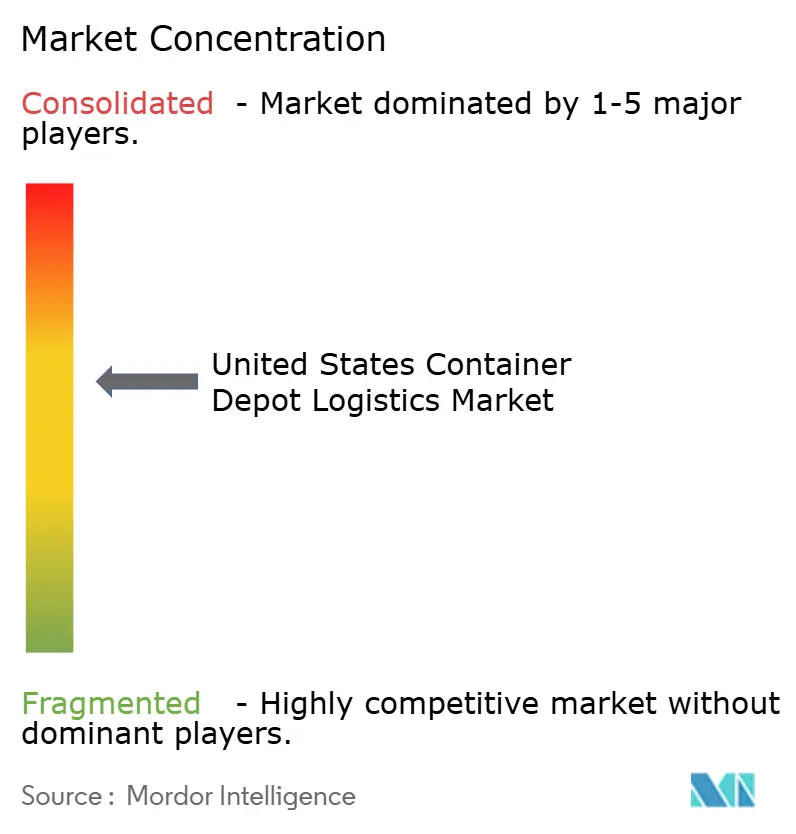
| Market Concentration | Medium |
Major Players *Disclaimer: Major Players sorted in no particular order Image © Mordor Intelligence. Reuse requires attribution under CC BY 4.0. | |
United States Container Depot Logistics Market Analysis by Mordor Intelligence
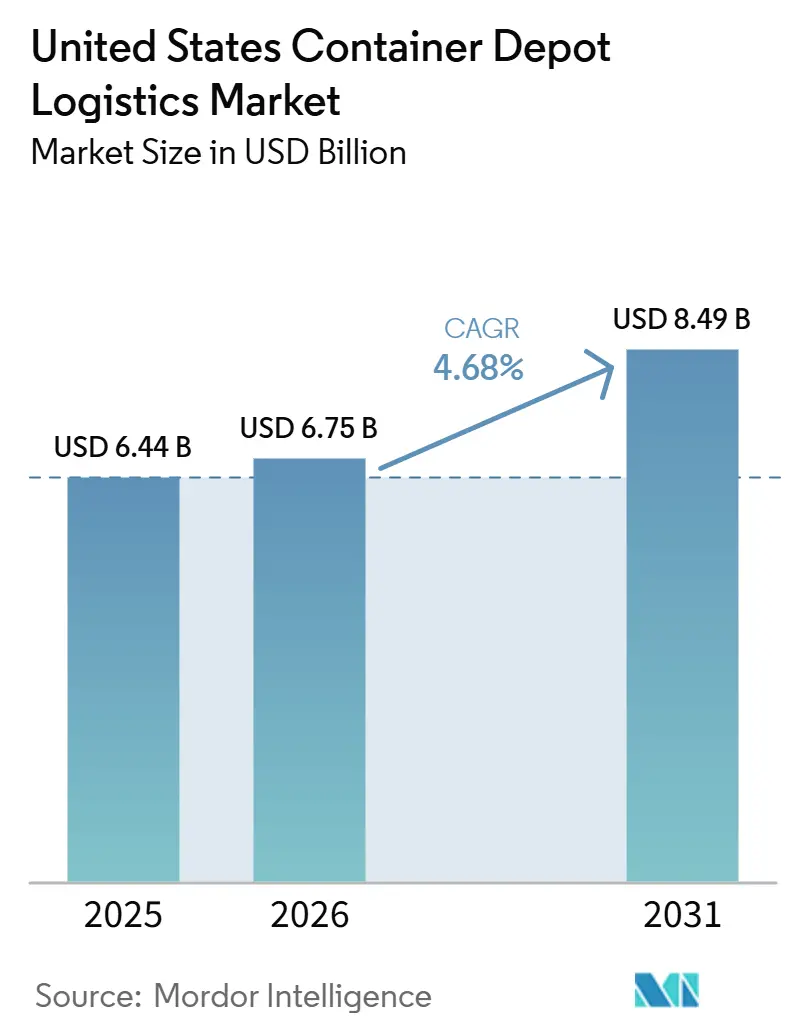
The United States container depot logistics market size was valued at USD 6.44 billion in 2025 and estimated to grow from USD 6.75 billion in 2026 to reach USD 8.49 billion by 2031, at a CAGR of 4.68% during the forecast period (2026-2031).
Sustained import activity, wider intermodal links, and a steady move toward inland container handling continue to support the United States container depot logistics market. Competition is also shifting as railroads, terminal operators, and ocean carriers invest deeper in inland and terminal assets. At the same time, service differentiation now depends more on repair depth, reefer readiness, and digital yard control. Margin pressure remains tied to labor shortages and emissions compliance spending. Yet, operators with scale, grant access, or stronger technology are still better positioned to capture the next stage of growth in the United States container depot logistics market.
Key Report Takeaways
- By depot type, inland container depots accounted for 38.20% of the United States container depot logistics market size in 2025 and are projected to expand at a 7.54% CAGR through 2031.
- By service type, container storage services accounted for 34.99% of the United States container depot logistics market share in 2025, while container maintenance and repair services are forecast to grow at 8.70% CAGR through 2031.
- By container type, dry containers accounted for 84% of the United States container depot logistics market size in 2025, while reefer containers are projected to grow at a 7.12% CAGR through 2031.
- By trade orientation, domestic container movement accounted for 57.64% of the United States container depot logistics market share in 2025, while international and transshipment container handling is expected to expand at a 6.83% CAGR through 2031.
- By geography, the West captured 29.57% of the United States container depot logistics market size in 2025, while the Midwest is set to grow at 6.55% CAGR through 2031.
Note: Market size and forecast figures in this report are generated using Mordor Intelligence’s proprietary estimation framework, updated with the latest available data and insights as of January 2026.
United States Container Depot Logistics Market Trends and Insights
Drivers Impact Analysis*
| Driver | (~) % Impact on CAGR Forecast | Geographic Relevance | Impact Timeline |
|---|---|---|---|
| Intermodal Rail and Port Congestion Diversion Demand | +1.1% | National, with the strongest pressure in the Northeast, West, and Midwest corridors | Short term (≤ 2 years) |
| Growth in Import Container Repositioning and Storage Cycles | +0.9% | National, concentrated at coastal gateways with spillover into the Southeast and Gulf. | Medium term (2-4 years) |
| E-Commerce Led Domestic Container Movement | +0.8% | National, especially the West, Northeast, and Midwest, distribution hubs | Medium term (2-4 years) |
| Expansion of Value-Added Depot Services | +0.7% | National, with strong relevance near Savannah and Houston | Long term (≥ 4 years) |
| Digital Yard Visibility and Appointment Management Adoption | +0.5% | National, with faster uptake at high-throughput facilities in the West and Northeast | Medium term (2-4 years) |
| Demand for Refrigerated Container Handling Readiness | +0.6% | National, especially the Gulf Coast, West Coast, and Texas border corridor | Long term (≥ 4 years) |
| Source: Mordor Intelligence | |||
Intermodal Rail and Port Congestion Diversion Demand
Inland depots are taking freight that would otherwise sit longer inside port queues. ITS Logistics reported in June 2026 that concern levels remained elevated across the United States' port and rail regions, as capacity remained constrained and rising fuel costs increased the risk of downstream price surges during the peak season[1]Source: ITS Logistics, “UPDATE, ITS Logistics June Port/Rail Ramp Freight Index, Drayage and Intermodal Markets Brace for Downstream Price Surges,” GlobeNewswire, globenewswire.com. The shift is raising the strategic value of depots near inland rail ramps in Chicago, Dallas, Fort Worth, Memphis, and Atlanta, as those sites now absorb overflow that previously stayed near coastal terminals. Rail’s cost advantage is also widening the addressable base for inland handling, so congestion relief is becoming a planned use case instead of an emergency response. The new USD 134 million Gainesville Inland Port, which opened in May 2026 with Norfolk Southern service and 200,000-container annual capacity, shows how inland corridors are becoming dedicated nodes in the United States container depot logistics market.
Growth in Import Container Repositioning and Storage Cycles
A growing share of container activity is tied to repositioning and storage rather than direct loaded import movement. The weaker match-back efficiency in the United States trade and a higher volume of empty repositioning legs, which means more containers must cycle through depots for inspection, cleaning, and minor repair before returning to service. Tariff-led inventory stockpiling in 2025 added to this pressure, as higher inbound flows triggered a later wave of empty returns that had to be sorted and staged across depot networks. This demand base is useful for operators because it is less tied to day-to-day import growth and more tied to how carriers rebalance equipment after demand shocks. It also creates recurring work that extends beyond storage into washing, repair, and turn preparation, which improves revenue stability for larger facilities. Federal scrutiny of detention and demurrage practices is also pushing shipping lines and operators to shorten empty-container dwell time and improve yard efficiency across the United States container depot logistics market.
E-Commerce Led Domestic Container Movement
The expansion of e-commerce fulfillment networks is lifting domestic intermodal container demand along key inland distribution corridors. IANA reported that domestic container originations rose 2.2% to 2.3 million units in the fourth quarter of 2025, even as overall intermodal volume softened, indicating that domestic container demand remained resilient. IANA data also showed 3.2% full-year domestic container growth in 2025, which supports the view that this traffic held up amid tariff uncertainty. This changes the service mix at depots because e-commerce users need tighter appointment windows, faster turnaround, and integrated transloading rather than simple yard storage. Sea-to-rail transloading is therefore becoming increasingly important in facilities serving dense retail networks and high-velocity fulfillment flows. As a result, inland facilities that can combine storage, dray coordination, and transload execution are taking a larger role in the United States container depot logistics market.
Expansion of Value-Added Depot Services
Depot operators are moving beyond basic storage and building service bundles that include transloading, cargo consolidation, customs dray management, and fleet repositioning support. The commercial appeal is clear because a depot that captures transload and handling revenue alongside storage can earn far more per container than a commodity storage yard. A strong gateway throughout at Savannah is supporting near-port logistics development built around higher-value depot services. Operators that add bonded space, reefer plugs, hazmat readiness, and customs-linked workflows are better placed to win shipper business that values speed and coordination over basic storage rates. This shift also changes pricing power because broader service menus are harder to compare on a simple per-day storage basis. The result is an expansion of the service scope of the United States container depot logistics market and a reduced reliance on land-intensive storage alone.
Restraints Impact Analysis*
| Restraint | (~) % Impact on CAGR Forecast | Geographic Relevance | Impact Timeline |
|---|---|---|---|
| Labor Shortages in Yard and Repair Operations | -0.8% | National; most acute in California, Texas, and Arizona, where immigration-linked workforce exits have been documented | Short-to-medium term (1–3 years) |
| Emissions Compliance and Equipment Replacement Costs | -0.6% | California primary, with regulatory spill-over to all major US port regions under the EPA Clean Ports Program requirements | Medium-to-long term (3–6 years) |
| Rail and Truck Capacity Bottlenecks at Inland Hubs | -0.4% | National; most severe at Midwest corridors (Chicago, St. Louis, Kansas City) and Southwest inland hubs (Dallas–Fort Worth, Houston) | Medium-term (2–4 years) |
| Land Availability and Zoning Constraints Near Gateway Hubs | -0.3% | High-density coastal and near-port markets: California (LA, Long Beach, Oakland), New Jersey (Port Newark–Elizabeth), and Georgia (Savannah) | Long-term (≥ 4 years) |
| Source: Mordor Intelligence | |||
Labor Shortages in Yard and Repair Operations
Labor shortages continue to affect gate staffing, equipment handling, and specialized maintenance work across the United States container depot logistics market. An aging labor base and long training cycles for new hires limit how quickly operators can rebuild staffing depth after disruptions. These shortages are especially important in California, Arizona, and Texas, where high gateway volume magnifies the impact of any labor shortfall on yard turns and repair lead times. Los Angeles Times reporting in mid-2025 showed port job availability had fallen sharply as import softness and workforce constraints hit activity at the Port of Los Angeles. Operators are responding with automation and cleaner equipment programs, yet reefer servicing, welding, and IICL inspections still depend on trained technicians, whose scarcity extends repair cycles and increases detention exposure. The strain is most visible in maintenance and repair, where each missing specialist can delay container return-to-service for a much wider network.
Emissions Compliance and Equipment Replacement Costs
Emissions compliance is raising capital needs for yard equipment, tractors, and related terminal assets. Maritime industry reporting estimated that United States ports will invest USD 6.7 billion in cargo-handling equipment over the next 5 years, including major spending on cranes and yard equipment [2]Source: Maritime Magazine, “Survey Reports U.S. Ports Face USD 6.7B Cargo Equipment Investment Need Over Next Five Years,” Maritime Magazine, maritimemag.com. Rocky Mountain Institute also estimated that replacing the remaining diesel cargo handling equipment at San Pedro Bay ports with zero-emission alternatives would cost more than USD 2.5 billion. APM Terminals' USD 80 million Clean Ports program at Pier 400, announced in June 2026 with 60% federal grant funding, demonstrates how the transition is advancing through public-private cost-sharing. Large operators can spread these costs more easily, but smaller depot providers face greater pressure because they often lack grant access and still must meet tightening rules over time. This keeps compliance from outright halting growth, but it does raise the risk of margin pressure and slower equipment replacement among smaller operators.
*Our forecasts treat driver/restraint impacts as directional, not additive. The impact forecasts reflect baseline growth, mix effects, and variable interactions.
Segment Analysis
By Depot Type: Inland Hubs Redefine Container Flow Architecture
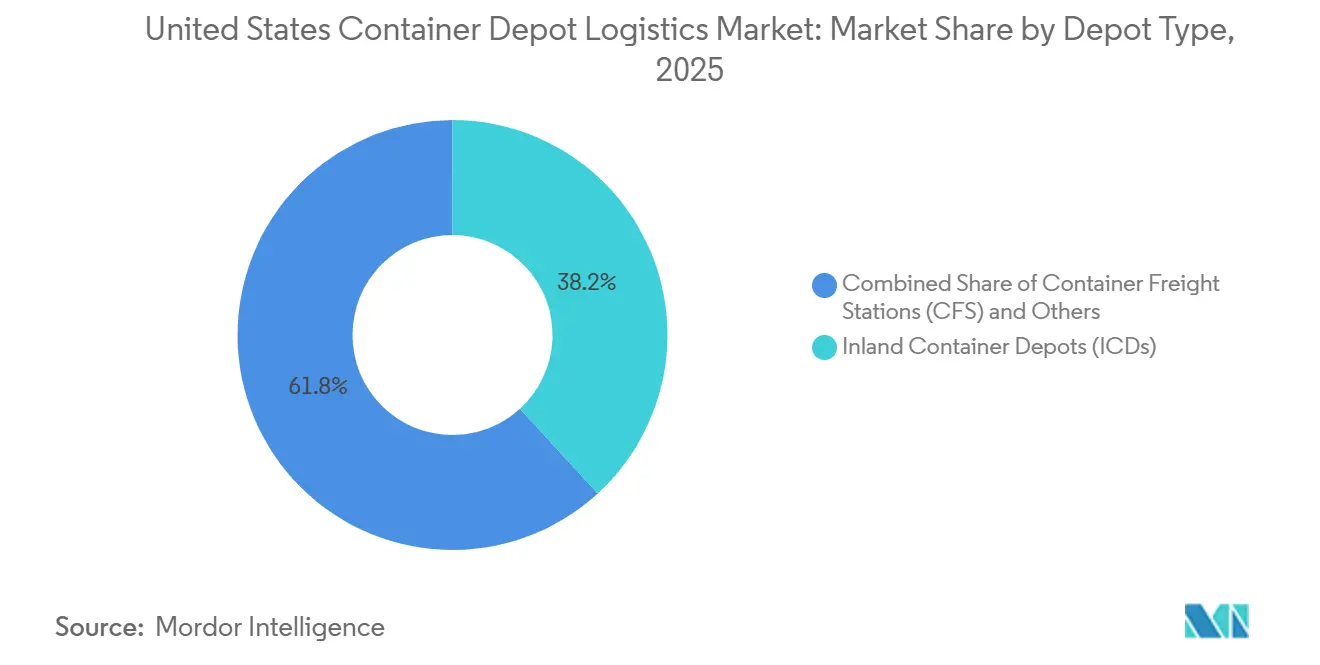
Inland container depots accounted for 38.20% of the United States container depot logistics market size in 2025 and are projected to expand at a 7.54% CAGR through 2031. That mix of scale and growth is unusual in a mature logistics niche, as the same asset type is driving both current demand and future network redesign. ICDs are gaining share because they relieve gateway congestion and move storage, customs work, reefer staging, and transloading closer to inland demand centers. The United States container depot logistics industry is therefore shifting part of its operating center away from coastal land scarcity and toward rail-linked inland corridors. Gainesville Inland Port and other inland terminal projects show that carriers and railroads now see inland access as a core piece of container flow design rather than a secondary overflow option.
Container freight stations keep a stable role because retailers and e-commerce importers still need less-than-container-load consolidation and deconsolidation near gateway and inland distribution points. Empty container depots benefit from higher inspection, washing, and repositioning needs as carriers work through weaker equipment match-back patterns after demand shocks. Port-based depots remain important for just-in-time equipment positioning because direct vessel access still matters for lines that want faster box turnaround near terminals. BNSF's approved 4,500-acre Barstow International Gateway shows where long-term capital is moving, with a model built around inland sorting and transloading rather than adding pressure to coastal yards[3]Source: BNSF Railway Project Coverage, “BNSF Secures Approval for Barstow International Gateway,” WorldCargo News, worldcargonews.com. This segment structure shows that depot-type competition is now less about simple yard classification and more about where each asset sits within broader rail, port, and cargo networks.



By Service Type: Maintenance and Repair Captures Disproportionate Growth
Container storage services accounted for 34.99% of the United States container depot logistics market share in 2025, while container maintenance and repair services are set to grow at 8.70% CAGR through 2031. Storage remains the largest service line because import surges, empty repositioning, and volatile demand patterns all keep buffer capacity in use. That gives storage a steady base, especially in networks where shippers use depots as a short-term valve when port or rail conditions tighten. Even so, faster growth is moving toward maintenance and repair because container age profiles have lengthened after the large ordering cycle. This means the United States container depot logistics market is generating more value from service intensity rather than from basic yard occupancy alone.
Handling services remain volume-driven and will continue to track throughput at marine terminals and inland depots. Cleaning and washing services are gaining relevance where imported agricultural and reefer containers face tighter inspection and biosecurity routines. Other value-added services, including transloading, fleet management, and customs coordination, offer the clearest scope for margin expansion because they keep operators inside more steps of the cargo chain. Federal scrutiny of detention and demurrage practices also underscores the importance of repair scheduling and faster service execution when containers are awaiting maintenance work. Over the forecast period, operators with broader service menus should be less exposed to rate pressure than providers that depend mainly on storage.
By Container Type: Dry Container Volume Masks Reefer's Strategic Ascent
Dry containers held 84% of the United States container depot logistics market share in 2025, keeping volume efficiency at the center of this segment. Because dry box traffic dominates flows, competitive performance often comes down to gate speed, stacking discipline, chassis turns, and rail connectivity rather than specialized service depth. That makes the dry container segment critical for establishing a baseline across the United States container depot logistics market. Even small efficiency gains in this segment can shift network economics, given the installed base is so large. Large dry container flows also help operators balance fixed yard costs, especially in locations where utilization can swing with retail import cycles.
Reefer containers are projected to grow at a 7.12% CAGR through 2031, faster than the broader market and well above dry box growth. Reefer work requires stricter operating requirements due to power supply, temperature monitoring, and food-grade compliance. SeaCube's move to expand reefer depot services on the West Coast shows how operators are treating cold-chain handling as a specialized growth field rather than a side offering[4]Source: SeaCube Container Leasing, “SeaCube Continues Strategic Pivot,” WorldCargo News, worldcargonews.com. The reefer demand is also linked to stronger cold-chain imports and certified in-transit treatment processes, which increase the value of compliant staging capacity. As a result, the capability gap between compliant reefer operators and smaller competitors is likely to widen further over the forecast period.
By Trade Orientation: Domestic Container Growth Redraws Depot Network Geography
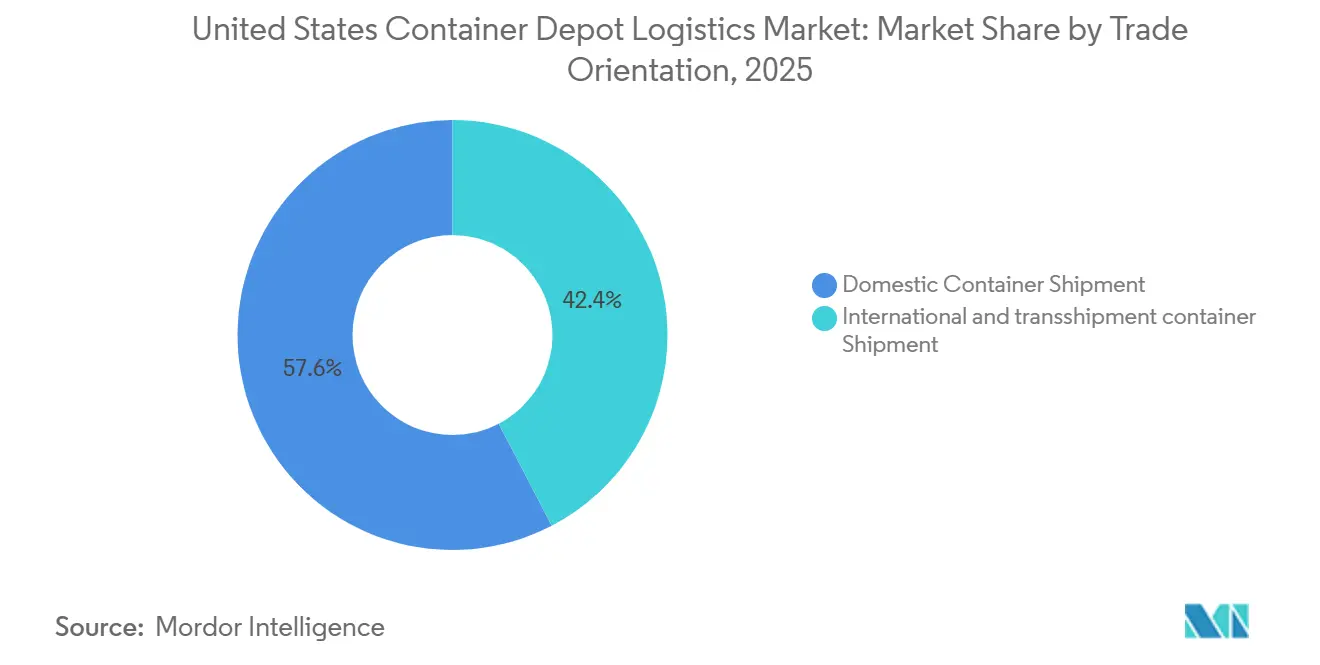
Domestic container movement accounted for 57.64% of the United States container depot logistics market size in 2025, while international and transshipment container handling is projected to grow at a 6.83% CAGR through 2031. The domestic lead reflects the growing use of containers within the United States retail and fulfillment networks, rather than just for import and export legs. IANA data on domestic container growth in 2025 supports this shift toward inland distribution demand that stays active even when broader intermodal volumes are less stable. This part of the United States container depot logistics industry is drawing more investment into lanes where retail density, rail access, and transload demand overlap. Domestic flows also give depots a more predictable operating base because they depend less on port call timing than international cycles do.
International and transshipment flows still matter because supply chain realignment continues to change where containers enter the country and where empties need to be repositioned. Trade normalization through 2026 is supporting a measured recovery in international handling demand through major gateway-linked depot systems. That improves prospects for operators that can balance domestic turns with international storage, repair, and repositioning within a single network. It also raises the value of facilities that can switch quickly between import-driven peaks and inland domestic distribution cycles. Over time, the segment mix should favor operators that can respond to both steady domestic demand and sharper swings in global trade flows.
Geography Analysis
The West held 29.57% of the United States container depot logistics market share in 2025 and remains the largest regional base for the United States container depot logistics market. APM Terminals is advancing a USD 80 million electrification program at Pier 400, and the first 40 battery-electric terminal tractors are scheduled to arrive in June 2026 under the EPA Clean Ports framework. The region is also attracting large, inland-linked investment through BNSF's Barstow International Gateway, a 4,500-acre project designed to move sorting and transloading activity 130 miles inland from Los Angeles and Long Beach. This matters because Western growth is no longer only a Portland story; it is becoming a corridor-and-network story that blends terminal assets with inland depot control. California emissions deadlines also raise near-term costs, but they give early movers a chance to lock in grants, cleaner fleets, and lower operating costs before lagging operators catch up.
The Northeast and Southeast together represent a large share of current depot activity because both regions combine strong gateway throughput with dense inland demand. In the Northeast, Maher Terminals' lease extension through 2063 shows a continued commitment to long-term capacity at the Port of New York and New Jersey. Maher's hybrid straddle carrier order for delivery in late 2026 also shows that major East Coast operators are pairing capacity commitments with fleet modernization. In the Southeast, the Gainesville Inland Port opened in May 2026 with 200,000-container annual capacity, while Savannah-linked activity continues to support nearby depot and transload development. This regional pattern shows that depot growth follows both gateway scale and the availability of inland land, rail access, and industrial users that can absorb container flows.
The Midwest is projected to grow at 6.55% CAGR through 2031 and is the fastest-growing regional segment in the United States container depot logistics market. Norfolk Southern's East Edge service and the Union Pacific and Norfolk Southern intermodal gateway expansion are improving inland access and making Midwest depots more competitive for both domestic and international flows. The Southwest is benefiting from cross-border and reefer activity, while Gulf projects, such as the new Mobile berth, will strengthen links to inland networks over the next 24 months. Regional performance now shows a clear divide, with coastal gateways still setting volume direction and inland corridors taking a larger share of storage, transload, and repositioning work.
Competitive Landscape
The United States container depot logistics market remains moderately fragmented at the operating level, with no single company controlling a dominant position across all depot formats. Port-based terminal operators such as APM Terminals, Ports America, SSA Marine, Maher Terminals, and Fenix Marine Services still control the most constrained land near major gateways. Their advantage comes from direct terminal adjacency, established customer flows, and the ability to combine yard control with marine-side handling. At the same time, Class I railroads are becoming stronger rivals because they can shape inland container flows through terminal access, schedule design, and corridor investment. This is why competitive power in the United States container depot logistics market is increasingly tied to network control rather than simple yard acreage.
Carrier-led vertical integration is becoming one of the clearest shifts in the competitive structure. CMA CGM and Stonepeak announced United Ports LLC in January 2026, creating a USD 2.4 billion joint venture that includes Fenix Marine Services and Port Liberty and adds scope for further capital deployment. MSC's Terminal Investment Limited and Tradepoint Atlantic broke ground in May 2026 on the USD 1.2 billion Sparrows Point Container Terminal, signaling a stronger carrier role in United States terminal and depot ownership. These moves matter because the same group can now control vessel capacity, terminal space, inland box flows, and a larger share of the landside margin pool. The result is a competitive field in which traditional depots increasingly face rivals that combine shipping, terminal, and inland infrastructure under a single strategy.
Smaller and mid-sized operators still have room to grow where reefer-capable inland depots, digital appointment systems, and transload services remain underbuilt. ContainerPort Group's acquisition of Dray Alliance in March 2025 expanded its Southern California technology footprint, while IMC Logistics is widening its network into Canada after building a deeper Gulf Coast presence. Technology is also becoming a clearer moat, as Maher's Nokia deployment and Yusen's battery-electric top handlers demonstrate that yard visibility and cleaner equipment can improve throughput consistency and compliance. Taken together, the competitive picture supports a United States container depot logistics market where scale helps, network control matters more, and capability depth often decides who protects margin.
United States Container Depot Logistics Industry Leaders
SSA Marine
Ports America
APM Terminals
Fenix Marine Services
Maher Terminals
- *Disclaimer: Major Players sorted in no particular order

Recent Industry Developments
- June 2026: APM Terminals contracted Orange EV for 40 HUSK-e XP battery-electric terminal tractors at Pier 400, Los Angeles, as part of a USD 80 million sub-recipient contract under the EPA Clean Ports Program. Funding is structured with 60% federal, 20% Port of LA, and 20% APM Terminals capital, while APM Terminals separately committed USD 40 million to its broader Pier 400 electrification program.
- April 2026: Hapag-Lloyd's Hanseatic Global Terminals (HGT) completed the acquisition of 100% ownership of Florida International Terminal (FIT) at Port Everglades, acquiring the remaining 30% stake from Grupo Empresas Navieras (GEN)/Agunsa USA for USD 29 million. The transaction gives HGT sole control of a key Southeast US gateway serving trade lanes to Latin America and the Caribbean.
- January 2026: Norfolk Southern launched the East Edge double-stack intermodal corridor connecting Chicago and New England, representing a USD 64 million investment that cuts transit times by up to 10 hours and adds substantial capacity on a corridor previously served only by single-stack routing. The service leverages a CSX trackage-rights agreement and is projected to double Norfolk Southern's New England intermodal volume within 2 years.
- October 2025: Alabama Port Authority and APM Terminals announced an agreement to proceed with construction of a new 1,300-foot container berth at the Port of Mobile, with a combined USD 131 million investment funded by federal appropriations and APM Terminals' private capital.


United States Container Depot Logistics Market Report Scope
| Inland Container Depots (ICDs) |
| Container Freight Stations (CFS) |
| Empty Container Depots (ECDs) |
| Port-Based Container Depots |
| Container Storage Services |
| Container Handling Services |
| Container Maintenance and Repair (M&R) Services |
| Container Cleaning & Washing Services |
| Other Value-Added Logistics Services |
| Dry Containers |
| Reefer Containers |
| International/Transshipment Container Handling |
| Domestic Container Movement |
| Northeast |
| Southeast |
| Midwest |
| Southwest |
| West |
| By Depot Type | Inland Container Depots (ICDs) |
| Container Freight Stations (CFS) | |
| Empty Container Depots (ECDs) | |
| Port-Based Container Depots | |
| By Service Type | Container Storage Services |
| Container Handling Services | |
| Container Maintenance and Repair (M&R) Services | |
| Container Cleaning & Washing Services | |
| Other Value-Added Logistics Services | |
| By Container Type | Dry Containers |
| Reefer Containers | |
| By Trade Orientation | International/Transshipment Container Handling |
| Domestic Container Movement | |
| By Region | Northeast |
| Southeast | |
| Midwest | |
| Southwest | |
| West |


Key Questions Answered in the Report
What is the forecast value of United States container depot logistics by 2031?
The United States container depot logistics market is projected to reach USD 8.49 billion by 2031, rising from USD 6.75 billion in 2026 at a 4.68% CAGR.
Which depot type is growing the fastest in this space?
Inland container depots lead both on current scale and future growth, with 38.20% share in 2025 and a projected 7.54% CAGR through 2031.
Why are inland depots gaining importance across the United States?
Inland sites help relieve port congestion, connect better with rail corridors, and support services such as transloading, reefer staging, and customs-linked handling.
Which service line offers the strongest growth potential?
Container maintenance and repair stands out with an 8.70% CAGR through 2031, helped by longer container age profiles and stronger repair demand.
How important is domestic container movement to depot demand?
Domestic container movement accounted for 57.64% of the market in 2025, indicating that depot demand now depends heavily on inland retail and fulfillment networks rather than just on import and export traffic.
Which region should operators watch most closely for new growth?
The Midwest is the fastest-growing region, with a 6.55% CAGR through 2031, supported by new intermodal corridors, rail investments, and the stronger economics of the inland network.
Page last updated on:





