
United States Commercial Greenhouse Market Size and Share
Market Overview
| Study Period | 2021 - 2031 |
|---|---|
| Forecast Data Period | 2026 - 2031 |
| Base Year Market Size (2025) | USD 2.40 Billion |
| Market Size (2026) | USD 2.5 Billion |
| Market Size (2031) | USD 3.70 Billion |
| Growth Rate (2026 - 2031) | 8.16 % |
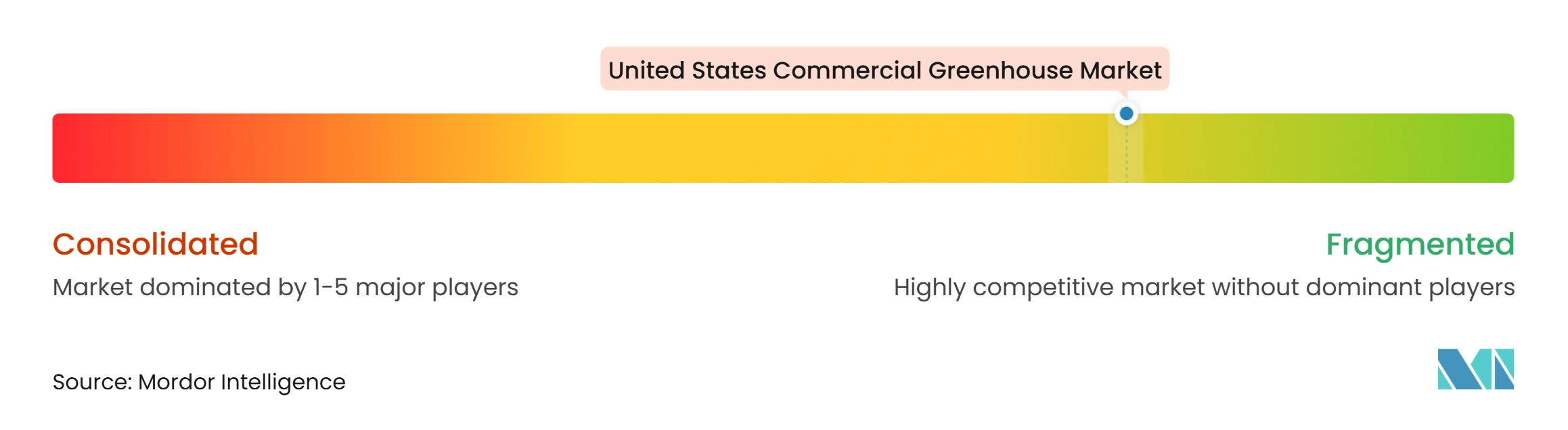
| Market Concentration | Low |
Major Players *Disclaimer: Major Players sorted in no particular order Image © Mordor Intelligence. Reuse requires attribution under CC BY 4.0. | |
United States Commercial Greenhouse Market Analysis by Mordor Intelligence
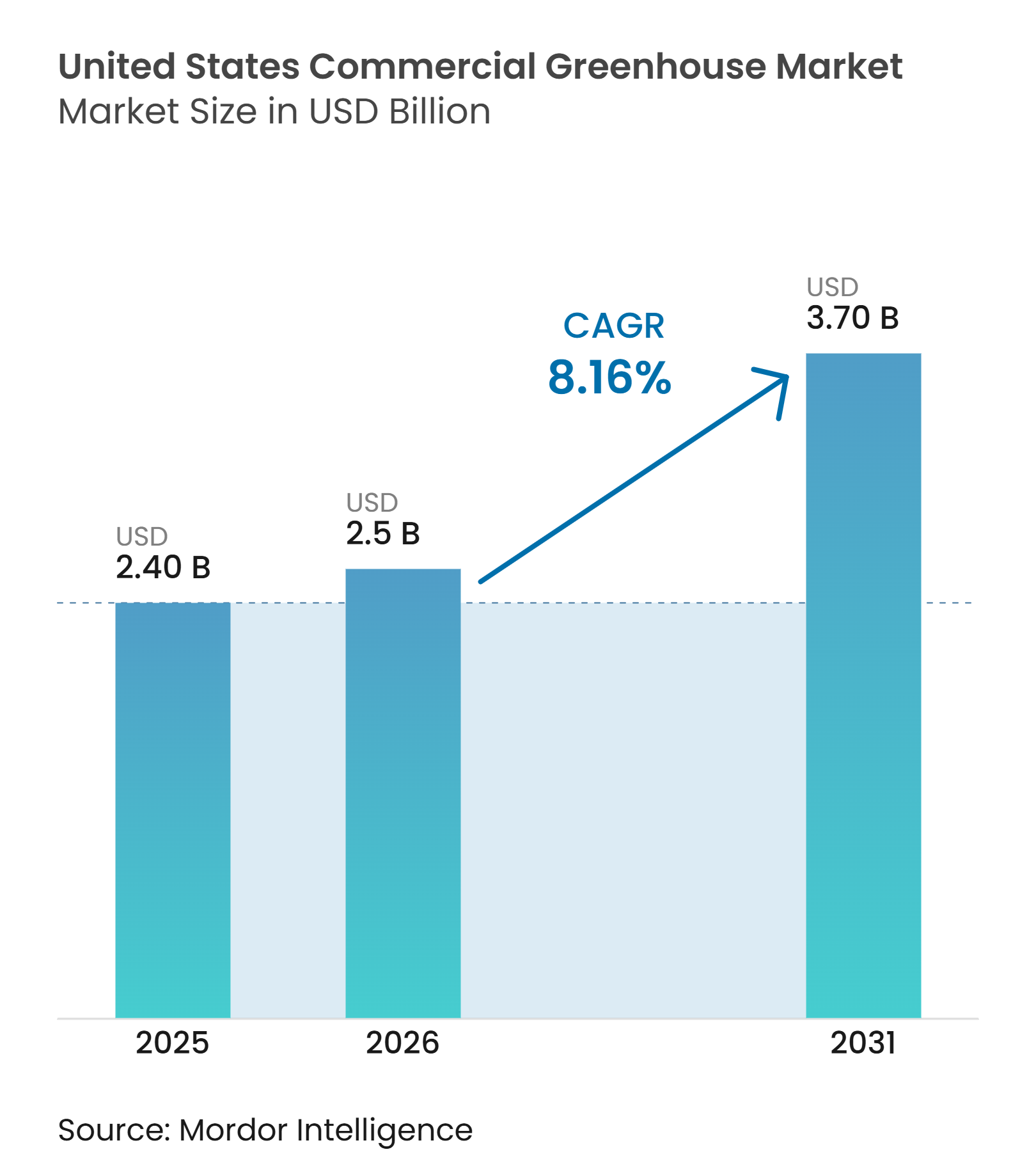
The United States commercial greenhouse market size was valued at USD 2.4 billion in 2025 and estimated to grow from USD 2.5 billion in 2026 to reach USD 3.7 billion by 2031, at a CAGR of 8.16% during the forecast period (2026-2031). Demand for fresh domestic produce year-round is supporting investment in structures and equipment to provide a predictable supply. Protected food-crop sales reached USD 1.01 billion according to the United States Department of Agriculture’s National Agricultural Statistics Service (USDA NASS), 44% above 2019, which shows the continued shift toward protected production according to the United States Department of Agriculture’s National Agricultural Statistics Service (USDA NASS). Retail and foodservice buyers need consistent quality and supply, while growers need systems that manage labor, energy, and crop conditions more precisely. These conditions create opportunities for integrated climate control, lighting, irrigation, and cultivation systems across the United States commercial greenhouse market.
Key Report Takeaways
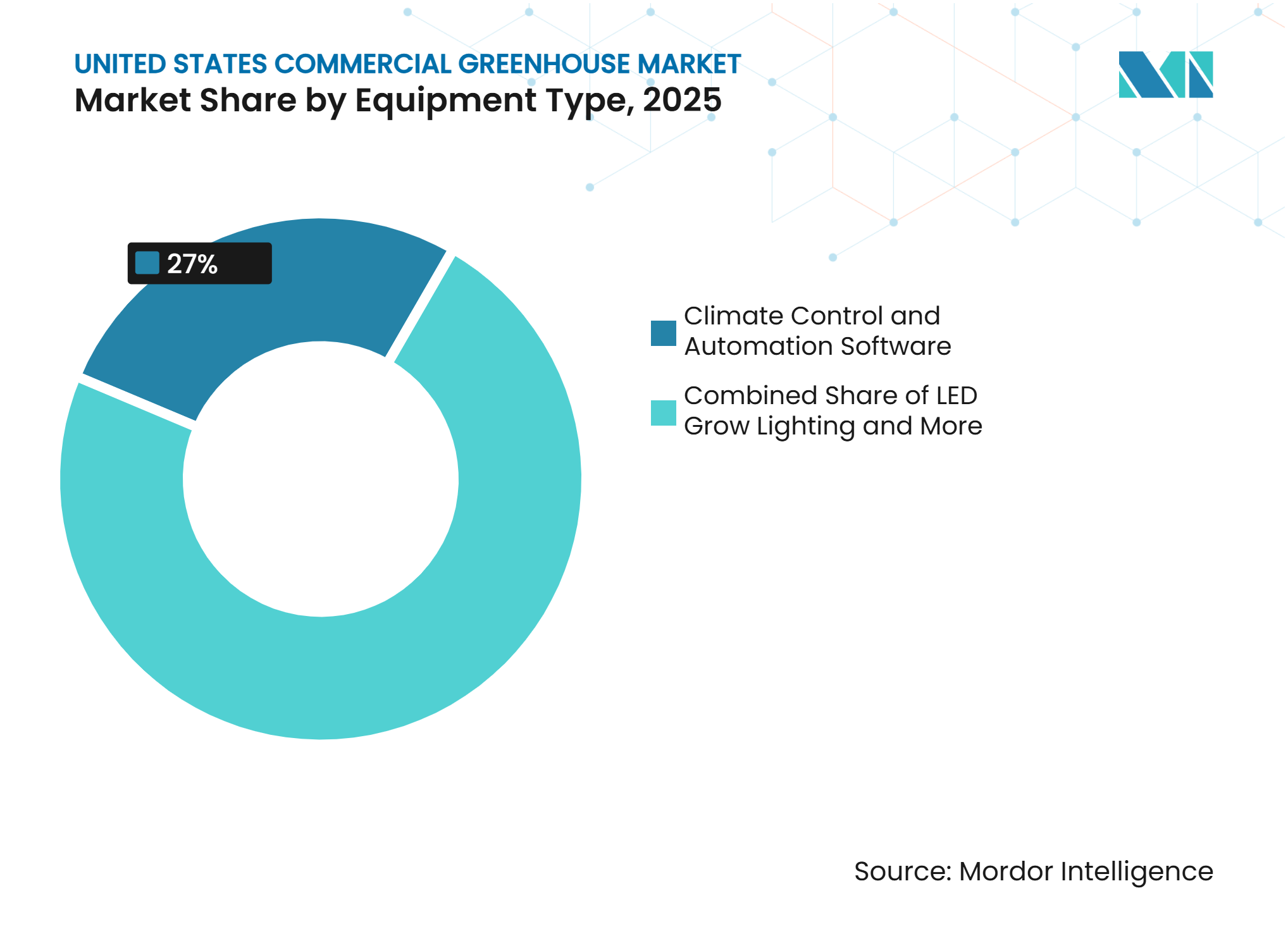
- By equipment type, climate control and automation software was the largest segment, with 27% of the United States commercial greenhouse market share in 2025. It is projected to be the fastest-growing segment, growing at a 12.5% CAGR during 2026–2031.
- By crop type, fruits and vegetables were the largest segment with 57% of the United States commercial greenhouse market size in 2025, while herbs and microgreens are anticipated to grow at an 11.5% CAGR during 2026–2031.
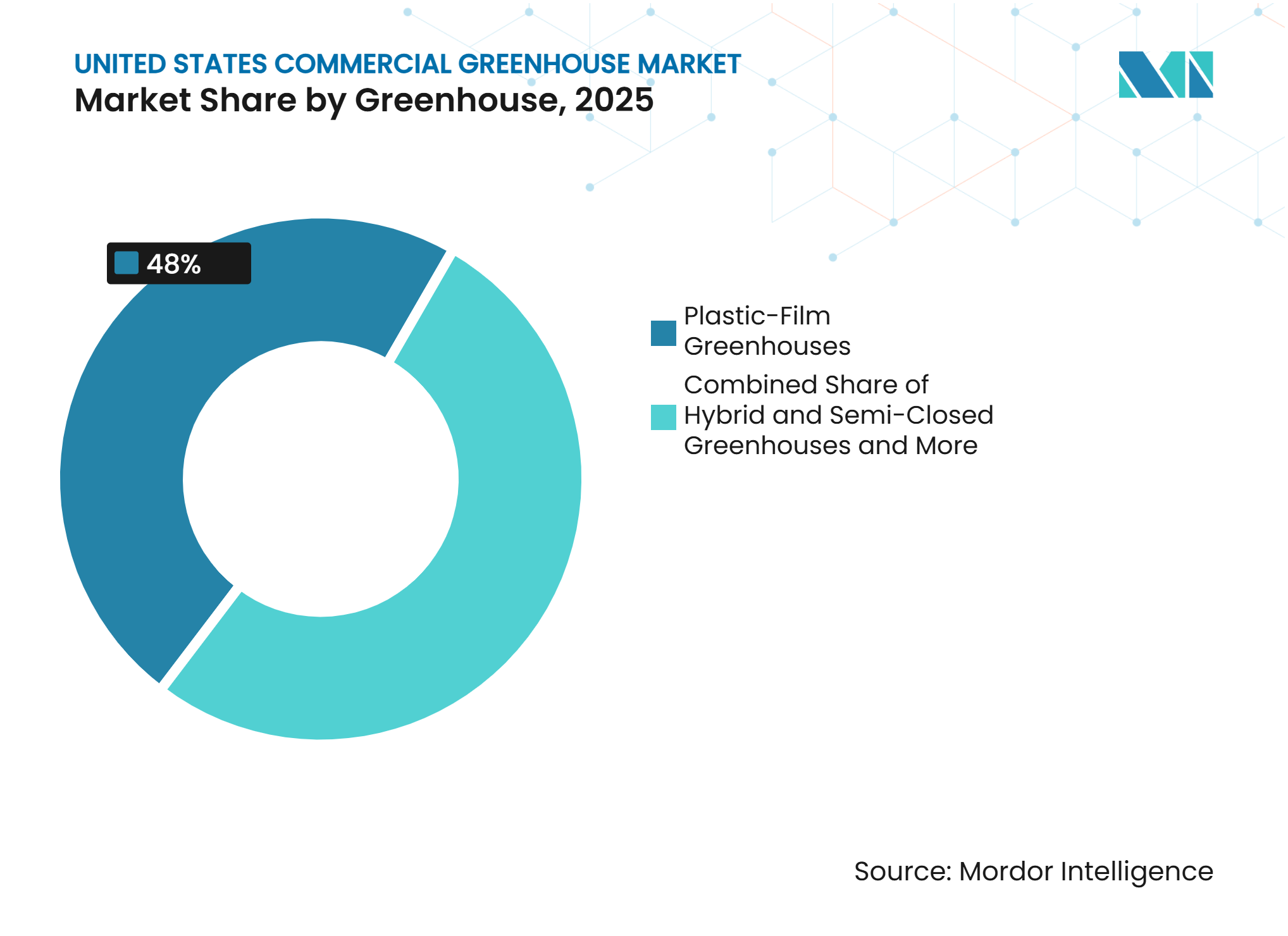
- By greenhouse type, plastic-film greenhouses were the largest segment with 48% share in 2025, while hybrid and semi-closed greenhouses are projected to grow at a 10.8% CAGR during 2026–2031.
- By cultivation technology, hydroponic cultivation was the largest segment with 55% share in 2025, while hybrid and vertical integration are p to grow at a 12.2% CAGR during 2026–2031.
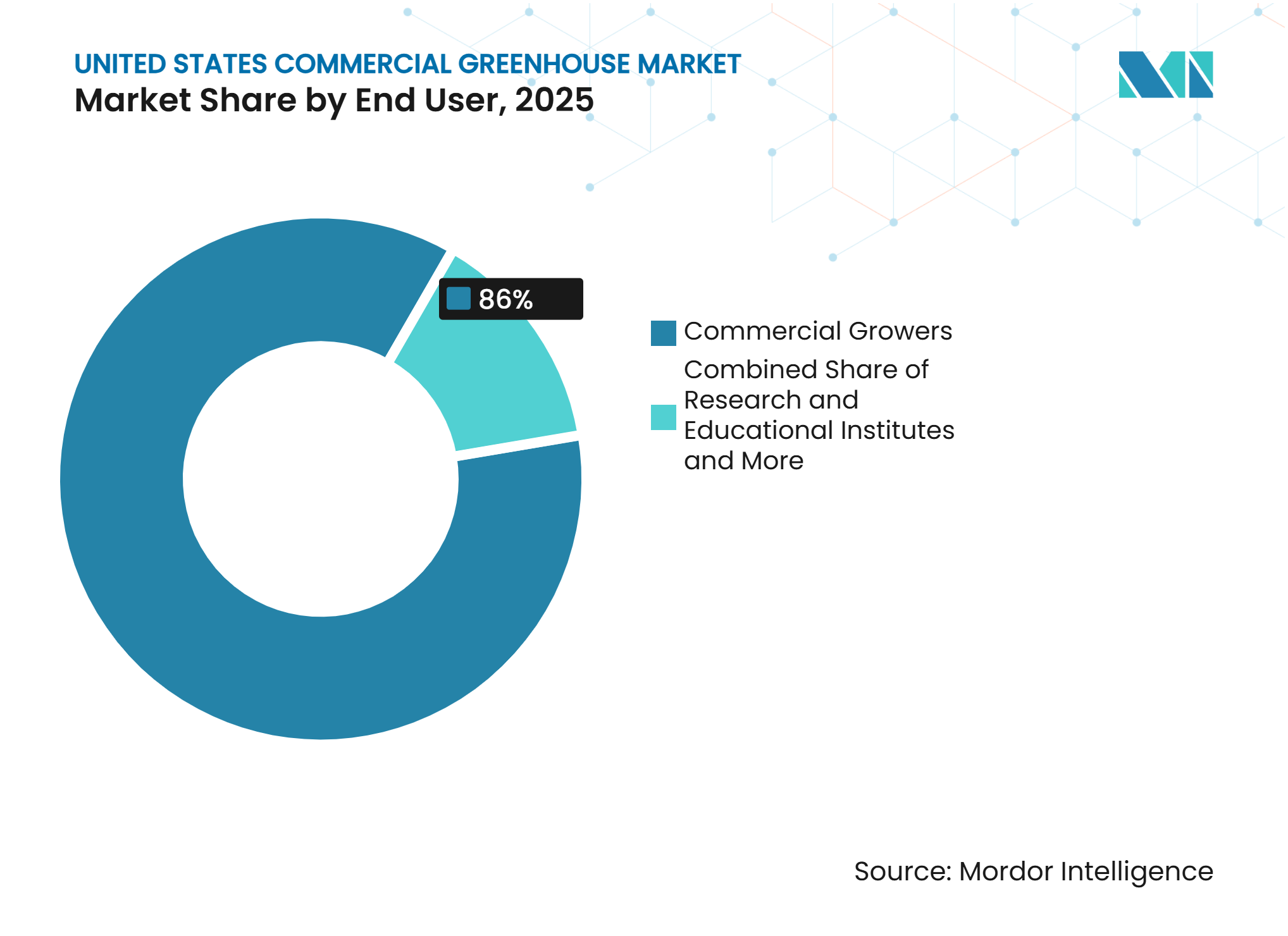
- By end user, commercial growers were the largest segment with 86% share in 2025, while research and educational institutes are anticipated to grow at a 9.5% CAGR during 2026–2031.
Note: Market size and forecast figures in this report are generated using Mordor Intelligence’s proprietary estimation framework, updated with the latest available data and insights as of January 2026.
Market Trends and Insights
Drivers Impact Analysis of United States Commercial Greenhouse Market*
| Driver | (~) % Impact on CAGR Forecast | Geographic Relevance | Impact Timeline |
|---|---|---|---|
| Rising Demand for Year-Round Domestic Greenhouse Produce | +2.0% | United States, especially the Northeast, Midwest, and West | Short term (≤ 2 years) |
| Antidumping Duties on Mexican Tomatoes Supporting Domestic Greenhouse Growers | +1.8% | United States, especially the Northeast, Midwest, and West | Medium term (2-4 years) |
| Expansion of Greenhouse Production for High-Value Fruits, Vegetables, Herbs, and Ornamentals | +1.5% | United States, especially the West, South, and Midwest | Medium term (2-4 years) |
| Adoption of Automation to Address Greenhouse Labor Availability Constraints | +1.3% | United States, especially the Midwest, South, and West | Medium term (2-4 years) |
| Growth of Utility-Connected Energy Management Systems in US Greenhouses | +0.6% | United States, especially the Northeast, Midwest, and West | Long term (≥ 4 years) |
| Retailer and Foodservice Preference for Consistent Domestic Greenhouse Supply | +0.5% | United States, especially the Northeast, Midwest, and West | Short term (≤ 2 years) |
| Source: Mordor Intelligence | |||
Rising Demand for Year-Round Domestic Greenhouse Produce
Consumer demand for fresh domestic greenhouse vegetables has moved beyond a premium niche and now shapes mainstream retail purchasing. The 2024 Census of Horticultural Specialties recorded a 44% increase in protected food-crop sales from 2019 to 2024, according to the United States Department of Agriculture’s National Agricultural Statistics Service (USDA NASS). That change supports the United States commercial greenhouse market because protected facilities can produce vegetables when the local open-field supply is limited. Multi-year purchase agreements can give growers clearer visibility into demand when they assess new greenhouse projects. These arrangements also support facilities near major consumption centers in the Northeast and Midwest, where shorter supply routes can matter to retailers. Domestic supply requirements, therefore, strengthen the case for year-round climate-managed production.
Antidumping Duties on Mexican Tomatoes Supporting Domestic Greenhouse Growers
The United States Department of Commerce terminated the 2019 tomato suspension agreement with Mexico on July 14, 2025, and imposed antidumping duties of 17.09% on most imports of fresh tomatoes from Mexico, including greenhouse varieties[1]. The duty raises costs for the largest import competitor, as Mexico supplies about two-thirds of the tomatoes consumed in the United States. In August 2026, the United States International Trade Commission (USITC) kept the order in place, signaling that the policy will remain a lasting factor in pricing and sourcing decisions. This is expected to improve the price competitiveness of United States greenhouse growers, although the effect on domestic capacity will depend on how quickly growers can expand vine-ripened production.
Expansion of Greenhouse Production for High-Value Fruits, Vegetables, Herbs, and Ornamentals
High-value food and ornamental crops are widening the commercial basis for greenhouse investment. According to USDA NASS, nursery stock sales reached USD 5.3 billion in 2024, while annual bedding and garden plant sales reached USD 2.7 billion, with both categories reporting growth from the prior year. The same census found that sales of potted herbaceous perennials increased by 47% from 2019 to 2024, while sales of potted flowering plants increased by 7%. Herbs and microgreens also support flexible facilities that can rotate basil, cilantro, arugula, and specialty greens across crop cycles. This crop mix favors adaptable irrigation, nutrient delivery, lighting, and environmental systems rather than single-crop facilities. Demand across food and ornamental crops is broadening equipment purchases in the United States commercial greenhouse market.
Adoption of Automation to Address Greenhouse Labor Availability Constraints
Automation is becoming a practical response to labor constraints and the need for consistent crop conditions. Automation can coordinate temperature, humidity, carbon dioxide levels, irrigation, lighting, and fertigation with fewer operating steps. Priva B.V. released Connext 916 in 2026 with dynamic light control, support for Philips GreenPower LED systems, and added energy-management functions. Ridder Holding Harderwijk B.V. introduced the Hortimax Plus climate computer at GreenTech 2026 for operators seeking a lower-cost entry point to integrated greenhouse management. These product developments show that suppliers are addressing both larger facilities and mid-scale growers. The United States commercial greenhouse market benefits when automation can be adopted in stages rather than only through complete facility redesigns.
Restraints Impact Analysis of United States Commercial Greenhouse Market*
| Restraint | (~) % Impact on CAGR Forecast | Geographic Relevance | Impact Timeline |
|---|---|---|---|
| High Upfront Capital Requirements for Commercial Greenhouse Construction | -1.50% | United States, especially the Midwest, Northeast, and West | Short term (≤ 2 years) |
| High Winter Heating and Supplemental Lighting Costs in Northern US Growing Regions | -1.00% | United States, especially the Northeast and Midwest | Medium term (2-4 years) |
| State and Local Permitting, Zoning, and Building-Code Complexity for Greenhouse Projects | -0.80% | United States, especially the Northeast and West | Medium term (2-4 years) |
| Shortage of US Greenhouse-Specific Engineering, Operations, and Technical Automation Personnel | -0.70% | United States, especially the Midwest, South, and West | Long term (≥ 4 years) |
| Source: Mordor Intelligence | |||
High Upfront Capital Requirements for Commercial Greenhouse Construction
Commercial greenhouse construction requires substantial upfront investment before a facility begins generating revenue. The investment covers the structure, glazing, heating, ventilation, irrigation, lighting, controls, and site preparation. Mid-scale operators can face a difficult financing position because their projects may not qualify for the same funding options as smaller grant-supported projects or larger institutional builds. The United States Department of Agriculture invested USD 120 million across 516 clean-energy projects in 2025 through its Rural Energy for America Program, which remains available through fiscal year 2027. Such support can improve the viability of energy improvements, but it does not remove the full cost of a new high-technology greenhouse. Phased construction and modernization can therefore remain more accessible than large single-site developments in the United States commercial greenhouse market.
High Winter Heating and Supplemental Lighting Costs in Northern US Growing Regions
Winter heating and supplemental lighting remain material operating issues for facilities in northern growing regions. The Pennsylvania Technical Assistance Program documented a greenhouse energy-efficiency project in 2025 that reduced annual costs by USD 33,000 after lighting and building-envelope improvements supported by a Rural Energy for America Program assessment[2]. This example shows why growers are assessing lighting upgrades together with insulation and heating measures. Signify N.V. introduced its Philips GreenPower LED Toplighting Force Performance and Elite models in 2026, with the Elite configuration offering up to 4.2 micromoles per joule of efficacy. Improved lighting efficiency can reduce power use, although it does not eliminate regional energy price exposure. Northern operators must continue to weigh the production benefits of year-round supply against heating and lighting costs.
*Our forecasts treat driver/restraint impacts as directional, not additive. The impact forecasts reflect baseline growth, mix effects, and variable interactions.
United States Commercial Greenhouse Market Segment Analysis
By Equipment Type:
Software Leads Equipment DemandClimate control and automation software held 27% of the United States commercial greenhouse market size in 2025. The segment is projected to grow at a 12.5% CAGR during 2026–2031, the fastest among all equipment types. The segment supports centralized management of temperature, humidity, carbon dioxide, lighting, irrigation, and fertigation. Growers are moving from separate control points toward platforms that coordinate operating decisions across the facility. Priva B.V. updated Connext 916 in 2026 to provide dynamic light control across multiple light systems and stronger energy management capabilities. This type of integration makes controls relevant to both crop performance and energy management. It also increases the value of data that operators can use in daily production decisions.
Irrigation and fertigation systems remain important because soilless production requires reliable delivery of water and nutrients. Heating, cooling, and ventilation systems remain essential, but their specifications vary across climate zones. Northern facilities place greater emphasis on heating capacity, while southern facilities require effective ventilation and cooling. Screening, shading, glazing, frames, and trusses are established capital categories where material improvements can extend replacement cycles. Light systems are also becoming more integrated with climate controls as growers seek to align energy use with crop requirements. Together, these equipment categories support a broader shift from individual components toward coordinated greenhouse operating systems.



By Crop Type:
Fruits and Vegetables Remain the Largest CategoryFruits and vegetables held 57% of the United States commercial greenhouse market share in 2025, making them the largest crop-type segment. Greenhouse tomatoes, cucumbers, and lettuce provide consistent specifications for retailers during periods when open-field supply is less reliable. Dalsem Greenhouse Projects B.V. reported that its Pluck'd project in Carroll County, Virginia, began operations in 2026 and targets more than 20,411.66 metric tons of annual tomato production for the Northeast, Southeast, and Midwest. This project reflects the scale of tomato facilities being built for regional distribution. Herbs and microgreens are projected to grow at an 11.5% CAGR during 2026–2031, the fastest among all crop types. Their growth is linked to foodservice demand for traceable specialty ingredients and to the operational flexibility afforded by short crop cycles.
Flowers and ornamentals remain important alongside food crops. United States floriculture sales reached USD 8.4 billion in 2025, increasing 25% from 2024, according to the United States Department of Agriculture’s National Agricultural Statistics Service (USDA NASS)[3]. Cut flowers, potted plants, and bedding plants support demand for greenhouse structures and environmental systems. Cannabis and specialty crops maintain a greenhouse presence where regulated cultivation requires controlled conditions. Seedlings and propagation crops also need reliable environmental management during early development. Strawberries and other berries are an emerging premium category as controlled production methods mature. The crop mix allows equipment suppliers to serve facilities with different production cycles, climate requirements, and price points.
By Greenhouse Type:
Plastic Film Is the Largest Structure CategoryPlastic-film greenhouses were the largest greenhouse-type segment, holding 48% of the United States commercial greenhouse market in 2025. The 2024 Census of Horticultural Specialties recorded 666 million square feet of plastic-film area, compared with 109 million square feet under glass and 111 million square feet under rigid plastic. Lower capital cost per square foot supports the use of plastic film across many commercial operations. These structures can be appropriate where growers need to expand capacity with lower initial investment. Glass and rigid polycarbonate structures remain relevant when crop value, light transmission, thermal performance, or long asset life justify higher cost. Structure selection, therefore, depends on crop mix, climate, financing, and expected operating life.
Hybrid and semi-closed greenhouses are projected to grow at a 10.8% CAGR during 2026–2031, the fastest among all greenhouse types. These designs use controlled air handling and dehumidification to manage the indoor climate more closely than conventional open-vent structures. Van der Hoeven Horticultural Projects B.V. deployed its ModulAIR semi-closed greenhouse system at Local Bounti’s Texas lettuce facility in 2024. The segment’s growth reflects interest in production systems that balance energy use, dehumidification, and carbon dioxide management.

By Cultivation Technology:
Hydroponics Supports Commercial ProductionHydroponic cultivation was the largest cultivation technology segment, with a 55% share in 2025. It gives growers precise control of water and nutrient delivery in soilless production systems. Nutrient Film Technique and Deep Water Culture are widely used for leafy greens and herbs, while drip hydroponics supports tomato and cucumber production. KUBO Group B.V. reported in 2024 that it had supported BrightFarms greenhouse projects across several states in the United States, including New Hampshire, Pennsylvania, Virginia, North Carolina, Ohio, and Illinois. These projects illustrate the regional model used for commercial hydroponic greenhouse production. Hydroponic systems are particularly useful when growers need repeatable root-zone conditions and efficient use of a protected production area.
Hybrid and vertical integration is projected to grow at a 12.2% CAGR during 2026–2031, the fastest among all cultivation technologies. Operators use this approach to increase yield density without expanding the overall facility footprint at the same rate. Soil-based systems and substrate methods remain relevant for ornamentals and some regulated crops. Coco coir and rockwool can support high-wire tomato and cucumber production by allowing detailed root-zone management with lower system complexity than fully recirculating systems. The American Society of Agricultural and Biological Engineers provides technical standards relevant to irrigation and fertigation system design for commercial horticulture. The United States commercial greenhouse industry therefore includes several cultivation approaches rather than a single technology path.
By End User:
Commercial Growers Account for Most DemandCommercial growers were the largest end-user segment, accounting for 86% of the United States commercial greenhouse market in 2025. Their purchasing needs include structures, heating, cooling, lighting, irrigation, controls, and cultivation systems. Large operators in tomatoes, lettuce, and ornamentals account for a substantial share of equipment and structure procurement. Mid-scale growers in herbs, microgreens, and specialty crops provide another source of demand as they expand controlled production. Domestic manufacturing and local service can be important considerations for these buyers when they select greenhouse partners. The segment’s scale reflects the capital intensity and specialized operating requirements of commercial crop production.
Research and educational institutes are projected to grow at a 9.5% CAGR during 2026–2031, the fastest among all end-user segments. These institutions use greenhouse systems for applied research, student training, and technology validation. Signify N.V. and the University of British Columbia continued their Philips GreenPower LED Toplighting Force bell pepper trial through its 5th year in 2025. The trial shows how academic facilities can test lighting approaches under controlled production conditions. Retail garden centers and nurseries remain a stable end-user group with seasonal demand for bedding plants, perennials, and shrubs. Their preference for plastic-film and rigid polycarbonate structures often reflects an emphasis on capital efficiency rather than the full climate precision needed for food production.
Geography Analysis
Geography Analysis
The Northeast and Midwest are major commercial greenhouse production regions because they combine established growers with large urban markets for consumption. According to the United States Department of Agriculture National Agricultural Statistics Service (USDA NASS), Florida led the nation in floriculture sales with USD 1,408 million in 2025, followed by California with USD 1,110 million and Michigan with USD 818 million. These states support a dense base of ornamental and food-crop greenhouse activity. Their proximity to retail and foodservice distribution can support year-round domestic supply. Winter energy needs remain a key constraint in these northern locations. Energy-efficiency measures and upgrades can help operators manage this exposure. The United States commercial greenhouse market has a strong incentive to improve heating, lighting, and control systems in these regions.
The South is expanding as a location for commercial greenhouse investment, particularly in Florida, Virginia, Texas, and North Carolina. Lower winter heating needs and available land support the case for new projects in several southern states. Dalsem Greenhouse Projects B.V. began construction of its 26-hectare tomato greenhouse in Carroll County, Virginia, in May 2025 and also began construction of a 3-hectare lettuce greenhouse project in Newberry, Florida, in 2026. Van der Hoeven Horticultural Projects B.V. completed the 47,180-square-meter Equinox Growers semi-closed greenhouse in Virginia in 2024. These projects show the role of the South in new greenhouse capacity for produce distribution.
California led the western United States in floriculture sales, reporting USD 1,110 million in 2025 and ranking second nationally after Florida, which reported USD 1,408 million, according to the United States Department of Agriculture National Agricultural Statistics Service (USDA NASS). California’s greenhouse operators face significant energy-management requirements, creating demand for efficient lighting, climate systems, and automation. Oregon also supports the western greenhouse base through nursery stock and ornamental production. Western states provide important demand for greenhouse technologies that can manage energy and climate conditions in commercial facilities.
Competitive Landscape
Market Concentration
Competitive Landscape
The United States commercial greenhouse market is fragmented because suppliers operate across structures, climate controls, lighting, irrigation, and other distinct parts of the value chain. Gibraltar Industries, Inc., Agra Tech, Inc., Atlas Greenhouse Systems, Inc., Nexus Corporation, and Poly-Tex, Inc. are among the domestic structure-focused suppliers. Priva B.V., Ridder Holding Harderwijk B.V., Argus Control Systems Limited, Signify N.V., and Netafim Ltd. address the needs of controls, lighting, and irrigation. Van der Hoeven Horticultural Projects B.V., Dalsem Greenhouse Projects B.V., and KUBO Group B.V. bring high-technology greenhouse engineering experience to projects in the United States. These suppliers do not all compete for the same sale, which limits direct concentration across the full value chain. Partnerships and system compatibility are therefore important forms of competition.
Priva B.V. and IUNU announced a partnership in January 2026 that combines Priva One climate-execution data with IUNU’s LUNA system for yield forecasting over 1 to 8 weeks. This move links climate data with production planning for greenhouse operators. Ridder Holding Harderwijk B.V. integrated Philips horticulture lighting through the Horti Lighting Protocol in 2025. Ridder also introduced Hortimax Plus in 2026 for mid-scale operators seeking integrated process automation. These actions show how control-platform providers are expanding compatibility with lighting and other greenhouse equipment. System integration can make it easier for growers to manage several operating functions through connected tools.
Dalsem Greenhouse Projects B.V. has active projects in Virginia and Florida, while Van der Hoeven Horticultural Projects B.V. has completed advanced facilities in Virginia and Texas. KUBO Group B.V. has also supported BrightFarms facilities across multiple United States states. These suppliers compete through engineering capability, project execution, and technology integration. Domestic companies can compete through manufacturing capacity, local service, and familiarity with United States project conditions. Suppliers that offer scalable automation packages may address the needs of operators between basic equipment buyers and large enterprise facilities. The competitive field remains broad because commercial greenhouse projects require several specialist inputs rather than one standardized product.
United States Commercial Greenhouse Industry Leaders
-
Gibraltar Industries, Inc.
-
Agra Tech, Inc.
-
Priva B.V.
-
Argus Control Systems Limited
-
Heliospectra AB
- *Disclaimer: Major Players sorted in no particular order
United States Commercial Greenhouse Market Companies Covered in this Report
- Gibraltar Industries, Inc.
- Agra Tech, Inc.
- Atlas Greenhouse Systems, Inc.
- Nexus Corporation
- Poly-Tex, Inc.
- Priva B.V.
- Ridder Holding Harderwijk B.V.
- Van der Hoeven Horticultural Projects B.V.
- Dalsem Greenhouse Projects B.V.
- KUBO Group B.V.
- Signify N.V.
- Current Lighting Solutions, LLC
- Heliospectra AB
- Argus Control Systems Limited
- Netafim Ltd.
Recent Industry Developments in United States Commercial Greenhouse Market
- June 2026: Ridder Holding Harderwijk B.V. unveiled the Hortimax Plus climate computer at GreenTech 2026 in Amsterdam, completing the Hortimax portfolio and specifically targeting mid-scale global and United States greenhouse operators seeking cost-efficient, future-ready process automation as an entry point into full greenhouse management capability.
- June 2026: Signify N.V. expanded the Philips GreenPower LED Toplighting Force portfolio with Performance and Elite models, offering growers a product-level choice between lower initial investment and maximum long-term lighting efficiency at an efficacy of up to 4.2 micromoles per joule for the Elite configuration.
- January 2026: Priva B.V. and IUNU announced a technology partnership integrating Priva One climate execution data with IUNU’s LUNA system to deliver 1-to-8-week yield forecasting capability for commercial greenhouse growers, converting climate management records into predictive operational intelligence without requiring manual crop registration.
United States Commercial Greenhouse Market Report Scope
The United States Commercial Greenhouse Market report is segmented by equipment type (heating systems, cooling and ventilation systems, LED grow lighting, irrigation and fertigation systems, climate control and automation software, screening and shading systems, and structural components [glazing systems and frames and trusses]), crop type (fruits and vegetables [tomatoes, cucumbers, lettuce and leafy greens, peppers, and strawberries and berries], flowers and ornamentals [cut flowers and potted plants and bedding plants], herbs and microgreens, and cannabis and specialty crops [medical cannabis and seedlings and propagation crops]), greenhouse type (glass greenhouses, plastic-film greenhouses, rigid polycarbonate greenhouses, and hybrid and semi-closed greenhouses), cultivation technology (hydroponic [nutrient film technique, deep water culture, and drip hydroponics], non-hydroponic soil and substrate [soil-based and coco coir and rockwool substrate], and hybrid and vertical integration), and end user (commercial growers, research and educational institutes, and retail garden centers and nurseries). The market forecasts are provided in terms of value (USD).
Segmentation Overview
| Heating Systems | |
| Cooling and Ventilation Systems | |
| LED Grow Lighting | |
| Irrigation and Fertigation Systems | |
| Climate Control and Automation Software | |
| Screening and Shading Systems | |
| Structural Components | Glazing Systems |
| Frames and Trusses |
| Fruits and Vegetables | Tomatoes |
| Cucumbers | |
| Lettuce and Leafy Greens | |
| Peppers | |
| Strawberries and Berries | |
| Flowers and Ornamentals | Cut Flowers |
| Potted Plants and Bedding Plants | |
| Herbs and Microgreens | |
| Cannabis and Specialty Crops | Medical Cannabis |
| Seedlings and Propagation Crops |
| Glass Greenhouses |
| Plastic-Film Greenhouses |
| Rigid Polycarbonate Greenhouses |
| Hybrid and Semi-Closed Greenhouses |
| Hydroponic | Nutrient Film Technique |
| Deep Water Culture | |
| Drip Hydroponics | |
| Non-Hydroponic Soil and Substrate | Soil-Based |
| Coco Coir and Rockwool Substrate | |
| Hybrid and Vertical Integration |
| Commercial Growers |
| Research and Educational Institutes |
| Retail Garden Centers and Nurseries |
| By Equipment Type | Heating Systems | |
| Cooling and Ventilation Systems | ||
| LED Grow Lighting | ||
| Irrigation and Fertigation Systems | ||
| Climate Control and Automation Software | ||
| Screening and Shading Systems | ||
| Structural Components | Glazing Systems | |
| Frames and Trusses | ||
| By Crop Type | Fruits and Vegetables | Tomatoes |
| Cucumbers | ||
| Lettuce and Leafy Greens | ||
| Peppers | ||
| Strawberries and Berries | ||
| Flowers and Ornamentals | Cut Flowers | |
| Potted Plants and Bedding Plants | ||
| Herbs and Microgreens | ||
| Cannabis and Specialty Crops | Medical Cannabis | |
| Seedlings and Propagation Crops | ||
| By Greenhouse Type | Glass Greenhouses | |
| Plastic-Film Greenhouses | ||
| Rigid Polycarbonate Greenhouses | ||
| Hybrid and Semi-Closed Greenhouses | ||
| By Cultivation Technology | Hydroponic | Nutrient Film Technique |
| Deep Water Culture | ||
| Drip Hydroponics | ||
| Non-Hydroponic Soil and Substrate | Soil-Based | |
| Coco Coir and Rockwool Substrate | ||
| Hybrid and Vertical Integration | ||
| By End User | Commercial Growers | |
| Research and Educational Institutes | ||
| Retail Garden Centers and Nurseries | ||
Key Questions Answered in the Report
What is the projected value of the United States commercial greenhouse market by 2031?
The market is forecast to reach USD 3.7 billion by 2031, growing at an 8.16% CAGR during 2026-2031. The outlook reflects investment in structures, equipment, automation, and integrated greenhouse solutions.
Which equipment category leads commercial greenhouse spending in the United States?
Climate control and automation software led equipment demand with 27% share in 2025 and is forecast to grow at a 12.5% CAGR during 2026-2031. It supports coordinated management of climate, light, water, and nutrient delivery.
Which crops account for the largest share of greenhouse activity in the United States?
Fruits and vegetables held 57% share in 2025, supported by tomatoes, cucumbers, lettuce, and other crops supplied to retailers throughout the year. Flowers, ornamentals, herbs, and microgreens also support equipment demand.
Who are the principal buyers of commercial greenhouse systems?
Commercial growers accounted for 86% share in 2025, while research and educational institutes are the fastest-growing end-user group at a 9.5% CAGR during 2026-2031. Retail garden centers and nurseries remain a stable seasonal buyer group.