
United States Candy Market Size and Share
Market Overview
| Study Period | 2021 - 2031 |
|---|---|
| Forecast Data Period | 2026 - 2031 |
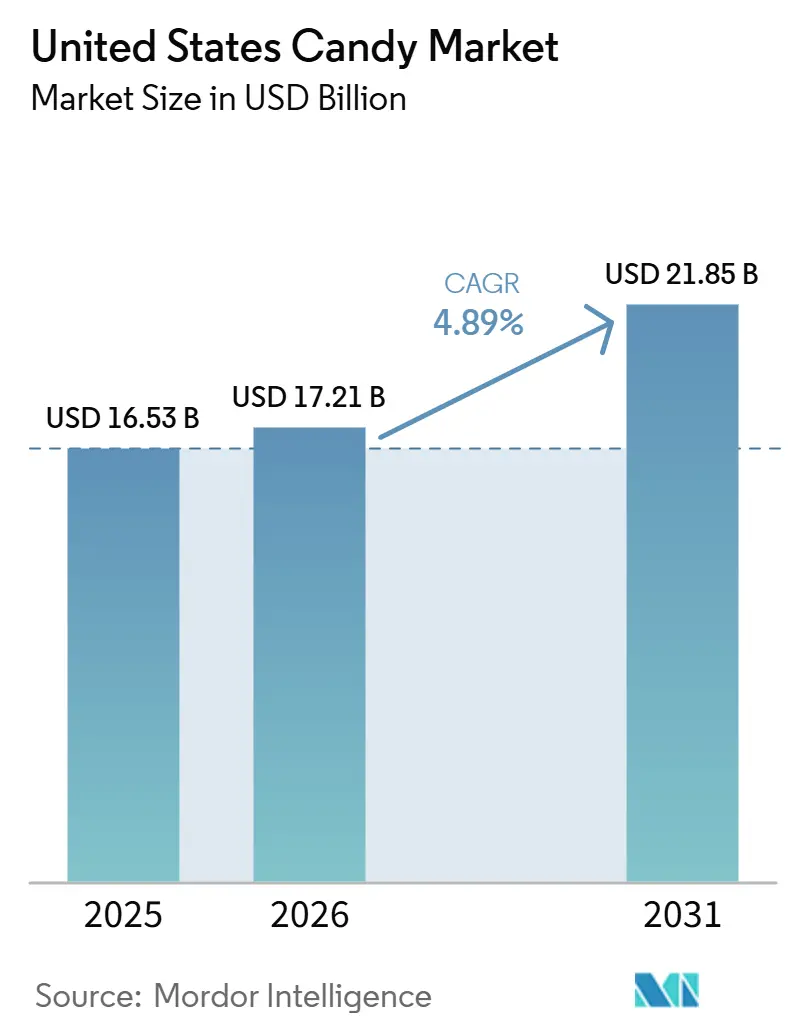
| Base Year Market Size (2025) | USD 16.53 Billion |
| Market Size (2026) | USD 17.21 Billion |
| Market Size (2031) | USD 21.85 Billion |
| Growth Rate (2026 - 2031) | 4.89 % |
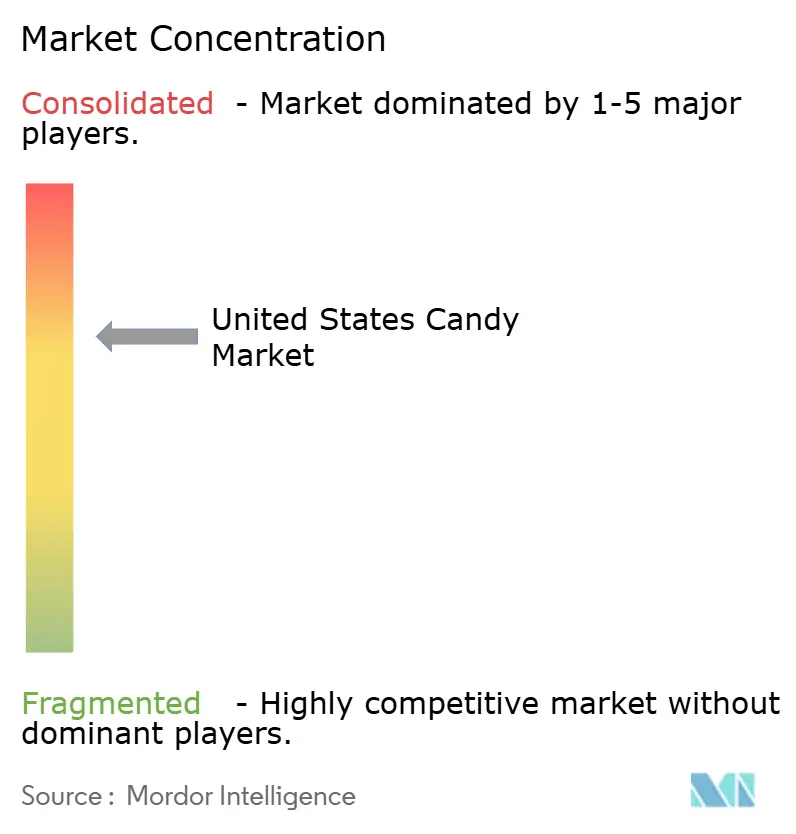
| Market Concentration | Medium |
Major Players *Disclaimer: Major Players sorted in no particular order Image © Mordor Intelligence. Reuse requires attribution under CC BY 4.0. | |
United States Candy Market Analysis by Mordor Intelligence
The United States candy market size is projected to reach USD 17.21 billion in 2026 and USD 21.85 billion by 2031, registering a CAGR of 4.89% during 2026-2031. Broad household participation continues to support the United States candy market, even as higher prices reduce unit purchases. In 2025, 99.8% of United States households are expected to purchase confectionery at least once, while 44% are expected to consume treats more than once a week, according to the National Confectioners Association[1]Source: National Confectioners Association, “State of Treating 2026,” National Confectioners Association, candyusa.com. Value growth is shifting toward premium products, novel formats, and smaller but more intentional purchases. Digital discovery is gaining importance among younger consumers, while stores continue to play a central role in impulse and seasonal purchases. Large manufacturers are also expanding beyond confectionery into broader snacking, creating opportunities for focused candy brands that can respond quickly to changing preferences in flavor, texture, and wellness.
Key Report Takeaways
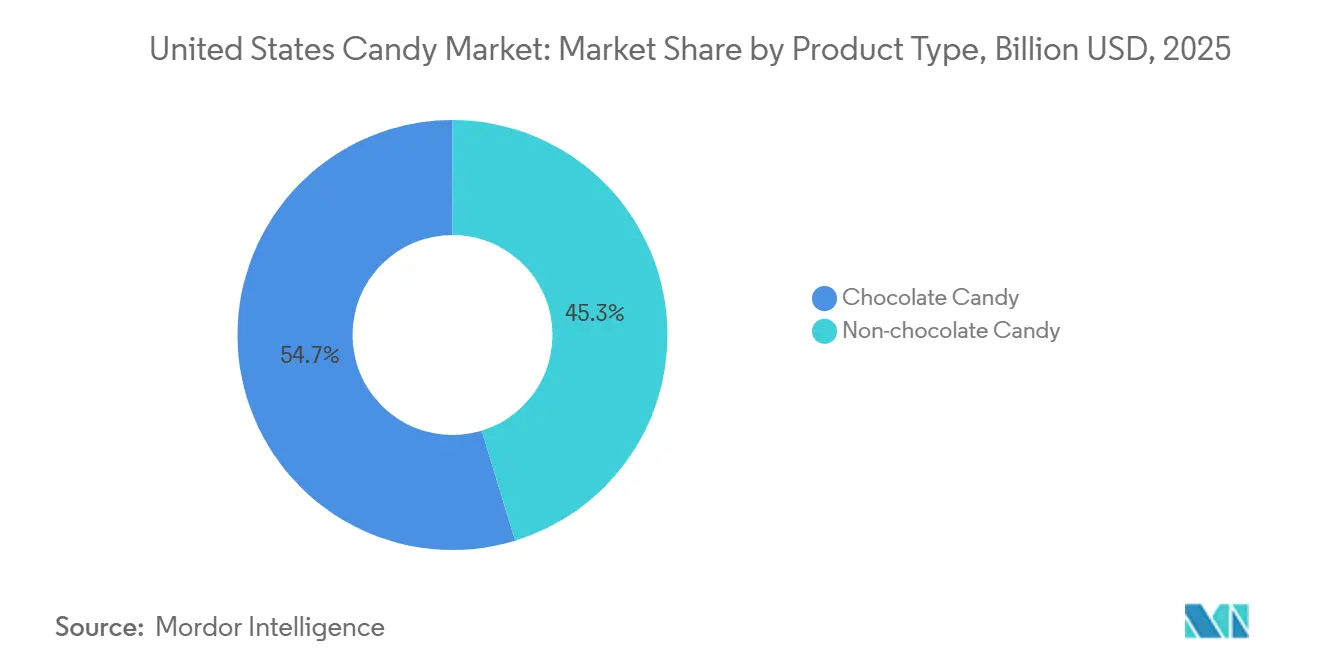
- By product type, chocolate candy held 54.71% of the United States candy market share in 2025, while non-chocolate candy is forecast to grow at a 6.96% CAGR through 2031.
- By ingredient type, sugar-based candy held 72.62% of the United States candy market share in 2025, while sugar-free and reduced-sugar candy is forecast to grow at a 7.01% CAGR through 2031.
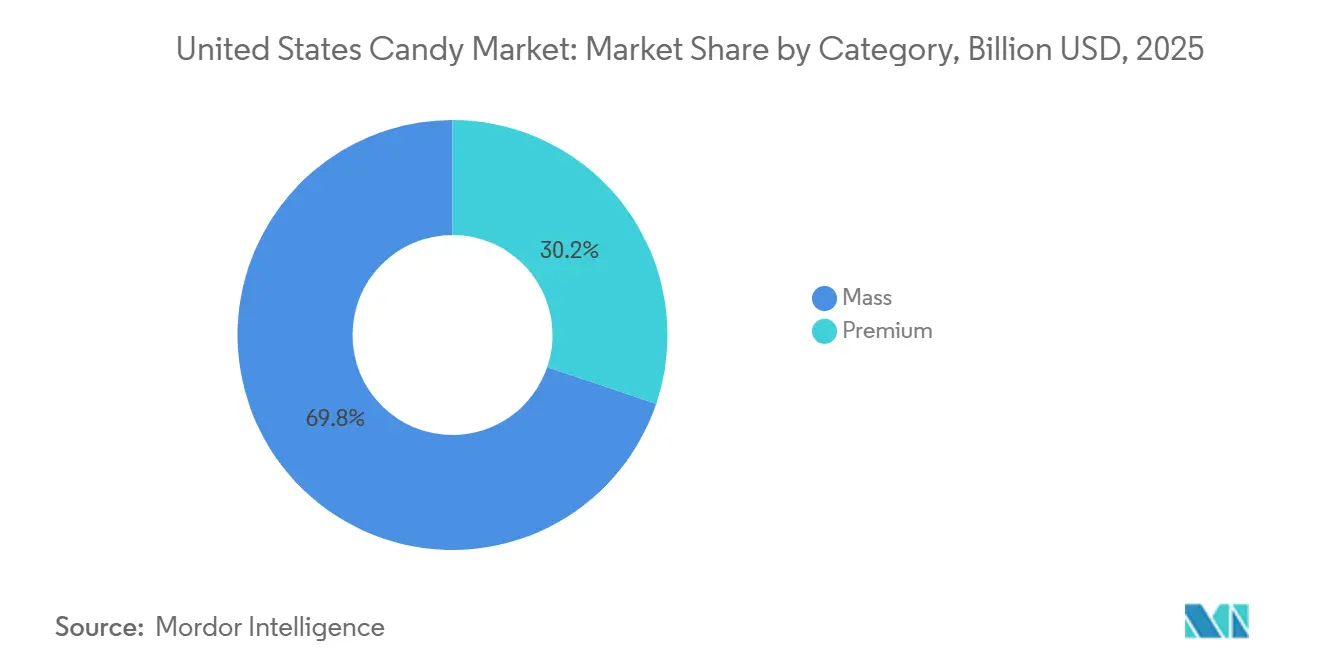
- By category, mass candy held 69.81% of the United States candy market share in 2025, while premium candy is forecast to grow at a 6.11% CAGR through 2031.
- By distribution channel, supermarkets and hypermarkets held 35.13% of the United States candy market share in 2025, while online retail stores are forecast to grow at a 7.51% CAGR through 2031.
Note: Market size and forecast figures in this report are generated using Mordor Intelligence’s proprietary estimation framework, updated with the latest available data and insights as of January 2026.
United States Candy Market Trends and Insights
Drivers Impact Analysis*
| Driver | (~) % Impact on CAGR Forecast | Geographic Relevance | Impact Timeline |
|---|---|---|---|
| Premiumization and affordable indulgence | +1.2% | National, with pronounced gains in the Northeast and West Coast urban markets | Medium term (2-4 years) |
| Omnichannel and direct-to-consumer discovery | +0.8% | National; spill-over to suburban and rural via e-commerce | Medium term (2-4 years) |
| Gummy, novel texture, and flavor innovation | +0.9% | National, skewed toward markets with high Gen Z/Millennial density | Short term (≤ 2 years) |
| Better-for-you, functional, and plant-based formulation | +0.6% | National; early adoption in the West Coast, Mountain West, and Northeast | Long term (≥ 4 years) |
| Product innovation and flavor variety | +0.5% | National | Short term (≤ 2 years) |
| Seasonal and occasion-based treating | +0.7% | National, with particular strength in the Southeast and the Midwest | Short term (≤ 2 years) |
| Source: Mordor Intelligence | |||
Premiumization and affordable indulgence
The phrase "affordable luxury" defines the consumption logic that sustains candy sales through inflationary cycles. However, the market structure beneath it is bifurcating in ways that require segmented responses. The National Confectioners Association's 2026 State of Treating report indicates that 82% of United States consumers agree it is acceptable to occasionally enjoy chocolate or candy, while 74% agree that physical and emotional well-being are interconnected. Among the 17% of consumers who identify as financially comfortable, brand and mood drive purchase decisions. Among the 24% who are financially tight or struggling, price and promotion dominate purchase decisions. Brands with only a mid-market position face pressure from both ends: premium entrants from above and private-label offerings from below, with limited insulation from either. Hershey's March 2026 Investor Day is expected to explicitly acknowledge this bifurcation, with the company committing to a pipeline of elevated, social-first indulgent formats targeted at Gen Z and a parallel "democratization of luxury" at accessible price points.
Gummy, novel texture, and flavor innovation
Texture-led innovation is reshaping the non-chocolate candy segment faster than traditional product development cycles can respond. Social media now functions as a product-validation platform. According to the National Confectioners Association, #freezedriedcandy generated 4.7 billion views on TikTok in 2025, shortening manufacturer entry timelines from years to months. Mars launched Skittles POP’d in 2024, soft-launched M&M’s POP’d Caramel on TikTok Shop in November 2025 before its nationwide rollout in January 2026, and Ferrara introduced freeze-dried SweeTARTS, Lemonheads, and Spree in August 2025. This shift shows that social commerce virality has compressed the product-launch risk cycle, giving agile mid-sized players a structural advantage over incumbents that still follow annual new-product development calendars. Ferrara’s Brach’s Crunchy Chewy Jelly Beans won Most Innovative New Product in the Seasonal Category at the 2026 Sweets & Snacks Expo, marking the company’s second consecutive innovation award at the event. This achievement indicates that multi-textural formats have become a durable platform rather than a passing trend.
Better-for-you, functional, and plant-based formulation
The better-for-you (BFY) candy segment has broader potential than purchase frequency indicates. Although only 10% of United States consumers frequently chose BFY candy in 2024, 62% recognized the category, creating a recognition-to-purchase gap that signals pent-up conversion potential. Manufacturers increasingly use sugar-free gummy formats as delivery vehicles for probiotics, prebiotic fibers, protein, and botanical extracts, repositioning these products within the wellness supplement aisle and enabling price premiums that conventional candy cannot achieve. Hispanic consumers are driving nuanced demand for these functional candy formats, representing a fast-growing demographic in major Sun Belt candy markets. Spanish-language industry sources confirm that the fastest-growing Latino candy brands in the US combine cultural authenticity, through sour, spicy, and heritage-inspired formats, with modern BFY credentials. Major multinationals have largely not addressed this intersection of flavor identity and better-for-you positioning, creating a formulation white space for targeted innovation.
Omnichannel and direct-to-consumer discovery
E-commerce, with a 7.51% CAGR, outpaces every other distribution channel, driven by structural factors that extend beyond convenience. Online channels support subscription models, bulk purchasing, and direct-to-consumer (DTC) access to limited editions that are unavailable in physical retail formats. According to the National Confectioners Association, these formats disproportionately attract younger, brand-loyal consumers. Gen Z discovery patterns highlight the channel’s strategic role: 48% of Gen Z consumers discovered new confectionery items through TikTok in 2025, compared with 58% of Boomers who continued to discover products primarily in-store, according to the National Confectioners Association. This divergence indicates that brands must operate two fundamentally different retail activation models simultaneously: a digitally native model and an impulse-driven in-store model. Mars’ dual-channel launch strategy for M&M’s POP’d, first on TikTok Shop, followed by nationwide mass retail distribution, demonstrates how leading brands use social commerce to test velocity before committing to shelf space. This approach reduces trade risk while building organic demand ahead of wider distribution. Brands that treat e-commerce as a secondary fulfillment channel rather than a primary discovery engine risk structural share loss within the decade.
Restraints Impact Analysis*
| Restraint | (~) % Impact on CAGR Forecast | Geographic Relevance | Impact Timeline |
|---|---|---|---|
| Cocoa and sugar cost volatility | -1.0% | National; disproportionate in chocolate-heavy mid-market segments | Medium term (2-4 years) |
| Added-sugar health pressure and GLP-1 portfolio risk | -0.8% | National; more acute in higher-income, health-conscious urban markets | Long term (≥ 4 years) |
| Private-label and promotion-led price compression | -0.6% | National; most acute in mass-market chocolate | Short term (≤ 2 years) |
| Packaging compliance and material-cost burden | -0.4% | National | Medium term (2-4 years) |
| Source: Mordor Intelligence | |||
Cocoa and sugar cost volatility
Volatility in cocoa and sugar prices continues to restrain the United States candy market by increasing manufacturing costs, compressing profit margins, and forcing confectionery companies to implement price increases, reduce pack sizes, or reformulate products. The USDA has highlighted persistent sugar policy and supply dynamics that keep the United States sugar prices above world levels, while unprecedented cocoa price spikes driven by adverse weather and crop disease in West Africa further intensified cost pressures during 2024–2025. Despite these challenges, manufacturers have relied on innovation to sustain demand. In 2025, The Hershey Company introduced new seasonal and flavor extensions while adjusting pricing strategies to offset cocoa inflation. In 2026, confectionery manufacturers continued launching premium and limited-edition products to encourage value-added purchases even as ingredient costs remained elevated. The National Confectioners Association reported that confectionery sales reached USD 55 billion in 2025, although inflation boosted dollar sales while unit volumes remained under pressure, underscoring how raw material volatility continues to constrain market expansion despite ongoing product innovation.
Added-sugar health pressure and GLP-1 portfolio risk
GLP-1 adoption is reshaping confectionery demand in more nuanced ways than the headline narrative of category decline suggests. In November 2024, Hershey's CEO acknowledged a "mild impact" from GLP-1s and, during the Q2 2025 earnings call, emphasized that the company did not expect a material impact through 2026. Nestlé also reported no significant category impact while developing portion-controlled formats for GLP-1 users. The impact across the category remains uneven: calorie-dense chocolate formats face the most direct pressure, while sugar-free gummies, smaller-portion premium formats, and functional candy are benefiting from redirected indulgence spending. This asymmetry indicates that the medium-term risk is not a collapse in volume but habituation drift, defined as a gradual reduction in the frequency of impulsive sugar consumption among a growing cohort of medicated consumers, which current POS data has yet to fully capture. The FDA's proposed front-of-package nutrition labeling framework, published in January 2025, would display "Low/Med/High" ratings for added sugars on most packaged foods[2]Source: U.S. Food and Drug Administration, “Front-of-Package Nutrition Labeling,” U.S. Food and Drug Administration, fda.gov. This framework adds a compliance timeline that will increase consumer scrutiny of high-sugar product lines and further accelerate reformulation investment across the candy segment.
*Our forecasts treat driver/restraint impacts as directional, not additive. The impact forecasts reflect baseline growth, mix effects, and variable interactions.
Segment Analysis
By Product Type: Non-chocolate Formats Gaining Structural Ground
According to the National Confectioners Association, non-chocolate candy increased its share of the total confectionery market from roughly one-third in 2015 to 40.9% by 2025, marking a decade-long structural shift across all outlets. With a projected CAGR of 6.96% from 2026 to 2031, the segment’s momentum now comes less from a single format and more from sensory innovation platforms, including freeze-dried, liquid-filled, popping, and multi-textural variants. These formats command price premiums and generate disproportionate social media engagement. Within non-chocolate candy, gummies, jellies, and chews represent the high-velocity sub-segment. Hard-boiled candies and mints remain stable and largely occasion-driven segments with limited structural growth. Toffees, caramels, and nougat offer a premium trade-up opportunity, particularly in gifting occasions and specialty retail channels.
Chocolate candy accounted for a 54.71% market share in 2025, supported by strong brand loyalty, impulse-driven purchases, and seasonal volume, attributes that no non-chocolate format has matched at scale. However, major players are developing products that intentionally bridge the two segments. Mars’s M&M’s POP’d Caramel and Ferrara’s freeze-dried SweeTARTS use texture modification to extend established chocolate-adjacent equity into experiential, non-chocolate-style territory[3]Source: Mars, Incorporated, “Mars to Acquire the Kellanova Family of Snack Food Brands,” Mars, Incorporated, mars.com. This cross-category blending is likely to moderate non-chocolate candy’s structural share gains while increasing the average revenue per unit across both product types. This dynamic favors innovators over steady-state operators in both segments.


By Ingredient Type: Sugar-Free Formulations Move from Niche to Mainstream
Sugar-based candies are expected to hold 72.62% of the ingredient-type market share in 2025, supported by consumer flavor preferences, manufacturing cost efficiency, and decades of accumulated brand equity. The 7.01% forecast CAGR for sugar-free and reduced-sugar candies during 2026-2031 indicates that the segment is moving beyond its health-store niche and entering mainstream retail. Regulatory developments are expected to accelerate this shift. The FDA’s proposed front-of-package nutrition labeling rule, expected to be published in January 2025, would display “Low/Med/High” ratings for added sugars on most packaged foods. This compliance framework would increase shelf-level scrutiny of traditional high-sugar candy lines and encourage reformulation investments across the category.
The formulation landscape has moved beyond simple sugar reduction to include functional ingredient integration. Manufacturers increasingly use sugar-free gummies as delivery formats for probiotics, prebiotic fibers, vitamins, and botanical extracts, repositioning the format from a compromise purchase to a wellness-oriented choice. Ingredient companies such as BENEO have introduced Isomalt-based sugar-free hard candy concepts designed to achieve sensory parity with sugar-based formats, indicating that the texture and flavor gap is narrowing. SmartSweets, available in more than 55,000 retail locations across the United States and Canada, including Target, Walmart, Whole Foods, and Costco, and Russell Stover’s no-sugar-added seasonal chocolate line, introduced across national chains in September 2024, show how both challenger and incumbent brands are scaling within this ingredient paradigm.
By Category: Premium Expansion Accelerating Despite Mass Dominance
Premium candy is the fastest-growing category, with a projected CAGR of 6.11% from 2026 to 2031. Meanwhile, mass candy is expected to retain 69.81% of the category share in 2025, supported by broad retail accessibility, promotional depth, and its status as a household staple. This growth divergence reflects a shift in consumption occasions. Consumers increasingly purchase premium candy as a gifting option or a deliberate self-reward rather than as an impulse buy, which helps insulate the segment from the price sensitivity that influences mass-market transactions. Lindt’s internal data indicates that the United States GLP-1 users are expected to increase premium chocolate purchases by 17% in 2025, compared with 6.5% for non-users. This trend directly illustrates how intentional consumption, characterized by less frequent but higher-value purchases, structurally supports the premium tier.
Mass candy’s volume challenge presents a more critical strategic issue for legacy incumbents. By the end of 2025, cumulative inflation is expected to push confectionery prices roughly 40% above 2019 levels. According to the National Confectioners Association, the average confectionery price per unit is expected to rise 6.9% year-over-year, outpacing total grocery prices at 2.6%, dairy at 5.6%, and meat at 4.7%. This price inflation gap is driving private-label switching, with private label approaching a 5% share in chocolate, a category that has historically resisted private-label penetration. To defend mass category share, companies will need to prioritize pack-size innovation, promotional discipline, and value-tier product architecture rather than relying on further price escalation.
By Distribution Channel: Online Retail's 7.51% CAGR Reshapes the Candy Shelf
Supermarkets and hypermarkets are expected to retain the largest distribution channel share in 2025, at 35.13%, supported by high foot traffic, impulse placement strategies, and seasonal front-of-store activations. Convenience stores, specialty retailers, and other channels serve distinct consumption occasions, including on-the-go snacking, premium gifting, and event-driven purchasing, with each channel offering differentiated assortments and pricing structures. Online retail stores are projected to record a 7.51% CAGR from 2026 to 2031, driven by subscription formats, bulk buying behavior, and DTC access to limited-edition and premium brands with constrained physical distribution.
E-commerce’s strategic significance is structural rather than incremental. According to the National Confectioners Association, it is expected to account for 7% of total confectionery sales in 2025 and is projected to more than double its penetration share by the mid-2030s. Brands such as YumEarth and SmartSweets, which built audiences through DTC channels and Amazon before entering mass retail, have effectively reversed the traditional go-to-market sequence. The NCA’s 2026 State of Treating report is expected to recommend that mainstream confectioners emulate this model by expanding their e-commerce presence, “particularly around gifting and seasonal promotions,” and using TikTok to drive product discovery. According to the National Confectioners Association, seasonal sales are expected to represent 63% of total confectionery revenues in 2025, suggesting that online retail’s fastest near-term growth opportunity lies in seasonal gifting and occasion-based treating, where e-commerce subscription, bulk-buying, and curation models outperform in-store execution.
Geography Analysis
The United States candy market is national in scope, but regional demand varies by population density, income, health preferences, and retail access. The Northeast is a major revenue center due to its dense population, established retail base, and concentration of higher-income consumers. Demand in the region aligns more with premium products and seasonal occasions than with large increases in unit volume. Consumers may buy treats less often but place greater value on quality and gifting, supporting premium chocolate, specialty retail, and smaller formats. The Northeast also serves as a useful market for testing products that combine indulgence with portion control. Retailers can address this demand through premium assortments, specialty placement, and seasonal presentations. Mass products remain relevant, but the region’s demand profile changes the balance between value and volume.
The South and Southeast offer different growth conditions for the United States candy market. Population growth and lower living costs support regular mass-candy purchases, while the expanding Hispanic consumer base broadens demand for sour, spicy, and heritage-inspired flavors. Texas and Florida are particularly relevant due to their large Hispanic populations and broad retail networks, making them important launch markets for brands combining culturally familiar flavors with mainstream availability. Seasonal treating also has particular strength in the Southeast and Midwest, according to the market’s driver assessment. These regions remain important for retailers that rely on high-visibility holiday displays, accessible price points, flavor variety, and large-format or multipack products for family and event occasions. The opportunity depends on maintaining consistent product availability across diverse retail formats.
The West is a leading area for better-for-you, functional, and direct-to-consumer candy. Health-focused consumers, natural and specialty retailers, and strong internet access support reduced-sugar and functional products, especially in California, Washington, and Colorado. The region can serve as an early testing ground for challenger brands that begin online or in specialty stores. Successful products can use early sales results to seek wider distribution, helping reshape entry into the United States candy market. This pathway favors brands that pair a clear product benefit with digital discovery and reliable retail execution. Direct sales also provide feedback on flavors, package sizes, and messages, helping companies refine their offers before expanding production and pursuing national retail consideration.
Competitive Landscape
The United States candy market has a moderately consolidated top tier, led by Mars, Hershey, Ferrero, and Mondelēz, while specialty and mid-sized brands remain fragmented. Major companies are expanding through broader snack portfolios rather than relying solely on candy. Mars is expected to complete its USD 36 billion acquisition of Kellanova in late 2025, combining M&M’s, Snickers, Skittles, and Twix with Pringles, Cheez-It, and Pop-Tarts under Mars Snacking. Hershey is expected to complete its USD 750 million acquisition of LesserEvil in April 2025, adding an organic and better-for-you snack business. These moves show that large manufacturers are building platforms across indulgent, salty, and functional snacking. They may also create opportunities for smaller candy brands focused on distinctive formats, textures, flavors, or lower-sugar propositions. To sustain this advantage, smaller brands must convert early consumer interest into consistent distribution and repeat purchases.
Private-label growth presents a key competitive challenge in the United States candy market, especially in mass chocolate. Private-label chocolate candy sales increased while branded equivalents declined, with store-brand share nearing 5% despite historical penetration challenges. This pressure makes product differentiation more important than price matching. Hershey’s March 2026 investor presentation is expected to describe investments in supply chain automation and a five-year innovation pipeline across premium confectionery, salty snacks, and functional snacking. Large companies are pursuing efficiency and product relevance at the same time. Automation can help manage costs, but innovation must give shoppers a clear reason to choose branded items over lower-priced private-label alternatives. Therefore, the competitive response depends on combining operational discipline with visible product differentiation.
Social-first launches are changing how companies compete for consumer attention. Mars is expected to use TikTok Shop and MMS.com to introduce M&M’s POP’d Caramel before taking it nationwide in January 2026. Ferrara is expected to continue investing in gummy and texture-led products, including NERDS Juicy Gummy Clusters in September 2025. Ferrara’s holding company is also expected to enter exclusive discussions in July 2025 to acquire CPK Group, a French candy and chocolate producer. These actions highlight the value of speed, distinctive textures, and broader production capabilities. Brands with strong social communities can test ideas before major retail investment, identify effective messages and formats, and then use retail distribution to convert interest into repeat purchases and broad availability. Companies that coordinate these steps are better positioned to respond to fast-moving product trends.
United States Candy Industry Leaders
The Hershey Company
Mars Incorporated
Ferrero International SA
Mondelēz International, Inc.
Chocoladefabriken Lindt and Sprüngli AG
- *Disclaimer: Major Players sorted in no particular order

Recent Industry Developments
- May 2026: Perfetti Van Melle USA launched Bubblicious Gummy Gum, a first-of-its-kind dual-texture product combining soft gummy candy with classic bubble gum in Strawberry Orange and Watermelon Original flavors, available at retailers nationwide. The launch represented direct entry into the hybrid-texture segment that had drawn accelerating consumer and manufacturer interest since 2024.
- February 2026: Sweet Venture Group launched Gummi Popz, the world's first popping gummy candy, combining a chewy gummy texture with popping candy for a multi-sensory snacking experience. The product rolled out nationally across Walmart, Albertsons/Safeway, Circle K, and H-E-B, expanding the brand’s retail presence and strengthening its position in the hybrid-texture candy segment.
- January 2026: Mars launched M&M's POP'd Caramel to stores nationwide after a TikTok Shop and MMS.com soft launch in November 2025, following the 2024 success of Skittles POP'd. The dual-channel launch established Mars's social-commerce-first go-to-market model as a repeatable template for major confectionery SKUs.


United States Candy Market Report Scope
Candy broadly refers to any confection made primarily from sugar, honey, or chocolate, and often flavored or combined with nuts, fruit, or syrup. The United States candy market report is segmented by product type, ingredient type, category, and distribution channel. By product type, the market is segmented into chocolate candy and non-chocolate candy. The non-chocolate candy segment is further sub-segmented into hard-boiled candies, pastilles, gums, jellies, and chews, toffees, caramels, nougat, mints, and other non-chocolate candies. By ingredient type, the market is segmented into sugar-based and sugar-free/reduced-sugar. By category, the market is segmented into mass and premium. By distribution channel, the market is segmented into supermarkets/hypermarkets, convenience stores, specialty retailers, online retail stores, and other channels. The Market forecasts are provided in terms of value (USD).
| Chocolate Candy | |
| Non-chocolate Candy | Hard-boiled Candies |
| Pastilles, Gums, Jellies, and Chews | |
| Toffees, Caramels, and Nougat | |
| Mints | |
| Other Non-chocolate Candies |
| Sugar-based Candies |
| Sugar-free / Reduced-sugar Candies |
| Mass |
| Premium |
| Supermarkets/Hypermarkets |
| Convenience Stores |
| Specialty Retailers |
| Online Retail Stores |
| Other Distribution Channels |
| Product Type | Chocolate Candy | |
| Non-chocolate Candy | Hard-boiled Candies | |
| Pastilles, Gums, Jellies, and Chews | ||
| Toffees, Caramels, and Nougat | ||
| Mints | ||
| Other Non-chocolate Candies | ||
| Ingredient Type | Sugar-based Candies | |
| Sugar-free / Reduced-sugar Candies | ||
| Category | Mass | |
| Premium | ||
| Distribution Channel | Supermarkets/Hypermarkets | |
| Convenience Stores | ||
| Specialty Retailers | ||
| Online Retail Stores | ||
| Other Distribution Channels | ||


Key Questions Answered in the Report
What is the forecast for the United States candy market?
The United States candy market was forecast to grow from USD 17.21 billion in 2026 to USD 21.85 billion by 2031, at a 4.89% CAGR. Household participation, premium purchases, new formats, online discovery, and seasonal demand supported the outlook across retail and direct-to-consumer channels.
Which product type is growing fastest in United States confectionery?
Non-chocolate candy is the fastest-growing product type, with a forecast 6.96% CAGR through 2031. Gummy, freeze-dried, and multi-textural formats support this growth. These formats give consumers a visible reason to try familiar brands in a different form and help companies build interest through short-form social content.
Why are reduced-sugar candy products expanding?
Sugar-free and reduced-sugar candy is forecast to grow at a 7.01% CAGR through 2031. Demand is supported by wellness preferences, functional ingredients, and attention to added-sugar labeling. Wider retail distribution is helping reduced-sugar products move beyond specialty outlets and into regular supermarkets, clubs, and mass retail shopping occasions.
How important is online retail for candy brands?
Online retail stores are forecast to grow at a 7.51% CAGR through 2031. The channel supports product discovery, limited editions, direct sales, subscriptions, and gifting. It also lets brands test new products before a broad store rollout and learn which package, flavor, and message attracts the strongest response.
Page last updated on:





