
United States Battery Recycling Market Size and Share
Market Overview
| Study Period | 2022 - 2032 |
|---|---|
| Forecast Data Period | 2027 - 2032 |
| Base Year Market Size (2026) | USD 6.06 Billion |
| Market Size (2027) | USD 7.11 Billion |
| Market Size (2032) | USD 24.77 Billion |
| Growth Rate (2027 - 2032) | 28.35 % |
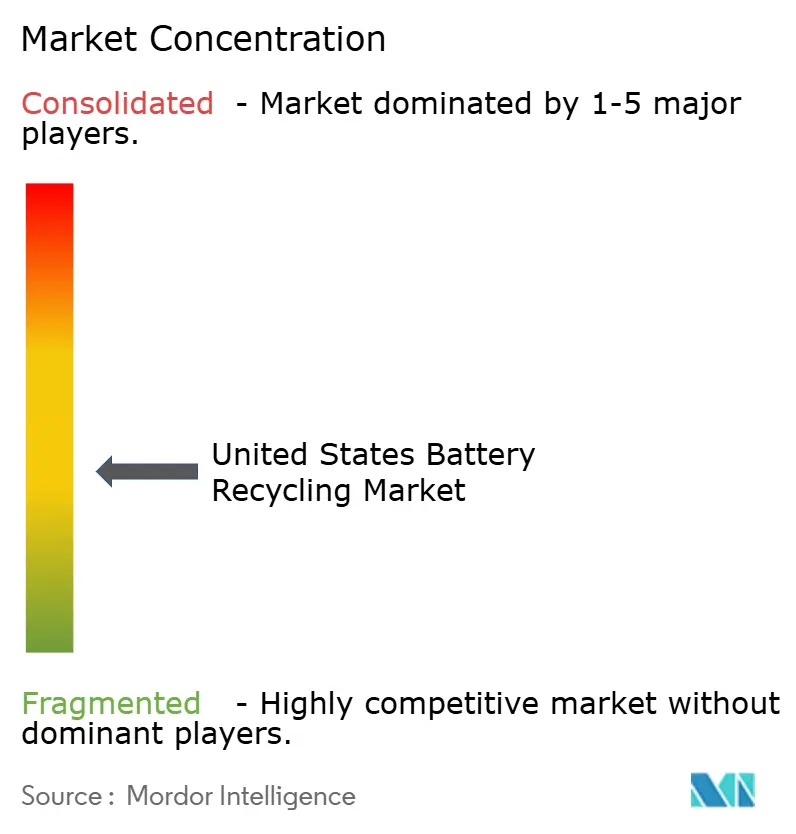
| Market Concentration | Medium |
Major Players *Disclaimer: Major Players sorted in no particular order Image © Mordor Intelligence. Reuse requires attribution under CC BY 4.0. | |
United States Battery Recycling Market Analysis by Mordor Intelligence
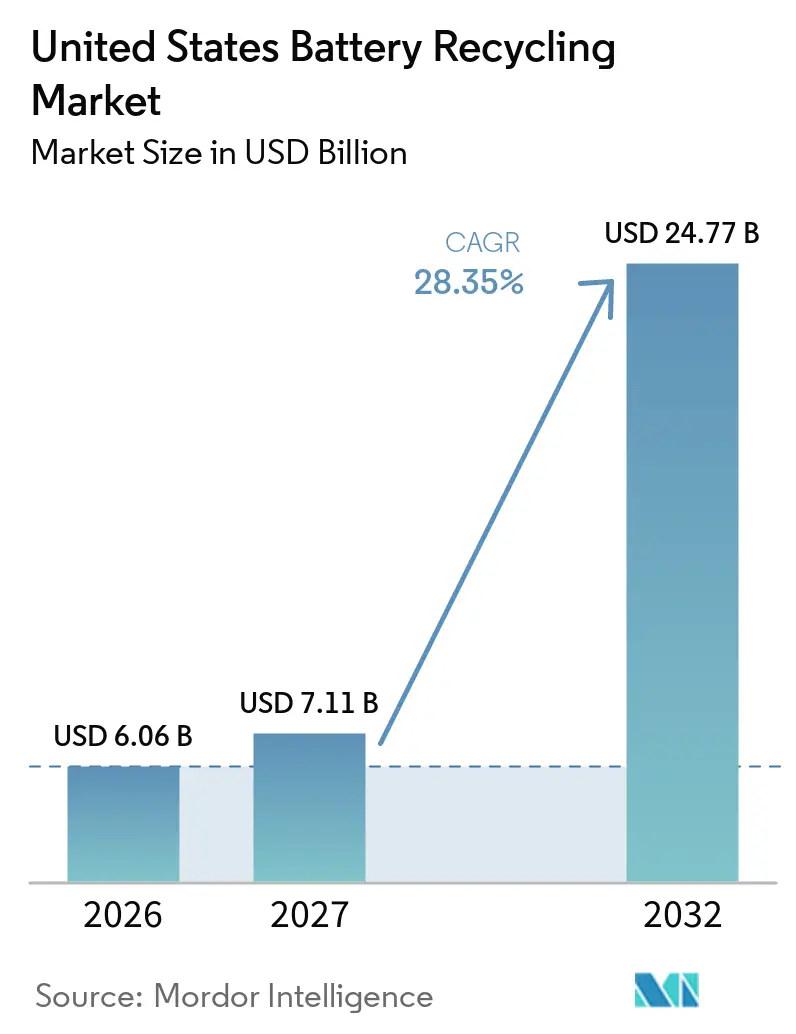
The United States battery recycling market size is projected to expand from USD 6.06 billion in 2026 and USD 7.11 billion in 2027 to USD 24.77 billion by 2032, at a CAGR of 28.35% between 2027 and 2032. The US battery recycling market is expanding as electric vehicle adoption, battery manufacturing, and critical mineral policy increase the value of domestic recovery capacity. Federal action on recoverable critical minerals has made domestic processing more important for recyclers that previously depended on overseas refining routes. The near-term feedstock base remains weighted toward manufacturing scrap, while end-of-life vehicle packs are expected to become more significant later in the forecast period. Companies are therefore pursuing supply agreements, processing technology, and refining capacity simultaneously. This creates opportunities for integrated operators, but also exposes single-revenue businesses to financing, construction, and material-price risks.
Key Report Takeaways
- By battery chemistry, lead-acid held 73.3% of the US battery recycling market share in 2026, while lithium-ion is forecast to grow at a 35.3% CAGR through 2032.
- By source of scrap, automotive batteries accounted for 57.5% of the US battery recycling market share in 2026, while manufacturing scrap is forecast to expand at a 30.1% CAGR through 2032.
- By recycling technology, pyrometallurgical processing held 43.2% of the US battery recycling market share in 2026, while hydrometallurgical processing is projected to grow at a 29.2% CAGR through 2032.
- By process stage, collection and logistics accounted for 29.4% of the US battery recycling market size in 2026, while material refining and recovery is forecast to grow at a 31.3% CAGR through 2032.
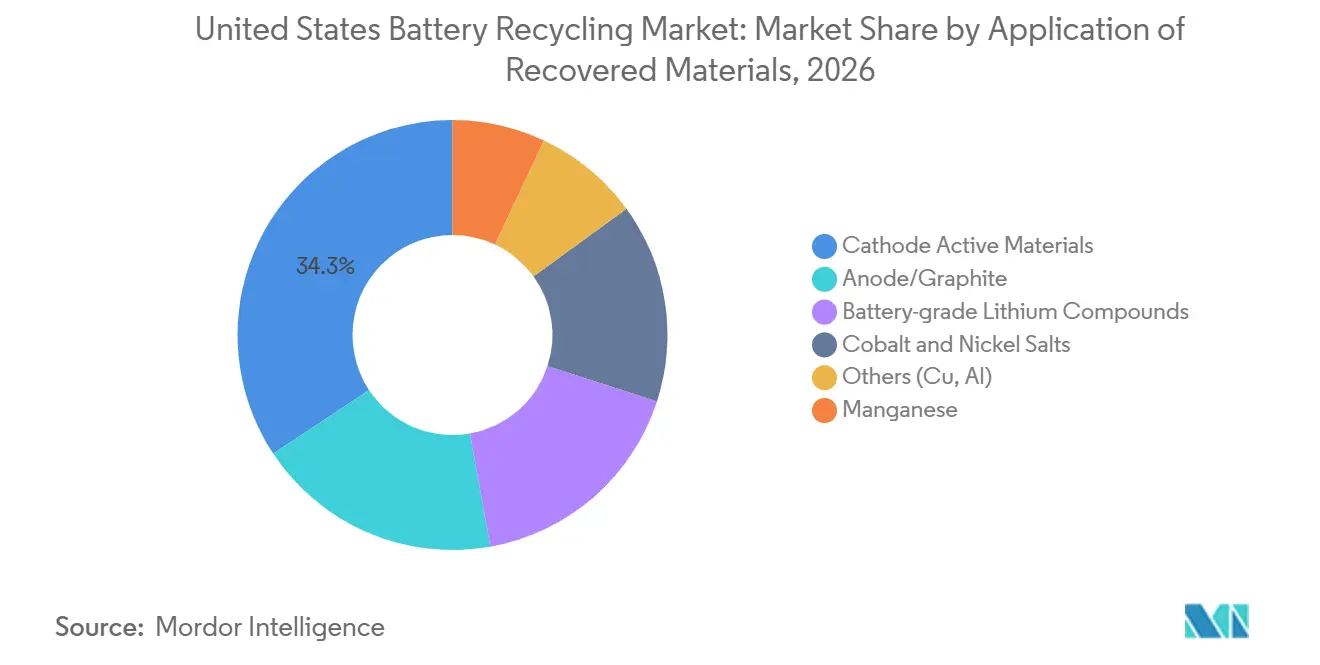
- By application of recovered materials, cathode active materials held 34.3% of the US battery recycling market size in 2026, while battery-grade lithium compounds are projected to expand at a 32.4% CAGR through 2032.
- By end-user industry, automotive held 58.7% of the US battery recycling market share in 2026, while power and energy storage is forecast to grow at a 29.5% CAGR through 2032.
Note: Market numbers in this report are based on Mordor Intelligence's proprietary estimation framework, which combines nine months of actuals with Q4 projections for base year 2026.
United States Battery Recycling Market Trends and Insights
Drivers Impact Analysis*
| Driver | (~) % Impact on CAGR Forecast | Geographic Relevance | Impact Timeline |
|---|---|---|---|
| EV Electrification Expands End-of-Life Battery Feedstock | +7.2% | National, with the highest concentration in California, Texas, Florida, and Southeast EV-adoption clusters | Medium term (2-4 years) |
| Domestic Critical-Mineral Security Raises Recycled-Material Demand | +5.8% | Global, with direct effects on national recycling investment and offtake policy | Long term (≥ 4 years) |
| Manufacturing Scrap Creates Predictable Feedstock | +3.4% | Midwest and Southeast gigafactory corridors, including Ohio, Tennessee, South Carolina, and Georgia | Short term (≤ 2 years) |
| DOE Grants and Tax Incentives Support Commercial Capacity | +3.1% | National, including DOE-funded activity in South Carolina, Georgia, Nevada, Ohio, and California | Medium term (2-4 years) |
| Hydrometallurgical and Direct-Recycling Yields Raise Recoverable Value | +2.5% | National, with activity in Nevada, Ohio, and Southeast processing hubs | Long term (≥ 4 years) |
| OEM Traceability and Recycled-Content Commitments Support Demand | +2.1% | National, with partnerships across the Midwest and Southern manufacturing belt | Short term (≤ 2 years) |
| Source: Mordor Intelligence | |||
Electrification Expands End-of-Life EV Battery Feedstock
The US battery recycling market is set to receive a larger supply of end-of-life EV batteries as earlier electric vehicles reach retirement. The United States had 3 million EVs on the road in 2024. Published 2026 research placed potential US end-of-life EV battery volumes at 1 million to 2 million metric tons by 2030 and 3 million to 5 million metric tons by 2035. Current recycler throughput still depends heavily on manufacturing scrap rather than retired vehicle packs. This means capacity decisions made now must accommodate a feedstock profile that will change as vehicle retirements increase. Recyclers also need to prepare for differences between the chemistry of future retired packs and the chemistry of current production scrap.
The expected shift in feedstock affects collection, testing, dismantling, and material recovery throughout the US battery recycling market. Manufacturing scrap usually arrives with documented chemistry and a known condition. Retired vehicle packs may have varying states of charge, different pack designs, and damage from use or accidents. End-of-life material is expected to match production scrap volumes by 2028 and to account for 80% of the recyclable pool by 2035. These conditions favor companies that develop collection networks and safe handling procedures before volumes rise. The later feedstock wave can support higher utilization, but only if recycling facilities can process a wider mix of batteries efficiently.
Domestic Critical-Mineral Security Increases Recycled-Material Demand
Domestic critical-mineral policy is changing the role of the US battery recycling market in the battery supply chain. A Presidential Determination dated July 30, 2026, identified recoverable critical minerals and materials as essential to national defense.[1] The related Bureau of Industry and Security allocation order took effect on August 27, 2026, and requires US persons to allocate 100% of monthly black mass sales to US persons unless an exception applies.[2] The requirement makes domestic refining more relevant for companies that previously sold black mass to overseas refiners. It also directs more commercial attention toward lithium carbonate (Li2CO3), nickel sulfate (NiSO4), cobalt sulfate (CoSO4), and other refined outputs. The policy can support domestic offtake relationships by making processing within the United States more important to the value chain.
This policy framework places additional pressure on recyclers who only shred or produce intermediate black mass. Those firms may need to build hydrometallurgical capacity, use tolling arrangements, or form partnerships with domestic refiners. The US battery recycling market can therefore gain more value from refining rather than from intermediate-material sales alone. Pyrometallurgical operators may also face added pressure where their outputs require further processing before battery-grade use. Hydrometallurgical and direct-recycling processes are better suited to producing targeted battery materials. The commercial outcome will depend on whether new refining facilities reach operation on schedule and meet battery-grade specifications.
Battery Manufacturing Scrap Creates Earlier, More Predictable Feedstock
Battery manufacturing scrap supplies the US battery recycling market with a more predictable near-term feedstock source. It generally has known chemistry, documented discharge conditions, and contracted access from cell manufacturers. Argonne National Laboratory modeled a 92% manufacturing yield assumption and found that battery plants can supply more recycled material than end-of-life vehicles through 2035.[3] This supports recycler business models based on production scrap while vehicle-retirement volumes remain limited. General Motors and Redwood Materials expanded their partnership in May 2024 to include production scrap from Ultium Cells facilities in Ohio and Tennessee. Redwood Materials reported receiving more than 28,000 metric tons of material from General Motors and Ultium Cells by June 2026.
This feedstock source provides operational benefits, but it also creates concentration risk for the US battery recycling market. A recycler with only a small group of factory suppliers can face lower utilization if a production line changes output or chemistry. Chemistry shifts from nickel manganese cobalt cells to lithium iron phosphate cells can reduce the value of recovered nickel and cobalt. The material remains recyclable, but the revenue profile can change. Companies, therefore, need contracts that address volume, chemistry, ownership, and processing terms. Manufacturing scrap is an important bridge to future end-of-life volumes, but not a complete substitute for broad collection capability.
DOE Grants and Tax Incentives De-Risk Commercial-Scale Capacity
Federal funding is supporting commercial expansion across the US battery recycling market. The Department of Energy Battery Manufacturing and Recycling Grants Program had deployed USD 1.82 billion across 14 projects in its first two rounds.[4] On August 20, 2026, Round 3 added USD 500 million across 7 projects. The awards included USD 100 million for Nth Cycle and USD 50 million for Princeton NuEnergy. The support can reduce the financing burden for first-of-kind plants, especially facilities that add refining capacity. It can also make projects more attractive to private investors and industrial partners.
Grant support does not remove construction or operating risks in the US battery recycling market. Ascend Elements filed for Chapter 11 in April 2026 after construction disputes, cancelled federal grants, and lower lithium prices affected its position. The case shows that project funding must be matched by reliable execution, feedstock, and customers. Section 45X can provide a 10% production-cost credit for qualifying electroactive materials. That credit can improve economics for facilities that operate at scale. Companies must still reach production before they can benefit from the longer-term revenue support.
Restraints Impact Analysis*
| Restraint | (~) % Impact on CAGR Forecast | Geographic Relevance | Impact Timeline |
|---|---|---|---|
| High Collection, Handling, and Transportation Costs for Damaged Packs | -2.8% | National, with the greatest effect in low-density rural areas and states without extended producer responsibility mandates | Short term (≤ 2 years) |
| Feedstock Timing Mismatch Between Capacity and End-of-Life Volumes | -2.4% | National, with a larger effect in states pursuing aggressive capacity targets | Medium term (2-4 years) |
| Chemistry and Pack-Format Diversity Complicates Standardized Processing | -1.9% | National, particularly in multi-chemistry processing hubs | Long term (≥ 4 years) |
| Fire, Permitting, and Environmental Liability Raise Operating Risk | -1.5% | National, with greater exposure in states with strict air and hazardous-waste permitting | Medium term (2-4 years) |
| Source: Mordor Intelligence | |||
High Collection, Handling, and Transportation Costs for Damaged Packs
Collection and transportation remain challenging aspects of the US battery recycling market, particularly for damaged lithium-ion packs. The Pipeline and Hazardous Materials Safety Administration classifies lithium batteries as Class 9 hazardous materials. Damaged or defective batteries are subject to stricter packaging, carrier training, and transportation requirements. These requirements increase the cost of moving heavy packs from collision sites, dealerships, service centers, and remote locations. The Environmental Protection Agency also outlines federal requirements for the management and recycling of lithium-ion batteries. These obligations can limit the number of economically viable collection points.
The geographic distribution of facilities adds to cost pressures in the US battery recycling market. Lithium-ion processing capacity remains concentrated in a limited number of states, leaving rural areas and interior regions far from permitted dismantling or refining facilities. Lead-acid recycling developed a broad network over many decades, whereas lithium-ion collection systems are comparatively newer. Pack condition is also a factor, as damaged packs require additional safety controls before shipment and processing. Improving local collection, diagnostic testing, and safe transportation can reduce these constraints over time.
Feedstock Timing Mismatch Between New Capacity and End-of-Life Volumes
The timing gap between new processing capacity and available feedstock is a key restraint in the US battery recycling market. Ascend Elements Incorporated filed for Chapter 11 in April 2026, while Li-Cycle Holdings Corporation entered creditor protection in May 2025 before its acquisition by Glencore PLC. These events illustrate the difficulty of financing plants built to process end-of-life volumes that have not yet materialized. Manufacturing scrap is currently available but is often covered by supply agreements and does not consistently fill large facilities. As a result, new plants may operate below planned capacity in their early years, increasing the burden of fixed costs and debt service.
Lithium price fluctuations add further uncertainty to the US battery recycling market. Lower prices during 2024 and 2025 reduced the value of recovered black mass. Recyclers cannot rely solely on projected inbound material when capacity is expanding ahead of end-of-life volumes. Long-term supply agreements, offtake contracts, and staged construction can help manage this exposure. Companies also need capacity that can handle both manufacturing scrap and end-of-life packs. A flexible operating model will remain important until battery retirements provide a larger and more consistent supply.
*Our forecasts treat driver/restraint impacts as directional, not additive. The impact forecasts reflect baseline growth, mix effects, and variable interactions.
Segment Analysis
By Battery Chemistry: Lead-Acid Retains Revenue Leadership While Lithium-Ion Drives Growth
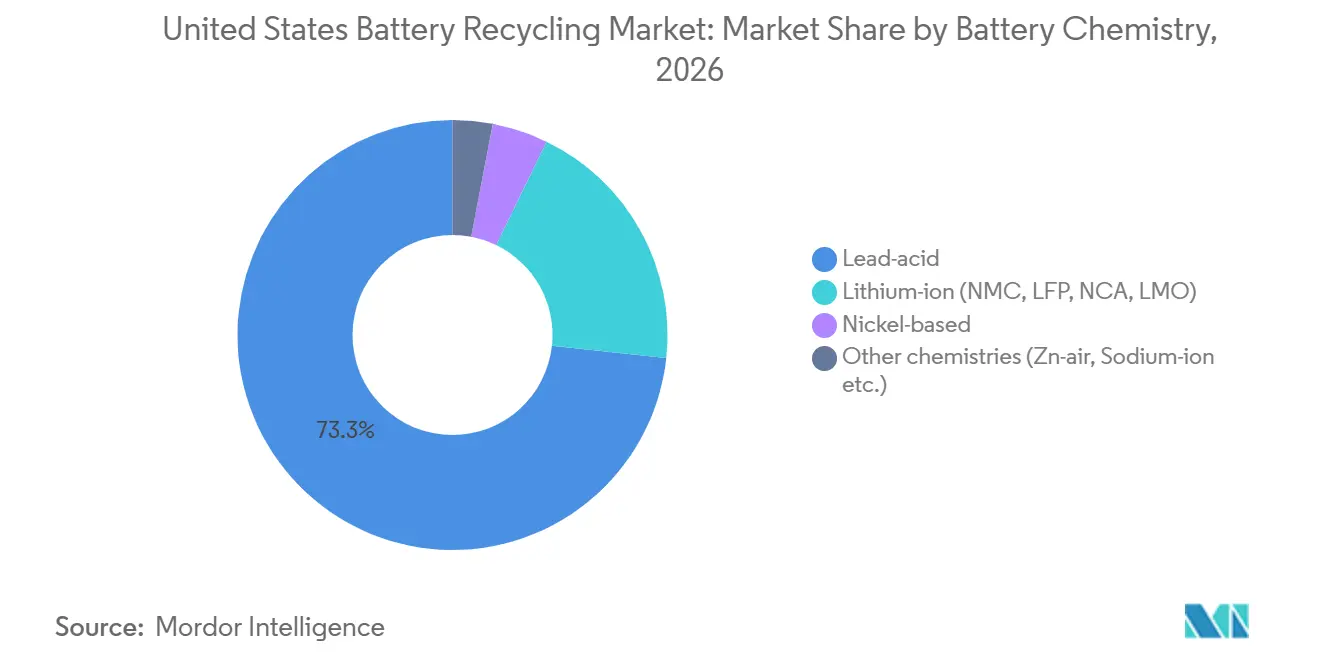
Lead-acid batteries held 73.3% of the US battery recycling market share in 2026. Their position reflects an established closed-loop collection and recovery system. Secondary lead accounted for more than 80% of US lead battery production in the supplied research base. This infrastructure provides established collection routes, processing methods, and end markets. Lithium-ion batteries are forecast to grow at a 35.3% CAGR through 2032, driven by EV adoption, manufacturing scrap, and domestic critical-mineral policy. The two chemistries serve different parts of the US battery recycling market. Lead-acid offers a mature revenue base, while lithium-ion is attracting new capacity and technology investment. Nickel-based and other chemistries remain smaller contributors but broaden the required processing capability.
Lithium-ion recycling economics vary by battery chemistry. Nickel manganese cobalt batteries have a higher recoverable nickel and cobalt value per unit than lithium iron phosphate batteries in the supplied research base. Lithium iron phosphate is gaining use in stationary storage and mid-range EV applications. Its material profile contains no cobalt or nickel premium, which increases the importance of process efficiency and direct recycling for lithium iron phosphate feedstock. Research on recycling routes also indicates that next-generation batteries will require process adaptation.[5] The US battery recycling market must therefore avoid designs that depend on a single chemistry. Facilities capable of safely processing multiple feedstocks are better positioned to manage changes in battery production and retirement patterns.

By Source of Scrap: Automotive Batteries Lead While Manufacturing Scrap Supports Early Growth
Automotive batteries accounted for 57.5% of scrap-source revenue in 2026, reflecting the size of automotive packs and the importance of partnerships between automakers and recyclers. Manufacturing scrap is forecast to expand at a 30.1% CAGR through 2032. Argonne modeling supports the view that production scrap can exceed end-of-life vehicle material through 2035 under a 92% yield assumption. Consumer electronics remain a relevant source, but their relative importance decreases as EV and energy-storage volumes rise. Industrial and energy-storage batteries can provide a stable flow with known decommissioning schedules. Source diversity reduces reliance on a single set of suppliers and affects how facilities plan collection, storage, and processing capacity. The US battery recycling market must balance current factory scrap with future vehicle returns.
Manufacturing scrap is operationally attractive because it typically has consistent chemistry and controlled handling conditions, and it often comes directly from cell plants under supply contracts. Automotive end-of-life packs require inspection, discharge, dismantling, and more varied logistics. The supplied research base expects the combined North American scrap pool to grow more than 9.5 times between 2025 and 2035, with most later growth expected from end-of-life batteries after 2028. Recyclers focused on factory scrap can establish throughput and commercial relationships before that shift occurs, but they also need collection arrangements for automotive packs. A business model that combines both sources can support utilization through changes in the US battery recycling market.
By Recycling Technology: Pyrometallurgy Leads While Hydrometallurgy Gains Ground
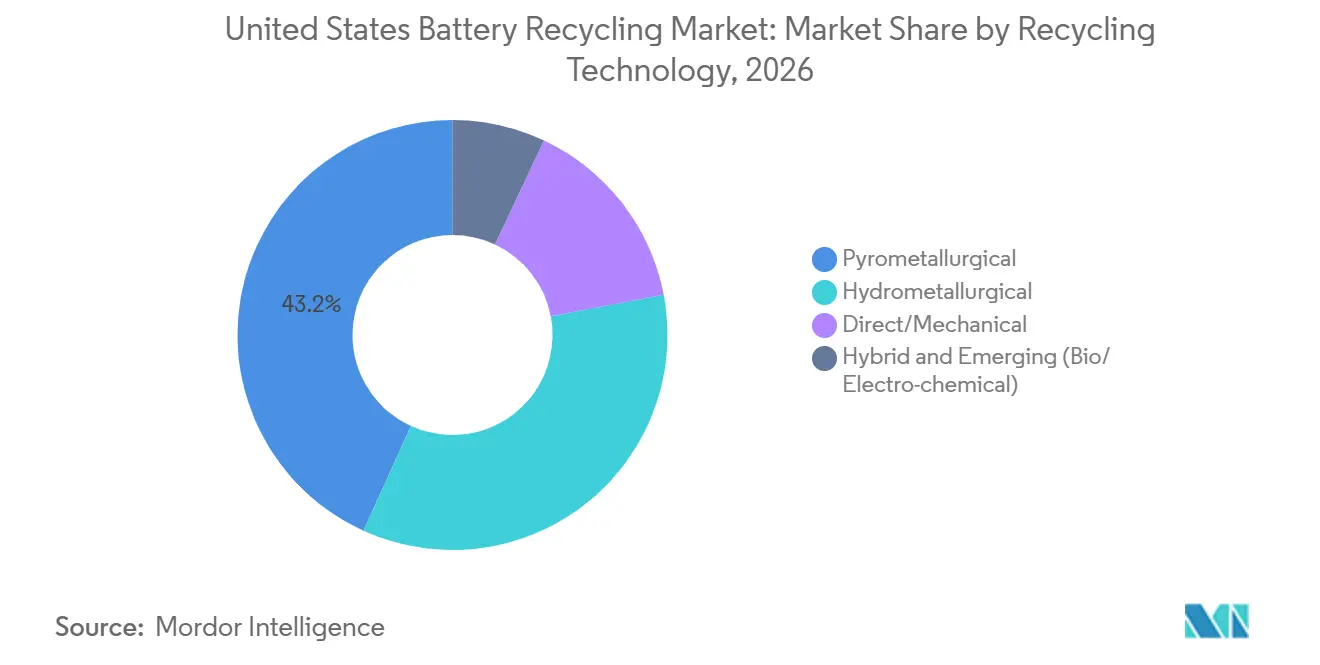
Pyrometallurgical processing held 43.2% of technology revenue in 2026. It can process mixed inputs and may reduce the need for detailed sorting before treatment. Hydrometallurgical processing is forecast to grow at a 29.2% CAGR through 2032, driven by more selective recovery of lithium, nickel, and cobalt. Under optimized conditions, hydrometallurgical recovery can exceed 93% for these metals. The method can also support domestic refining of materials to battery-grade specifications. Direct regeneration and related processes are receiving attention as alternatives to conventional routes. Research has identified direct regeneration as a promising option while noting its limitations with mixed-chemistry feedstocks and large-scale deployment. The US battery recycling market is therefore using several approaches rather than converging on a single technology.
Technology selection depends on the input material and the desired output. Pyrometallurgy offers broad input tolerance but may require additional downstream steps for certain recovered materials. Hydrometallurgy can target specific compounds but requires careful chemical management and stable operating conditions. Princeton NuEnergy received a USD 50 million Department of Energy award in August 2026 for a cathode-to-cathode facility in Georgia. Nth Cycle received USD 100 million for domestic black mass refining in the same funding round. Hybrid, biological, and electrochemical approaches remain smaller parts of the US battery recycling market but may become more important if they reduce energy use or improve recovery from evolving battery chemistries.
By Process Stage: Collection Leads Today While Refining Expands Fastest
Collection and logistics accounted for 29.4% of the US battery recycling market size in 2026. This stage includes aggregation from original equipment manufacturer, retail, municipal, and other sources, and requires safe storage, transportation, and documentation before batteries enter processing. Material refining and recovery is forecast to grow at a 31.3% CAGR through 2032, reflecting the growing value of converting black mass into lithium carbonate (Li2CO3), nickel sulfate (NiSO4), cobalt sulfate (CoSO4), and other usable materials. Dismantling and discharge remain essential for large automotive packs. Mechanical shredding and sorting connect these upstream and downstream stages. Each stage requires coordinated capacity to prevent delays or excess material accumulation. The US battery recycling market benefits when collection systems and refining assets grow together.
Downstream refining can capture more value but requires capital, technical skill, and dependable feedstock. Black-mass production and mechanical processing can become exposed if more capacity is built than domestic refiners can accept. Dismantling is labor-intensive because batteries must be made safe before shredding, which can add time and cost to the process. R3 Lithium launched its Covington, Georgia facility in September 2026 with integrated black-mass shredding and lithium carbonate (Li2CO3) production, according to the supplied research base. The facility illustrates the appeal of combining process stages at one site, which can reduce transportation needs and retain more material value within the US battery recycling market.
By Application of Recovered Materials: Cathode Materials Lead While Lithium Compounds Accelerate
Cathode active materials accounted for 34.3% of recovered-material application revenue in 2026. This position reflects demand from nickel manganese cobalt cathode recycling and early automotive retirements. Battery-grade lithium compounds are forecast to grow at a 32.4% CAGR through 2032. Demand is supported by domestic sourcing requirements and the greater focus on US refining. The August 2026 black mass allocation order increases the importance of completing refining within the United States. Anode and graphite recovery are also receiving attention because of import-dependency concerns in the supplied research base. Cobalt and nickel salts remain valuable outputs, although chemistry changes can affect their future demand. Copper, aluminum foil, manganese, and other materials support plant economics by reducing disposal needs.
Recycled lithium compounds are important because they can return material to the battery supply chain. Ascend Elements reported commercial-scale recycled lithium carbonate production in December 2025 before its April 2026 bankruptcy, according to the supplied research base. R3 Lithium subsequently acquired the Covington facility and entered commercial production in September 2026. The supplied research base states that R3 Lithium holds USD 1 billion in signed offtake agreements. This demonstrates demand for domestically refined output, while also showing the difficulty of turning technical capability into a durable business. Peer-reviewed work has also evaluated hydrometallurgical recycling flows for lithium-ion batteries. The US battery recycling market requires reliable purification and customer qualification before recovered materials can serve higher-value applications.
By End-User Industry: Automotive Leads While Power and Energy Storage Gains Pac
Automotive held 58.7% of end-user revenue in 2026. Automakers generate demand through recycling commitments, vehicle retirement, and supply-chain requirements. Power and energy storage is forecast to grow at a 29.5% CAGR through 2032, with the supplied research base linking this growth to AI data-center power needs and grid-scale battery deployment. Recycled lithium carbonate (Li2CO3) can support cell production for both vehicles and stationary storage. Consumer electronics represent a declining relative share as larger batteries account for more recovered material. Marine applications remain smaller, but electrification pilots may create future feedstock. Telecom backup and grid uninterruptible power systems can provide more predictable decommissioning schedules. These end uses broaden demand across the US battery recycling market.
Second-life use can add a revenue stage before recycling. Redwood Materials launched Redwood Energy in June 2025 to repurpose used EV packs for stationary storage, according to the supplied research base. The unit deployed a 12 MW and 63 MWh system for Crusoe and signed a July 2025 memorandum with General Motors. In April 2026, Rivian and Redwood Materials announced a 10 MWh second-life storage system at Rivian's Illinois facility. These projects show that some batteries can generate value before being processed for material recovery. Second-life uses still require testing, safety management, and suitable pack condition. The US battery recycling market can benefit from these uses, but they may delay the arrival of some material at recycling facilities.
Geography Analysis
The Southeast is emerging as a major processing corridor within the US battery recycling market. Redwood Materials opened the first phase of its USD 3.5 billion Berkeley County, South Carolina, facility in May 2026, according to the supplied research base. Cirba Solutions is developing a Department of Energy-funded USD 200 million plant in Columbia, South Carolina. Princeton NuEnergy received funding for a USD 110 million cathode-recycling facility in Commerce, Georgia. These projects place collection, processing, and refining closer to battery manufacturing activity in the region. This concentration can reduce transportation exposure for heavy and hazardous battery packs and connect recyclers with automakers and cell manufacturers in the Southeast.
Nevada remains another important hub for the US battery recycling market. Redwood Materials' 175-acre Sparks campus processed 20 GWh of batteries annually in 2026, according to the supplied research base. Its location near Tesla's Gigafactory supports direct links between manufacturing and recycling activity. The Midwest also plays a significant role due to its automotive and battery manufacturing base. Cirba Solutions operates a lithium-ion black-mass processing facility in Lancaster, Ohio, with the supplied research base indicating capacity is increasing by 600% from 2022 levels. Ultium Cells plants in Warren, Ohio, and Spring Hill, Tennessee, create a manufacturing scrap corridor for Redwood Materials. This geographic pattern favors regions that combine feedstock availability, permitted facilities, and industrial customers.
California, New York, and New England states generate meaningful early-EV and consumer electronics feedstock due to earlier EV adoption. Much of this material currently moves to Nevada, Ohio, and Southeast facilities, where permitted, large-scale capacity is concentrated. California's recycling regulations and extended producer responsibility frameworks can support higher collection rates, according to the supplied research base. California, Texas, and Florida are expected to generate larger end-of-life pack volumes after 2028. The federal black mass allocation order is intended to retain more recyclable material within the United States. A shortage of permitted hydrometallurgical refining near feedstock sources can keep transport costs high. Geographic expansion must therefore address both collection coverage and domestic refining capacity.
Competitive Landscape
The United States battery recycling market is moderately concentrated in processing and more fragmented in collection. Redwood Materials is a major domestic operator, processing more than 70% of used or discarded battery packs in North America, with 20 GWh of annual processing capacity and supply agreements with six major automakers, according to the supplied research base. Redwood Materials closed a USD 425 million Series E round in January 2026 at a valuation above USD 6 billion. Ascend Elements' April 2026 Chapter 11 filing and Li-Cycle's 2025 creditor protection reduced the number of large domestic operators. Cirba Solutions remains a significant alternative, with more than USD 400 million in capital investment and an increase of more than 600% in lithium-ion processing capacity since 2022, according to the supplied research base. Ecobat's exit from lithium-ion recycling in 2026 further demonstrated that cost position and capital discipline remain important factors in this market.
Companies in the United States battery recycling market are differentiating through vertical integration, technology, and partnerships. Redwood Materials combines collection, recycling, materials production, and second-life storage activity. Its May 2024 agreement with General Motors covered manufacturing scrap from Ultium Cells plants in Ohio and Tennessee. General Motors expanded the relationship in June 2026 to include manufacturing scrap recovery, end-of-life recycling, and second-life energy storage, according to the supplied research base. Nth Cycle is deploying its OYSTER electroextraction platform for domestic black mass refining with USD 100 million in Department of Energy support. Princeton NuEnergy is pursuing low-temperature plasma-assisted separation for cathode-to-cathode recycling. These approaches aim to retain more value from recovered materials and reduce reliance on intermediate exports.
Lithium iron phosphate recycling represents a technical and commercial gap in the US battery recycling market. This chemistry lacks the cobalt and nickel values that have supported other lithium-ion recycling models, requiring processes that recover value from lithium, iron, and phosphate without depending on nickel, manganese, and cobalt economics. Compliance presents another barrier, as recyclers must manage hazardous materials, environmental requirements, and site permitting. These requirements can protect established operators with permitted facilities and operating experience while delaying new entrants that could otherwise add capacity. Competitive outcomes will depend on successful execution, secure feedstock, and the ability to sell battery-grade products.
United States Battery Recycling Industry Leaders
-
Cirba Solutions
-
Redwood Materials, Inc.
-
Li-Cycle Corp.
-
Ascend Elements
-
Ecobat
- *Disclaimer: Major Players sorted in no particular order
Recent Industry Developments
- August 2026: The Bureau of Industry and Security (BIS) issued a Temporary Final Rule under the Defense Production Act requiring U.S. persons to allocate 100% of monthly black mass sales to domestic buyers. Effective from August 27, 2026, through August 2027, the measure aims to strengthen domestic battery recycling, critical mineral recovery, and battery-material manufacturing by ensuring recoverable battery feedstocks remain within the United States supply chain.
- August 2026: The U.S. Department of Energy (DOE) announced approximately USD 500 million in Round 3 Battery Manufacturing and Recycling Grants across seven projects to strengthen the domestic battery ecosystem. Notable recipients included Nth Cycle, which received USD 100 million, and Princeton NuEnergy, which received USD 50 million, supporting critical mineral recovery, battery-material production, and circular battery supply-chain development.
- June 2026: General Motors became the first automaker to collaborate with Redwood Materials across the entire battery lifecycle, encompassing manufacturing scrap recovery, end-of-life battery recycling, and second-life energy storage deployment. The expanded partnership supports closed-loop material recovery to increase the reuse of lithium, nickel, cobalt, and copper within North America's battery supply chain.
- November 2025: Redwood Materials began operations at the first phase of its Carolina Campus in Ridgeville, South Carolina, a cornerstone of the company's planned USD 3.5 billion battery recycling and materials manufacturing hub. Located on more than 600 acres within Camp Hall Commerce Park, the facility started critical-material recovery operations focused on extracting lithium, nickel, cobalt, and copper from end-of-life batteries and battery manufacturing scrap for reuse in the domestic battery supply chain.
United States Battery Recycling Market Report Scope
Battery recycling refers to the processing of spent batteries to reduce the volume of batteries disposed of as municipal solid waste. In this process, spent batteries are collected, disassembled, and treated to recover valuable metals and materials such as lithium, cobalt, nickel, and lead. These recovered materials are then purified and reused to manufacture new batteries or other industrial products. Battery recycling helps prevent soil and water contamination by keeping hazardous chemicals out of landfills, while also supporting a circular economy.
The United States Battery Recycling Market is segmented by battery chemistry into lead-acid, lithium-ion, nickel-based, and other chemistries. By source of scrap, the market is segmented into automotive batteries, consumer electronics batteries, industrial and energy storage system batteries, and manufacturing scrap. By recycling technology, the market is segmented into hydrometallurgical, pyrometallurgical, direct/mechanical, and hybrid and emerging technologies. By process stage, the market is segmented into collection and logistics, dismantling and discharge, mechanical shredding and sorting, black-mass production, and material refining and recovery. By application of recovered materials, the market is segmented into cathode active materials, anode/graphite, battery-grade lithium compounds, cobalt and nickel salts, manganese, and others (copper and aluminum). By end-user industry, the market is segmented into automotive, marine, power and energy storage, consumer electronics, and others. For each segment, the market sizing and forecasts have been provided on the basis of value (USD).
| Lead-acid |
| Lithium-ion (NMC, LFP, NCA, LMO) |
| Nickel-based |
| Other chemistries (Zn-air, Sodium-ion etc.) |
| Automotive Batteries |
| Consumer Electronics Batteries |
| Industrial and ESS Batteries |
| Manufacturing Scrap |
| Hydrometallurgical |
| Pyrometallurgical |
| Direct/Mechanical |
| Hybrid and Emerging (Bio/ Electro-chemical) |
| Collection and Logistics |
| Dismantling and Discharge |
| Mechanical Shredding/Sorting |
| Black-Mass Production |
| Material Refining and Recovery |
| Cathode Active Materials |
| Anode/Graphite |
| Battery-grade Lithium Compounds |
| Cobalt and Nickel Salts |
| Manganese |
| Others (Cu, Al) |
| Automotive |
| Marine |
| Power and Energy Storage |
| Consumer Electronics |
| Others |
| By Battery Chemistry | Lead-acid |
| Lithium-ion (NMC, LFP, NCA, LMO) | |
| Nickel-based | |
| Other chemistries (Zn-air, Sodium-ion etc.) | |
| By Source of Scrap | Automotive Batteries |
| Consumer Electronics Batteries | |
| Industrial and ESS Batteries | |
| Manufacturing Scrap | |
| By Recycling Technology | Hydrometallurgical |
| Pyrometallurgical | |
| Direct/Mechanical | |
| Hybrid and Emerging (Bio/ Electro-chemical) | |
| By Process Stage | Collection and Logistics |
| Dismantling and Discharge | |
| Mechanical Shredding/Sorting | |
| Black-Mass Production | |
| Material Refining and Recovery | |
| By Application of Recovered Materials | Cathode Active Materials |
| Anode/Graphite | |
| Battery-grade Lithium Compounds | |
| Cobalt and Nickel Salts | |
| Manganese | |
| Others (Cu, Al) | |
| By End-user Industry | Automotive |
| Marine | |
| Power and Energy Storage | |
| Consumer Electronics | |
| Others |
Key Questions Answered in the Report
What is driving growth in the US battery recycling market?
Growth is supported by EV adoption, manufacturing scrap, domestic refining needs, and critical mineral policy. The market is forecast to grow at a 28.35% CAGR from 2027 to 2032.
Which battery chemistry leads US recycling revenue?
Lead-acid batteries led revenue with a 73.3% share in 2026, while lithium-ion is forecast to grow faster at a 35.3% CAGR through 2032.
Why is manufacturing scrap important for US battery recyclers?
Manufacturing scrap has known chemistry, controlled handling conditions, and contracted access. It can provide feedstock before end-of-life EV battery volumes become significantly larger.
Which recycling technology is growing fastest in the United States?
Hydrometallurgical recycling is forecast to grow at a 29.2% CAGR through 2032. It supports selective recovery and domestic production of refined battery materials.
Which US regions are major battery recycling hubs?
The Southeast, Nevada, and the Midwest are major hubs. South Carolina, Georgia, Nevada, Ohio, and Tennessee combine recycling activity with battery manufacturing or automotive production.
What challenge do battery recyclers face before more EVs reach end of life?
New capacity can arrive before sufficient end-of-life feedstock is available. Companies need supply agreements and flexible processing to manage this timing gap.
What is the current market size of the United States battery recycling market?
The United States battery recycling market size is projected to expand from USD 6.06 billion in 2026 and USD 7.11 billion in 2027 to USD 24.77 billion by 2032, at a CAGR of 28.35% between 2027 and 2032.