
United States Autonomous Agricultural Tractors Market Size and Share
Market Overview
| Study Period | 2021 - 2031 |
|---|---|
| Forecast Data Period | 2026 - 2031 |
| Base Year Market Size (2025) | USD 0.87 Billion |
| Market Size (2026) | USD 0.99 Billion |
| Market Size (2031) | USD 1.95 Billion |
| Growth Rate (2026 - 2031) | 14.40 % |
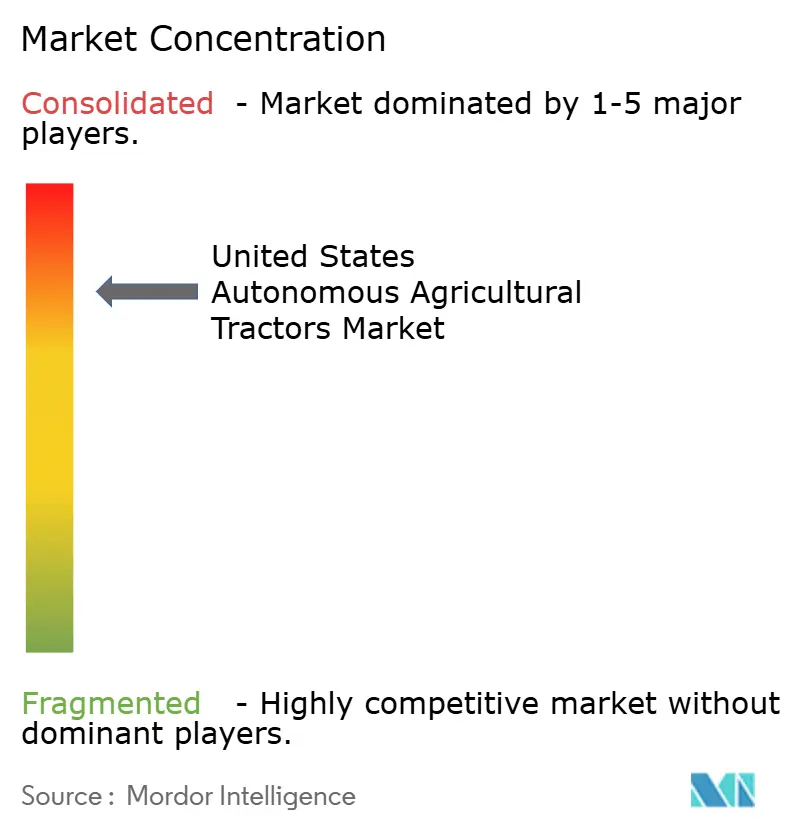
| Market Concentration | High |
Major Players *Disclaimer: Major Players sorted in no particular order Image © Mordor Intelligence. Reuse requires attribution under CC BY 4.0. | |
United States Autonomous Agricultural Tractors Market Analysis by Mordor Intelligence
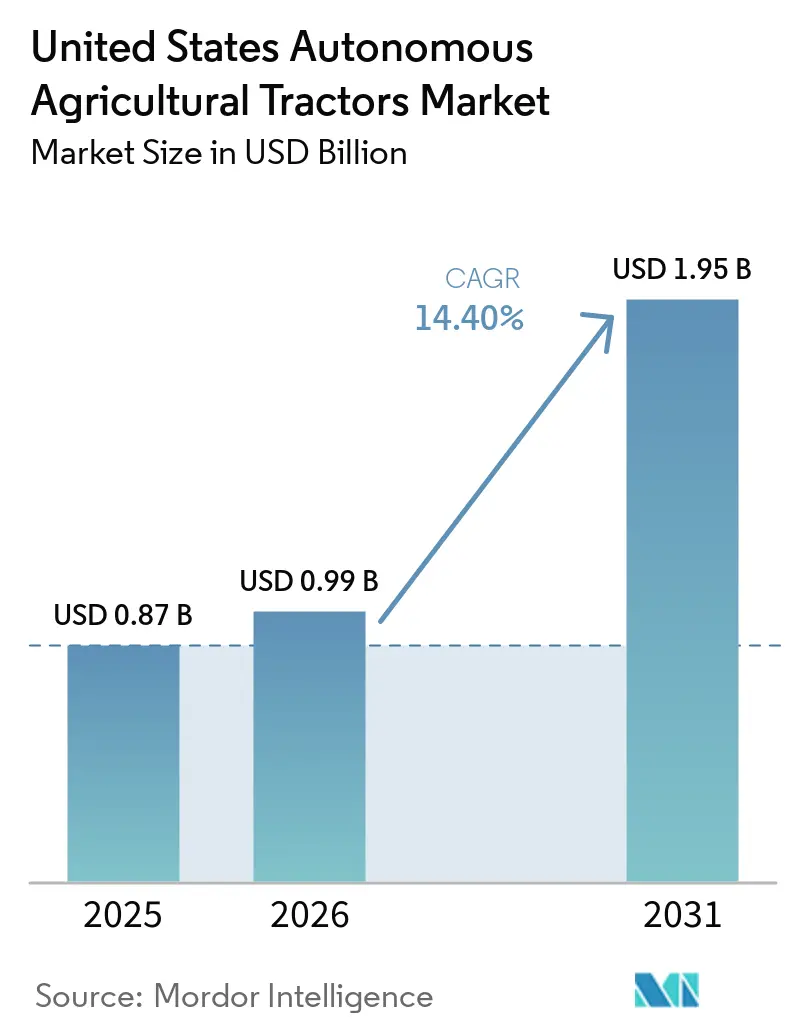
The United States autonomous agricultural tractors market was valued at USD 0.87 billion in 2025 and is estimated to grow from USD 0.99 billion in 2026 to USD 1.95 billion by 2031, at a CAGR of 14.4% during the forecast period (2026-2031). Labor availability, rather than interest in new technology alone, is shaping demand for autonomous equipment. United States farm operators directly hired 637,000 workers in April 2025, when the average gross wage was USD 19.52 per hour. Preliminary data indicated that immigration enforcement actions removed an estimated 155,000 agricultural positions between March and July 2025[1]Source: Federal Reserve Bank of Kansas City, “Some Segments of the Agricultural Economy Are Particularly Sensitive to Changes in the Foreign-Born Farm Labor Supply,” Federal Reserve Bank of Kansas City, kansascityfed.org. H-2A certifications reached 385,000 in fiscal year 2024, reflecting continued reliance on seasonal foreign labor. The United States autonomous agricultural tractors market is therefore most relevant where farms cannot secure trained operators during planting, tillage, and harvest windows. Established manufacturers are strengthening fleet software, data connectivity, and dealer support, as these capabilities affect day-to-day use after a tractor is purchased. Purdue found that autonomous machinery was generally not cost-competitive on commercial grain farms until labor wages exceeded USD 44 per hour, which limits near-term adoption to farms with acute labor constraints.
Key Report Takeaways
- By horsepower, 31 to 100 HP held 46% of the United States autonomous agricultural tractors market share in 2025, while above 100 HP is forecast to grow fastest at a 23.4% CAGR through 2031.
- By automation level, semi-autonomous systems held 58% of the United States autonomous agricultural tractors market share in 2025, while fully autonomous systems are the fastest-growing segment, expanding at a 22.5% CAGR through 2031.
- By drive type, diesel held the largest share of 72% in 2025, while battery-electric platforms are forecast to grow fastest at a 28.2% CAGR through 2031.
- By application, tillage accounted for 47% of the United States autonomous agricultural tractors market size in 2025, while orchard and vineyard operations are projected to expand fastest at a 28.0% CAGR through 2031.
- By component, GPS and GNSS held 38% share in 2025, while LiDAR and radar modules are forecast to grow at a 22.6% CAGR through 2031.
- By farm size, large farms above 500 hectares held 61% share in 2025, while medium farms with 100 to 500 hectares are projected to expand at a 23.9% CAGR through 2031.
Note: Market size and forecast figures in this report are generated using Mordor Intelligence’s proprietary estimation framework, updated with the latest available data and insights as of January 2026.
United States Autonomous Agricultural Tractors Market Trends and Insights
Drivers Impact Analysis*
| Driver | (~) % Impact on CAGR Forecast | Geographic Relevance | Impact Timeline |
|---|---|---|---|
| Persistent shortage of skilled farm equipment operators | +3.0% | National, strongest in the Midwest, Great Plains, and California | Short term (≤ 2 years) |
| Autonomous work during narrow weather windows | +2.0% | Midwest and Great Plains | Short term (≤ 2 years) |
| Precision placement and input-use optimization | +2.5% | National, with strong relevance in the Midwest, California, and Pacific Northwest | Medium term (2-4 years) |
| Retrofit autonomy for existing tractors | +2.0% | National, with early uptake in the Midwest and South | Medium term (2-4 years) |
| Multi-machine supervision on large row-crop farms | +1.5% | Corn Belt and Great Plains | Medium term (2-4 years) |
| Specialty-crop safety and labor economics | +1.5% | California, Washington, Oregon, and Florida | Medium term (2-4 years) |
| Source: Mordor Intelligence | |||
Persistent Shortage of Skilled Farm Equipment Operators
The shortage of trained equipment operators is a direct driver for the United States autonomous agricultural tractors market. According to the United States Department of Agriculture (USDA), H-2A certifications rose from 48,000 in fiscal year 2005 to 385,000 in fiscal year 2024. This expansion did not eliminate seasonal coverage gaps, as not every certified position resulted in a visa issuance. Farms require operators who can handle large equipment and understand precision planting, guidance systems, and field conditions. These capabilities are more specialized than general farm labor, making it difficult for farms to quickly replace experienced tractor operators. Autonomous systems enable experienced employees to shift from continuous driving to supervision and exception handling, addressing both operational and numerical workforce gaps. This need is most pronounced when farms must complete multiple field tasks within a short period.
Autonomous Work during Narrow Weather Windows
Planting and tillage windows in the Corn Belt can last fewer than 10 days before soil conditions become unsuitable. A tractor that can continue working through the night allows farms to make better use of this limited time. The benefit comes from timely fieldwork, not only from reduced labor hours. John Deere presented its autonomous 9RX at CES 2025, featuring a 16-camera perception system and a 40% increase in field speed compared with the first-generation platform[2]Source: Deere and Company, “CES 2025 New Autonomous Machines Technology, Autonomous 9RX,” Deere and Company, deere.com. The system was designed for field tasks where consistent operation is critical over long work periods. Autonomous equipment can perform headland turns and adjust implement depth using the same programmed approach during both day and night operations, reducing variability between daytime and overnight field passes. The United States autonomous agricultural tractor market benefits when delayed planting or tillage would otherwise reduce crop management options. Flat, large fields in the Midwest and Great Plains offer the most suitable operating conditions for this use case.
Precision Placement and Input-Use Optimization
RTK-GNSS guidance supports repeatable field passes and can reduce overlap in seed, fertilizer, and chemical applications. A 2025 peer-reviewed study reported lower overlap and lower input consumption across three seasons of controlled field experiments. Deere & Company reported an average 6% reduction in fuel and labor linked to GPS guidance across its installed base. These gains give autonomy an operating value beyond driver replacement. More consistent pass-to-pass guidance can also support controlled-traffic practices across several seasons, helping reduce repeated soil compaction in the same field areas. The operational benefit builds over time, while many purchase decisions focus only on the first season. The United States autonomous agricultural tractors market is supported when farms place equal value on input control and labor management. This driver is relevant across row and specialty crops where precision passes are important.
Retrofit Autonomy for Existing Tractors
Retrofit systems provide a pathway to autonomy for existing tractors without requiring complete vehicle replacement, changing the capital decision for farms with tractors purchased in 2017 or later. Sabanto stated that its retrofit approach can reduce capital expenditure by 70% compared with a new autonomous platform. AGCO Corporation stated that its PTx Trimble OutRun system supports John Deere 8000R and 8R tractors and Fendt 900 and 1000 tractors already in use on farms. Autonomy upgrades extend the productive life of existing equipment, while also allowing providers to build installed fleets without waiting for new tractor replacement cycles. Each installed system generates field data that can support product development and service improvements. This lower-entry approach expands the pool of potential buyers in the United States autonomous agricultural tractors market and is particularly relevant for medium-sized farms that need to manage capital spending carefully.
Restraints Impact Analysis*
| Restraint | (~) % Impact on CAGR Forecast | Geographic Relevance | Impact Timeline |
|---|---|---|---|
| High upfront cost and uncertain farm-level payback | -2.5% | National, with the greatest barrier for small and medium farms | Short term (≤ 2 years) |
| State-level operator-presence and liability uncertainty | -1.5% | California and farms operating across multiple states | Medium term (2-4 years) |
| Intervention needs in real field conditions | -1.0% | California specialty crops and variable-terrain operations nationwide | Medium term (2-4 years) |
| Limited interoperability across implements and farm software | -0.8% | Multi-brand commercial farms nationwide | Long term (≥ 4 years) |
| Source: Mordor Intelligence | |||
High Upfront Cost and Uncertain Farm-Level Payback
Autonomy kits require an upfront investment that many farms find difficult to justify. In February 2026, Purdue University's center for agriculture cited retrofit costs of USD 40,000 to USD 45,000 for John Deere 8R and 9R tractors, plus annual subscription fees of USD 10,000 for unlimited-acre tillage. Its 2026 analysis modeled a 50/50 corn-soybean rotation in the Midwest. The study found a USD 63 per-hectare deficit under baseline assumptions. It also found that autonomous equipment did not outperform conventional equipment until wages exceeded USD 44 per hour. The USDA reported an average field worker wage of USD 18.58 per hour in April 2025 [3]Source: United States Department of Agriculture National Agricultural Statistics Service, “Farm Labor, May 2025,” USDA National Agricultural Statistics Service, esmis.nal.usda.gov. This gap means that labor savings alone are not enough to support the purchase decision. The United States autonomous agricultural tractors market to expand first among farms that cannot obtain labor at critical times. Smaller farms may need a service-based payment model or lower kit prices before adoption becomes practical.
State-Level Operator-Presence and Liability Uncertainty
Off-road autonomous equipment does not operate under a single nationwide regulatory framework. California requires a Cal/OSHA variance for unattended equipment used in agricultural settings. This process can add documentation, testing, and approval work before commercial use. A farm that operates across multiple states may face different requirements in each location. Liability remains uncertain when an autonomous tractor damages irrigation equipment, encounters livestock, or loses GNSS positioning during an operation. Responsibility may involve the equipment manufacturer, software provider, dealer, and grower. These questions have not been widely tested in state courts. Farms may therefore prefer semi-autonomous systems with an operator available for oversight. The United States autonomous agricultural tractors market faces slower adoption, as buyers view regulation and liability as unresolved operating risks. Smaller operators may face a greater compliance burden due to limited resources.
*Our forecasts treat driver/restraint impacts as directional, not additive. The impact forecasts reflect baseline growth, mix effects, and variable interactions.
Segment Analysis
By Horsepower: Mid-Range Platforms Lead While High-Horsepower Fleets Expand
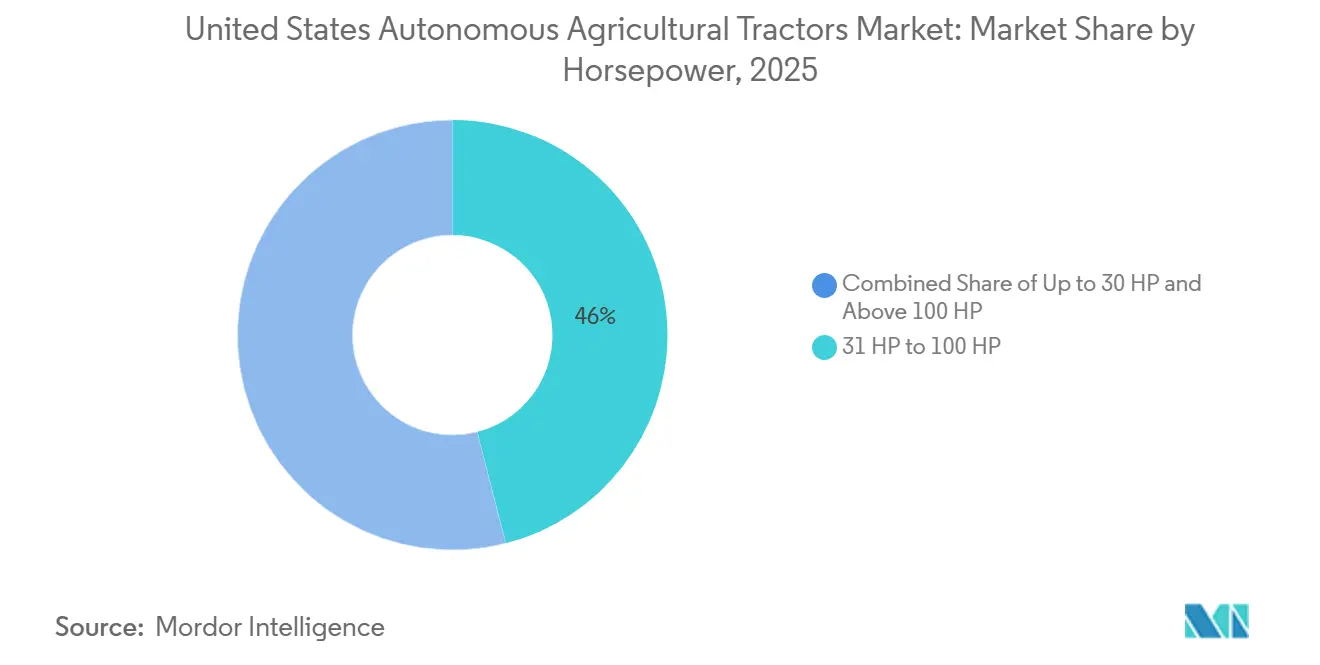
The 31 to 100 HP segment accounted for 46% of the United States autonomous agricultural tractors market revenue in 2025. This segment supports common row-crop tasks and is compatible with many tractors already in use on Midwestern farms. Demand is further supported by compatibility with retrofit systems, which allows buyers to upgrade existing equipment rather than replace it. The horsepower range also suits farms requiring autonomy for recurring tillage and field-preparation work. The segment's leading share reflects the size of the installed base and the practical utility of these tractors. At CES 2025, Deere & Company introduced the autonomous 9RX tractor, featuring a 16-camera perception system, demonstrating that manufacturers are extending autonomous capabilities across different tractor classes. The United States autonomous agricultural tractors market spans multiple horsepower ranges, as operating requirements vary by crop type and farm acreage.
The above 100 HP segment is forecast to grow at a 23.4% CAGR through 2031. Large commercial farms use these machines for heavy tillage and broad-acre fieldwork. Multi-machine supervision improves the value of high-horsepower equipment, as a single operator can oversee several units simultaneously. These machines can also cover more acreage during narrow weather windows, making their higher purchase cost more manageable on farms with substantial acreage. The less than 30 HP segment remains smaller in value but plays a role in specialty crops and controlled environments, as their compact dimensions suit areas where larger equipment cannot operate easily. The United States autonomous agricultural tractors market continues to include both high-capacity field platforms and smaller specialty machines, with the high-horsepower segment more closely tied to fleet-scale operations.



By Automation Level: Supervised Systems Lead Current Adoption
Semi-autonomous systems accounted for 58% of the United States autonomous agricultural tractors market revenue in 2025. These systems require human supervision, either on-site or remotely. This operating model aligns with current safety practices and state-level requirements, and allows growers to become familiar with autonomous technology without committing to fully unattended operation. The segment's majority share reflects the balance between available technology and practical farm risk management. Semi-autonomous systems can handle repeatable tasks while allowing human judgment when conditions change. This approach applies to tillage, grain cart work, and other planned field operations. Supervised systems currently serve as the primary commercial entry point in the United States autonomous agricultural tractors market.
Fully autonomous systems are forecast to grow at a 22.5% CAGR through 2031. Their growth depends on accumulated field experience, software improvements, and reduced intervention requirements. Each commercial deployment provides manufacturers with additional data on obstacle detection, positioning, and machine behavior, which helps expand the range of tasks that can be performed with less direct oversight. This segment is particularly relevant where farms cannot reliably hire operators during critical periods, and it offers a more scalable labor model for large fleets compared to semi-autonomous setups. Regulations and liability frameworks will influence how quickly unattended operation becomes common. The United States autonomous agricultural tractors market will remain weighted toward supervised models in the near term. Fully autonomous equipment carries a higher growth rate because it addresses the longer-term need for scalable fleet management.
By Drive Type: Diesel Remains the Working Base While Electric Platforms Grow
Diesel powertrains accounted for 72% of the United States autonomous agricultural tractors market revenue in 2025. Diesel retains advantages in range, refueling availability, and power output for large row-crop tractors. These strengths are important when equipment must operate for long hours during planting or tillage windows. Existing dealer networks and farm fuel systems also support diesel use. Autonomous capability does not remove the need for a dependable power source. As a result, diesel platforms remain the primary base for current commercial deployments. Their established service model reduces the risk of adding autonomy to a working farm fleet. The United States autonomous agricultural tractors market continues to rely on diesel for high-horsepower applications.
Battery-electric tractors are forecast to grow at a 28.2% CAGR through 2031. Their growth is linked to specialty applications and clean-equipment policies in California. The California Air Resources Board FARMER program supports charging infrastructure for zero-emission off-road equipment in the Central Valley. Deere and Company is committed to delivering a fully autonomous battery-powered electric agricultural tractor by 2026. CNH Industrial N.V.'s New Holland brand also presented electric and hybrid versions of the R4 robotic platform for orchard and vineyard work in 2026. Hybrid systems provide an intermediate option where daily operating hours are shorter and added system weight is acceptable. ISO 18497 safety principles apply regardless of powertrain, so electrification does not create a separate autonomy safety track. The United States autonomous agricultural tractors market will use different powertrains for different workloads, rather than shifting all operations away from diesel at the same pace.
By Application: Tillage Is the Largest Use Case While Specialty Crops Grow Faster
Tillage accounted for 47% of the United States autonomous agricultural tractors market in 2025. Flat, repetitive fields in Midwest corn and soybean production are well-suited to current autonomous guidance systems. Tillage operations involve predictable passes that can be programmed and supervised, resulting in fewer unexpected events. These conditions make tillage a practical starting point for farms adopting autonomous equipment. Large field sizes allow buyers to distribute system costs across more acres. Tillage can also be scheduled during tight weather windows, increasing the value of extended machine operating hours. The category supports current revenue across established row-crop regions, and tillage serves as a foundation for broader deployment of autonomous tractors across farm tasks.
Orchard and vineyard operations are forecast to grow at a 28.0% CAGR through 2031. Specialty-crop farms face high labor requirements for repeated work in narrow rows and require equipment capable of operating near vines, trees, irrigation systems, and variable ground surfaces. Kubota Corporation identified the M5 Narrow platform for vineyard and orchard applications. Deere & Company introduced the 5ML autonomous orchard tractor with LiDAR for dense-canopy navigation. Sowing and harvesting have lower autonomous adoption rates, as they require more complex coordination between tractors and implements. Full crop-cycle autonomy will require machine coordination beyond vehicle guidance alone. The United States autonomous agricultural tractors market is likely to develop application by application, with specialty work expanding where labor constraints and safety needs are most pronounced.
By Component: Positioning Leads Revenue While Perception Systems Advance
GPS and GNSS modules accounted for 38% of the United States autonomous agricultural tractors market revenue in 2025. These systems provide the positioning foundation for commercial tractor autonomy. RTK corrections support pass-to-pass repeatability of 1 cm to 2 cm in field operations. EUSPA testing with CNH Industrial N.V. and Hemisphere GNSS equipment confirmed the suitability of Galileo HAS for precision agriculture. Reliable positioning enables tractors to follow planned paths and maintain implement placement, while also supporting the input management benefits associated with precision farming. GPS and GNSS modules remain important because every commercial autonomy system requires an accurate location reference. As software functions become more sophisticated, the United States autonomous agricultural tractors market continues to depend on positioning hardware.
LiDAR and radar modules are forecast to grow at a 22.6% CAGR through 2031. These sensors provide obstacle detection and depth information when a positioning signal alone is insufficient. They are particularly important in orchards, where canopy cover can affect satellite reception. In April 2025, PTx Trimble introduced the NAV-960 guidance controller, claiming it improved positioning performance by up to 50% compared to the NAV-900. The controller combines GNSS capability with inertial sensing to deliver more reliable performance under degraded satellite conditions. Control and navigation software is also gaining importance as providers offer fleet orchestration through subscription models, shifting part of the value from one-time component sales to ongoing software use. As operations move into more varied environments, the United States autonomous agricultural tractors market will require both precise navigation and perception systems.
By Farm Size: Large Farms Provide Revenue While Medium Farms Expand Access
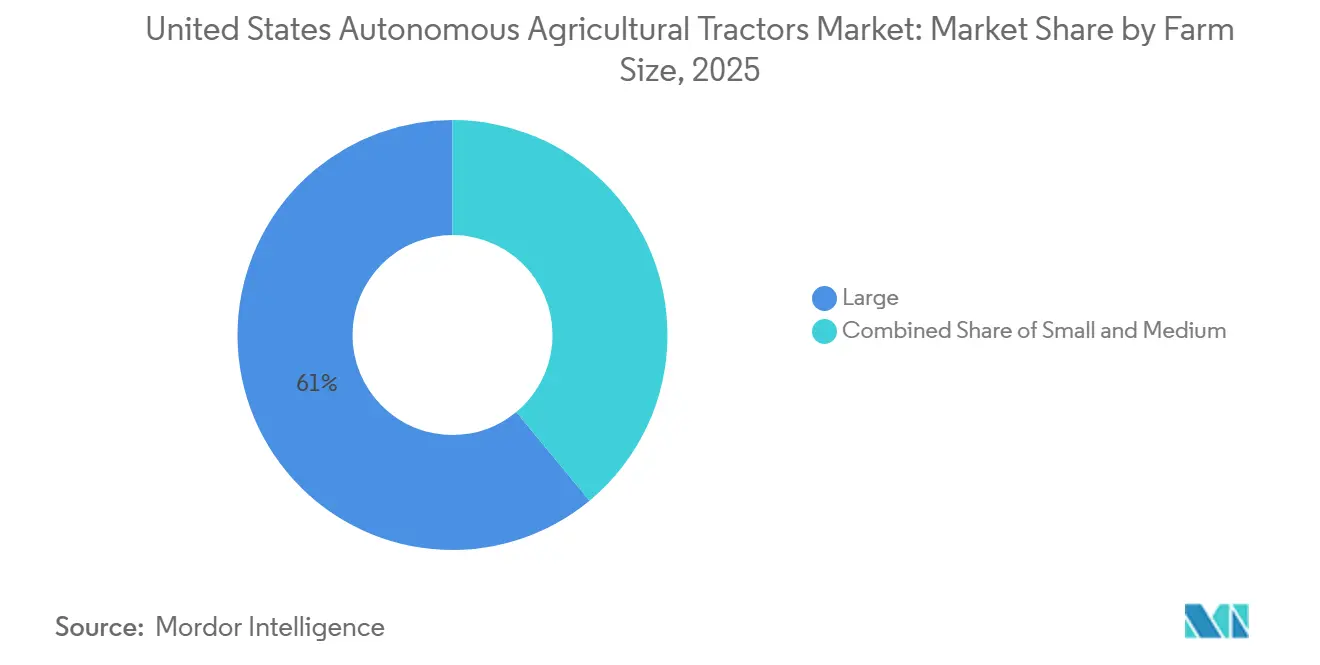
Large Farms above 500 hectares accounted for 61% of United States autonomous agricultural tractors market revenue in 2025. These farms can spread the fixed cost of kits and subscriptions across more acres and are more likely to operate multiple tractors simultaneously, giving fleet management software a clearer operational role. Large farms can use autonomy to reduce reliance on a limited number of trained operators and typically have the dealer relationships and technical staff needed to support new equipment. This leading share reflects the stronger financial and operational case at scale. As a result, the United States autonomous agricultural tractors market has developed first around farms with large, repeatable field operations.
Medium Farms with 100 to 500 hectares are forecast to grow at a 23.9% CAGR through 2031. Retrofit systems are important for this group because they lower the entry cost compared with purpose-built autonomous tractors. Sabanto's July 2026 funding was intended to support dealer expansion, kit production, and the development of autonomy software. Medium-sized farms can adopt autonomy without replacing their full equipment fleet, making them a practical next customer group after large commercial operators. Farms below 100 hectares remain a smaller part of current revenue because the fixed cost is harder to justify at that scale. Per-acre service pricing or further reductions in kit cost may be necessary for wider adoption among small farms. The United States autonomous agricultural tractors market can broaden through retrofit models that fit the capital requirements of medium-sized operations.
Geography Analysis
The Midwest region combines large corn and soybean operations with flat terrain and established dealer networks. These conditions make autonomous tillage and grain-cart operations easier to deploy and service. Farms also face short weather windows, which increases the value of continuous machine operation. Purdue's 2026 analysis of a Midwestern corn-and-soybean rotation found that current labor wages did not always support a positive payback. This limits adoption to farms with substantial labor constraints. The Midwest remains the largest regional base because its field scale and operating conditions are well matched to current systems.
The West is forecast to grow as California, Washington, and Oregon have specialty-crop operations where labor-intensive tasks are common. The region supports demand for narrow-track tractors used in orchards and vineyards. Kubota Corporation stated that its autonomous M5 Narrow was operating at vineyards owned by Treasury Wine Estates in California. The California Air Resources Board FARMER program also supports charging infrastructure for zero-emission off-road equipment. California's variance requirements for unattended agricultural machinery add a separate compliance step. The West's faster growth reflects strong use cases, although regulatory requirements can slow individual deployments.
The South and Northeast hold a smaller combined share of the United States autonomous agricultural tractors market. The South includes large sugarcane, cotton, and other commodity operations that can support fleet-scale equipment use. The United States Sugar's 2026 deployment across 255,000 acres in Florida demonstrated the potential for autonomous operation in a large Southern farm setting. Crop diversity and irregular field shapes have historically slowed adoption in parts of the region. The Northeast is smaller in revenue and has more fragmented farms. It is relevant for compact autonomous equipment used in organic vegetables, specialty dairy, and greenhouse-adjacent crops. Adoption in both regions depends on matching equipment size and automation level to local production systems.
Competitive Landscape
The United States autonomous agricultural tractors market is concentrated in 2025, with the top five companies being Deere & Company, CNH Industrial N.V., AGCO Corporation, Kubota Corporation, and CLAAS KGaA mbH . Deere & Company holds a strong position due to its 9RX and 8R autonomy offerings, broad dealer coverage, and Operations Center platform. The company's advantage is supported by its ability to connect equipment, field data, and dealer service. CNH Industrial N.V. deploys the Raven Autonomy stack across Case IH and New Holland products and works with Bluewhite for specialty-crop orchard applications. AGCO Corporation uses PTx Trimble to build a retrofit path compatible with selected tractor brands. These approaches indicate that competition is shifting beyond tractor horsepower toward fleet software and support capability. The market rewards providers that can keep equipment running during time-sensitive field operations.
AGCO Corporation's PTx Trimble OutRun system won the 2026 Davidson Prize for Agriculture Innovation for the second consecutive year. The system extends autonomous work from grain-cart operations to driverless tillage on supported John Deere and Fendt tractors. Kubota Corporation invested in Agtonomy in April 2026 to support specialty-crop autonomy through its western United States dealer network, building on the commercial introduction of the M5 Narrow platform. United States Sugar's deployment of five autonomous John Deere tractors using ASI's Mobius platform represents another significant development. These examples indicate that manufacturers and autonomy providers are pursuing both original equipment and retrofit routes. The market remains open to companies that can demonstrate reliable field performance and local service capacity.
The most significant competitive challenge is interoperability across tractor brands, implements, and farm management software. Many medium-sized commercial farms operate mixed fleets, which limits the utility of single-brand systems. AGCO Corporation's selected-brand support reflects progress, but full compatibility has not yet been achieved. Open data connections and ISOBUS-based implementation could reduce this challenge over time. Providers that can connect autonomy, implement status, and farm records may gain an advantage in retrofit sales. Smaller providers can compete by offering software layers compatible with existing drive-by-wire equipment, though they still require dealer networks and support resources to serve farms at scale. The United States autonomous agricultural tractors market to remain led by established equipment manufacturers, while specialist providers continue to shape software, retrofit, and specialty-crop segments.
United States Autonomous Agricultural Tractors Industry Leaders
Deere & Company
CNH Industrial N.V.
AGCO Corporation
Kubota Corporation
CLAAS KGaA mbH
- *Disclaimer: Major Players sorted in no particular order

Recent Industry Developments
- May 2026: United States Sugar, Autonomous Solutions Inc., and Everglades Equipment Group announced the deployment of 5 unmanned John Deere tractors operating across 255,000 acres in South Florida, using ASI's Vehicle Automation Kit and Mobius fleet management platform.
- April 2026: Kubota Corporation made a strategic investment in Agtonomy to support the commercialization of specialty-crop autonomy through the company's western United States dealer network.
- January 2026: Kubota Corporation unveiled the commercial autonomous M5 Narrow tractor, powered by Agtonomy technology, for vineyard and orchard work.


United States Autonomous Agricultural Tractors Market Report Scope
Autonomous agricultural tractors are self-driving farm tractors that use AI, GPS, sensors, and onboard control systems to perform agricultural operations with minimal or no human intervention.
The United States autonomous tractors market report is segmented by horsepower (up to 30 hp, 31 to 100 hp, and above 100 hp), by automation level (fully automated and semi-automated), by drive type (diesel, hybrid, and more), by application (tillage, sowing, harvesting, and more), by component (GPS and GNSS, and more), and by farm size (small, medium, and large). The market forecasts are provided in terms of value (USD).
| Up to 30 HP |
| 31 to 100 HP |
| Above 100 HP |
| Semi-Autonomous |
| Fully Autonomous |
| Diesel |
| Hybrid |
| Battery-Electric |
| Tillage |
| Sowing |
| Harvesting |
| Orchard and Vineyard Operations |
| GPS and GNSS |
| Sensors and Vision Systems |
| LiDAR and Radar Modules |
| Control and Navigation Software |
| Small (Less than 100 ha) |
| Medium (100 to 500 ha) |
| Large (More than 500 ha) |
| By Horsepower | Up to 30 HP |
| 31 to 100 HP | |
| Above 100 HP | |
| By Automation Level | Semi-Autonomous |
| Fully Autonomous | |
| By Drive Type | Diesel |
| Hybrid | |
| Battery-Electric | |
| By Application | Tillage |
| Sowing | |
| Harvesting | |
| Orchard and Vineyard Operations | |
| By Component | GPS and GNSS |
| Sensors and Vision Systems | |
| LiDAR and Radar Modules | |
| Control and Navigation Software | |
| By Farm Size | Small (Less than 100 ha) |
| Medium (100 to 500 ha) | |
| Large (More than 500 ha) |


Key Questions Answered in the Report
What is the projected growth rate for United States autonomous agricultural tractors?
The market is forecast to grow at a 14.4% CAGR from 2026 to 2031, rising from USD 0.99 billion in 2026 to USD 1.95 billion by 2031.
Which horsepower range currently leads adoption in the United States?
Tractors in the 31 to 100 HP range led with 46% of revenue in 2025, supported by row-crop use and retrofit compatibility.
Why are farms adopting autonomous tractor technology?
The main reasons are shortages of trained operators, narrow planting and tillage windows, and the need for more consistent field operations.
Which tractor applications are growing fastest?
Orchard and vineyard operations are forecast to grow at a 28.0% CAGR through 2031 because they have intensive labor and safety needs.
Page last updated on:


 Your data is secure and never sold or shared.


