
United States Archery Equipment Market Size and Share
Market Overview
| Study Period | 2021 - 2031 |
|---|---|
| Forecast Data Period | 2026 - 2031 |
| Base Year Market Size (2025) | USD 612.37 Million |
| Market Size (2026) | USD 638.32 Million |
| Market Size (2031) | USD 819.40 Million |
| Growth Rate (2026 - 2031) | 5.12 % |
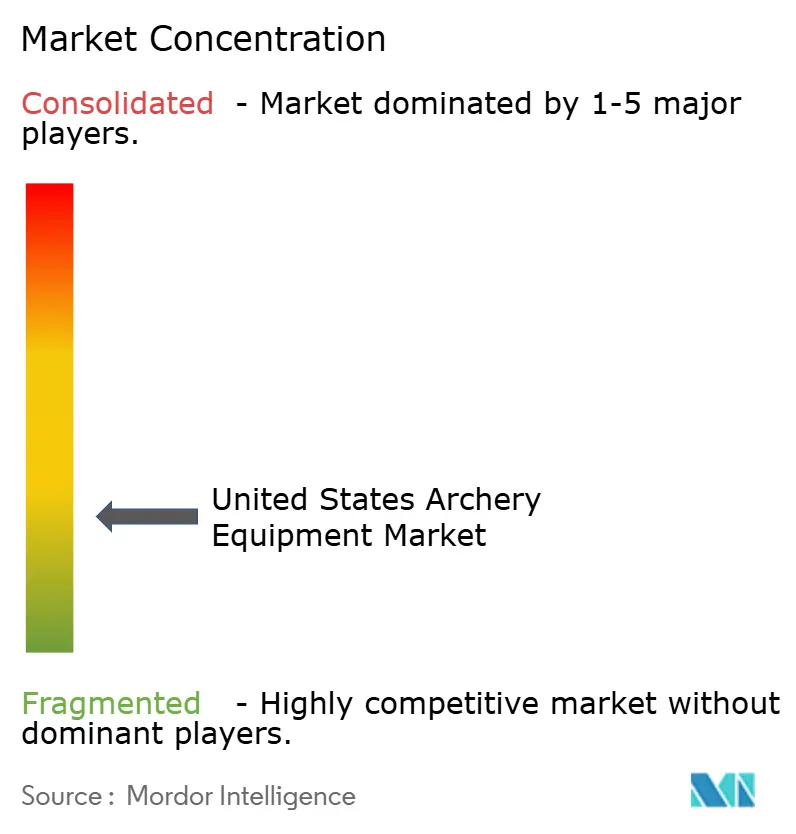
| Market Concentration | Low |
Major Players
*Disclaimer: Major Players sorted in no particular order Image © Mordor Intelligence. Reuse requires attribution under CC BY 4.0. |
|
United States Archery Equipment Market Analysis by Mordor Intelligence
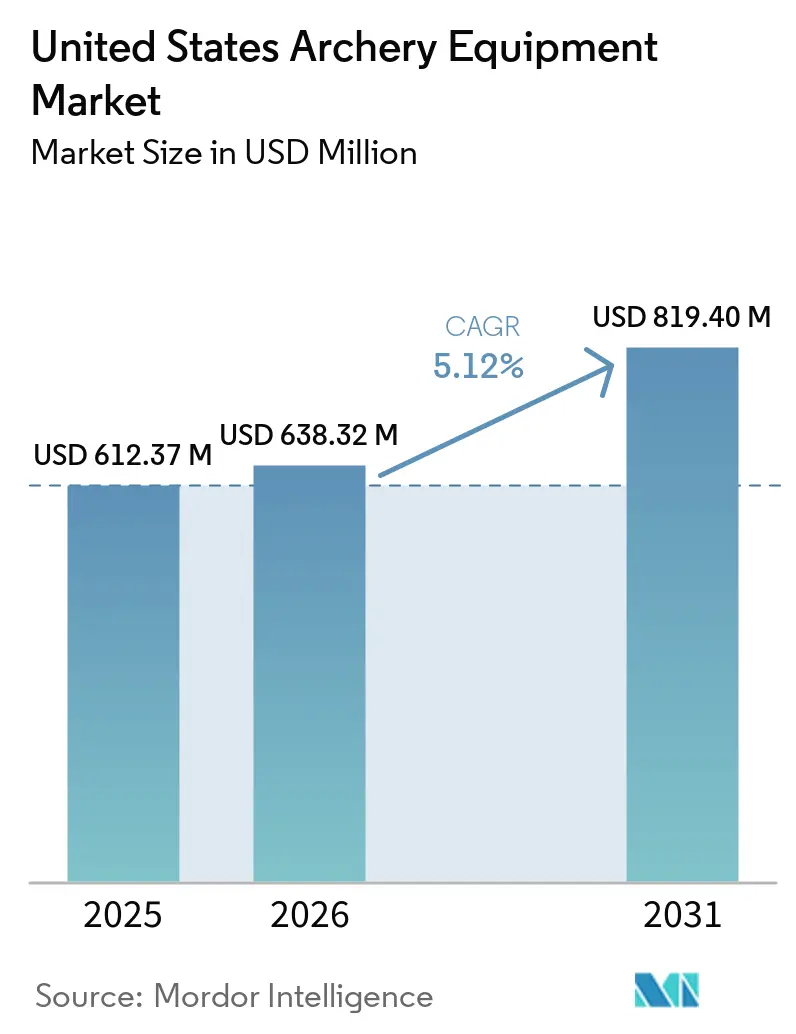
The United States archery equipment market size is expected to grow from USD 612.37 million in 2025 to USD 638.32 million in 2026, and is forecast to reach USD 819.40 million by 2031 at a 5.12% CAGR over 2026-2031. The United States archery equipment market derives demand from competitive target shooting and bowhunting, each supporting distinct purchase patterns. Target participants purchase equipment for practice and organized programs, while hunters replace arrows, broadheads, and other consumables more frequently. This demand mix supports sales when recreational spending or hunting activity weakens. School programs introduce new participants to the category, while experienced users continue to upgrade equipment and accessories. Manufacturers are balancing entry-level products for newer participants with premium offerings that feature advanced materials, tuning capabilities, and mounting systems.
Key Report Takeaways
- By product type, bows led the United States archery equipment market with a share of 45.63% in 2025, while targets is anticipated to register the fastest CAGR of 6.06% during 2026-2031.
- By category, mass retained 68.42% share in 2025, whereas premium is forecast to expand at a 6.78% CAGR through 2031.
- By end user, adults led the market with an 87.22% share in 2025, while kids are anticipated to register the fastest CAGR of 6.23% during 2026-2031.
- By distribution channel, offline retail stores led the market with a share of 73.59% in 2025, while online retail stores is anticipated to register the fastest CAGR of 6.86% during 2026-2031.
Note: Market size and forecast figures in this report are generated using Mordor Intelligence’s proprietary estimation framework, updated with the latest available data and insights as of January 2026.
United States Archery Equipment Market Trends and Insights
Drivers Impact Analysis*
| Driver | % Impact on CAGR Forecast | Geographic Relevance | Impact Timeline |
|---|---|---|---|
| Rising youth enrollment in archery programs | +1.1% | National, concentrated in Texas, the Midwest, and the Southeast | Short term (≤ 2 years) |
| Growing federal and state support for archery participation | +0.6% | National, with early uptake in states with National Archery in the Schools Program (NASP) and wildlife agency programs | Medium term (2-4 years) |
| Bowhunting culture and participation | +0.8% | Midwest, South, and Mountain West | Short term (≤ 2 years) |
| Premiumization of high-performance equipment | +0.5% | National, with higher spending in the West and Northeast | Medium term (2-4 years) |
| Technological advancements shaping modern archery gear | +0.7% | National | Medium term (2-4 years) |
| Innovation in compound bows and accessories | +0.4% | National, with major launches from United States headquartered manufacturers | Long term (≥ 4 years) |
| Source: Mordor Intelligence | |||
Rising Youth Enrollment in Archery Programs
School and collegiate programs provide a regular entry point for the United States archery equipment market. National Archery in the School Programs surpassed 10,000 participating schools during the 2024-2025 academic year [1]Source: National Archery in the Schools Program (NASP), "NASP Credited in Dominant Participation Rates of Youth Archers," naspschools.org. As of March 2026, the program reached between 1.2 million and 1.3 million students annually and added 1,300 schools each year. Youth aged 6-15 recorded the highest level of archery participation in the 2025 federal addendum cited by National Archery in the School Programs. Gender-balanced tournament teams also expand demand for equipment with varying grip sizes, draw lengths, and draw weights. Manufacturers that meet school recurve specifications can participate in purchases made through institutional budgets.
Growing Federal and State Support for Archery Participation
Federal and state programs support archery instruction and local participation. United States Archery received a Fish and Wildlife Service Multi-State Conservation Grant for a recruitment, retention, and reactivation program linked to the Los Angeles 2028 Olympic and Paralympic Games [2]Source: USA Archery, "USA Archery awarded grant to grow participation" usarchery.org. The program aims to convert Olympic visibility into sustained grassroots enrollment. The United States archery equipment market may benefit as schools and local programs require bows, targets, safety equipment, and trained coaches. These efforts also improve access for communities with limited exposure to organized archery. Public support can help programs sustain equipment purchases over time.
Bowhunting Culture and Participation
Bowhunting remains a key source of repeat demand in the United States archery equipment market. According to the Archery Trade Association, archery participation has increased significantly from seven million in 2000 to over 19 million by April 2025. Hunters replace arrows, broadheads, and related gear more frequently than complete bows. Spending remains particularly strong in the Midwest and Southeast, where hunting participation drives purchases throughout the season. The 2025 National Sporting Goods Association participation report showed a high index for bow-and-arrow hunting among children aged 7-11 [3]Source: National Sporting Goods Association, " STATISTICAL STUDY OF SPORTS PARTICIPATION" nsga.org. This trend supports demand for youth kits and adult equipment. Premium carbon arrows also give hunters a higher-priced option when they seek more consistent shaft performance.
Technological Advancements Shaping Modern Archery Gear
Materials, cam systems, and tuning features are reshaping product competition in the United States archery equipment market. Mathews introduced Limb Shift Technology for its 2025 LIFT X, enabling users to make minor tuning adjustments without a press. These features can make higher-priced equipment more attractive to experienced archers while shifting some tuning activity from pro shops to individual users. Smaller brands can source advanced components and compete more closely with established brands in the mid-tier segment. As a result, product design, dealer support, and customer service have become important competitive factors alongside price.
Restraints Impact Analysis*
| Restraint | (~) % Impact on CAGR Forecast | Geographic Relevance | Impact Timeline |
|---|---|---|---|
| High cost of premium equipment | -0.6% | National, most acute in rural and lower-income areas | Medium term (2-4 years) |
| Safety rules at public facilities | -0.3% | National, with a higher compliance burden in urban areas | Short term (≤ 2 years) |
| Declining access to private hunting lands in key states | -0.5% | Mountain West and Midwest | Long term (≥ 4 years) |
| Dependence on imported components and materials | -0.4% | National, especially for sourcing from China and Taiwan | Short term (≤ 2 years) |
| Source: Mordor Intelligence | |||
High Cost of Premium Equipment
The cost of a complete compound-bow setup can discourage beginners from entering the United States archery equipment market. The supplied draft stated that a mid-tier setup, including a bow, sights, stabilizers, a rest, a release aid, and arrows, could cost more than USD 2,500. It also indicated that flagship configurations approached USD 4,000 in 2025. Premium carbon arrows add a recurring replacement cost. The premium category is still forecast to grow at 6.8%, indicating that experienced buyers continue to pay for advanced equipment. The concern remains more acute for new participants, who must purchase several items before they can begin. Equipment testing requirements can also increase costs, making it harder for suppliers to lower prices.
Declining Access to Private Hunting Lands in Key States
Reduced access to private land may limit bowhunting activity in parts of the United States archery equipment market. The Montana's Block Management Program enrolled 6.8 million acres in 2025 and that more hunters sought access during this period. It also states that the 2025 federal farm bill extension did not fund the Voluntary Public Access and Habitat Incentive Program. Fewer available hunting days can affect purchases of arrows and broadheads more quickly than purchases of bows. As a result, suppliers focused on consumables face greater exposure to this constraint. This effect is likely to be most relevant in the Mountain West and Midwest.
*Our forecasts treat driver/restraint impacts as directional, not additive. The impact forecasts reflect baseline growth, mix effects, and variable interactions.
Segment Analysis
By Product Type: Targets Emerge as the Fastest-Growing Category
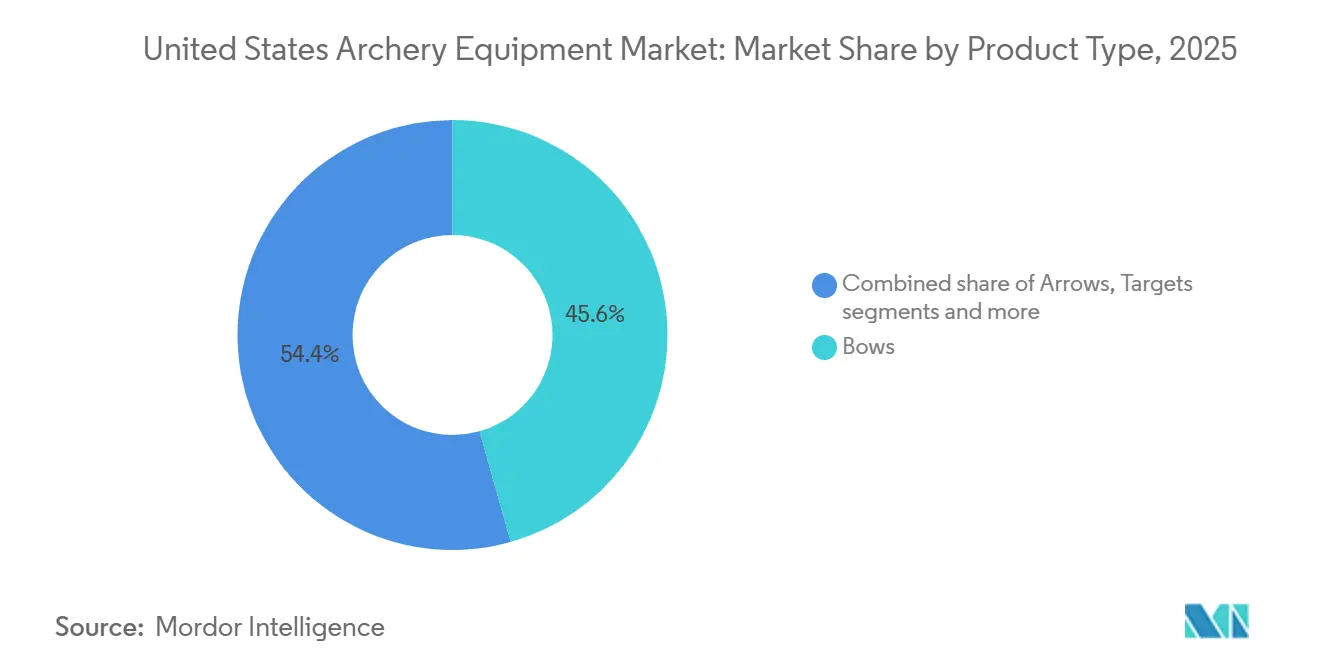
Bows accounted for 45.63% of revenue in 2025, representing the largest product share in the United States archery equipment market. Compound bows remain important for hunters and 3D shooting participants, while recurve bows continue to support school programs and Olympic-style target shooting. Arrows generate high turnover, as hunters and target users replace them after use or damage. Accessories, including sights, stabilizers, releases, quivers, and cases, increase spending without requiring consumers to replace the entire bow.
Targets are forecasted to record a CAGR of 6.06% through 2031, the fastest growth rate among product categories. Demand for targets in the United States archery equipment market is supported by schools, local ranges, 3D courses, and long-range practice. Institutional buyers require dependable targets that meet the needs of beginners and organized programs. Target sales reflect both consumer demand and purchases by schools, clubs, and public facilities.



By Category: Premium Growth Outpaces Mass Volume Despite Cost Barriers
The mass category accounted for 68.42% of revenue in 2025. It includes most entry-level and mid-tier equipment purchased by schools, recreational users, and first-time hunters. Bows priced between USD 300 and USD 700 appeal to buyers who prioritize practical performance over incremental improvements in speed or weight. This broad customer base positions the mass category at the core of the United States archery equipment market. Ongoing participation in youth programs and recreational archery supports steady demand for affordable, reliable equipment in this category.
The premium category is projected to register a CAGR of 6.78% through 2031. Growth is driven by established archers upgrading to advanced equipment. Mathews’ 2026 ARC 30 and ARC 34 are priced at USD 1,459 and USD 1,569, respectively. Modular mounting systems also create opportunities for future sales of compatible accessories. An increasing emphasis on precision, customization, lightweight construction, and performance optimization encourages experienced users to allocate more of their spending to premium equipment.
By End User: Kids Segment Gains Momentum on Institutional Tailwinds
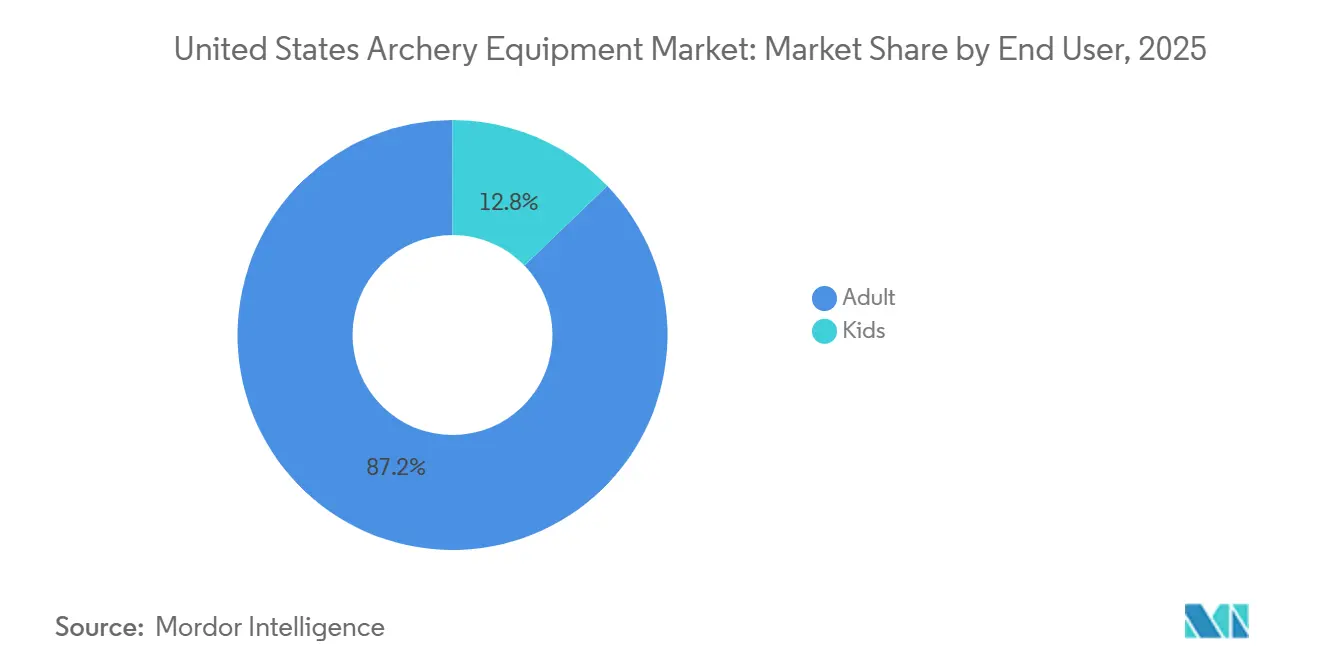
Adults accounted for 87.22% of revenue in 2025. Adult hunters and competitive archers generally have higher purchasing power and longer participation histories, reinforcing the adult segment’s leading share of the United States archery equipment market in 2025. Their requirements also support pro shops that provide fitting and tuning services. Continued equipment upgrades and replacement purchases by experienced adult users further sustain the segment’s revenue contribution.
The kids segment is projected to grow at a CAGR of 6.23% through 2031. NASP’s continued presence in schools provides younger participants with regular access to introductory archery programs. Youth equipment requires lower draw weights, shorter draw lengths, and lighter construction. These requirements may help develop future adult buyers as participants continue their involvement beyond school. The expansion of school-based programs and youth-focused competitions is expected to increase early participation and support continued demand for appropriately sized archery equipment.
By Distribution Channel: Online Retail Accelerates Faster Than Overall Market Growth
Offline retail stores accounted for 73.59% of revenue in 2025. Physical pro shops enable customers to measure draw length, tune arrows, assess grip comfort, and select suitable bows. This channel remains integral to the United States archery equipment market, as many customers seek expert guidance before purchasing primary equipment. Pro shops also offer equipment setup and maintenance services. The ability to test equipment physically and receive personalized recommendations further strengthens the role of offline retailers in high-value archery equipment purchases.
Online retail stores are forecasted to expand at a CAGR of 6.86% through 2031. Digital channels enable customers to purchase accessories, targets, arrows, and other standardized products more conveniently. They also allow brands to reach repeat buyers directly. An omnichannel approach can serve customers who research products online but prefer in-person fitting. Improved product information, customer reviews, and wider product availability are also encouraging archers to use online channels for equipment research and repeat purchases.
Geography Analysis
The South records dense bowhunting activity, supported by long deer seasons and established access traditions. Texas also has youth program infrastructure that supports National Archery in the School Program curriculum adoption and tournament activity. United States of America Archery’s recruitment program, funded by the United States Fish and Wildlife Service, has a national scope.
The Mountain West and Midwest account for a large share of bowhunting equipment demand. Montana, Wyoming, Idaho, Colorado, Ohio, Michigan, and Wisconsin have active hunting or tournament communities. A decline in Block Management acreage in Montana could reduce available hunting days. Ohio and Wisconsin also support 3D archery and tournaments, which increase demand for targets and accessories. The United States archery equipment market size in these areas depends on continued access to ranges and hunting land.
The Northeast and West Coast have stronger ties to recreational target archery and Olympic-style recurve shooting. The 2028 Los Angeles Olympic and Paralympic Games are expected to provide a focal point for organized archery participation. United States Archery’s R3 grant is designed to use that attention to expand local enrollment. California and nearby states may record stronger demand for recurve equipment and related accessories.
Competitive Landscape
The United States archery equipment market does not have a single manufacturer that dominates across product categories. Mathews Archery, Bowtech, Hoyt Archery, Bear Archery, and PSE Archery remain recognized competitors in compound bows. Competition in premium bows centers on cam systems, riser design, materials, and factory-tuning features. Bowtech's Alliance is associated with the Best New Bow award at the 2026 Archery Trade Show.
Companies use product launches to address different buyer needs and price points. In January, 2026 Mathews introduced the 2026 ARC 30 and ARC 34, featuring its SWX-2 Cam and a redesigned riser. Bowtech leveraged the Alliance launch and ATA recognition to strengthen dealer visibility. Bear Archery used the Adapt 2 HP Series to collaborate with The Hunting Public and reach buyers through dealers and online channels. These initiatives address hunting, performance, and customer reach.
The transition from school recurve equipment to adult products remains an important area for product planning. Pro shops remain relevant because many buyers still require specialized assistance for fitting and tuning. Range certification and equipment testing can influence institutional buyers and large retailers. Robertson Stykbow remains a legitimate but materially smaller participant in traditional bows.
United States Archery Equipment Industry Leaders
-
Scott Archery
-
Mathews Archery Inc.
-
Bowtech
-
Darton Archery LLC.
-
Bear Archery, Inc.
- *Disclaimer: Major Players sorted in no particular order

Recent Industry Developments
- August 2026: Elite Archery unveiled the Victra 40 target bow at the ASA Classic. The launch expanded the Victra platform with a 40-inch axle-to-axle design for competitive archers seeking improved stability, forgiveness, and precision. The bow features Elite’s SPX2 Cam System, Micro Splitters, S.E.T. Technology, and VX Mods.
- November 2025: Hoyt introduced its 2026 hunting bow lineup, which includes the Carbon RX-10 and Alpha AX-3 series. The lineup features improved carbon risers, enhanced cam systems, and lighter-weight designs for bowhunters.
- November 2025: Mathews Archery unveiled the 2026 ARC 30 and ARC 34, its new flagship hunting bows priced at USD 1,459 and USD 1,569, respectively. The bows feature the second-generation SWX-2 Cam with Perimeter Weight Technology and a redesigned riser with a fully integrated Silent Connect anchor.
- August 2025: Bear Archery launched the Adapt 2 HP Series in collaboration with The Hunting Public. The fourth-generation Adapt platform was developed using direct feedback from bowhunters and is available through Bear dealers and online.


United States Archery Equipment Market Report Scope
Archery equipment refers to the collection of tools and accessories used for recreational, competitive, and hunting-based archery activities. It includes bows, arrows, targets, protective gear, and performance-enhancing accessories such as sights, stabilizers, quivers, and releases that enable accurate and safe shooting. The United States archery equipment market is segmented by product type, category, end user, and distribution channel. By product type, the market is segmented into Bows, arrows, targets, and accessories. By category, the market is segmented into mass and premium. By end user, the market is segmented into adults and kids. By distribution channel, the market is segmented into offline retail stores and online retail stores. The Market Forecasts are Provided in Terms of Value (USD).
| Bows |
| Arrows |
| Targets |
| Accessories |
| Mass |
| Premium |
| Adult |
| Kids |
| Offline Retail Stores |
| Online Retail Stores |
| By Product Type | Bows |
| Arrows | |
| Targets | |
| Accessories | |
| By Category | Mass |
| Premium | |
| By End User | Adult |
| Kids | |
| By Distribution Channel | Offline Retail Stores |
| Online Retail Stores |


Key Questions Answered in the Report
What is the size of the United States Archery Equipment Market?
The United States Archery Equipment Market was valued at USD 612.37 million in 2025 and is projected to reach USD 819.40 million by 2031, growing at a CAGR of 5.12% during 2026–2031.
Which product type held the largest share in the United States Archery Equipment Market in 2025?
Bows were the leading product segment in 2025, accounting for 45.63% of the total market revenue. Their dominance is attributed to their essential role in archery and the availability of various bow types, including compound, recurve, and traditional bows.
Which category dominated the market in 2025?
The Mass category dominated the United States Archery Equipment Market in 2025, representing 68.42% of total sales.
Which end-user segment accounted for the largest market share in 2025?
The Adult segment held the largest share of the market in 2025, accounting for 87.22% of total revenue.
Which distribution channel led the market in 2025?
Offline Retail Stores remained the dominant distribution channel in 2025, capturing 73.59% of the market.
Which distribution channel is expected to grow the fastest between 2026 and 2031?
Online Retail Stores are forecast to be the fastest-growing distribution channel, registering a CAGR of 6.86% during the forecast period. The growth is supported by increasing e-commerce adoption, wider product availability, and competitive online pricing.
Page last updated on:





