
United Kingdom Social Commerce Market Size and Share
Market Overview
| Study Period | 2020 - 2031 |
|---|---|
| Forecast Data Period | 2026 - 2031 |
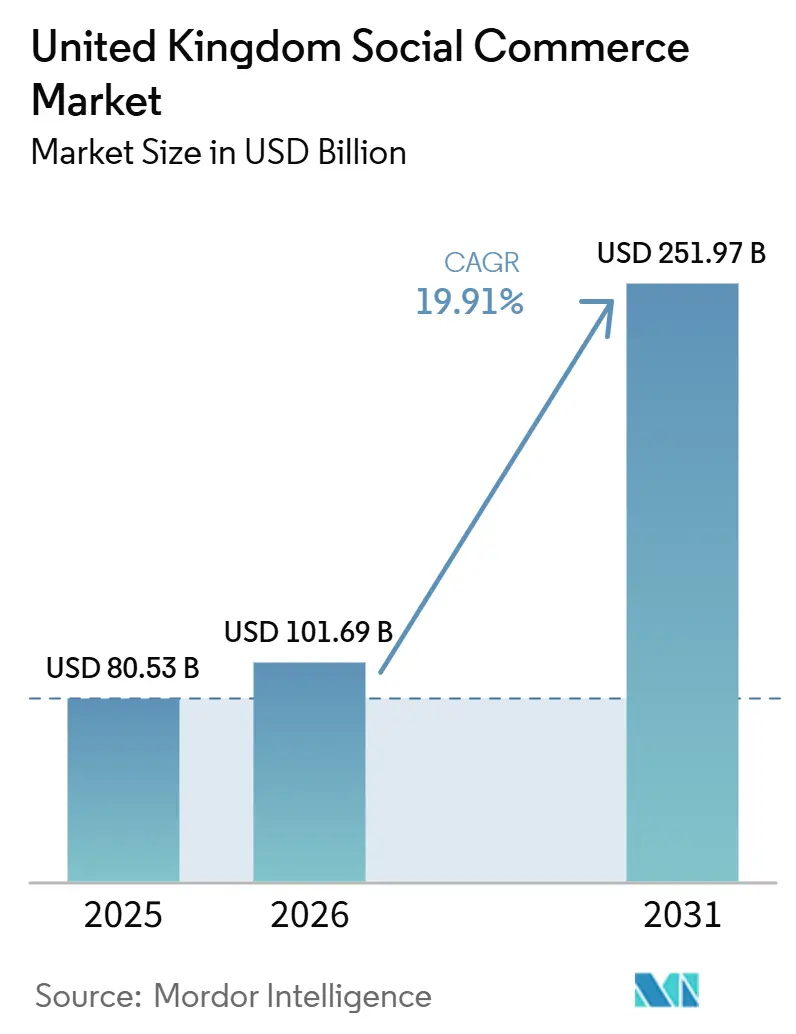
| Base Year Market Size (2025) | USD 80.53 Billion |
| Market Size (2026) | USD 101.69 Billion |
| Market Size (2031) | USD 251.97 Billion |
| Growth Rate (2026 - 2031) | 19.91 % |
| Market Concentration | Medium |
Major Players *Disclaimer: Major Players sorted in no particular order Image © Mordor Intelligence. Reuse requires attribution under CC BY 4.0. | |
United Kingdom Social Commerce Market Analysis by Mordor Intelligence
The United Kingdom social commerce market size was valued at USD 80.53 billion in 2025 and estimated to expand from USD 101.69 billion in 2026 to reach USD 251.97 billion by 2031, at a CAGR of 19.91% during the forecast period (2026-2031). The UK social commerce market has become a distinct retail channel because product discovery, social proof, and checkout now occur within one app session. Embedded payments are reducing the steps between viewing content and completing a purchase. A large creator base and established digital payment use support product discovery through social platforms. Younger consumers are increasingly using TikTok and Instagram for product research, which shifts attention away from search-led discovery. Competition is increasing as major platforms develop end-to-end commerce tools while specialists focus on live selling and resale.
Key Report Takeaways
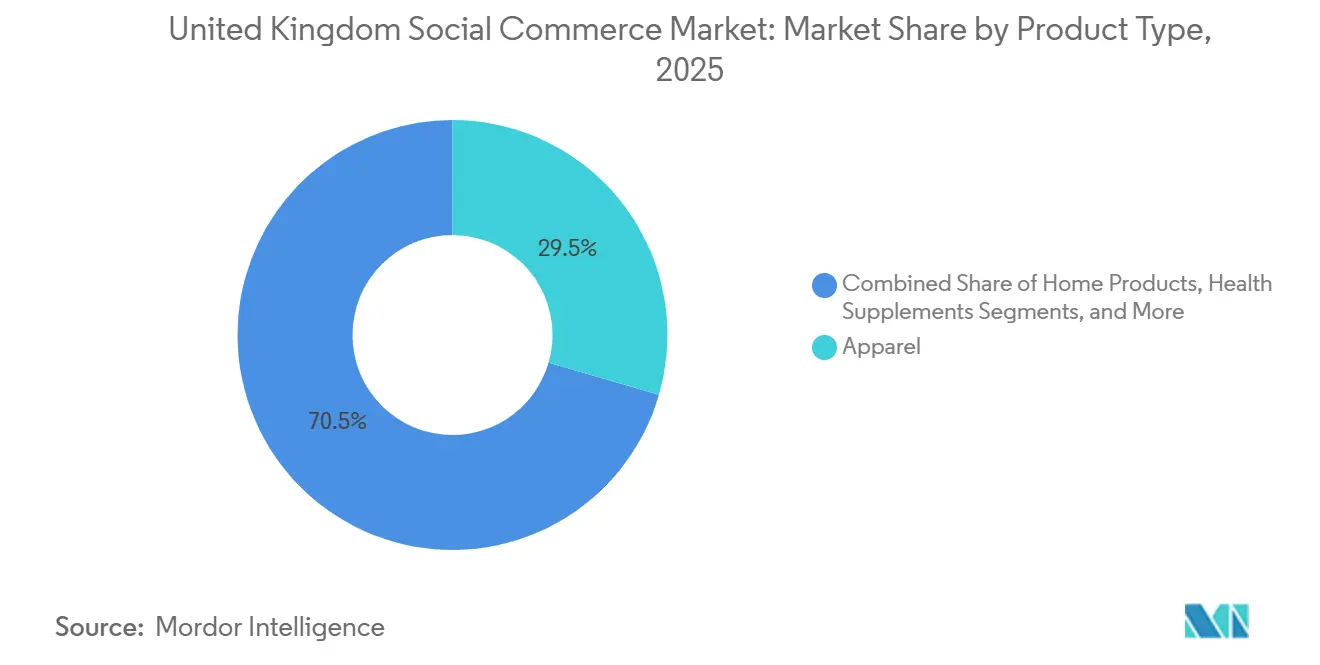
- By product type, apparel held 29.48% of the United Kingdom social commerce market share in 2025, while personal and beauty care is projected to expand at a 20.14% CAGR through 2031.
- By device, smartphones accounted for 78.23% of United Kingdom social commerce activity in 2025 and are projected to expand at a 20.26% CAGR through 2031.
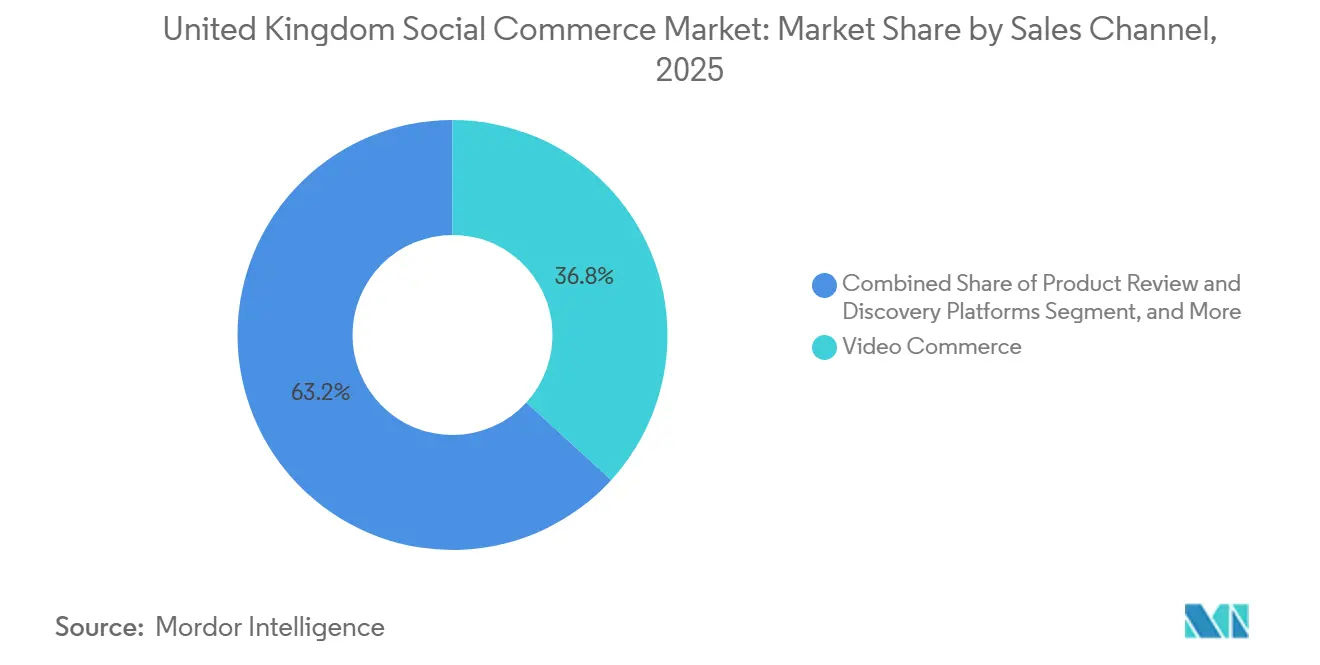
- By sales channel, video commerce held 36.77% of the United Kingdom social commerce market share in 2025, while social reselling is projected to expand at a 20.88% CAGR through 2031.
Note: Market size and forecast figures in this report are generated using Mordor Intelligence’s proprietary estimation framework, updated with the latest available data and insights as of January 2026.
United Kingdom Social Commerce Market Trends and Insights
Drivers Impact Analysis*
| Driver | (~) % Impact on CAGR Forecast | Geographic Relevance | Impact Timeline |
|---|---|---|---|
| Frictionless In-App Checkout and Embedded Payments | +3.5% | UK-wide, strongest among high-purchase-frequency urban consumers | Short term (≤ 2 years) |
| Creator-Led Product Discovery and Social Proof | +3.0% | UK-wide, especially beauty, fashion, and health supplements | Medium term (2-4 years) |
| Live and Video Commerce Adoption | +2.5% | UK-wide, with faster uptake among consumers aged 18-34 | Medium term (2-4 years) |
| Smartphone-First Shopping Journeys | +2.0% | UK-wide, especially Gen Z and millennial consumers | Short term (≤ 2 years) |
| Algorithmic Product Discovery Replacing Search-Led Discovery | +1.5% | Global platforms with UK feed personalization | Long term (≥ 4 years) |
| Scalable Creator-Affiliate Attribution and Payout Infrastructure | +1.2% | UK and Western Europe | Long term (≥ 4 years) |
| Source: Mordor Intelligence | |||
Frictionless In-App Checkout and Embedded Payments
Checkout friction had long limited conversion in the United Kingdom social commerce market. Stripe introduced an embedded Facebook checkout experience in 2026 that lets buyers use saved Meta payment credentials without leaving the feed.[1] The arrangement shortened the transaction path for customers who already use Meta’s payment tools. Meta’s PayPal partnership extended that option to users without Meta wallet credentials. TikTok Shop had already set an in-app purchase standard for UK buyers, and competing platforms are moving toward similar experiences. This shift gives brands a reason to direct more performance spending toward creator content when it can lead directly to a completed purchase.
Creator-Led Product Discovery and Social Proof
Creator content serves as a key route to product discovery in the United Kingdom social commerce market. UK brands are projected to spend heavily on affiliate and partner marketing, generating substantial revenue and delivering a strong return on investment. Clear disclosure rules can strengthen audience confidence when sponsored content is properly labeled. The UK’s financial promotion guidance requires firms and influencers to consider whether social media content is fair, clear, and not misleading. YouTube launched its UK Shopping Affiliate Programme in 2025 with retail partners including M&S, Boots, Debenhams, and Currys, extending creator commerce into long-form video.[2] The broader set of content formats gives brands more ways to link trusted recommendations with retail offers.
Live and Video Commerce Adoption
Live shopping is becoming a more established part of the United Kingdom social commerce market. TikTok Shop is expected to report a significant year-over-year increase in LIVE Shopping sessions, with thousands of sessions hosted each day. Whatnot is also expected to report strong year-over-year growth in UK first-time buyers in its State of Live Selling Report. Its expansion across categories shows that live selling is moving beyond collectibles and fashion. Video, livestreams, and affiliate links give retailers different ways to connect discovery with checkout. Platforms also need stronger safeguards for misleading ads and user safety as live sessions become more common.[3]
Smartphone-First Shopping Journeys
Smartphones represented a dominant share of activity in the United Kingdom social commerce market. Mobile shopping supports vertical video, notifications, biometric authentication, and app-based checkout in one environment. A substantial share of UK adults expected social platforms to capture a larger portion of online purchases, with stronger expectations among Gen Z consumers. TikTok Shop recorded strong sales activity during its Black Friday peak, demonstrating the scale that mobile-focused shopping systems can support. Brands, therefore, need pages that load quickly and provide clear trust signals during short browsing sessions. Notification-led visits and post-video browsing make personalization and checkout simplicity important for mobile performance.
Restraints Impact Analysis*
| Restraint | (~) % Impact on CAGR Forecast | Geographic Relevance | Impact Timeline |
|---|---|---|---|
| Product Quality and Payment Security Concerns | -2.5% | UK-wide, especially health supplements and third-party marketplace listings | Medium term (2-4 years) |
| Platform Dependence and Algorithm Volatility | -1.8% | Global, with high exposure for UK small businesses using one social storefront | Long term (≥ 4 years) |
| Compliance Burden Across Influencer, Consumer, and Online Safety Rules | -1.0% | UK-specific, with EU spillover for cross-border sellers | Short term (≤ 2 years) |
| Impulse-Commerce Returns, Fraud, and Chargeback Leakage | -0.7% | UK-wide, concentrated in apparel and personal care | Short term (≤ 2 years) |
| Source: Mordor Intelligence | |||
Product Quality and Payment Security Concerns
Product quality and payment security remain material barriers for the United Kingdom social commerce market. More than half of UK consumers who had not bought through social channels cited concerns over authenticity or payment security. These concerns are especially relevant in health supplements, cosmetics, and listings from third-party sellers. The FCA’s guidance has increased attention on posts containing financial claims or high-return promises. Seller verification and buyer-protection programs can help, but their standards are not consistent across platforms. The Advertising Standards Authority continues to monitor influencer advertising and consumer understanding of commercial content.
Platform Dependence and Algorithm Volatility
Platform dependence creates a structural risk for sellers in the United Kingdom social commerce market. TikTok Shop stated in July 2026 that more than 300,000 UK small businesses sell through the platform. Sellers using one platform may struggle to transfer audience data, reviews, and transaction history when platform rules change. A change in ranking criteria can sharply reduce organic discovery during a short period. Meta moved Facebook and Instagram Shops toward website-based checkout in September 2025, requiring merchants to adjust established operating processes. Ofcom’s proposed fraud-advertising codes would add responsibilities for major categorized services and could affect how commercial content is surfaced.
*Our forecasts treat driver/restraint impacts as directional, not additive. The impact forecasts reflect baseline growth, mix effects, and variable interactions.
Segment Analysis
By Product Type: Beauty Content Broadens the Category Mix
Apparel held 29.48% of the United Kingdom social commerce market share in 2025. Fashion creators and short-form video support clothing discovery because products are easy to demonstrate visually. Womenswear sellers led TikTok Shop’s UK creator rankings in the first half of 2026. Whatnot also reported strong fashion viewing activity as its women’s fashion audience expanded. Apparel sellers face closer scrutiny of size, sustainability, and promotional claims under UK advertising rules.
Personal and beauty care is projected to record a 20.14% CAGR through 2031, the highest rate among product types. TikTok Shop said beauty sales increased 60% year over year in 2025, and the platform became the UK’s 4th-largest beauty retailer. Skin care, cosmetics, and Korean beauty products are well-suited to creator demonstrations and reviews. Accessories, home products, health supplements, and food and beverages each serve different demand needs within the UK social commerce market. Health supplements face greater attention to health claims, which can limit aggressive creator partnerships.

By Device: Mobile Design Sets the Shopping Standard
Smartphones represented 78.23% of the United Kingdom social commerce market size by device activity in 2025. App-based purchase flows, biometric checkout, and notifications favor brands that design for mobile first. The smartphone segment is projected to expand at a 20.26% CAGR through 2031. Better 5G coverage and mobile-focused retail design are supporting this direction. Laptops and desktops retain a role in higher-consideration purchases such as home furnishings and electronics.
Mobile use also concentrates purchase decisions in short session windows. Consumers often browse during commutes, after viewing creator content, or after receiving a notification. These moments make speed and simple trust cues more important than long product descriptions. Brands need content and pages that communicate key information within seconds. This behavior affects creative choices across every product category in the UK social commerce market.
By Sales Channel: Resale Expands Alongside Video Commerce
Video commerce held 36.77% of the United Kingdom social commerce market share in 2025. TikTok Shop combined shoppable short videos, LIVE sessions, and creator-affiliate activity during the 2025 holiday period. The platform recorded its highest UK sales day on Black Friday, reaching 27 items sold per second. Social network-led commerce on Facebook and Instagram now functions more as a discovery and click-through layer after Meta’s checkout change. This gives merchants more control over website conversion but requires them to manage their own checkout path.
Social reselling is projected to advance at a 20.88% CAGR through 2031. Vinted reported strong revenue growth in 2025, while gross merchandise value also increased significantly. These results show the scale of peer-to-peer resale in the UK and Europe. Group buying remains less developed in the UK than in Southeast Asian social commerce markets. Product review and discovery platforms remain important early points of validation for high-consideration purchases in the UK social commerce market.
Geography Analysis
The United Kingdom social commerce market has reached a substantial scale. The country has a strong online retail base and an English-language creator ecosystem that supports brand discovery beyond its borders. This ecosystem can also influence buyers in Ireland, Australia, and North America. TikTok reported that its platform made a significant economic contribution and supported employment in the UK.
London and the South East account for the largest concentration of creators, fashion brands, and early-adopter consumers. The UK social commerce market has also expanded beyond these areas as small businesses adopt social selling tools. TikTok stated that its Local Feed directed 4.3 million consumers to local shops and 6.1 million to local cafes and restaurants in 2025. This wider participation creates an opportunity for regional small and medium-sized businesses. The Online Safety Act applies throughout the country, although larger platforms face the greatest scrutiny under categorized service rules.
The United Kingdom sits between the faster adoption seen in Southeast Asia and the earlier stage of social commerce development in parts of Southern and Eastern Europe. The United States has a larger absolute social-selling base, but the United Kingdom has a more mature online retail starting point. Germany and France may narrow the gap as TikTok Shop expands on the continent and Whatnot adds European sellers. South America and the Middle East and Africa have different regulatory settings and platform use patterns. The UK therefore remains a useful operating reference for live-commerce practices in other developed markets.
Competitive Landscape
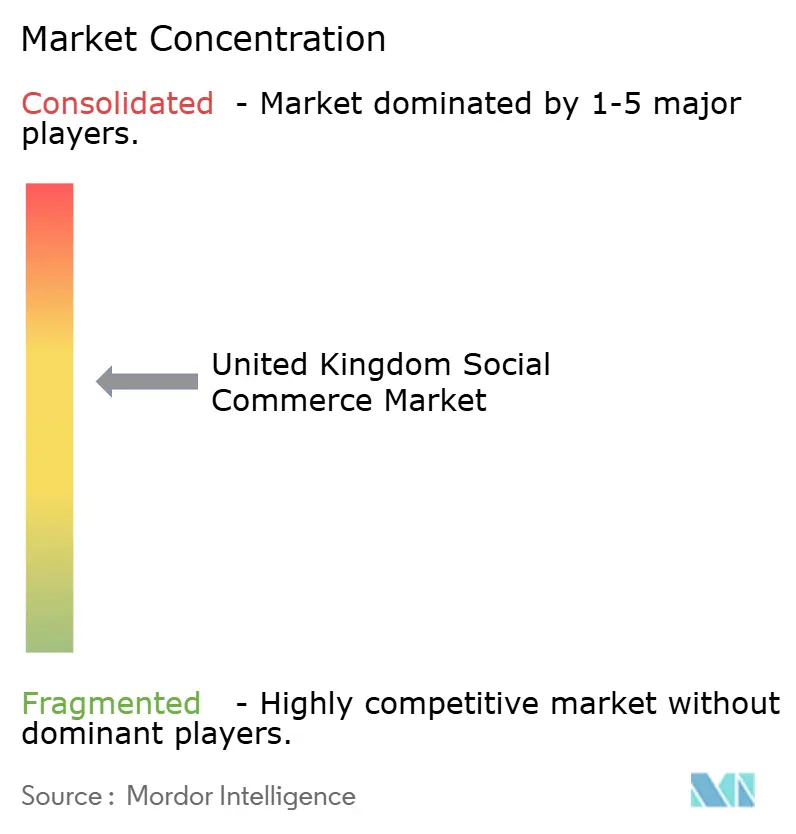
The United Kingdom social commerce market is moderately concentrated at the platform level and more fragmented in resale, infrastructure, and live-commerce services. TikTok and Meta account for a large share of active buyer sessions, while specialized providers compete for narrower use cases. TikTok combines seller tools, creator partnerships, affiliate programs, and checkout in one system.
Meta changed its operating model by moving Shops toward website checkout in September 2025 and supporting an embedded checkout experience with Stripe in 2026. This approach supports Meta’s role in product discovery and advertising while allowing merchants to retain website transaction infrastructure. Pinterest serves a different role through visual search and purchase-intent discovery. Pinterest reported 619 million monthly active users and 80 billion monthly searches in fiscal year 2025.[4] Its position can help brands reach consumers earlier in their purchase research.
Whatnot is strengthening its live-commerce capability through personalization and merchant integration. The company acquired Shaped in July 2026 to develop real-time recommendations and search for live shopping. Whatnot also integrated with Shopify, enabling merchants to coordinate inventory, listings, and orders across both services. Bambuser provides live-commerce software for retailers rather than operating a consumer marketplace. Compliance capacity will favor platforms that can manage advertising controls, fraud prevention, and content governance at scale.
United Kingdom Social Commerce Industry Leaders
-
TikTok Information Technologies UK Limited
-
Meta Platforms, Inc.
-
Pinterest, Inc.
-
Whatnot, Inc.
-
Shopify Inc.
- *Disclaimer: Major Players sorted in no particular order
Recent Industry Developments
- July 2026: Whatnot acquired Shaped, a machine learning company specializing in real-time recommendation and search systems, to power personalized live-shopping discovery at scale. Whatnot's systems process more than 500,000 hours of live video and millions of real-time interactions weekly. Shaped founder Tullie Murrell joined as head of a new Applied AI Research group. The deal followed Whatnot's USD 225 million Series F, achieved at a valuation exceeding USD 11 billion.
- July 2026: TikTok Shop confirmed that more than 300,000 UK small businesses sold on the platform, with new seller registrations up 200% year over year and LIVE Shopping sessions increasing 55% year over year, generating over 6,000 sessions daily. The milestone reinforced TikTok Shop's position as one of the UK's largest e-commerce platforms by active merchant count.
- July 2026: Ofcom published draft codes of practice under the Online Safety Act 2023 targeting fraudulent advertising on categorized services, Category 1 and 2A. The proposals place new transparency and accountability obligations on major social commerce platforms operating in the UK, with enforcement power to compel removal of non-compliant promotional content.
- April 2026: Whatnot launched a full integration with Shopify, enabling Shopify merchants to simultaneously manage inventory, listings, and orders across both platforms. Beta users generated more than USD 10 million in sales across nearly 20 categories. The integration is designed to lower the barrier for established e-commerce brands to enter live commerce.
United Kingdom Social Commerce Market Report Scope
The United Kingdom Social Commerce Market refers to the buying and selling of products directly through social media platforms and social-network-driven commerce experiences within the UK. It includes shoppable posts, creator-led product discovery, live shopping, in-app checkout, and commerce features embedded in platforms such as Instagram, TikTok, Facebook, and Pinterest.
The United Kingdom Social Commerce Market Report is Segmented by Product Type (Apparel, Personal and Beauty Care, Accessories, Home Products, Health Supplements, and Food and Beverages), by Device (Laptops and Desktops, and Smartphone), and by Sales Channel (Video Commerce, Social Network-Led Commerce, Social Reselling, Group Buying / Team Purchase, and Product Review and Discovery Platforms). The Market Forecasts are Provided in Terms of Value (USD).
| Apparel |
| Personal and Beauty Care |
| Accessories |
| Home Products |
| Health Supplements |
| Food and Beverages |
| Other Product Types |
| Laptops and Desktops |
| Smartphone |
| Video Commerce |
| Social Network-Led Commerce |
| Social Reselling |
| Group Buying / Team Purchase |
| Product Review and Discovery Platforms |
| By Product Type | Apparel |
| Personal and Beauty Care | |
| Accessories | |
| Home Products | |
| Health Supplements | |
| Food and Beverages | |
| Other Product Types | |
| By Device | Laptops and Desktops |
| Smartphone | |
| By Sales Channel | Video Commerce |
| Social Network-Led Commerce | |
| Social Reselling | |
| Group Buying / Team Purchase | |
| Product Review and Discovery Platforms |
Key Questions Answered in the Report
What is the United Kingdom social commerce market size?
The United Kingdom social commerce market size is USD 101.69 billion in 2026 and is forecast to reach USD 251.97 billion by 2031 at a 19.91% CAGR.
Which product category leads social shopping in the United Kingdom?
Apparel led with 29.48% share in 2025, supported by fashion creators and video-based product discovery.
What is the fastest-growing product category in UK social commerce?
Personal and beauty care is projected to expand at a 20.14% CAGR through 2031.
Which device is most used for social shopping in the United Kingdom?
Smartphones accounted for 78.23% of activity in 2025 and are projected to expand at a 20.26% CAGR through 2031.
Which sales channel has the largest share in UK social commerce?
Video commerce held 36.77% share in 2025, supported by shoppable video and livestream shopping.
What limits consumer adoption of social shopping in the United Kingdom?
Product authenticity, payment security, platform dependence, and compliance requirements remain important barriers.