
United Kingdom OTT Market Size and Share
Market Overview
| Study Period | 2020 - 2031 |
|---|---|
| Forecast Data Period | 2026 - 2031 |
| Base Year Market Size (2025) | USD 23.53 Billion |
| Market Size (2026) | USD 25.63 Billion |
| Market Size (2031) | USD 36.58 Billion |
| Growth Rate (2026 - 2031) | 7.37 % |
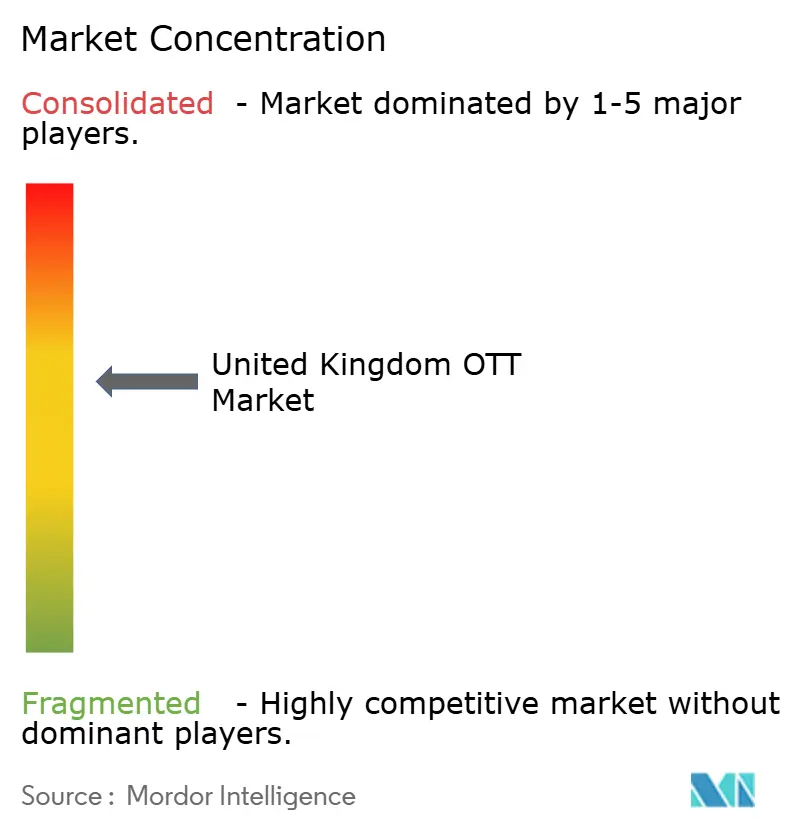
| Market Concentration | Medium |
Major Players *Disclaimer: Major Players sorted in no particular order Image © Mordor Intelligence. Reuse requires attribution under CC BY 4.0. | |
United Kingdom OTT Market Analysis by Mordor Intelligence
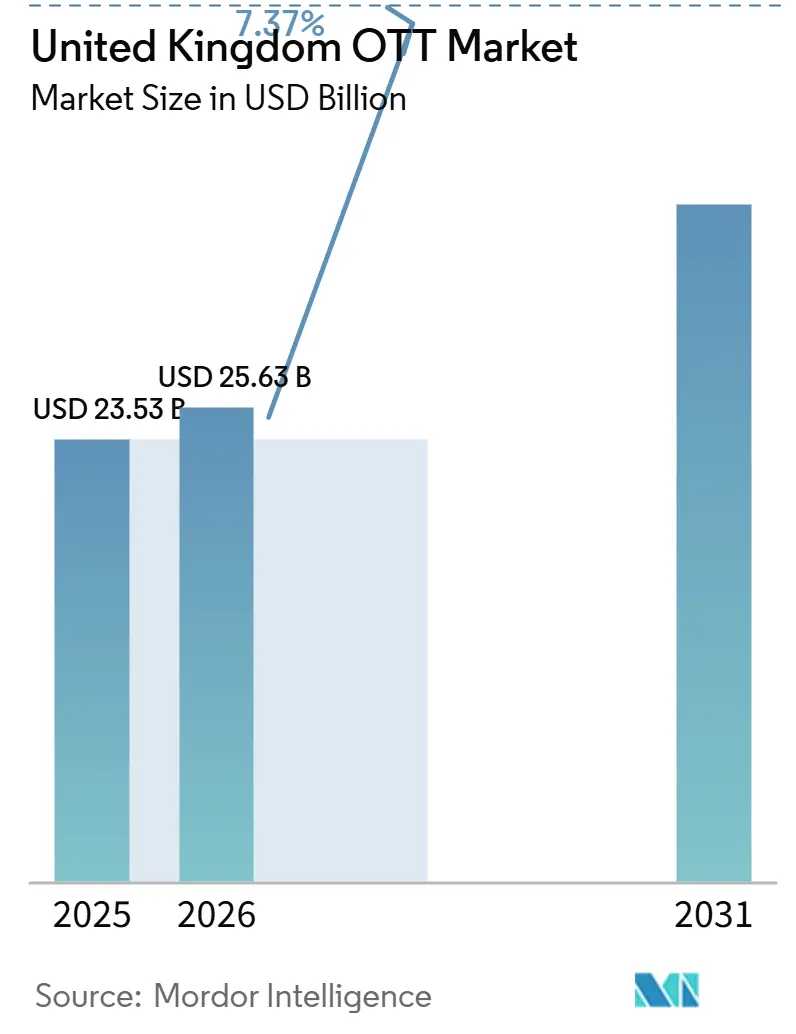
The United Kingdom OTT market size is expected to grow from USD 23.53 billion in 2025 to USD 25.63 billion in 2026 and is forecast to reach USD 36.58 billion by 2031 at 7.37% CAGR over 2026-2031. The UK OTT market has moved from a period centered on adding subscribers to one centered on increasing revenue from established households, where several paid services already coexist. Subscription video on demand revenue reached GBP 5.17 billion (USD 6.5 billion) in 2025, supported by price changes and ad-supported plans rather than by substantial household additions. The United Kingdom OTT market benefits from widespread subscription use, with 70.3% of households holding at least 1 SVOD subscription in Q1 2026, which limits the remaining scope for household expansion. The decline in broadcast viewing continues to shift attention toward on-demand services, although social and short-form video compete for the same viewing time and make sustained engagement important. Advertising tiers, local programming, sports rights, and easier content discovery will shape how platforms protect revenue and reduce cancellations through 2031.
Key Report Takeaways
- By revenue model, SVOD held 58.44% of the United Kingdom OTT market share in 2025, while the hybrid subscription-and-ads model is projected to expand at a 7.96% CAGR through 2031.
- By device type, smart TVs accounted for 57.61% of the United Kingdom OTT market's device segment in 2025 and are expected to grow at an 8.03% CAGR through 2031.
- By content genre, TV shows and episodic content held 45.19% of the United Kingdom OTT market share in 2025, while documentaries are projected to record an 8.11% CAGR through 2031.
Note: Market size and forecast figures in this report are generated using Mordor Intelligence’s proprietary estimation framework, updated with the latest available data and insights as of January 2026.
United Kingdom OTT Market Trends and Insights
Drivers Impact Analysis*
| Driver | (~) % Impact on CAGR Forecast | Geographic Relevance | Impact Timeline |
|---|---|---|---|
| Transition From Linear TV to On-Demand Viewing | +2.1% | National, with steeper migration among 18-44 cohorts in England and urban centers | Short term (≤ 2 years) |
| Ad-Supported Tier Adoption Across Major OTT Platforms | +1.7% | National, with highest ad-tier adoption density in London and Southeast England | Short term (≤ 2 years) |
| Connected TV and Big-Screen Streaming Growth | +1% | National | Medium term (2-4 years) |
| Premium Sports and Local Content Rights Supporting Retention | +0.8% | National, with particular depth in England and Scotland | Medium term (2-4 years) |
| Subscription Bundling and Hybrid Monetization | +0.6% | National, with global platform decisions affecting UK pricing | Medium term (2-4 years) |
| Personalization and Recommendation Engines Increasing Watch Time | +0.3% | Global technology deployment with UK implementation | Long term (≥ 4 years) |
| Source: Mordor Intelligence | |||
Strong Transition From Linear TV to On-Demand Viewing
Live television viewing declined on a per-person, per-day basis compared with the previous year. Weekly reach for live or recorded broadcast television also declined over the period. The change extended across age groups, including older viewers, which shows that the shift is broader than younger viewers replacing older ones. Broadcaster video-on-demand services partly absorbed this movement, as weekly reach and time spent on these services increased. The United Kingdom OTT market also faces competition for viewing time because total in-home video viewing has declined. Ofcom's prominence framework supports domestic services by requiring public service broadcaster applications to remain easy to find on smart television interfaces, which preserves their access to viewers when device home screens also feature global streaming applications.[1]Ofcom, “Media Nations: UK,” Ofcom, ofcom.org.uk
Rising Adoption of Ad-Supported Tiers Across Major OTT Platforms
Netflix's ad-supported plan reached a substantial share of its UK subscribers, compared with a lower share previously. Disney+'s corresponding share also increased, while Amazon Prime Video's ad-supported option accounted for most of its UK subscriber base.[2]Barb, “Barb Data Show That 20.8m UK Homes Had Access to an SVOD Service in Q1 2026,” Barb, barb.co.uk The United Kingdom OTT market is therefore increasingly shaped by advertising yield, audience targeting, and access to first-party data rather than subscriber totals alone, especially as household penetration limits acquisition-led growth. Platforms can keep price-sensitive viewers in their ecosystems by offering a lower-priced plan with advertising while retaining a higher-priced ad-free option for other households.Netflix reported that a majority of new subscribers in territories with an ad plan chose that option instead of a premium plan.[3]Netflix, “GenPage: Towards End-to-End Generative Homepage Construction at Netflix,” Netflix, netflix.com This pattern indicates that the ad-supported model still has room to develop in the UK despite already high adoption, but it also raises the importance of inventory quality and advertiser demand.
Growth of Connected TV and Big-Screen Streaming Consumption
Smart televisions are the main streaming interface in the UK, and broadcaster on-demand application viewing on connected televisions has increased. Television manufacturers now influence viewing decisions through their operating systems, installed applications, and free ad-supported channel offerings that appear alongside subscription services. This gives device operators a larger role in the distribution and advertising value that once sat mainly with dedicated streaming services, while also making application placement more important for service visibility. EE TV introduced Smart Search and Mood Matcher, bringing conversational search and mood-based recommendations to its pay television service. Netflix also announced a vertical video feed and its GenPage system to improve content discovery and personalize the home page. The United Kingdom OTT market requires smaller services to improve discovery tools because viewers can switch between services with little difficulty and may not reach a title when catalog options are difficult to navigate.
Premium Sports and Local Content Rights Supporting Subscriber Retention
Sky Sports and TNT Sports began the latest Premier League domestic rights cycle, covering multiple upcoming seasons. Amazon Prime Video stopped showing live Premier League matches after previously holding those rights, removing a streaming-exclusive tool that had supported subscription acquisition. Live sports and UK-made drama can keep viewers engaged because they offer fixed-date viewing and familiar local programming, rather than relying only on browsing a large library. BBC content accounted for most of the most-watched programs in the United Kingdom in the year to date. The fragmented sports-rights position leaves scope for bundles and partnerships between rights holders and streaming distributors, since no single service has comprehensive sports coverage. The United Kingdom OTT market can use exclusive local programming to limit cancellations in ways that broad catalog expansion may not achieve.
Restraints Impact Analysis*
| Restraint | (~) % Impact on CAGR Forecast | Geographic Relevance | Impact Timeline |
|---|---|---|---|
| Subscription Fatigue Among Multi-Service Households | -1.5% | National, with highest churn risk among middle-income households in England | Short term (≤ 2 years) |
| Price Sensitivity and Tier Downgrades | -1.2% | National | Short term (≤ 2 years) |
| Fragmented Rights Landscape Raising Content Costs | -0.7% | National, particularly affecting mid-tier and niche OTT platforms | Medium term (2-4 years) |
| Regulatory Scrutiny of Children’s Safety, Advertising, and Data Use | -0.4% | National, governed by Ofcom and UK data protection frameworks | Long term (≥ 4 years) |
| Source: Mordor Intelligence | |||
Subscription Fatigue Among Multi-Service Households
Many UK households hold several services, which makes monthly cancellation and rejoining a practical way to control spending when major titles are released at different times. The United Kingdom OTT market is exposed to this behavior because free domestic services, including BBC iPlayer, ITVX, and Channel 4 Streaming, provide established local programming without a direct subscription charge. Households that rotate paid services may still value the content, but their changing subscriptions make platform revenue less predictable and reduce the value of promotional acquisition. Broadcaster video-on-demand viewing grew, showing the relevance of free, ad-funded alternatives. Platforms must therefore give viewers clear reasons to maintain a paid service between major releases or sports events, whether through programming, plan choice, or a useful bundle. Bundles and differentiated content can reduce this pressure, but they do not remove the basic need for households to manage costs.
Intensifying Price Sensitivity and Tier Downgrades
Average SVOD prices in the UK rose significantly over the past decade. SVOD revenue continued to expand, with price increases rather than subscriber additions supporting growth. This creates a trade-off for the United Kingdom OTT market because higher prices can lift revenue while encouraging viewers to choose lower-priced plans and reconsider the number of subscriptions they retain. Netflix UK saw some subscribers downgrade their plans, with many moving to the ad-supported tier. Moving to an ad plan preserves the subscriber relationship and creates advertising income, which is preferable to a full cancellation for platform revenue. Yet higher prices may lead to cancellations once households have already moved to the lowest available tier and have no further plan to choose.
*Our forecasts treat driver/restraint impacts as directional, not additive. The impact forecasts reflect baseline growth, mix effects, and variable interactions.
Segment Analysis
By Revenue Model, SVOD Commands Scale as Hybrid Models Gain Ground
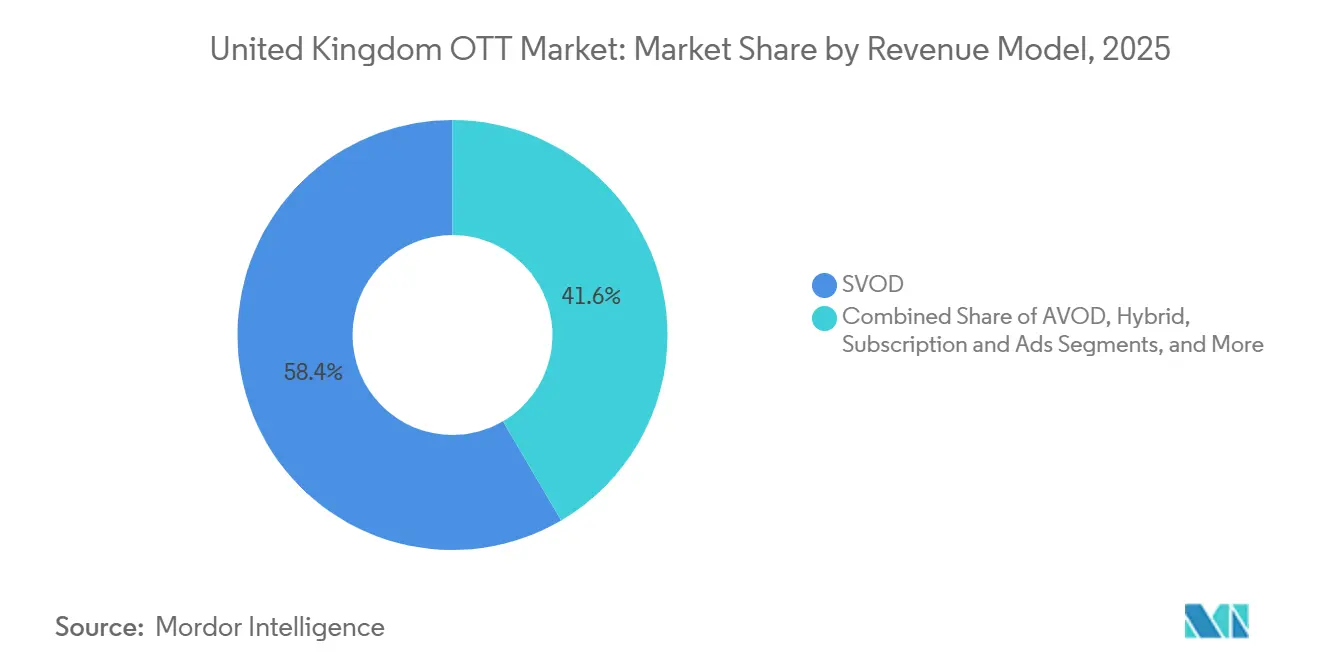
SVOD accounted for 58.44% of UK paid streaming revenue in 2025, supported by Netflix, Amazon Prime Video, Disney+, and Discovery+. Netflix was present in 61% of UK households in Q1 2026, compared with 46.1% for Amazon Prime Video and 26.1% for Disney+. These services accounted for 80% of UK SVOD revenue, reflecting their content investment, established user bases, and household familiarity, and their earlier expansion also gave them a stronger position in a mature household-subscription market. The United Kingdom OTT market has reached a high level of subscriptions, so revenue growth is expected to rely more on price increases, premium plans, and bundles than on new household adoption.
The hybrid subscription-and-ads model is projected to grow at a 7.96% CAGR from 2026 to 2031. Ad-supported plans provide a route for services to retain customers who do not want to pay for an ad-free tier. Domestic broadcaster services also expanded their on-demand viewing by 9% in 2025, reinforcing the role of ad-funded video. TVOD continues to serve viewers seeking new releases and early digital viewing windows, while services such as Rakuten TV operate across advertising and transaction-led formats. MUBI maintains a distinct position across subscription and transaction-led viewing for art-house and independent cinema, where a focused catalog and distinct release strategy separate it from larger general entertainment services.



By Device Type, Smart TVs Anchor the Big-Screen Experience
Smart TVs held 57.61% of the UK smart TV segment in 2025 and are projected to grow at an 8.03% CAGR through 2031. The leading position shows that in-home viewing remains central even as mobile video habits continue. The United Kingdom OTT market is increasingly influenced by smart TV operating systems because they control application placement, search, free channels, and advertising inventory. This position allows hardware companies to participate directly in the distribution layer rather than only supplying screens, and this changes the commercial relationship between hardware, applications, channels, and advertisers.
Smartphones and tablets remain important for commuting, short viewing sessions, and live sports follow-along. Laptops and desktops serve a smaller but continuing group of viewers, including those watching live events and longer factual programs. EE TV's March 2026 introduction of Smart Search and Mood Matcher shows how operators are investing in content discovery on the television screen. As connected television use expands, interface design will become more important for preventing viewers from leaving before selecting content. Other devices will continue to complement big-screen viewing in secondary rooms and outside the home, where they meet viewing needs that are less suitable for a fixed television screen.
By Content Genre, Episodic Content Leads While Documentaries Accelerate
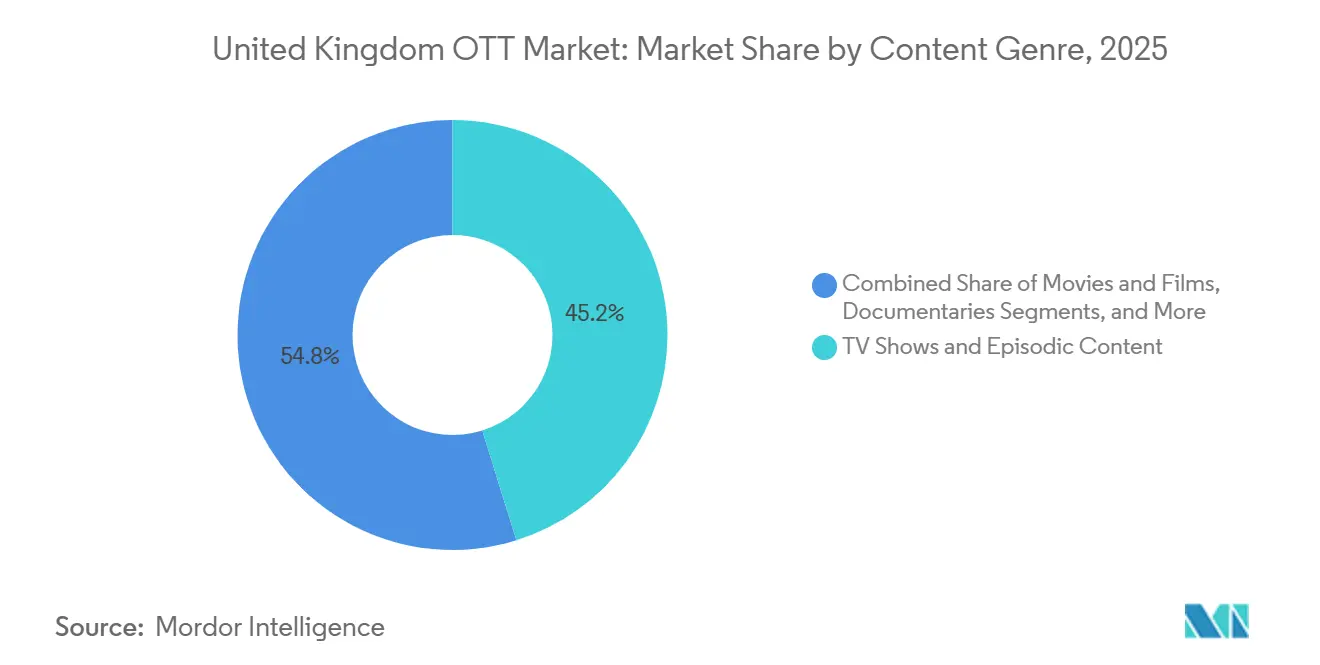
TV shows and episodic content captured 45.19% of UK streaming viewing by genre in 2025. Netflix's Adolescence and K-Pop Demon Hunters were the 2 most-watched streaming programs in the UK in 2025 under Barb measurement. British drama, soap operas, and returning series give broadcasters on-demand services a continuing source of local programming. BVoD libraries contained more than 60,000 hours of UK-originated programming, which supports regular viewing and repeat visits, particularly when viewers return for continuing storylines rather than a single standalone title.
Documentaries are projected to be the fastest-growing genre, with an 8.11% CAGR from 2026 to 2031. BBC Select reported 61% revenue growth in 2025/26, the strongest growth among BBC Commercial direct-to-consumer offerings. True crime, social-issue investigations, and long-form factual programming can attract trial users and sustain discussion after release. Movies and films remained the second-largest genre and continue to support premium subscription and transaction-led services. Focused factual programming can give specialist services a clearer audience proposition than a general entertainment catalog, especially where its commissioning and rights strategy aligns closely with a clearly defined audience.
Geography Analysis
The United Kingdom OTT market size was USD 23.53 billion in 2025, and SVOD household penetration reached 70.3% in Q1 2026. UK SVOD revenue reached GBP 5.17 billion (USD 6.5 billion) in 2025. High use of English-language content, established broadband access, and active viewing habits support this position. UK households held more than 2 SVOD subscriptions on average. 20% of households subscribed to Netflix, Amazon Prime Video, and Disney+ at the same time, supporting opportunities for bundles and premium plans.
Greater London and Southeast England have a higher concentration of premium-tier subscribers, consistent with higher disposable income and faster broadband speeds. Scotland has a distinct regional offering through STV Player, which recorded 75 million annual viewing hours in 2025. STV Player entered free ad-supported television distribution in July 2026 through a partnership with Narrative Entertainment's Great! portfolio. Wales has a bilingual viewing environment shaped by S4C-linked Welsh-language programming. Northern Ireland has a cross-border media setting because some Republic of Ireland content is accessible there.
The United Kingdom OTT market will be affected by the proposed transition away from terrestrial digital television, with a potential switch-off window between 2034 and 2044. Rural and semi-rural areas of Scotland, Wales, Northern Ireland, and northern England still face lower broadband speeds that can limit streaming quality. Government and commercial broadband programs are expected to reduce this gap over time. Better access could bring additional demand from areas that have not experienced the same streaming growth as better-connected urban locations.
Competitive Landscape
The United Kingdom OTT market has high revenue concentration among leading paid services, although the number of active platforms remains broad. Netflix, Amazon Prime Video, and Disney+ lead paid SVOD revenue, while BBC iPlayer, ITVX, Channel 4 Streaming, STV Player, MUBI, DAZN, Rakuten TV, Plex, and Everyone TV serve other models and audiences. Netflix generated GBP 2 billion (USD 2.5 billion) in UK revenue in 2025, while Amazon Prime Video generated GBP 981 million (USD 1.2 billion) and Disney+ generated GBP 553 million (USD 695 million). Leading services are pursuing ad-supported plans, UK programming, and better discovery tools to protect engagement. Netflix's advertising business targeted USD 3 billion in 2026, showing the commercial importance of its advertising model.
Sky agreed in July 2026 to acquire ITV's Media and Entertainment division for up to GBP 1.6 billion (USD 2.1 billion), including ITVX and ITV's broadcast channel portfolio. The combined entity accounts for 20% of UK in-home viewing and expects GBP 200 million (USD 251 million) in annual cost synergies. Sky and ITV's deal combines pay television distribution and free streaming in a larger domestic commercial offering. EE TV introduced conversational search and mood-based recommendations in March 2026, showing that discovery is also a competitive feature. Netflix's GenPage work similarly shows that platforms are treating personalized discovery as proprietary infrastructure.
Samsung and YouTube hold hybrid positions as device or platform ecosystems that also distribute video and advertising. BBC Select's 61% revenue growth in 2025/26 shows continuing room for focused documentary services. Services must also meet Ofcom advertising requirements and Online Safety Act obligations, particularly for children's content, age assurance, and targeted advertising. These requirements affect global and domestic operators because service design must account for advertising and audience safeguards.
United Kingdom OTT Industry Leaders
Netflix, Inc.
Amazon.com, Inc.
The Walt Disney Company
Alphabet Inc.
Paramount, a Skydance Corporation
- *Disclaimer: Major Players sorted in no particular order

Recent Industry Developments
- July 2026: Sky agreed to acquire ITV's Media and Entertainment division for up to GBP 1.6 billion (USD 2.1 billion), including ITVX and ITV's broadcast channel portfolio. The transaction includes a GBP 2.1 billion (USD 2.8 billion) 5-year content supply agreement with ITV Studios and is subject to Competition and Markets Authority review. Deal close is expected in H2 2027. The combined entity accounts for 20% of all UK in-home viewing, creating what Sky and ITV described as a commercial streaming champion for the UK.
- July 2026: UK Culture Secretary Lisa Nandy signaled that the BBC's Royal Charter settlement from 2028 will include license fee reform. Proposals under consideration would extend the annual GBP 180 (USD 239) license fee to households subscribing to Netflix, Disney+, or Amazon Prime Video regardless of BBC iPlayer use. The Motion Picture Association publicly opposed the proposals on behalf of U.S. studios and streaming platforms.
- July 2026: STV Player entered free ad-supported television channel distribution for the first time through a strategic content partnership with Narrative Entertainment's Great! channel portfolio. STV Player recorded 75 million annual viewing hours in 2025, up 9% year over year, its highest consumption year before the expansion.
- April 2026: Netflix announced plans to integrate a TikTok-style vertical video feed and deploy its GenPage system, which generates personalized page layouts from individual viewing history. Netflix stated that internal testing reduced end-to-end latency by 20%. The announcement focused on improving content discovery for Netflix's 18.1 million UK subscribers.


United Kingdom OTT Market Report Scope
The United Kingdom OTT market refers to the revenue and ecosystem generated by internet-delivered video services, subscription, ad-supported, transactional, and hybrid within the United Kingdom. It includes OTT TV and video platforms, streaming apps, and connected‑TV services that deliver content over broadband instead of traditional broadcast or pay‑TV channels
The United Kingdom OTT Market Report is Segmented by Revenue Model (SVOD, AVOD, TVOD, and Hybrid, Subscription and Ads), Device Types (Smartphones and Tablets, Smart TVs, and More), Content Genre (Movies and Films, TV Shows and Episodic Content, and Documentaries). The Market Forecasts are Provided in Terms of Value (USD).
| SVOD |
| AVOD |
| TVOD |
| Hybrid, Subscription and Ads |
| Smartphones and Tablets |
| Smart TVs |
| Laptops and Desktops |
| Other Device Types |
| Movies and Films |
| TV Shows and Episodic Content |
| Documentaries |
| Other Content Genres |
| By Revenue Model | SVOD |
| AVOD | |
| TVOD | |
| Hybrid, Subscription and Ads | |
| By Device Type | Smartphones and Tablets |
| Smart TVs | |
| Laptops and Desktops | |
| Other Device Types | |
| By Content Genre | Movies and Films |
| TV Shows and Episodic Content | |
| Documentaries | |
| Other Content Genres |


Key Questions Answered in the Report
What is the United Kingdom OTT market size?
The United Kingdom OTT market was USD 23.53 billion in 2025, is expected to reach USD 25.63 billion in 2026, and is forecast to reach USD 36.58 billion by 2031 at a 7.37% CAGR. The forecast reflects an established subscription base and continued revenue expansion from existing households, not a large increase in the number of subscribing homes, because the UK already has a deeply established subscription video audience.
What is driving United Kingdom streaming revenue growth?
Price optimization, ad-supported tiers, local programming, and sports rights are supporting revenue growth as household subscription penetration matures. The move away from broadcast television also maintains demand for on-demand services, although social video competes for time and gives consumers many shorter alternatives to long-form programming, which makes the quality and visibility of streaming content important for continued use.
Which revenue model leads in the United Kingdom?
SVOD led with 58.44% share in 2025, while the hybrid subscription-and-ads model is projected to grow at a 7.96% CAGR through 2031. Paid services are using advertising tiers to retain customers who choose lower-cost viewing options, while retaining a route to advertising income and future plan upgrades, as viewers may move between advertising and ad-free plans according to monthly budgets.
Which device is most important for United Kingdom streaming services?
Smart TVs held 57.61% share in 2025 and are projected to grow at an 8.03% CAGR. Application visibility, search, recommendations, and free channels on television operating systems increasingly affect what viewers select, particularly when several applications carry similar program libraries, so simple navigation can determine whether a viewer starts watching or leaves the service.
Which content genre has the largest audience?
TV shows and episodic content held 45.19% share by genre in 2025, while documentaries are expected to grow fastest at an 8.11% CAGR. Returning British series and large broadcaster libraries support repeat use of episodic programming, which can keep viewers engaged between individual film releases, while documentaries offer a different factual format that can support focused specialist services.
How do ad-supported plans affect United Kingdom streaming services?
Ad-supported plans help platforms retain price-sensitive viewers and build advertising revenue, with Netflix's ad plan reaching 40% of its UK subscriber base in Q1 2026. These plans can protect subscriber relationships when higher prices lead consumers to reassess ad-free options, helping platforms manage price sensitivity without immediately losing the customer relationship, which is especially important when household spending on several services is under pressure throughout the forecast period.
Page last updated on:





