
United Kingdom Educational Tourism Market Size and Share
Market Overview
| Study Period | 2021 - 2031 |
|---|---|
| Forecast Data Period | 2026 - 2031 |
| Base Year Market Size (2025) | USD 25.29 Billion |
| Market Size (2026) | USD 25.67 Billion |
| Market Size (2031) | USD 35.85 Billion |
| Growth Rate (2026 - 2031) | 6.91 % |
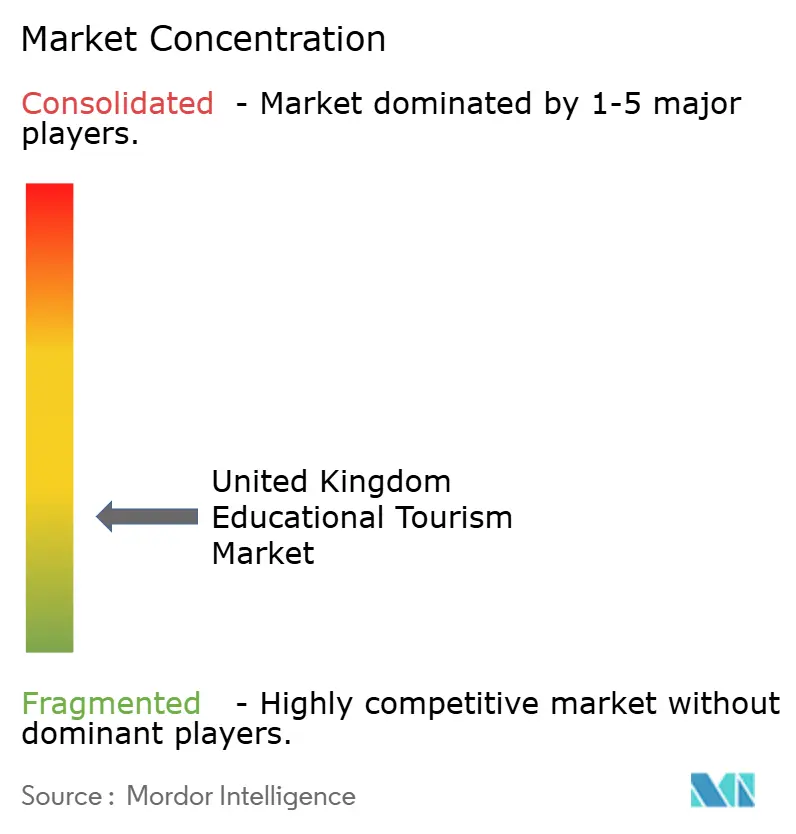
| Market Concentration | Low |
Major Players *Disclaimer: Major Players sorted in no particular order Image © Mordor Intelligence. Reuse requires attribution under CC BY 4.0. | |
United Kingdom Educational Tourism Market Analysis by Mordor Intelligence
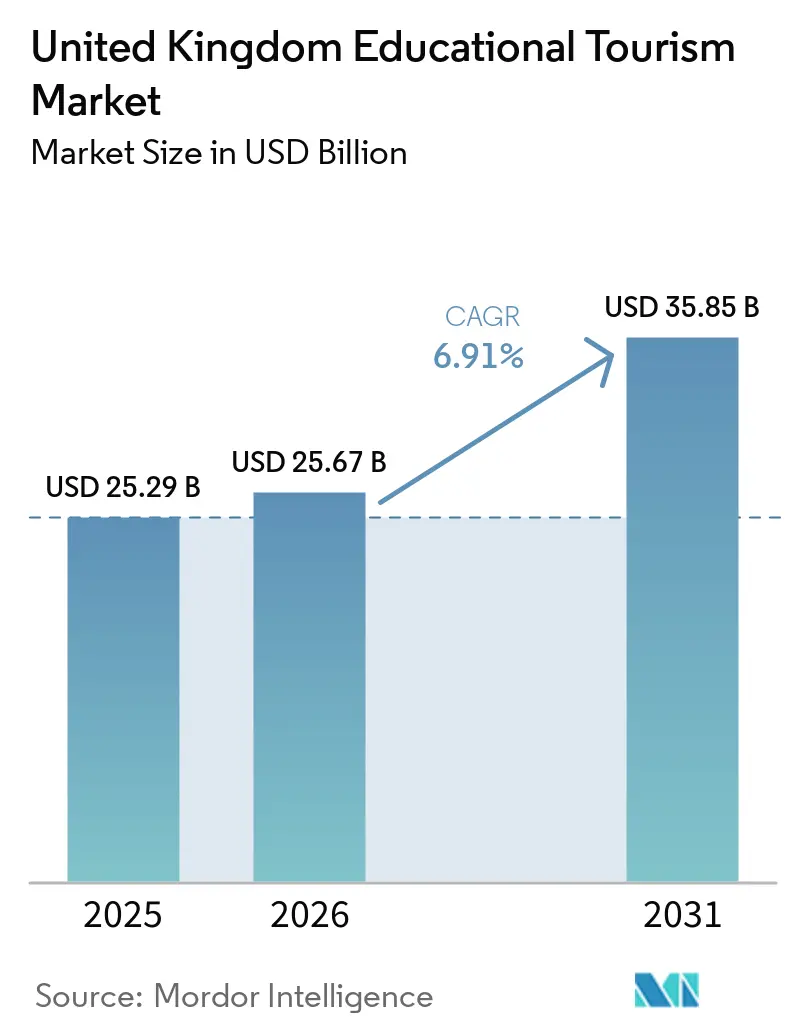
The United Kingdom educational tourism market was valued at USD 25.29 billion in 2025 and is estimated to grow from USD 25.67 billion in 2026 to reach USD 35.85 billion by 2031, at a CAGR of 6.91% during the forecast period (2026 - 2031). British institutions remain attractive, with 17 universities ranked in the global QS top 100 in 2026. Policies aim to increase education exports from GBP 32.3 billion (USD 43.58 billion) in 2022 to GBP 40 billion (USD 53.96 billion) by 2030. Demand is shifting toward travel that integrates study, culture, and local experiences. In 2024, youth, students, and educational visitors contributed GBP 37.7 billion (USD 50.86 billion) to the economy from 13.6 million arrivals, highlighting their economic significance[1]. Market competition is moderate to high, with providers including universities, pathway operators, language schools, and experience-led operators. English language teaching generated GBP 996 million (USD 1,343.7 million) in direct revenue across English United Kingdom member centers in 2024. International higher education demand stabilized, with 697,365 overseas enrollments in 2024/25. Visa growth from Nepal, Bangladesh, and Ghana offset declines from older markets. Challenges include affordability, stricter visa rules, and the geographic concentration of teaching capacity in London and southern England. The planned 2027 return to Erasmus+ and the United Kingdom-European Union Youth Experience Scheme presents potential growth opportunities not yet reflected in the current market outlook.
Key Report Takeaways
- By age group, 13 - 25 years held 39.42% of the United Kingdom educational tourism market share in 2025, and the same cohort is projected to record the fastest growth at 7.64% through 2031.
- By education type, graduation programs accounted for 34.34% of the United Kingdom educational tourism market size in 2025, while post-graduation is forecast to expand at a 7.14% CAGR through 2031.
- By course and program duration, long-term programs represented 45.51% of the United Kingdom educational tourism market value in 2025, while medium-term programs are set to grow fastest at 7.06% through 2031.
- By booking channel, education agents and counselors held 40.42% of the United Kingdom educational tourism market value in 2025, while online and digital platforms are projected to post the highest CAGR at 8.36% through 2031.
- By tourism type, international tourism accounted for 68.72% of the United Kingdom educational tourism market value in 2025, while domestic tourism is forecast to expand at 7.52% through 2031.
Note: Market size and forecast figures in this report are generated using Mordor Intelligence’s proprietary estimation framework, updated with the latest available data and insights as of January 2026.
United Kingdom Educational Tourism Market Trends and Insights
Drivers Impact Analysis*
| Drivers | (~) % Impact on CAGR Forecast | Geographic Relevance | Impact Timeline |
|---|---|---|---|
| Global demand for English education sustains strong United Kingdom academic-tourism growth | +2.1% | Primary uplift from Asia, Middle East, South America | Long term (≥ 4 years) |
| The United Kingdom's International Education Strategy supports long-term education-export expansion | +1.5% | United Kingdom-wide, priority markets include India, Indonesia, Nigeria, Saudi Arabia, Vietnam | Long term (≥ 4 years) |
| Rising middle-class and HNWI populations are increasing immersive study-travel demand | +1.2% | Asia-Pacific core, with spillover to Gulf and Southeast Asia | Medium term (2-4 years) |
| Youth Mobility Scheme expansion enhances inbound travel for students and school groups | +0.8% | Australia, Canada, New Zealand, Japan, South Korea, prospective European Union markets | Medium term (2-4 years) |
| Demand for United Kingdom-accredited certifications drives professional education-tourism growth | +0.7% | Especially India, Nigeria, and Gulf states (high demand across emerging student-sending regions) | Medium term (2-4 years) |
| In-person study in the United Kingdom enhances cultural immersion and increases visitor spending | +1.0% | Concentrated in France, Germany, Spain, Italy, and South America | Short term (≤ 2 years) |
| Source: Mordor Intelligence | |||
Global demand for English education sustains strong United Kingdom academic-tourism growth
English remains the primary language for business, higher education, and global mobility, ensuring the United Kingdom educational tourism market relies on steady global demand rather than short-term travel trends. The British Council reports significant annual student inflows to the United Kingdom for English studies, enabling providers to offer diverse programs, including junior camps, adult courses, exam preparation, and blended language options. By 2024, ELT student numbers had not fully recovered to pre-pandemic levels, but spending per student increased, reflecting a shift toward shorter, higher-value stays[2]. The market benefits from diversified source countries, with growth from China, Turkey, and Colombia helping offset declines from Spain and Italy. Provider credibility is supported by the British Council accreditation scheme, operated with English United Kingdom, which fosters trust across source markets and establishes accredited delivery as a key requirement for sustained success in the United Kingdom educational tourism market.
The United Kingdom's International Education Strategy supports long-term education-export expansion
The United Kingdom’s International Education Strategy seeks to enhance education exports significantly by 2030. It emphasizes student recruitment, transnational education, English language teaching, skills programs, and edtech, broadening the scope of offerings to attract visitors. Heads of Mission will act as Local Education Champions in West Africa and the Gulf starting in 2026, utilizing diplomatic infrastructure to promote education in key regions. The Turing Scheme is set to fund thousands of outbound placements in 2025/26, with a majority allocated to disadvantaged students. Plans to rejoin Erasmus+ in 2027 aim to strengthen exchange routes with Europe. The global delivery of United Kingdom higher education continues to play a vital role, with hundreds of thousands of students across numerous countries enrolled in United Kingdom programs, creating pathways for future visits and campus-based learning opportunities in the United Kingdom.
Rising middle-class and HNWI populations are increasing immersive study-travel demand
Increasing household wealth in key source countries is driving families toward higher-value and longer-duration study travel, strengthening the United Kingdom educational tourism market. India has become a significant contributor, reflecting strong demand for British credentials. This interest extends beyond full degrees, with affluent households also supporting boarding schools, summer programs, language camps, and cultural experiences that combine education with travel and private accommodations. Spending patterns indicate that these learners tend to stay longer, purchase additional services beyond tuition, and are less affected by moderate price changes compared to budget-conscious groups. This trend enhances revenue stability and encourages diversification across age groups, from early education to postgraduate and executive learning. By offering a range of programs, operators can increase lifetime value and reduce reliance on single enrollment events.
Youth Mobility Scheme expansion enhances inbound travel for students and school groups
The Youth Mobility Scheme facilitates temporary study and cultural participation for young people from an increasing number of partner countries, enhancing the United Kingdom's educational tourism market[3]. Quotas for Canada, New Zealand, and Japan were expanded, and the United Kingdom-European Union Youth Experience Scheme announced in May 2025 is expected to attract more participants. Current usage remains low, with only a fraction of the quota utilized, leaving room for growth. France's exemption from ETA requirements for under-18 school groups has simplified continental travel planning. The United Kingdom-Germany School Group Travel Scheme, launching in August 2026, aims to address similar barriers in a key European market. These initiatives support language schools, heritage tours, residential programs, and short academic visits, broadening the United Kingdom's educational tourism demand beyond higher education.
Restraints Impact Analysis*
| Restraints | (~) % Impact on CAGR Forecast | Geographic Relevance | Impact Timeline |
|---|---|---|---|
| Post-Brexit travel restrictions sharply reduced European Union school-group arrivals | -0.9% | European Union-27, especially Germany, Italy, Spain, Poland, and Romania | Long term (≥ 4 years) |
| High tuition and living costs reduce affordability versus competing destinations | -0.7% | Especially China at the master’s level, Nigeria, and South and Southeast Asia | Medium term (2-4 years) |
| Student-dependent visa restrictions lower demand from key source markets | -0.6% | India, Nigeria, Pakistan | Short term (≤ 2 years) |
| Homestay accommodation shortages limit peak-season enrolment capacity | -0.4% | Southwest England, Channel Islands, London, and Southeast England | Short term (≤ 2 years) |
| Source: Mordor Intelligence | |||
Post-Brexit travel restrictions sharply reduced European Union school-group arrivals
Brexit has complicated the United Kingdom educational tourism market, making school travel, higher education entry, and short study planning more difficult for European Union learners. European Union student enrollments in United Kingdom higher education have significantly declined since the shift from home-fee to international-fee status. The IZA Institute of Labor Economics attributes much of this drop to the fee policy change, which heavily impacted cross-border mobility. School groups face similar challenges due to new passport and ETA requirements for adult chaperones, particularly in markets like Germany, where ID-card arrangements previously sufficed. These barriers have strengthened the appeal of rival destinations such as Ireland, Malta, and Canada, which promote easier access. As a result, the United Kingdom has lost ground in European Union short-course and group travel segments.
High tuition and living costs reduce affordability versus competing destinations
Rising tuition, accommodation, and compliance costs are restraining the United Kingdom educational tourism market. International undergraduate tuition fees are significantly higher compared to many competing destinations, while postgraduate taught fees also add to the financial burden. The British Council attributed a decline in Chinese master's visa issuances in 2025 to affordability concerns and changing perceptions in China's labor market about overseas education[4]. Cost pressures have intensified with the Immigration Health Surcharge increase in February 2024 and the proposed annual levy on international student fees starting in the 2028/29 academic year. The United Kingdom’s low ranking in travel and tourism price competitiveness in 2024 highlights a structural price disadvantage, especially as students increasingly prioritize value.
*Our forecasts treat driver/restraint impacts as directional, not additive. The impact forecasts reflect baseline growth, mix effects, and variable interactions.
Segment Analysis
By Age Group: The 13-25 Cohort Anchors Revenue and Drives Future Growth
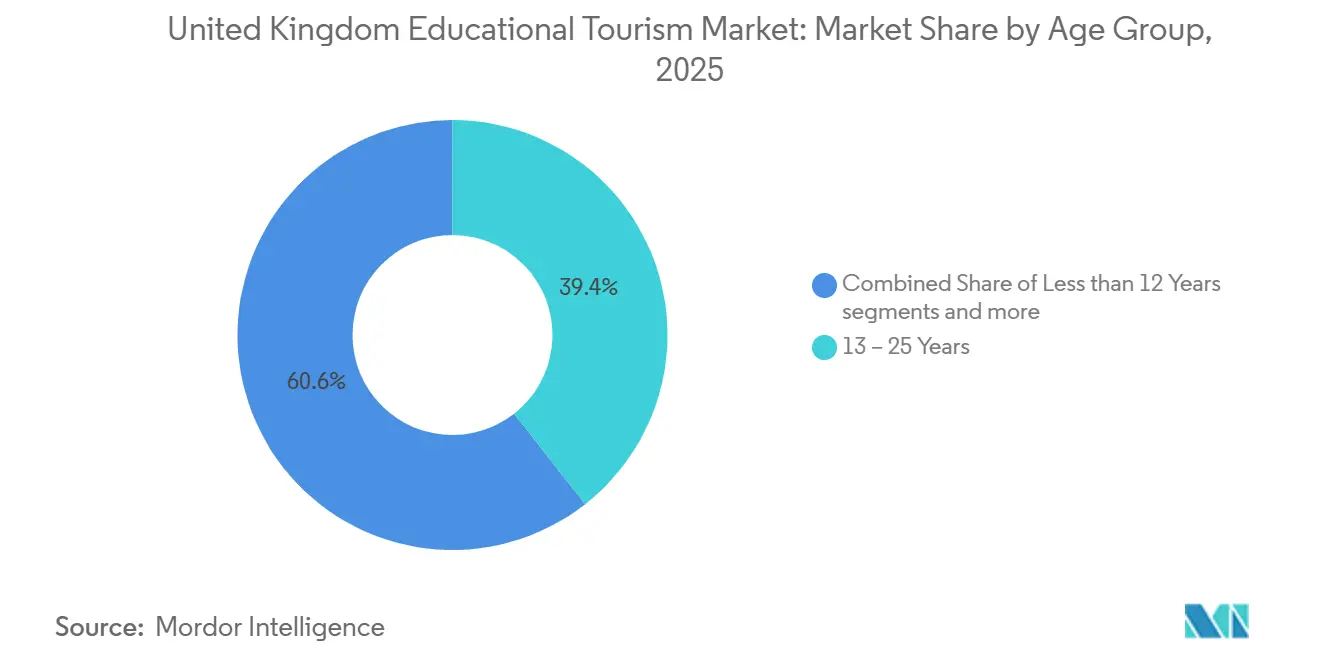
The 13-25 years age group accounted for 39.42% of the United Kingdom educational tourism market revenue in 2025 and is projected to grow at a 7.64% CAGR through 2031. This segment benefits from demand for junior language immersion and degree or pathway travel. In 2024, junior learners represented 38% of English United Kingdom's full-time ELT students, while adult volumes declined by 8%, highlighting stronger resilience among younger travelers. This group supports local spending through travel formats combining classroom instruction, excursions, homestays, and campus life. Providers can retain learners across multiple products, spanning school age to early degree studies, ensuring long-term engagement in the market.
The under-12 segment faces challenges, with Child Student visas declining by 15.9% in 2025 and mainland China recording a one-third drop after VAT was introduced on private school tuition in January 2025. This change has increased costs, limiting access to families with higher purchasing power or domestic school trips. The 26-40 age group is growing as mid-career learners seek residential upskilling, executive education, and micro-credentials that align with work schedules. The over-40 group, though smaller, contributes through longer stays, private accommodations, and interest in cultural and small-group learning experiences. The 13-25 years segment remains central to the United Kingdom educational tourism market, while older age groups diversify the value mix and create opportunities for specialized offerings.

By Education Type: Graduation Leads, Post-Graduation Accelerates
Graduation-level programs accounted for 34.34% of market value in 2025, highlighting the prominence of undergraduate and pathway-linked studies in the United Kingdom educational tourism market. Post-graduation programs are projected to grow at 7.14% through 2031, reflecting increased demand for research, specialization, and career-focused credentials. This shift aligns with a maturing market, as undergraduate volumes have stabilized while postgraduate research enrollment rose by 6.3% in 2024/25, driving longer stays and higher accommodation spending. Graduation programs remain central to global student mobility, connecting feeder schools, international colleges, pathway companies, and universities, supported by a well-established distribution network.
Postgraduate taught studies declined by 12.7% in 2024/25, driven by reduced demand from India and Nigeria following dependent visa policy changes, exposing the segment’s sensitivity to migration regulations. Secondary education contributes significantly through A-Level, GCSE, school immersion, and study tours, particularly where administrative ease benefits European school groups. Primary programs face challenges due to high boarding costs and weaker Child Student visa demand, shifting some interest to domestic curriculum travel. Providers spanning pathway, graduation, and post-graduation stages can leverage repeat spending across a learner’s educational journey, enhancing cross-selling opportunities. This multi-tier approach is increasingly valuable as source-market conditions vary more sharply by age, income, and visa profiles, making broad market exposure more advantageous than focusing on a single degree category.
By Course & Program Duration: Long-Term Programs Dominate, Medium-Term Gains Ground
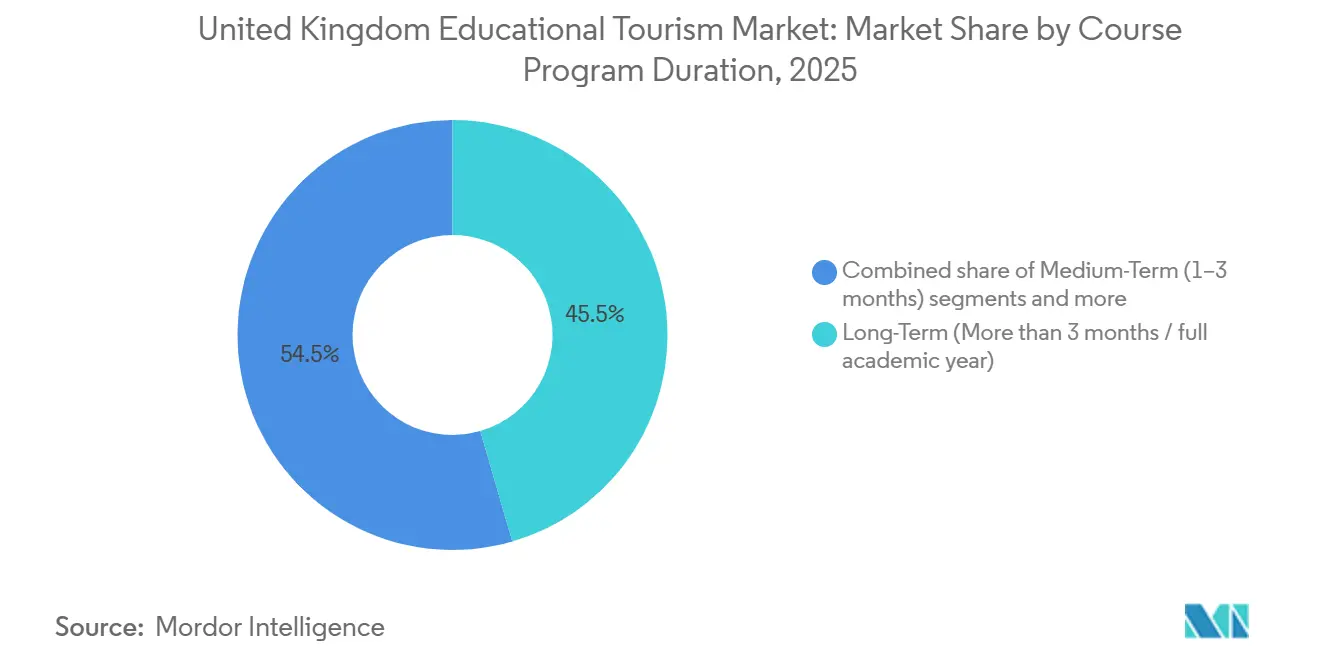
Long-term programs accounted for 45.51% of the United Kingdom educational tourism market value in 2025 due to extended in-country spending from full higher education programs, boarding placements, and academic pathways. This dominance is structural, as learners in multi-month or academic-year formats spend on tuition, accommodation, transport, local living, and leisure over longer periods. These programs also strengthen the roles of agents, pathway operators, and compliance-led advisors, reinforcing the market's distribution model. Institutions rely on long-term programs to maintain stable occupancy for housing and campus infrastructure. Providers benefit from additional revenue opportunities through language support, excursions, internships, and extension programs.
Medium-term programs are projected to grow at 7.06% through 2031, making them the fastest-growing category. They bridge leisure trips and full academic study, appealing to working professionals, pre-university students, and gap-year learners seeking clear outcomes without committing to a full academic year. English United Kingdom’s 2024 data showed an average stay of 3.3 weeks in private centers, up from the previous year, indicating a preference for practical yet immersive formats. Short-term programs remain relevant for junior camps and cultural trips but face challenges from post-Brexit paperwork and accommodation shortages, limiting peak-season recovery. Medium-term programs are emerging as a flexible growth driver, balancing affordability with demand for meaningful in-person experiences.
By Booking Channel: Agents Hold Share, Digital Platforms Take Fastest Growth
Education agents and counselors accounted for 40.42% of the market value in 2025, highlighting their significant role in the United Kingdom's educational tourism market, particularly in cross-border enrollments and structured study planning. Agents remain crucial for long-form programs, assisting with visas, housing, institutional fit, and documentation, while partner institutions rely on their networks for scale. The 2026 strategy's Agent Quality Framework strengthens regulated agencies by raising standards, limiting informal brokers, and enhancing compliance and student confidence. Traditional channels remain relevant despite the growing shift to digital platforms earlier in the search process.
Online and digital platforms are projected to grow at 8.36% through 2031, becoming the fastest-growing booking route as prospective learners increasingly start with virtual discovery. AI-driven searches, virtual campus tours, application engines, and blended information journeys enable direct provider comparisons. English United Kingdom reported online-only ELT enrollments for the first time in 2023, and blended formats combining on-campus and online study are now common among providers. Direct enrollment remains strong in short courses, summer camps, and domestic educational trips, where school connections and word-of-mouth often bypass intermediaries. The channel mix is hybrid, but digital capabilities are becoming a key advantage in the United Kingdom educational tourism market, reducing friction while preserving choice.
By Tourism Type: International Leads in Value, Domestic Leads in Growth
International tourism accounted for 68.72% of the market value in 2025, highlighting the importance of overseas learners in the United Kingdom educational tourism market. The United Kingdom's position as the second most popular higher education destination globally and its share of international tertiary students emphasize the role of long-haul academic mobility in market value. International students contribute higher spending by combining tuition with accommodation, transport, leisure, and extended stays compared to domestic visitors. The market remains dependent on overseas source-market health, exchange rates, and visa policies, despite improvements in domestic travel programs.
Domestic tourism, projected to grow at 7.52% through 2031, is the fastest-growing segment, though it starts from a smaller base. Growth is driven by curriculum-linked school trips, Turing-linked exchanges, and interest in short residential learning in heritage cities like Oxford, Cambridge, and Edinburgh. Bradford's designation as United Kingdom City of Culture 2025, supported by GBP 15 million (USD 20.23 million) in funding and 6,000 projected training opportunities, reflects a shift toward northern cities. Domestic growth reduces reliance on international markets by supporting utilization during periods of weaker overseas demand. While domestic demand does not replace international value, it stabilizes the market and promotes regional development.
Geography Analysis
London and the South of England represented the largest share of ELT student weeks in 2025, with London and the South and South-East contributing significantly. These regions benefit from dense provider networks, strong air connectivity, and overlap between study destinations and tourism itineraries, making them key entry points for first-time educational visitors. Oxford and Cambridge enhance this appeal with their academic and cultural programs. However, the Southwest and Channel Islands faced the most significant accommodation shortfall in English United Kingdom's 2024 survey, limiting providers' ability to meet summer demand. Accreditation and welfare standards remain critical, with providers competing on service, product, and capacity under British Council and English United Kingdom frameworks.
Northern England accounted for a smaller portion of national ELT student weeks in 2025 but is emerging as a growth region. The West Midlands reported growth in international enrollments during 2024/25, while Bradford’s City of Culture designation is expanding cultural and educational capacity. Scotland, with a smaller share of ELT student weeks, outperformed in higher education visibility due to institutions in Edinburgh and Glasgow and government promotion. Wales experienced a decline in international enrollments during 2024/25, reflecting its vulnerability to demand shifts. India issued the highest number of new student visas in 2025, followed by China, which saw a decline. Nigeria recovered, while Bangladesh, Nepal, and Ghana showed strong growth. Non-European Union markets now contribute more value density, while Spain and Italy together accounted for a significant share of ELT student weeks in 2024, highlighting the importance of both long-haul and short-course demand.
Competitive Landscape
The United Kingdom educational tourism market remains fragmented, with some subsegments controlled by pathway specialists, branded language operators, or school travel companies. EF Education First held the largest market share in 2025, followed by Kaplan International Languages, St Giles International, International House London, and British Study Centers. This structure highlights the importance of scale in pathways and branded networks, while local expertise, welfare standards, and itinerary quality are critical in ELT and school travel. Competitive intensity is shaped by consolidation at the top and the entry and exit of smaller providers. Bell Educational Services, after decades of operation, entered administration in 2025, reflecting the market's challenges for weaker operators.
Strategic moves in 2026 indicate firms are expanding across the learner lifecycle rather than focusing on single niches. INTO University Partnerships acquired Kings Education, adding K-12 schooling, adult ELT, young learner programs, and transnational education partner schools to its higher education pathways. Oxford International Education Group expanded its international routing platform through partnerships and new destinations, retaining more of the value chain within its network. EF invested in its EF Hello AI tutor and immersive learning campuses, enhancing digital engagement. These developments show the market favors operators combining distribution, delivery, and digital engagement over reliance on location or legacy reputation.
Smaller specialists like NST Travel Group, Halsbury Travel, The School Travel Company, and ECE Travel compete effectively by prioritizing safety, service responsiveness, and itinerary design. Rising costs in accommodation, transport, exchange rates, and documentation are pressuring margins in school travel. INTO reported significantly adjusted turnover for FY2024, with a substantial portion from the United Kingdom, highlighting the advantages of diversified operators. Competition also includes conversion technology, where AI tools and digital admissions improve lead quality. Firms with strong compliance, diverse portfolios, and digital infrastructure are capturing a larger share of demand.
United Kingdom Educational Tourism Industry Leaders
-
EF Education First
-
Kaplan International Languages
-
St Giles International
-
International House London
-
British Study Centers (BSC)
- *Disclaimer: Major Players sorted in no particular order
Recent Industry Developments
- May 2026: Inspirit Capital acquired Kaplan Languages Group (KLG) from Kaplan on May 1, 2026. KLG operates over 20 language schools in 8 countries and a language travel agency with 200+ partner destinations. Inspirit plans to maintain standards, ensure continuity, and refresh KLG's brand identity.
- May 2026: The United Kingdom–Germany School Group Travel Scheme, announced in May 2026, will launch on August 1, 2026. It allows groups of five or more students aged 19 and under to enter the United Kingdom with national ID cards, removing ETA requirements to boost German student visits.
- April 2026: INTO University Partnerships acquired Kings Education after its administration entry, ensuring continuity for 1,600 students and 250 staff. The acquisition expands INTO's HE pathway portfolio to include K-12 schooling, adult ELT, young learner programs, and TNE partner schools.
- March 2026: EF Language Abroad plans to open a flagship English campus at St. George's Bay, Malta, on June 15, 2026, and expand its Cape Town campus at the V&A Waterfront, increasing classroom capacity from 8 to 10 rooms.
United Kingdom Educational Tourism Market Report Scope
| Less than 12 Years |
| 13 - 25 Years |
| 26 - 40 Years |
| Over 40 Years |
| Primary |
| Secondary |
| Graduation |
| Post-Graduation |
| Short-Term (Less than or equal to 4 weeks) |
| Medium-Term (1 - 3 months) |
| Long-Term (More than 3 months / full academic year) |
| Direct Enrolment |
| Education Agents & Counselors |
| Online & Digital Platforms |
| Others |
| Domestic |
| International |
| By Age Group | Less than 12 Years |
| 13 - 25 Years | |
| 26 - 40 Years | |
| Over 40 Years | |
| By Education Type | Primary |
| Secondary | |
| Graduation | |
| Post-Graduation | |
| By Course & Program Duration | Short-Term (Less than or equal to 4 weeks) |
| Medium-Term (1 - 3 months) | |
| Long-Term (More than 3 months / full academic year) | |
| By Booking Channel | Direct Enrolment |
| Education Agents & Counselors | |
| Online & Digital Platforms | |
| Others | |
| By Tourism Type | Domestic |
| International |
Key Questions Answered in the Report
What is the current size of the United Kingdom educational tourism market?
The United Kingdom educational tourism market stood at USD 25.29 billion in 2025 and is valued at USD 25.67 billion in 2026, with forecasts pointing to USD 35.85 billion by 2031 at a 6.91% CAGR through 2031.
Which age group contributes the most revenue in the United Kingdom educational tourism space?
The 13-25 years cohort led with 39.42% of revenue in 2025 and is also the fastest-growing age segment, expanding at a 7.64% CAGR through 2031.
Why does the United Kingdom remain attractive for international study travel?
Demand is supported by globally recognized institutions, strong English language learning demand, and government support through the International Education Strategy, alongside the high spending profile of educational visitors.
What are the main challenges affecting demand in the United Kingdom?
The main constraints are post-Brexit travel friction, high tuition and living costs, visa rule changes around dependants, and accommodation shortages that limit peak-season intake.
Which booking model is growing fastest for education-related travel to the United Kingdom?
Education agents and counselors held the largest share of the France educational tourism market at 40.42% in 2025, while online and digital platforms are projected to grow at the fastest CAGR of 8.36% through 2031.
Which source countries matter most to United Kingdom education travel providers?
India is currently the leading source market by new student visas, while China remains large despite a decline, and Nigeria, Bangladesh, Nepal, and Ghana are showing strong recovery or expansion.