United Kingdom Chocolate Market Size and Share
United Kingdom Chocolate Market Analysis by Mordor Intelligence
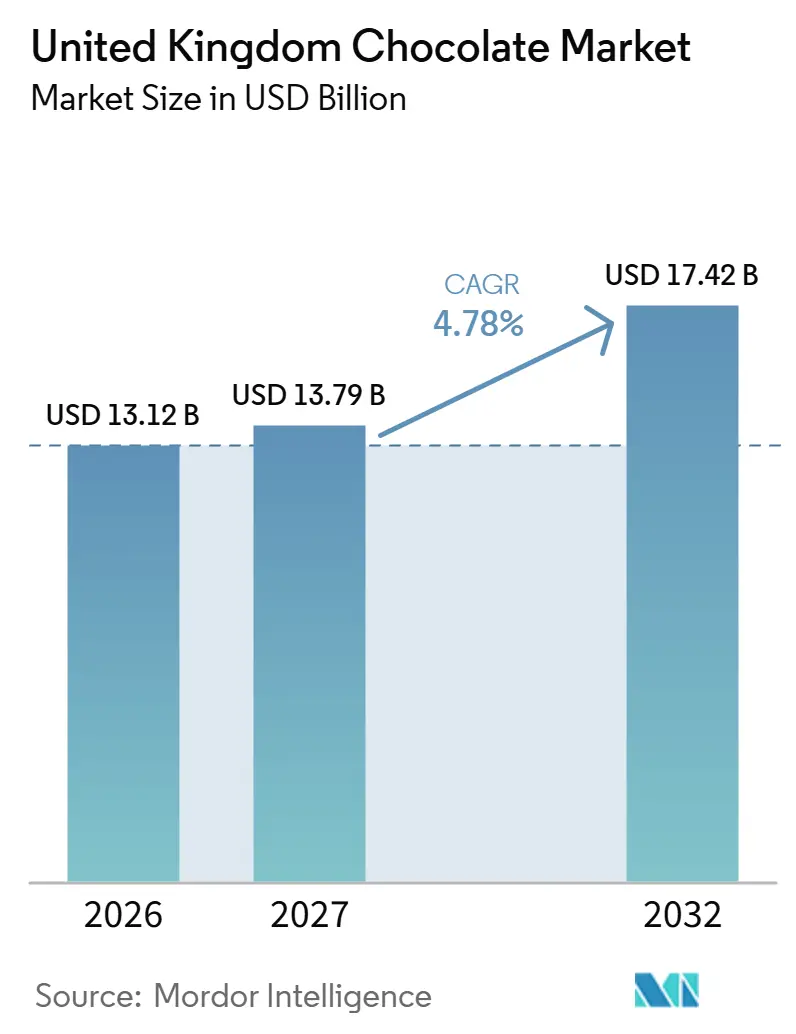
The United Kingdom chocolate market size was valued at USD 13.12 billion in 2026 and estimated to grow from USD 13.79 billion in 2027 to reach USD 17.42 billion by 2032, at a CAGR of 4.78% during the forecast period (2027-2032). The market volume was valued at 520.3 thousand tons in 2026 and estimated to grow from 526 thousand tons in 2027 to reach 555.6 thousand tons by 2032, at a CAGR of 1.1% during the forecast period (2027-2032).
United Kingdom chocolate suppliers balance Easter egg demand with cocoa-driven price pressure. Distinctive formats and direct retail access provide ways to compete for higher-value purchases. In England, promotion restrictions make the product proposition more consequential to sales growth. Manufacturers therefore need differentiation that sustains purchasing while input costs and constrained incentives limit volume expansion.
Key Report Takeaways
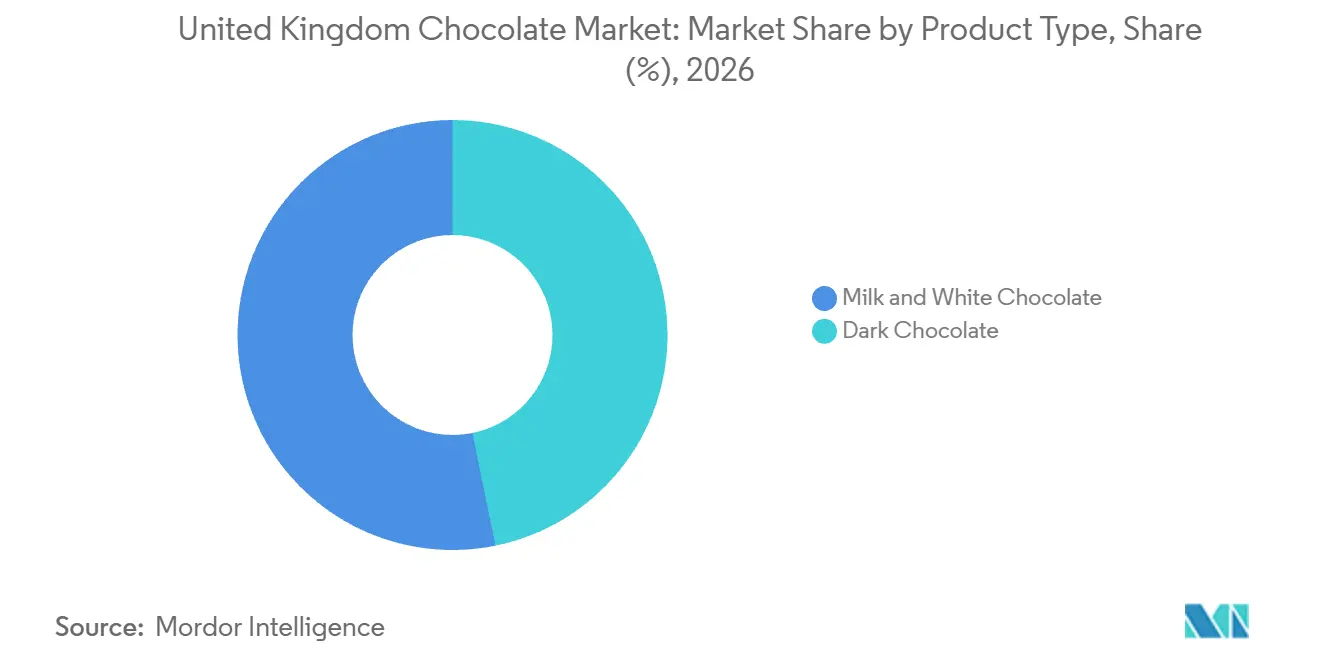
- By product type, milk and white chocolate led with 53.2% of market value in 2026, while dark chocolate is forecast to grow fastest at a CAGR of 5.75% during 2027-2032.
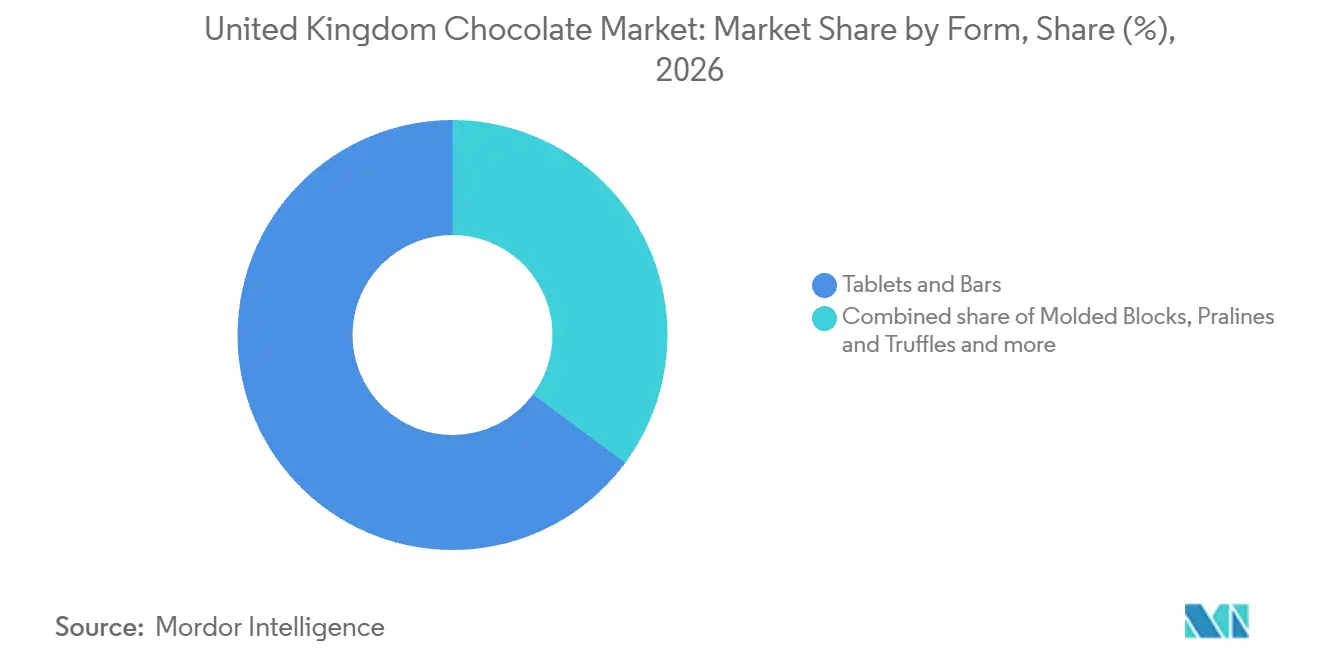
- Tablets and bars led the form category with a 64.86% United Kingdom chocolate market share in 2026, and pralines and truffles are projected to grow fastest at a CAGR of 5.55% during 2027-2032.
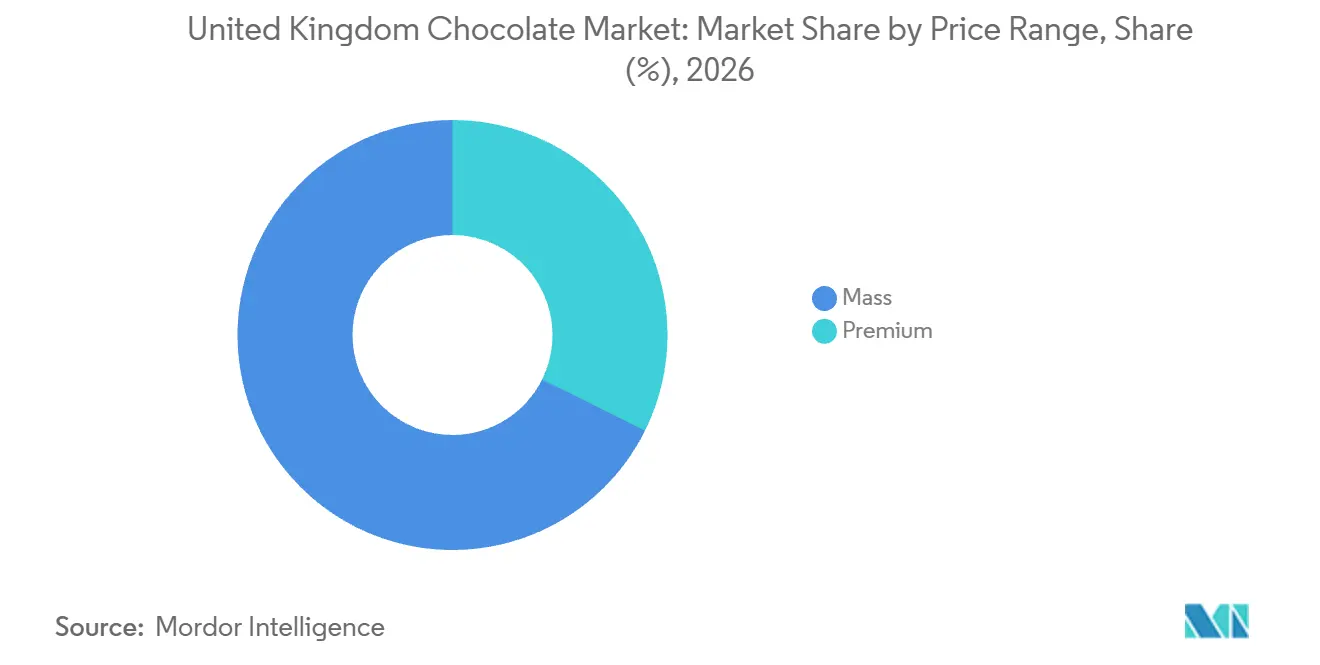
- Across price ranges, mass chocolate held a 67.66% share of the United Kingdom chocolate market size in 2026, with premium chocolate forecast to grow fastest at a CAGR of 6.15% during 2027-2032.
- By ingredient type, dairy-based chocolate accounted for 79.89% of market value in 2026, while plant-based chocolate is projected to grow fastest at a CAGR of 5.85% during 2027-2032.
- The category breakdown was led by conventional chocolate with 64.9% of market value in 2026, and single-origin chocolate is forecast to grow fastest at a CAGR of 6.45% during 2027-2032.
- Distribution was led by supermarkets and hypermarkets with 68.53% of market value in 2026, while online retail stores are projected to grow fastest at a CAGR of 6.8% during 2027-2032.
Note: Market numbers in this report are based on Mordor Intelligence's proprietary estimation framework, which combines nine months of actuals with Q4 projections for base year 2026.
United Kingdom Chocolate Market Trends and Insights
Drivers Impact Analysis*
| Driver | (~) % Impact on CAGR Forecast | Geographic Relevance | Impact Timeline |
|---|---|---|---|
| Rising popularity of premium and artisanal chocolates | +1.9% | London, including Piccadilly | Medium term (2-4 years) |
| Growth in plant-based and vegan chocolate alternatives | +1.4% | Nationwide | Medium term (2-4 years) |
| Innovation in flavors and formats | +1.5% | Nationwide | Short term (≤ 2 years) |
| Seasonal demand spikes during holidays | +1.7% | Nationwide | Short term (≤ 2 years) |
| Demand for allergen-free options | +0.7% | Nationwide | Medium term (2-4 years) |
| Advancements in Chocolate Processing | +0.6% | Slough in Berkshire | Long term (≥ 4 years) |
| Source: Mordor Intelligence | |||
Rising popularity of premium and artisanal chocolates
Premium producers can build demand through a combination of differentiated chocolate and direct access to shoppers. In 2025, Lindt & Sprüngli reported that its UK and Ireland business outpaced the market and gained share. Lindt attributed these gains to Lindt Dubai Style Chocolate and a record Lindor Pistachio launch, showing buyer response to new flavors and formats within its premium range. Its rapid direct-to-consumer expansion included the opening of a Piccadilly flagship store in London. Lindt can therefore capture the retail sale as well as supply the chocolate, making the store expansion a downstream revenue opportunity.
Growth in plant-based and vegan chocolate alternatives
Plant-based alternatives can extend the chocolate offer to shoppers seeking a plant-powered ingredient profile. Zertus UK & Ireland reported that NOMO held 19% value share in the plant-powered and free-from chocolate brand category for the 52 weeks ending November 1, 2025, citing Nielsen Scantrack and Homescan data. For retailers extending these chocolate ranges, NOMO's position makes specialist-brand selection consequential alongside ingredient suitability.
Innovation in flavors and formats
Distinctive chocolate formats can create a specific reason to buy within an established gifting occasion. Ocado Retail reported that Guinness Rugby Ball Easter Egg sales on Ocado.com rose 355% in the period from December 15, 2025, to March 8, 2026, compared with December 16, 2024, to March 9, 2025. The commercial signal concerns a clearly differentiated Easter product with realized retail sales. Manufacturers can use such specificity to extend the chocolate gifts available for a defined occasion. Product-level selling performance then provides a basis for deciding which format variations deserve a larger role in seasonal assortments. For suppliers, the opportunity is selective format development around a recognizable gifting use, with commercial expansion tied to demonstrated purchasing of the individual product.
Seasonal demand spikes during holidays
Holiday gifting concentrates chocolate demand into selling periods that can support purchases beyond ordinary consumption occasions. NIQ reported that UK Easter egg unit sales rose 6.6% in the 4 weeks ending March 21, 2026, against the same Easter build in 2025.[1] Broader chocolate confectionery unit sales increased 7.9% against the same calendar period a year earlier, when Easter fell later. NIQ linked the broader rise to Mothering Sunday gifting and Easter promotions appearing earlier online and in store that year. Easter eggs gave manufacturers a dated selling window in which unit demand exceeded the prior Easter build, supporting assortments and promotion timed to the gifting occasion.
Restraints Impact Analysis*
| Restraint | (~) % Impact on CAGR Forecast | Geographic Relevance | Impact Timeline |
|---|---|---|---|
| Fluctuating cocoa prices due to climate change | -1.5% | Nationwide | Short term (≤ 2 years) |
| Rising health concerns over sugar content and obesity | -0.9% | Retail locations in England | Short term (≤ 2 years) |
| Intense competition from multinational brands | -0.4% | Nationwide | Medium term (2-4 years) |
| Regulatory pressures on food safety | -0.2% | Nationwide | Short term (≤ 2 years) |
| Source: Mordor Intelligence | |||
Fluctuating cocoa prices due to climate change
Climate-related cocoa cost pressure reaches consumers through higher prices, limiting manufacturers' room to recover additional increases. ECIU reported that average pre-promotion prices for popular Easter chocolates at UK supermarkets rose by two-thirds between 2023 and January-March 2026. ECIU attributed that Easter price increase primarily to cocoa costs following climate-driven extreme weather in West Africa.[3] Separately, UK chocolate confectionery value sales rose 9.2% in 2025 while volume sales fell 2.6% amid commodity cost increases. For UK manufacturers, these conditions make price-led revenue growth a poor basis for assuming that consumers can absorb further cost increases. Suppliers therefore face a choice between absorbing input-cost volatility and risking additional pressure on quantities sold when raising shelf prices.
Rising health concerns over sugar content and obesity
Health policy constrains the promotional tools available to chocolate sellers, increasing the difficulty of stimulating larger purchases. England restricted volume-price promotions on qualifying less-healthy foods, including chocolate confectionery, from October 1, 2025. Coverage depends on product-category and nutrient-profiling criteria, together with qualifying-business conditions and other exemptions. Specialist chocolate retailers are exempt from location restrictions but remain subject to applicable volume-price restrictions. For affected suppliers, a product's gifting appeal therefore cannot automatically be reinforced through offers such as 3 for the price of 2. The remaining commercial constraint is a narrower set of quantity-based incentives for covered products, particularly when sellers seek to increase the number of items purchased in one transaction.
*Our forecasts treat driver/restraint impacts as directional, not additive. The impact forecasts reflect baseline growth, mix effects, and variable interactions.
Segment Analysis
By Product Type: Industrial Milk Chocolate Scale and Dark Chocolate Discovery
Milk and white chocolate accounted for a 53.2% share of the United Kingdom chocolate market size in 2026. On October 19, 2026, Mondelēz's Bournville manufacturing lead reported production of over 1.5 million Cadbury Dairy Milk tablets daily. Because this rate concerns a single branded tablet, it illustrates how much manufacturing capacity can be concentrated behind one milk-chocolate product. Matching that line's physical throughput would require a substantial manufacturing commitment from a challenger.
Dark chocolate is the fastest-growing segment, with a projected CAGR of 5.75% during 2027-2032. Ocado Retail reported that searches for dark chocolate Easter eggs on Ocado.com increased 247% in the period from December 15, 2025, to March 8, 2026, compared with December 16, 2024, to March 9, 2025. Search activity gives retailers a direct signal of interest in a precisely defined seasonal dark-chocolate offer. That makes the link between product description and discovery commercially relevant when shoppers seek a dark-chocolate version of an existing gifting format. Retailers that list dark Easter eggs under searchable names can meet that interest where shoppers are looking for the product.

By Form: Bar Manufacturing and Truffle Gifting Create Different Sales Routes
Tablets and bars represented a 64.86% United Kingdom chocolate market share in 2026. In May 2026, Mars said its Slough factory produced Mars bars and Snickers bars for UK demand. The same site also produced chocolate for distribution in Ireland and the Netherlands. Decisions about the plant's capacity must account for UK bar demand alongside overseas chocolate distribution.
Pralines and truffles are the fastest-growing segment, with a projected CAGR of 5.55% during 2027-2032. Lindt Lindor Truffles 200 g appeared among Unitas Wholesale's gifting-confectionery bestsellers by convenience value sales in the 52 weeks ending May 18, 2025, alongside Ferrero Rocher Pralines 200 g. Retailers can position truffle and praline lines as choices for shoppers seeking confectionery gifts. A new gift-pack line entering convenience stores competes for shelf space against established Lindor and Ferrero Rocher offers.
By Price Range: Affordability and Premium Resilience Require Different Product Choices
Mass chocolate was the largest segment, with 67.66% of market value in 2026. ECIU found that UK prices per 100 g for Quality Street, Celebrations, Roses and Heroes rose 23% to 47% over the 2 years before December 2025, compared with 6% general inflation. Higher prices for a fixed weight put pressure on the quantity that a price-sensitive buyer can obtain from these mainstream assortments. Reducing the pack price through a smaller quantity can protect the transaction's affordability while leaving the per-weight increase intact. Mass suppliers must reconcile a reachable purchase price with the amount of chocolate offered, making pack size a consequential response to the documented price pressure.
Premium chocolate is the fastest-growing segment, with a projected CAGR of 6.15% during 2027-2032. Premium chocolate sales in UK independent stores fell 4.1% in the 12 weeks ending January 25, 2025, compared with a 9.9% decline for mainstream chocolate. Forecourt Trader interpreted the smaller fall as shoppers who were indulging choosing premium brands over mainstream ones in that channel and period. Within independent stores, premium suppliers can pursue trade-up purchases even when the broader chocolate sales environment is weaker.
By Ingredient Type: Dairy Formulation Rules and Plant-Based Range Design
Dairy-based chocolate was the largest segment, accounting for 79.89% of market value in 2026. In England, products using the reserved description milk chocolate must meet minimum milk-solids requirements and restrictions on additional ingredients. The defined recipe basis gives these products a clear compositional identity, connecting ingredient choice with the name that can be used on sale. Manufacturers must therefore consider product description as well as formulation when altering a recipe. A recipe that no longer meets the reserved description's requirements would also need a different sales description in England.
Plant-based chocolate is the fastest-growing segment, with a projected CAGR of 5.85% during 2027-2032. In a May 2025 report, NOMO said its plant-based Cookie Dough chocolate line had grown 26% in sales year over year. The line's sales increase suggests that plant-based buyers respond to confectionery flavors as well as to the ingredient claim.
By Category: Conventional Producer Scale and Single-Origin Sourcing Identity
Conventional chocolate was the largest segment, accounting for 64.9% of market value in 2026. CBI reported that conventional chocolate in the United Kingdom was produced mainly by large multinational chocolate companies in 2025. Nestlé said in 2025 that its York factory could make up to 4 million KitKat bars per day, illustrating the capacity behind a mainstream branded product. Smaller conventional brands therefore compete against products backed by manufacturing capability at that scale.
Single-origin chocolate is the fastest-growing segment, with a projected CAGR of 6.45% during 2027-2032. In May 2025, Cocoa Sisters brought single-origin chocolate made from Solomon Islands cocoa to British consumers through direct sourcing from women-led farms. The farms supply the cocoa, while the British maker turns that named origin into a finished consumer product. Cocoa Sisters can compete on an identifiable farm-to-product relationship, giving its single-origin positioning a more specific basis than a broad ethical claim.
By Distribution Channel: Supermarket Scale and Integrated Online Occasions
Supermarkets and hypermarkets were the largest segment, accounting for 68.53% of market value in 2026. Circana data reported in March 2025 showed 11.6% growth in chocolate value sales at major multiple supermarkets over the preceding 52 weeks. For the wider chocolate category, Circana attributed growth over the previous 12 months to price, with volume and unit sales down. A supplier without a place in those stores is absent from the channel that carries most UK chocolate value.
Online retail stores are the fastest-growing segment, with a projected CAGR of 6.8% during 2027-2032. Ocado Retail reported a 56% year-over-year increase in chocolate sales in its Everything Valentine's aisle on Ocado.com from February 2025 to February 2026. The aisle also brought chocolate together with cards, gifts, and breakfast items. That setting allows chocolate brands to participate in a broader Valentine's offer, connecting a confectionery purchase with several products for the same occasion. An integrated seasonal aisle can make chocolate part of a wider occasion purchase, expanding the merchandising role available to the online seller.
Geography Analysis
London and Manchester illustrate how specialist chocolate retail can compete through distinct store concepts. Barnaby opened a Mount Street shop in Mayfair in 2026, selling handmade bars and offering an in-store make-your-own-bar service. Hotel Chocolat, acquired by Mars's wholly owned indirect subsidiary Hive Bidco, Inc. on January 25, 2024, opened its largest store to date in Manchester on July 24, 2025. These formats can make the setting part of the chocolate offer, adding a service or a dedicated destination to the packaged product. The cities provide different physical routes to differentiation, with customization shaping the London example and the scale of a dedicated chocolate store distinguishing the Manchester opening within Hotel Chocolat's own network.
Scotland's chocolate activity combines destination retail with businesses that can reach customers beyond their home city. Hotel Chocolat opened its Glasgow Silverburn store in 2025, combining chocolate gifts with a café serving Velvetised drinking chocolate. Edinburgh's chocolate tour attraction, The Chocolatarium, launched a UK-wide online chocolate shop on June 5, 2025, selling chocolate bars and truffles, including its own raspberry-infused and whisky-inspired truffle boxes. These models link local presence with different commercial reach, allowing one business to combine packaged chocolate and on-site consumption while another extends an Edinburgh-based offer into national online retail.
In Wales, South East England, and Birmingham, production and consumer retail create different commercial footprints. In 2025, Mr Holt's expanded chocolate production at a newly refitted factory in Llangefni, Anglesey. Hotel Chocolat's Horsham store in West Sussex combines chocolate gifts with a café selling hot chocolate and other cacao drinks. Bournville's manufacturing lead reported in October 2026 that the Birmingham factory produced Cadbury buttons, Creme Eggs, and other chocolate products. The regional distinction in these examples lies in the activity, with production capacity in Wales and Birmingham and a consumer-facing store and café in South East England.
Regulatory Framework and Outlook
This comparison of selected jurisdictions contrasts the framework for England, Wales and Northern Ireland with Scotland's product and enforcement requirements from a chocolate manufacturer's perspective. The Food Standards Agency (FSA) oversees food safety in England, Wales, and Northern Ireland, while Food Standards Scotland (FSS) is the equivalent public body in Scotland. Local food authorities perform enforcement, making jurisdiction relevant to how manufacturers handle safety and product-information duties. The Cocoa and Chocolate Products (Scotland) Regulations 2003 set composition and labeling requirements for cocoa and chocolate products intended for human consumption.
Regulatory Table
| Decision factor | United Kingdom | Scotland |
|---|---|---|
| Primary authority | FSA in England, Wales and Northern Ireland; FSS in Scotland; local food authorities | Local food authorities under FSS oversight and its enforcement code |
| Key instruments or direction | General Food Law Article 14 safety duty in England, Wales and Northern Ireland | Cocoa and Chocolate Products Regulations 2003; Food (Scotland) Act 2015 reporting measures |
| Commercial effect | Unsafe food cannot be placed on the market in England, Wales and Northern Ireland | Composition and labeling controls; mandatory reporting of food-information breaches |
| Current policy attractiveness | Medium | Medium |
| Future direction of policy attractiveness | No change | No change |
| Source: Mordor Intelligence | ||
England, Wales and Northern Ireland receive a Medium rating under FSA oversight and General Food Law Article 14's prohibition on unsafe food, while September 2026 discovery on a possible later extension of the planned large-retailer model has not adopted new manufacturing duties. Defra's September 2026 due-diligence proposal for qualifying Great Britain businesses, including those in Scotland, awaits consultation without a commencement date and therefore does not change manufacturers' operative duties. No change describes the manufacturer's position before the relevant Northern Ireland EU Deforestation Regulation phase, with application for covered cocoa and chocolate scheduled to start December 30, 2026, rather than every requirement beginning together. Scotland's Medium rating reflects chocolate composition controls and food-information breach reporting since April 2015, while No change reflects that FSS's 2026-2031 modernization strategy and cost-recovery option development have not changed those duties or adopted a fee schedule.
Value Chain Stages
This comparison follows finished chocolate from manufacturing through distribution to the consumer-facing retail sale. Mondelēz International manufactures Cadbury chocolate at Bournville. Waitrose provides the retail stage through its own-brand chocolate bars, seasonal treats and boxed chocolates.
Value Chain Analysis Table
| Primary activity | Key participants | Value capture | Bottleneck | Resilience response |
|---|---|---|---|---|
| Chocolate manufacturing | Chocolate manufacturers such as Mondelēz International Inc. and Mars, Incorporated | Finished-chocolate product sales | Coordinating production across chocolate formats | Match format-specific production runs to downstream requirements |
| Product distribution | Producer distributors such as Mondelēz International Inc. | Wholesale product sales | Coordinating storage conditions with retail dispatch | Align chilled storage and dispatch schedules with retailer supply needs |
| Consumer retail | Chocolate retailers such as Waitrose | Retail chocolate sales | Communicating differences across chocolate products | Make pack quantity and product type clear at purchase |
| Source: Mordor Intelligence | ||||
Booker supplies retailers with grocery products and confectionery through its UK wholesale business, placing a resale intermediary between production and the retail sale. Mondelēz International operates Minworth as one of its main UK distribution centers and a large chilled warehouse, illustrating a producer-operated logistics capability. These roles locate value capture differently, through product resale to retailers for the wholesaler and through finished-product sales supported by in-house distribution for the manufacturer.
Competitive Landscape
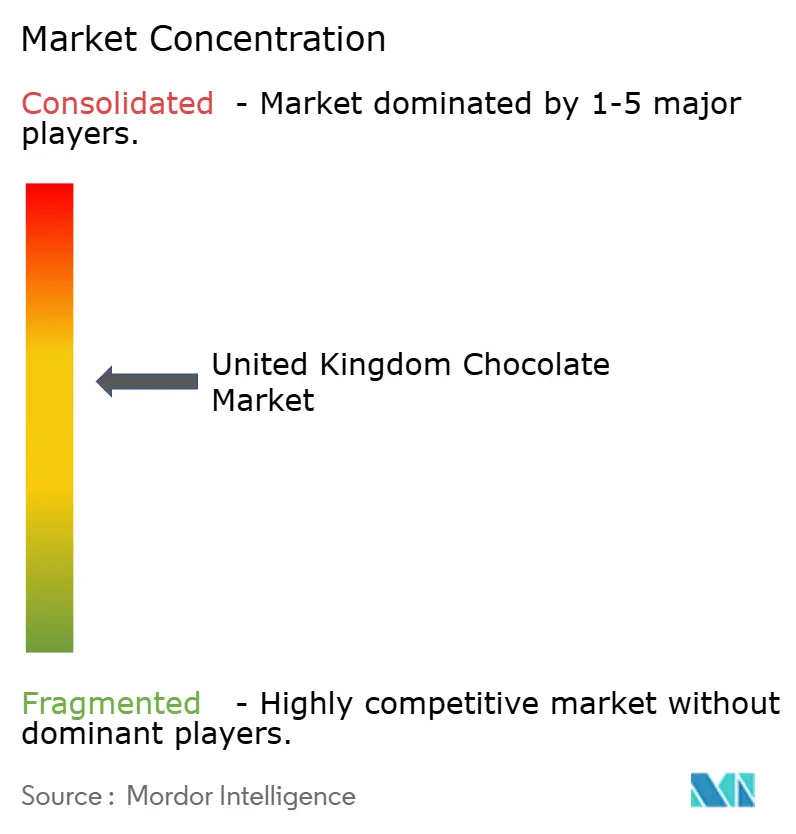
Large branded groups anchor competition, with Mars, Incorporated, Ferrero International SA, Nestlé S.A., Chocoladefabriken Lindt & Sprüngli AG, and Mondelēz International Inc. among the principal participants. Mondelēz's Cadbury ranked first among UK grocery brands by value sales for the year ending December 31, 2025. In May 2026, Mars reported that upgraded lines at its Slough factory could produce up to 5 million chocolate bars daily, double its 2025 output. Large branded incumbents set a demanding entry benchmark by combining established consumer spending with industrial supply capacity.
Mondelēz launched Cadbury Dairy Milk Lotus Biscoff in the UK in March 2025, and the product became one of Cadbury's fastest-growing lines that year. The co-branded offer combines chocolate and biscuit identities, giving the extension a specific proposition within an established chocolate portfolio. Its reported performance shows commercial traction within Cadbury's own range, creating a more concrete competitive challenge than launch activity alone. An incumbent can refresh its offer through a partnership while retaining its brand identity, putting pressure on rivals to define an equally specific reason to choose their extensions.
Beyond factory investment, incumbents also develop limited-edition flavors. Nestlé introduced the limited-edition KitKat Chunky Funky and KitKat Chunky Duo Salted Caramel flavors in the UK in June 2025. For challengers, a distinctive flavor offer provides a narrower point of competition than matching an incumbent's production footprint. In England, Wales, and Northern Ireland, food businesses must identify immediate suppliers and business customers, while consumer-direct sales are generally exempt from forward-record duties. That distinction makes wholesale expansion a choice about business-customer record systems as well as chocolate distribution.
United Kingdom Chocolate Industry Leaders
-
Mars, Incorporated
-
Ferrero International SA
-
Nestlé S.A.
-
Chocoladefabriken Lindt & Sprüngli AG
-
Mondelēz International Inc.
- *Disclaimer: Major Players sorted in no particular order
Recent Industry Developments
- Sep 2026: Waitrose announced expanded Tony's Open Chain sourcing for seasonal and boxed chocolate, with over half of its seasonal chocolate to use mass balance, which permits cocoa mixing after initial processing.
- Sep 2026: Nestlé announced its UK Christmas confectionery range, including KitKat Santas, Milkybar Caramel Crunch bars, and After Eight Chocolate Oranges, with nationwide availability at announcement.
- May 2026: Mars, Incorporated said its Slough factory investment program had begun in 2023 and was scheduled to continue through 2028, including further investment planned for 2027-2028.
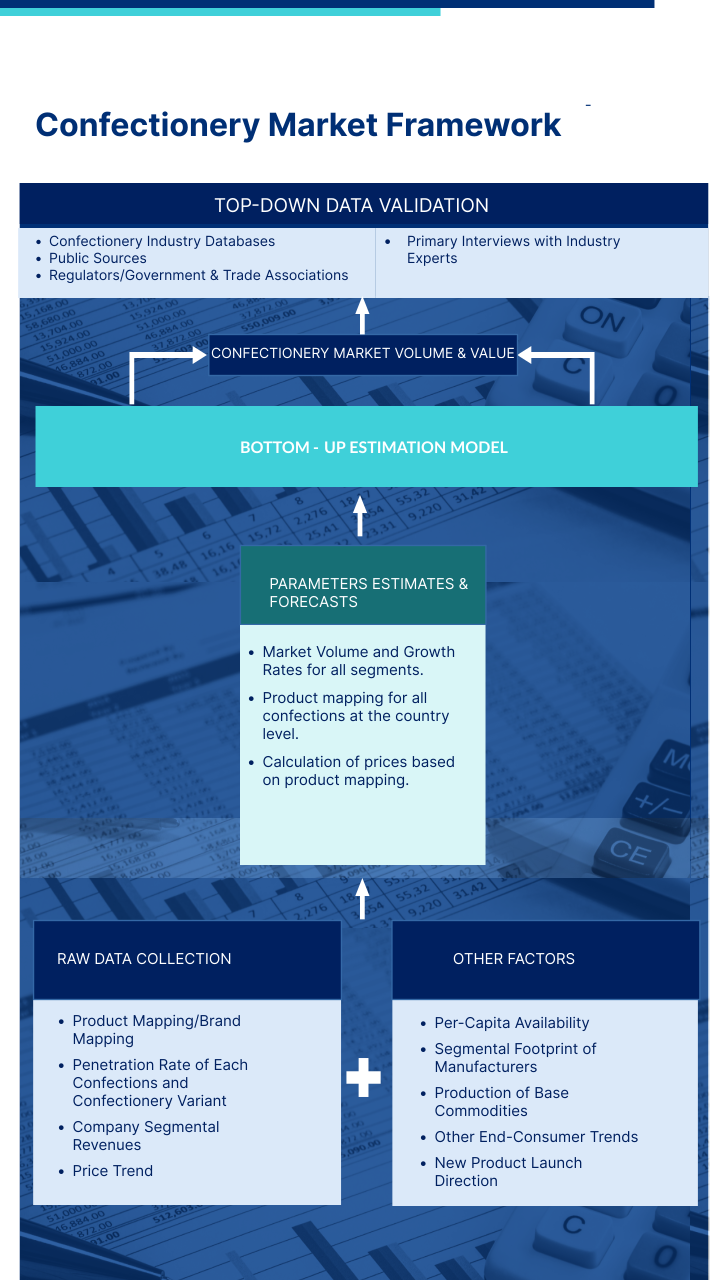
Scope and Methodology
| Dark Chocolate |
| Milk and White Chocolate |
| Tablets and Bars |
| Molded Blocks |
| Pralines and Truffles |
| Other Forms |
| Mass |
| Premium |
| Dairy-based |
| Plant-based |
| Single Origin Chocolate |
| Conventional Chocolate |
| Supermarkets/Hypermarkets |
| Online Retail Stores |
| Convenience Store |
| Other Distribution Channels |
| By Product Type | Dark Chocolate |
| Milk and White Chocolate | |
| By Form | Tablets and Bars |
| Molded Blocks | |
| Pralines and Truffles | |
| Other Forms | |
| By Price Range | Mass |
| Premium | |
| By Ingredient Type | Dairy-based |
| Plant-based | |
| By Category | Single Origin Chocolate |
| Conventional Chocolate | |
| By Distribution Channel | Supermarkets/Hypermarkets |
| Online Retail Stores | |
| Convenience Store | |
| Other Distribution Channels |
Market Definition
- Milk and White Chocolate - Milk chocolates is a solid chocolate made with milk (in the form of either milk powder, liquid milk, or condensed milk) and cocoa solids. White chocolate is made from cocoa butter and milk and contains no cocoa solids whatsoever. The scope includes regular chocolates, low-sugar, and sugar-free variants
- Toffees & Nougats - Toffees include hard, chewy, and small or one-bite candies marketed with labels as toffee or toffee-like confectionery. Nougat is a chewy confection with almond, sugar, and egg white as a basic ingredient; and it originated in Europe and Middle East countries.
- Cereals Bars - A snack composed of breakfast cereal that has been compressed into a bar shape and is held together with a form of edible adhesive. The scope includes snack bars made with cereals such as rice, oats, corn, etc. mixed with a binding syrup. These also include products labeled as cereal bars, cereal treat bars, or grain bars.
- Chewing Gum - This is a preparation for chewing, usually made of flavored and sweetened chicle or such substitutes as polyvinyl acetate. The types of chewing gums included in the scope are sugar-chewing gums and sugar-free chewing gums
| Keyword | Definition |
|---|---|
| Dark Chocolate | Dark chocolate is a form of chocolate containing cocoa solids and cocoa butter without the milk. |
| White Chocolate | White chocolate is the type of chocolate containing the highest percentage of milk solids, typically around or over 30 percent. |
| Milk Chocolate | Milk chocolate is made from dark chocolate that has a low cocoa solid content and higher sugar content, plus a milk product. |
| Hard Candy | A candy made of sugar and corn syrup boiled without crystallizing. |
| Toffees | A hard, chewy, often brown sweet that is made from sugar boiled with butter. |
| Nougats | A chewy or brittle candy containing almonds or other nuts and sometimes fruit. |
| Cereal bar | A cereal bar is a bar-shaped food product, made by pressing cereals and usually dried fruit or berries, which are in most cases held together by glucose syrup. |
| Protein bar | Protein bars are nutrition bars that contain a high proportion of protein to carbohydrates/fats. |
| Fruit & Nut bar | These are often based on dates with other dried fruit and nut additions and, in some cases, flavorings. |
| NCA | The National Confectioners Association is an American trade organization that promotes chocolate, candy, gum and mints, and the companies that make these treats. |
| CGMP | Current good manufacturing practices are those conforming to the guidelines recommended by relevant agencies. |
| Unstandardized foods | Unstandardized foods are those that do not have a standard of identity or that deviate from a prescribed standard in any manner. |
| GI | The glycemic index (GI) is a way of ranking carbohydrate-containing foods based on how slowly or quickly they are digested and increase blood glucose levels over a period of time |
| Skimmed milk powder | Skimmed milk powder is obtained by removing water from pasteurized skim milk by spray-drying. |
| Flavanols | Flavanols are a group of compounds found in cocoa, tea, apples, and many other plant-based foods and beverages. |
| WPC | Whey protein concentrate- the substance obtained by the removal of sufficient nonprotein constituents from pasteurized whey so that the finished dry product contains greater than 25% protein. |
| LDL | Low density Lipoprotein- the bad cholesterol |
| HDL | High density Lipoprotein- the good cholesterol |
| BHT | butylated Hydroxytoluene is a lab-made chemical that is added to foods as a preservative. |
| Carrageenan | Carrageenan is an additive used to thicken, emulsify, and preserve foods and drinks. |
| Free form | Not containing certain ingredients, such as gluten, dairy, or sugar. |
| Cocoa butter | It is a fatty substance obtained from cocoa beans, used in the manufacture of confectionery. |
| Pastellies | A type of of Brazilian candy made from sugar, eggs, and milk. |
| Draggees | Small, round candies that are coated with a hard sugar shell |
| CHOPRABISCO | Royal Belgian Association of the chocolate, pralines, biscuit, and confectionery industry- A trade association that represents the Belgian chocolate industry. |
| European Directive 2000/13 | A European Union directive that regulates the labeling of food products |
| Kakao-Verordnung | The German chocolate ordinance, a set of regulations that define what can be labeled as "chocolate" in Germany. |
| FASFC | Federal Agency for the Safety of the Food Chain |
| Pectin | A natural substance that is derived from fruits and vegetables. It is used in confectionery to create a gel-like texture. |
| Invert sugars | A type of sugar that is made up of glucose and fructose. |
| Emulsifier | A substance that helps to mix to liquids that does not mix together. |
| Anthocyanins | A type of flavonoid that is responsible for the red, purple, and blue colors of confectionery. |
| Functional Foods | Foods that have been modified to provide additional health benefits beyond basic nutrition. |
| Kosher certificate | This certification verifies that the ingredients, production process including all machinery, and/or food-service process complies with the standards of Jewish dietary law |
| Chicory root extract | A natural extract from the chicory root that is a good source of fiber, calcium, phosphorous, and folate |
| RDD | Recommended daily dose |
| Gummies | A chewy gelatin-based candy that is often flavored with fruit. |
| Nutraceuticals | Food or dietary supplements that are claimed to have health benefits. |
| Energy bars | Snack bars that are high in carbohydrates and calories are designed to provide energy on the go. |
| BFSO | Belgian Food Safety Organization for the food chain. |
Research Methodology
Mordor Intelligence follows a four-step methodology in all our reports.
- Step-1: Identify Key Variables: In order to build a robust forecasting methodology, the variables and factors identified in Step 1 are tested against available historical market numbers. Through an iterative process, the variables required for market forecast are set, and the model is built on the basis of these variables.
- Step-2: Build a Market Model: Market-size estimations for the forecast years are in nominal terms. Inflation is not a part of the pricing, and the average selling price (ASP) is kept constant throughout the forecast period for each country.
- Step-3: Validate and Finalize: In this important step, all market numbers, variables, and analyst calls are validated through an extensive network of primary research experts from the market studied. The respondents are selected across levels and functions to generate a holistic picture of the market studied.
- Step-4: Research Outputs: Syndicated Reports, Custom Consulting Assignments, Databases & Subscription Platforms