
UAE Mechanical, Electrical, and Plumbing (MEP) Services Market Size and Share
Market Overview
| Study Period | 2020 - 2031 |
|---|---|
| Forecast Data Period | 2026 - 2031 |
| Base Year Market Size (2025) | USD 2.04 Billion |
| Market Size (2026) | USD 2.21 Billion |
| Market Size (2031) | USD 3.32 Billion |
| Growth Rate (2026 - 2031) | 8.45 % |
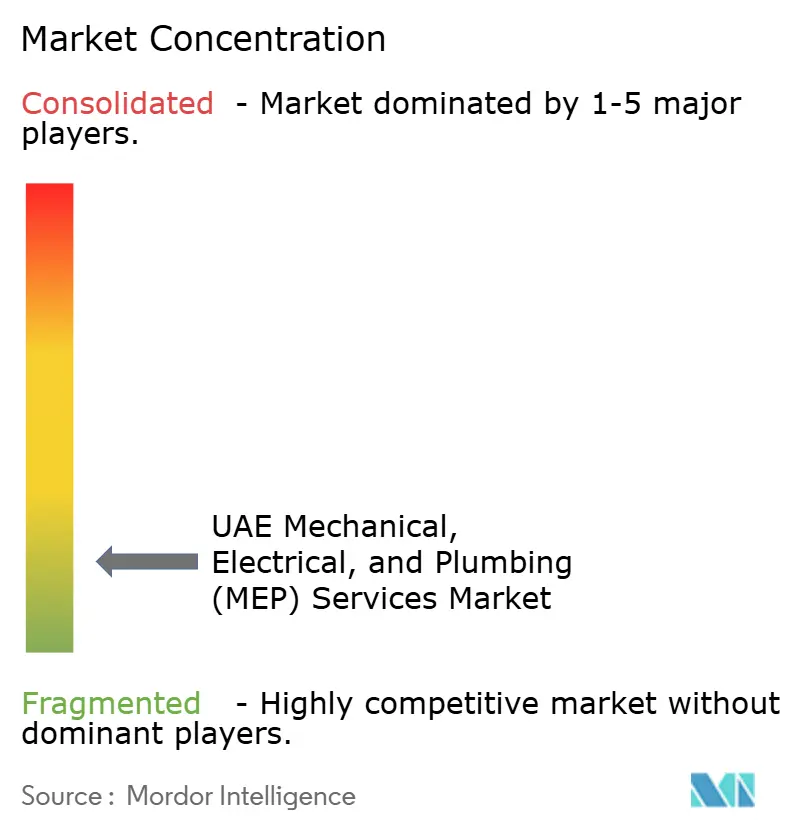
| Market Concentration | Low |
Major Players *Disclaimer: Major Players sorted in no particular order Image © Mordor Intelligence. Reuse requires attribution under CC BY 4.0. | |
UAE Mechanical, Electrical, and Plumbing (MEP) Services Market Analysis by Mordor Intelligence
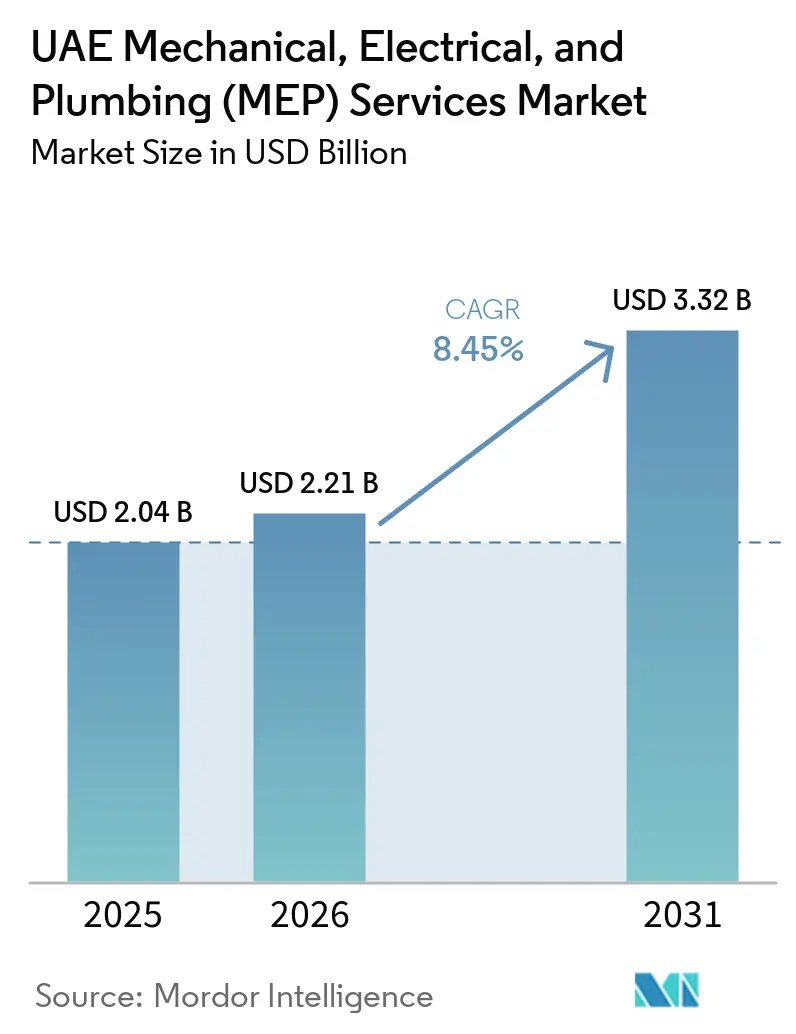
The UAE Mechanical, Electrical, And Plumbing Services Market size is expected to increase from USD 2.04 billion in 2025 to USD 2.21 billion in 2026 and reach USD 3.32 billion by 2031, growing at a CAGR of 8.45% over 2026-2031.
The UAE MEP services market is supported by construction, transport, tourism, and public infrastructure activity that requires mechanical, electrical, and plumbing work throughout design, construction, commissioning, and operations. Demand is also shifting toward facilities that need tighter coordination across cooling, power, water, life safety, and digital control systems. Data center construction adds a specialized source of work because high-density computing requires resilient power and liquid cooling systems. Retrofit programs create a second source of revenue because building owners need to reduce energy and water use without replacing their assets. Suppliers that combine engineering, fabrication, commissioning, and maintenance capabilities are better placed to manage the UAE MEP services market as project schedules and equipment availability become more demanding. At the same time, their planning, technical coordination, testing records, and post-handover support can improve execution on complex projects that demand reliable system performance, clear accountability, and a coordinated response to operational issues during each stage of the project life cycle, from design through long-term operation.
Key Report Takeaways
- By type, Mechanical Services held 45.1% of the UAE MEP services market share in 2025, while Integrated MEP Services is forecast to grow at a 9.02% CAGR through 2031.
- By service type, Installation, Testing, and Commissioning accounted for 41.3% of the UAE MEP services market size in 2025, while Maintenance, Repair, and Retrofit is forecast to grow at a 9.12% CAGR through 2031.
- By end-user industry, Commercial held 38.9% of the UAE MEP services market share in 2025, while Infrastructure is forecast to grow at an 8.97% CAGR through 2031.
- By geography, Dubai held 42.5% of revenue in 2025, while Ras Al Khaimah is forecast to grow at a 9.55% CAGR through 2031.
Note: Market size and forecast figures in this report are generated using Mordor Intelligence’s proprietary estimation framework, updated with the latest available data and insights as of January 2026.
UAE Mechanical, Electrical, and Plumbing (MEP) Services Market Trends and Insights
Drivers Impact Analysis*
| Drivers | (~) % Impact on CAGR Forecast | Geographic Relevance | Impact Timeline |
|---|---|---|---|
| Construction, Tourism, and Transport Project Pipeline | +3.2% | Dubai, Abu Dhabi, Ras Al Khaimah | Long term (≥ 4 years) |
| District Cooling and Green-Building Compliance Requirements | +1.4% | Dubai, Abu Dhabi | Medium term (2-4 years) |
| Data-Center and AI Infrastructure Cooling Demand | +1.2% | Dubai, Abu Dhabi | Medium term (2-4 years) |
| Hospitality, Aviation, and Mixed-Use Asset Expansion | +1.0% | Ras Al Khaimah, Dubai | Long term (≥ 4 years) |
| Off-Site Modular MEP and Prefabricated Delivery | +0.8% | Dubai, Abu Dhabi | Medium term (2-4 years) |
| Performance-Based Energy and Facilities Management Contracts | +0.6% | Dubai, Abu Dhabi | Short term (≤ 2 years) |
| Source: Mordor Intelligence | |||
Construction, Tourism, Transport, and Mixed-Use Project Pipeline
The project pipeline provides the broadest source of work for the UAE MEP services market, because every new asset needs coordinated building systems before it can operate. Abu Dhabi announced a USD 15 billion public-private partnership pipeline covering 24 projects for 2026 and 2027 procurement, which supports future work across transport, social, and core infrastructure[1]. Airport, transport, hospitality, and mixed-use developments require complex electrical distribution, cooling, plumbing, fire protection, and controls. The planned expansion of Al Maktoum International Airport includes five parallel runways and 400 aircraft gates, extending the need for coordinated building-services packages into the next decade. In Ras Al Khaimah, the USD 545 million Fairmont Residences and Hotel project began piling in 2026 and is targeting 2028 completion, adding a major hospitality scheme to the local workload. These projects favor contractors that can coordinate several technical disciplines while meeting demanding delivery schedules.
District Cooling and Green-Building Compliance
Cooling demand makes mechanical engineering central to the UAE MEP services market, particularly where high temperatures and continuous occupancy require reliable, efficient operation. Dubai’s Green Building Regulations and the Abu Dhabi Estidama Pearl framework require designers to address energy performance and building-system efficiency. A 2025 academic assessment of UAE green buildings reported that certified buildings can achieve 30% to 40% long-term utility savings compared with conventional buildings[2]. This economic case supports the replacement of inefficient equipment as well as higher standards for new installations. Empower’s DLRC District Cooling Plant received LEED Gold certification in May 2025, showing that energy performance expectations also extend to district cooling infrastructure. Contractors, therefore, need skills in network interfaces, system controls, and verification of operating performance.
Data Center and AI Infrastructure Cooling Demand
Data centers are a specialized growth channel within the UAE MEP services market, because their thermal and power requirements exceed those of typical commercial facilities. UAE data center electricity consumption reached 3 terawatt-hours in 2025, equal to 2% of national electricity demand, according to Equinix’s regional leadership[3]. High-density graphics processing unit racks can exceed 200 kilowatts and may reach 1 megawatt, requiring liquid cooling, heat exchangers, redundant chillers, and resilient electrical systems. In February 2026, the Ministry of Energy and Infrastructure, Khazna Data Centers, and Agility announced a pilot using Phaidra artificial intelligence to improve efficiency in data centers and district cooling operations. This places cooling performance alongside capacity and uptime as a design requirement. The resulting work is more technically demanding than conventional building projects and raises the value of integrated engineering teams.
Hospitality, Aviation, and Mixed-Use Asset Expansion
Hospitality, aviation, and mixed-use assets support demand for the UAE MEP services market because they require complex cooling, electrical, plumbing, and life-safety systems. These properties operate for long hours and need dependable climate control, detailed zoning, and closely coordinated building services. The planned Al Maktoum International Airport expansion includes five parallel runways and 400 aircraft gates, creating a long-term requirement for MEP work across terminals, cargo areas, and utility corridors. The USD 545 million Fairmont Residences and Hotel project at Al Marjan Island began piling in 2026 and is planned for completion in 2028. Abu Dhabi’s Fahid Island master plan has a gross development value of more than USD 10.9 billion and combines residential, hospitality, and public areas. These projects favor contractors that can manage multiple utility interfaces and deliver systems that perform reliably after handover.
Restraints Impact Analysis*
| Restraints | (~) % Impact on CAGR Forecast | Geographic Relevance | Impact Timeline |
|---|---|---|---|
| Imported Equipment Lead Times and Price Volatility | -1.5% | Global, concentrated in Dubai and Abu Dhabi | Short term (≤ 2 years) |
| Skilled MEP Labor and Project-Execution Bottlenecks | -1.2% | Dubai, Abu Dhabi | Medium term (2-4 years) |
| District-Cooling Retrofit Suitability Constraints | -0.8% | Abu Dhabi, Dubai | Medium term (2-4 years) |
| Payment Cycles, Retention, and Variation-Approval Delays | -0.7% | Dubai, broader UAE | Short term (≤ 2 years) |
| Source: Mordor Intelligence | |||
Imported Equipment Lead Times and Price Volatility
Long delivery periods for critical equipment can delay project completion in the UAE MEP services market, particularly when equipment selection depends on final design approvals. The affected items include generators, switchgear, air handling units, chillers, and intelligent controls. These components are necessary at late construction stages, so a missed delivery can affect testing, commissioning, and handover. Price movements also make it harder for contractors to protect margins when bids are fixed before equipment is ordered. The risk is greater for data centers and critical infrastructure because resilient power and cooling equipment represent a large share of package value. Contractors with early procurement plans and stronger supplier relationships can reduce, but not remove, this exposure.
Skilled MEP Labor and Project-Execution Bottlenecks
The UAE MEP services market depends on experienced engineers, Building Information Modeling coordinators, commissioning specialists, and skilled site supervisors who can resolve technical issues across disciplines. Complex projects require these roles to coordinate several systems before installation work begins. Concurrent airport, hospitality, infrastructure, and data center projects place the same labor pool under pressure. A shortage of specialized staff can limit the number of major packages a contractor can deliver at one time. It can also increase payroll costs and make detailed commissioning more difficult. Firms with recruiting reach, training programs, and an established project portfolio can retain scarce staff more effectively.
*Our forecasts treat driver/restraint impacts as directional, not additive. The impact forecasts reflect baseline growth, mix effects, and variable interactions.
Segment Analysis
By Type: Mechanical Services Lead, While Integrated MEP Services Grow Fastest
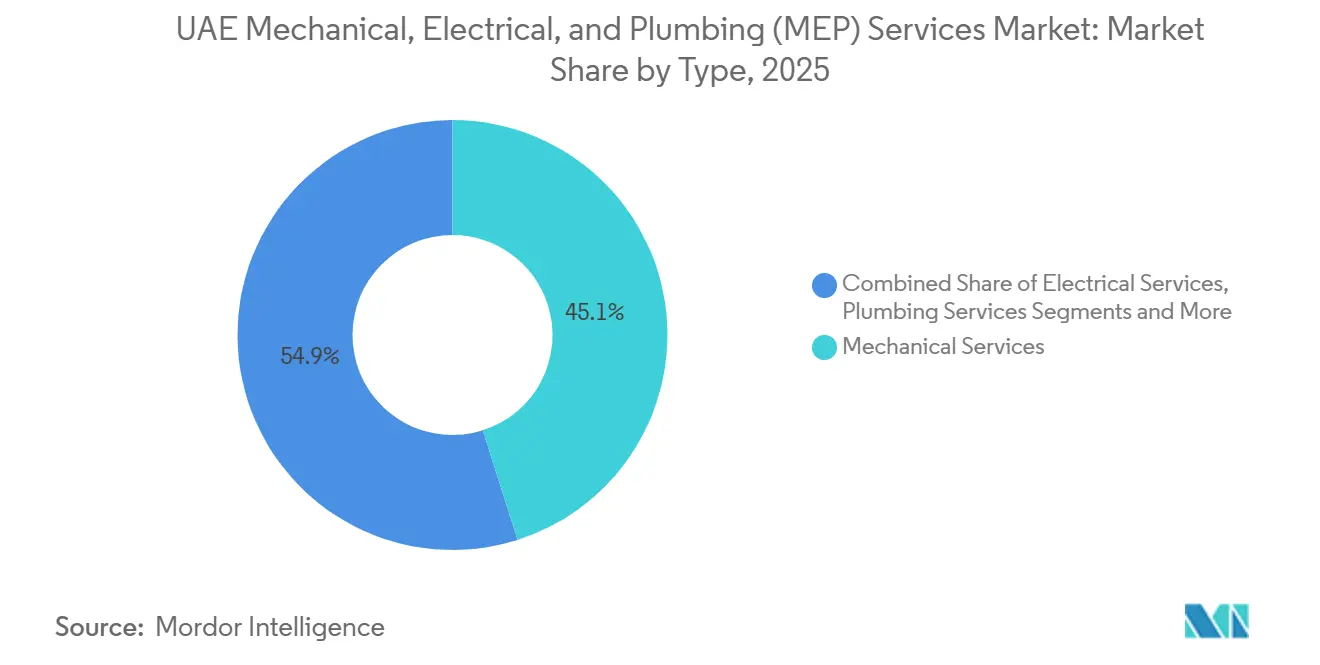
Mechanical Services held 45.1% of revenue in 2025, making them the largest type within the UAE MEP services market. Cooling requirements are a fundamental reason for this position because heating, ventilation, and air-conditioning systems account for 60% to 70% of building energy consumption in the country. A 2025 study found that variable refrigerant flow optimization, adaptive setpoints, and artificial intelligence controls can reduce energy use by 20% to 40% in suitable buildings. These savings strengthen the case for mechanical upgrades through retrofit and energy-performance contracts. Electrical Services remain important as smart building systems, low-voltage networks, backup power, and data center power systems grow more complex.
Integrated MEP Services is forecast to grow at a 9.02% CAGR through 2031, the fastest rate among service types. Clients increasingly prefer a single party that can coordinate mechanical, electrical, plumbing, controls, and life-safety work across a complex site. This structure can reduce handoff risks between individual trade packages. Data centers make this coordination more valuable because liquid cooling, power distribution, and fire suppression systems must operate as one set of infrastructure. Plumbing Services retain a stable role through treated sewage effluent reuse, condensate recovery, and gray-water systems that support water-efficiency objectives. The UAE MEP services industry is therefore moving toward contracts that place greater value on integrated engineering accountability.

By Service Type: Installation Remains Largest, While Retrofit Gains Pace
Installation, Testing, and Commissioning held 41.3% of 2025 revenue in the UAE MEP services market. New commercial, residential, hospitality, and infrastructure projects continue to require installation packages before a building can be occupied or an asset can begin operation. Commissioning has become more detailed as owners seek digital records, building information models, and validated system performance. Design and Engineering services also gain importance when cooling systems, district cooling interfaces, or mixed-use structures require early coordination. Managed and performance-based services extend the contractor relationship from project delivery into operations. This gives owners a way to assign operating responsibility to a provider with the technical capacity to manage it.
Maintenance, Repair, and Retrofit is forecast to expand at a 9.12% CAGR through 2031. In May 2026, the Ministry of Energy and Infrastructure launched a government-building program with USD 32.7 million allocated for phase 1 and a planned USD 272.3 million second phase covering 360 buildings. The program supports work on systems that reduce both energy and water use. TAQA Energy Services and Sdeira Group signed an implementation agreement in November 2025 for a large building retrofit at Aryam ICAD Residential City in Mussafah. Emrill Energy reported 14% verified energy savings from artificial intelligence-driven heating, ventilation, and air-conditioning retrofits in Dubai properties. These examples show why maintenance and retrofit work can provide a more recurring source of activity than new construction alone.
By End-User Industry: Commercial Leads, While Infrastructure Expands
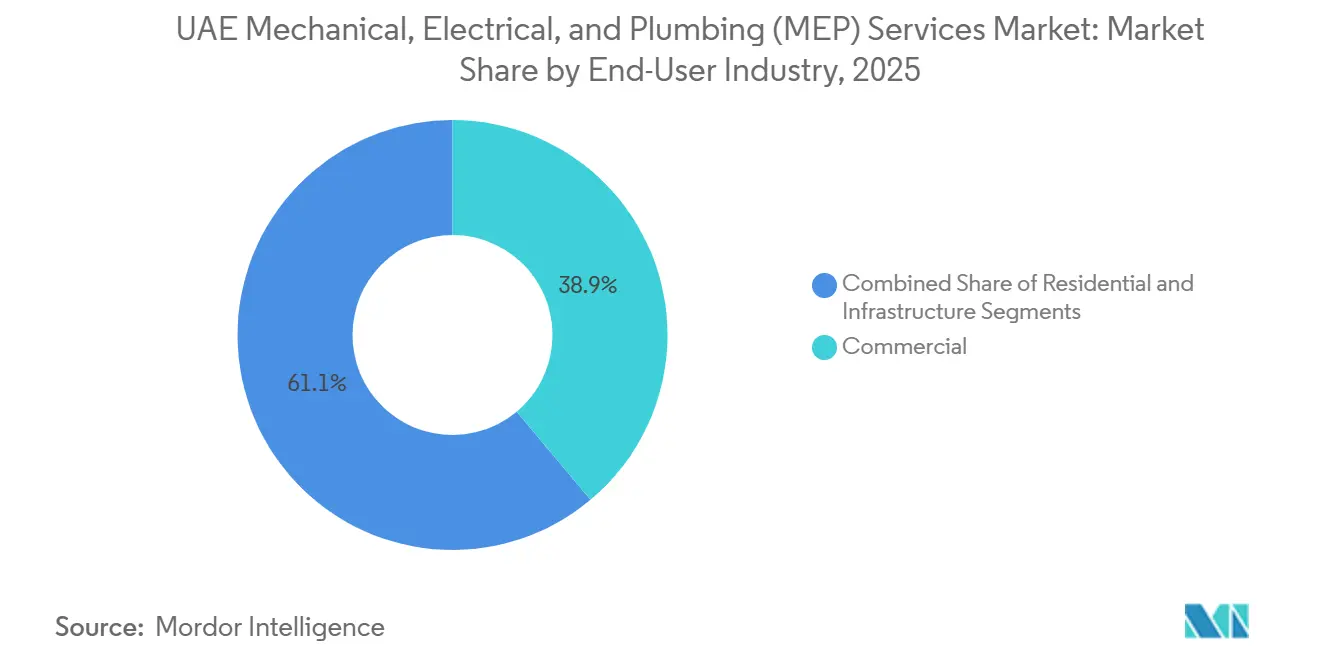
Commercial projects accounted for 38.9.02% of 2025 revenue, the largest end-user segment in the UAE MEP services market. Office, retail, hotel, and mixed-use assets require substantial cooling, power, water, security, and life-safety systems. Many projects must also meet the Dubai Green Building Regulations, Estidama requirements, or Leadership in Energy and Environmental Design standards. These frameworks increase the engineering content of commercial MEP packages. Residential activity provides steady demand through apartments, villas, and community infrastructure. The mix of asset types helps maintain work across both new installation and facility upgrade requirements.
Infrastructure is forecast to grow at an 8.97% CAGR through 2031, making it the fastest-growing end-user area. The segment includes rail, metro, sewerage, utility, and data center projects that need high-capacity power, cooling, drainage, and controls. Abu Dhabi’s planned transport and public-private partnership programs increase the visible pipeline for these systems. In May 2026, Dubai awarded five contracts for the Tasreef sewerage and stormwater program, with a combined value of USD 680.7 million across 30 key areas. Data center sites add a further source of demand because their power and liquid-cooling systems are more intensive than standard commercial installations. The UAE MEP services industry must therefore maintain capability across both building and underground utility work.
Geography Analysis
Dubai held 42.5% of revenue in 2025, making it the largest emirate in the UAE MEP services market. Its project base includes Palm Jebel Ali, The Oasis by Emaar, Marsa Al Arab, the Blue Line metro extension, and the Al Maktoum International Airport expansion. These developments create demand across high-rise buildings, transport facilities, hotels, utilities, and public spaces. The emirate also awarded USD 680.7 million of Tasreef sewerage and stormwater contracts in May 2026 for 30 areas. That activity broadens MEP demand beyond above-ground construction. Contractors must manage both building services and large underground utility interfaces.
Abu Dhabi represents the second-largest emirate market in 2025. Government-backed projects, education facilities, substations, public infrastructure, and artificial intelligence data center activity shape its work. The city’s Estidama Pearl Rating System maintains an ongoing requirement for building-system quality and efficiency. In March 2026, Abu Dhabi entities announced a USD 15 billion public-private partnership pipeline across 24 projects for 2026 and 2027 procurement. The stated program strengthens the outlook for complex MEP packages across public assets. Data center cooling also gives Abu Dhabi a distinct demand profile because these facilities need specialized liquid-cooling and electrical designs.
Ras Al Khaimah is forecast to grow at a 9.55% CAGR through 2031, the fastest rate across the UAE MEP services market. Branded resorts and mixed-use destinations at Al Marjan Island and RAK Central are shifting local demand toward more complex hospitality work. The Fairmont Residences and Hotel at Al Marjan Island began piling in early 2026 and is planned for delivery in 2028. The Ras Al Khaimah municipality published the Barjeel 13 green building standard in July 2025, aligned with ASHRAE 55 and ISO 7730 thermal comfort benchmarks. Sharjah continues to add volume through industrial zones and educational facilities. Fujairah, Ajman, and Umm Al Quwain contribute incremental demand through housing, logistics, industrial, and port-related assets.
Competitive Landscape
The UAE MEP services market is moderately fragmented, although a limited group of established contractors can pursue the most complex packages. Large contractors differentiate through integrated engineering, Building Information Modeling coordination, off-site fabrication, commissioning, and facilities management relationships. These capabilities matter when a project combines cooling, power, plumbing, digital controls, and strict handover requirements. Smaller firms can compete on selected scopes, but they may have less capacity to finance equipment purchases or retain specialized talent. This creates a practical advantage for firms with a broad technical workforce and repeat relationships with major clients.
Data center work and energy retrofit contracts are important areas of competition in the UAE MEP services market. Companies pursuing data center projects need competence in liquid cooling, high-density power distribution, redundancy, and detailed commissioning. In April 2026, the Dubai Integrated Economic Zones Authority and VOLT UAE formed a joint venture to develop an artificial intelligence-ready data center in Dubai Silicon Oasis. The project illustrates the need for providers that can integrate cooling, electrical, monitoring, and infrastructure systems. In the retrofit field, Etihad Energy Services Company completed Dubai’s first Energy Savings Performance Contract with independently verified results, establishing a relevant operating model for building upgrades. These opportunities reward firms that can demonstrate results after installation, not only deliver construction work.
Strategic alliances can extend MEP contractors into building operations and long-term energy management. Al-Futtaim Technologies and Johnson Controls launched the OpenBlue smart building platform in the UAE in June 2025, targeting intelligent infrastructure and energy-efficient operations. BK Gulf’s modular fabrication model is another example of a strategy that can improve control over quality, sequencing, and site delivery. TAQA Energy Services and Sdeira Group also moved into major retrofit implementation through their November 2025 agreement for Aryam ICAD Residential City. The UAE MEP services market rewards these approaches because they connect project delivery with operating performance and recurring service needs.
UAE Mechanical, Electrical, and Plumbing (MEP) Services Industry Leaders
-
BK Gulf LLC
-
ALEMCO
-
Al-Futtaim Engineering & Technologies
-
Voltas Limited
-
Khansaheb MEP
- *Disclaimer: Major Players sorted in no particular order
Recent Industry Developments
- June 2026: ALEMCO delivered the complete MEP infrastructure for the Natural History Museum Abu Dhabi, covering more than 35,000 square meters of galleries, research laboratories, and support spaces. The work included energy-efficient climate control and radiant cooling in exhibition areas.
- May 2026: The Ministry of Energy and Infrastructure launched a government-building program with USD 32.7 million in phase 1 and a planned USD 272.3 million phase 2 covering 360 buildings.
- May 2026: Dubai awarded five Tasreef sewerage and stormwater drainage contracts totaling USD 680.7 million across 30 key areas.
UAE Mechanical, Electrical, and Plumbing (MEP) Services Market Report Scope
| Mechanical Services |
| Electrical Services |
| Plumbing Services |
| Integrated MEP Services |
| Design & Engineering |
| Installation, Testing, and Commissioning |
| Maintenance, Repair, and Retrofit |
| Managed / Performance-based Services |
| Residential |
| Commercial |
| Infrastructure |
| Dubai |
| Abu Dhabi |
| Sharjah |
| Ras Al Khaimah |
| Rest of the United Arab Emirates |
| By Type | Mechanical Services |
| Electrical Services | |
| Plumbing Services | |
| Integrated MEP Services | |
| By Service Type | Design & Engineering |
| Installation, Testing, and Commissioning | |
| Maintenance, Repair, and Retrofit | |
| Managed / Performance-based Services | |
| By End-User Industry | Residential |
| Commercial | |
| Infrastructure | |
| By Emirate | Dubai |
| Abu Dhabi | |
| Sharjah | |
| Ras Al Khaimah | |
| Rest of the United Arab Emirates |
Key Questions Answered in the Report
What is the forecast growth rate for UAE MEP services through 2031?
The sector is forecast to grow at an 8.45% CAGR from 2026 to 2031 and reach USD 3.32 billion by 2031. Demand comes from construction, transport, hospitality, data center, and public-asset work, which together require installation, commissioning, maintenance, and performance improvement services.
Which MEP service type is expected to grow the fastest in the UAE?
Maintenance, Repair, and Retrofit is forecast to grow at a 9.12% CAGR through 2031. Government building upgrades and verified energy-saving projects support this work because owners can improve operating performance, reduce resource use, and keep existing properties in service.
Why are data centers important for MEP contractors in the UAE?
Data centers need liquid cooling, high-capacity electrical distribution, resilient backup systems, controls, and thorough commissioning. Their requirements are more specialized than those of a standard commercial building, which creates demand for teams that coordinate mechanical, electrical, plumbing, and monitoring infrastructure.
Which emirate leads demand for MEP services?
Dubai led with 42.5% of revenue in 2025. Airport expansion, metro work, major real estate developments, and the Tasreef drainage program support building services and utility work across commercial, hospitality, transport, and public infrastructure projects.
Which emirate is forecast to grow the fastest for MEP work?
Ras Al Khaimah is forecast to grow at a 9.55% CAGR through 2031. Resort, hotel, and mixed-use projects at Al Marjan Island and RAK Central are increasing demand for cooling, plumbing, electrical, controls, and energy-efficiency systems.
What constrains MEP project delivery in the UAE?
Equipment lead times, price volatility, specialized labor shortages, retrofit feasibility issues, and delayed payment processes can limit delivery capacity. These constraints are especially important when contractors procure critical power and cooling equipment, retain experienced commissioning teams, and complete fast-track infrastructure projects.