
Trans-Caspian (Middle Corridor) Rail Freight Transport Market Size and Share
Market Overview
| Study Period | 2021 - 2032 |
|---|---|
| Forecast Data Period | 2027 - 2032 |
| Base Year Market Size (2026) | USD 298.04 Million |
| Market Size (2027) | USD 324.53 Million |
| Market Size (2032) | USD 471.01 Million |
| Growth Rate (2027 - 2032) | 7.73 % |
| Market Concentration | Medium |
Major Players *Disclaimer: Major Players sorted in no particular order Image © Mordor Intelligence. Reuse requires attribution under CC BY 4.0. | |
Trans-Caspian (Middle Corridor) Rail Freight Transport Market Analysis by Mordor Intelligence
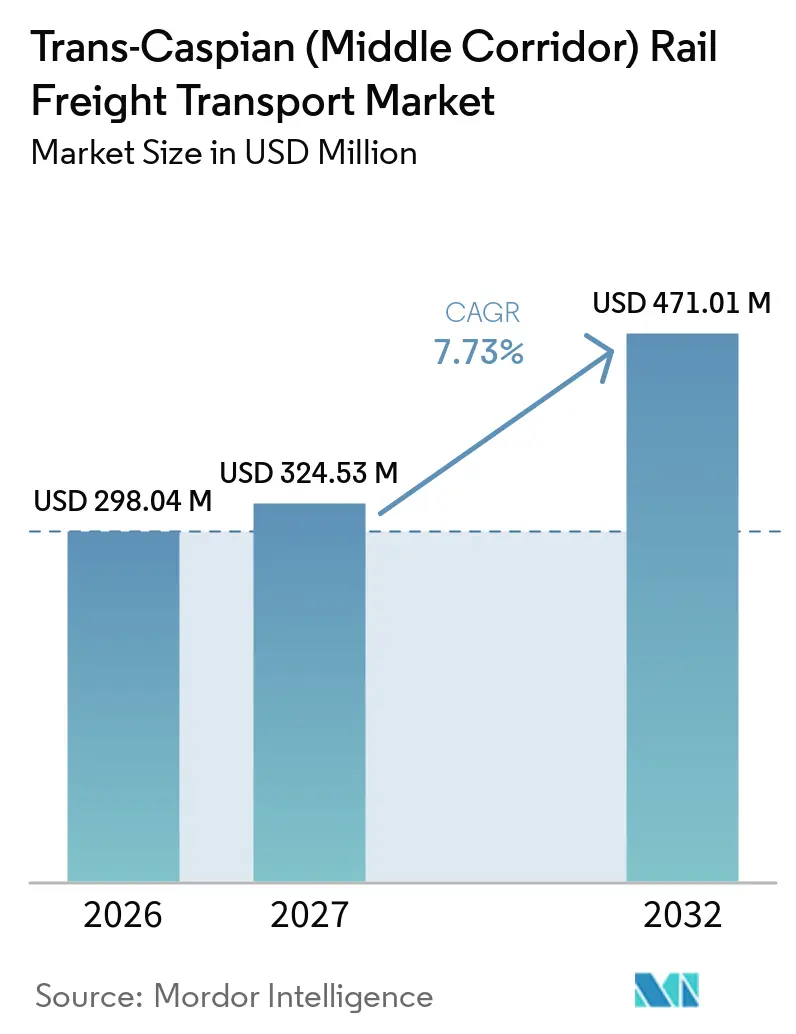
The Trans-Caspian (middle corridor) rail freight transport market size is projected to be USD 298.04 million in 2026, USD 324.53 million in 2027, and reach USD 471.01 million by 2032, growing at a CAGR of 7.73% from 2027 to 2032.
The Trans-Caspian (middle corridor) rail freight transport market is gaining importance as shippers redirect Eurasian cargo away from northern routes that cross Russia. This redirection has moved beyond occasional shipments and is supporting multi-year commercial commitments by shippers. Container traffic on the Trans-Caspian International Transport Route rose 36% to 76,900 TEU in 2025, while total corridor tonnage was 4.12 million tons. That change points to a larger role for containerized, higher-value goods and supports stronger revenue per ton. Freight volumes increased 22% year-over-year in the first 8 months of 2026, while East-West transit freight grew 55%, showing that demand remained active across the corridor.[1]
Key Report Takeaways
- By cargo type, containerized freight held 42.75% of the Trans-Caspian (middle corridor) rail freight transport market size in 2026, while project and oversized cargo projected a 9.31% CAGR through 2032.
- By commodity, machinery, electrical equipment, and industrial goods held 22.19% of the Trans-Caspian (middle corridor) rail freight transport market share in 2026, while automotive and automotive components are projected to grow at a 9.85% CAGR through 2032.
- By shipment configuration, full-container-load shipments held 35.22% of the Trans-Caspian (middle corridor) rail freight transport market size in 2026, while dedicated and block-train services are projected to grow at an 8.70% CAGR through 2032.
- By customer type, freight forwarders and third-party logistics providers held 38.65% of the Trans-Caspian (middle corridor) rail freight transport market share in 2026, while shipping lines and intermodal operators are projected to grow at an 8.64% CAGR through 2032.
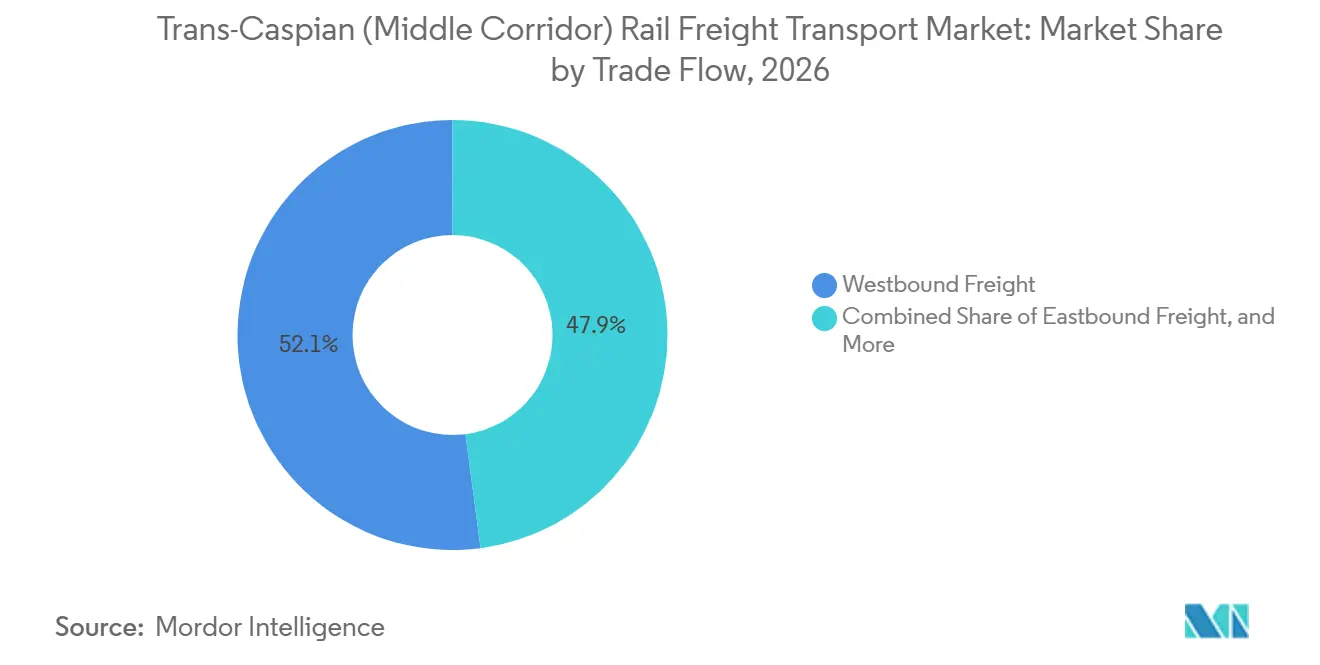
- By trade flow, westbound freight held 52.07% of the Trans-Caspian (middle corridor) rail freight transport market size in 2026, while eastbound freight projected to grow at an 8.56% CAGR through 2032.
- By geography, China held 28.58% of the Trans-Caspian (middle corridor) rail freight transport market share in 2026, while other connected markets projected to grow at a 9.18% CAGR through 2032.
Note: Market numbers in this report are based on Mordor Intelligence's proprietary estimation framework, which combines nine months of actuals with Q4 projections for base year 2026.
Market Trends and Insights
Drivers Impact Analysis of Trans-Caspian (Middle Corridor) Rail Freight Transport Market*
| Driver | (~) % Impact on CAGR Forecast | Geographic Relevance | Impact Timeline |
|---|---|---|---|
| Supply Chain Diversification Away From the Northern Corridor | +2.2% | Global, with demand from EU, United States, and East Asian shippers requiring Russia-bypass routing | Long term (≥ 4 years) |
| Growth in Time-Sensitive China-Europe Cargo | +1.5% | China origin hubs and European termini in Poland, Romania, Germany, and Turkey | Medium term (2-4 years) |
| Expansion of Baku-Tbilisi-Kars and Caspian Port Capacity | +1.2% | Azerbaijan and Georgia, with effects in Kazakhstan and Turkey | Medium term (2-4 years) |
| Corridor-Wide Digitalization and Trade Facilitation | +0.8% | Kazakhstan, Azerbaijan, and Georgia, extending to EU gateways | Medium term (2-4 years) |
| Scheduled Block-Train Density and Cargo Aggregation | +0.6% | Kazakhstan and China origin nodes, Azerbaijan, and Georgia | Short term (≤ 2 years) |
| Caspian Water-Level Adaptation and Port Uptime Investments | +0.4% | Kazakhstan, Azerbaijan, and Turkmenistan | Medium term (2-4 years) |
| Source: Mordor Intelligence | |||
Supply Chain Diversification Away from the Northern Corridor
The Trans-Caspian (middle corridor) rail freight transport market is benefiting from a durable shift in China-Europe freight planning away from Russian territory. Shipper risk policies and insurer restrictions have made alternative routing more important for many cargo owners. DSV completed its EUR 14.3 billion (USD 16.82 billion) acquisition of DB Schenker in April 2025 and subsequently discontinued rail freight transiting Russia in August 2025. These choices direct freight toward alternative corridors and increase the value of reliable block-train capacity. Higher service frequency can improve transit-time reliability, which can reduce the route risk perceived by European shippers. The combined DSV and Schenker network also has the scale to negotiate dedicated capacity with rail operators, placing pressure on smaller forwarding firms that lack similar cargo volumes.
Growth in Time-Sensitive China-Europe Cargo
The Trans-Caspian (middle corridor) rail freight transport market is becoming more relevant for goods that need shorter delivery cycles than sea freight can provide. Container block trains recorded average transit times of 12 to 15 days in 2025, bringing the route within the delivery range needed for electronics, apparel, and automotive spare parts. China-Europe rail activity expanded in the first quarter of 2026, with 5,460 trains (up 29% year-over-year) carrying 546,000 containers (up 22% year-over-year). Faster customs processing also supports the route, as electronic procedures at Altynkol-Khorgos reduced declaration processing from 24 hours to 30 minutes. This improvement shortens total delivery time and supports cargo with faster inventory turnover. Kazakhstan’s simplified customs procedures also align with single-window practices that help the corridor compete with deep-sea routing for time-sensitive consumer goods.[2]
Expansion of Baku-Tbilisi-Kars and Caspian Port Capacity
The Trans-Caspian (middle corridor) rail freight transport market has gained capacity at important rail and port sections of the route. Azerbaijan Railways completed modernization of the 184-kilometer Georgian section of the Baku-Tbilisi-Kars railway in 2025 at a cost of USD 250 million. The work covered 13 stations, 55 bridges, and 8 traction substations, and it increased annual freight capacity from 1 million tons to 5 million tons. Turkey has announced a further capacity target of 17 million tons by 2034.[3] The EBRD and EU approved financing of up to EUR 45 million (USD 52.93 million) for Aktau Port upgrades in 2025 to expand container throughput and reduce average handling time from 4 minutes to 2.5 minutes per container. Baku Port is moving through a staged expansion, with container capacity targeted at 300,000 TEU by the end of 2027.
Corridor-Wide Digitalization and Trade Facilitation
The Trans-Caspian (middle corridor) rail freight transport market relies on shared digital systems because cargo crosses several rail, maritime, and customs jurisdictions. Kazakhstan introduced an electronic Maritime Single Window for Caspian ports through its Transport Industry Digitalization Roadmap for 2025 to 2027. The system is intended to support paperless vessel entry and exit at Aktau and Kuryk. Azerbaijan and Kazakhstan activated electronic data exchange between Baku Port and Aktau Sea Trade Port in April 2025, which improved vessel-loading coordination and container tracking. The Aktau container hub has connected with Georgian Railway's digital systems and reduced train inspection time at the Georgian border from 8 to 9 hours to 40 minutes. The TITR Association also reached an agreement on electronic document management and digital signatures in April 2026, which might extend digital coordination across the route.
Restraints Impact Analysis of Trans-Caspian (Middle Corridor) Rail Freight Transport Market*
| Restraint | (~) % Impact on CAGR Forecast | Geographic Relevance | Impact Timeline |
|---|---|---|---|
| Multimodal Transshipment and Border-Crossing Delays | -0.9% | All transit points, especially Kazakhstan-China crossings and Caspian ferry terminals | Medium term (2-4 years) |
| Shortage of Locomotives, Wagons, Vessels, and Handling Equipment | -0.7% | Kazakhstan and Azerbaijan Caspian legs and the Georgian rail network | Medium term (2-4 years) |
| Fragmented Tariff, Liability, and Corridor Governance | -0.5% | Corridor-wide, especially multi-country rate negotiation and claims resolution | Long term (≥ 4 years) |
| Empty-Container Imbalance and Weak Reverse Cargo Flows | -0.4% | Westbound legs from Kazakhstan to Europe and return repositioning at EU and Turkish terminals | Long term (≥ 4 years) |
| Source: Mordor Intelligence | |||
Multimodal Transshipment and Border-Crossing Delays
The Trans-Caspian (middle corridor) rail freight transport market still faces schedule risk at its rail-to-sea transfers and border crossings. The Caspian Sea passage adds a maritime stage that can be disrupted by adverse weather and port closures. Five national rail systems, 3 maritime jurisdictions, and separate customs regimes add coordination demands across a single shipment. Azerbaijan, Kazakhstan, and Georgia signed an action plan in October 2025 that covered customs pre-clearance and synchronized timetables. Full implementation will continue through the forecast period, while coordination reform remains important for improving service consistency.
Empty-Container Imbalance and Weak Reverse Cargo Flows
The Trans-Caspian (middle corridor) rail freight transport market has a clear directional imbalance that raises equipment repositioning costs. In the first 8 months of 2026, 42,642 TEU moved westward, and 10,932 TEU moved eastward, producing a nearly 4-to-1 imbalance. Operators often return equipment to China without revenue cargo, which reduces revenue per train movement. KTZ Express and Pasifik Eurasia Lojistik ran a pilot eastbound train from Izmir to China in May 2026 with 50 forty-foot containers of household refrigerators. The pilot demonstrated that eastbound traffic can be developed, but it had not reached commercial scale. More sustainable return freight from Turkey’s automotive and consumer goods manufacturing base would improve equipment use and corridor economics.
*Our forecasts treat driver/restraint impacts as directional, not additive. The impact forecasts reflect baseline growth, mix effects, and variable interactions.
Trans-Caspian (Middle Corridor) Rail Freight Transport Market Segment Analysis
By Cargo Type:
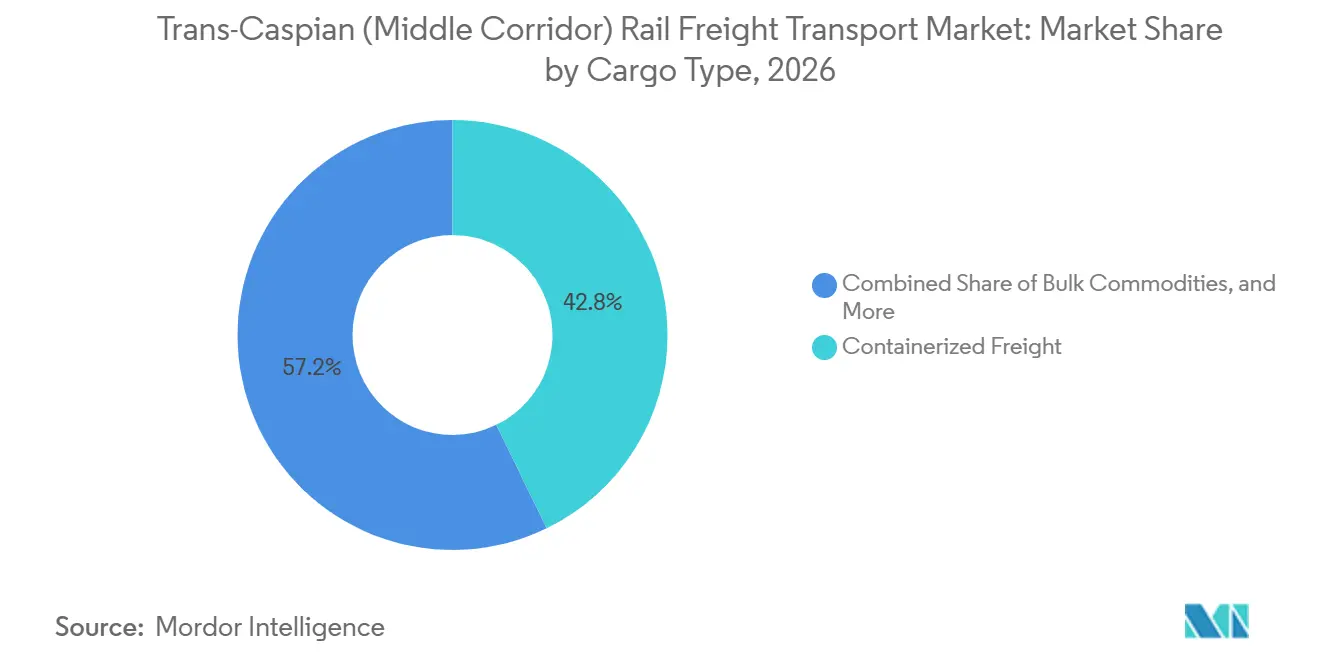
Containerized Freight Leads a Higher-Value MixContainerized freight held 42.75% of the Trans-Caspian (middle corridor) rail freight transport market share in 2026. The market benefits from the corridor’s larger role in moving manufactured products that need secure box handling across the Caspian Sea transfer. TITR container traffic rose 36% to 76,900 TEU in 2025, even as total corridor tonnage fell. This movement supports a continued shift away from lower-value bulk traffic and toward containerized cargo. Bulk commodities remain relevant for oil, grain, and ferroalloy flows between Kazakhstan and Azerbaijan. General cargo and breakbulk serve regional industrial needs, although their pace is lower than containerized growth.
Project and oversized cargo is forecast to grow at a 9.31% CAGR between 2027 and 2032. Central Asian infrastructure investment supports demand for heavy capital equipment, where rail offers a practical alternative to higher-cost air freight. Azerbaijan Railways received 392 east-to-west block trains in 2025, 37% more than in 2024, and targets 400 trains for 2026. The longer-term objective is 1,000 trains each year. The TITR Association also supported 600 China-Kazakhstan container trains for 2026 through its April agreement. Temperature-controlled, hazardous-goods, and oversized-load services remain smaller parts of the Trans-Caspian rail freight transport industry, but they benefit from alignment with OSJD rules and TIR documentation.

By Commodity:
Automotive and Automotive Components Record the Fastest GrowthMachinery, electrical equipment, and industrial goods held 22.19% of the Trans-Caspian (middle corridor) rail freight transport market share in 2026. The market is supported by capital equipment imports into Central Asian manufacturing and energy sectors, while Chinese consumer electronics create frequent westbound shipments. China State Railway Group launched the first Wuhan-Baku container block train in 2026 with electronics, household appliances, and consumer goods. The service had an 18-day transit time and added a manufacturing origin to the corridor network.
Automotive and automotive components are forecast to grow at a 9.85% CAGR from 2027 to 2032. Turkey-based final assembly using Chinese components supports this freight stream and can offer a faster inbound route than Red Sea-Suez transport. Agricultural products and foodstuffs have a role in efforts to develop return cargo. KTZ Express completed a pilot movement of Kazakh flour to New York through the corridor and a CMA CGM maritime connection in March 2026. It also moved rice to Antwerp through the same multimodal combination. Chemicals and petrochemicals follow Kazakhstan’s downstream processing plans, while minerals, ores, and bulk cargo remain most exposed to Caspian ferry-loading constraints. Textiles, apparel, and consumer goods gain from demand for faster delivery to European buyers. These cargo groups broaden the corridor’s commercial base and reduce reliance on a limited set of containerized imports.
By Shipment Configuration:
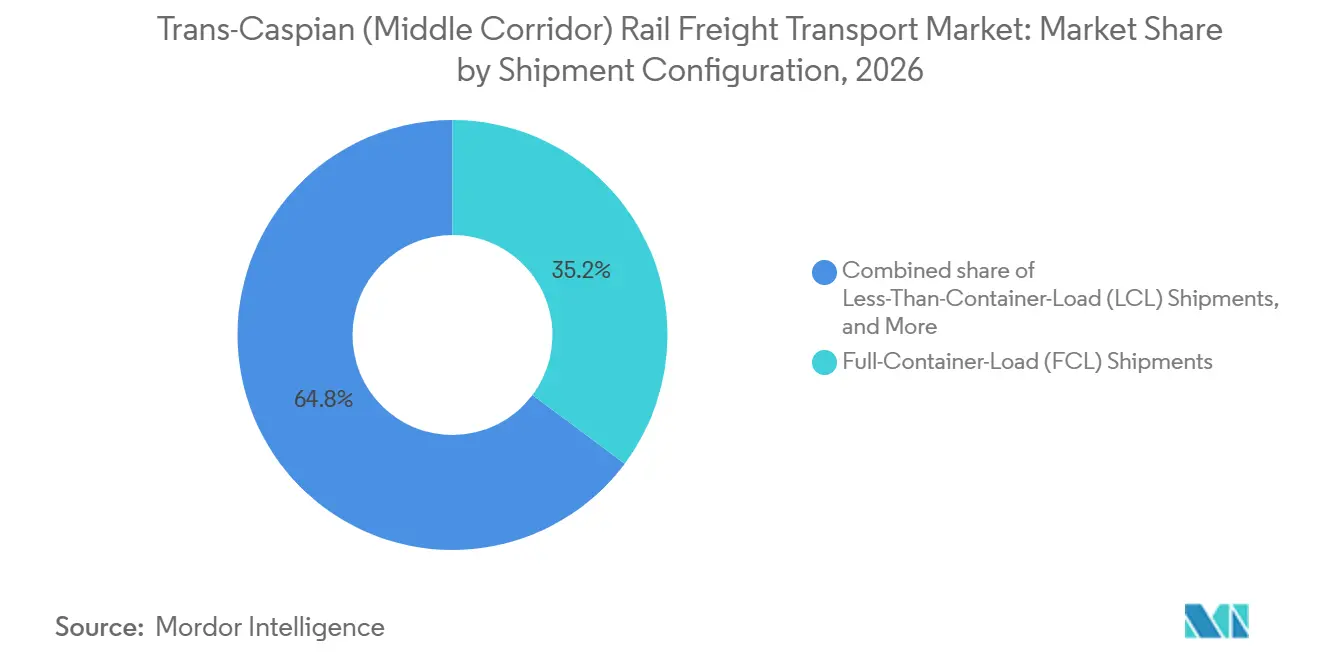
Scheduled Block Trains Improve Service PlanningFull-container-load shipments held 35.22% of the Trans-Caspian (middle corridor) rail freight transport market size in 2026. Shippers use dedicated containers to protect cargo across a route with multiple transfer points. The structure is especially useful during the Caspian Sea crossing, where mixed loads can face greater handling and damage risks. Less-than-container-load shipments provide an option for smaller firms that cannot fill a full container. These shippers can obtain shorter delivery cycles than shared ocean-container services may provide.
Dedicated and block-train services are forecast to grow at an 8.70% CAGR through 2032. Georgian Railway launched a 4-times-weekly scheduled container block-train service between Poti and Tbilisi in August 2025. The market gains more regular cargo aggregation through this service and improved inland-port planning for connected shippers. The Aktau container hub began operating in December 2025 with Phase I capacity of 140,000 TEU and integrated digital customs processes. Its operating model supports consolidation by reducing dwell time for individual containers. Wagonload and single-wagon services continue to handle domestic Kazakhstan industrial traffic. Specialized freight services serve oversized energy and mining equipment that require permits under OSJD conventions, which broadens the Trans-Caspian rail freight transport market beyond standard container flows.
By Customer Type:
Forwarders Coordinate Complex Cross-Border MovementsFreight forwarders and third-party logistics providers held 38.65% of the Trans-Caspian (middle corridor) rail freight transport market size in 2026. They consolidate cargo, manage multi-country documents, and take on coordination work across rail, sea, and road stages. Many cargo owners prefer this model because a single shipment can cross several operational systems. ADY Express and Hellmann Worldwide Logistics completed a joint shipment of 55 forty-foot containers from Chongqing to destinations in Georgia, Romania, Turkey, and Germany in January 2025. The movement showed that large forwarder networks could use the Trans-Caspian (middle corridor) rail freight transport market for commercially managed shipments.
Shipping lines and intermodal operators are forecast to grow at an 8.64% CAGR through 2032. CMA CGM opened regional offices in Kazakhstan, Uzbekistan, Kyrgyzstan, Tajikistan, Turkmenistan, and Azerbaijan during 2025. The locations link Caspian rail movements with Black Sea and Mediterranean services and strengthen sea-rail product offerings. Manufacturers and industrial shippers are another major source of volume, including Central Asian mining and energy firms and Chinese electronics exporters. State-owned enterprises use the route for capital equipment imports and export promotion activities. Commodity producers and traders are more exposed to ferry capacity limits, while retailers and consumer goods distributors become more relevant as reliability improves. This group mix helps the Trans-Caspian (middle corridor) rail freight transport industry serve both large contracted shippers and smaller time-sensitive cargo owners.
By Trade Flow:
Westbound Volumes Support Eastbound DevelopmentWestbound freight held a 52.07% share in 2026. China’s manufacturing surplus and European demand for electronics, machinery, and consumer goods support the Trans-Caspian rail freight transport market in this direction. Container traffic was 80% westbound and 20% eastbound in the first 8 months of 2026. That pattern creates full-haul revenue on westbound services, while the return movement often requires equipment repositioning. Azerbaijan Railways has identified automotive products and consumer goods from Turkey as priority eastbound cargo categories.
Eastbound freight is forecast to grow at an 8.56% CAGR between 2027 and 2032. The World Bank approved a USD 846 million guarantee package in February 2026 that mobilizes USD 1.41 billion for Middle Corridor railway investment. The package targets 3 times freight volumes and 1-half transit times by 2030, including infrastructure gaps that affect eastbound pricing. Intra-corridor freight among Kazakhstan, Azerbaijan, Georgia, and Turkey is smaller, but it can provide a baseline for scheduled train services. Consistent regional cargo can increase schedule density and lower unit costs for transit shippers. The TITR Association’s April 2026 agreement on coordinated Caspian loading and vessel deployment addressed this need. Better regional frequency supports the wider Trans-Caspian rail freight transport market by making the transit segments more dependable.
Geography Analysis
China held 28.58% of the Trans-Caspian (middle corridor) rail freight transport market share in 2026, reflecting its position as the main freight origin and a growing infrastructure partner. The Trans-Caspian rail freight transport market also draws on China’s wider terminal and rail coordination capability. Lianyungang Port Holding Group, Kazakhstan Temir Zholy, China Railway Container Transport Corp., and COSCO Shipping Container Transport signed a 4-party agreement in July 2026. The agreement links Aktau Port, the Khorgos-East Gate dry port, and Lianyungang’s container yard through a coordinated model. China Railway Container Transport Corp. formally joined Middle Corridor Multimodal Ltd. in November 2025. That entry extends Chinese participation from origin terminals into trans-Caspian coordination.
Other Connected Markets, including Japan, South Korea, and potential Southeast Asian connections through Lianyungang feeders, are forecast to grow at a 9.18% CAGR from 2027 to 2032. Kazakhstan contains the longest land section of the route and has Caspian gateways at Aktau and Kuryk. The country completed construction and modernization of 911 kilometers of rail in 2025, including the 836-kilometer Dostyk-Moiynty double-track section. These works increase the ability to receive China-origin freight without creating new border bottlenecks. The EBRD and EU financing for Aktau targets container terminal capacity of up to 240,000 TEU by the end of 2026. Kazakhstan and Uzbekistan also launched a 159.4-hectare logistics center project in the Tashkent Region in November 2025. Phase I has USD 84 million planned for 2027, which extends the route’s commercial reach into Uzbekistan.
Azerbaijan carried 9.1 million tons of transit cargo in the first 7 months of 2026, a 5-year high and an 11.6% increase from 2025. Its role centers on coordinating the Caspian crossing, connecting Baku infrastructure to the Baku-Tbilisi-Kars rail route, and managing trade interfaces with Georgia. Georgia provides the Black Sea handover and scheduled inland services, while Turkey links the route with Europe and has a large potential base for eastbound automotive and consumer goods. Europe has moved from being mainly a destination to being an active investor and policy participant. The European Commission has stated an intention to mobilize up to EUR 12 billion (USD 14.12 billion) in public and private investment through Global Gateway activities, with the aim of tripling trade flows and halving transit times by 2030.[4] This participation also advances customs and competition alignment for operators serving European customers.
Competitive Landscape
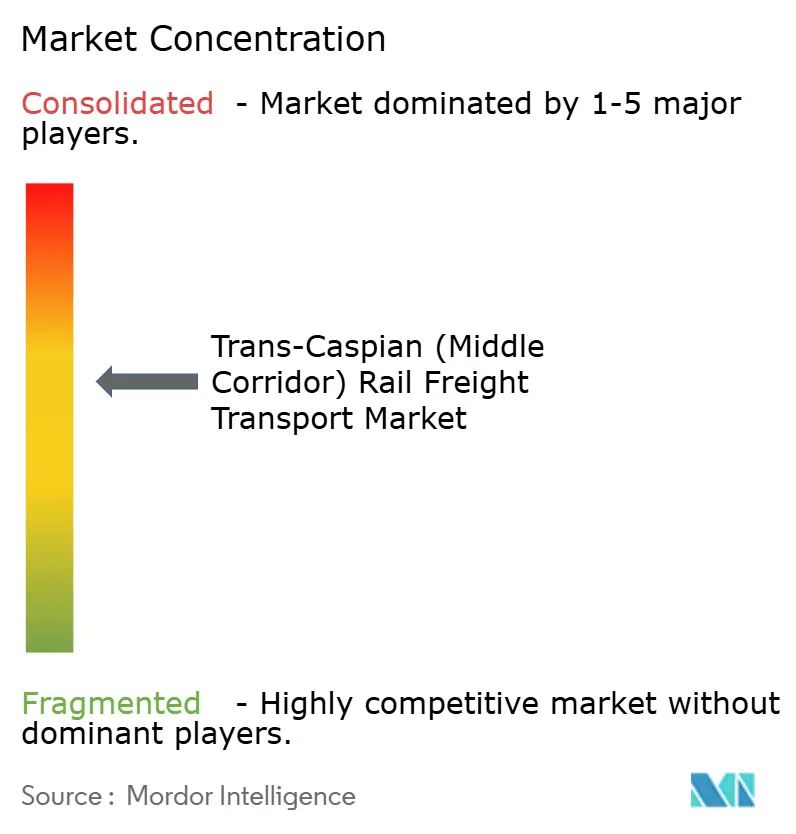
The Trans-Caspian (middle corridor) rail freight transport market is moderately consolidated in infrastructure and more fragmented in freight origination and forwarding. Azerbaijan Railways, Kazakhstan Temir Zholy, and Georgian Railway control important corridor capacity through Middle Corridor Multimodal Ltd. China Railway Container Transport Corp. joined the venture in November 2025, adding an origin-side rail participant to the coordination structure. State rail entities are building stronger links between origin terminals and transit capacity. Commercial forwarders, therefore, compete mainly through customer service, digital coordination, and their ability to aggregate varied cargo. This split means asset ownership remains concentrated, while access to customer cargo remains open to a broad set of logistics firms.
DSV’s acquisition of DB Schenker for EUR 14.3 billion (USD 16.82 billion) in April 2025 created a larger forwarding group with the ability to secure rail capacity across alternative Eurasian routes. Its later decision to discontinue Russia rail services increased the importance of other routing choices for its customers. Rhenus acquired the rail-connected QAZContargo Almaty terminal near Almaty in January 2026, providing block-train access and bonded storage. Rhenus also announced plans for up to 14 intermodal terminals from Uzbekistan to Turkey, including a trimodal terminal at Aktau developed with KTZ and Aktau Port. These moves position global logistics groups as long-term capacity and service providers rather than only shipment intermediaries. CMA CGM’s regional-office expansion adds a sea-rail competitor with links to Black Sea and Mediterranean networks.
Technology is an important difference for cargo owners that need visibility through each handover. Aktau’s container hub introduced tracking connected to Chinese and Georgian customs systems, cutting cross-border processing from 24 hours to 30 minutes. CMA CGM uses shipment tracking with corridor rail-management systems to offer door-to-port visibility for customers. Smaller regional providers may rely more heavily on manual status updates and have fewer integrated systems. Compliance with OSJD operating rules, the CIM/SMGS unified consignment note, and the UNECE TIR Convention is increasingly relevant during shipper route reviews. The Trans-Caspian (middle corridor) rail freight transport market, therefore, rewards providers that can combine capacity access, compliant documents, and reliable digital information across every national border.
Trans-Caspian (Middle Corridor) Rail Freight Transport Industry Leaders
-
NC Kazakhstan Temir Zholy JSC
-
Azerbaijan Railways CJSC
-
JSC Georgian Railway
-
China State Railway Group Co., Ltd.
-
Baku International Sea Trade Port CJSC
- *Disclaimer: Major Players sorted in no particular order
Trans-Caspian (Middle Corridor) Rail Freight Transport Market Companies Covered in this Report
- Azerbaijan Railways CJSC
- NC Kazakhstan Temir Zholy JSC
- JSC Georgian Railway
- China State Railway Group Co., Ltd.
- Baku International Sea Trade Port CJSC
- Azerbaijan Caspian Shipping CJSC
- Pasifik Eurasia Lojistik Dis Ticaret A.S.
- Grampet Group
- Eastcomtrans LLP
- Lianyungang Port Holdings Group
- CMA CGM Group
- DSV A/S
- DHL Group
- Kuehne+Nagel
- PKP CARGO S.A.
- TCDD Tasimacilik A.S.
- Rhenus Group
- Hellmann Worldwide Logistics
- Nurminen Logistics
- Uzbekistan Railways
Recent Industry Developments in Trans-Caspian (Middle Corridor) Rail Freight Transport Market
- July 2026: Lianyungang Port Holding Group, Kazakhstan Temir Zholy, China Railway Container Transport Corp., and COSCO Shipping Container Transport signed a 4-party “Three Hub Integration” cooperation agreement in Shanghai to jointly develop the Trans-Caspian corridor, incorporating Aktau Port, the Khorgos-East Gate dry port, and Lianyungang’s container yard under a coordinated operational model.
- June 2026: Kazakhstan Temir Zholy signed a cooperation agreement with A.P. Moller-Maersk to expand container transport along the Middle Corridor and held discussions with DHL Global Forwarding on integrated multimodal services linking China, Central Asia, Turkey, and Europe.
- June 2026: Rhenus Group announced plans to build a network of up to 14 intermodal terminals along the Middle Corridor from Uzbekistan through Kazakhstan and Azerbaijan to Turkey, anchored by a new trimodal container terminal in Aktau, developed with KTZ and Aktau Port.
- February 2026: Azerbaijan Railways, Uzbekistan Railways, Turkmenistan’s Ministry of Railway Transport, and Georgian Railway signed a cooperation protocol in Ashgabat covering cargo transport development, joint digitalization of the Middle Corridor, and corridor diagnostics.
Trans-Caspian (Middle Corridor) Rail Freight Transport Market Report Scope
Segmentation Overview
| Containerized Freight |
| Bulk Commodities |
| General Cargo and Breakbulk |
| Project and Oversized Cargo |
| Other Specialized Cargo |
| Agricultural Products and Foodstuffs |
| Automotive and Automotive Components |
| Chemicals and Petrochemicals |
| Machinery, Electrical Equipment and Industrial Goods |
| Metals and Metal Products |
| Minerals, Ores and Other Bulk Commodities |
| Textiles, Apparel and Consumer Goods |
| Other Commodities |
| Full-Container-Load (FCL) Shipments |
| Less-Than-Container-Load (LCL) Shipments |
| Dedicated and Block-Train Services |
| Conventional Wagonload Shipments |
| Specialized Rail Freight Services |
| Freight Forwarders and Third-Party Logistics Providers |
| Shipping Lines and Intermodal Operators |
| Manufacturers and Industrial Shippers |
| Commodity Producers and Traders |
| Retailers and Consumer Goods Distributors |
| Government and State-Owned Enterprises |
| Other Customers |
| Eastbound Freight |
| Westbound Freight |
| Intra-Corridor Freight |
| China |
| Kazakhstan |
| Azerbaijan |
| Georgia |
| Turkiye |
| Europe |
| Other Connected Markets |
| By Cargo Type | Containerized Freight |
| Bulk Commodities | |
| General Cargo and Breakbulk | |
| Project and Oversized Cargo | |
| Other Specialized Cargo | |
| By Commodity | Agricultural Products and Foodstuffs |
| Automotive and Automotive Components | |
| Chemicals and Petrochemicals | |
| Machinery, Electrical Equipment and Industrial Goods | |
| Metals and Metal Products | |
| Minerals, Ores and Other Bulk Commodities | |
| Textiles, Apparel and Consumer Goods | |
| Other Commodities | |
| By Shipment Configuration | Full-Container-Load (FCL) Shipments |
| Less-Than-Container-Load (LCL) Shipments | |
| Dedicated and Block-Train Services | |
| Conventional Wagonload Shipments | |
| Specialized Rail Freight Services | |
| By Customer Type | Freight Forwarders and Third-Party Logistics Providers |
| Shipping Lines and Intermodal Operators | |
| Manufacturers and Industrial Shippers | |
| Commodity Producers and Traders | |
| Retailers and Consumer Goods Distributors | |
| Government and State-Owned Enterprises | |
| Other Customers | |
| By Trade Flow | Eastbound Freight |
| Westbound Freight | |
| Intra-Corridor Freight | |
| By Geography | China |
| Kazakhstan | |
| Azerbaijan | |
| Georgia | |
| Turkiye | |
| Europe | |
| Other Connected Markets |
Key Questions Answered in the Report
What is the projected value of the Trans-Caspian (middle corridor) rail freight transport market by 2032?
The Trans-Caspian (middle corridor) rail freight transport market is projected to reach USD 471.01 million by 2032, growing at a 7.73% CAGR from 2027 to 2032. The outlook reflects the corridor’s growing use for China-Europe container traffic.
Which cargo type leads the Trans-Caspian (middle corridor) rail freight transport market?
Containerized freight leads with 42.75% share in 2026. The Trans-Caspian (middle corridor) rail freight transport market gains from its role in moving higher-value manufactured products safely across the Caspian Sea.
Which cargo category is growing fastest on the Trans-Caspian route?
Project and oversized cargo are forecast to record the fastest cargo-type growth, at a 9.31% CAGR through 2032. Infrastructure investment in Central Asia supports demand for heavy equipment movements.
Why are shippers using the Middle Corridor?
Shippers use the route to diversify away from northern rail routes, improve access to China-Europe trade, and move time-sensitive cargo through a 12 to 15-day rail transit option.
What limits growth along the Trans-Caspian route?
Border delays, weather-related Caspian disruptions, equipment shortages, fragmented governance, and weak eastbound return cargo can constrain performance. These matters affect schedule reliability and the cost of returning empty equipment.
Which geography holds the largest share in 2026?
China held 28.58% share in 2026 because it is the main freight origin and an active participant in the route’s terminal and coordination network. Its links with Aktau, Khorgos, and Lianyungang support wider corridor operations.