
Trail Camera Market Size and Share
Market Overview
| Study Period | 2021 - 2032 |
|---|---|
| Market Size (2027) | USD 157.51 Million |
| Market Size (2032) | USD 232.63 Million |
| Growth Rate (2027 - 2032) | 8.10 % |
| Fastest Growing Market | Asia-Pacific |
| Largest Market | North America |
| Market Concentration | Medium |
Major Players *Disclaimer: Major Players sorted in no particular order Image © Mordor Intelligence. Reuse requires attribution under CC BY 4.0. | |
Trail Camera Market Analysis by Mordor Intelligence
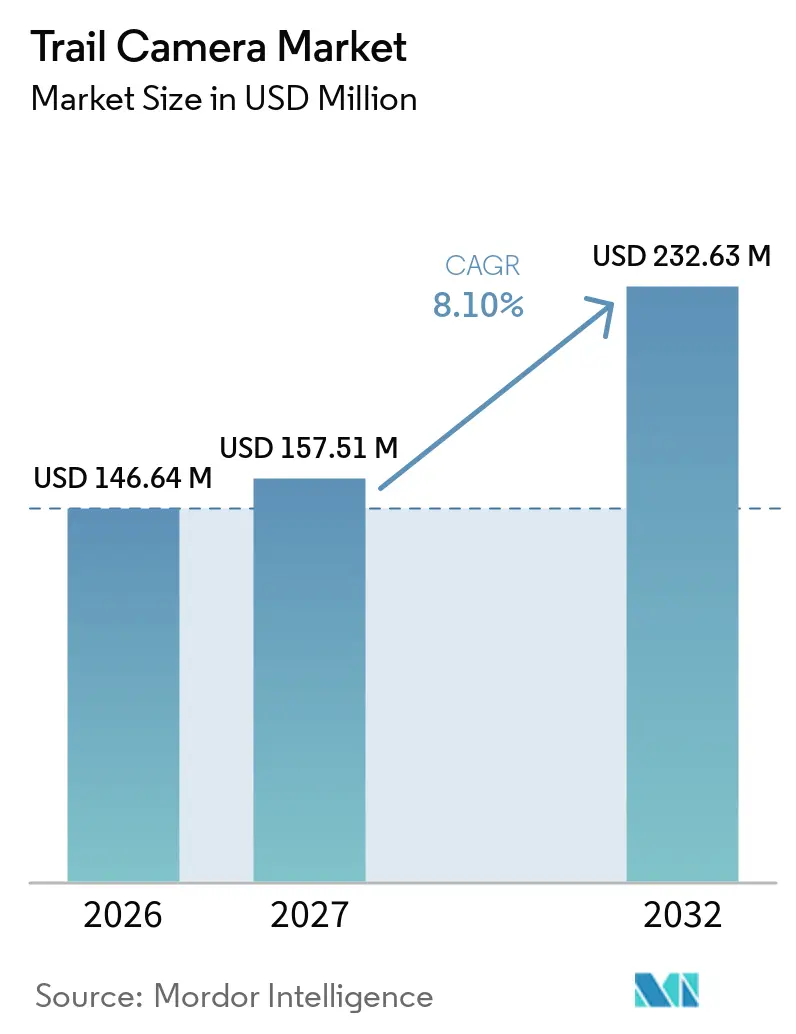
The Trail Camera Market size is projected to expand from USD 146.64 million in 2026 and USD 157.51 million in 2027 to USD 232.63 million by 2032, registering a CAGR of 8.10% between 2027 and 2032.
The category is moving beyond seasonal hunting use toward environmental monitoring and off-grid property security, which supports demand for connected equipment with stronger power management. This change brings more institutional buyers into the Trail camera market, including conservation bodies, public agencies, and rural property operators with different purchase cycles from recreational users. Cellular plans and cloud applications are becoming central to competitive positioning because they link device sales with recurring service revenue. Suppliers that combine reliable image transmission, longer battery life, and simple software are better placed to serve both individual users and organizations. Price pressure remains strong in basic products, while privacy rules and weak rural connectivity limit some deployments. These conditions make dependable support, clear data practices, and efficient power use important competitive features for suppliers that serve remote users across varied operating environments.
Key Report Takeaways
- By connectivity, cellular cameras held 37.82% of the trail camera market share in 2026, while cellular and satellite hybrid cameras are projected to expand at a 10.20% CAGR through 2032.
- By product type, standard cameras accounted for 58.63% share of the trail camera market in 2026, while wireless cameras are expected to expand at a 9.90% CAGR through 2032.
- By pixel size, 8-12 MP cameras held 55.41% share of the trail camera market in 2026, while cameras with below 8 MP are projected to expand at a 9.80% CAGR through 2032.
- By flash type, low-glow cameras accounted for 44.78% share of the trail camera market in 2026, while no-glow cameras are expected to expand at a 9.70% CAGR through 2032.
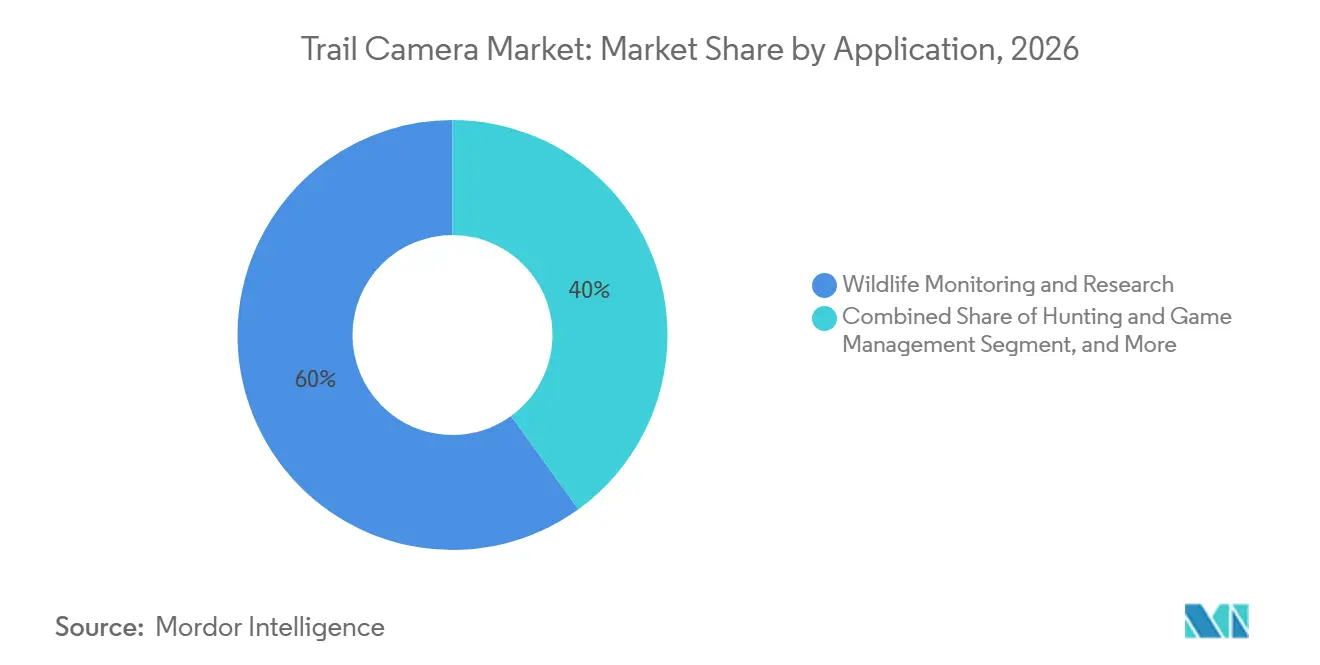
- By application, wildlife monitoring and research held 59.96% share in 2026, while security and property surveillance is projected to expand at a 9.30% CAGR through 2032.
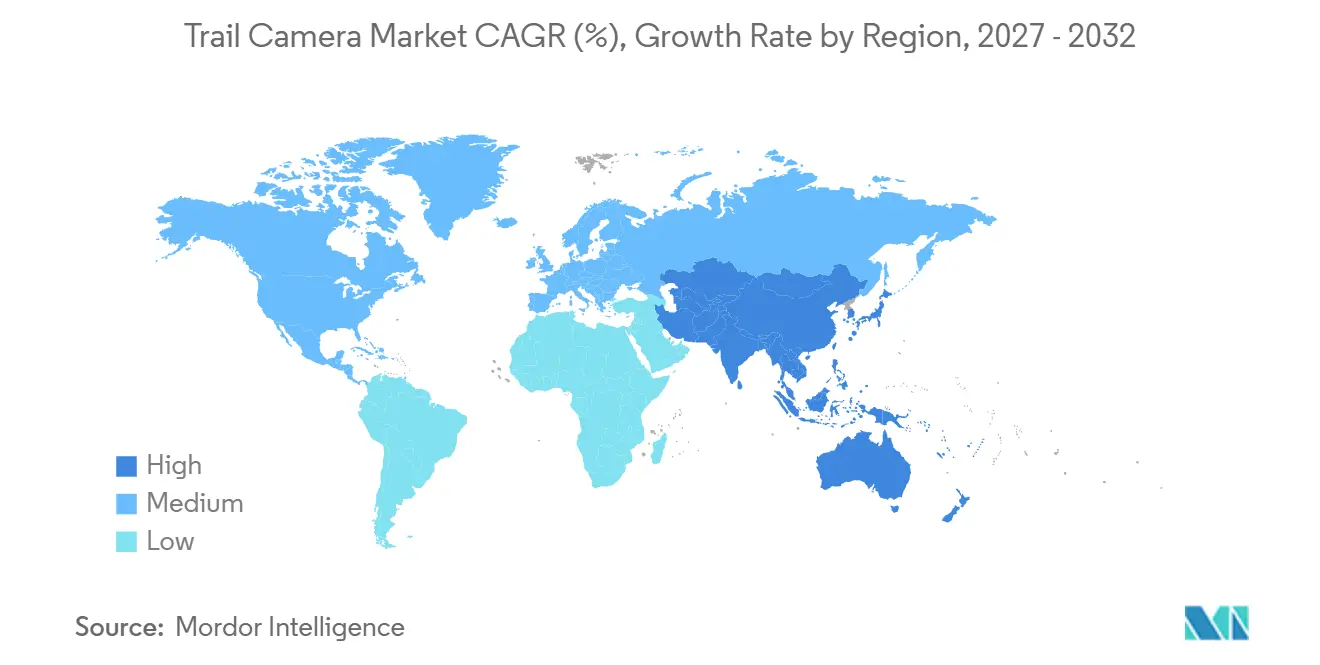
- By geography, North America held 28.14% share of the trail camera market in 2026, while Asia-Pacific is expected to expand at a 9.20% CAGR through 2032.
Note: Market numbers in this report are based on Mordor Intelligence's proprietary estimation framework, which combines nine months of actuals with Q4 projections for base year 2026.
Global Trail Camera Market Trends and Insights
Drivers Impact Analysis*
| Driver | (~) % Impact on CAGR Forecast | Geographic Relevance | Impact Timeline |
|---|---|---|---|
| Cellular and Cloud-Connected Remote Monitoring | +2.0% | North America and Europe, with spillover to Asia-Pacific and South America | Medium term (2-4 years) |
| Wildlife Conservation and Biodiversity Monitoring Programs | +1.8% | Global, concentrated in North America, Asia-Pacific, and Sub-Saharan Africa | Long term (≥ 4 years) |
| Hunting, Camping, and Outdoor Recreation Participation | +1.4% | North America, with emerging demand in Western Europe | Medium term (2-4 years) |
| Off-Grid Security for Farms and Rural Properties | +1.2% | North America, Europe, and Australia | Medium term (2-4 years) |
| Satellite-Backed Connectivity for Low-Coverage Locations | +0.9% | North America, with spillover to South America and the Middle East and Africa | Long term (≥ 4 years) |
| AI-Based Image Filtering and Species Recognition | +0.8% | Global, led by North America and Asia-Pacific | Long term (≥ 4 years) |
| Source: Mordor Intelligence | |||
Growth of Cellular and Cloud-Connected Remote Monitoring
Cellular delivery removes many physical visits that were needed to collect SD cards from remote cameras. That change lowers labor demands across multi-camera deployments and supports higher initial spending on connected products. SPYPOINT introduced the FLEX-RANGE in January 2026, with satellite backup capability, alongside its FLEX-M2 and FORCE-4K models. Tactacam released its REVEAL 4.0 series in July 2026 with dual sensors, 4K photo capability, GPS, and automatic carrier selection, and reported more than 2 million active REVEAL cameras. Tactacam data plans start at USD 5 per month, giving suppliers a recurring revenue stream alongside hardware sales.[1] Developers now evaluate LTE-M, NB-IoT, 4G LTE, and satellite links together because the appropriate connection depends on deployment density and transmission frequency.[2]
Expansion of Wildlife Conservation and Biodiversity Monitoring Programs
Public conservation programs are making camera traps part of structured monitoring networks rather than occasional research tools. This favors durable devices with long battery life, remote upload functions, and dependable field support. UNESCO deployed trail cameras and GPS devices in the Kanchenjunga Conservation Area in July 2025, working with Indigenous communities to monitor snow leopards, red pandas, and other species.[3] The U.S. Forest Service used trail cameras and audio recorders in its Northern Blue Mountains work during 2025 to study wildlife responses to forest restoration treatments.[4] Colombia's Humboldt Institute expanded its Red Otus camera trap network to 446 cameras during 2025 after its COP16 launch. As funded programs set clearer performance requirements, low-specification private-label products face a higher barrier to institutional use.
Rising Hunting, Camping, and Outdoor Recreation Participation
Outdoor recreation continues to support the installed base for the trail camera market in the United States. The Outdoor Industry Association reported 183.2 million participants in 2025, equal to 59% of Americans aged 6 and older. The organization also reported a net increase of nearly 30 million participants since 2019. The Bureau of Economic Analysis stated that hunting, shooting, and trapping contributed USD 16.5 billion in current-dollar value added during 2024. Buyers increasingly use cameras year-round for wildlife viewing, property observation, and nature content, which can raise units per participant. Participation among seniors rose 7.4%, and youth participation rose 5.6% in 2024, supporting interest in connected products used for wildlife observation.
Increasing Off-Grid Security Requirements for Farms and Rural Properties
Rural sites often lack fixed power and wired broadband, creating a use case for 4G-connected cameras. Real-time mobile alerts and AI-based human recognition make these products relevant for farms, livestock areas, and isolated buildings. The security use case shifts attention from image quality alone toward uptime, alert accuracy, and data handling. It also brings business buyers into the trail camera market, especially where conventional CCTV systems are costly to install. These users may favor managed services that combine equipment, connectivity, and data controls. This demand supports no-glow products because covert operation is often more important than nighttime image detail. It also encourages suppliers to offer simple alert settings, durable housings, and service options that reduce the operational burden on small rural teams.
Restraints Impact Analysis*
| Restraint | (~) % Impact on CAGR Forecast | Geographic Relevance | Impact Timeline |
|---|---|---|---|
| Low-Cost Generic and Private-Label Alternatives | -1.5% | Global, most acute in North America and Asia-Pacific | Short term (≤ 2 years) |
| Battery Dependency and Uneven Cellular Network Coverage | -1.0% | Asia-Pacific, with spillover to South America and the Middle East and Africa | Medium term (2-4 years) |
| Privacy, Wildlife-Disturbance, and Data-Protection Concerns | -0.7% | North America and the European Union | Medium term (2-4 years) |
| Seasonal Demand Concentration and Long Replacement Cycles | -0.5% | North America | Short term (≤ 2 years) |
| Source: Mordor Intelligence | |||
Availability of Low-Cost Generic and Private-Label Alternatives
Low-cost cameras from Chinese manufacturers have reduced the entry price for basic wildlife observation. Many OEM suppliers sell similar hardware to private-label brands, which intensifies price competition in retail channels. These models can sell at prices 40% to 60% below branded products while meeting basic user needs. The most exposed category is the mid-range device, where basic cellular transmission narrows the gap with products priced from USD 150 to USD 200. Established suppliers must refresh premium features more often or use subscription plans to retain users. SPYPOINT's free cellular tier and paid service plans show how suppliers use software and connectivity to reduce dependence on hardware margins.
Battery Dependency and Uneven Cellular Network Coverage
Cellular transmission uses more power than non-connected camera operation, making battery life a continuing field constraint. Tactacam positioned doubled battery life as a key feature of its REVEAL 4.0 release in July 2026. Solar accessories can reduce maintenance work, but dense forest cover limits their value in many wildlife locations. Uneven 4G LTE access across rural India, interior China, and parts of Southeast Asia also restricts connected deployments. This is a significant limitation because biodiversity programs are expanding in these same areas. Camera makers, therefore, need to balance transmission frequency, image quality, battery use, and connection reliability.
*Our forecasts treat driver/restraint impacts as directional, not additive. The impact forecasts reflect baseline growth, mix effects, and variable interactions.
Segment Analysis
By Connectivity: Satellite Backup Broadens the Premium Offer
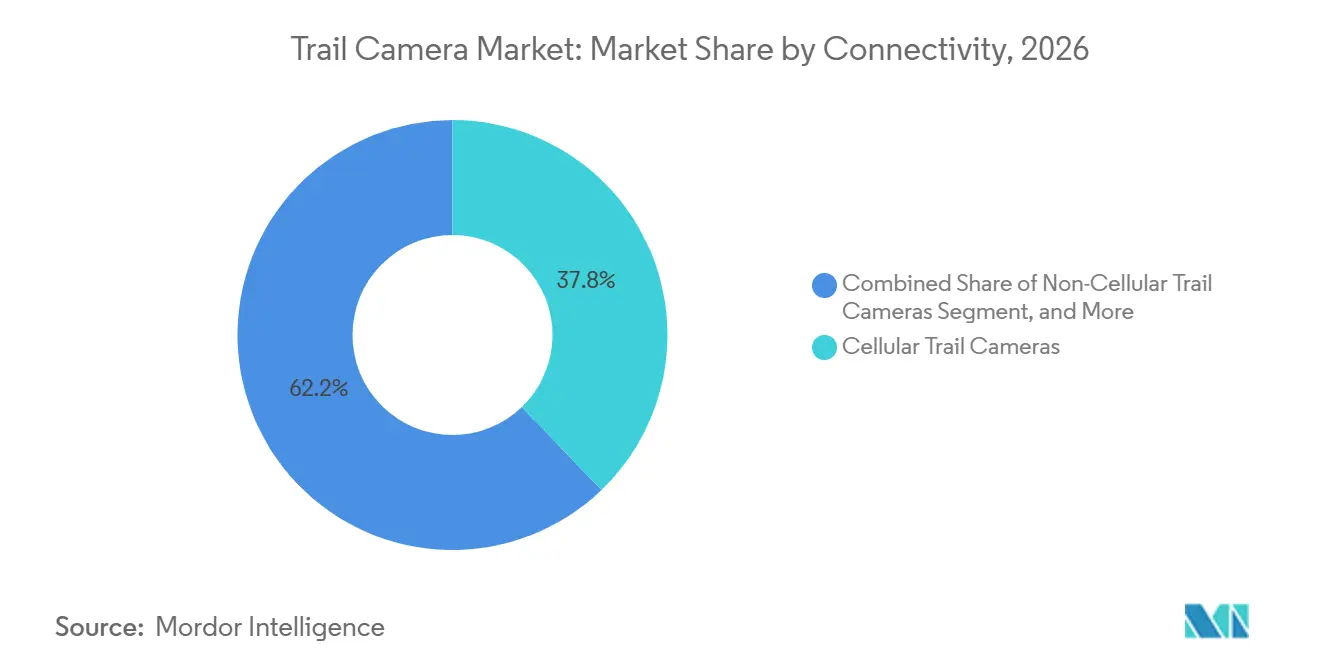
Cellular cameras held 37.82% of the Trail camera market share by connectivity in 2026, reflecting continued demand for remote image delivery. The cellular format reduces the need for site visits and helps users manage scattered devices through a single application. Tactacam's connected range shows how mobile applications, data plans, and camera hardware now operate as one customer offering. Cellular and satellite hybrid cameras are projected to expand at a 10.20% CAGR through 2032. Their value lies in maintaining limited communication when terrestrial coverage is intermittent. SPYPOINT's FLEX-RANGE uses dual-SIM LTE as the primary connection and satellite backup when cellular service is unavailable.
Satellite backup gives suppliers a way to address remote monitoring sites without treating satellite transmission as a permanent primary connection. That approach can control power consumption and data use while improving confidence in remote alerts. Non-cellular products remain relevant where users do not require immediate uploads or prefer local storage. They can also suit research settings where cloud uploads are restricted by data governance requirements. Wi-Fi cameras fit managed reserves and properties that already have local network infrastructure. Their lower recurring connectivity cost can appeal when devices are installed close to a building or hub. The trail camera market size for connectivity is increasingly shaped by the practical cost of transmitting images, not only by the camera's physical specifications. Image frequency, transmission distance, application response times, and the availability of local service all affect this operating cost. A camera that offers reliable basic communication may be more useful than one that provides the highest technical specification but requires frequent visits or costly data usage. This is particularly relevant for conservation teams and property operators that manage dispersed sites with limited staff. Suppliers that provide flexible connection choices can serve recreational users and institutions without forcing one operating model on both groups. Their applications must also make it easy to change settings when site conditions or coverage change.

By Product Type: Standard Cameras Retain Volume as Wireless Models Advance
Standard cameras accounted for 58.63% of the trail camera market share by product type in 2026. Their position rests on familiar operation, lower upfront cost, and broad use among hunters and recreational observers. These models remain the accessible starting point for buyers who do not need constant remote access. Wireless cameras are projected to expand at a 9.90% CAGR through 2032. Their stronger outlook reflects wider use of cellular functions in both personal and professional deployments. Wireless formats also support services that send images directly to an application instead of relying on manual collection.
Smart cameras add automated image filtering and species classification, which can reduce the time required to review large image collections. Google's SpeciesNet can identify nearly 2,500 categories of mammals, birds, and reptiles, and is used in platforms serving wildlife agencies. This capability raises expectations for professional equipment used in conservation and research. Solar-powered cameras are also gaining attention, where long deployments make battery changes costly. Manufacturers increasingly present solar capability as a built-in premium option rather than a separate accessory. The trail camera market is therefore separating into basic standard products, connected wireless products, and higher-function smart or solar offerings. Product design must reflect the needs of hunters, property owners, and researchers without making entry-level equipment unnecessarily complex. This supports a broader product range rather than a complete replacement of standard cameras. Standard units can remain appropriate for periodic wildlife observation, while wireless products are more useful when timely action is needed. Smart functions have greater value where teams must process high image volumes, and solar capability is most relevant for installations that remain active over long periods. These differences mean that suppliers need clear product positioning instead of relying on a single feature set across the entire range.
By Pixel Size: Mid-Range Resolution Holds the Largest Position
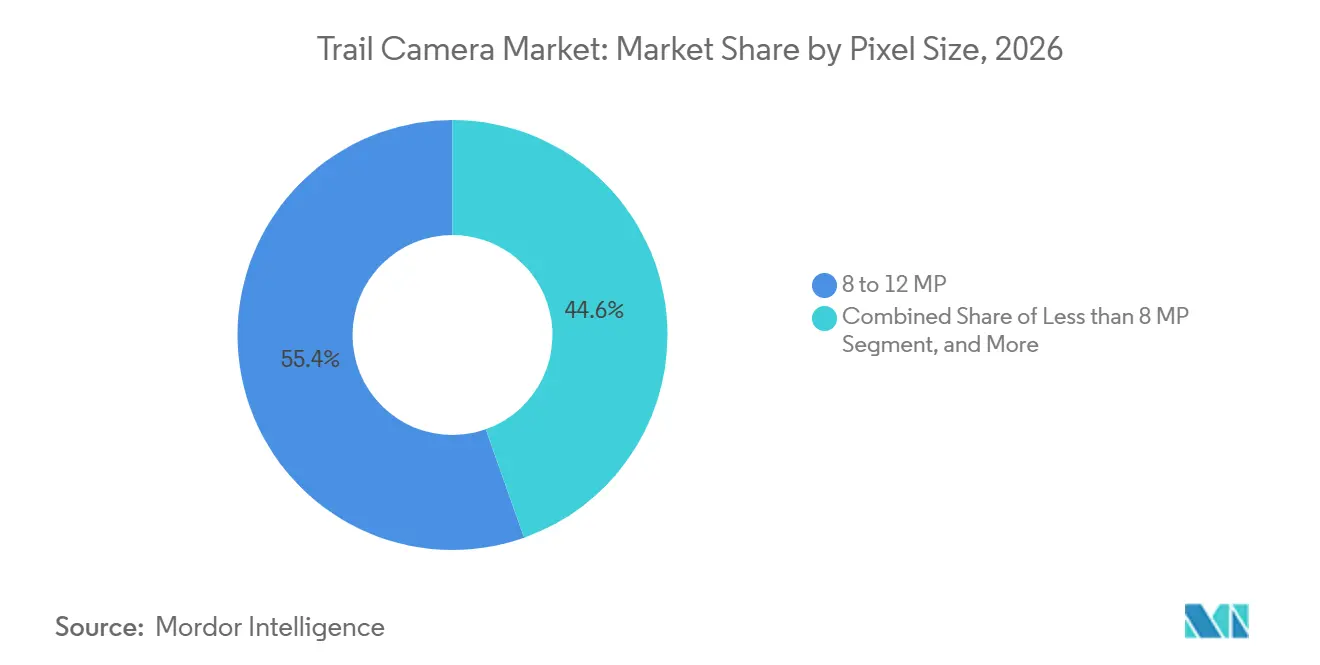
The 8-12 MP category held 55.41% share of the trail camera market size by pixel tier in 2026. This range provides sufficient clarity for many wildlife and property monitoring uses without creating excessive data transmission costs. It also aligns with the practical limits of battery-powered cellular devices. Below 8 MP cameras are projected to expand at a 9.80% CAGR through 2032. Lower-resolution images use less data per transmission and can extend operating time between battery changes. These benefits matter when cameras send frequent images from remote locations.
A 2025 Scientific Reports study found that a two-stage deep-learning framework achieved a 96.2% F1-Score for wildlife detection from camera trap images. The finding supports the use of lower-resolution images where AI-assisted detection, rather than detailed documentation, is the main purpose. Higher-resolution products still serve professional uses that require detailed video or evidence capture. The high-end tier remains associated with research-grade documentation and premium buyers who prioritize image quality. Pixel decisions also influence the cost of cellular data plans, storage requirements, and power consumption. Manufacturers must therefore match sensor resolution to the intended frequency and purpose of image transmission. The Trail camera market benefits from this mix because buyers can select lower-cost functional devices or advanced documentation equipment. Resolution alone no longer defines product value when connected software can extract useful information from simpler images. For some users, a less detailed image that arrives quickly and triggers a useful alert has greater practical value than a large file reviewed days later. Buyers also weigh storage needs and the reliability of image transfer when deciding which resolution tier to use. The resulting demand pattern allows mid-range sensors to remain relevant even as both lower-cost and premium options develop.
By Flash Type: Low-Glow Leads While No-Glow Gains Security Demand
Low-glow cameras held 44.78% of the trail camera market share by flash type in 2026. They balance usable nighttime images with limited visibility at common game-trail distances. This makes them suitable for many hunting and wildlife observation settings. No-glow cameras are projected to expand at a 9.70% CAGR through 2032. Their appeal is strongest in security and property surveillance, where a visible flash may reveal a camera's location. The shift also reflects institutional interest in reducing disturbance during wildlife monitoring.
Tactacam's REVEAL Ultra and REVEAL 4.0 series offer selectable low-glow and no-glow settings through application controls. This feature lets one hardware platform address both hunting and security users. White-flash products face limits in hunting because visible light can alert animals. They are also less attractive for security uses because they can disclose the camera position to people. Japanese municipal programs have introduced AI-supported wildlife detection systems for bear, deer, and wild boar monitoring, showing how low-disturbance observation is becoming more important. Flash selection is therefore tied closely to the deployment purpose, not simply to image brightness. Suppliers that provide selectable modes can reduce the need to develop separate products for each end use. This gives users more flexibility when a property is used for hunting during one season and security monitoring at another time. It may also simplify inventory planning for retailers and distributors. The distinction between flash categories will nonetheless remain important because the operating requirements of covert monitoring and wildlife photography are different.
By Application: Wildlife Monitoring Leads While Security Expands Faster
Wildlife monitoring and research accounted for 59.96% of the trail camera market size by application in 2026. Government agencies, universities, and nongovernmental organizations support this demand through multiyear project funding. These buyers value reliable field operation, standardized data, and the ability to review images remotely. Security and property surveillance is projected to expand at a 9.30% CAGR through 2032. It uses connected cameras as an alternative to conventional CCTV at locations without fixed power or wired internet. Farms, rural homes, and isolated facilities are key settings for this application.
Hunting and game management still provides a substantial installed base, but participation has not repeated the temporary surge seen during the pandemic. U.S. Fish and Wildlife Service information for the 2025-26 hunting seasons shows participation remained broadly steady. Forestry and environmental monitoring are also gaining relevance, where wildlife records can support carbon-credit verification. Agriculture and farm monitoring extend the customer base beyond traditional recreational use. Scenic capturing adds a separate demand stream for users interested in wildlife photography and nature content. The Trail camera market is becoming less dependent on hunting cycles as organizations use cameras for security, research, and land management. This diversification gives suppliers room to develop specialized software, alerts, and service plans around the same core hardware. Wildlife users may prioritize species identification and research data, while security users may need alerts that distinguish people from animals. Land managers can value dependable evidence of activity over high-resolution media. Suppliers that can adapt the software experience to these needs may increase the value of a camera without changing the basic hardware platform.
Geography Analysis
North America held 28.14% of the trail camera market share in 2026. The region benefits from a large outdoor recreation base, established retail channels, and broad use by state and federal wildlife agencies. The Outdoor Industry Association reported 183.2 million U.S. outdoor recreation participants in 2025. The Bureau of Economic Analysis recorded USD 16.5 billion in value added from hunting, shooting, and trapping during 2024. Canada adds demand through wildlife management across large forest regions. The region is also central to subscription competition as Tactacam, SPYPOINT, and Reconyx connect device sales with ongoing services.
Asia-Pacific is projected to expand at a 9.20% CAGR through 2032. Government biodiversity programs, human-wildlife conflict, and cost-competitive manufacturing support demand across the region. Japanese companies have introduced AI-supported systems for municipal bear detection, addressing a local public-safety need. China combines its position as a major manufacturing base with a growing domestic user base for cellular and solar-hybrid devices. Rural broadband and smart-agriculture programs support the use of connected products in selected areas. India uses cameras through Project Tiger and state programs that cover tiger corridor landscapes. The trail camera market size in Asia-Pacific is nevertheless constrained by uneven rural cellular coverage and power limitations.
Europe has a distinct regulatory setting that affects product placement and data practices. The United Kingdom, Germany, France, and Italy are major regional locations for wildlife research, forestry monitoring, and rural security use. The UK Upper Tribunal confirmed in 2025 that the processing of personal data through camera observation could fall within the scope of data protection law. Clearer deployment practices are important when cameras may capture identifiable individuals. South America and the Middle East and Africa offer longer-term opportunities as monitoring programs and connectivity develop. Colombia's Red Otus network reached 446 cameras in 2025, while anti-poaching programs in Sub-Saharan Africa are building institutional demand.
Competitive Landscape
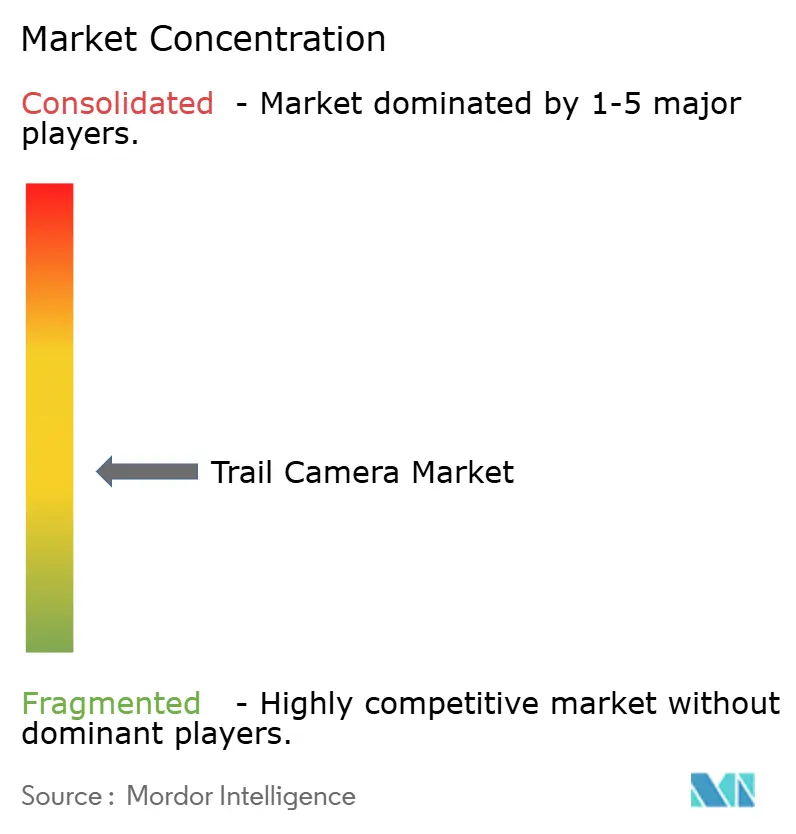
The trail camera market is moderately fragmented, with North American specialists competing on performance, application quality, subscription depth, and brand recognition. Tactacam, SPYPOINT, and Reconyx are prominent in premium connected products, while Chinese OEM suppliers compete strongly in entry-level and standard formats. Hardware pricing alone is becoming less decisive when a supplier can provide dependable connectivity and useful software. The trail camera market increasingly rewards product systems that combine physical equipment, service plans, and simple image management. Subscription plans can improve retention because users accumulate camera settings, image histories, and workflows in one application. This creates a difference between companies that sell devices and companies that manage continuing monitoring services. In the trail camera market, this distinction can affect customer retention as much as camera specifications do. At the same time, private-label offerings remain a material source of pressure in basic products.
VOSKER acquired Reconeyez in February 2026 and secured USD 200 million in senior debt financing to extend into enterprise autonomous surveillance. The acquired platform serves enterprises and government agencies in more than 60 countries. SPYPOINT introduced satellite backup through the FLEX-RANGE as a response to intermittent coverage. Tactacam added dual sensors, 4K capability, GPS, and automated carrier selection with its REVEAL 4.0 line. These moves show that remote connectivity, power efficiency, and image processing remain central areas of product development. They also indicate that suppliers are seeking to serve security and institutional buyers in addition to hunters.
Patent activity is concentrated in cellular transmission efficiency, on-device species identification, and solar power management. These areas align with the connected and AI-assisted formats that are expected to expand faster than basic camera types. Boly Media Communications and Ltl Acorn compete on price per megapixel and unit volume through proprietary and private-label supply. The clearest opening for new competitors is managed monitoring as a service, where hardware comes with AI-processed alerts and reporting. Such services could help organizations manage large camera networks without reviewing every image manually. Adoption will depend on whether service pricing becomes accessible for smaller users.
Trail Camera Industry Leaders
-
Vista Outdoor Operations LLC
-
GSM Outdoors, LLC
-
Spartan Camera, Inc.
-
Reconyx, Inc.
-
PRADCO Outdoor Brands, LLC
- *Disclaimer: Major Players sorted in no particular order
Recent Industry Developments
- July 2026: Tactacam launched the REVEAL 4.0 cellular trail camera series, REVEAL Pro 4.0, REVEAL X 4.0, and REVEAL Pro 4.0 Solar, alongside five accessories including the FlexPack rechargeable power system. The 4.0 series introduced dual image sensors, simultaneous photo and video capture, automatic strongest-carrier selection, and claimed doubled battery life versus the prior generation. The company reported more than 2 million REVEAL cameras in active global operation.
- June 2026: SPYPOINT released the FLEX-M2 cellular trail camera globally with dual-SIM automatic carrier selection, 32 MP photos, and 1080p video. It was also offered in a solar bundle and positioned as an entry point into the SPYPOINT cellular subscription ecosystem.
- June 2026: SOREST began commercial shipment of MIRAI-X KUMA, a video AI bear detection system trained on Japanese footage of Asiatic black bears and brown bears. The system was designed for municipal use in rural communities facing human-wildlife conflict.
- April 2026: Australian Wildlife Conservancy deployed 10 SmartCams at the Curramore sanctuary. The deployment combined 4G image upload with the AWC135 AI model for real-time species classification and staff alerts within minutes of detection.
Global Trail Camera Market Report Scope
The trail Camera Market refers to the market for specialized remote cameras designed to capture photographs and videos of wildlife, animals, and outdoor activities, typically using motion sensors, infrared or low-glow illumination, and automatic image or video recording capabilities. The market includes standard trail cameras, cellular trail cameras, non-cellular trail cameras, Wi-Fi-enabled trail cameras, and cellular and satellite hybrid trail cameras, along with associated hardware, connectivity technologies, software, and services. These cameras are used for wildlife monitoring, hunting and scouting, ecological research, forestry management, property surveillance, and outdoor security. Trail cameras transmit or store captured images and videos through cellular networks, Wi-Fi, satellite connectivity, or local storage, depending on their configuration, enabling users to monitor remote locations with minimal human intervention.
The trail Camera Market Report is Segmented by Connectivity (Cellular Trail Cameras, Non-Cellular Trail Cameras, Cellular and Satellite Hybrid Trail Cameras, Wi-Fi-Enabled Trail Cameras), Product Type (Standard Trail Cameras, Wireless Trail Cameras, Smart Trail Cameras, Solar-Powered Trail Cameras), Pixel Size (Less than 8 MP, 8 MP to 12 MP, 12 MP to 16 MP, Above 16 MP), Flash Type (White Flash, Low Glow, No Glow), Application (Wildlife Monitoring and Research, Hunting and Game Management, Security and Property Surveillance, Forestry and Environmental Monitoring, Agriculture and Farm Monitoring, Scenic Capturing and Nature Content Creation), and Geography (North America, Europe, Asia-Pacific, South America, Middle East and Africa). The Market Forecasts are Provided in Terms of Value (USD).
| Cellular Trail Cameras |
| Non-Cellular Trail Cameras |
| Cellular and Satellite Hybrid Trail Cameras |
| Wi-Fi-Enabled Trail Cameras |
| Standard Trail Cameras |
| Wireless Trail Cameras |
| Smart Trail Cameras |
| Solar-Powered Trail Cameras |
| Less than 8 MP |
| 8 MP to 12 MP |
| 12 MP to 16 MP |
| Above 16 MP |
| White Flash |
| Low Glow |
| No Glow |
| Wildlife Monitoring and Research |
| Hunting and Game Management |
| Security and Property Surveillance |
| Forestry and Environmental Monitoring |
| Agriculture and Farm Monitoring |
| Scenic Capturing and Nature Content Creation |
| North America | United States |
| Canada | |
| Mexico | |
| Europe | Germany |
| United Kingdom | |
| France | |
| Italy | |
| Rest of Europe | |
| Asia-Pacific | China |
| India | |
| Japan | |
| South Korea | |
| Rest of Asia-Pacific | |
| South America | |
| Middle East and Africa |
| By Connectivity | Cellular Trail Cameras | |
| Non-Cellular Trail Cameras | ||
| Cellular and Satellite Hybrid Trail Cameras | ||
| Wi-Fi-Enabled Trail Cameras | ||
| By Product Type | Standard Trail Cameras | |
| Wireless Trail Cameras | ||
| Smart Trail Cameras | ||
| Solar-Powered Trail Cameras | ||
| By Pixel Size | Less than 8 MP | |
| 8 MP to 12 MP | ||
| 12 MP to 16 MP | ||
| Above 16 MP | ||
| By Flash Type | White Flash | |
| Low Glow | ||
| No Glow | ||
| By Application | Wildlife Monitoring and Research | |
| Hunting and Game Management | ||
| Security and Property Surveillance | ||
| Forestry and Environmental Monitoring | ||
| Agriculture and Farm Monitoring | ||
| Scenic Capturing and Nature Content Creation | ||
| By Geography | North America | United States |
| Canada | ||
| Mexico | ||
| Europe | Germany | |
| United Kingdom | ||
| France | ||
| Italy | ||
| Rest of Europe | ||
| Asia-Pacific | China | |
| India | ||
| Japan | ||
| South Korea | ||
| Rest of Asia-Pacific | ||
| South America | ||
| Middle East and Africa | ||
Key Questions Answered in the Report
What is the trail camera market size?
The trail camera market was valued at USD 146.64 million in 2026 and is estimated to reach USD 232.63 million by 2032 at an 8.10% CAGR. Its expansion reflects wider use in environmental monitoring and off-grid security, alongside its established role in hunting and wildlife observation. Connected hardware can also support recurring service revenue through cellular data plans and related applications.
Which connectivity type leads trail camera sales?
Cellular cameras led connectivity with a 37.82% share in 2026, supported by demand for remote image delivery. The format helps users manage dispersed devices without collecting SD cards, and it supports recurring data-plan services. Battery endurance and available coverage remain important operating considerations for buyers. Cellular and satellite hybrid products are projected to expand faster, at a 10.20% CAGR through 2032.
Which product type is projected to expand fastest?
Wireless cameras are projected to expand at a 9.90% CAGR through 2032, as more users seek immediate mobile access to images. Standard cameras still accounted for 58.63% share in 2026, which shows that lower-cost products remain important for buyers who do not require constant connection. This keeps the category relevant for recreational users and locations with limited mobile service.
What application accounts for the largest trail camera demand?
Wildlife monitoring and research held 59.96% share in 2026, supported by government and conservation programs. These users value durable devices, remote image access, and consistent field operation. Security and property surveillance is projected to expand faster at a 9.30% CAGR through 2032. Rural properties without fixed power or wired broadband are a key use case.
Why are no-glow cameras becoming more important?
No-glow cameras are expected to expand at a 9.70% CAGR through 2032 because security users value covert operation. Low-glow models remained the largest flash format with 44.78% share in 2026, as they balance limited visibility with useful nighttime images for wildlife observation. Selectable flash settings can help suppliers address hunting and security needs with one camera platform.
Which region is expected to expand fastest?
Asia-Pacific is projected to expand at a 9.20% CAGR through 2032, supported by biodiversity programs and local manufacturing. The region's Trail camera market is also shaped by human-wildlife conflict and municipal detection programs, although uneven rural coverage can limit cellular deployment. North America remained the largest region with a 28.14% share in 2026. Its strong retail network and outdoor recreation base continue to support established demand.