
Tow Prepreg Market Size and Share
Market Overview
| Study Period | 2021 - 2031 |
|---|---|
| Market Size (2026) | USD 495.69 Million |
| Market Size (2031) | USD 775.01 Million |
| Growth Rate (2026 - 2031) | 9.35 % |
| Fastest Growing Market | Asia-Pacific |
| Largest Market | North America |
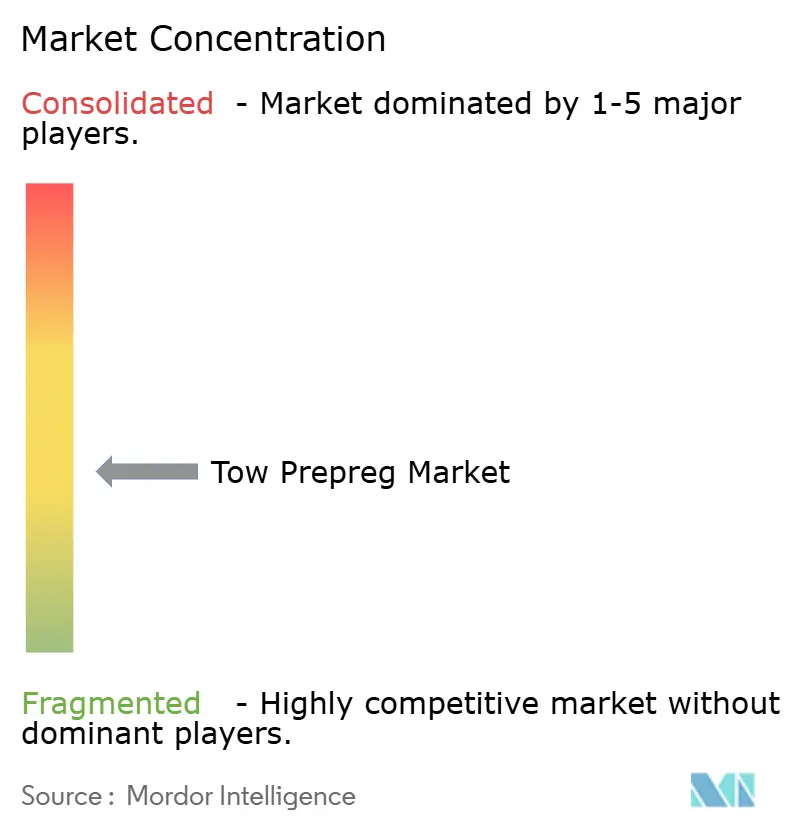
| Market Concentration | Medium |
Major Players *Disclaimer: Major Players sorted in no particular order Image © Mordor Intelligence. Reuse requires attribution under CC BY 4.0. | |
Tow Prepreg Market Analysis by Mordor Intelligence
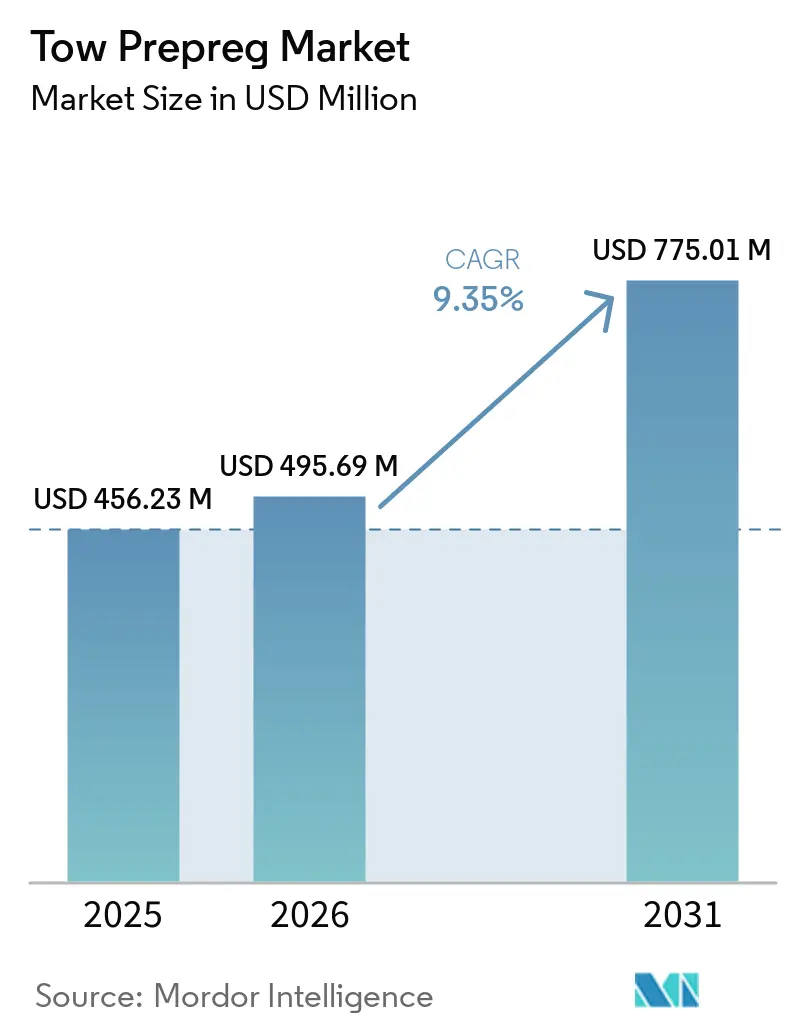
The Tow prepreg market size was valued at USD 456.23 million in 2025 and is estimated to grow from USD 495.69 million in 2026 to USD 775.01 million by 2031, at a CAGR of 9.35% during the forecast period (2026-2031). Growth is driven by the wider use of Type IV and Type V composite pressure vessels for hydrogen and compressed-gas storage, where continuous reinforcement is central to vessel design. It is also supported by the increasing use of composite materials in commercial aircraft and military platforms that require low weight and controlled structural performance. Tow prepreg applies resin uniformly across continuous fibers, eliminating the bath-impregnation step required in wet winding operations. This supports more consistent fiber-to-resin ratios in filament winding and automated fiber placement, particularly for cylindrical parts and complex load-bearing structures.
Key Report Takeaways
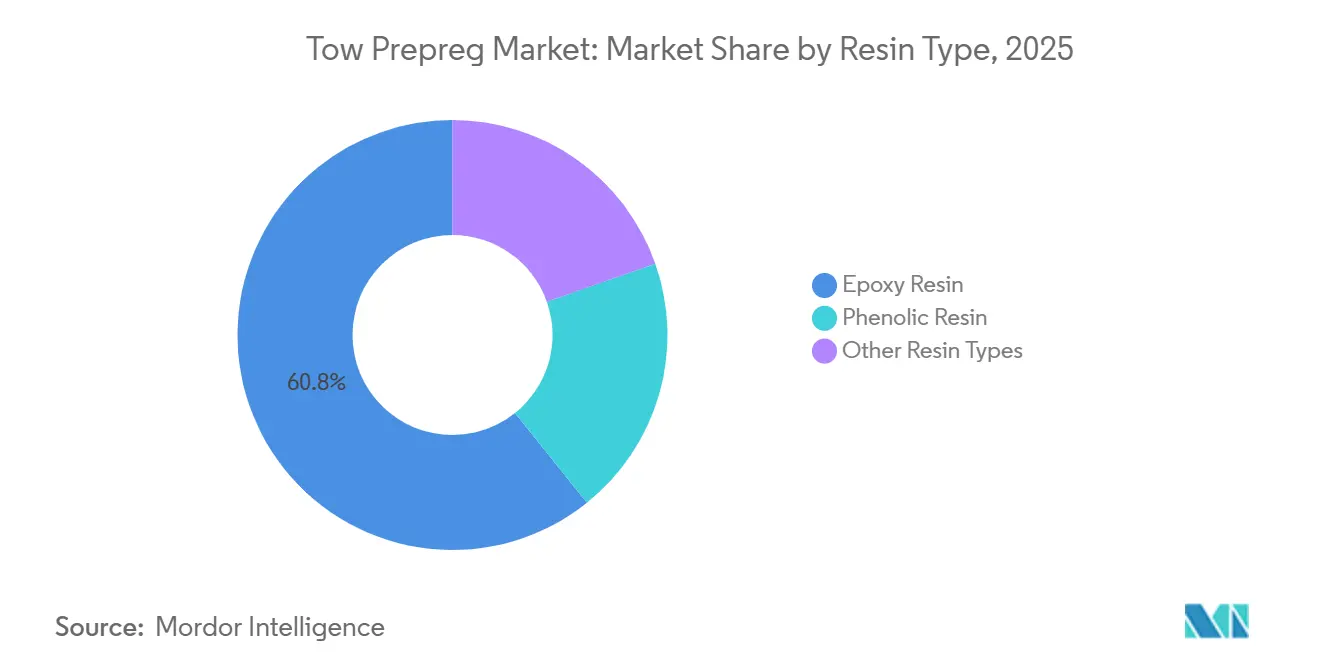
- By resin type, epoxy resin held 60.76% of the Tow prepreg market share in 2025 and is forecast to grow at a CAGR of 9.85% through 2031.
- By fiber type, carbon fiber held 76.03% of the Tow prepreg market share in 2025, while glass fiber is forecast to grow at a CAGR of 9.92% through 2031.
- By application, pressure vessels accounted for 38.47% of the Tow prepreg market size in 2025 and are forecast to grow at a CAGR of 10.34% through 2031.
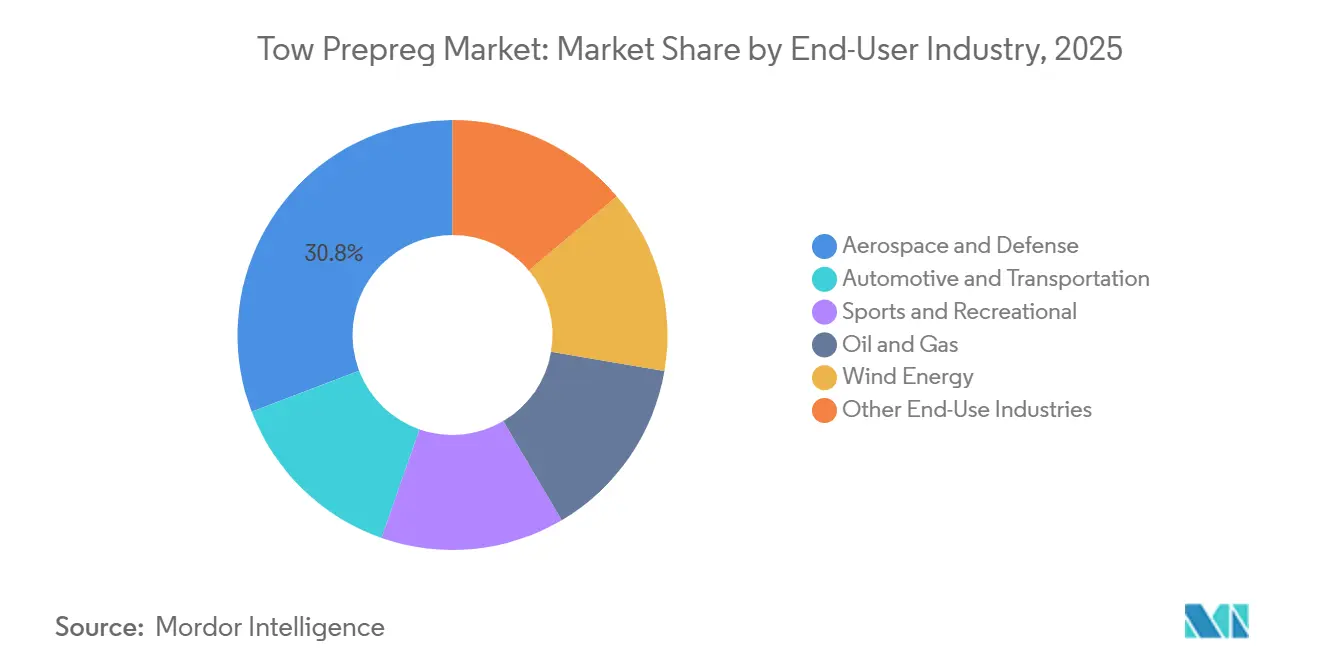
- By end-user industry, aerospace and defense accounted for 30.81% of the Tow prepreg market share in 2025 and is forecast to grow at a CAGR of 10.76% through 2031.
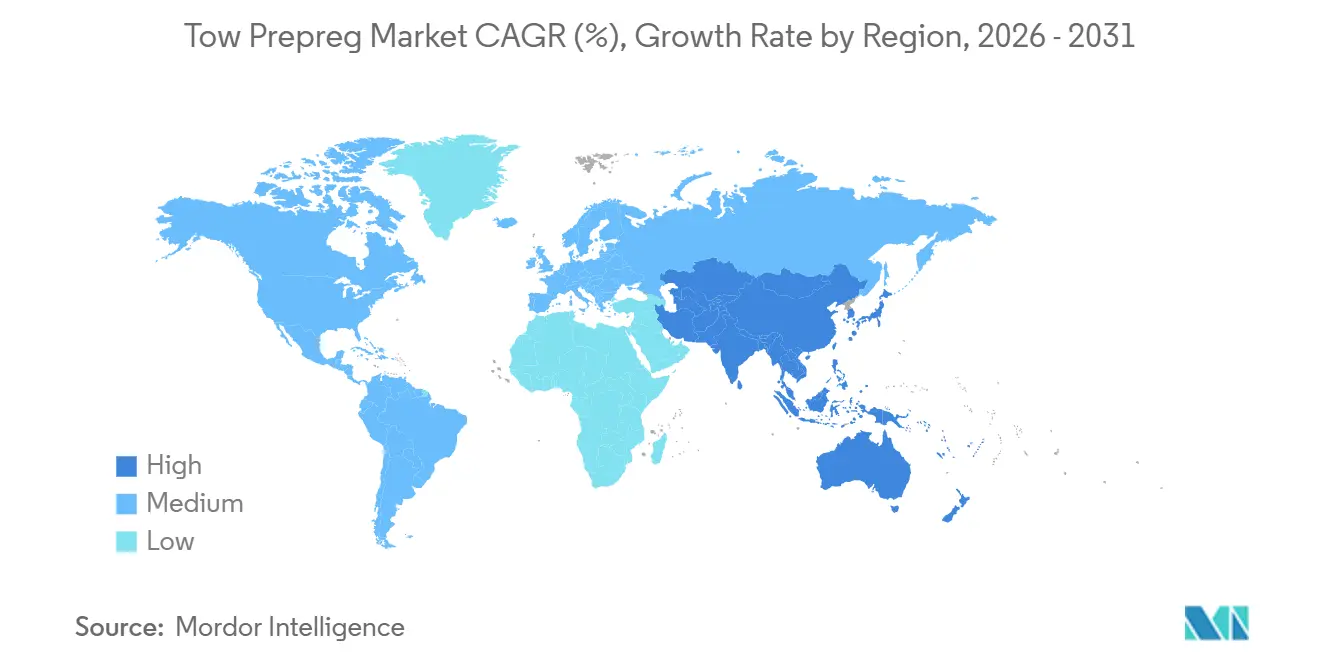
- By geography, North America held 33.22% of revenue in 2025, and Asia-Pacific is projected to grow at a 10.02% CAGR through 2031.
Note: Market size and forecast figures in this report are generated using Mordor Intelligence’s proprietary estimation framework, updated with the latest available data and insights as of January 2026.
Global Tow Prepreg Market Trends and Insights
Drivers Impact Analysis*
| Drivers | (~) % Impact on CAGR Forecast | Geographic Relevance | Impact Timeline |
|---|---|---|---|
| Demand for Lightweight and High-Strength Composite Structures | +2.2% | Global, concentrated in North America and Europe | Medium term (2-4 years) |
| Expansion of Hydrogen and Compressed-Gas Storage Vessels | +2.0% | APAC core, China, Japan, and South Korea, with spillover to North America and Europe | Medium term (2-4 years) |
| Adoption of Automated Fiber Placement and Filament Winding | +1.5% | North America, Germany, France, and Japan | Long term (≥ 4 years) |
| Aerospace, Defense and Advanced Air Mobility Production | +2.5% | North America and Europe, with early gains in Japan and India | Medium term (2-4 years) |
| Wind Energy and Renewable Infrastructure Deployment | +1.0% | Europe, APAC, and USA | Short term (≤ 2 years) |
| Source: Mordor Intelligence | |||
Demand for Lightweight and High-Strength Composite Structures
The need to reduce structural weight continues to expand the use cases for the tow prepreg market across mobility and industrial applications. Tow prepreg is suited to cylindrical and geodesic parts, including vessels, shafts, and spars, where uninterrupted fibers are important for load-bearing performance. It is distinct from sheet prepreg, which is more commonly used for flat or lightly curved surfaces. A 2025 study of Type IV hydrogen vessels reported a 15.4% mass reduction and 17% higher gravimetric hydrogen storage efficiency for optimized dry tow prepreg winding compared to wet winding. The same research reported that optimized winding parameters can improve the balance among weight, strength, and usable hydrogen storage performance. The resulting uniform reinforcement can improve vessel performance without reliance on a wet resin bath. The Boeing 787 and Airbus A350 programs use fiber content above 50% in primary structures, thereby supporting demand for composite parts such as overwrapped fittings and drive shafts[1]Hexcel Corporation, “JEC World 2026: Hexcel to Unveil Breakthrough Composite Solutions for Aerospace, Defense and Automotive Markets,” Hexcel..
Expansion of Hydrogen and Compressed-Gas Storage Vessels
Pressure vessels represent the largest application segment and the fastest-growing application in the tow prepreg market. Type IV polymer-lined cylinders and emerging Type V linerless vessels are used in fuel cell vehicles, heavy-duty trucks, and stationary hydrogen infrastructure. These vessel formats require repeatable fiber placement, controlled resin distribution, and reliable winding quality during manufacture. Their growing use places material consistency alongside pressure performance as key criteria in supplier selection. Research at IVW Kaiserslautern has examined material-efficient and cycle-time-optimized industrial production of hydrogen pressure tanks. Procurement requirements are therefore centered on consistent qualification data for pressure-vessel materials, production methods, and finished parts.
Adoption of Automated Fiber Placement and Filament Winding
Automated fiber placement and filament winding increasingly use the same prepreg as a common feedstock in composite manufacturing. A 2025 TANIQ system combined filament winding and automated fiber placement through a single design and simulation environment, enabling manufacturers to use winding speed and placement precision within the same equipment platform. A 2025 cost study found that automated fiber placement of composite pressure vessels costs at least 1.77× as much as filament winding. This difference makes automated fiber placement more applicable to high-value aerostructures and specialized defense components than to high-volume cylindrical parts. The cost difference is principally associated with slit tow prepreg materials, which limits early adoption to applications with higher performance requirements. Hexcel introduced a hot-melt thermoset towpreg range in March 2026 for filament winding, using fast-cure and high-temperature resin systems. The range also supports carbon sleeves for high-performance electric motors, extending the set of potential industrial applications.
Aerospace, Defense, and Advanced Air Mobility Production
Aerospace and defense provide the tow prepreg market with demand from commercial aviation, defense procurement, and advanced air mobility programs. Commercial aviation programs represent an established source of composite demand, while defense procurement supports specialized materials and components. Advanced air mobility programs create additional demand for composite-intensive airframes and rotor components as aircraft designs move toward production. Japan selected Maruhachi for a Space Strategy Fund program in July 2025 to develop CFRP tanks for liquid-hydrogen rocket propulsion. The program covers 0.5 m and 2.0 m tank diameters and plans demonstration testing through 2029, broadening the relevant use of CFRP tank materials into space-launch applications.
Restraints Impact Analysis*
| Restraints | (~) % Impact on CAGR Forecast | Geographic Relevance | Impact Timeline |
|---|---|---|---|
| High Carbon Fiber and Processing Costs | -1.8% | Global, with a stronger effect in cost-sensitive emerging markets | Medium term (2-4 years) |
| Controlled Storage and Resin Shelf-Life Requirements | -1.2% | Global, with heightened impact in the Middle East, Africa, and South America | Short term (≤ 2 years) |
| Specialized Equipment and Skilled Labor Requirements | -0.8% | Developing APAC economies, the Middle East, and Africa | Long term (≥ 4 years) |
| Source: Mordor Intelligence | |||
High Carbon Fiber and Processing Costs
Carbon fiber represents the largest cost component in tow prepreg production, limiting its adoption in cost-sensitive applications such as industrial pressure vessels and mid-tier sporting goods. A 2025 study found that the cost of automated fiber placement pressure vessels was at least 1.77× that of filament winding. Higher resin content relative to dry fiber also increases delivered cost before processing begins. This can weaken per-unit economics for high-volume vessel production compared with wet winding at higher run rates, particularly where product performance does not justify a premium process route. Independent converters without integrated fiber supply face greater margin exposure during periods of material tightness. Specialized equipment requirements and the need for trained labor further compound this challenge in developing economies across APAC, the Middle East, and Africa.
Controlled Storage and Resin Shelf-Life Requirements
Thermoset tow prepregs require controlled cold storage, and resin working life limits the time available for processing. A 2024 aerospace study found that storage conditions affected the working life of out-of-autoclave epoxy prepreg. Reduced tack can disrupt automated layup, as fiber-placement systems depend on consistent adhesion during placement, which is necessary for repeatable manufacturing. Cold-chain construction and operation add capital and operating costs for geographically dispersed manufacturers. Materials approaching their allowable out-time may also be discarded, increasing effective material costs and inventory risk. Research on vitrimer composites has examined approaches that could improve recyclability and thermal behavior; however, as of 2026, ambient-stable systems remain pre-commercial.
*Our forecasts treat driver/restraint impacts as directional, not additive. The impact forecasts reflect baseline growth, mix effects, and variable interactions.
Segment Analysis
By Resin Type: Epoxy Systems Lead Across Processing Routes
Epoxy resin held 60.76% of the tow prepreg market share by resin type in 2025. This position reflects decades of qualification experience in aerospace, pressure vessels, and wind energy, where validated processing behavior is important. Epoxy supports autoclave cure at 120°C to 180°C and fast-cure out-of-autoclave systems. This range allows manufacturers to select cure routes based on part geometry, throughput needs, and available equipment, and it supports use across multiple winding and placement routes. Hexcel's March 2026 Towpreg range uses fast-cure, high-temperature thermoset resin systems for filament winding.
The epoxy portion of the tow prepreg market is forecast to grow at a 9.85% CAGR from 2026 to 2031. Its lead in both share and growth indicates that alternative resin chemistries are not expected to gain meaningful ground at current price-performance levels. This keeps formulation, curing behavior, and qualification experience centered on epoxy-based systems. Phenolic resin remains relevant for aircraft interior parts that must meet Federal Aviation Regulations (FAR) 25 smoke and toxicity requirements. However, its compatibility with automated winding is less favorable than epoxy's, and it requires higher processing temperatures. Other resins serve high-temperature and specialty applications where their distinct thermal characteristics are needed. These narrower applications are not expected to change the resin mix during the forecast period materially.



By Fiber Type: Carbon Fiber Leads, While Glass Fiber Expands
Carbon fiber held 76.03% of the tow prepreg market share by fiber type in 2025. Aerospace structures and high-pressure hydrogen vessels rely on their strength and stiffness in load-critical designs. These performance requirements limit substitution by glass or aramid in structures designed for demanding pressure or load conditions. Carbon fiber use is therefore closely associated with applications where weight reduction and mechanical performance must be achieved together. Toray Carbon Fibers Europe started up a new production facility in 2026, raising European annual carbon fiber capacity to 6,000 tons for Airbus A350 and A320neo supply chains.
Glass fiber is the fastest-growing fiber type, with a projected 9.92% CAGR from 2026 to 2031. Offshore wind blade programs support this growth, as long blades require fatigue-resistant spar-cap materials at competitive cost points. Glass fiber offers a cost-oriented option for structures that do not require carbon fiber across their entire length. Aramid and other fibers remain focused on impact protection, ballistic resistance, and hybrid constructions in sporting goods. Hybrid carbon-glass designs are gaining use in wind blades, where different zones have distinct load requirements. Glass prepreg demand remains concentrated in selected structural zones rather than across entire blades, leaving demand dependent on both blade geometry choices and installation figures.
By Application: Pressure Vessels Account for the Largest Application Share and Fastest Growth
Pressure vessels accounted for 38.47% of the tow prepreg market share by application in 2025. The segment is forecast to grow at a 10.34% CAGR through 2031, making it the fastest-growing application. Type IV and Type V hydrogen storage cylinders remain central to the use of tow prepreg materials, reflecting the need for continuous reinforcement of vessel shapes operating under high pressure. A 2025 study reported a tensile strength of 2,462 MPa and a shear strength of 64.4 MPa for an optimized 9-liter Type IV vessel fabricated via dry-tow prepreg filament winding.
Oxygen cylinders and scuba tanks are established applications that benefit from consistent fiber-to-resin ratios and reduced void content. Their expansion is below that of hydrogen vessels because their demand base is more mature. Drive shafts, aerospace structural tubes, and electric-motor carbon sleeves represent additional uses for tow prepreg, demonstrating that winding materials are relevant beyond gas containment. Hexcel has identified winding applications and electric-motor sleeves for its 2026 Towpreg range. ISO 11119-3 requirements for composite gas cylinders favor suppliers with established material-process records, and certification expectations make repeatable production data important for application-specific demand.
By End-User Industry: Aerospace and Defense Leads, Wind Energy Broadens Demand
Aerospace and defense held 30.81% of the tow prepreg market share by end-user industry in 2025 and is forecast to record the fastest end-user CAGR at 10.76% through 2031. Commercial aviation production, defense procurement, and electric vertical take-off and landing (eVTOL) airframe development support its demand base. These applications require composite materials for structural parts and specialized components that face demanding performance requirements. The industry's qualification history supports continued use of established material systems and qualified manufacturing routes.
Automotive and transportation demand is linked mainly to hydrogen fuel-cell tanks and composite drive shafts for electric platforms. Sports and recreational applications remain technically demanding but limited in scale. Wind energy drives demand for glass fiber tow prepreg in structural blade sections, providing a separate demand base from aerospace and high-pressure storage. Oil and gas, along with other end users, provide stable demand for industrial pressure vessels and rotating equipment components. The Maruhachi program illustrates the extension of carbon fiber reinforced polymer (CFRP) tank development into space propulsion, adding a specialized demand pathway beyond traditional industrial and aerospace applications.
Geography Analysis
North America held 33.22% of the tow prepreg market share in 2025, making it the largest regional segment. Demand is supported by Boeing composite aircraft programs, defense modernization, rotorcraft, unmanned systems, and specialized defense platforms. FAA qualification frameworks and AS9100 supplier standards favor suppliers with established domestic capabilities and prior aerospace experience. Canada contributes through compressed-gas vessel manufacturing, while Mexico contributes through automotive composites.
Asia-Pacific is forecast to grow at a 10.02% CAGR from 2026 to 2031, the fastest regional growth rate in the tow prepreg market. Demand across China, Japan, South Korea, and India is supported by hydrogen mobility, aerospace manufacturing, and defense investment. In July 2025, Japan's Space Strategy Fund selected Maruhachi to develop CFRP hydrogen fuel tanks for rockets. The program targets demonstration tests through 2029 and commercial realization in the early 2030s, indicating how hydrogen-storage materials can extend into space applications. South Korean Type IV tank certification activity and Chinese PAN-based carbon fiber capacity development also support regional procurement. India is developing its participation in eVTOL composite supply chains, while ASEAN remains largely focused on assembly activities.
Europe is the second-largest consuming region, led by Germany, France, and the Nordic countries, where Airbus supply chains and offshore wind blade manufacturing are core sources of demand. Germany's IVW Kaiserslautern is developing material-efficient, cycle-time-optimized production methods for hydrogen pressure tanks[2]Leibniz-Institut für Verbundwerkstoffe, “Materialeffiziente und taktzeitoptimierte Industrialisierung von H2-Drucktanks,” IVW Kaiserslautern.. This work supports Europe's position in process development and early adoption of advanced grades. South America remains an emerging market for tow prepreg. In contrast, the Middle East and Africa remain limited in scale, although hydrogen infrastructure projects could generate demand for pressure vessels in both regions at a later stage.

Competitive Landscape
The tow prepreg market is moderately fragmented. Toray Industries, Hexcel Corporation, SGL Carbon, Mitsubishi Chemical, Teijin Limited, and Syensqo form the leading supplier group. Vertical integration supports cost control, supply continuity, and consistent quality through the conversion process. It also makes it more difficult for independent converters to match established producers in qualified applications. A secondary group, including Gurit, Axiom Materials, TCR Composites, Red Composites, and Vitech Composites, competes by offering application customization and smaller-order fulfillment.
In March 2026, Hexcel launched its hot-melt thermoset towpreg range for filament winding and high-temperature applications, including high-performance electric-motor carbon sleeves and winding applications. Toray Carbon Fibers Europe commissioned a new facility in 2026, raising capacity to 6,000 tons per year to serve the Airbus A350 and A320neo supply chains. These developments link supply investment with aerospace programs, winding applications, and material availability, and reinforce the role of qualification in supplier strategies.
Software-supported winding and specialized vessel geometry are areas where suppliers can differentiate their offerings. TANIQ's 2025 hybrid system combines filament winding and automated fiber placement on a single platform. New suppliers face lengthy qualification requirements under aerospace and pressure-vessel standards. ISO 11119-3 and aerospace supplier certifications can extend entry timelines from months to years, favoring incumbents with established performance records.
Tow Prepreg Industry Leaders
Hexcel Corporation
Solvay
TEIJIN LIMITED
Mitsubishi Chemical Corporation
SGL Carbon
- *Disclaimer: Major Players sorted in no particular order

Recent Industry Developments
- August 2026: Magnolia Advanced Materials launched an advanced materials product suite for eVTOL manufacturers, including epoxy systems engineered for short cure times and composite-intensive airframe bonding applications. The product range is designed to support extended battery-powered range and faster production throughput, addressing the tow prepreg structural composite requirements of eVTOL airframes.
- July 2026: Sora Aviation signed a memorandum of understanding (MoU) with Toray Advanced Composites at Farnborough International Airshow 2026 to supply carbon fiber composite materials for the S-1 eVTOL's airframe and propeller blades, covering both primary and secondary structures. The S-1 is a 30-passenger, six-rotor electric aircraft and represents one of the most material-intensive eVTOL programs currently in development.


Global Tow Prepreg Market Report Scope
Tow prepreg is a continuous bundle of reinforcing fibers, such as carbon, glass, or aramid, pre-impregnated with a precise amount of partially cured resin (usually epoxy) and wound onto spools for automated or specialized manufacturing.
The tow prepreg market is segmented by resin type, fiber type, application, end-user industry, and geography. By resin type, the market is segmented into epoxy resin, phenolic resin, and other resin types. By fiber type, the market is segmented into carbon fiber, glass fiber, aramid fiber, and other fiber types. By application, the market is segmented into pressure vessels, oxygen cylinders, scuba tanks, and other applications. By end-user industry, the market is segmented into aerospace and defense, automotive and transportation, sports and recreational, oil and gas, wind energy, and other end-use industries. The report also covers market size and forecasts for tow prepreg across 15 countries in major regions. The market sizes and forecasts are provided in terms of value (USD).
| Epoxy Resin |
| Phenolic Resin |
| Other Resin Types |
| Carbon Fiber |
| Glass Fiber |
| Aramid Fiber |
| Other Fiber Types |
| Pressure Vessels |
| Oxygen Cylinders |
| Scuba Tanks |
| Other Applications |
| Aerospace and Defense |
| Automotive and Transportation |
| Sports and Recreational |
| Oil and Gas |
| Wind Energy |
| Other End-Use Industries |
| Asia-Pacific | China |
| India | |
| Japan | |
| South Korea | |
| ASEAN Countries | |
| Rest of Asia-Pacific | |
| North America | United States |
| Canada | |
| Mexico | |
| Europe | Germany |
| United Kingdom | |
| France | |
| Italy | |
| NORDIC Countries | |
| Rest of Europe | |
| South America | Brazil |
| Argentina | |
| Rest of South America | |
| Middle East and Africa | Saudi Arabia |
| South Africa | |
| Rest of Middle East and Africa |
| By Resin Type | Epoxy Resin | |
| Phenolic Resin | ||
| Other Resin Types | ||
| By Fiber Type | Carbon Fiber | |
| Glass Fiber | ||
| Aramid Fiber | ||
| Other Fiber Types | ||
| By Application | Pressure Vessels | |
| Oxygen Cylinders | ||
| Scuba Tanks | ||
| Other Applications | ||
| By End-User Industry | Aerospace and Defense | |
| Automotive and Transportation | ||
| Sports and Recreational | ||
| Oil and Gas | ||
| Wind Energy | ||
| Other End-Use Industries | ||
| By Geography | Asia-Pacific | China |
| India | ||
| Japan | ||
| South Korea | ||
| ASEAN Countries | ||
| Rest of Asia-Pacific | ||
| North America | United States | |
| Canada | ||
| Mexico | ||
| Europe | Germany | |
| United Kingdom | ||
| France | ||
| Italy | ||
| NORDIC Countries | ||
| Rest of Europe | ||
| South America | Brazil | |
| Argentina | ||
| Rest of South America | ||
| Middle East and Africa | Saudi Arabia | |
| South Africa | ||
| Rest of Middle East and Africa | ||


Key Questions Answered in the Report
What is current market size of Tow Prepreg Market?
The Tow prepreg market size was valued at USD 456.23 million in 2025 and is estimated to grow from USD 495.69 million in 2026 to USD 775.01 million by 2031, at a CAGR of 9.35% during the forecast period (2026-2031).
Which application leads to demand for tow prepreg?
Pressure vessels led with 38.47% share in 2025 and are forecast to grow at a 10.34% CAGR through 2031.
Why are hydrogen pressure vessels important for tow prepreg demand?
Type IV and Type V vessel production needs-controlled fiber placement and resin distribution for hydrogen and compressed-gas storage.
Which resin type has the largest role in tow prepreg production?
Epoxy held 60.76% share in 2025 and is forecast to grow at a 9.85% CAGR through 2031.
Page last updated on:





