
Tool Holder Market Size and Share
Market Overview
| Study Period | 2022 - 2032 |
|---|---|
| Market Size (2027) | USD 2.33 Billion |
| Market Size (2032) | USD 3.11 Billion |
| Growth Rate (2027 - 2032) | 5.93 % |
| Fastest Growing Market | Asia-Pacific |
| Largest Market | Asia-Pacific |
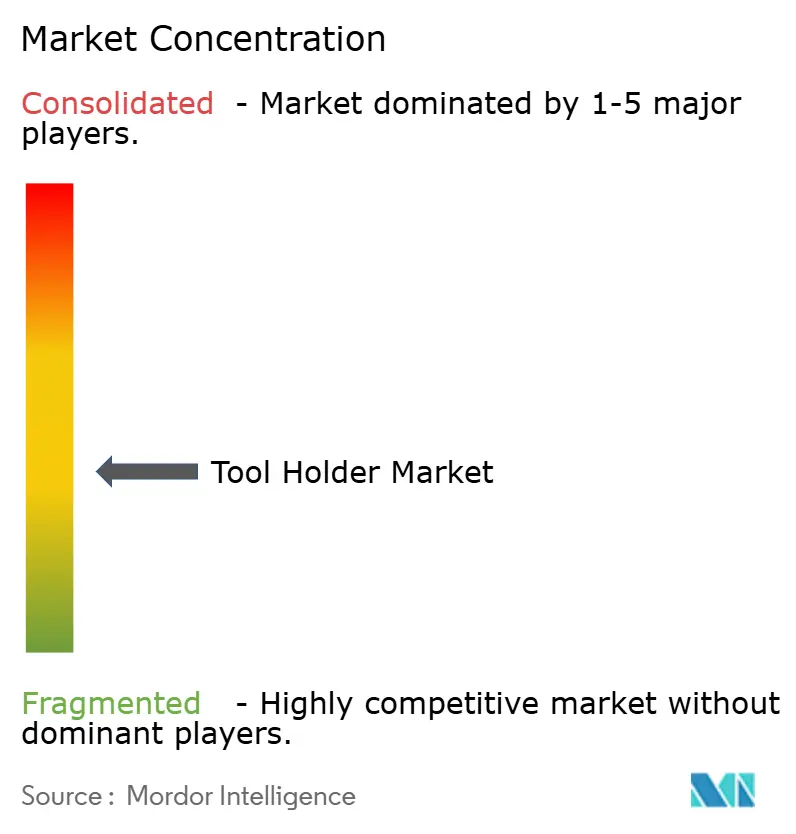
| Market Concentration | Medium |
Major Players *Disclaimer: Major Players sorted in no particular order Image © Mordor Intelligence. Reuse requires attribution under CC BY 4.0. | |
Tool Holder Market Analysis by Mordor Intelligence
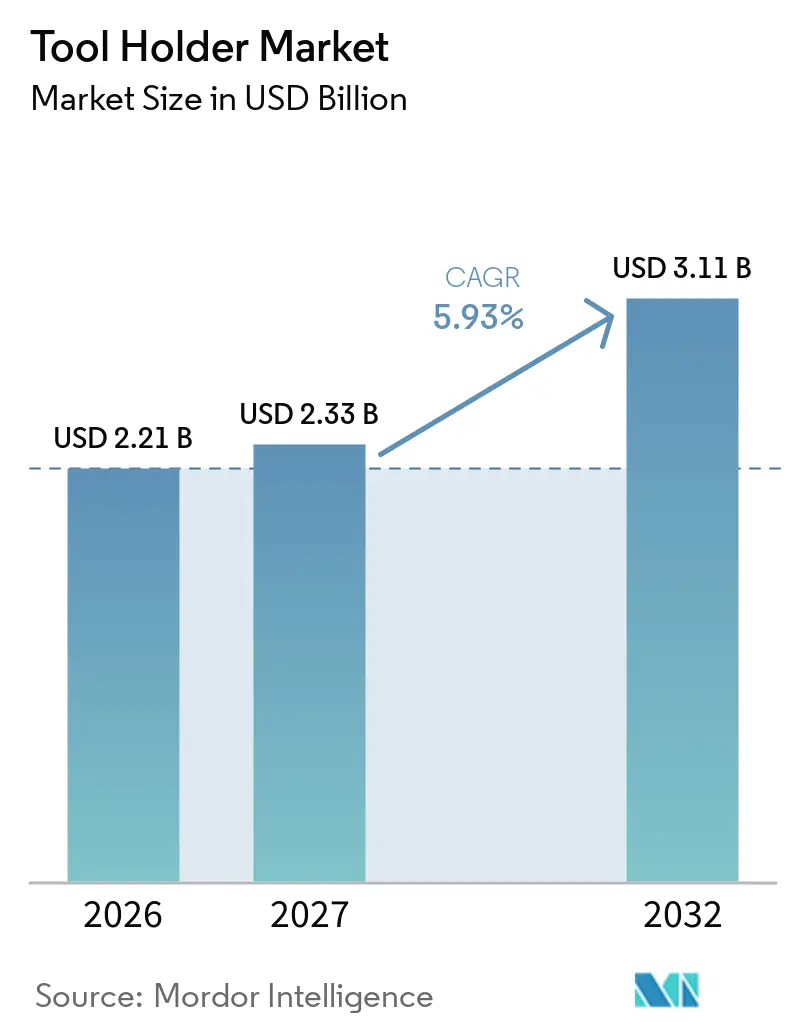
The Tool Holder Market size is projected to be USD 2.21 billion in 2026, USD 2.33 billion in 2027, and reach USD 3.11 billion by 2032, growing at a CAGR of 5.93% from 2027 to 2032. The global tool holder market is moving toward precision holders that support tighter runout control, repeatable surface finish, and higher spindle speeds. Automotive, aerospace, and electronics manufacturers are raising machining requirements, which favor shrink-fit and hydraulic designs over legacy collet and side-lock products. Suppliers are combining physical holders with digital tool data, monitoring, and presetting services to deepen customer relationships. The global tool holder market also faces pressure from raw-material availability, especially for tungsten carbide inputs, while durable holders limit replacement demand in established machining operations.[1]
Key Report Takeaways
- By product type, collet chuck holders held 21.5% of the global tool holder market share in 2026, while shrink-fit tool holders are projected to grow at a 6.8% CAGR through 2032.
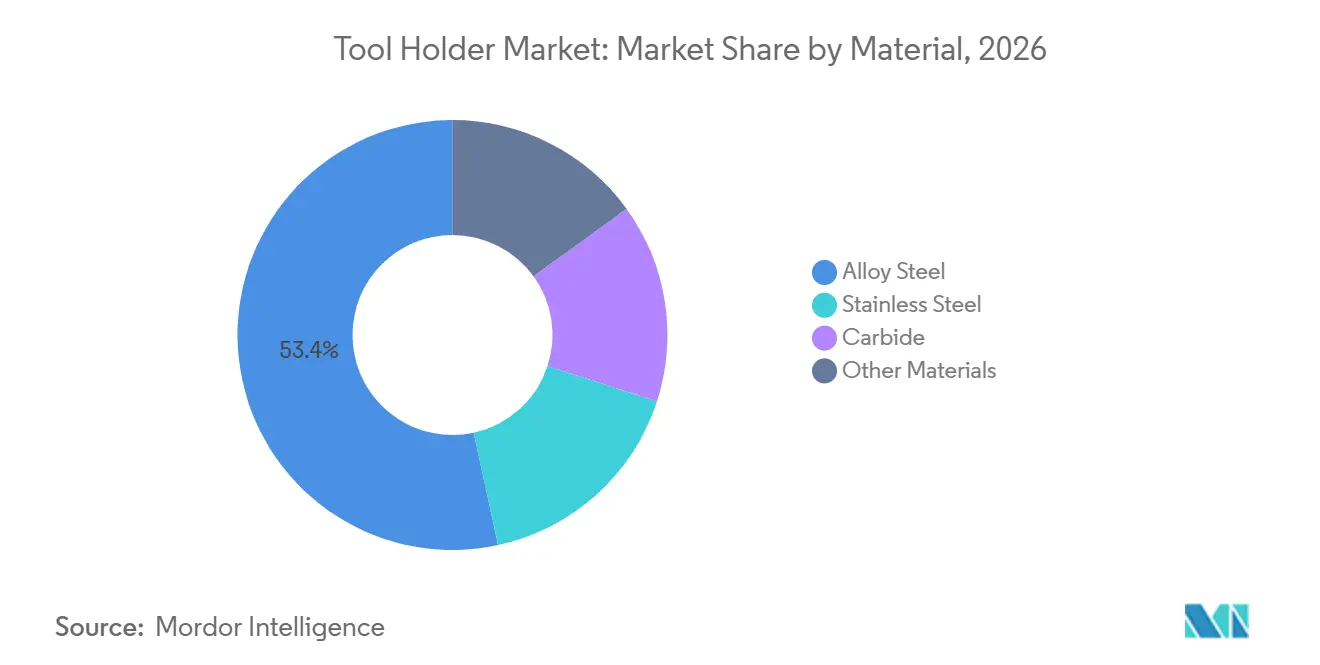
- By material, alloy steel held 53.4% of the global tool holder market share in 2026, while carbide body grades are projected to grow at a 6.6% CAGR through 2032.
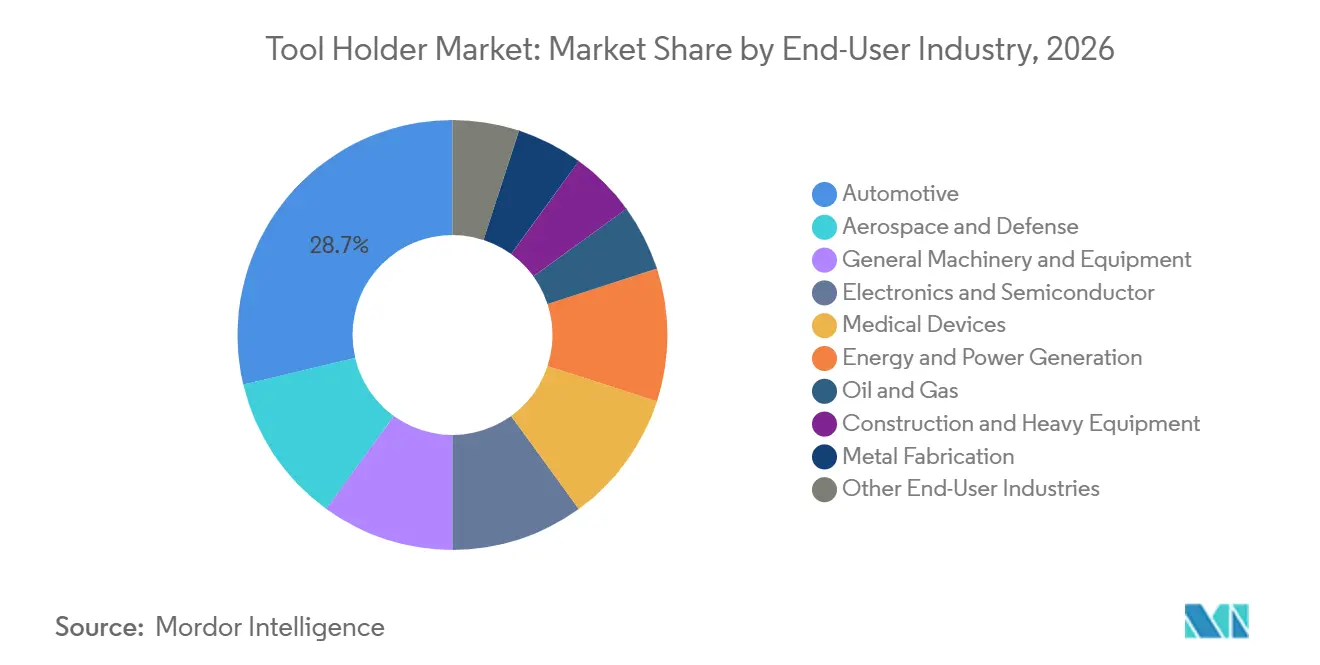
- By end-user industry, automotive held 28.7% of the global tool holder market share in 2026, while electronics and semiconductor manufacturing is projected to grow at a 7.2% CAGR through 2032.
- By geography, Asia-Pacific held 38.6% of the global tool holder market share in 2026 and is projected to grow at a 6.5% CAGR through 2032.
Note: Market numbers in this report are based on Mordor Intelligence's proprietary estimation framework, which combines nine months of actuals with Q4 projections for base year 2026.
Market Trends and Insights
Drivers Impact Analysis of Tool Holder Market*
| Driver | (~) % Impact on CAGR Forecast | Geographic Relevance | Impact Timeline |
|---|---|---|---|
| Expansion of CNC Machining in Automotive, Aerospace, and Electronics | +1.2% | Global, concentrated in China, Germany, Japan, and the United States | Medium term (2-4 years) |
| Rising Precision, Runout, and Surface-Finish Requirements | +0.9% | Global, strongest in Japan, Germany, and South Korea | Medium term (2-4 years) |
| Growth of High-Speed and Multi-Task Machining | +0.8% | North America, Europe, and Japan | Medium term (2-4 years) |
| Adoption of Industry 4.0 and Automated Manufacturing | +1.1% | Asia-Pacific core, North America, and the European Union, with spillover to the Middle East, Africa, and South America | Medium term (2-4 years) |
| Sensor-Enabled Tool Condition Monitoring | +0.7% | North America, the European Union, and Japan | Long term (≥ 4 years) |
| Replacement of Legacy Holders Through Modular and Quick-Change Systems | +0.6% | Global, with early adoption in Europe and North America | Short term (≤ 2 years) |
| Source: Mordor Intelligence | |||
Expansion of CNC Machining in Automotive, Aerospace, and Electronics
The global tool holder market benefits as automotive suppliers change the machining requirements for electric-vehicle components. Electric vehicles use fewer individually machined components than internal-combustion platforms, but rotor shafts, stator housing, and reducer gears require close concentricity and surface-finish control. These requirements support demand for shrink-fit and hydraulic expansion holders in applications where conventional mechanical clamping is less suitable. Aerospace machining also supports premium demand because titanium, composite, and nickel-superalloy work needs stable tool interfaces with low runout. MAPAL reported significant double-digit growth in aerospace tooling over 2024 and 2025, reflecting continued demand for high-precision aerospace machining.[2] Electronics equipment manufacturing adds demand for rigid holders used to machine semiconductor fabrication equipment, wafer-handling systems, and advanced hardware enclosures.
Adoption of Industry 4.0 and Automated Manufacturing
Automated machine cells are changing the role of tool holders from mechanical interfaces to sources of operating data. Fraunhofer IWU and Fraunhofer IIS presented a smartTOOL holder at EMO Hannover 2025 with force, vibration, and temperature sensing at the cutting point. The unit uses 25% less installation space than the earlier design and supports wireless sampling rates of up to 10 kHz.[3] These features help automated cells detect chatter, wear, and thermal changes during unattended production. The global tool holder market gains where manufacturers connect tool data to process-monitoring systems and use it to reduce scrap and interruptions. Smart holders also fit wider demand for predictive maintenance in automotive and electronics supply chains.[4]
Sensor-Enabled Tool Condition Monitoring
Sensor-enabled monitoring is becoming relevant to holder design because it can show machining instability before surface quality declines. SCHUNK’s iTENDO² hydraulic expansion holder places an acceleration sensor close to the workpiece and provides stability, spindle-condition, wear, and vibration information. A 2025 study described an adaptive condition-monitoring system that combined case-based reasoning and convolutional neural networks to identify tool wear before it affected surface quality. The global tool holder market can therefore extend beyond the sale of a holder into condition monitoring and lifecycle support. Suppliers with sensing products can support usage-based maintenance arrangements where customers value uptime and consistency. This direction is most relevant in high-value automated machining cells, where an unplanned failure can disrupt several linked operations.
Replacement of Legacy Holders Through Modular and Quick-Change Systems
Modular and quick-change systems are replacing older side-lock and straight-shank holders where setup time is a material production constraint. Eppinger Technologies launched its Quick-Lock BMT (Base Mount Turret) CNC lathe tool holder in September 2025 with automated precision clamping in under 4 seconds. The company stated that the self-locking system had been tested for more than 100,000 cycles and could be integrated with robots. Sandvik Coromant’s Coromant Capto platform supports quick tool changes in turning operations and reduces the need for spindle stops and recalibration. The global tool holder market gains from these systems when labor shortages and mixed production make repeatable changeovers more valuable. Standardized modular interfaces can also reduce training demands for newer operators. This makes quick-change tooling relevant in both mature production centers and developing CNC machining locations.
Restraints Impact Analysis of Tool Holder Market*
| Restraint | (~) % Impact on CAGR Forecast | Geographic Relevance | Impact Timeline |
|---|---|---|---|
| High Acquisition Cost of Premium Hydraulic and Shrink-Fit Holders | -0.8% | Global, most acute in price-sensitive markets of South and Southeast Asia and South America | Short term (≤ 2 years) |
| Standardized Interfaces Limiting Product Differentiation | -0.4% | Europe and North America, where standardization is most mature | Medium term (2-4 years) |
| Long Replacement Cycles for Durable Tool Holders | -0.5% | Global | Long term (≥ 4 years) |
| Thermal Expansion and Vibration Management at Extreme Spindle Speeds | -0.3% | Global, with acute needs in Asia-Pacific and European high-speed machining hubs | Long term (≥ 4 years) |
| Source: Mordor Intelligence | |||
High Acquisition Cost of Premium Hydraulic and Shrink-Fit Holders
Premium holder systems require a higher initial investment than basic mechanical products, which limits adoption among smaller machine shops. The cost includes the holder itself and, in shrink-fit applications, induction heating equipment and operating processes. BIG DAISHOWA notes that hydraulic holders contain an internal hydraulic mechanism, while shrink-fit systems use a solid body design and require a heating process. The global tool holder market is therefore more exposed to price sensitivity in South Asia, Southeast Asia, and South America, where many shops retain installed collet and mechanical holder inventories. Financing and lease arrangements for shrink-fit equipment can lower the upfront barrier. However, premium equipment remains more accessible through established dealer networks in Europe, North America, and Japan.
Long Replacement Cycles for Durable Tool Holders
Long service lives limit replacement demand for holders that remain within their original precision specification. SCHUNK reported that hydraulic expansion chucks can maintain clamping quality for 10,000 to 15,000 cycles under its stated comparison conditions. The global tool holder market depends more on new machine installations, line expansions, and tighter machining requirements than on routine physical replacement. Restocking typically becomes necessary when customers change spindle configurations, rebuild equipment, or need lower runout than existing holders can provide. Standardized interfaces further constrain visible product differentiation in mature markets. At extreme spindle speeds, thermal expansion and vibration management can also slow qualification because customers need to validate the entire tooling setup before changing holders.
*Our forecasts treat driver/restraint impacts as directional, not additive. The impact forecasts reflect baseline growth, mix effects, and variable interactions.
Tool Holder Market Segment Analysis
By Product Type:
Shrink-Fit Growth Reshapes the Premium SegmentCollet chuck holders accounted for 21.5% of the global tool holder market share in 2026 because they work with widely used ER collet systems and support milling, drilling, and tapping. Their broad installed base keeps them important for general CNC machining, even as customers assess higher-precision alternatives. Shrink-fit holders are projected to record a 6.8% CAGR through 2032, the highest rate among product types. The global tool holder market size for shrink-fit holders is supported by low runout performance in applications that use long tool overhangs and high spindle speeds. Shrink-fit designs can achieve runout below 3 micrometers at 4 times tool-diameter overhang, which supports exacting finishing work.
Hydraulic holders provide damping for reaming, boring, and long-overhang milling, while end mill, milling, drilling, and boring holders serve automotive transfer lines and general fabrication. Turning and lathe tool holders follow the continuing shift from conventional turning to CNC turning in India and Southeast Asia. Sandvik Coromant launched CoroTurn PI in March 2026 with a dual-insert-seat holder that combines roughing and finishing capability in one design. The global tool holder industry is shifting its revenue mix toward shrink-fit and hydraulic categories, which can raise average selling prices in premium applications. This shift lets suppliers focus on technically demanding products grow value even when unit volume changes more slowly.
By Material:
Alloy Steel Retains Volume While Carbide ExpandsAlloy steel held 53.4% of the global tool holder market share in 2026, reflecting its toughness, manufacturability, and predictable cost in general machining applications. It remains widely used in automotive, heavy equipment, and other applications that require reliable clamping over repeated tool changes. High-strength steel grades can be hardened on bearing surfaces to support repeatable tool changes, while stainless steel addresses narrower applications that need corrosion resistance. The global tool holder market continues to rely on alloy steel for the largest volume of holder bodies. Its established supply base and machining properties support continued use across commodity and mid-tier products.
Carbide body grades are projected to grow at a 6.6% CAGR through 2032 as high-speed and hard-material machining place greater value on stiffness, hardness, and thermal stability. Carbide body holders are relevant to semiconductor equipment manufacturing, aerospace titanium machining, and high-speed die and mold work. These applications value reduced thermal movement, stable cutting conditions, fine surface finishes, and higher spindle speeds. The global tool holder industry therefore sees carbide expand beyond its traditional role in cutting inserts. The change favors close-tolerance and higher-value applications rather than broad replacement of steel across all holder categories.
By End-User Industry:
Automotive Anchors Volume While Electronics AdvancesAutomotive accounted for 28.7% of the global tool holder market share in 2026 because powertrain, chassis, and body components require repeated CNC machining at high volume. The transition toward electric-vehicle production is changing the parts mix and raising precision requirements for rotor shafts, bearing seats, and stator housings. These applications favor stable clamping and controlled runout, especially where circularity and concentricity affect motor performance. General machinery, metal fabrication, and oil and gas remain volume markets with moderate precision requirements, while medical devices and energy and power generation create smaller demand for precision and corrosion-resistant configurations. These sectors rely heavily on collet chucks and mechanical holders at competitive price points.
Electronics and semiconductor manufacturing is projected to grow at a 7.2% CAGR through 2032, making it the fastest-growing end-user area in the global tool holder market. Semiconductor equipment and advanced packaging machinery require precise components and stable dimensional performance across demanding machining steps. Hantop Intelligence Tech demonstrated ultrasonic machining with purpose-designed tool holders for silicon carbide wafer processing at SEMICON Taiwan 2025. This application points to specialty holder demand for hard and brittle materials. The global tool holder industry benefits when semiconductor investment increases demand for the equipment used to manufacture wafers and handling systems.
Geography Analysis
APAC Tool Holder Market
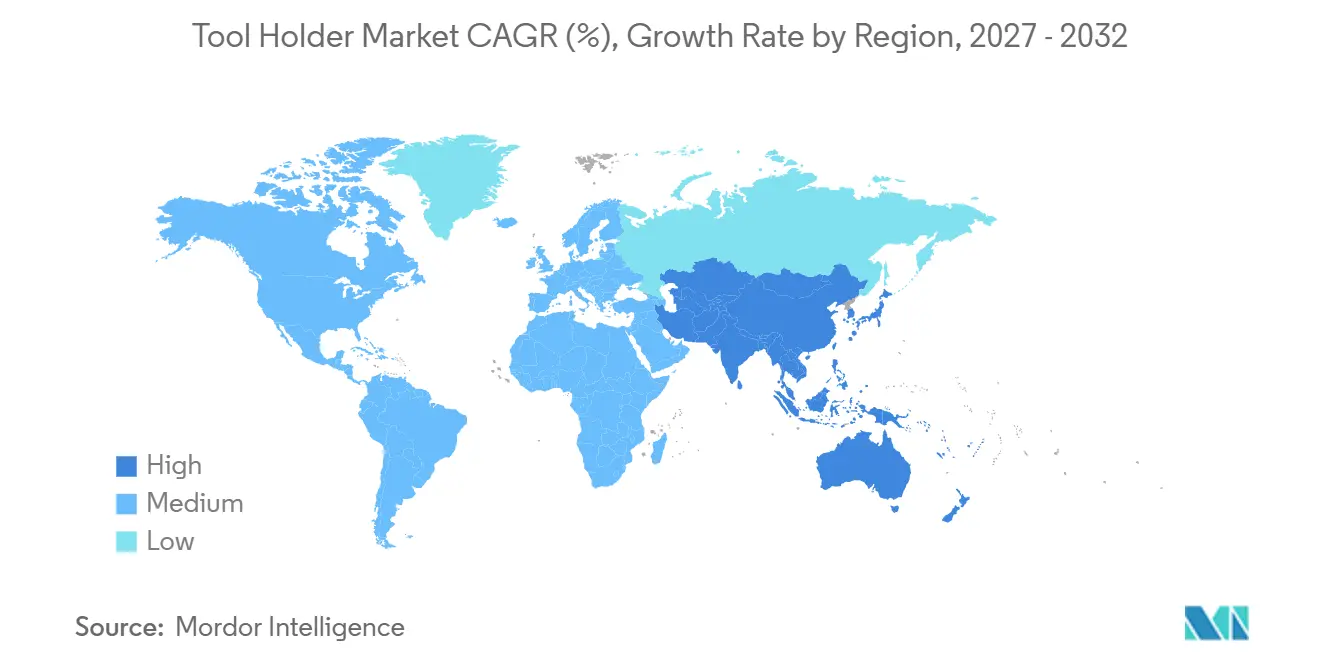
Asia-Pacific accounted for 38.6% of the global tool holder market share in 2026 and is projected to expand at a 6.5% CAGR through 2032. The region combines a large CNC machining base across China, Japan, South Korea, India, and Southeast Asia with growing investment in high-value production. China remains the largest regional demand driver because of its domestic CNC and manufacturing base. Foreign suppliers continue to hold a strong position in China’s CNC controller segment, where Fanuc, Mitsubishi, and Siemens collectively accounted for 69% of the market cited by the U.S.-China Economic and Security Review Commission. This technology base supports demand for holders that can help machine tools achieve their intended accuracy and speed.
India and Northeast Asia Tool Holder Market
India is an important contributor to regional growth as machining capacity rises. Jyoti CNC Automation disclosed an expansion in annual machine capacity from 6,000 to 16,000 units and an order book of USD 467.21 million in its Q3 FY2026 investor presentation. DN Solutions opened its first India plant in Bengaluru in August 2025, with an investment of INR 600 crore, or USD 72 million, based on the company disclosure in the supplied material. These developments support local production capacity and demand for capable CNC tooling. Japan and South Korea continue to provide strong demand for high-precision holders in automotive, electronics, and machine-tool production.
The Americas and EMEA Tool Holder Market
Europe is the second-largest regional market in the global tool holder market, with Germany, Italy, and France providing dense demand for premium toolholding. HAIMER, SCHUNK, MAPAL, Walter, and Gühring have a strong presence in European premium applications. MAPAL reported that slower European economic conditions and raw-material supply issues affected the pace of new machine-tool investment through 2026. North America benefits from investment in semiconductor equipment, defense aerospace, and electric-vehicle battery plants. South America is centered on Brazilian automotive and heavy-equipment activity, while the Middle East and Africa gain demand from industrial diversification programs in Saudi Arabia and the United Arab Emirates. These regions remain smaller than Asia-Pacific and Europe, but aerospace maintenance, defense manufacturing, and local production development require more capable holder specifications.
Competitive Landscape
The global tool holder market is moderately concentrated in the premium tier and fragmented in the mid-tier and commodity range. HAIMER, SCHUNK, Sandvik Coromant, Kennametal, BIG DAISHOWA, and MAPAL are among the European and Japanese specialists serving technically differentiated applications. These companies compete through clamping geometry, interface capability, balancing, presetting, application support, and digital connectivity. The global tool holder market remains more price competitive in standardized products, where mid-tier suppliers can offer compatible designs at lower prices. Leading suppliers use certified portfolios and application engineering to serve aerospace, medical, semiconductor, and advanced automotive machining. ISO 26623-1 for Capto polygon interfaces and ISO 1940 for dynamic balancing remain important qualification points for customers that need documented performance.
HAIMER and DMG MORI expanded their global strategic partnership in November 2025. The partnership combines shrink-fit, presetting, and balancing hardware with WinTool digital-twin software and Toolbase dispensing systems across DMG MORI facilities. Kennametal integrated verified digital tooling data with Hexagon’s cloud-based WORKNC Computer-Aided Manufacturing (CAM) software in December 2025. This allows users to work with realistic 3D tool holder models and cutting data during process planning. These moves show how established suppliers are adding software links and process data around physical holder products.
Sandvik acquired an 80% stake in K&Y Diamond in April 2026, extending its position in ultra-precision diamond tooling for semiconductor and optics applications. K&Y Diamond generated SEK 120 million in 2025 revenue, according to Sandvik’s announcement. Mid-tier manufacturers from China, Taiwan, and South Korea offer shrink-fit and hydraulic holders at prices 20% to 30% below European list prices in the supplied material. The global tool holder market gives established suppliers room to respond through tool-life support, software integration, and application engineering rather than direct price matching. Opportunities remain in sensor-enabled holders for smaller shops and quick-change lathe tooling for emerging markets.
Tool Holder Industry Leaders
-
Guhring KG
-
Sandvik AB
-
Kennametal Inc.
-
Haimer GmbH
-
BIG DAISHOWA SEIKI Co., Ltd.
- *Disclaimer: Major Players sorted in no particular order
Tool Holder Market Companies Covered in this Report
- BIG DAISHOWA SEIKI Co., Ltd.
- Bilz Werkzeugfabrik GmbH & Co. KG
- CERATIZIT S.A.
- EMUGE-FRANKEN Group
- Gühring KG
- HAIMER GmbH
- ISCAR Ltd.
- Kennametal Inc.
- Kyocera Corporation
- Lyndex-Nikken Inc.
- MAPAL Dr. Kress SE & Co. KG
- Mitsubishi Materials Corporation
- NT Tool Corporation
- REGO-FIX AG
- Sandvik AB
- SCHUNK GmbH & Co. KG
- Seco Tools AB
- Tungaloy Corporation
- Walter AG
- WTO Werkzeug-Einrichtungen GmbH
Recent Industry Developments in Tool Holder Market
- November 2025: HAIMER GmbH and DMG MORI Co., Ltd. expanded their global strategic partnership to deploy HAIMER’s “Tool Room of the Future,” combining i4.0-capable shrink-fit, presetting, and balancing hardware with WinTool digital-twin software and Toolbase dispensing systems across DMG MORI’s worldwide facilities. The HAIMER Automation Cube One, a 12-axis cobot cell for unmanned 24/7 tool preparation, was commissioned at DMG MORI’s Iga plant, addressing skilled-labor shortages in high-throughput machining environments.
- September 2025: Eppinger Technologies launched Quick-Lock BMT, an automated CNC lathe tool holder delivering precision clamping in under 4 seconds, with self-locking security validated over 100,000 cycles and robot-integration capability, addressing skilled-operator shortages and rising production costs in CNC turning applications.
- September 2025: Fraunhofer IWU and Fraunhofer IIS unveiled the next-generation smartTOOL at EMO Hannover 2025, featuring multi-directional force, vibration, and temperature sensing at each cutting edge, a 25% reduction in installation space, 10 kHz wireless sampling rates, and ECC4P AI-based monitoring integration powered by energy harvesting.
- August 2025: Kennametal Inc. expanded its BTKV tooling platform with the BTKV30 for high-speed small-parts machining in aerospace, medical, oil and gas, and automotive. The system uses taper face contact technology and supports hydraulic, shrink-fit, ER collet, and shell-mill adapter configurations.
Global Tool Holder Market Report Scope
The tool holder market encompasses the design, manufacturing, and distribution of precision mechanical devices used to interface cutting tools with the rotating spindles of machining equipment.
The global tool holder market is segmented by product type, material, end-user industry, and geography. By product type, the market is segmented into collet chuck, end mill, hydraulic, shrink-fit, milling, turning, drilling, boring, and lathe holders. By material, the market is segmented into alloy steel, stainless steel, carbide, and other materials. By end-user industry, the market is segmented into automotive, aerospace, general machinery, electronics, medical, energy, oil and gas, and other industries. The report also covers the market size and forecasts for the global tool holder market across 26 countries in key regions. For each segment, the market sizing and forecasts have been provided on the basis of value (USD).
Segmentation Overview
| Collet Chuck Holders |
| End Mill Holders |
| Hydraulic Tool Holders |
| Shrink-Fit Tool Holders |
| Milling Tool Holders |
| Turning Tool Holders |
| Drilling Tool Holders |
| Boring Tool Holders |
| Lathe Tool Holders |
| Other Product Types |
| Alloy Steel |
| Stainless Steel |
| Carbide |
| Other Materials |
| Automotive |
| Aerospace and Defense |
| General Machinery and Equipment |
| Electronics and Semiconductor |
| Medical Devices |
| Energy and Power Generation |
| Oil and Gas |
| Construction and Heavy Equipment |
| Metal Fabrication |
| Other End-User Industries |
| North America | United States |
| Canada | |
| Mexico | |
| Europe | Germany |
| France | |
| Italy | |
| Spain | |
| United Kingdom | |
| Poland | |
| Russia | |
| Rest of Europe | |
| Asia-Pacific | China |
| India | |
| Japan | |
| South Korea | |
| Australia | |
| Indonesia | |
| Vietnam | |
| Thailand | |
| Rest of Asia-Pacific | |
| South America | Brazil |
| Argentina | |
| Chile | |
| Rest of South America | |
| Middle East and Africa | Saudi Arabia |
| United Arab Emirates | |
| Egypt | |
| South Africa | |
| Morocco | |
| Rest of Middle East and Africa |
| By Product Type | Collet Chuck Holders | |
| End Mill Holders | ||
| Hydraulic Tool Holders | ||
| Shrink-Fit Tool Holders | ||
| Milling Tool Holders | ||
| Turning Tool Holders | ||
| Drilling Tool Holders | ||
| Boring Tool Holders | ||
| Lathe Tool Holders | ||
| Other Product Types | ||
| By Material | Alloy Steel | |
| Stainless Steel | ||
| Carbide | ||
| Other Materials | ||
| By End-User Industry | Automotive | |
| Aerospace and Defense | ||
| General Machinery and Equipment | ||
| Electronics and Semiconductor | ||
| Medical Devices | ||
| Energy and Power Generation | ||
| Oil and Gas | ||
| Construction and Heavy Equipment | ||
| Metal Fabrication | ||
| Other End-User Industries | ||
| By Geography | North America | United States |
| Canada | ||
| Mexico | ||
| Europe | Germany | |
| France | ||
| Italy | ||
| Spain | ||
| United Kingdom | ||
| Poland | ||
| Russia | ||
| Rest of Europe | ||
| Asia-Pacific | China | |
| India | ||
| Japan | ||
| South Korea | ||
| Australia | ||
| Indonesia | ||
| Vietnam | ||
| Thailand | ||
| Rest of Asia-Pacific | ||
| South America | Brazil | |
| Argentina | ||
| Chile | ||
| Rest of South America | ||
| Middle East and Africa | Saudi Arabia | |
| United Arab Emirates | ||
| Egypt | ||
| South Africa | ||
| Morocco | ||
| Rest of Middle East and Africa | ||
Key Questions Answered in the Report
What is the projected growth rate for global tool holders?
The global tool holder market is projected to grow at a 5.93% CAGR from 2027 to 2032, reaching USD 3.11 billion by 2032.
Which tool holder product type is growing fastest?
Shrink-fit tool holders are projected to grow at a 6.8% CAGR through 2032, supported by demand for low runout and high-speed machining.
Which end-user sector creates the most demand for tool holders?
Automotive held 28.7% of revenue in 2026 because of its extensive CNC machining needs for powertrain, chassis, and body components.
Why are smart tool holders becoming more important?
Sensor-enabled holders can provide vibration, temperature, and stability data that supports condition monitoring in automated machining cells.
Which region leads demand for tool holders?
Asia-Pacific held 38.6% of revenue in 2026 and is projected to grow at a 6.5% CAGR through 2032.
How do hydraulic and shrink-fit holders differ from standard holders?
Hydraulic and shrink-fit holders are used where damping, low runout, and stable clamping are needed, although their upfront cost can be higher.