
Tongue Depressors Market Size and Share
Market Overview
| Study Period | 2021 - 2032 |
|---|---|
| Market Size (2027) | USD 355.74 Million |
| Market Size (2032) | USD 448.36 Million |
| Growth Rate (2027 - 2032) | 4.74 % |
| Fastest Growing Market | Asia-Pacific |
| Largest Market | North America |
| Market Concentration | Low |
Major Players *Disclaimer: Major Players sorted in no particular order Image © Mordor Intelligence. Reuse requires attribution under CC BY 4.0. | |
Tongue Depressors Market Analysis by Mordor Intelligence
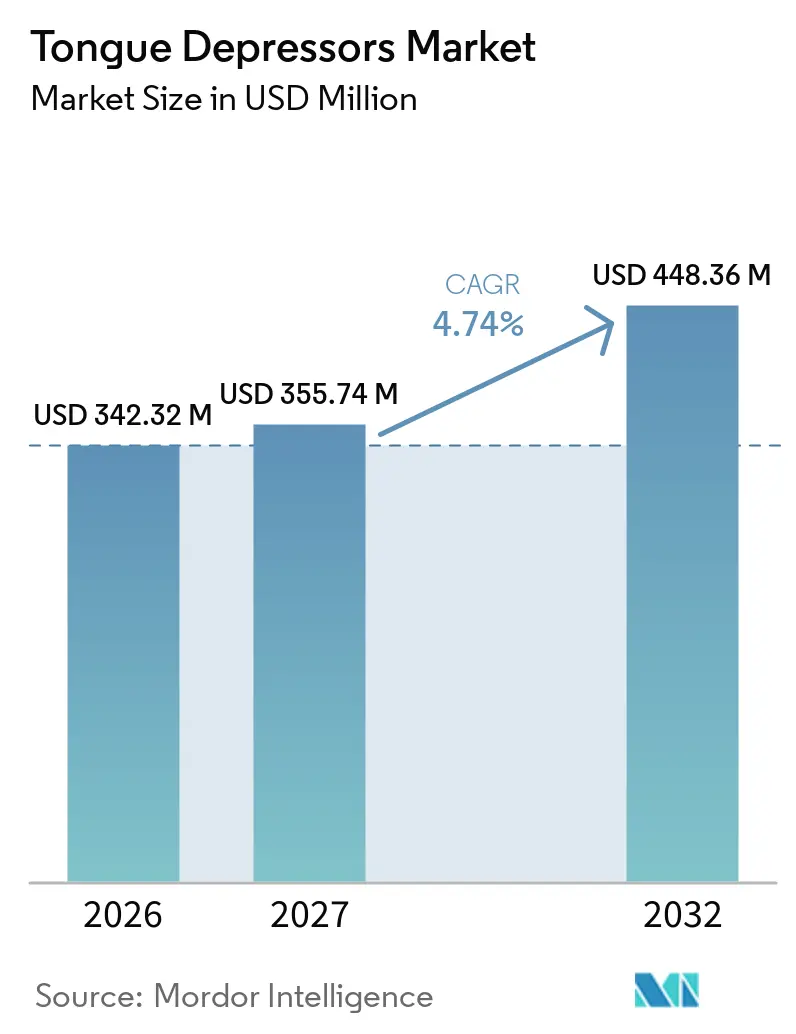
The Tongue Depressors Market size is projected to expand from USD 342.32 million in 2026 and USD 355.74 million in 2027 to USD 448.36 million by 2032, registering a CAGR of 4.74% between 2027 and 2032.
The tongue depressors market continues to depend on its routine use in oral, throat, ENT, and pediatric examinations. Demand is moving from non-sterile bulk products toward individually packaged sterile products, which changes the value of each item sold even when the number of units purchased does not rise at the same pace. Suppliers are competing through sterile packaging, responsible wood sourcing, and reliable digital ordering rather than through major changes to the basic product. The tongue depressors market also benefits from the expansion of outpatient and primary care settings, where single-use examination supplies are used frequently. These sites often have limited storage space and need simple ordering methods, which gives established distributors and online channels different but complementary roles. The outlook is constrained by low unit prices, procurement pressure, environmental documentation, and the uncertainty surrounding sterilization compliance. Even so, the basic need for oral and throat assessment gives the category a stable base across hospitals, clinics, urgent care centers, and community health facilities.
Key Report Takeaways
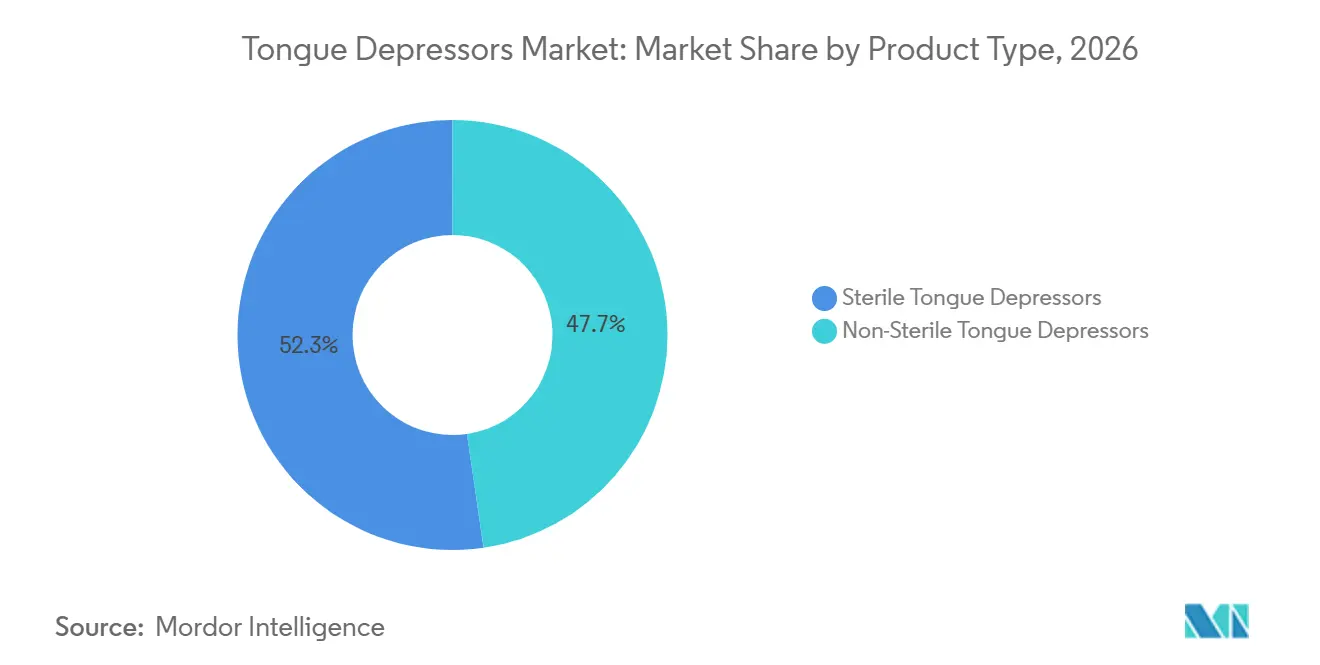
- By product type, sterile tongue depressors held 52.26% of product-type revenue in 2026, and the same segment is forecast to grow at a 5.26% CAGR through 2032.
- By material, wooden tongue depressors held 41.63% of material revenue in 2026, while metal tongue depressors are expected to grow at a 6.22% CAGR through 2032.
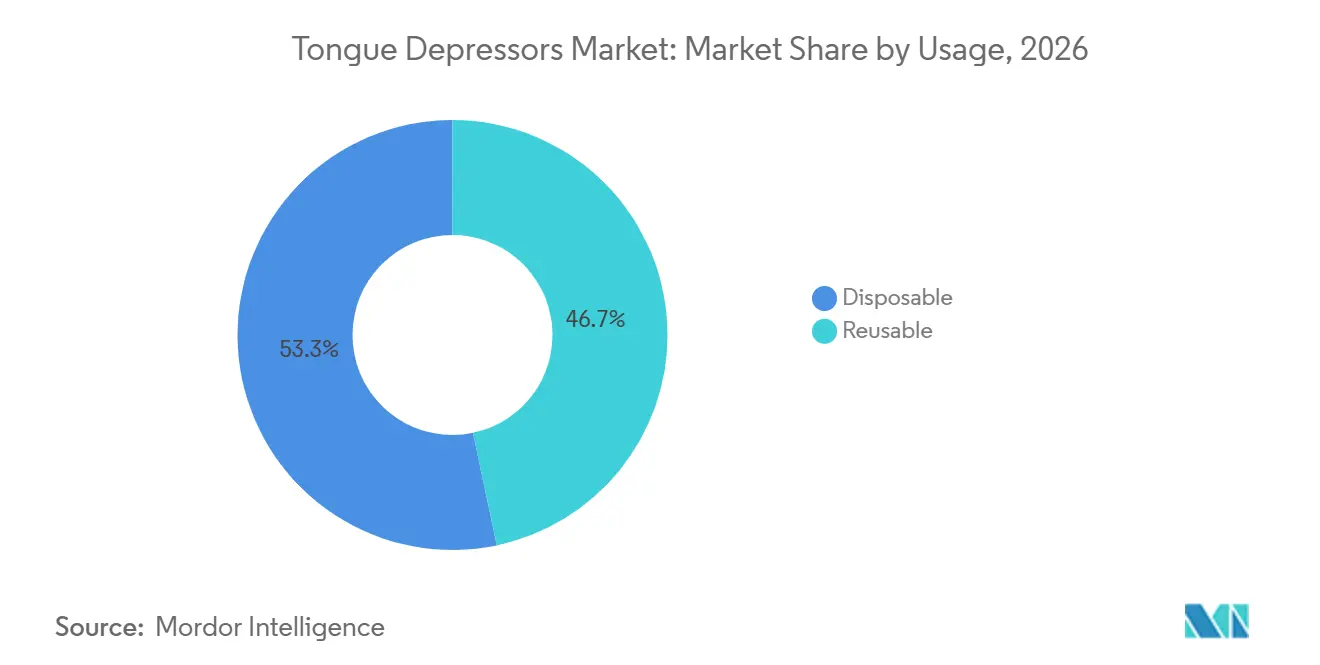
- By usage, disposable products held 53.33% of the tongue depressors market share in 2026, while reusable products are expected to grow at a 4.83% CAGR through 2032.
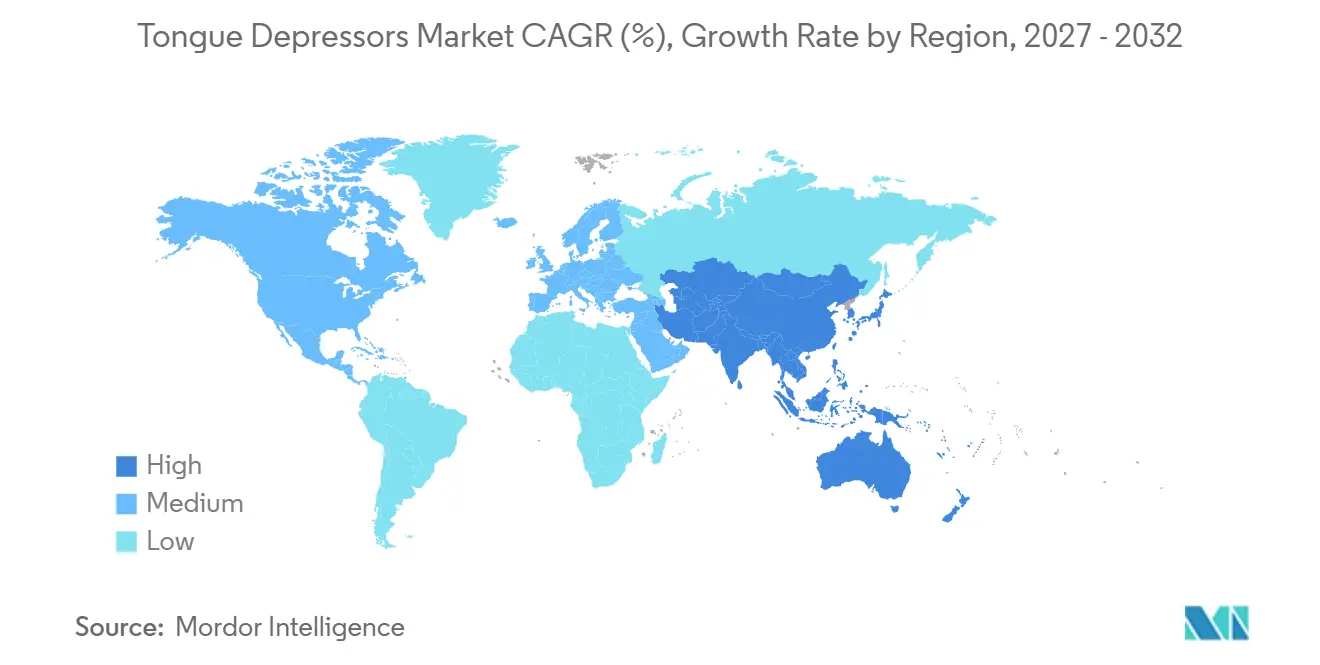
- By geography, North America held 46.42% of revenue in 2026, while Asia-Pacific is projected to grow at an 6.41% CAGR through 2032.
Note: Market numbers in this report are based on Mordor Intelligence's proprietary estimation framework, which combines nine months of actuals with Q4 projections for base year 2026.
Market Trends and Insights
Drivers Impact Analysis of Tongue Depressors Market*
| Driver | (~) % Impact on CAGR Forecast | Geographic Relevance | Impact Timeline |
|---|---|---|---|
| Rising Volume of Oral, Throat, Pediatric and ENT Examinations | +1.1% | Global | Long term (≥ 4 years) |
| Infection-Control Preference for Single-Use Products | +0.9% | Global | Medium term (2–4 years) |
| Expansion of Outpatient, Urgent-Care and Primary-Care Facilities | +0.7% | North America & Europe, spill-over to APAC | Medium term (2–4 years) |
| Healthcare Access Expansion in China, India and Southeast Asia | +0.8% | APAC core, spill-over to MEA | Long term (≥ 4 years) |
| Sustainability-Led Shift Toward Responsibly Sourced Wood and Bio-Based Polymers | +0.4% | EU, North America | Long term (≥ 4 years) |
| Individually Packaged Depressors in Telehealth and At-Home Examination Kits | +0.5% | Global | Medium term (2–4 years) |
| Source: Mordor Intelligence | |||
Growing Oral, Throat, Pediatric, and ENT Examinations
The tongue depressors market is supported by growing examination activity in pediatric, ENT, and urgent care settings. Ear and throat checks remain a routine part of pediatric assessment, which sustains regular use of basic examination instruments. Respiratory illnesses also remain a leading reason for urgent care visits in the United States. The tongue depressors market therefore gains from each new outpatient contact point as well as from the number of examinations completed at each site. Individually wrapped sterile products can support a consistent workflow for clinicians who need a ready-to-use item for every examination. The tongue depressors market retains a broad base of demand because oral and throat examinations remain simple, frequent, and necessary across many care settings.
Infection Control Demand for Single-Use Products
The tongue depressors market is shifting toward single-use products as infection control becomes part of purchasing policy. The U.S. Food and Drug Administration lists manual tongue depressors under 21 CFR 880.6275 and classifies them as Class I medical devices.[1] General controls, labeling, and quality requirements provide hospitals with a basic framework for sourcing these products. Under the EU Medical Device Regulation, Class I devices must meet relevant general safety and performance requirements. Sterility validation can also make it harder for small suppliers to win hospital tenders. Gamma irradiation and ethylene oxide processes require documented controls, which smaller producers may not have in place. The tongue depressors market is likely to keep separating into a compliant sterile segment and a price-led bulk segment.
Expansion of Outpatient, Urgent Care, and Primary Care Facilities
The tongue depressors market benefits from the continued expansion of care outside traditional hospitals. The Urgent Care Association reported 611 new U.S. urgent care centers in 2025, bringing the total to 15,309.[2] More than 80% of new centers had on-site diagnostic capability. Their inventory models are often leaner than those of large hospitals. This favors dependable replenishment and simple ordering processes. Urgent care groups and physician offices can benefit from online ordering because it offers visibility into stock availability and repeat purchasing. However, smaller care sites may be more willing to order through digital platforms when they need faster replenishment. Suppliers that connect with group purchasing organizations and digital procurement systems can reach both established hospitals and decentralized care providers.
Healthcare Access Expansion in China, India, and Southeast Asia
The tongue depressors market has a larger long-term opportunity as primary healthcare networks expand across Asia-Pacific. China recorded 5.56 billion patient visits at primary-level medical institutions in 2025, accounting for 52.6% of national diagnoses and treatments.[3]This higher use of community-level services creates more routine demand for basic diagnostic supplies. Primary care growth therefore extends the number of locations that need standard single-use instruments. Registration and quality requirements may favor suppliers that already have recognized medical-device quality systems. Regional producers can remain competitive in non-sterile formats where price is the main consideration. The tongue depressors market in Asia-Pacific can thus support both low-cost bulk supply and higher-value sterile formats.
Restraints Impact Analysis of Tongue Depressors Market*
| Restraint | (~) % Impact on CAGR Forecast | Geographic Relevance | Impact Timeline |
|---|---|---|---|
| Low Unit Prices and Procurement-Led Margin Compression | -1.6% | Global | Short term (≤ 2 years) |
| Environmental Scrutiny of Single-Use Medical Consumables | -0.8% | EU, North America, APAC | Medium term (2–4 years) |
| Sterile-Packaging and Ethylene Oxide Validation Complexity | -0.5% | Global | Medium term (2–4 years) |
| Limited Clinical Differentiation and Substitution by Integrated Examination Tools | -0.4% | North America & EU | Long term (≥ 4 years) |
| Source: Mordor Intelligence | |||
Low Unit Prices and Procurement-Led Margin Pressure
The tongue depressors market faces margin pressure because many products are purchased as standard commodities. Wooden non-sterile formats can sell for less than USD 0.05 per unit in competitive hospital tenders. Group purchasing organizations in North America and Europe use competitive bidding to limit price increases. Buyers may accept higher-value sterile products, but they still expect reliable pricing and supply. Manufacturers must absorb changes in timber sourcing, packaging, and quality documentation costs. This creates a difficult operating environment for suppliers that lack scale. The pressure can be greater for small producers in Europe and Asia. Such firms may have to invest in certified wood sourcing and sterile packaging without securing a corresponding price increase. The tongue depressors market therefore rewards operational efficiency, dependable quality, and access to high-volume channels.
Environmental Scrutiny of Single-Use Medical Consumables
The tongue depressors market is affected by increasing scrutiny of single-use healthcare products. European buyers are paying closer attention to sourcing, waste, and supplier documentation. The EU Deforestation Regulation requires companies placing relevant forest-derived products on the EU market to show that products are not linked to deforestation. FSC and PEFC chain-of-custody evidence can help suppliers address these buyer expectations. Environmental requirements do not remove the need for single-use instruments in clinical care. Instead, they shift purchasing toward products with clearer sourcing documentation. The tongue depressors market is therefore moving toward a more defined split between documented, compliant supply and lower-cost bulk supply.
*Our forecasts treat driver/restraint impacts as directional, not additive. The impact forecasts reflect baseline growth, mix effects, and variable interactions.
Tongue Depressors Market Segment Analysis
By Product Type:
Sterile Formats Become the Clinical StandardSterile tongue depressors held 52.26% of product-type revenue in 2026, and the tongue depressors market for sterile products is expected to grow at a 5.26% CAGR through 2032. This combination of the largest share and the fastest growth rate shows that sterile formats are becoming the usual institutional choice. Individually wrapped products fit hospital and ambulatory care procedures that require one item for each patient. These settings may place less emphasis on individual packaging where the clinical risk is lower.
Sterile formats also need stronger documentation than basic non-sterile products. ISO 13485 quality systems further support their position with regulated buyers. Non-sterile demand remains substantial in developing care systems, but it is more exposed to price competition. The tongue depressors market has therefore become less about a simple choice between formats and more about meeting different procurement requirements.
By Material:
Wood Retains Scale While Metal Serves Specialty UseWooden products held 41.63% of material revenue in 2026, giving them the leading share in the tongue depressors market. Their position reflects low unit cost, broad clinical familiarity, and biodegradability. Birch has been a widely used material because it can provide a smooth, splinter-free surface and stable dimensions. It is also suitable for gamma sterilization when suppliers use appropriate production controls. Plastic products have a meaningful role in developed markets.
Metal products are forecasted to grow at a 6.22% CAGR through 2032, the highest rate among materials. Stainless steel products are used in operating rooms, dental chairs, and ENT preparation rooms where reuse is practical. Bamboo and composite formats also serve smaller needs, especially in Asia-Pacific locations with relevant local supply chains.
By Usage:
Disposable Products Lead as Reusable Formats Expand SelectivelyDisposable products accounted for 53.33% of usage revenue in 2026, reflecting infection-control practices across hospitals and ambulatory care. Single-patient instruments avoid cross-contamination concerns and remove the need for reprocessing. Their broad availability also supports centralized purchasing through hospital formularies. These conditions maintain their leading position in the tongue depressors market.
Reusable products are forecasted to grow at a 4.83% CAGR through 2032. Growth is linked to cost-sensitive public health systems in South Asia, Southeast Asia, and sub-Saharan Africa, where in-house autoclaving can reduce the cost per examination. Suppliers offering both reusable and disposable products can meet a wider range of procurement needs in the tongue depressor industry.
Geography Analysis
North America
North America held 46.42% of the tongue depressors market share in 2026, supported by a dense network of urgent care, primary care, and ambulatory facilities. The United States had 15,309 urgent care centers at the end of 2025. These facilities create frequent demand for single-use examination items. FDA requirements and hospital accreditation expectations also encourage the use of sterile, individually packaged formats. Large distributors have strong channel positions because they bundle tongue depressors with other examination supplies.
Europe
Europe maintains steady consumption through primary care systems in Germany, France, and the United Kingdom. EU Medical Device Regulation requirements shape supplier selection and product documentation. The EUDR has added a traceability requirement for wooden products placed on the EU market. Institutional purchasers may therefore favor FSC-certified or PEFC-verified products. This creates an advantage for suppliers that can document their wood supply chain. It also increases the relevance of bio-based alternatives and reusable metal products in selected specialties.
Asia-Pacific, Middle East and Africa and South America
Asia-Pacific is projected to grow at an 6.41% CAGR through 2032, the fastest regional pace in the tongue depressors market. China’s primary care system and India’s expanding Ayushman Arogya Mandir network are increasing the number of care locations that use basic diagnostic supplies. Japan and South Korea sustain use through preventive health checks and older populations. Middle East and Africa and South America remain smaller regions, with demand supported by healthcare infrastructure investment, public tenders, and private clinic growth. GCC markets are expanding primary care under national health programs, while Brazil and Argentina continue to use low-cost wooden formats alongside growing demand for sterile products in private clinics. Regulatory requirements in China and India can favor established domestic and international manufacturers with the ability to maintain required registrations.
Competitive Landscape
The tongue depressors market is fragmented at the manufacturing level but more concentrated at the distribution level, with major distributors such as Cardinal Health, McKesson, and Henry Schein leveraging broad consumables portfolios to strengthen relationships with hospitals and ambulatory providers. Key manufacturers include Puritan Medical Products, Medline Industries, and Dynarex Corporation in North America, and DTR Medical, Timesco Healthcare, and F.L. Medical in Europe. Competition is driven by supply reliability, sterile packaging capabilities, product breadth, quality documentation, and pricing. Because tongue depressors are low-cost products, buyers prioritize dependable availability and efficient procurement, giving distributors an advantage through bundled ordering, while specialist manufacturers remain competitive by offering specific sterile formats, material options, or quality certifications.
Recent industry developments highlight the importance of manufacturing capacity, distribution reach, and portfolio expansion. B. Braun’s 2025 investment in its Pennsylvania manufacturing facility and Puritan Medical Products’ expansion of U.S.-based hiring demonstrate the strategic value of domestic production and supply continuity. Dynarex’s portfolio expansion further strengthens its ability to serve customers through established distribution channels. These initiatives do not significantly alter the product itself but enhance supplier positioning by improving customer relationships, supply resilience, and cross-selling opportunities. In a price-sensitive category with limited product differentiation, broader portfolios help suppliers spread compliance and distribution costs while simplifying procurement for healthcare providers.
Market competition is also shaped by customer requirements, regulatory expectations, and purchasing channels. Asian manufacturers remain highly competitive in non-sterile bulk products where cost is the primary consideration, while sterile products require validated sterilization processes, documented quality systems, and compliance with regulatory standards such as the FDA’s Quality Management System Regulation. Large hospital systems typically favor pre-qualified vendors capable of meeting bulk delivery and compliance requirements, whereas smaller clinics often prioritize easy ordering and rapid replenishment. As online procurement channels grow, suppliers with strong logistics networks, digital marketplace visibility, and reliable inventory management gain a competitive advantage. Overall, success in the tongue depressors market depends less on product innovation and more on the ability to provide the right product format, quality documentation, distribution access, and supply reliability for different buyer segments.
Tongue Depressors Industry Leaders
-
Puritan Medical Products Company LLC
-
Medline Industries, LP
-
DTR Medical Ltd.
-
Dynarex Corporation
-
Agaplastic
- *Disclaimer: Major Players sorted in no particular order

Tongue Depressors Market Companies Covered in this Report
- Agaplastic
- B. Braun
- Cardinal Health
- Deltalab, S.L.U.
- DTR Medical Ltd.
- DUKAL, LLC
- Dynarex
- F.L. Medical S.r.l.
- FASA GROUP
- Fazzini
- Fisher Scientific International, Inc.
- Franz Mensch GmbH
- Hardwood Products Company
- Henry Schein
- Mckesson
- Medline Industries
- Parburch Medical Developments Ltd.
- PLASTI LAB S.a.r.l.
- Puritan Medical Products Company LLC
- Timesco Healthcare Ltd.
Recent Industry Developments in Tongue Depressors Market
- June 2026: Dynarex Corporation launched an expanded wound care and specialised treatment solutions portfolio, including advanced DynaCol AG collagen wound dressings, highly absorbent nasal sponges, and a new black disposable exam garment line. Distribution coverage extends across North America, the Caribbean, Central and South America, and the Middle East, deepening Dynarex's footprint in markets where it also competes in examination consumables.
- April 2026: Dynarex expanded its DynaCare personal care portfolio to support skin health, hygiene, and comfort across healthcare and assisted-care settings, broadening the product range available through its national distribution network and reinforcing its role as a multi-category medical consumable supplier.
Global Tongue Depressors Market Report Scope
According to the report’s scope, the tongue depressors market refers to disposable or reusable medical tools, typically wooden or plastic flat sticks, used to hold down the tongue during oral and throat examinations. They are widely utilized in hospitals, clinics, and diagnostic centers, with demand driven by routine medical checkups, infection control practices, and the expansion of primary healthcare services.
The tongue depressors market is segmented into product type, material, usage, and geography. By product type, the market is segmented into sterile tongue depressors and non-sterile tongue depressors. By material, the market is segmented into wooden tongue depressors, plastic tongue depressors, metal tongue depressors, and other materials. By usage, the market is segmented into disposable and reusable. By geography, the market is segmented into North America, Europe, Asia-Pacific, the Middle East and Africa, and South America. The report also covers the estimated market sizes and trends for 17 countries across major regions globally. The report offers values (USD) for all the above segments.
Segmentation Overview
| Sterile Tongue Depressors |
| Non-Sterile Tongue Depressors |
| Wooden Tongue Depressors |
| Plastic Tongue Depressors |
| Metal Tongue Depressors |
| Other Materials |
| Disposable |
| Reusable |
| North America | United States |
| Canada | |
| Mexico | |
| Europe | Germany |
| United Kingdom | |
| France | |
| Italy | |
| Spain | |
| Rest of Europe | |
| Asia-Pacific | China |
| Japan | |
| India | |
| Australia | |
| South Korea | |
| Rest of Asia-Pacific | |
| Middle East and Africa | GCC |
| South Africa | |
| Rest of Middle East and Africa | |
| South America | Brazil |
| Argentina | |
| Rest of South America |
| By Product Type | Sterile Tongue Depressors | |
| Non-Sterile Tongue Depressors | ||
| By Material | Wooden Tongue Depressors | |
| Plastic Tongue Depressors | ||
| Metal Tongue Depressors | ||
| Other Materials | ||
| By Usage | Disposable | |
| Reusable | ||
| By Geography | North America | United States |
| Canada | ||
| Mexico | ||
| Europe | Germany | |
| United Kingdom | ||
| France | ||
| Italy | ||
| Spain | ||
| Rest of Europe | ||
| Asia-Pacific | China | |
| Japan | ||
| India | ||
| Australia | ||
| South Korea | ||
| Rest of Asia-Pacific | ||
| Middle East and Africa | GCC | |
| South Africa | ||
| Rest of Middle East and Africa | ||
| South America | Brazil | |
| Argentina | ||
| Rest of South America | ||
Key Questions Answered in the Report
What is the projected value of tongue depressors market by 2032?
The market is expected to increase from USD 355.74 million in 2027 to USD 448.36 million by 2032, at a CAGR of 4.74% during the forecast period.
Which tongue depressor product type is growing fastest?
Sterile tongue depressors are both the largest product type, with 52.26% revenue share in 2026, and expected to be the fastest growing, at a 5.26% CAGR through 2032.
Which material leads tongue depressor sales?
Wooden tongue depressors held 41.63% of material revenue in 2026 because it remains low cost, familiar to clinicians, and biodegradable.
Which region will grow fastest through 2032?
Asia-Pacific is projected to grow at an 6.41% CAGR as China and India expand primary healthcare access and care locations.