
Tire Wear Control Additives Market Size and Share
Market Overview
| Study Period | 2021 - 2031 |
|---|---|
| Market Size (2026) | USD 2.07 Billion |
| Market Size (2031) | USD 2.76 Billion |
| Growth Rate (2026 - 2031) | 5.86 % |
| Fastest Growing Market | Asia-Pacific |
| Largest Market | Asia-Pacific |
| Market Concentration | Medium |
Major Players *Disclaimer: Major Players sorted in no particular order Image © Mordor Intelligence. Reuse requires attribution under CC BY 4.0. | |
Tire Wear Control Additives Market Analysis by Mordor Intelligence
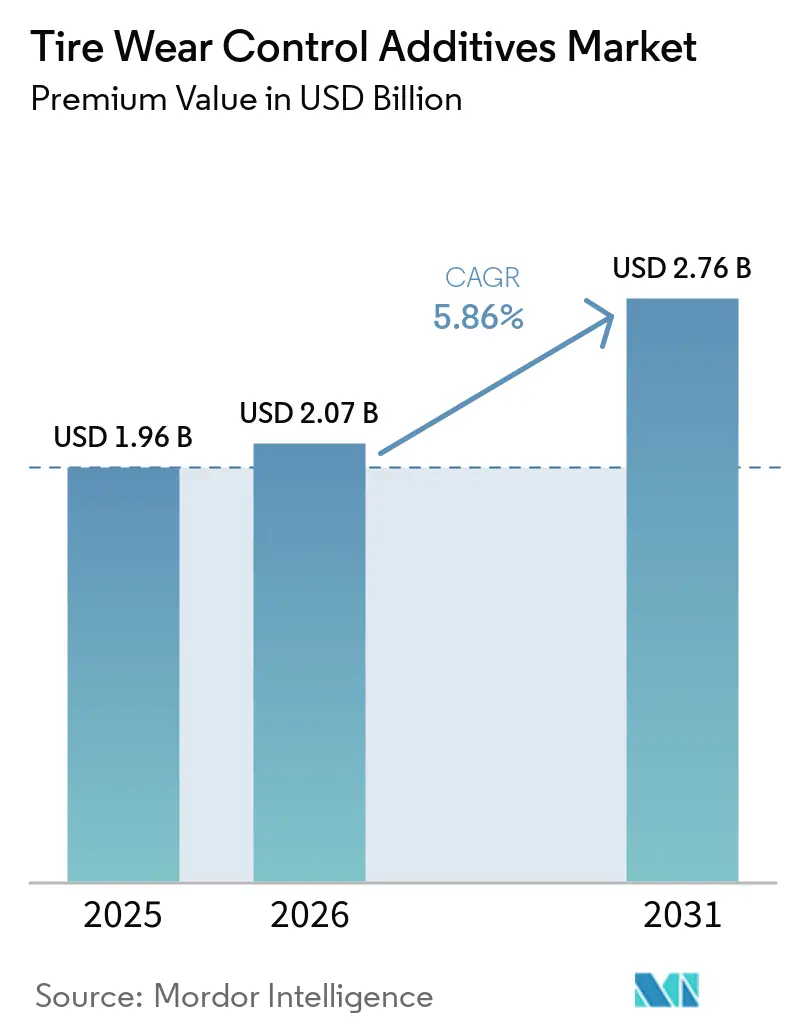
The Tire Wear Control Additives Market was valued at USD 1.96 billion in 2025 and is estimated to grow from USD 2.07 billion in 2026 to reach USD 2.76 billion by 2031, at a CAGR of 5.86% during the forecast period (2026–2031). Regulatory requirements, electric vehicle adoption, and demand for longer tire life are supporting the tire wear control additives market. Suppliers are focusing on silica, silane coupling agents, and sustainable reinforcing materials that can improve tread performance. Tire manufacturers are also seeking additives that support lower rolling resistance without weakening wet grip or abrasion resistance. This favors suppliers with established technical relationships and qualified products. Feedstock costs and testing uncertainty may limit adoption among smaller compounders.
Key Report Takeaways
- By additive type, silica held 40.18% of the tire wear control additives market share in 2025, while silane coupling agents are projected to advance at a 6.72% CAGR through 2031.
- By tire type, passenger car tires held 57.34% of the tire wear control additives market share in 2025, while commercial vehicle tires are projected to advance at a 6.18% CAGR through 2031.
- By rubber type, Styrene-Butadiene Rubber (SBR) held 42.33% of the tire wear control additives market share in 2025 and is projected to advance at a 6.21% CAGR through 2031.
- By application, tread compounds held 56.45% of the tire wear control additives market share in 2025 and are projected to advance at a 6.35% CAGR through 2031.
- By geography, Asia-Pacific held 42.78% of the tire wear control additives market share in 2025 and is projected to advance at a 6.48% CAGR through 2031.
Note: Market size and forecast figures in this report are generated using Mordor Intelligence’s proprietary estimation framework, updated with the latest available data and insights as of January 2026.
Market Trends and Insights
Drivers Impact Analysis of Tire Wear Control Additives Market*
| Driver | (~) % Impact on CAGR Forecast | Geographic Relevance | Impact Timeline |
|---|---|---|---|
| Rising Adoption of Silica-Silane Systems for Low-Wear Tire Treads | +1.5% | Global, with strongest intensity in Asia-Pacific and Europe | Long term (≥ 4 years) |
| Euro 7 Tire Abrasion Compliance Requirements | +1.3% | Europe core, with spill-over to APAC and North America | Medium term (2–4 years) |
| Electric Vehicle Torque and Vehicle-Mass Demands | +1.0% | Global; APAC and North America lead, Europe following | Medium term (2–4 years) |
| Fleet Total-Cost-of-Ownership Focus on Tire Life | +0.7% | North America and Europe; early gains in APAC fleet hubs | Long term (≥ 4 years) |
| Circular and Bio-Based Reinforcing Materials | +0.5% | Europe and APAC, with global rollout from 2026 | Long term (≥ 4 years) |
| Data-Driven Compound Development and Abrasion Testing | +0.3% | Global; concentrated in R&D hubs in Germany, Japan, South Korea | Long term (≥ 4 years) |
| Source: Mordor Intelligence | |||
Rising Adoption of Silica-Silane Systems for Low-Wear Tire Treads
Silica-silane chemistry is becoming a standard requirement in low-wear tread development. Evonik Industries AG stated that its Si 363 silane could reduce rolling resistance by up to 35% against carbon-black-filled tires while maintaining comparable wear performance[1]. High-surface-area silica needs a matched silane to deliver its intended performance. This creates a linked demand pattern for silica and coupling agents within the tire wear control additives market. Momentive introduced NRX for silica-filled natural rubber in truck and bus radial tires, where the balance between wear and rolling resistance had been difficult to achieve. The wider use of these systems can reduce the advantage of conventional carbon black and standard sulfur silanes.
Euro 7 Tire Abrasion Compliance Requirements
Euro 7 places tire abrasion performance within a mandatory type-approval framework. Regulation (EU) 2024/1257 includes abrasion limits for vehicle categories. Under the amended United Nations Economic Commission for Europe Regulation No. 117, manufacturers must communicate abrasion data for new C1 tire types to type-approval authorities from January 1, 2027. Different test approaches still create uncertainty for suppliers and tire manufacturers. This uncertainty is encouraging earlier investment in compounds that can perform across testing protocols. It also supports demand for silica, silane coupling agents, and antidegradants in the tire wear control additives market before the 2028 deadline for new passenger-car types.
Electric Vehicle Torque and Vehicle-Mass Demands
Electric drivetrains create tire wear conditions that differ from those of internal combustion engine vehicles. Electric vehicle tires wear 20%-30% faster under typical use because of immediate torque delivery, greater vehicle mass, and reduced coasting. A 2025 abrasion study also examined the relation between electric vehicles and tire abrasion. Oak Ridge National Laboratory found that replacing electric-vehicle original-equipment tires with conventional aftermarket tires reduced range by 2%-14%. Momentive designed NXT P97 for electric vehicle passenger tires and certified it at 79% renewable carbon content under American Society for Testing and Materials (ASTM) D6866. These performance requirements are extending into electric trucks and are strengthening demand for specialized commercial tire compounds.
Fleet Total-Cost-of-Ownership Focus on Tire Life
Tire replacement remains a major routine maintenance expense for commercial fleets. The American Transportation Research Institute reported that United States trucking tire costs increased 6.4% in 2025 to USD 0.05 per mile, within total operating costs of USD 2.336 per mile. This places emphasis on additives that can show a measurable reduction in cost per mile. Suppliers that translate abrasion results into operating savings have a clearer route to fleet procurement teams. The resulting focus on longevity is bringing functionalized polymers and advanced coupling agents into commercial tire formulations that previously used commodity processing aids. Tire durability has become an important practical basis for tire selection.
Restraints Impact Analysis of Tire Wear Control Additives Market*
| Restraint | (~) % Impact on CAGR Forecast | Geographic Relevance | Impact Timeline |
|---|---|---|---|
| Trade-Off Between Abrasion Reduction, Wet Grip, and Rolling Resistance | -1.4% | Global | Long term (≥ 4 years) |
| Volatility in Silica, Silicon, Carbon, and Specialty Chemical Feedstocks | -1.1% | Global; APAC and Europe most exposed | Short term (≤ 2 years) |
| High Formulation and Dispersion Complexity for Smaller Tire Producers | -0.8% | South America, Middle-East and Africa, emerging APAC | Medium term (2–4 years) |
| Inconsistent Tire-Wear Measurement Methods and Incomplete Heavy-Duty Data | -0.5% | Europe and APAC; regulatory-active markets most affected | Medium term (2–4 years) |
| Source: Mordor Intelligence | |||
Trade-Off Between Abrasion Reduction, Wet Grip, and Rolling Resistance
Abrasion reduction, wet grip, and rolling resistance remain difficult to optimize at the same time. A 2026 journal study found that graphene nanoplatelets improved Styrene-Butadiene Rubber wear resistance by up to 26% at 0.5 parts per hundred rubber (phr) loading. The effects on wet grip and rolling resistance varied with the formulation. Each new compound, therefore, requires verification under wet-grip and rolling-resistance protocols. A 2024 study found that Lambourn, LAT100, DIN, and cut-and-chip abrasion tests could produce materially different outcomes for silica-reinforced solution Styrene-Butadiene Rubber. This increases development cost and can delay commercialization in the tire wear control additives market. It also encourages the use of several functional ingredients rather than a single additive solution.
Volatility in Silica, Silicon, Carbon, and Specialty Chemical Feedstocks
Feedstock volatility affects both compound cost and supply planning. Wacker raised prices for silicone-based products, including organosilanes used in tire compounds, effective April 1, 2026, because of higher energy, raw-material, and logistics costs[2]. Tire producers are responding by diversifying supply sources for specialty additives. This can limit willingness to depend on a single supplier for new formulations. Smaller compounders face the greatest difficulty because they have less scope to absorb increases across silica, silanes, and antidegradants. The restraint is most evident in the tire wear control additives market when voluntary additive upgrades are not supported by regulation or a clear customer premium.
*Our forecasts treat driver/restraint impacts as directional, not additive. The impact forecasts reflect baseline growth, mix effects, and variable interactions.
Tire Wear Control Additives Market Segment Analysis
By Additive Type:
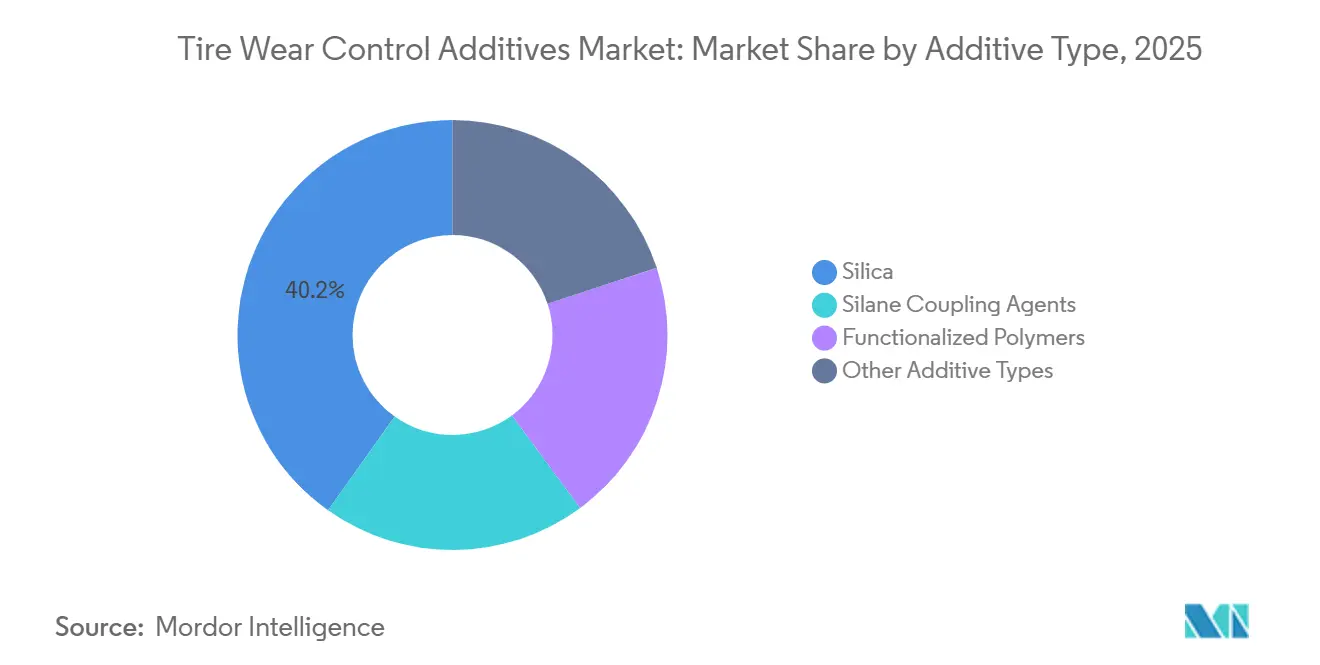
Silica Anchors Revenue While Silane Coupling Agents Drive Value GrowthSilica held 40.18% of the tire wear control additives market share in 2025, reflecting its central role in high-performance passenger-car tread compounds. It is used in compounds that seek lower rolling resistance and strong wet performance. Momentive introduced NRX for silica-filled natural rubber truck and bus radial tires, where carbon black had traditionally been more common. This supports hybrid and full-silica systems in heavy-duty treads. Silane coupling agents are projected to advance at a 6.72% CAGR through 2031 because each highly dispersible silica grade requires suitable coupling chemistry.
The tire wear control additives market size for silane coupling agents benefits from more demanding tread specifications. Regulatory attention to N-(1,3-Dimethylbutyl)-N′-phenyl-p-phenylenediamine, commonly known as 6PPD, is affecting the selection of antioxidants and antiozonants. LANXESS reported commercial-scale readiness for Vulkanox 4060, an alternative to 6PPD, with Registration, Evaluation, Authorisation and Restriction of Chemicals registration planned for volumes above 1,000 metric tons per year from mid-2026. Evonik Industries AG localized the final production step for POLYVEST ST-E 60 in Shanghai during 2025 to expand silane-functionalized polybutadiene capacity in Asia. Conventional carbon black remains cost-competitive, while recycled reinforcing carbon, processing aids, reinforcing resins, and vulcanization additives provide circular and performance alternatives.

By Tire Type:
Commercial Vehicle Tires Intensity Rising Against a Large Passenger Car Tires BasePassenger car tires held 57.34% of the market share in 2025, reflecting production volumes and complex additive packages in modern tread systems. Electric vehicle fitments require particularly durable compounds because torque and mass can accelerate tread wear. Commercial vehicle tires are projected to advance at a 6.18% CAGR through 2031. Fleet demand for longer service life is raising the value of advanced coupling agents and functionalized polymers. This is gradually increasing compound sophistication in the tire wear control additives market.
Electric trucks add another source of demand for the tire wear control additives market. Research presented to the Heavy Vehicle Transport Technology Forum in 2025 found that battery-electric trucks have higher traction torque and different axle-load distribution than diesel vehicles. These conditions require purpose-designed tread compounds rather than direct adaptations of existing truck tire specifications. Off-the-road tires require higher reinforcing resin loadings and tailored functionalized elastomers for mining, quarrying, and construction uses. Two-wheeler and three-wheeler tires are also adopting more precipitated silica in India and Southeast Asia as electrification raises performance requirements.
By Rubber Type:
SBR Leads Both Share and Growth in a Filler-Compatible ArchitectureThe styrene-butadiene rubber held 42.33% of the market share in 2025 and is projected to advance at a 6.21% CAGR through 2031. Its compatibility with highly dispersible silica, silanes, and functionalized polymers supports passenger-car tread compounds. Solution-polymerized and functionalized grades can improve filler dispersion and rubber-filler interaction. A 2026 study found that surface-modified carbon nanotubes at 1 phr improved wear resistance by 6-7.5% above carbon-black-only references. This innovation extends beyond established silica-silane systems in the tire wear control additives market.
Natural rubber remains important in truck and bus radial tires because of its load-bearing performance. Its wear performance in full-silica systems has lagged that of styrene-butadiene rubber, creating a need for coupling agents such as NRX. Butadiene rubber is usually blended with styrene-butadiene rubber to improve abrasion resistance and low-temperature behavior. Halobutyl rubber and functionalized synthetic elastomers are gaining relevance in electric vehicle tires. They address noise, vibration, harshness, and thermal stability requirements beyond conventional wear control.
By Application:
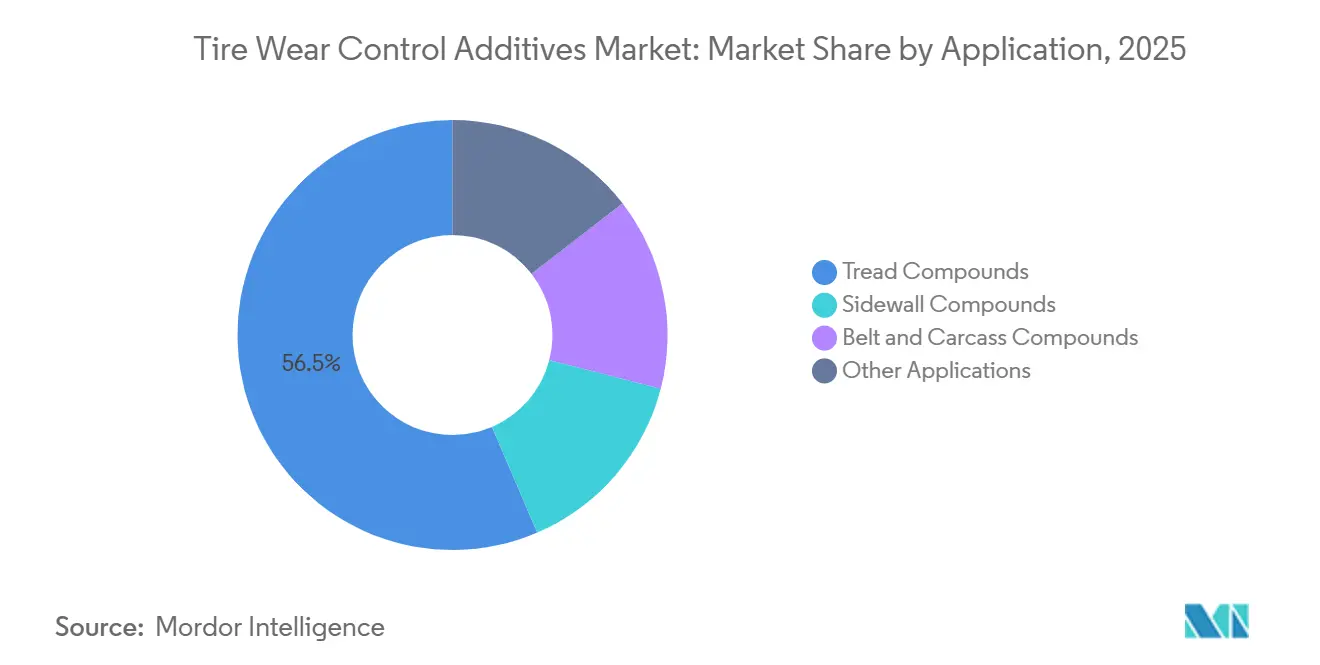
Tread Compounds Capture Both the Largest Share and the Fastest GrowthTread compounds held 56.45% of the market share in 2025 and are projected to advance at a 6.35% CAGR through 2031. The tread is the tire component in direct contact with the road and determines abrasion, rolling resistance, and wet-grip performance. Electric vehicle treads often combine precipitated silica, functionalized solution-polymerized styrene-butadiene rubber, mercapto silanes, and processing aids. This raises additive spending per unit of tread compound in the tire wear control additives market. A 2025 scientific review of 502 publications identified tread composition as the most controllable factor in tire and road wear particle generation.
Tread development is the main area for regulation-led innovation in the tire wear control additives market. Sidewall compounds are receiving more attention as producers seek alternatives to 6PPD that retain oxidation protection. Belt and carcass compounds are adopting resorcinol-free coupling systems, and LANXESS identified Cohedur RA as a validated option. Inner liner and bead or apex compounds remain more commodity-oriented because their additive loading is lower. Processing-aid improvements can still lower scrap rates in high-volume production settings.
Geography Analysis
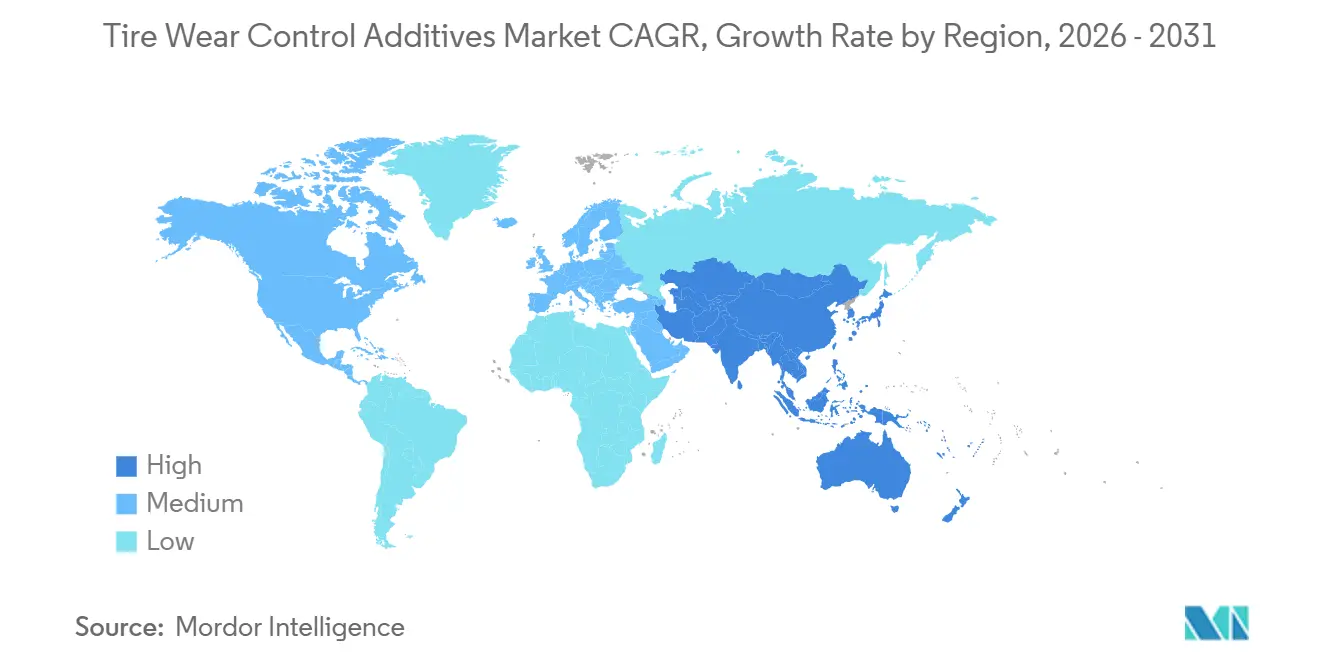
APAC Tire Wear Control Additives Market
Asia-Pacific held 42.78% of the tire wear control additives market share in 2025 and is projected to advance at a 6.48% CAGR through 2031. China’s tire production base and specialty-chemical supply network supported the region’s leading position, while electric vehicle adoption is encouraging tread reformulation. Solvay’s 2026 conversion of its Qingdao and Gunsan silica plants to certified waste-sand feedstocks strengthens regional circular silica availability. The conversion supports manufacturers pursuing more than 40% sustainable-material content by 2030. Japan has high-performance and original-equipment tire demand, and Sumitomo Rubber Industries worked with NEC in 2025 on artificial intelligence-supported material discovery.
Europe and North America Tire Wear Control Additives Market
Europe remains the regulatory and technology center for the tire wear control additives market. Euro 7, the amended United Nations Economic Commission for Europe Regulation No. 117, and the European Union tire labeling framework are increasing tire-producer compliance requirements. Evonik Industries AG commenced commercial production of International Sustainability and Carbon Certification PLUS-certified ULTRASIL eCO in Adapazarı, Turkey, in June 2026. Continental reported that sustainable materials represented 28% of its tires in 2025, compared with 26% in 2024. North America benefits from fleet replacement demand, electric vehicle penetration, and interest in longer-lasting compounds.
MEA and South America Tire Wear Control Additives Market
South America and Middle-East and Africa account for smaller parts of the tire wear control additives market. Growth is tied more closely to domestic tire manufacturing capacity than to frontier additive innovation. South America faces higher barriers to specialty silica and silane adoption because import costs can sustain carbon-black-led formulations in price-sensitive applications. Suppliers can address this gap through local technical support, locally produced precursors, and investment in markets such as Saudi Arabia and South Africa.
Competitive Landscape
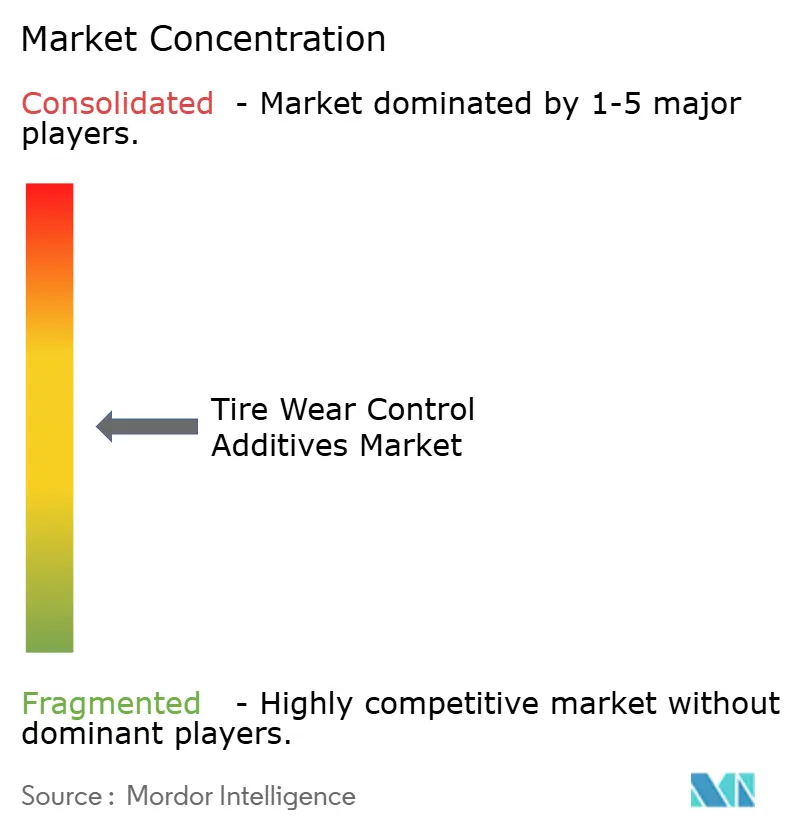
The tire wear control additives market is moderately concentrated, with the top five players including LANXESS, Evonik Industries AG, BASF, Solvay, and Cabot Corporation. Chinese suppliers, including Jiangxi Chenguang New Materials and Jiangxi Hungpai, compete in standard sulfur silanes and coupling agents. Momentive confirmed a joint venture with Jiangxi Hungpai for Asian silane production and distribution in February 2026. This competition shapes supplier choices in the tire wear control additives market.
Sustainability certification is becoming a more important basis for competition in the tire wear control additives market. Evonik Industries AG’s ULTRASIL eCO certification, Solvay’s Asian circular-feedstock conversion, and Momentive’s bio-based silane indicate a shift toward verified circular-content claims. These credentials matter to tire makers with circular-content targets in supplier scorecards. Cabot completed the USD 70 million acquisition of Mexico Carbon Manufacturing from Bridgestone in February 2026. The Altamira facility increased Cabot’s reinforcing-carbon capacity in North America and retained a long-term supply agreement with Bridgestone.
Digital compound development is a second competitive factor. Fraunhofer ITWM’s SUMERA project is developing a physics-based tire-wear simulation framework. This can allow compound designers to assess additives before physical prototypes. Suppliers that provide compatible molecular-level data can retain early-stage design influence in the tire wear control additives market.
Tire Wear Control Additives Industry Leaders
-
LANXESS
-
Evonik Industries AG
-
BASF
-
Solvay
-
Cabot Corporation
- *Disclaimer: Major Players sorted in no particular order
Tire Wear Control Additives Market Companies Covered in this Report
- Arkema
- BASF
- Birla Carbon
- Cabot Corporation
- Dow
- Evonik Industries AG
- Jiangxi Chenguang New Materials Co., Ltd.
- Jiangxi Hungpai NEW MATERIAL CO., LTD
- LANXESS
- Momentive
- Orion S.A.
- Shin-Etsu Chemical Co., Ltd.
- SI Group, Inc.
- Solvay
- Wacker Chemie AG
Recent Industry Developments in Tire Wear Control Additives Market
- June 2026: Evonik Industries AG commenced commercial production of ULTRASIL eCO, an International Sustainability and Carbon Certification PLUS-certified circular precipitated silica, at its plant in Adapazarı, Turkey. The product provides tire and rubber manufacturers with verifiable circular content at industrial scale without requiring reformulation, expanding Evonik Industries AG's global portfolio of certified sustainable silica solutions.
- February 2026: Momentive launched its NRX and NXT tire chemistry platforms for truck, bus, and passenger car tire applications, targeting improved rolling resistance, wear performance, processing efficiency, and material sustainability. The launch supported the tire wear control additives market by expanding additive technologies designed to improve tire tread durability and control material wear.
Global Tire Wear Control Additives Market Report Scope
Tire wear control additives are functional materials incorporated into tire compounds to improve abrasion resistance, durability, and wear performance while helping reduce particulate emissions from tire use. They support the development of tires with balanced traction, rolling resistance, service life, and environmental performance.
The Tire Wear Control Additives Market is segmented by additive type, tire type, rubber type, application, and geography. By additive type, the market is segmented into silica, silane coupling agents, functionalized polymers, and other additive types (including processing aids, reinforcing resins, antioxidants and antiozonants, vulcanization and curing additives, and carbon-based reinforcing materials). By tire type, the market is segmented into passenger car tires, commercial vehicle tires, off-the-road (OTR) tires, and other tire types (including two- and three-wheeler tires and specialty and racing tires). By rubber type, the market is segmented into styrene-butadiene rubber (SBR), natural rubber, butadiene rubber (BR), and other rubber types (including halobutyl rubber, functionalized synthetic elastomers, and other elastomers). By application, the market is segmented into tread compounds, sidewall compounds, belt and carcass compounds, and other applications (including inner liner compounds and bead and apex compounds). The report also covers the market size and forecasts for tire wear control additives in 15 countries across major regions. For each segment, the market sizing and forecasts have been done on the basis of value (USD).
Segmentation Overview
| Silica |
| Silane Coupling Agents |
| Functionalized Polymers |
| Other Additive Types (Processing Aids, Reinforcing Resins, Antioxidants and Antiozonants, Vulcanization and Curing Additives, Carbon-Based Reinforcing Materials) |
| Passenger Car Tires |
| Commercial Vehicle Tires |
| Off-the-Road (OTR) Tires |
| Other Tire Types (Two- and Three-Wheeler Tires, Specialty and Racing Tires) |
| Styrene-Butadiene Rubber (SBR) |
| Natural Rubber |
| Butadiene Rubber (BR) |
| Other Rubber Types (Halobutyl Rubber, Functionalized Synthetic Elastomers, Other Elastomers) |
| Tread Compounds |
| Sidewall Compounds |
| Belt and Carcass Compounds |
| Other Applications (Inner Liner Compounds, Bead and Apex Compounds) |
| Asia-Pacific | China |
| India | |
| Japan | |
| South Korea | |
| ASEAN Countries | |
| Rest of Asia-Pacific | |
| North America | United States |
| Canada | |
| Mexico | |
| Europe | Germany |
| United Kingdom | |
| France | |
| Italy | |
| NORDIC Countries | |
| Rest of Europe | |
| South America | Brazil |
| Argentina | |
| Rest of South America | |
| Middle-East and Africa | Saudi Arabia |
| South Africa | |
| Rest of Middle-East and Africa |
| By Additive Type | Silica | |
| Silane Coupling Agents | ||
| Functionalized Polymers | ||
| Other Additive Types (Processing Aids, Reinforcing Resins, Antioxidants and Antiozonants, Vulcanization and Curing Additives, Carbon-Based Reinforcing Materials) | ||
| By Tire Type | Passenger Car Tires | |
| Commercial Vehicle Tires | ||
| Off-the-Road (OTR) Tires | ||
| Other Tire Types (Two- and Three-Wheeler Tires, Specialty and Racing Tires) | ||
| By Rubber Type | Styrene-Butadiene Rubber (SBR) | |
| Natural Rubber | ||
| Butadiene Rubber (BR) | ||
| Other Rubber Types (Halobutyl Rubber, Functionalized Synthetic Elastomers, Other Elastomers) | ||
| By Application | Tread Compounds | |
| Sidewall Compounds | ||
| Belt and Carcass Compounds | ||
| Other Applications (Inner Liner Compounds, Bead and Apex Compounds) | ||
| By Geography | Asia-Pacific | China |
| India | ||
| Japan | ||
| South Korea | ||
| ASEAN Countries | ||
| Rest of Asia-Pacific | ||
| North America | United States | |
| Canada | ||
| Mexico | ||
| Europe | Germany | |
| United Kingdom | ||
| France | ||
| Italy | ||
| NORDIC Countries | ||
| Rest of Europe | ||
| South America | Brazil | |
| Argentina | ||
| Rest of South America | ||
| Middle-East and Africa | Saudi Arabia | |
| South Africa | ||
| Rest of Middle-East and Africa | ||
Key Questions Answered in the Report
What is the size of the tire wear control additives market?
The tire wear control additives market stands at USD 2.07 billion in 2026 and is projected to reach USD 2.76 billion by 2031.
What is driving demand for tire wear control additives?
Demand is supported by abrasion rules, electric vehicle tire requirements, fleet focus on tire life, and the wider use of silica-silane tread systems.
Which additive type led revenue in 2025?
Silica led the market demand and held 40.18% of revenue in 2025.
Which tire type is expected to grow fastest through 2031?
Commercial vehicle tires are projected to advance at a 6.18% CAGR through 2031 as fleets seek longer tire life and electric trucks require specialized compounds.