
Thailand Hydraulic Presses Market Size and Share
Market Overview
| Study Period | 2020 - 2031 |
|---|---|
| Forecast Data Period | 2026 - 2031 |
| Base Year Market Size (2025) | USD 74.40 Million |
| Market Size (2026) | USD 79.90 Million |
| Market Size (2031) | USD 114.10 Million |
| Growth Rate (2026 - 2031) | 7.39 % |
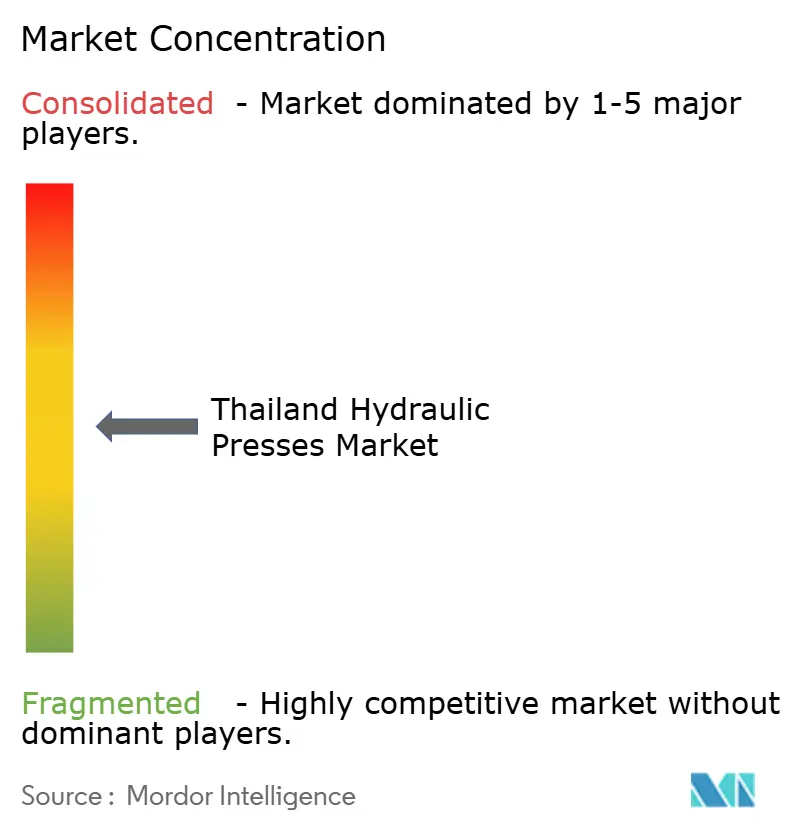
| Market Concentration | Medium |
Major Players *Disclaimer: Major Players sorted in no particular order Image © Mordor Intelligence. Reuse requires attribution under CC BY 4.0. | |
Thailand Hydraulic Presses Market Analysis by Mordor Intelligence
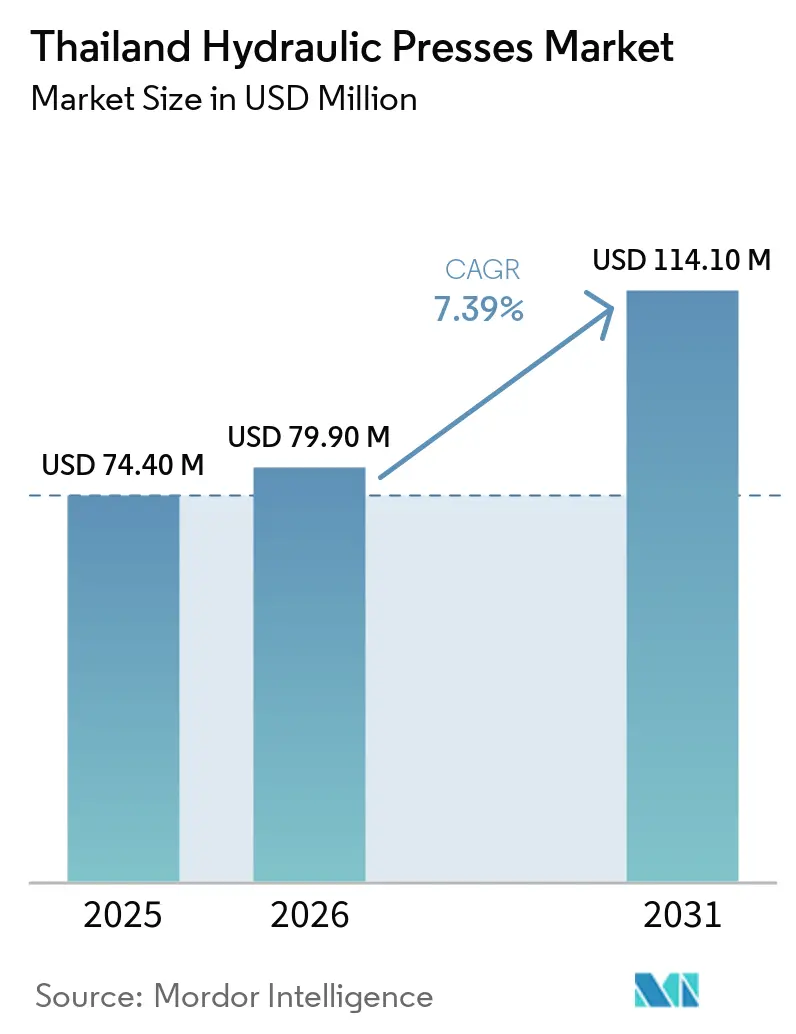
The Thailand hydraulic presses market size was valued at USD 74.4 million in 2025 and is estimated to grow from USD 79.9 million in 2026 to reach USD 114.1 million by 2031, at a CAGR of 7.4% during the forecast period (2026-2031).
Investment in electric vehicles, batteries, and associated components is creating a longer equipment purchasing cycle in Thailand. Manufacturing activity in the Eastern Economic Corridor is concentrating demand for body-panel, battery-enclosure, and structural-component forming equipment. Suppliers are also replacing older equipment to improve energy performance, safety controls, and connectivity. Higher precision requirements are favoring hydraulic systems in applications involving deep drawing, heavy forming, and composite materials. At the same time, mechanical, servo, and electric equipment are competing for lighter forming work, which limits demand in some applications.
Key Report Takeaways
- By frame configuration, C-frame or gap-frame presses held 31.5% of the Thailand hydraulic presses market share in 2025, while Four-Post or Four-Column presses are forecast to grow at a 7.9% CAGR through 2031.
- By tonnage, the 101–500 ton category accounted for 34.5% of the Thailand hydraulic presses market size in 2025, while presses above 2,000 tons are projected to expand at an 8.3% CAGR through 2031.
- By application, sheet metal forming and deep drawing held 28.0% of the Thailand hydraulic presses market share in 2025, while compression molding is expected to record an 8.6% CAGR through 2031.
- By end-use industry, automotive and transportation held 42.0% of the market revenue in 2025, while electrical and electronics is projected to advance at a 7.5% CAGR through 2031.
Note: Market size and forecast figures in this report are generated using Mordor Intelligence’s proprietary estimation framework, updated with the latest available data and insights as of January 2026.
Thailand Hydraulic Presses Market Trends and Insights
Drivers Impact Analysis*
| Driver | (~) % Impact on CAGR Forecast | Geographic Relevance | Impact Timeline |
|---|---|---|---|
| EV Battery, Body, and Lightweight Component Forming Investment | +2.1% | EEC core, Rayong, Chonburi, and Chachoengsao, with spillover to Greater Bangkok | Medium term (2-4 years) |
| Automotive Supplier Retooling for xEV Production | +1.8% | EEC core, Samut Prakan, and Ayutthaya automotive clusters | Medium term (2-4 years) |
| Automation, Robotics, and Connected Press Adoption | +1.4% | EEC and Bangkok industrial zones | Medium term (2-4 years) |
| Aerospace, Defense, and High-Precision Manufacturing Investment | +1% | Lopburi, Don Mueang, and Rayong defense-industrial zones | Long term (≥ 4 years) |
| Brownfield Replacement for Energy, Safety, and Controls Obsolescence | +0.8% | National, with early demand in the EEC and Greater Bangkok | Medium term (2-4 years) |
| Local Tooling, Die, and Process-Validation Ecosystem Development | +0.6% | EEC, Ayutthaya, and Chiang Mai tooling clusters | Long term (≥ 4 years) |
| Source: Mordor Intelligence | |||
EV Battery, Body, and Lightweight-Component Forming Investment
Battery enclosure forming and lightweight body-panel stamping are changing press specifications in the Eastern Economic Corridor. Battery cases require deep-drawn aluminum or high-strength steel enclosures. These parts use presses in the 500–2,000 ton range and require tighter parallelism than many earlier vehicle panels. The BOI reported 198 approved EV-related projects worth THB 137 billion (USD 4.35 billion) in May 2026, including THB 12.5 billion (USD 0.37 billion) for traction motors and power-control components across 49 projects. These projects support demand for body-shop, battery-enclosure, and structural-component presses. Precision hydraulic platforms can meet the parallelism and sustained-force requirements of battery-module production more consistently than some mid-range alternatives.
Automotive Supplier Re-tooling for xEV Production
The move from internal combustion vehicles to xEVs is driving retooling among Thailand’s Tier 1 and Tier 2 suppliers. Under the EV3.5 program, eligible automakers that previously imported electric vehicles must increase local production to 2 domestic vehicles for each imported unit in 2026. The requirement becomes more stringent in 2027 and directs more work to local component makers.[1]Thailand Board of Investment, “EV Board Approves Policy Refresh to Strengthen Thailand’s Electric Vehicle Ecosystem,” BOI Thailand, osos.boi.go.th Mazda committed THB 5 billion (USD 0.16 billion) to upgrade Thai facilities for electrified compact SUV production in 2025. The Thailand hydraulic presses market, therefore, benefits when existing body shops need equipment for stronger steel grades, aluminum-intensive structures, greater die-cushion force, and closed-loop force control.
Automation, Robotics, and Connected Press Adoption
Thai manufacturers are pairing hydraulic presses with robot loading, sensors, and connected controls. The BOI approved more than THB 10 billion (USD 0.32 billion) of investment by 5 Chinese robotics companies for a humanoid robot component manufacturing base in the EEC in 2026. The proposed production includes robot frames, motion-control joints, and structural parts made from lightweight and high-strength materials. The National Competitiveness Enhancement Fund also approved 55 automation and digital upgrade projects worth THB 3.54 billion (USD 0.11 billion) for Thai small and medium-sized manufacturers. Connected hydraulic systems can help users schedule seal replacement and reduce unplanned downtime. Established suppliers with sensor-ready equipment and local service capability are better placed as buyers focus on operating costs and safety compliance.
Aerospace, Defense, and High-Precision Manufacturing Investment
Aerospace and defense programs are creating demand for more precise forming equipment. Thailand and Sweden signed a Gripen E/F Phase 1 procurement agreement worth THB 19.5 billion (USD 0.62 billion) in August 2025. The agreement included an offset package above THB 100 billion (USD 3.17 billion) for technology transfer and Thai airframe component manufacturing. Airbus also announced an expanded arrangement with Thai Aviation Industries covering in-country maintenance and structural support in September 2025. Components such as structural fittings, sleeves, and spherical bearings require controlled pressure, precise parallelism, and dwell capability. Qualification periods may last 18–36 months, which delays the conversion of committed capital into production demand.
Restraints Impact Analysis*
| Restraint | (~) % Impact on CAGR Forecast | Geographic Relevance | Impact Timeline |
|---|---|---|---|
| High Capital Cost and Limited SME Financing for Large Press Systems | -1.4% | National, particularly SME clusters in Samut Prakan, Ayutthaya, and Chiang Mai | Medium term (2-4 years) |
| Competition from Mechanical, Servo, and Electric Forming Technologies | -1.1% | EEC electronics and EV battery lines, and Bangkok precision SMEs | Medium term (2-4 years) |
| Shortage of Hydraulic, Controls, and Press-Commissioning Specialists | -0.8% | National, particularly EEC expansion zones | Medium term (2-4 years) |
| Imported Components, Long Lead Times, and Cross-Border Service Dependence | -0.6% | EEC and Greater Bangkok, especially installations above 1,000 tons | Long term (≥ 4 years) |
| Source: Mordor Intelligence | |||
High Capital Cost and Limited SME Financing for Large Press Systems
Large hydraulic systems remain difficult for smaller suppliers to finance. A 500-ton servo-hydraulic press with automation and connected controls requires USD 500,000–USD 2 million in capital. BOI Notification No. 5/2568, effective June 5, 2025, extended the corporate income tax exemption for qualifying SME machinery upgrades to 5 years at 100% of the eligible investment. Eligibility requires at least 51% Thai ownership, consolidated revenue below THB 500 million (USD 15.86 billion), and an eligible investment of at least THB 0.5 million (USD 15.9 thousand). Firms outside these conditions can face a higher replacement burden. The EEC Office also reported a shortage of 50,000 engineers and technicians, which makes capital spending less attractive for firms unable to staff advanced equipment.
Competition from Mechanical, Servo, and Electric Forming Technologies
Mechanical, servo-mechanical, and electric presses compete directly with hydraulic systems below 500 tons. ISO 6909:2026 recognizes hydraulic servo-drive, screw servo-drive, and belt-spring servo-drive press brakes as compliant production equipment. Thailand’s investment-promotion schedule supports servo-drive and energy-efficient press systems without providing a clear preference for hydraulic equipment. In electronics and battery-module assembly, sub-200-ton servo-electric systems can offer repeatable force profiles without hydraulic-fluid exposure. Hydraulic suppliers must therefore rely more heavily on deep drawing, hydroforming, high-tonnage forging, and other specialized applications. This shifts growth in the Thailand hydraulic presses market toward configurations that are harder to replace.
*Our forecasts treat driver/restraint impacts as directional, not additive. The impact forecasts reflect baseline growth, mix effects, and variable interactions.
Segment Analysis
By Frame / Structural Configuration: High-Volume Stamping Lifts C-Frame, Heavy-Duty Forming Moves Four-Post
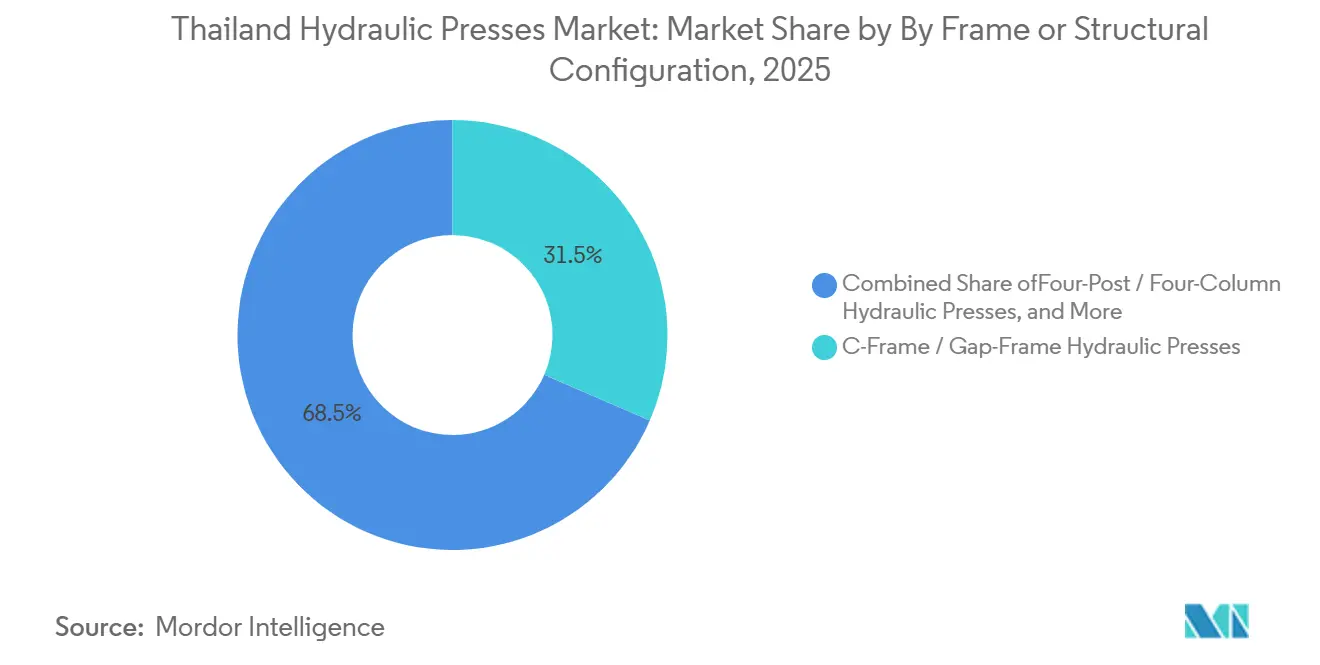
C-Frame or gap-frame presses led the Thailand hydraulic presses market at 31.5% in 2025. Their compact footprint suits mid-volume automotive sub-assembly, electronics stamping, and Tier 2 workshops. Three-sided tool access also supports use in standard factory bays. H-frame, straight-side, and gib-guided equipment is selected where deflection must remain controlled during high-force blanking and deep drawing.
Four-Post or Four-Column presses are forecast to grow at a 7.9% CAGR from 2026 to 2031. Uniform platen pressure makes them suitable for large EV battery enclosures and composite parts. They also support carbon-fiber component forming for aerospace and motorsport supply chains. Greensky Power began construction of a USD 120 million BLDC motor facility in the EEC in June 2025. Rotor lamination forming and magnetic-material compaction can use this equipment. Certified guarding and controlled ram parallelism support procurement requirements in formal supply chains.



By Tonnage / Press Force: Mid-Range Dominates, Ultra-High Tonnage Accelerates on EV and Forging Demand
The 101–500 ton category held 34.5% of the Thailand hydraulic presses market share in 2025. This range matches common needs in automotive Tier 1 and Tier 2 stamping shops. It also supports electronics enclosure forming and general metal fabrication. Structural vehicle parts, door panels, and crossmembers use these specifications in transfer and progressive die operations. Presses up to 100 tons support maintenance, general fabrication, and lighter electronics work.
Presses above 2,000 tons are projected to expand at an 8.3% CAGR from 2026 to 2031. Battery-case deep drawing, structural aluminum die forging, and pressure-vessel forming are supporting this demand. ANDRITZ Schuler completed work to commission a 1,600-ton hydraulic press for a Rayong customer in July 2026. The installation indicates that heavy-tonnage demand is reaching the installed-base stage. Energy-reporting requirements are also encouraging larger facilities to consider servo-hydraulic drives with variable-frequency pump control.
By Application / Forming Process: Sheet Metal Forming Anchors the Market, Compression Molding Accelerates on EV and Composites Demand
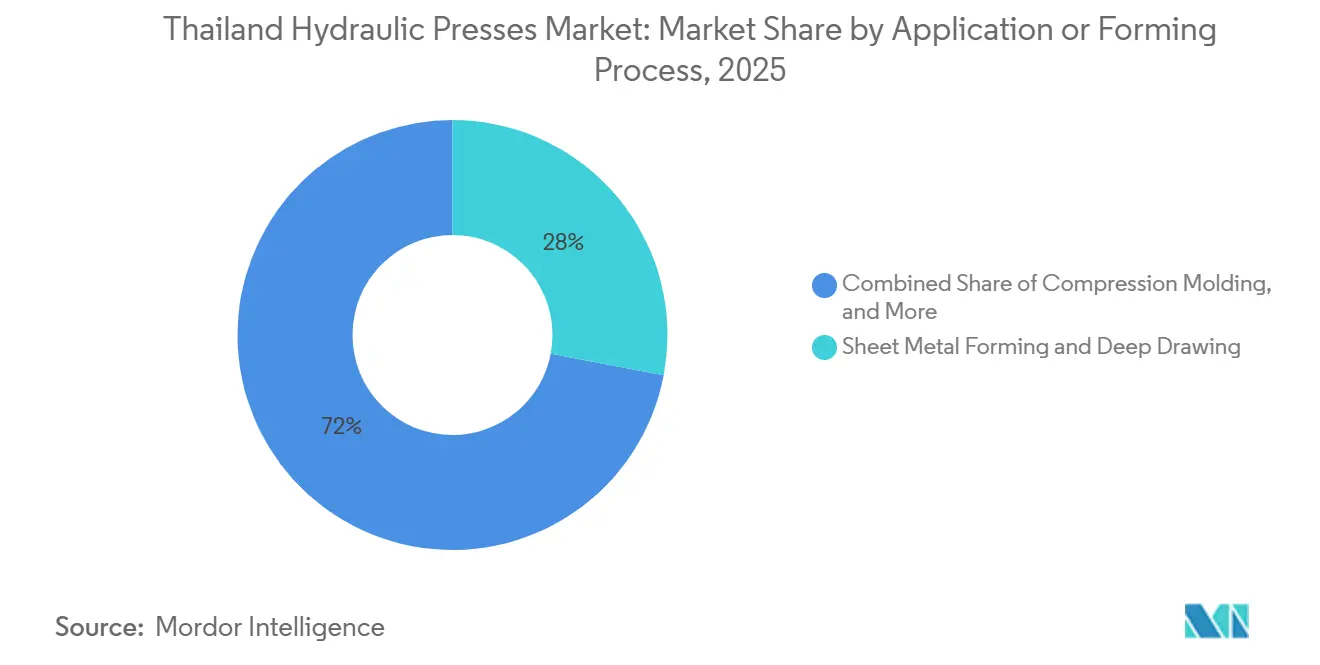
Sheet metal forming and deep drawing accounted for 28% of the Thailand hydraulic presses market size in 2025. Automotive suppliers use these processes for door skins, body-in-white panels, chassis rails, and structural reinforcements. Forging is concentrated in higher-investment facilities that produce crankshafts, suspension knuckles, and powertrain components. Bending, straightening, punching, blanking, coining, assembly, and press fitting serve the wider small and medium-sized fabrication base.
Compression molding is forecast to grow at an 8.6% CAGR from 2026 to 2031. Glass-fiber-reinforced and carbon-fiber-reinforced polymers are increasingly used in EV body structures and battery enclosure lids. The BOI reported more than 180 PCB investment-promotion applications worth above THB 200 billion (USD 6.35 billion) from 2022 to mid-2025. Powder compaction and hydroforming remain specialized applications for titanium parts and high-strength-steel tubular structures. Wabash MPI and DORST Technologies offer dedicated equipment for compression molding and powder compaction.
By End-Use Industry: Automotive Commands the Largest Share, Electrical and Electronics is the Fastest Growing
Automotive and transportation held 42% of the Thailand hydraulic presses market in 2025. The position reflects the scale of installed forming capacity at Japanese-affiliated and Chinese OEM body shops. The sector employed more than 90,000 people directly. Thailand aims to produce 500,000 EVs annually by 2028 across EEC facilities. Registered xEV units reached 238,000 by September 2025 under the EV3 and EV3.5 programs.[2]International Institute for Trade and Development, “Global Supply Chains, How Thai Industry Is Adapting Under Geopolitical Pressure,” ITD Thailand, itd.or.th
Electrical and electronics are projected to grow at a 7.5% CAGR from 2026 to 2031. PCB production and new robotics activity in the EEC are supporting purchases of precision-frame hydraulic and servo-hydraulic presses below 300 tons. The 5 Chinese robotics companies involved in the EEC cluster have BOI-approved investment above THB 10 billion (USD 0.31 billion). The NXPO identified a requirement for 226,423 high-skilled roles in smart electronics and industrial robotics from 2025 to 2029. Buyers also consider contamination control, RoHS requirements, ISO 9001, and IATF 16949 when specifying hydraulic equipment.
Geography Analysis
The Eastern Economic Corridor is the principal demand area for the Thailand hydraulic presses market. Chonburi, Rayong, and Chachoengsao host facilities operated by BYD, Great Wall Motor, Changan, and SAIC-MG. Their body shops and battery assembly lines use presses from 200–2,000 tons. The corridor received investment-promotion applications exceeding THB 2.6 trillion (USD 82.56 billion) from January 2023 to mid-2026. This represented 50% of national investment applications in the stated period. EEC Phase 2 commits THB 540 billion (USD 17.15 billion) over 5 years. The program includes THB 180 billion (USD 5.71 billion) for EV and battery manufacturing. The Thailand hydraulic presses market benefits from this concentration of factory investment.
Greater Bangkok and the Central region form the second-largest demand cluster. Samut Prakan, Pathum Thani, Nakhon Pathom, and Ayutthaya contain established Japanese-affiliated automotive supply chains. Many presses in this area are 10–25 years old. This creates replacement demand for energy, safety, and controls upgrades. Factories using more than 1,000 kW are designated factories that must report energy management to DEDE. EGAT and DEDE signed an agreement in March 2025 to integrate their machinery energy-efficiency labeling work.[3]Electricity Generating Authority of Thailand, “DEDE and EGAT to Set National Energy Efficiency Label Standard,” EGAT, egat.co.th
Northern Thailand has electronics and precision-component activity in Lamphun and Chiang Mai. These locations create demand for lightweight-frame presses below 200 tons. Southern and other regional zones have a smaller share of demand, linked to rubber processing and food-processing equipment fabrication. Regional BOI incentives can partly offset logistics and infrastructure constraints outside Bangkok and the EEC. Connected press systems and IIoT retrofits remain less established in these regions. Provincial service networks could support wider adoption in the Thailand hydraulic presses market over time.
Competitive Landscape
The Thailand hydraulic presses market is moderately fragmented. European and Japanese suppliers are active in premium metalworking, aerospace, and precision applications. Chinese manufacturers are expanding in volume in automotive and mid-range applications. This split reflects different requirements for precision, service, equipment price, and installation support. ANDRITZ Schuler has a visible service and installation presence in the EEC. Its Rayong commissioning project involved a 1,600-ton hydraulic press in July 2026. Komatsu Industries markets servo and hydraulic equipment in Thailand. Its position relies on Japanese quality expectations as Chinese competitors compete on price.
Matsuki Thailand, MEC Machinery, Komatsu Industries Thailand, Kulawat Engineering, Vorawut Hydraulic, and Sanshin High Technology are among the local providers. They compete through installation speed, local parts availability, local pricing, and repair capabilities. Vorawut Hydraulic serves the installed base through hydraulic power-unit service and repair. Yangli Group and JIER Machine-Tool Group compete strongly in the 200–500 ton category. Their machines can qualify for duty relief under promoted manufacturing activities.[4]Thailand Board of Investment, “Eligible Activities for Promotion by Business Categories, Machinery, Automotive, Electrical Appliances and Electronics Industries,” BOI Thailand, boi.go.th This creates price pressure in general fabrication. Buyers still need supplier support for installation, tooling, commissioning, and ongoing maintenance.
The Thailand hydraulic presses market has an opening for energy-efficient servo-hydraulic retrofits in Greater Bangkok and Central Thailand. Turnkey press cells with robot loading, die change, and connected controls are relevant for smaller suppliers. ISO 16092-3 safety compliance is increasingly important in automotive and aerospace procurement. This can favor suppliers that provide certified guarding and controlled operation. Industrial connectivity, maintenance analytics, and energy monitoring are shifting buyer attention toward service capability. Companies with local technical teams can respond more directly to these requirements. The Thai hydraulic presses industry remains differentiated by installation support and lifecycle service, not only equipment price.
Thailand Hydraulic Presses Industry Leaders
ANDRITZ Schuler Group
Komatsu Industries Corp.
Yangli Group
JIER Machine-Tool Group Co., Ltd.
SIEMPELKAMP Group
- *Disclaimer: Major Players sorted in no particular order

Recent Industry Developments
- July 2026: ANDRITZ Schuler's Thailand service team completed rigging, assembly, and commenced commissioning of a 1,600-ton hydraulic press for a new customer in Rayong, extending the company's installed-base footprint into one of the EEC's highest-press-density industrial zones.
- June 2026: The BOI approved BOI-supported investment from Minebea Mitsumi Group for a precision aircraft component manufacturing facility in Lopburi, covering high-precision flight propulsion and structural components such as balls, race bushes, spherical bearings, bolts, and sleeves for Airbus and Boeing platforms, requiring hydraulic press and precision forming equipment.
- May 2025: Changan Automobile launched production at its first international NEV manufacturing base in Rayong, having invested THB 10 billion (USD 0.32 billion), with the facility incorporating body shop, paint shop, powertrain workshop, and battery assembly operations.
- March 2025: EGAT and DEDE signed a cooperation agreement to study the integration of EGAT's Energy-saving Label No.5 and DEDE's Energy Efficiency Label for machinery and high-efficiency industrial equipment, with the objective of establishing a single national standard that will tighten energy performance baselines for press systems in designated factories.


Thailand Hydraulic Presses Market Report Scope
| C-Frame / Gap-Frame Hydraulic Presses |
| H-Frame / Straight-Side / Gib-Guided Hydraulic Presses |
| Four-Post / Four-Column Hydraulic Presses |
| Two-Post / Column Hydraulic Presses |
| Benchtop / Workshop Hydraulic Presses |
| Other Specialized Hydraulic Press Configurations |
| Up to 100 Tons |
| 101–500 Tons |
| 501–1,000 Tons |
| 1,001–2,000 Tons |
| Above 2,000 Tons |
| Sheet Metal Forming and Deep Drawing |
| Forging |
| Bending and Straightening |
| Punching, Blanking and Coining |
| Compression Molding |
| Powder Compaction |
| Hydroforming |
| Assembly, Press-Fitting and General Pressing |
| Other Specialized Applications |
| Automotive and Transportation |
| Aerospace and Defense |
| Industrial Machinery and General Manufacturing |
| Electrical and Electronics |
| Plastics, Rubber and Composites |
| Construction and Heavy Equipment |
| Energy and Power Equipment |
| Rail and Marine |
| Powder Metallurgy, Ceramics and Advanced Materials |
| Other End-Use Industries |
| By Frame / Structural Configuration | C-Frame / Gap-Frame Hydraulic Presses |
| H-Frame / Straight-Side / Gib-Guided Hydraulic Presses | |
| Four-Post / Four-Column Hydraulic Presses | |
| Two-Post / Column Hydraulic Presses | |
| Benchtop / Workshop Hydraulic Presses | |
| Other Specialized Hydraulic Press Configurations | |
| By Tonnage / Press Force | Up to 100 Tons |
| 101–500 Tons | |
| 501–1,000 Tons | |
| 1,001–2,000 Tons | |
| Above 2,000 Tons | |
| By Application / Forming Process | Sheet Metal Forming and Deep Drawing |
| Forging | |
| Bending and Straightening | |
| Punching, Blanking and Coining | |
| Compression Molding | |
| Powder Compaction | |
| Hydroforming | |
| Assembly, Press-Fitting and General Pressing | |
| Other Specialized Applications | |
| By End-Use Industry | Automotive and Transportation |
| Aerospace and Defense | |
| Industrial Machinery and General Manufacturing | |
| Electrical and Electronics | |
| Plastics, Rubber and Composites | |
| Construction and Heavy Equipment | |
| Energy and Power Equipment | |
| Rail and Marine | |
| Powder Metallurgy, Ceramics and Advanced Materials | |
| Other End-Use Industries |


Key Questions Answered in the Report
What is the forecast for hydraulic presses in Thailand?
The Thailand hydraulic presses market is projected to increase from USD 79.9 million in 2026 to USD 114.1 million by 2031, at a 7.4% CAGR. EV, battery, and automotive investments are central to the equipment outlook described in this report.
Which press configuration leads demand in Thailand?
C-frame or gap-frame equipment led demand with 31.5% in 2025, supported by automotive sub-assembly and electronics stamping requirements. Four-post or four-column presses are expected to grow faster because they support larger battery and composite parts.
Which tonnage category is growing the fastest?
Presses above 2,000 tons are forecast to grow at an 8.3% CAGR through 2031. Battery-case drawing, structural aluminum die forging, and pressure-vessel forming are the stated demand areas for this category.
What applications support equipment purchases?
Sheet metal forming and deep drawing led with 28% in 2025, while compression molding is forecast to grow at an 8.6% CAGR. These processes support vehicle panels, structural parts, composite materials, and specialized production needs.
Which end-use sector has the largest requirement?
Automotive and transportation held 42% in 2025, while electrical and electronics are expected to be the fastest-growing end-use at a 7.5% CAGR. Electronics demand is linked to PCB production and expanding robotics activity in the EEC.
Why is the Eastern Economic Corridor important?
The corridor concentrates on EV, battery, and component manufacturing. This concentration supports demand for body-shop, battery-enclosure, and precision forming systems, alongside the local services needed to operate them.
Page last updated on:





