
Thailand Beach Hotels and Resorts Market Size and Share
Market Overview
| Study Period | 2022 - 2032 |
|---|---|
| Forecast Data Period | 2027 - 2032 |
| Base Year Market Size (2026) | USD 23.53 Billion |
| Market Size (2027) | USD 24.94 Billion |
| Market Size (2032) | USD 33.59 Billion |
| Growth Rate (2027 - 2032) | 6.14 % |
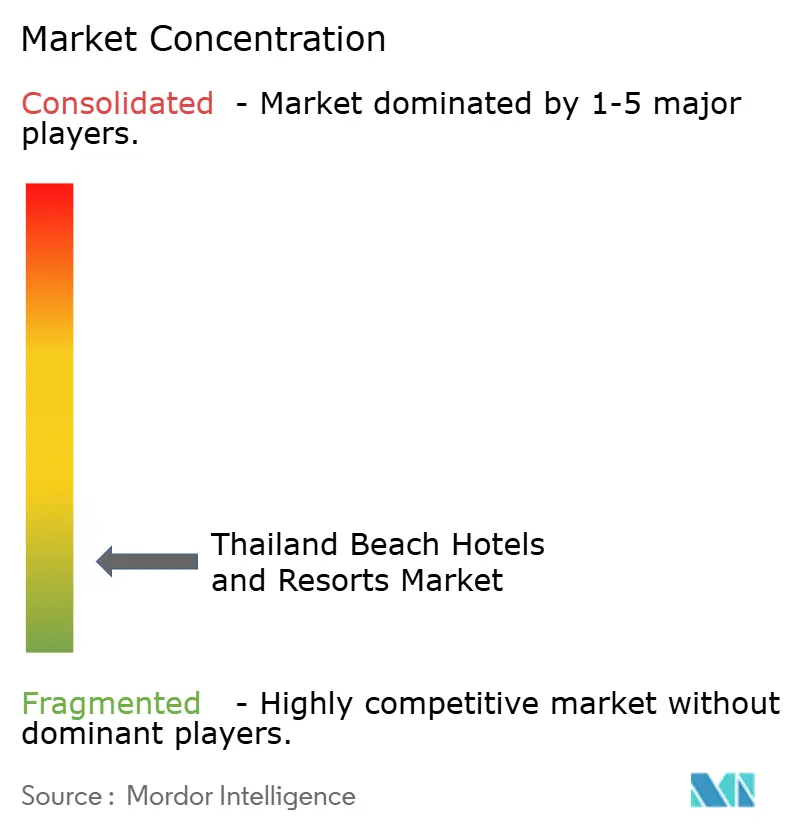
| Market Concentration | Low |
Major Players *Disclaimer: Major Players sorted in no particular order Image © Mordor Intelligence. Reuse requires attribution under CC BY 4.0. | |
Thailand Beach Hotels and Resorts Market Analysis by Mordor Intelligence
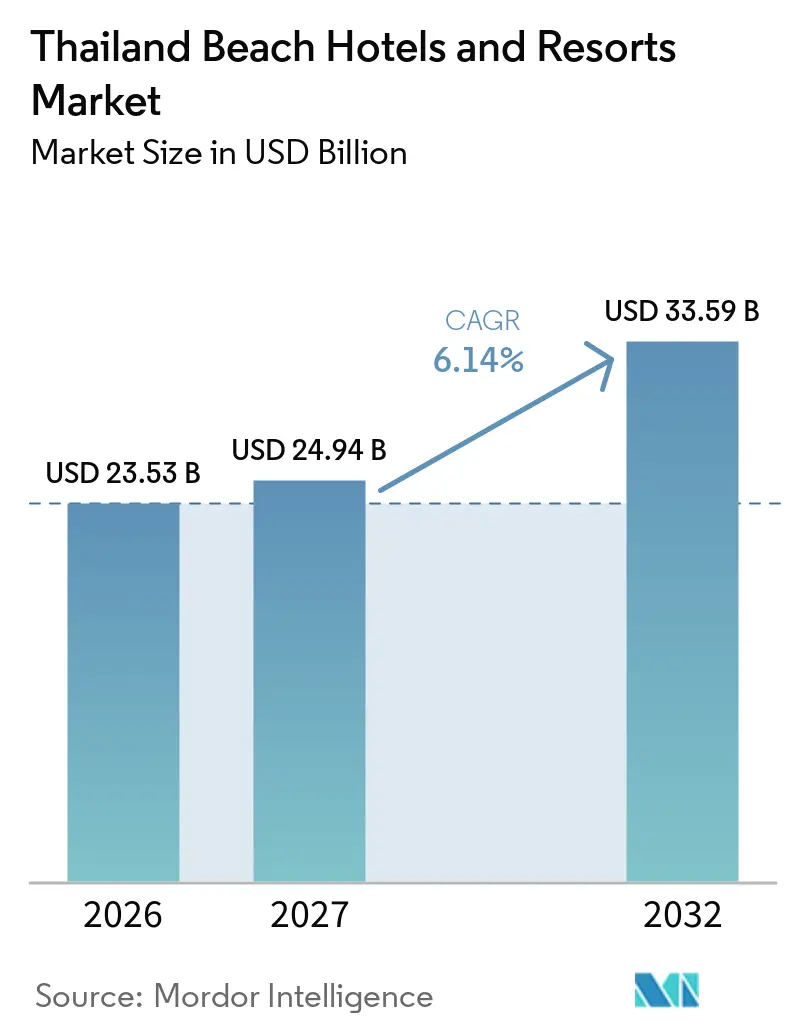
The Thailand beach hotels and resorts market size was valued at USD 23.53 billion in 2026 and is estimated to grow from USD 24.94 billion in 2027 to reach USD 33.59 billion by 2032, at a CAGR of 6.14% during the forecast period (2027-2032). The Thailand beach hotels and resorts market is moving toward longer stays, higher guest spending, and accommodation that combines leisure, wellness, dining, and local experiences. Thailand earned THB 2.70 trillion (USD 86.6 billion) in tourism revenue in 2025, while domestic trips rose 2.7% to 202.37 million and international arrivals fell 7.2% to 32.97 million, which makes a balanced mix of domestic and overseas demand important for coastal properties. This pattern increases the importance of fast-growing, high-spending source markets, such as India, the Middle East, and Western Europe, whose travelers often book beach holidays, weddings, and wellness stays. Operators are therefore placing greater emphasis on service quality, direct relationships with guests, and products that can sustain room rates rather than depend only on high visitor volumes. The Thailand beach hotels and resorts market also faces pressure from unlicensed rentals, seasonal demand, and tighter coastal rules, which favor licensed operators with strong compliance, distribution, and financial capacity.
Key Report Takeaways
- By accommodation type, Luxury Beach Hotels and Resorts accounted for 32.94% of the Thailand beach hotels and resorts market share in 2026, while Eco-Resorts and Regenerative Beach Resorts are projected to grow at a 6.94% CAGR through 2032.
- By booking channel, Online Travel Agencies accounted for 40.72% of the Thailand beach hotels and resorts market share in 2026, while Direct Booking Channels are projected to grow at a 7.24% CAGR through 2032.
- By property type, Independent Properties accounted for 54.93% of the Thailand beach hotels and resorts market share in 2026, while Chain / Branded Properties are projected to grow at a 7.41% CAGR through 2032.
- By tourism type, International Tourism accounted for 62.84% of the Thailand beach hotels and resorts market share in 2026, while Domestic Tourism is projected to grow at a 7.82% CAGR through 2032.
- By geography, Southern Thailand’s Andaman Coast accounted for 42.81% of the Thailand beach hotels and resorts market share in 2026, while Southern Thailand’s Gulf Coast is projected to grow at a 7.93% CAGR through 2032.
Note: Market numbers in this report are based on Mordor Intelligence's proprietary estimation framework, which combines nine months of actuals with Q4 projections for base year 2026.
Thailand Beach Hotels and Resorts Market Trends and Insights
Drivers Impact Analysis*
| Driver | (~) % Impact on CAGR Forecast | Geographic Relevance | Impact Timeline |
|---|---|---|---|
| Recovery and Diversification of International Arrivals | +1.8% | Andaman Coast and Gulf of Thailand core, with spillover to Eastern Thailand and other coastal areas | Short term (≤ 2 years) |
| Premiumization of Coastal Stays and Experiential Hospitality | +1.3% | Global, with the strongest relevance in Phuket, Koh Samui, and Krabi | Medium term (2-4 years) |
| Expansion of Integrated Resorts | +0.8% | Phuket Bang Tao, Koh Samui North Shore, and Krabi Ao Nang | Medium term (2-4 years) |
| Growth in Mobile, OTA, and Direct Reservations | +0.7% | Global, with the highest conversion relevance in Phuket and Bangkok-adjacent beach destinations | Short term (≤ 2 years) |
| Rising Demand for Weddings, Wellness, Island Hopping, and Family Holidays | +0.6% | Southern Gulf Coast and Andaman Coast, supported by Indian and United Kingdom travelers | Medium term (2-4 years) |
| Hotel Investment and Upgrades Supported by Connectivity | +0.5% | Phuket, Krabi, Pattaya, and Hua Hin | Long term (≥ 4 years) |
| Source: Mordor Intelligence | |||
Recovery and Diversification of International Arrivals
Thailand recorded 32.97 million international arrivals in 2025, down 7.23% from the previous year. However, shifts in the visitor mix have affected demand for beach resorts. India contributed 2.49 million arrivals and THB 93.86 billion (USD 2.98 billion) in tourism revenue in 2025, while the Ministry of Tourism and Sports reported a 22.61% increase in spending. This trend diversified the demand base for the Thailand beach hotels and resorts market and reduced reliance on large group-tour volumes from a single source market. Indian travelers were particularly relevant to Phuket, Krabi, and Koh Samui, given demand for destination weddings, family vacations, luxury stays, and short-haul international travel. Thailand’s 2026 target of 36.7 million international arrivals and THB 2.78 trillion (USD 88.3 billion) in tourism revenue depends on demand from Western Europe, India, Russia, the Middle East, and China[1]. Properties offering personalized services, flexible family accommodation, and credible wedding or wellness packages were better positioned to address this diverse visitor mix.
Premiumization of Coastal Stays and Experiential Hospitality
Coastal stays are becoming more central to the Thailand beach hotels and resorts market, as guests pay for privacy, wellness, dining, and distinctive resort settings. Luxury and upper-upscale properties can command higher rates by offering private villas, tailored activities, and strong service standards. International hotel groups’ development pipelines continue to include luxury resort concepts in Phuket and Koh Samui. This trend is widening the gap between luxury resorts and properties that compete primarily on room rates. Destination wedding groups, including those from India, also support this positioning, as event budgets can include accommodations, food and beverage, ceremony venues, and extended stays. Operators gain the greatest commercial benefit when they position beach locations as complete stays rather than room-only products.
Expansion of Integrated Resorts
Integrated resorts combine accommodation with dining, wellness, event spaces, marine activities, and entertainment, encouraging guests to spend beyond room rates. This model can support the Thailand beach hotels and resorts market by creating more opportunities for on-property expenditure. In January 2025, ONYX Hospitality Group announced its joint venture with Equatorial Group to develop EQ Phuket at Kata Beach, following an agreement signed on November 18, 2024. As of May 2026, the project’s total investment value was approximately THB 2.8 billion (USD 88.9 million), with around 170 keys planned, including pool villas, suites, and guest rooms[2]. The resort will combine hilltop views with direct beach access and is expected to open in the second quarter of 2028. Wellness tourism presents a complementary opportunity: Tourism Authority of Thailand material indicates that health and wellness travelers spend around THB 100,000 (about USD 3,175) per trip. Resorts can potentially capture this demand through wellness programs, fitness facilities, food experiences, and locally rooted activities. Such strategies are most viable where destinations and operators have the space, infrastructure, and investment capacity to deliver multiple services consistently.
Growth in Mobile, OTA, and Direct Reservations
Digital discovery is a key route into the Thailand beach hotels and resorts market, as many travelers compare coastal destinations, room types, and prices online before booking. Online travel agencies hold the largest channel share because they provide broad reach, search tools, and booking confidence for international guests. However, direct bookings are growing faster as hotel groups seek greater control over guest data, communications, and commission costs. Minor Hotels announced a unified application strategy across eight hotel brands in 2025, including Anantara, Avani, and NH Hotels, to consolidate loyalty engagement and support direct reservations. This strategy may challenge smaller independent resorts that lack comparable technology platforms and loyalty databases. For international guests, resorts can improve direct conversion through a clear mobile booking experience, localized payment options, and prompt responses to wedding and family inquiries without changing the core resort product.
Restraints Impact Analysis*
| Restraint | (~) % Impact on CAGR Forecast | Geographic Relevance | Impact Timeline |
|---|---|---|---|
| Seasonal Demand Fluctuations | -0.6% | Andaman Coast, with different Gulf of Thailand seasonality providing some offset | Short term (≤ 2 years) |
| Exposure to International Tourism Downturns | -0.5% | Global, with Phuket and Pattaya most exposed because of international dependence | Medium term (2-4 years) |
| Competition from Villas, Condominiums, Rentals, and Unlicensed Accommodation | -0.5% | Phuket, Koh Samui, Koh Phangan, Koh Tao, and Pattaya | Medium term (2-4 years) |
| Environmental Restrictions, Coastal Rules, and Infrastructure Pressure | -0.4% | Koh Samui, Koh Phangan, Koh Tao, Phuket coastal areas, and Krabi buffer zones | Long term (≥ 4 years) |
| Source: Mordor Intelligence | |||
Seasonal Demand Fluctuations
Seasonal demand poses an operational challenge for beach hotels, as room demand, occupancy, and guest spending vary significantly by month. The Andaman Coast experiences a monsoon period from May to October, while the Gulf of Thailand follows a different rainfall pattern, providing portfolio balance. The Thailand beach hotels and resorts market requires flexible staffing, pricing, and promotional strategies during off-peak periods. Domestic tourism provides an occupancy base, with Thailand recording 202.37 million domestic trips in 2025[3]. Domestic travelers may book closer to travel dates and respond to package offers, making effective rate management essential for coastal operators. Resorts with properties in both the Andaman and Gulf regions can leverage their differing peak seasons more effectively than single-destination operators.
Exposure to International Tourism Downturns
Inbound tourism remains critical to the Thailand beach hotels and resorts market, with international tourism accounting for 62.84% of market value in 2026. Thailand recorded a 7.23% decline in international arrivals in 2025, highlighting coastal properties’ exposure to demand shocks. Chinese arrivals fell to 4.47 million, further illustrating the risks for properties that depend on group-tour demand. Phuket and Pattaya may be particularly exposed due to their reliance on overseas leisure travelers. Diversifying demand across India, Russia, Europe, and the Middle East can mitigate, but not eliminate, this risk. Operators need strategies that combine source-market diversification, domestic offerings, and products that protect rate quality during periods of weaker international demand.
*Our forecasts treat driver/restraint impacts as directional, not additive. The impact forecasts reflect baseline growth, mix effects, and variable interactions.
Consumer Behavior Analysis
International tourism accounted for 62.84% of Thailand’s beach hotels and resorts market value in 2026. Demand includes leisure travel, family holidays, weddings, and wellness tourism. Thailand hosted more than 1,200 Indian weddings between 2023 and 2024, with budgets of THB 10 million (USD 0.32 million) to THB 20 million (USD 0.64 million) per event. The Tourism Authority of Thailand reported that wellness tourists spent an average of THB 100,259 (USD 3,183.48) per person per trip. These segments enable resorts to bundle accommodations with spa treatments, dining, celebrations, and curated activities, increasing revenue beyond room bookings.
Digital discovery and booking convenience influence resort selection, making online distribution and direct guest engagement important. Minor Hotels signed 40 hotel contracts and master agreements in 2025 and emphasized its unified GHA DISCOVERY loyalty platform. Beach resorts can adopt similar approaches through mobile-friendly booking platforms, transparent family and event packages, and prompt inquiry responses. Clear information on amenities, dining options, safety measures, and wellness offerings can reduce booking friction and convert traveler research into reservations.
Hospitality Performance Intelligence
Thailand’s beach resort performance increasingly depends on visitor spending as well as arrival volumes. In 2025, tourism revenue reached THB 2.70 trillion (USD 86.6 billion), while Indian visitors generated THB 93.86 billion (USD 2.98 billion). These trends created opportunities for resorts to target family holidays, weddings, wellness stays, and dining experiences, increasing total guest expenditure beyond room rates.
Seasonality continued to shape occupancy and pricing across Thailand’s coastal destinations. Domestic travel provided a counterbalance in 2025, reaching 202.37 million trips, up 2.70%, and generating THB 1.17 trillion (USD 37.1 billion) in revenue, up 3.69%. International arrivals declined by 7.23%. Resorts could use domestic offers during softer periods and diversify international demand across growing markets, such as India, where arrivals increased by 16.82%, reducing reliance on individual source markets.
Segment Analysis
By Accommodation Type: Luxury Anchors Revenue While Eco Formats Reshape Demand
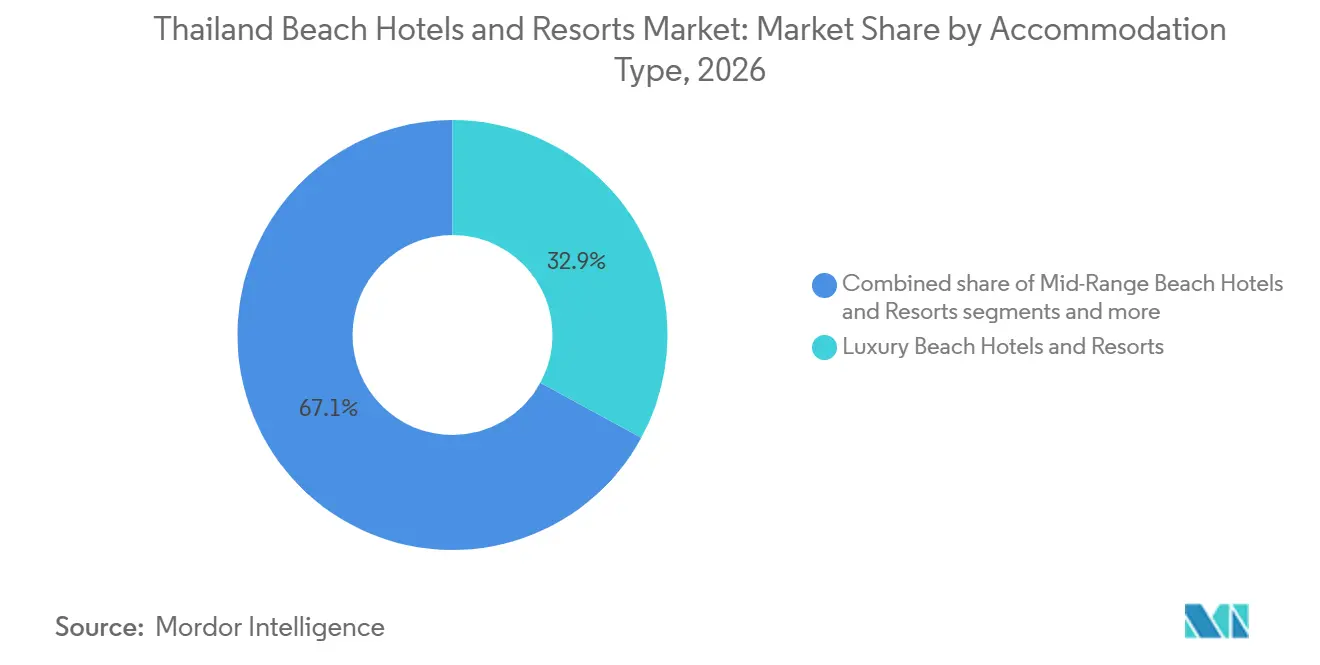
Luxury beach hotels and resorts accounted for 32.94% of the Thailand beach hotels and resorts market in 2026. International demand drives the segment through private villas, oceanfront locations, wellness facilities, high-quality dining, and personalized service. Luxury operators attract international wedding groups and affluent families requiring event spaces and larger accommodations. Hilton initially planned to open the 55-room Nivata Koh Samui, Tapestry Collection by Hilton, on Thong Tanote Beach in June 2026, and reservations are now open from November 2026. The project reflects the expansion of smaller, locally distinctive coastal resorts, while mid-range properties face competition from internationally branded upscale hotels and alternative accommodations.
Eco-resorts and regenerative beach resorts are projected to grow at a CAGR of 6.94% through 2032. Phuket’s GSTC Destination Assessment scored environmental sustainability at 1.43 out of 5, its weakest pillar and an area of moderate risk, highlighting the need for stronger visitor management, environmental protection, and resource management[4]. In June 2026, OUTRIGGER achieved Green Key certification for three Thailand beachfront resorts. Budget, boutique, and lifestyle formats continue to serve domestic, backpacker, design-led, and location-sensitive demand.

By Booking Channel: OTAs Command Share While Direct Bookings Capture Margin
Online travel agencies (OTAs) accounted for 40.72% of the Thailand beach hotels and resorts market size in 2026. They help international travelers compare rates, reviews, locations, and room types before selecting coastal properties. OTAs are particularly important for independent resorts without large marketing budgets or global loyalty programs. However, commissions reduce the net room revenue retained per reservation. Hotels therefore need to manage their channel mix, using OTAs for visibility while strengthening direct websites for repeat guests and higher-value inquiries.
Direct booking channels are forecast to grow at a CAGR of 7.24% through 2032, supported by investments in booking engines, loyalty programs, direct-only packages, and hotel applications. Minor Hotels’ unified app strategy facilitates repeat bookings across multiple brands. Direct channels can help international travelers by clearly communicating room occupancy policies, wedding services, family facilities, meal options, and guest support. Corporate and travel management company bookings remain relevant in destinations with meetings and events activity, including Pattaya and Phuket. Offline agents also support travelers seeking packaged beach holidays or assistance with complex group arrangements.
By Property Type: Independent Scale Meets Branded Distribution
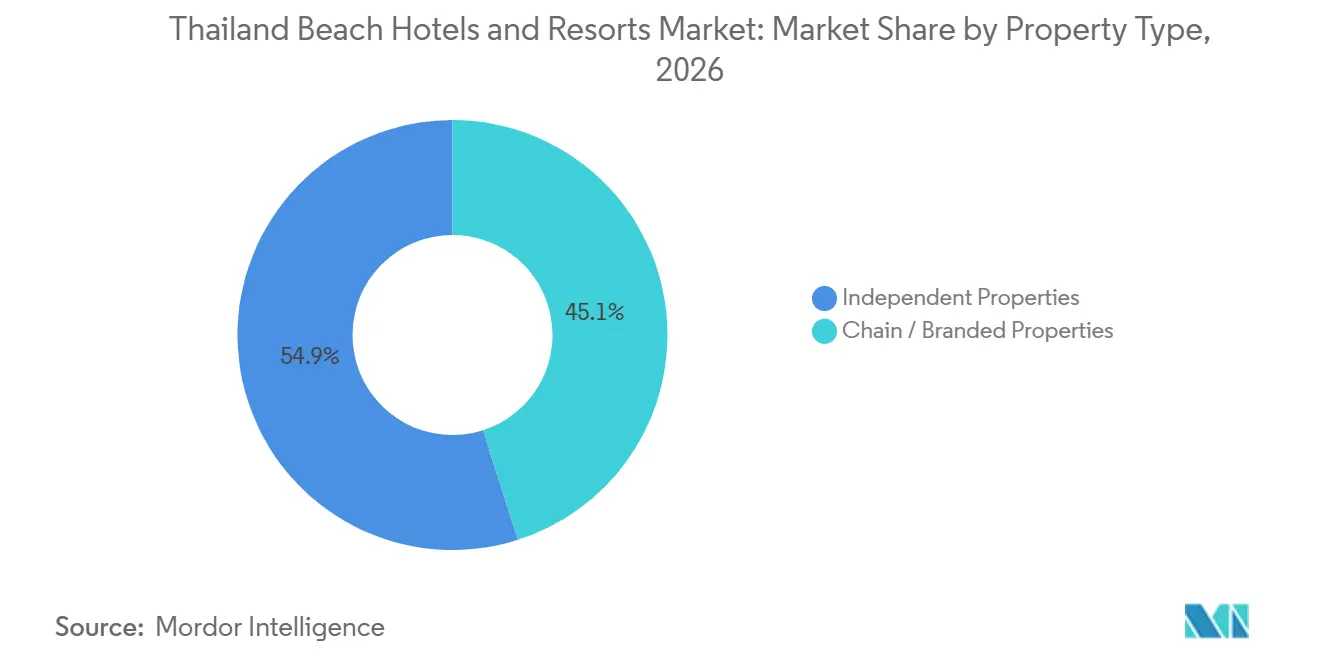
Independent properties accounted for 54.93% of the Thailand beach hotels and resorts market in 2026. This share reflects the established presence of family-owned resorts, local hospitality businesses, and boutique properties along Thailand’s coast. These properties offer local cuisine, community connections, flexible service, and distinctive designs that standardized brands may not replicate. However, limited distribution is a challenge, as international guests increasingly value brand recognition, loyalty programs, and technology platforms. International travelers, including those from India and long-haul markets, may prefer familiar brands for group travel, weddings, and family stays. Independent resorts can sustain their position through local experiences, service quality, and direct guest relationships.
Chain and branded properties are forecast to grow at a 7.41% CAGR through 2032. International hotel groups use management contracts and franchise agreements, allowing local owners to retain real estate ownership while accessing brand systems. In August 2025, IHG signed an agreement for the 175-key voco Phuket Bangtao, its first voco-branded property in Phuket, scheduled to open in 2029, supporting the group’s expansion in Thailand. Accor’s 2026 pipeline includes Navera Phuket and Kamaliss MontAzure Phuket under its MGallery Collection, reflecting continued investment in branded luxury coastal accommodation. Branded options are increasing in the upper-end segment, especially in major destinations, improving visibility while intensifying competition for locally owned resorts with limited distribution.
By Tourism Type: International Revenue Leads, Domestic Growth Accelerates
International tourism accounted for 62.84% of the Thailand beach hotels and resorts market size in 2026. Inbound travelers typically book longer vacations and spend money on accommodation, food and beverages, activities, wellness services, and local transportation. The Ministry of Tourism and Sports reported that 2.49 million arrivals from India generated THB 93.86 billion (USD 2.98 billion) in 2025, highlighting India’s importance to Thailand’s visitor economy. Fast-growing source markets, such as India, add families, couples, wedding groups, and luxury guests, helping properties reduce reliance on East Asian source markets. However, international tourism exposes operators to changes in air connectivity, economic conditions, and destination perceptions.
Domestic tourism is forecast to grow at a 7.82% CAGR through 2032. Thai residents took 202.37 million domestic trips in 2025, providing beach resorts with demand beyond international peak seasons. Domestic guests support weekend stays, school-holiday travel, and short coastal breaks from Bangkok and other urban areas. This segment can fill rooms when international demand weakens, or weather affects overseas bookings. Operators need domestic rates and packages that preserve their positioning among international guests. Faster domestic growth highlights the importance of local loyalty, accessible transportation, and repeat visits in demand planning.
Geography Analysis
Southern Thailand’s Andaman Coast accounted for 42.81% of the Thailand beach hotels and resorts market in 2026. Phuket, Krabi, and Khao Lak form the main beach resort corridor, supported by international air access, beaches, island excursions, and diverse accommodation. Phuket attracts international visitors, including from India, seeking luxury, wedding, and family travel, while Krabi offers a nature-focused coastal experience. Global brands and local operators serve varied price points, although competition challenges older mid-market properties. Established infrastructure and supply support the region despite seasonal weather and changes in international demand.
Southern Thailand’s Gulf Coast is projected to grow at a 7.93% CAGR through 2032. Koh Samui, Koh Phangan, and Koh Tao benefit from distinct identities and weather patterns. Koh Samui attracts luxury, wellness, small wedding, and European long-stay visitors. Hilton’s 55-room Nivata Koh Samui is scheduled to open in November 2026. Environmental rules introduced in May 2025 restrict development in sensitive areas across these islands.
Eastern Thailand broadens the market beyond southern clusters. Pattaya benefits from beach leisure, events, entertainment, and proximity to Bangkok. Marriott opened a branded resort on Jomtien Beach in June 2025. Hua Hin, Cha-Am, Koh Samet, Koh Chang, and smaller beach towns serve domestic and less-congested travel demand.
Hospitality Supply & Development Intelligence
Thailand’s beach resort pipeline is shifting toward branded luxury and upscale lifestyle properties. ONYX Hospitality Group revised the EQ Phuket development plan to approximately 170 keys, with an investment of THB 2.8 billion (USD 88.9 million) and an expected opening in Q2 2028. IHG also signed the 175-key voco Phuket Bangtao, scheduled to open in 2029. These projects reflect continued investment in differentiated coastal accommodation, although phased delivery will add inventory over several years rather than simultaneously.
Expansion faces stricter environmental and infrastructure constraints. Thailand’s coastal zoning update in 2025 introduced restrictions on beachfront development, hillside construction, wastewater management, and protected areas across Koh Samui, Koh Phangan, and Koh Tao. These requirements increase compliance and development costs but may preserve the natural assets supporting resort demand. Investors should prioritize feasible sites, infrastructure capacity, and differentiated positioning to mitigate oversupply and strengthen long-term asset resilience.
Competitive Landscape
The Thailand beach hotels and resorts market is highly fragmented. Minor Hotels, Centara Hotels and Resorts, Banyan Group, ONYX Hospitality Group, and Asset World Corporation compete with independent, boutique, and regional properties. Minor Hotels reported 32% profit growth in 2025 and signed 40 hotel contracts and master agreements, supporting its asset-light model. Centara is repositioning properties, including the planned Centara Reserve Krabi rebranding, under its 2026 agenda. Thai operators are strengthening brands, direct channels, and higher-value resort offerings.
International chains are expanding through management agreements and franchises. IHG signed voco Phuket Bangtao, supporting its Thailand growth. Accor added luxury openings in Phuket in 2026 for villa and resort travelers. Marriott expanded in Pattaya in 2025. Outrigger obtained Green Key certification for three Thailand resorts.
Independent beach hotels and resorts compete through locally rooted experiences, reliable service, direct-booking strategies, and environmental standards. Their local connections and flexible ownership can support differentiation and faster decision-making, but they face disadvantages against larger hotel groups in loyalty programs, technology investment, and marketing reach. Regulatory requirements, staffing constraints, environmental pressures, and competition from unlicensed accommodation further challenge their competitiveness.
Thailand Beach Hotels and Resorts Industry Leaders
-
Minor Hotels
-
Centara Hotels & Resorts
-
Banyan Group
-
ONYX Hospitality Group
-
Asset World Corporation
- *Disclaimer: Major Players sorted in no particular order
Recent Industry Developments
- February 2026: Minor Hotels reported its strongest development pipeline to date after signing 40 new hotel contracts and master agreements in 2025, its highest annual total. The group also highlighted four new brands - The Wolseley Hotels, Minor Reserve Collection, Colbert Collection, and iStay Hotels - as part of its global expansion strategy.
- December 2025: Accor scheduled two MGallery Collection properties in Phuket: Navera Phuket, featuring 19 villas at Surin Beach, and Kamaliss MontAzure Phuket, a 150-room resort at Kamala. These developments expand Accor’s planned luxury coastal portfolio through both villa-style and resort-scale accommodation.
- October 2025: CG Capital Advisory announced plans to invest more than THB 5 billion (USD 158.7 million) in five hotels: four in Phuket and one in Koh Samui. The proposed developments add private investment to Thailand’s coastal hospitality pipeline.
- June 2025: Marriott Hotels opened Pattaya Marriott Resort and Spa on Jomtien Beach. The 289-room resort expanded Marriott’s branded hospitality presence on Thailand’s Eastern Seaboard, strengthening its coverage of Pattaya’s coastal tourism market.
Thailand Beach Hotels and Resorts Market Report Scope
The Thailand Beach Hotels and Resorts Market report analyzes accommodation services offered by coastal hotels and resorts catering to domestic and international leisure travelers. The market is segmented by accommodation type, booking channel, property type, tourism type, and coastal geography. The study assesses drivers, including the recovery and diversification of international arrivals, premium beach stays, integrated resort experiences, mobile bookings, social-media discovery, destination weddings, wellness retreats, and tourism infrastructure improvements. It also examines restraints such as seasonal demand fluctuations, dependence on international source markets, competition from alternative accommodation, environmental restrictions, and infrastructure pressures in high-density coastal destinations. The report evaluates hospitality supply, room inventory, occupancy rates, average daily rates, traveler preferences, booking behavior, channel selection, travel spending, and emerging demand patterns. It provides market size and growth forecasts, regional analyses across the Andaman coast, Gulf coast, eastern Thailand, and other coastal destinations, alongside competitive assessments of market concentration, market shares, strategic developments, and profiles of domestic and international hotel groups and resort operators. The study also explores opportunities in sustainable, nature-based beach resorts and premium resort development beyond established destinations. Market estimates and forecasts are presented in value (USD) across all covered segments for 2022-2032.
Key Questions Answered in the Report
What is the projected value of the Thailand beach hotels and resorts market by 2032?
The Thailand beach hotels and resorts market was valued at USD 23.53 billion in 2026 and is projected to reach USD 33.59 billion by 2032, growing at a 6.14% CAGR from 2027 to 2032.
Which accommodation type leads Thailand’s coastal hotel sector?
Luxury Beach Hotels and Resorts lead with a 32.94% share in 2026, while Eco-Resorts and Regenerative Beach Resorts are the fastest-growing accommodation formats at a 6.94% CAGR.
Which region holds the largest share of the Thailand beach hotels and resorts market?
Southern Thailand – Andaman Coast held the largest share at 42.81% in 2026, supported by Phuket, Krabi, and Khao Lak.
Which Thai coastal region is growing fastest?
Southern Thailand’s Gulf Coast, including Koh Samui, Koh Phangan, and Koh Tao, is forecast to grow at a 7.93% CAGR through 2032.
What is the main booking channel for Thailand beach resorts?
Online Travel Agencies accounted for 40.72% of booking-channel value in 2026, although Direct Booking Channels are forecast to grow faster at a 7.24% CAGR.
What are the main risks for beach resort operators in Thailand?
Key risks include seasonal demand swings, dependence on international arrivals, competition from unlicensed rentals, and environmental requirements for coastal development.