
Thailand Aquafeed Market Size and Share
Market Overview
| Study Period | 2022 - 2032 |
|---|---|
| Forecast Data Period | 2027 - 2032 |
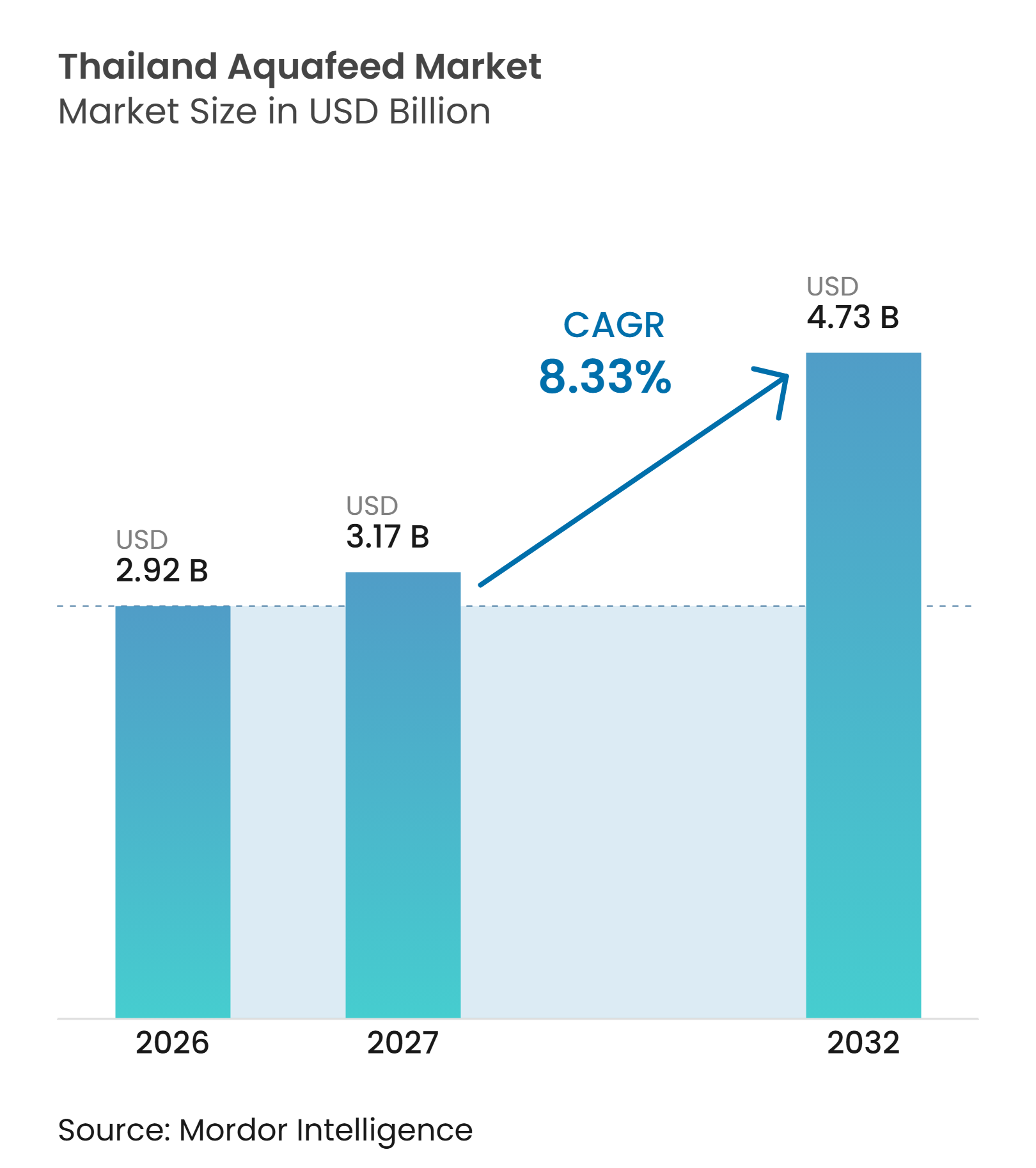
| Base Year Market Size (2026) | USD 2.92 Billion |
| Market Size (2027) | USD 3.17 Billion |
| Market Size (2032) | USD 4.73 Billion |
| Growth Rate (2027 - 2032) | 8.33 % |
| Market Concentration | Medium |
Major Players *Disclaimer: Major Players sorted in no particular order Image © Mordor Intelligence. Reuse requires attribution under CC BY 4.0. | |
Thailand Aquafeed Market Analysis by Mordor Intelligence
The Thailand Aquafeed Market was valued at USD 2.92 billion in 2026, which is estimated to reach USD 3.17 billion in 2027 and is projected to attain USD 4.73 billion by 2032, registering a CAGR of 8.33% between 2027 and 2032. Market growth is being supported by increasing adoption of formulated commercial aquafeed, greater emphasis on feed traceability, and rising certification requirements across export-oriented aquaculture supply chains. Aquaculture producers are increasingly replacing on-farm feed mixtures with nutritionally balanced commercial diets to improve productivity, biosecurity, and compliance with international seafood standards. Growing demand for functional feeds, specialty additives, and species-specific nutrition programs is further strengthening market value growth, particularly in shrimp and freshwater aquaculture. At the same time, feed manufacturers are expanding technical support services, automated feeding solutions, and digital farm-management capabilities to improve feed efficiency and customer retention. However, disease outbreaks, volatility in fishmeal and soybean prices, and competitive pricing pressure within the feed industry continue to affect profitability and purchasing decisions. As a result, suppliers are increasingly differentiating through certification compliance, nutrition expertise, product innovation, and value-added advisory services rather than competing solely on price.
Key Report Takeaways
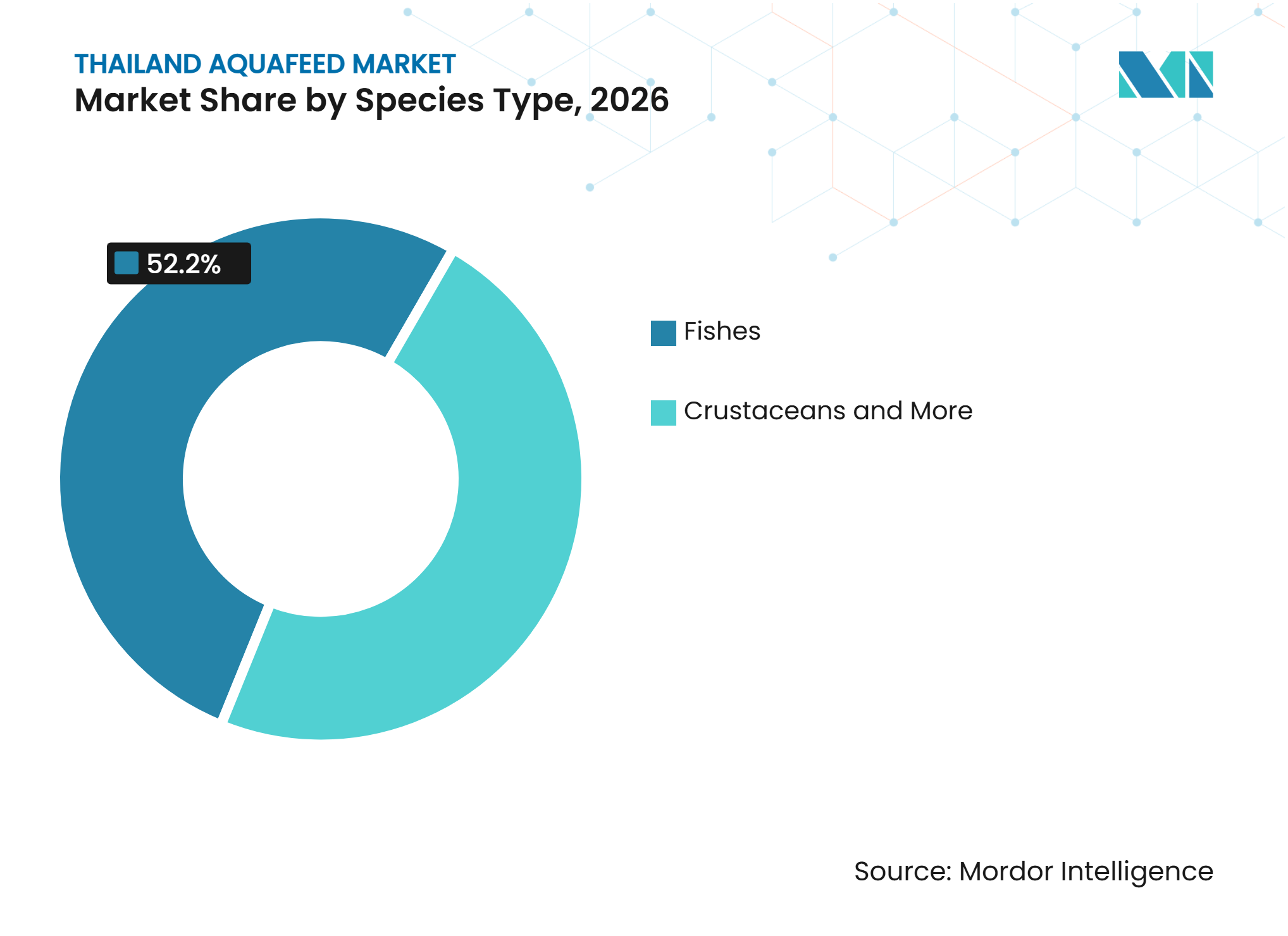
- By species type, Fishes accounted for 52.2% of the Thailand aquafeed market share in 2026, while Giant Freshwater Prawn Feed is forecast to grow fastest at a 10.4% CAGR through 2032.
- By feed type, Grower Feed held 46.1% of the Thailand aquafeed market size in 2026, while Functional and Health Management Feed is projected to grow fastest at an 8.5% CAGR through 2032.
- By ingredient type, Soybean and Soy Products held 28.1% of the Thailand aquafeed market share in 2026, while Enzymes, Probiotics and Antioxidants are forecast to grow fastest at a 9.0% CAGR through 2032.
- By product form, Pellets held 70.2% of the Thailand aquafeed market share in 2026, while Extruded Feed is forecast to grow fastest at an 8.8% CAGR through 2032.
- By lifecycle stage, Juvenile and Grow-Out Stage held 62.1% of the Thailand aquafeed market share in 2026, while Hatchery and Nursery Feed is forecast to grow fastest at a 9.3% CAGR through 2032.
- By production system, Pond Culture held 78.1% of the Thailand aquafeed market share in 2026, while Integrated and Recirculating Systems are forecast to grow fastest at an 11.0% CAGR through 2032.
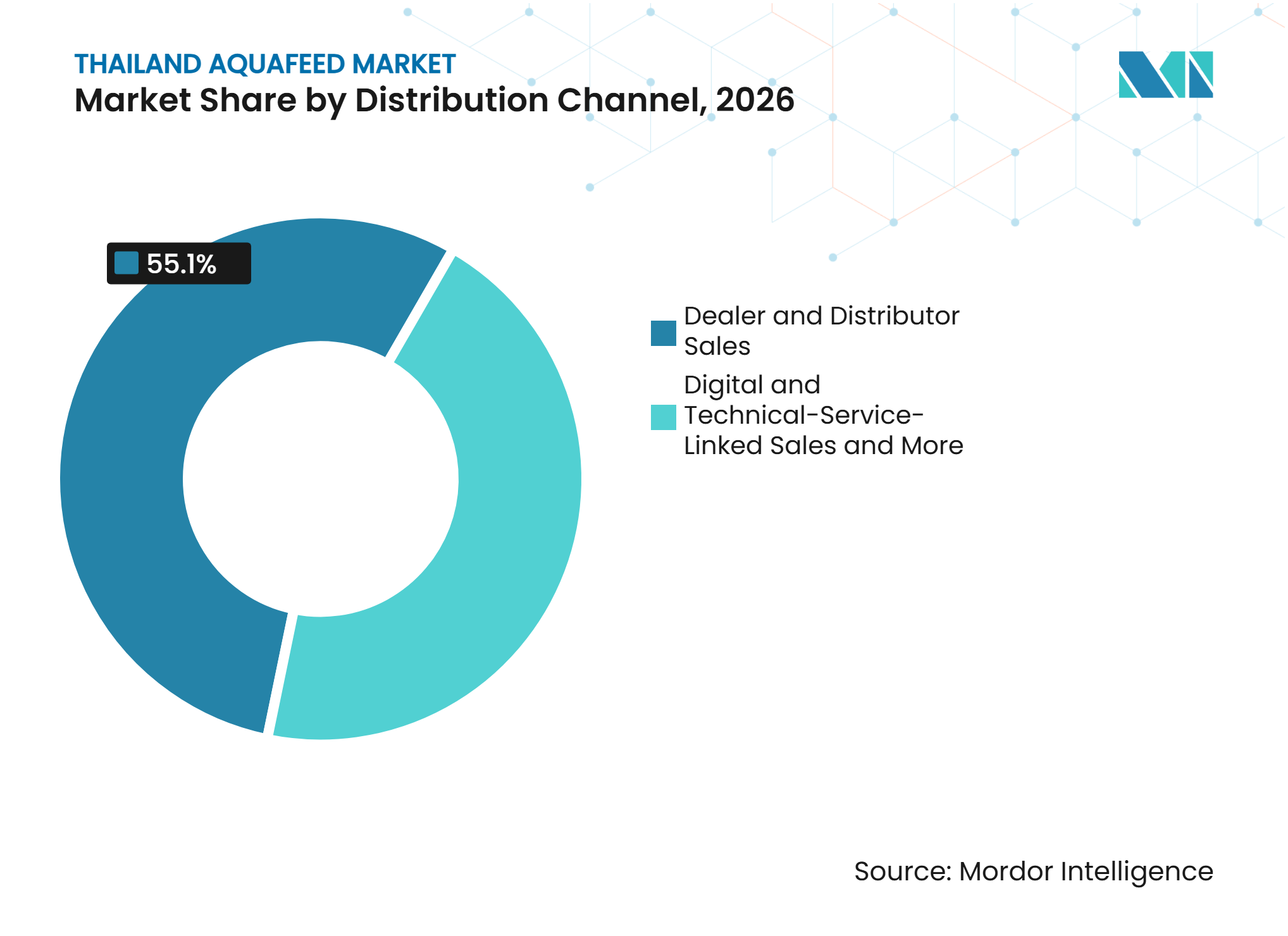
- By distribution channel, Dealer and Distributor Sales held 55.1% of the Thailand aquafeed market share in 2026, while Digital and Technical-Service-Linked Sales are forecast to grow fastest at a 12.0% CAGR through 2032.
- By customer type, Commercial Independent Farms held 48.1% of the Thailand aquafeed market share in 2026, while Hatcheries and Nurseries are forecast to grow fastest at a 9.5% CAGR through 2032.
Note: Market numbers in this report are based on Mordor Intelligence's proprietary estimation framework, which combines nine months of actuals with Q4 projections for base year 2026.
Market Trends and Insights
Drivers Impact Analysis of Thailand Aquafeed Market*
| Driver | % Impact on CAGR Forecast | Geographic Relevance | Impact Timeline |
|---|---|---|---|
| Export Recovery and Premium Seafood Positioning | +2.0% | Southern and Eastern coastal export supply chains | Medium term (2–4 years) |
| Commercial Feed Conversion from On-Farm Mixtures | +1.5% | Freshwater zones nationwide; Central and Northeastern pond farms | Medium term (2–4 years) |
| Precision Feeding to Reduce Disease-Linked Feed Waste | +0.9% | Intensive shrimp clusters in Southern and Eastern Thailand | Short term (≤ 2 years) |
| Certification-Led Demand for Traceable Feed Inputs | +0.8% | Export-oriented shrimp and seabass farms; premium processor supply chains | Long term (≥ 4 years) |
| Growth of Giant Freshwater Prawn Farming | +0.7% | Central Thailand (Chachoengsao, Ratchaburi) and Northeastern freshwater zones | Medium term (2–4 years) |
| Digital Farm Management and Automated Feeding Adoption | +0.6% | Integrated and large-scale commercial farms across all regions | Short to medium term |
| Source: Mordor Intelligence | |||
Export Recovery and Premium Seafood Positioning
Thai shrimp exports from January through October 2025 reached 112,000 metric tons, up 6% year over year, as differential U.S. tariff treatment placed Indian shrimp at a significant disadvantage, with India facing tariffs exceeding 60% versus Thailand's 19%[1]. The Thai Shrimp Association identified this tariff window as a structural opportunity to restore production toward 400,000 metric tons annually and secured government endorsement of a National Agenda for 2025–2030. The feed-specific implication is that premium export buyers purchasing under ASC-aligned or BAP-certified supply chains require certified feed inputs meaning export recovery generates pull-through demand specifically for high-margin formulated diets rather than commodity feed. Thai Union Feedmill Public Company Limited reported shrimp feed volumes from Thailand and export operations rising 26.0% year over year in its Q4 2025 results a figure that substantially outpaces the 1.2% overall shrimp market volume growth, confirming that certified commercial feed is gaining market share within the existing production base. Regulatory influence from ASC-STD-001 version 1.0, effective August 2025, further accelerates this dynamic by setting a May 2027 deadline for ASC-certified farms to source compliant feed.
Commercial Feed Conversion from On-Farm Mixtures
The transition from homemade on-farm feed blends to commercial aquafeed is a durable demand driver, particularly in Thailand's freshwater fish sector where smallholder pond culture remains prevalent. The Department of Fisheries reported tilapia production through the first nine months of 2025 at 274,324 metric tons, valued at USD 400.80 million a segment where on-farm mixing is still widespread[2]. As Thailand's feed labeling and residue regulations under Department of Fisheries guidelines tighten, farm-level mixing becomes a legal liability rather than simply a cost advantage. An SEC management discussion filing by Asian Sea Corporation Public Company Limited for Q3 2025 documented that new commercial feed formulas improved aquatic survival rates and lowered the feed conversion ratio for shrimp clients, enabling farmers to reduce costs while sustaining feed purchase growth a performance demonstration that creates network adoption effects across neighboring farms.
Precision Feeding to Reduce Disease-Linked Feed Waste
Feed waste driven by disease events and suboptimal feeding management represents a larger cost driver in Thai aquaculture than it appears at first glance, because feed accounts for 50–70% of variable production costs in intensive shrimp operations[3]. Research published in the Journal of the World Aquaculture Society in 2025 confirmed that automated and demand-based feeding systems consistently reduce the feed conversion ratio and improve survival rates compared to manual feeding, with the most significant gains in pond environments where overconsumption and sinking pellet loss are hardest to control. Thai Union Feedmill Public Company Limited committed over THB 300 million (approximately USD 8.8 million, using a 2025 average exchange rate of 34 THB/USD) in mid-2025 to upgrade its Mahachai and Ranot production lines to Industry 4.0 standards, producing small-pellet diets compatible with automated dispensing systems on integrated farms, according to the company's official communications. This investment signals a supply-side recognition that feed performance infrastructure not just feed formulation determines commercial outcomes in technology-linked production systems.
Certification-Led Demand for Traceable Feed Inputs
Certification is shifting from a marketing differentiator to a supply-chain entry requirement in Thailand's premium shrimp sector. Charoen Pokphand Foods Public Company Limited's Ban Bueng aquafeed mill received ASC Feed Standard certification in November 2025, while Thai Union Feedmill Public Company Limited had already secured ASC Feed Standard certification for its Mahachai plant in 2024 the first such certification in Asia establishing a certification arms race among leading mills, according to Aquafeed.com. The commercial consequence is structural: ASC-certified farms must source from ASC-certified feed mills by May 2027, creating a premium sub-market that excludes non-certified competitors regardless of price. One second-order effect is that certification investment systematically disadvantages smaller regional feed mills lacking the capital and audit management resources to pass ASC requirements, quietly concentrating the premium shrimp-feed segment even as the mid-tier commodity segment remains fragmented.
Restraints Impact Analysis of Thailand Aquafeed Market*
| Restraint | % Impact on CAGR Forecast | Geographic Relevance | Impact Timeline |
|---|---|---|---|
| Shrimp Disease and Biosecurity Volatility | -2.0% | Southern and Eastern shrimp zones; intensive coastal pond operations | Short to medium term |
| Fishmeal and Soybean Cost Exposure | -1.5% | All feed-manufacturing centers; most acute for shrimp and marine finfish producers | Short term (≤ 2 years) |
| Low-Cost Competition from Regional Shrimp Producers | -1.2% | Coastal export supply chains; most severe for export-volume feed demand recovery | Medium to long term |
| Feed-Mill Overcapacity and Margin Pressure | -0.8% | Shrimp-feed manufacturing clusters in Southern and Eastern Thailand | Medium term (2–4 years) |
| Source: Mordor Intelligence | |||
Shrimp Disease and Biosecurity Volatility
Disease risk is the most persistent constraint on Thailand's shrimp feed demand, as a forced pond fallowing event eliminates feed purchases entirely rather than simply reducing them. A 2025 peer-reviewed study published in PMC documented the first occurrence in Thailand of Decapod Hepanhamaparvovirus genotype V, found in 54.33% of sampled ponds and co-infecting with Enterocytozoon hepatopenaei in 40.16% of those with the co-infection causing distinct microbiome disruption likely to exacerbate growth retardation. BIOTEC, NSTDA, received a GBP 100,000 (approximately USD 127,000) IVVN Pump Priming grant in 2025 to develop an RNAi vaccine candidate against Enterocytozoon hepatopenaei, indicating government-funded disease research is at an early but commercially significant stage. For feed producers, the strategic counterweight is the growing commercial value of functional immunostimulant feeds that command higher per metric ton margins precisely because they demonstrate measurable survival improvements in disease-challenged ponds. Thai Union Feedmill Public Company Limited's Q4 2025 disclosures noted a gourami disease outbreak as a material factor suppressing fish feed category volumes, illustrating how non-shrimp disease events simultaneously constrain freshwater segments alongside the more visible shrimp disease exposure.
Fishmeal and Soybean Cost Exposure
Ingredient cost volatility compresses aquafeed margins and distorts procurement planning in ways that are asymmetric for smaller producers. Fishmeal prices reached USD 1,581 per metric ton in January 2025 and climbed to USD 2,840 per metric ton by October 2026 a 79.6% increase over 22 months based on World Bank commodity price data published by Protein Report. Thai Union Feedmill Public Company Limited reported fishmeal costs up more than 31% year over year in Q1 2026 in its earnings disclosures. Soybean meal offered partial relief, trading between USD 335 and USD 453 per metric ton through 2025–2026, driven by oversupply from reduced Chinese purchases and U.S. tariff-driven trade flow disruption, as documented by Aqua Culture Asia Pacific. The critical second-order risk is that sudden fishmeal price spikes force rapid reformulation, which can produce nutritional inconsistencies that harm farm productivity and damage commercial relationships before producers can communicate and implement formula changes.
*Our forecasts treat driver/restraint impacts as directional, not additive. The impact forecasts reflect baseline growth, mix effects, and variable interactions.
Thailand Aquafeed Market Segment Analysis
By Species Type:
Freshwater Fish Volume Masks the Crustacean Value StoryFishes hold an estimated 52.2% of the 2026 market volume, supported by tilapia, hybrid catfish, seabass, and frog production serving domestic consumption and selected export markets. The Department of Fisheries recorded tilapia production of 274,324 metric tons during the first nine months of 2025, reinforcing its position as the largest freshwater aquaculture species in Thailand. Crustaceans, primarily Whiteleg Shrimp and Black Tiger Shrimp, account for a smaller production share but require higher-value formulated feeds due to stricter protein and nutritional requirements, resulting in a greater value contribution relative to production volume. Mollusks and Other Aquatic Species represent a smaller but stable niche supported by natural pond productivity and supplemental commercial feed use.
Giant Freshwater Prawn Feed is the fastest-growing species segment and is forecast to expand at a 10.3% CAGR through 2032. Research published in the Thai Journal of Fisheries Science and Aquatic Resources reported that all-male monosex culture achieved yields of 2,076.6 kilograms per hectare and profitability that was 155.78% higher than traditional mixed-sex systems. These economics are encouraging wider adoption of specialized nursery and grow-out production protocols that require dedicated formulated feeds. Lukkungsetthi Company expanded commercial post-larvae supply in Chachoengsao during early 2025, improving stock availability for freshwater prawn farms across central and northeastern Thailand. This trend is creating opportunities for feed suppliers to provide species-specific nutrition products tailored to nursery, grow-out, and broodstock requirements.



By Feed Type:
Grower Feed's Dominance Conceals Functional Feed's Value TrajectoryGrower Feed accounts for an estimated 46.1% of the 2026 market, reflecting the significant feed requirements associated with the grow-out phase across shrimp and fish farming operations in Thailand. The segment maintains the largest share because feed consumption is concentrated during the longest production stage, where farmers prioritize growth performance, feed efficiency, and cost management across commercial aquaculture systems.
Functional and Health Management Feed is the fastest-growing feed type and is forecast to expand at an estimated 8.5% CAGR through 2032. Growth is being driven by rising disease-management requirements, increasing adoption of specialty nutrition products, greater focus on survival and feed efficiency, and growing demand for value-added diets that support resilience against environmental and biological stress factors.
By Ingredient Type:
Soybean Dominance Is Structurally Persistent but Increasingly ContestedSoybean and Soy Products represent the largest ingredient category, accounting for an estimated 28.1% of the Thailand aquafeed market in 2026. The segment benefits from broad availability, cost competitiveness, and its role as a core protein source across shrimp and fish feed formulations. Soybased ingredients remain widely used by feed manufacturers because they provide a consistent nutritional profile and help reduce dependence on more volatile marine protein sources. Their extensive use across multiple species and production systems supports their position as the largest ingredient category in the market.
Enzymes, Probiotics and Antioxidants represent the fastest-growing ingredient category and are forecast to expand at an estimated 9.0% CAGR through 2032. Growth is being driven by increasing demand for functional nutrition solutions that improve feed efficiency, support animal health, strengthen disease resistance, and enhance production performance. The adoption of specialty additives is also increasing as producers seek to improve sustainability, reduce feed conversion ratios, and comply with stricter biosecurity and certification requirements across export-oriented aquaculture supply chains.
By Product Form:
Pellets' Position Is Structural, Not ComplacentPellets account for an estimated 70.2% of the Thailand aquafeed market in 2026, supported by established feed manufacturing infrastructure, cost efficiency, ease of transportation, and compatibility with the country's pond-based aquaculture systems. The segment maintains the largest share because pelleted feeds are widely used across shrimp, tilapia, catfish, and other farmed aquatic species, providing a practical and scalable feeding solution for commercial producers throughout Thailand.
Extruded Feed is the fastest-growing product form and is forecast to expand at an estimated 8.7% CAGR through 2032. Growth is being driven by increasing adoption of precision feeding technologies, automated feeding systems, and farm-management practices focused on improving feed conversion efficiency. Floating extruded feeds allow farmers to observe feeding behavior more effectively, reduce feed waste, and optimize feeding schedules. As aquaculture producers increasingly integrate technology-based production systems, demand for extruded feed is rising due to its performance advantages in intensive and semi-intensive farming operations.
By Lifecycle Stage:
Hatchery Nutrition Earns Its PremiumJuvenile and Grow-Out Stage accounts for an estimated 62.1% of the Thailand aquafeed market in 2026, reflecting the substantial feed requirements associated with the longest production phase in commercial aquaculture. The segment maintains the largest share because most feed consumption occurs during the growth period, when shrimp and fish require sustained nutritional support to achieve target harvest weights. Its dominance is further reinforced by the widespread adoption of pond-based farming systems and established commercial feeding programs across Thailand's aquaculture industry.
Hatchery and Nursery Feed is the fastest-growing lifecycle stage segment and is forecast to expand at an estimated 9.2% CAGR through 2032. Growth is being driven by increased focus on biosecurity, seed quality, survival rates, and disease prevention during the earliest stages of production. Aquaculture producers are placing greater emphasis on specialized nutrition programs that improve larval and juvenile performance before animals enter commercial grow-out systems. Rising investment in certified post-larvae, hatchery modernization, and advanced nursery management is further supporting demand for high-performance hatchery and nursery feeds.
By Production System:
Pond Culture's Volume Masks Recirculating Systems' Value PremiumPond Culture accounts for an estimated 78.1% of the Thailand aquafeed market in 2026, supported by the country's extensive coastal shrimp ponds and inland tilapia and catfish farming infrastructure. The segment maintains the largest share because pond-based production remains the dominant aquaculture system across Thailand, creating sustained demand for commercial pellets, grower feeds, and species-specific nutrition programs. Its established farming base, widespread adoption, and compatibility with existing feed distribution networks continue to reinforce its leading position within the market.
Integrated and Recirculating Systems represent the fastest-growing production system and are forecast to expand at an estimated 11.0% CAGR through 2032. Growth is being driven by increasing biosecurity requirements, rising adoption of controlled aquaculture environments, greater focus on water management efficiency, and demand for technologies that improve survival rates and production consistency. These systems often requirae more intensive nutrition management and specialized feed formulations, creating opportunities for higher-value aquafeed products. As producers seek to reduce disease risk and improve operational performance, investment in integrated and recirculating aquaculture systems continues to accelerate across commercial farming operations.
By Distribution Channel:
Digital Sales Disrupt the Dealer DuopolyDealer and Distributor Sales account for an estimated 55.1% of the Thailand aquafeed market in 2026, supported by well-established distribution networks, farm-level logistics, credit availability, and long-standing relationships with aquaculture producers. The segment maintains the largest share because dealers and distributors provide broad market coverage across both coastal and inland farming regions, ensuring reliable feed availability and technical support for commercial aquaculture operations. Their extensive reach and proximity to farmers continue to make this the dominant distribution channel within the market.
Digital and Technical-Service-Linked Sales represent the fastest-growing distribution channel and are forecast to expand at an estimated 12.0% CAGR through 2032. Growth is being driven by increasing adoption of digital farm-management tools, automated feeding systems, performance monitoring platforms, and value-added technical advisory services. Feed manufacturers are increasingly combining nutrition products with farm support solutions that help producers improve feed conversion efficiency, optimize feeding practices, and enhance production outcomes. As aquaculture operations become more data-driven and technology-oriented, demand for integrated digital and service-based feed solutions continues to strengthen across Thailand's commercial farming sector.

By Customer Type:
Commercial Farms Hold Share, Hatcheries Build ValueCommercial Independent Farms account for an estimated 48.1% of the Thailand aquafeed market in 2026, supported by their large production volumes and extensive use of commercially formulated feeds across shrimp and fish farming operations. The segment maintains the largest share because medium and large aquaculture producers require reliable feed supply, consistent nutritional performance, and technical support to achieve production targets. Their substantial feed consumption and continued shift toward professionally managed farming systems reinforce their position as the largest customer group in the market.
Hatcheries and Nurseries represent the fastest-growing customer type and are forecast to expand at an estimated 9.5% CAGR through 2032. Growth is being driven by increasing investments in certified seed production, disease prevention, biosecurity programs, and early-stage nutrition management. Producers are placing greater emphasis on improving post-larvae survival, seed quality, and stocking performance, creating stronger demand for specialized hatchery feeds and technical nutrition solutions. As aquaculture operations focus on improving farm productivity from the earliest production stages, hatcheries and nurseries continue to emerge as a key growth opportunity for aquafeed suppliers.
Geography Analysis
Southern Thailand is the largest aquafeed consuming region in the country, supported by its concentration of commercial shrimp farming activity and extensive coastal pond infrastructure. Provinces such as Surat Thani, Nakhon Si Thammarat, Songkhla, and Phang Nga form the core of Thailand's export-oriented shrimp industry, creating sustained demand for commercial aquafeed, specialty nutrition products, and biosecurity-focused feed programs. Intensive farming practices, multiple production cycles, and certification requirements further strengthen feed consumption across the region. Premium export markets are also encouraging farmers to adopt traceable and performance-driven feed solutions, reinforcing Southern Thailand's position as the most important market for aquafeed suppliers.
Central Thailand serves as the country's freshwater aquaculture hub and distribution center, supported by large-scale tilapia, catfish, and giant freshwater prawn farming operations in provinces such as Chachoengsao, Ratchaburi, Pathum Thani, and Suphan Buri. The region benefits from well-developed dealer networks, feed distribution infrastructure, hatchery operations, and proximity to major processing and consumption centers. Commercial feed adoption continues to increase as freshwater producers transition from traditional feed mixtures to formulated diets designed to improve growth performance and feed conversion efficiency. The expansion of giant freshwater prawn farming is creating additional opportunities for specialized aquafeed products in the region.
Eastern Thailand remains an important shrimp production and processing corridor, supported by established aquaculture supply chains and growing demand for commercial feed products. At the same time, Northeastern Thailand is emerging as one of the fastest-growing aquaculture regions due to the expansion of freshwater fish and giant freshwater prawn farming. Cooperative purchasing programs, government extension initiatives, and increasing adoption of commercial feeding practices are supporting feed demand growth. As producers focus on productivity improvements and farm modernization, both regions present attractive opportunities for aquafeed manufacturers seeking growth beyond traditional coastal shrimp markets.
Western Thailand benefits from its proximity to major feed manufacturing clusters, seafood processing facilities, and logistics infrastructure connected to Bangkok and surrounding commercial centers. The region supports a combination of freshwater fish farming, shrimp distribution activities, and aquaculture supply-chain services. Access to feed mills, transportation networks, and technical support providers helps strengthen commercial feed penetration across farming operations. While smaller than Southern and Central Thailand in overall feed demand, Western Thailand remains an important market for suppliers targeting integrated aquaculture businesses and value-added feed solutions.
Competitive Landscape
Market Concentration
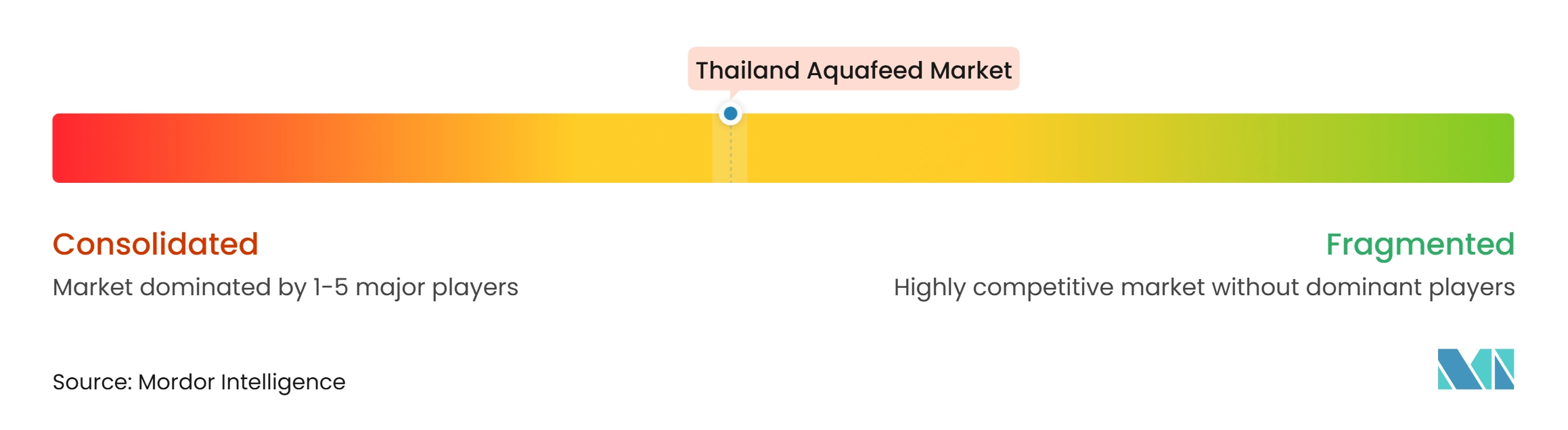
The Thailand aquafeed market is moderately concentrated, with a group of leading manufacturers maintaining strong positions across shrimp, fish, and specialty aquaculture nutrition segments. Charoen Pokphand Foods Public Company Limited benefits from its integrated feed-to-farm operating model and extensive certification portfolio, while Thai Union Feedmill Public Company Limited continues to strengthen its position through production upgrades, technical services, capacity investments, and expansion initiatives. Competition among leading suppliers is increasingly centered on feed performance, traceability, quality assurance, distribution reach, and customer support rather than pricing alone.
Product innovation has become a major competitive differentiator as aquaculture producers place greater emphasis on disease prevention, feed efficiency, and sustainability. Companies such as Skretting (Nutreco N.V.) are expanding their presence through functional nutrition products designed to improve animal health and production outcomes. Feed manufacturers are also broadening their offerings beyond conventional nutrition by providing farm advisory services, feeding optimization programs, biosecurity support, and traceability solutions that strengthen long-term customer relationships.
Growth opportunities remain concentrated in functional aquafeeds, hatchery and nursery nutrition, and digital service-linked feed programs. Suppliers that combine technical expertise, farm management support, and specialty nutrition products are well positioned to benefit from increasing certification requirements and stricter feed-safety standards across export-oriented aquaculture supply chains. At the same time, compliance with traceability, sustainability, and quality standards continues to increase the investment required for market participation, favoring established producers with stronger technical capabilities and wider distribution networks.
Thailand Aquafeed Industry Leaders
-
Charoen Pokphand Foods Public Company Limited
-
Thai Union Feedmill Public Company Limited
-
Skretting (Nutreco N.V.)
-
Grobest Group Limited
-
Alltech Coppens
- *Disclaimer: Major Players sorted in no particular order
Thailand Aquafeed Market Companies Covered in this Report
- Charoen Pokphand Foods Public Company Limited
- Thai Union Feedmill Public Company Limited (Thai Union Group Public Company Limited)
- Cargill, Incorporated
- Thai Luxe Enterprises (Thailand) Co., Ltd. (PP Prime Public Company Limited)
- Lee Feed Mill Public Company Limited
- Inteqc Feed Co., Ltd.
- Grobest Group Limited
- Skretting (Nutreco N.V.)
- ADM (Archer-Daniels-Midland Company)
- dsm-firmenich
- Asian Nutrition Co., Ltd. (Asian Sea Corporation Public Company Limited)
- Manit Intertrade Co., Ltd. (Manit Group Company Limited)
- Alltech, Inc.
- JBF Co., Ltd.
Recent Industry Developments in Thailand Aquafeed Market
- October 2025: Skretting (Nutreco N.V.) launched next-generation Lorica and Optiline shrimp feeds and the Necto functional fish diet, featuring proprietary EDGEOS PhytoComplexes targeting disease resilience across global markets including Asia, according to Skretting's 2025 Impact Report.
- September 2025: Full Circle Biotechnology began construction of a 7,000-ton-per-year insect protein facility in Kanchanaburi, Thailand, targeting shrimp, snakehead, and tilapia feed applications, establishing Thailand as an emerging production hub for alternative aquafeed protein ingredients.
- May 2025: Thai Union Group implemented an Aquaculture Improvement Project (AIP) in Prachuap Province in partnership with Key Traceability and participating shrimp farms, building a certification pathway toward ASC and BAP standards and deploying digitized gap analysis tools.
Thailand Aquafeed Market Report Scope
Aquafeed consists of nutritionally balanced feed products formulated for farmed aquatic species, including fish, shrimp, prawns, mollusks, and other aquaculture species. These feeds are designed to support growth, health, feed efficiency, survival, and production performance across different lifecycle stages and production systems. The Thailand Aquafeed Market report includes analysis of aquafeed ingredients, feed types, product forms, lifecycle-stage nutrition, production systems, distribution channels, supply-demand dynamics, pricing trends, regulatory framework, technology developments, competitive landscape, company profiles, and recent industry developments. The market is segmented by Species Type (Fishes, Crustaceans, Mollusks, and Other Aquatic Species), Feed Type (Starter Feed, Grower Feed, Finisher Feed, Broodstock Feed, Functional and Health Management Feed, and Hatchery and Nursery Feed), Ingredient Type, Product Form, Lifecycle Stage, Production System, Distribution Channel, Customer Type, and Geography (Southern Thailand, Central Thailand, Eastern Thailand, Northeastern Thailand, and Western Thailand). The market forecasts are provided in terms of value (USD) and volume (metric tons).
Segmentation Overview
| Fishes | Tilapia |
| Hybrid Catfish | |
| Common Silver Barb | |
| Seabass | |
| Frogs | |
| Other Fish Species | |
| Crustaceans | Whiteleg Shrimp |
| Black Tiger Shrimp | |
| Giant Freshwater Prawn | |
| Other Crustaceans | |
| Mollusks | |
| Other Aquatic Species |
| Starter Feed |
| Grower Feed |
| Finisher Feed |
| Broodstock Feed |
| Hatchery and Nursery Feed |
| Functional and Health-Management Feed |
| Soybean and Soy Products |
| Fish Meal |
| Wheat Flour and Wheat Products |
| Rice Products |
| Corn and Corn Products |
| Fish Oil and Other Lipids |
| Vitamins and Minerals |
| Amino Acids |
| Enzymes, Probiotics and Antioxidants |
| Other Functional Ingredients |
| Pellets |
| Extruded Feed |
| Powdered Feed |
| Liquid Feed |
| Larval and Nursery Stage |
| Juvenile and Grow-Out Stage |
| Broodstock Stage |
| Pond Culture |
| Cage Culture |
| Raceway and Tank Culture |
| Integrated and Recirculating Systems |
| Direct Sales to Integrated Farms |
| Dealer and Distributor Sales |
| Cooperative and Farmer-Group Sales |
| Digital and Technical-Service-Linked Sales |
| Integrated Aquaculture Companies |
| Commercial Independent Farms |
| Smallholder and Cooperative Farms |
| Hatcheries and Nurseries |
| Research, Government and Specialty Buyers |
| By Species Type | Fishes | Tilapia |
| Hybrid Catfish | ||
| Common Silver Barb | ||
| Seabass | ||
| Frogs | ||
| Other Fish Species | ||
| Crustaceans | Whiteleg Shrimp | |
| Black Tiger Shrimp | ||
| Giant Freshwater Prawn | ||
| Other Crustaceans | ||
| Mollusks | ||
| Other Aquatic Species | ||
| By Feed Type | Starter Feed | |
| Grower Feed | ||
| Finisher Feed | ||
| Broodstock Feed | ||
| Hatchery and Nursery Feed | ||
| Functional and Health-Management Feed | ||
| By Ingredient Type | Soybean and Soy Products | |
| Fish Meal | ||
| Wheat Flour and Wheat Products | ||
| Rice Products | ||
| Corn and Corn Products | ||
| Fish Oil and Other Lipids | ||
| Vitamins and Minerals | ||
| Amino Acids | ||
| Enzymes, Probiotics and Antioxidants | ||
| Other Functional Ingredients | ||
| By Product Form | Pellets | |
| Extruded Feed | ||
| Powdered Feed | ||
| Liquid Feed | ||
| By Lifecycle Stage | Larval and Nursery Stage | |
| Juvenile and Grow-Out Stage | ||
| Broodstock Stage | ||
| By Production System | Pond Culture | |
| Cage Culture | ||
| Raceway and Tank Culture | ||
| Integrated and Recirculating Systems | ||
| By Distribution Channel | Direct Sales to Integrated Farms | |
| Dealer and Distributor Sales | ||
| Cooperative and Farmer-Group Sales | ||
| Digital and Technical-Service-Linked Sales | ||
| By Customer Type | Integrated Aquaculture Companies | |
| Commercial Independent Farms | ||
| Smallholder and Cooperative Farms | ||
| Hatcheries and Nurseries | ||
| Research, Government and Specialty Buyers | ||
Key Questions Answered in the Report
What is the size of the Thailand aquafeed market?
The Thailand aquafeed market is valued at USD 2.92 billion in 2026 and is forecast to reach USD 4.73 billion by 2032. In volume terms, it stands at 508.90 thousand tons in 2026, rising to 743.90 thousand tons by 2032.
What is the growth rate of the Thailand aquafeed market?
The market grows at a CAGR of 8.35% during 2027–2032, driven by export recovery, rising adoption of commercial certified diets, and functional feed demand growth.
Which is the largest regional market within Thailand?
Southern Thailand is the largest and most commercially intensive regional aquafeed market, driven by concentrated whiteleg shrimp and black tiger shrimp farming across coastal provinces with the highest feed usage per hectare in the country.
What are the major challenges in the Thailand aquafeed market?
Key challenges include persistent shrimp disease volatility (EMS, EHP, and WSSV), fishmeal price fluctuations, and low-cost competition from Ecuador, India, Vietnam, and Indonesia, which constrain feed pricing and export recovery.