
Telecom Cooling Optimization Market Size and Share
Market Overview
| Study Period | 2021 - 2032 |
|---|---|
| Market Size (2027) | USD 403.19 Million |
| Market Size (2032) | USD 874.34 Million |
| Growth Rate (2027 - 2032) | 16.74 % |
| Fastest Growing Market | Asia-Pacific |
| Largest Market | Asia-Pacific |
| Market Concentration | Medium |
Major Players *Disclaimer: Major Players sorted in no particular order Image © Mordor Intelligence. Reuse requires attribution under CC BY 4.0. | |
Telecom Cooling Optimization Market Analysis by Mordor Intelligence
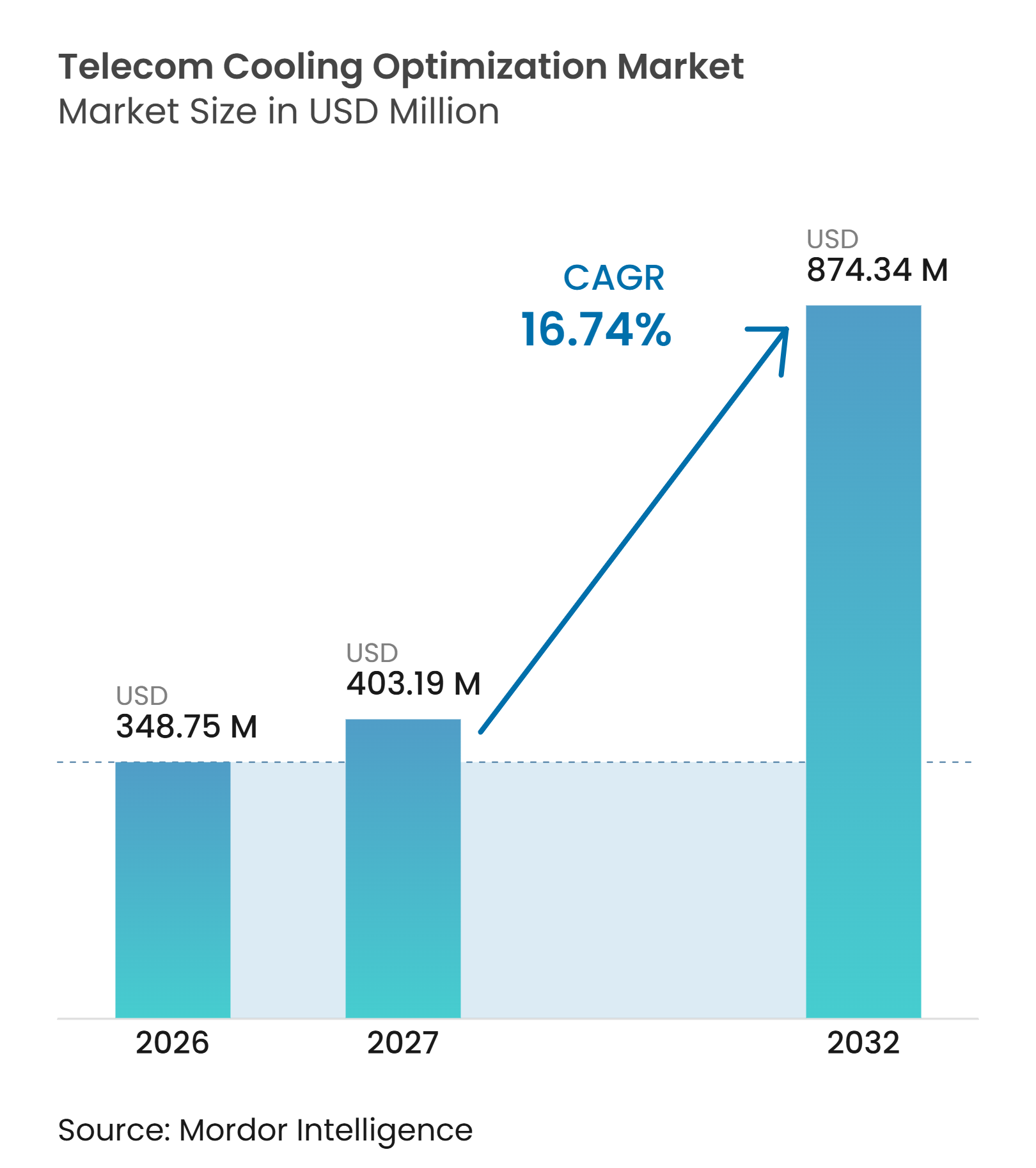
The Telecom cooling optimization market size was valued at USD 348.75 million in 2026 and is estimated to expand from USD 407.13 million in 2027 to reach USD 874.34 million by 2032, at a CAGR of 16.74% during the forecast period (2027-2032). The telecom cooling optimization market is being shaped by denser 5G networks, higher data traffic, and lower thermal headroom in centralized and distributed radio access network environments. Mobile operators in the telecom cooling optimization market are also treating cooling efficiency as part of their emissions programs, since the mobile sector reported operational emissions of 115 MtCO₂e in 2024 and 77 operators had validated near-term science-based targets by 2026. Higher power density is moving some deployments beyond the operating range where conventional air cooling is effective. Vendors are responding to the telecom cooling optimization market with liquid-cooling equipment, software that adjusts cooling settings, and integrated service contracts. The telecom cooling optimization market also faces retrofit costs, uneven site data, and a limited supply of specialists capable of deploying advanced systems across large networks.
Key Report Takeaways
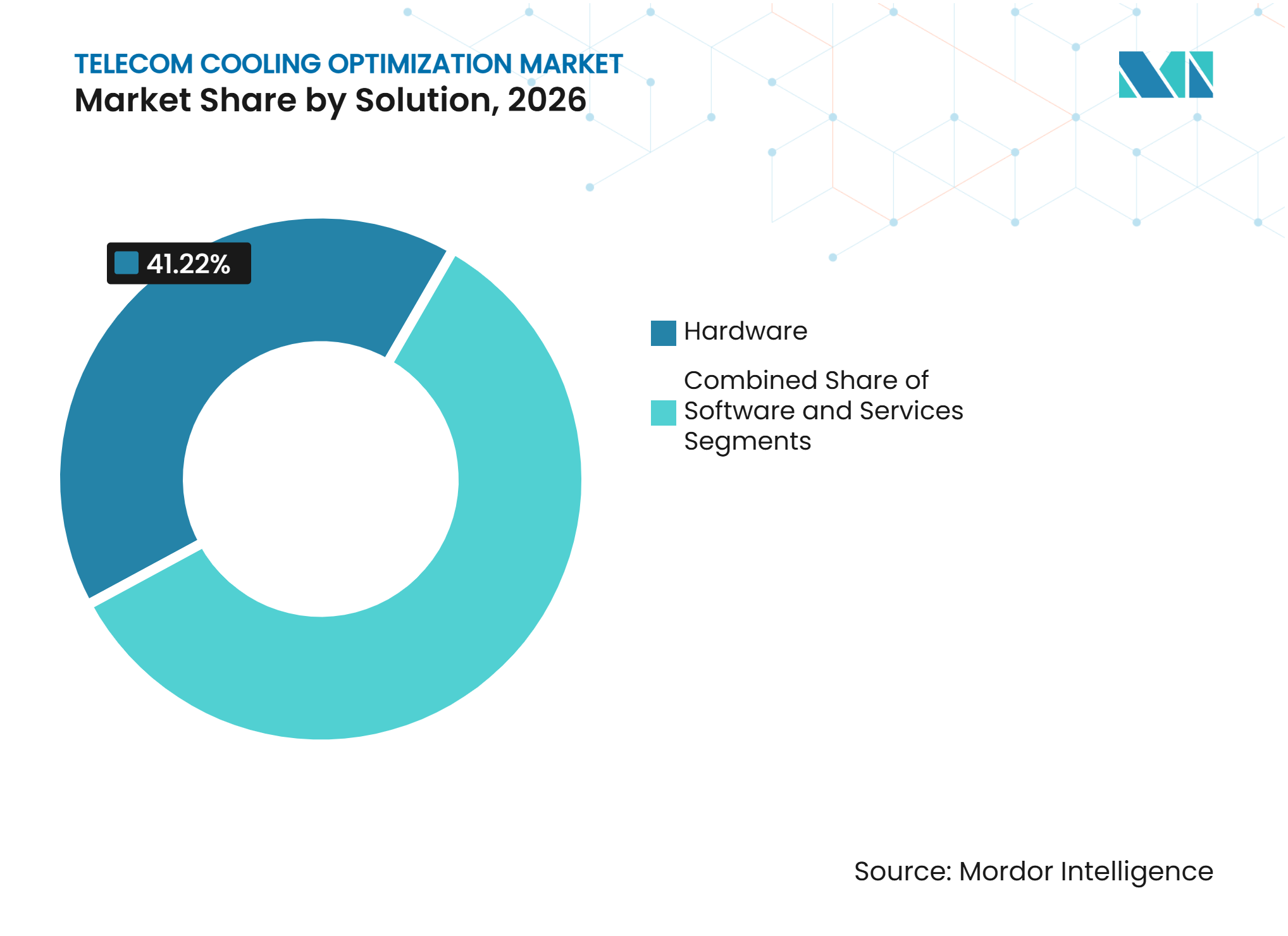
- By solution component, hardware held 41.22% of value in 2026, while software is projected to expand at a 17.32% CAGR through 2032 in the telecom cooling optimization market.
- By cooling technology, air cooling held 39.88% of value in 2026, while liquid cooling is projected to expand at an 18.34% CAGR through 2032.
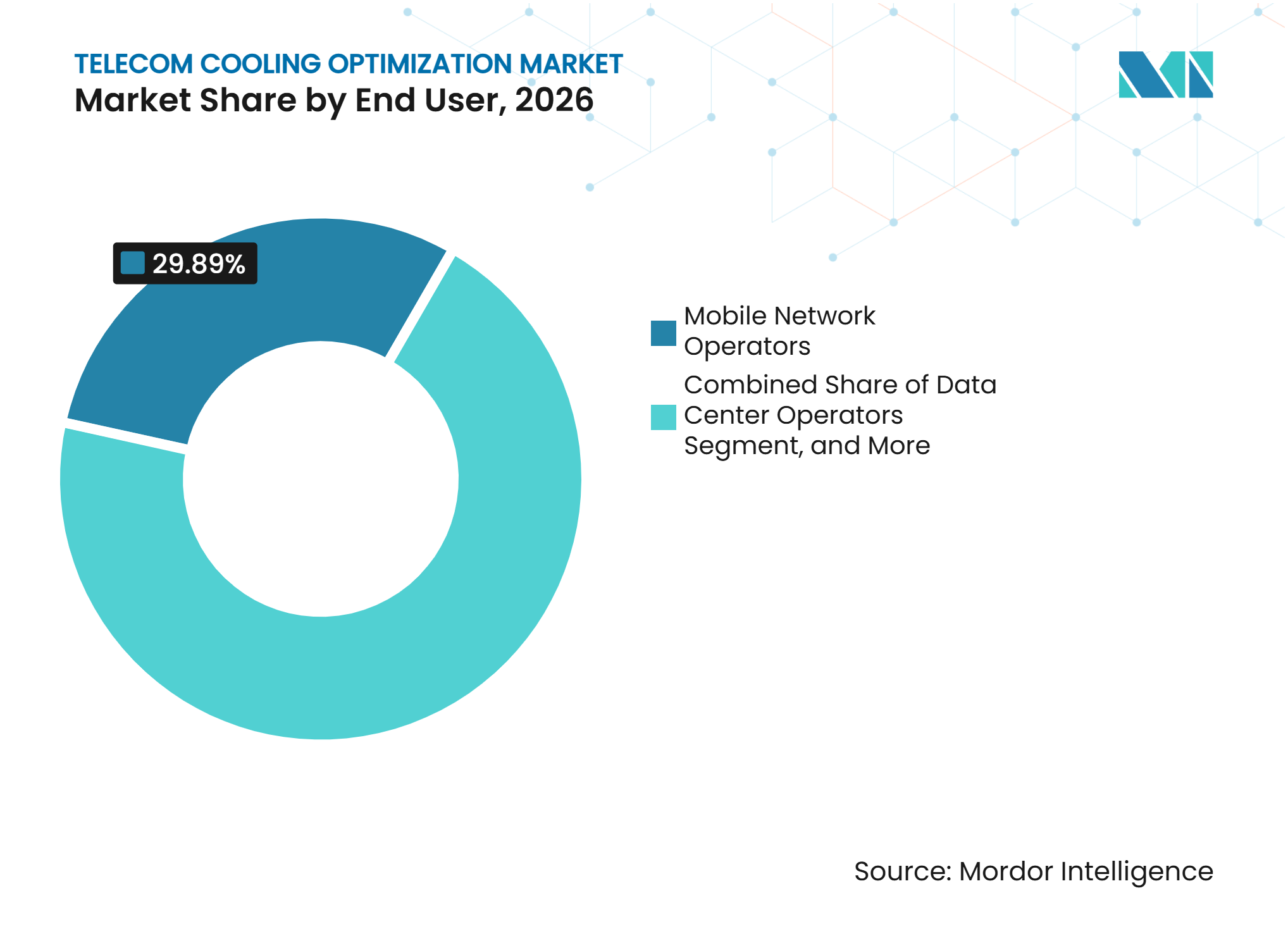
- By end user, mobile network operators held 29.89% of demand in 2026, while data center operators are projected to expand at a 17.55% CAGR through 2032 in the telecom cooling optimization market.
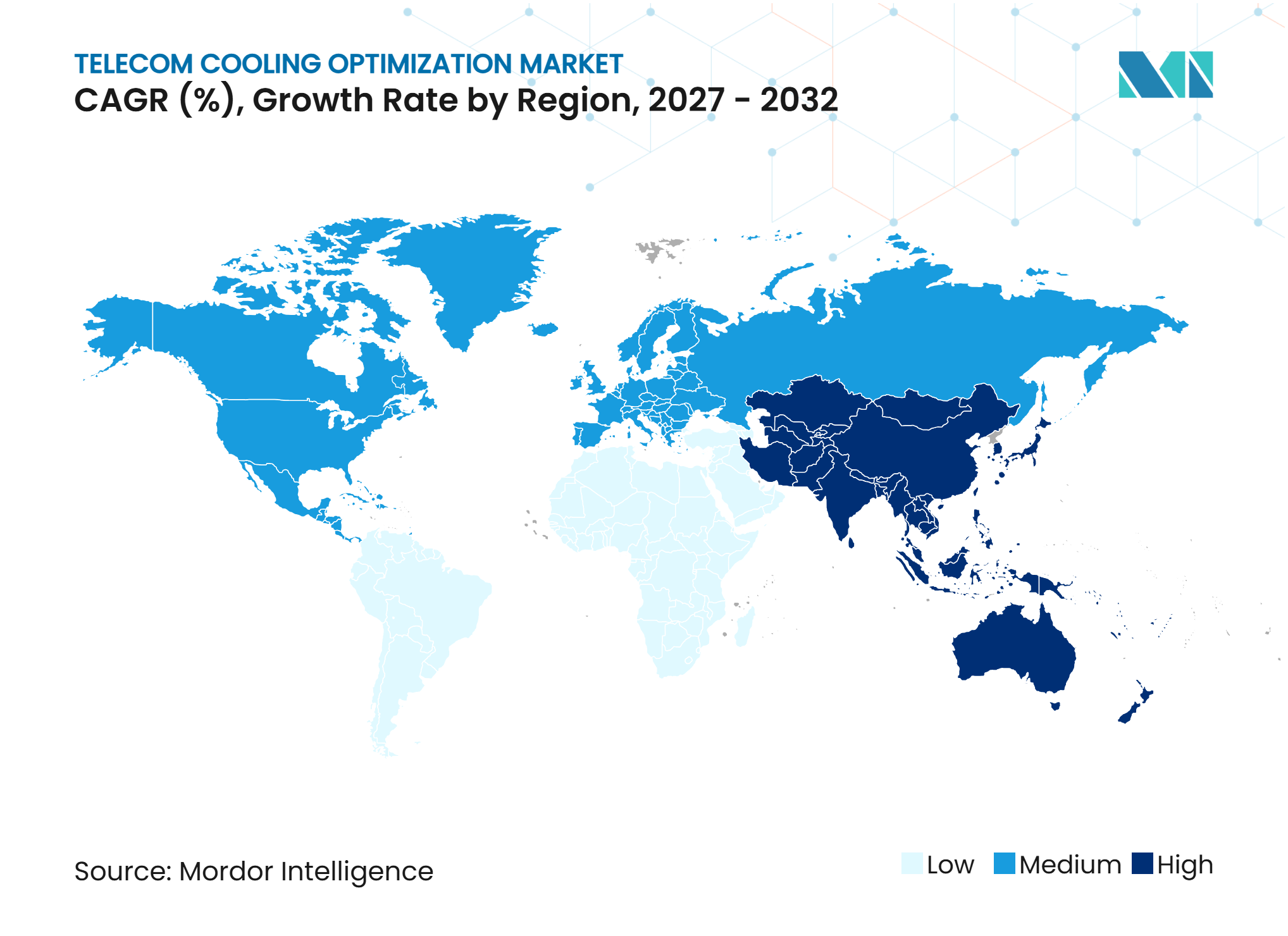
- By geography, Asia-Pacific accounted for 30.34% of value in 2026, and the region is projected to expand at an 18.78% CAGR through 2032 in the telecom cooling optimization market.
Note: Market numbers in this report are based on Mordor Intelligence's proprietary estimation framework, which combines nine months of actuals with Q4 projections for base year 2026.
Market Trends and Insights
Drivers Impact Analysis of Telecom Cooling Optimization Market*
| Driver | (~) % Impact on CAGR Forecast | Geographic Relevance | Impact Timeline |
|---|---|---|---|
| 5G Network Densification and Rising Thermal Loads | +6.5% | Global, with early intensity in China, South Korea, and Germany | Short term (≤ 2 years) |
| Growth of Edge Computing and Distributed RAN | +3.8% | Global, with concentration in North America, Europe, and Asia-Pacific | Medium term (2-4 years) |
| Network Energy Efficiency and Carbon Reduction Targets | +2.7% | Global, with strongest regulatory pressure in Europe and North America | Medium term (2-4 years) |
| Remote Monitoring and AI-Based Thermal Optimization | +2.4% | North America and Europe, with adoption extending to Asia-Pacific and the Middle East | Medium term (2-4 years) |
| Cabinet-Level Cooling Optimization for Unattended Sites | +1.9% | Asia-Pacific, with adoption extending to Africa and the Middle East | Long-term (≥ 4 years) |
| High-Density C-RAN Baseband Deployments Reaching Air-Cooling Limits | +1.6% | China, South Korea, and emerging 5G markets in Asia-Pacific and Europe | Short term (≤ 2 years) |
| Source: Mordor Intelligence | |||
5G Network Densification and Rising Thermal Loads
The Telecom cooling optimization market is gaining support as 5G equipment creates more concentrated heat loads than earlier network equipment. A 2025 study reported average power use of 3,000-5,000 W for a single 5G base station unit and local heat flux of 80-120 W/cm². The same study found that a 10°C increase in chip temperature raised failure rates by 25% and reduced component life by more than 30%.[1] These conditions make cooling performance relevant to network availability and operating costs. ITU-T L.1326 sets out requirements and use cases for liquid cooling and other high-efficiency cooling solutions for 5G baseband units in centralized RAN deployments.[2] The Telecom cooling optimization market therefore benefits when operators need to reduce equipment failures across large estates of unattended sites.
Growth of Edge Computing and Distributed RAN
Edge computing adds thermal demands at sites that often have limited power capacity, fewer technicians, and less sophisticated cooling equipment. Distributed RAN deployments place more compute resources outside central offices, which increases the need for compact thermal systems. A 2025 review of base-station thermal management identified distributed architectures as a setting where legacy cooling designs are under pressure. A cooling failure at a remote site can also require an unplanned field visit, increasing the cost of maintaining network availability. The Telecom cooling optimization market can address this need through enclosed, self-contained systems that require minimal site intervention. These requirements favor solutions designed for variable outdoor conditions and continuous monitoring.
Network Energy Efficiency and Carbon Reduction Targets
Energy and emissions targets are making site cooling a more visible part of network planning. The GSMA reported that mobile industry operational emissions fell by 5% in 2024, while mobile connections increased by 10% and data traffic rose more than 4 times from 2019 to 2024. The report also recorded 77 operators with validated near-term science-based targets in 2026.[3] The European Energy Efficiency Directive adds reporting requirements for qualifying data centers, which increases attention to measurable cooling performance. Cooling can represent more than 30% of radio access network energy consumption in China Mobile's network analysis. The Telecom cooling optimization market is supported when operators use cooling upgrades as a practical route to lower site energy use.
Remote Monitoring and AI-Based Thermal Optimization
Remote monitoring and software controls are expanding the value of installed cooling equipment. NTT Global Data Centers reported that its Rhine-Ruhr 1 site reduced cooling-system energy consumption by nearly 20% after deploying AI-based optimization using digital-twin models and machine learning.[4] These systems can adjust chilled-water settings and pump speeds in response to operating conditions. Their performance depends on reliable telemetry, so sites with more sensors can capture stronger results than low-data remote locations. Nokia deployed its Energy Efficiency platform with Indosat Ooredoo Hutchison in July 2025 to manage radio equipment during periods of low demand without affecting network performance. The Telecom cooling optimization market benefits from software subscriptions that reduce upfront costs and enable vendors to offer recurring services.
Restraints Impact Analysis of Telecom Cooling Optimization Market*
| Restraint | (~) % Impact on CAGR Forecast | Geographic Relevance | Impact Timeline |
|---|---|---|---|
| High Retrofit and Integration Costs | -1.5% | Global, with the greatest effect in legacy-heavy markets such as Europe and North America | Short term (≤ 2 years) |
| Limited Availability of Skilled Thermal Engineering and Field Service Personnel | -1.0% | Global, with acute constraints in Africa, South America, and the rest of Asia-Pacific | Medium term (2-4 years) |
| Liquid Coolant Safety, Leakage, and End-of-Life Compliance | -0.7% | Global, with greater pressure in the European Union, South Korea, and Japan | Long term (≥ 4 years) |
| Fragmented Site Telemetry and Multi-Vendor Interoperability | -0.5% | Global, with the greatest limitation in open-RAN environments | Medium term (2-4 years) |
| Source: Mordor Intelligence | |||
High Retrofit and Integration Costs
Existing telecom sites were usually designed around air cooling, so a liquid or hybrid retrofit can require changes to piping, power feeds, cabinet layouts, and structural loading. These changes make an upgrade more expensive than a greenfield installation. The Telecom cooling optimization market is affected because operators often manage sites built to different civil and mechanical specifications. Tower companies face an additional challenge because they may fund thermal upgrades while tenants capture the main network reliability benefit. The GSMA identifies shared infrastructure as a material area requiring action in telecom decarbonization planning. Reporting requirements can increase the case for upgrades, but they do not resolve how multi-tenant retrofit costs should be allocated.
Limited Availability of Skilled Thermal Engineering and Field Service Personnel
Advanced cooling deployments require personnel with knowledge of radio infrastructure, refrigeration systems, fluid handling, and site safety. This combination is difficult to source across remote and climate-exposed locations. The O-RAN Alliance notes that liquid cooling approaches are progressing through standardization but still require careful field deployment and safety procedures. A shortage of qualified personnel can delay installation even after an operator has committed capital and selected a supplier. The Telecom cooling optimization market can therefore show a gap between equipment orders and active deployments. Training offered by vendors and industry associations could ease this constraint over time.
*Our forecasts treat driver/restraint impacts as directional, not additive. The impact forecasts reflect baseline growth, mix effects, and variable interactions.
Telecom Cooling Optimization Market Segment Analysis
By Solution Component:
Hardware Holds the Largest Revenue Position While Software Advances QuicklyHardware is projected to account for 41.22% of the telecom cooling optimization market in 2026, as site upgrades require physical equipment. Precision cooling units, coolant distribution units, heat exchangers, and cabinet enclosures remain essential for upgrades at 5G base stations, centralized RAN halls, and telecom-adjacent data centers. These products represent a significant share of capital expenditure because they directly manage heat at the equipment level. Services include commissioning, maintenance contracts, and managed thermal operations. The telecom cooling optimization market will continue to require these services as operators transfer technical responsibility to specialized vendors.
Software is projected to expand at a CAGR of 17.32% through 2032, the fastest growth rate among solution components. AI-based platforms can adjust cooling settings according to traffic loads, ambient conditions, and equipment telemetry. Documented deployments have reduced cooling energy consumption by up to 20%, strengthening the operational case for software investment. NTT and Nokia are expected to deploy a multi-vendor platform with Indosat Ooredoo Hutchison in 2025 to manage network energy without upfront capital expenditure. The telecom cooling optimization industry is moving toward integrated systems that combine instrumented equipment with analytics, as hardware generates the data required by optimization platforms.



By Cooling Technology:
Air Cooling Remains Established While Liquid Cooling Gains GroundAir cooling is projected to account for 39.88% of the telecom cooling optimization market in 2026, reflecting its extensive installed base across telecom sites worldwide. Its position is supported by lower initial costs, established maintenance practices, and familiarity among field teams. A 2025 study is expected to find that air-conditioning configurations using phase-change materials still experience efficiency losses of more than 40% when rack power density exceeds 50 W/cm². This limitation becomes increasingly relevant in high-density centralized RAN environments. Consequently, the telecom cooling optimization market is shifting from air-only equipment to alternative technologies for higher-power-density applications.
Liquid cooling is projected to expand at an 18.34% CAGR through 2032, supported by direct-to-chip and immersion cooling approaches. The O-RAN Alliance reports that liquid immersion cooling can achieve a power usage effectiveness (PUE) as low as 1.02. Phase-change systems can buffer significant differences between peak and off-peak 5G heat loads, while thermoelectric systems are well-suited to small, sealed enclosures. Hybrid systems combine air and liquid cooling methods for operators that require greater capacity but cannot accommodate a complete liquid-cooling retrofit. Vertiv is expected to introduce MegaMod HDX configurations in January 2026, combining direct-to-chip liquid cooling with air-cooled architecture for rack densities ranging from 50 kW to more than 100 kW.
By End User:
Mobile Network Operators Provide Volume While Data Centers Expand FasterMobile network operators are projected to account for 29.89% of end-user demand in 2026, representing the largest share of the telecom cooling optimization market. Their position reflects the scale of the radio access infrastructure they own and operate. Replacing legacy equipment with 5G systems increases cooling requirements at many active sites. Tower companies face more complex investment decisions because of multi-tenant site models. Enterprise private 5G, government, defense, and public-safety networks require robust cooling systems to ensure continuous operations in challenging environments.
Data center operators are projected to expand at a CAGR of 17.55% through 2032. Their demand is driven by increasing rack densities, sustainability reporting requirements, and the convergence of telecom and data center infrastructure. Operators are building or colocating AI-ready capacity to support edge inference, network automation, and enterprise private 5G services. SK Telecom is expected to agree with Giga Computing and SK Enmove in 2025 to validate direct, immersion, and precision liquid cooling for AI data centers. The telecom cooling optimization market will benefit when suppliers can provide integrated hardware and software solutions across both radio access network and data center environments.

Geography Analysis
North America and Europe
North America and Europe are capital-intensive markets for telecom cooling optimization, driven by mature 5G networks and stringent energy compliance requirements. The United States is deploying standalone 5G networks and AI-capable infrastructure, increasing thermal loads in telecom data centers. Cross-border supply chain investments support the Canadian market, while Mexico is generating greenfield demand for cooling solutions as its 5G infrastructure expands. In Europe, the Energy Efficiency Directive and Regulation (EU) 2024/573 on fluorinated gases are increasing the demand for low-GWP refrigerants and energy-efficient cooling systems.
Asia-Pacific
Asia-Pacific is projected to account for 30.34% of regional market value in 2026 and expand at a CAGR of 18.78% through 2032. China has dense 5G infrastructure, and China Mobile attributes more than 30% of radio access network energy consumption to cooling. India is expanding its telecom networks while pursuing lower sector emissions and greater use of renewable electricity. South Korean operators are validating liquid-cooling technologies for AI data centers, strengthening demand for high-density thermal management equipment. Japan, Australia, Southeast Asia, and South Asia are expected to drive additional demand as network operators transition from air cooling to hybrid and liquid cooling configurations.
South America, the Middle East, and Africa
South America, the Middle East, and Africa present distinct conditions for the telecom cooling optimization market. Brazil and Argentina are expanding infrastructure through 5G spectrum and network deployment programs. Saudi Arabia and the United Arab Emirates experience high ambient temperatures, which increase the operating costs of conventional air-cooling systems and drive interest in free-cooling and hybrid designs. South Africa and Nigeria are key African markets, where cooling can account for 30–50% of tower energy consumption; however, capital constraints continue to limit deployment.
Competitive Landscape
Market Concentration
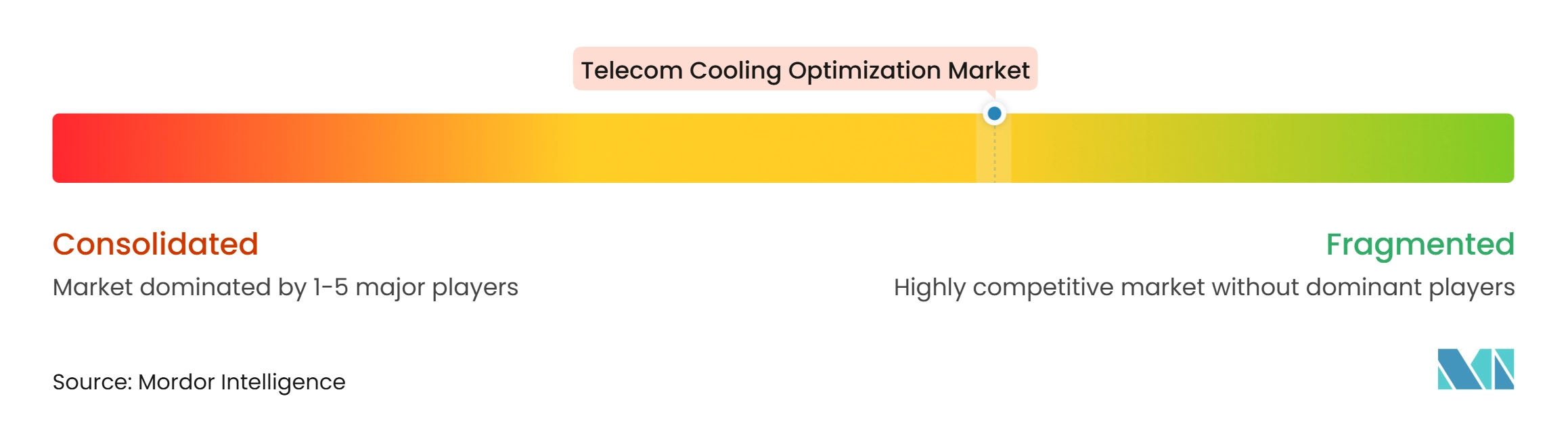
The telecom cooling optimization market is moderately fragmented in 2026. Large infrastructure companies benefit from global supply chains, broad product portfolios, and established service teams. Specialist thermal management companies compete through liquid cooling, phase-change systems, and solutions designed for high-density and edge sites. Schneider Electric expanded its liquid cooling capabilities by acquiring a controlling interest in Motivair in February 2025. ITU-T L.1326 provides a recognized framework for suppliers developing immersion and spray-cooling solutions for centralized RAN baseband equipment.
Competition is shifting toward AI-based thermal management software for multivendor site estates. No supplier has established a leading position across all equipment types and operator networks. Suppliers are also targeting compact systems for unattended sites in hot climates, as well as managed thermal services for enterprise private 5G and public-sector networks. Iceotope, LiquidStack, and Submer are focusing product development on liquid cooling and specialized fluids. Dell Technologies is expected to introduce the PowerEdge XR9700 in February 2026 as a closed-loop, liquid-cooled server for outdoor edge deployments.
European regulations are creating an upgrade cycle for suppliers offering energy-efficient refrigerants and free-cooling solutions. STULZ is expected to launch TelAir 4 and WallAir 4 in September 2026 for 5G, edge, and critical infrastructure applications using R454C refrigerant. Vertiv’s planned January 2026 launch of the MegaMod HDX demonstrates continued investment in modular hybrid infrastructure for high-density computing. The telecom cooling optimization market will reward suppliers that can integrate site equipment, monitoring, software controls, and service support.
Telecom Cooling Optimization Industry Leaders
-
Vertiv Group Corp.
-
Schneider Electric SE
-
Delta Electronics, Inc.
-
Huawei Technologies Co., Ltd.
-
Rittal GmbH & Co. KG
- *Disclaimer: Major Players sorted in no particular order
Telecom Cooling Optimization Market Companies Covered in this Report
- Vertiv Group Corp.
- Schneider Electric SE
- Delta Electronics, Inc.
- Huawei Technologies Co., Ltd.
- STULZ GmbH
- Rittal GmbH & Co. KG
- Johnson Controls International plc
- Eaton Corporation plc
- Mitsubishi Electric Corporation
- Daikin Industries, Ltd.
- Danfoss A/S
- nVent Electric plc
- Canovate Group
- Eltek AS
- Shenzhen Envicool Technology Co., Ltd.
- Airsys Refrigeration Engineering Technology Co., Ltd.
- CoolIT Systems, Inc.
- Iceotope Technologies Limited
- LiquidStack Limited
- Submer Technologies S.L.
- Asetek A/S
- Boyd Corporation
Recent Industry Developments in Telecom Cooling Optimization Market
- October 2026: Schneider Electric's Motivair brand began shipping the wall-coupled coolant distribution unit with 3.5 MW capacity and a flow rate of 1.5 liters per minute per kW. Up to 20 units can operate in group mode to support 30-40 MW data halls. The unit began shipping in select regions in October 2026, with U.S. preorders opening in early 2027.
- September 2026: STULZ introduced the TelAir 4 and WallAir 4 cooling systems for telecommunications containers, shelters, radio stations, and edge data centers. The units use the low-GWP R454C refrigerant and offer cooling capacities ranging from 6 kW to 17 kW across 4 classes.
- February 2026: Dell Technologies launched the PowerEdge XR9700, a closed-loop liquid-cooled server for utility poles, rooftops, and building exteriors. Its sealed aluminum-cast chassis manages thermal dissipation from -40°C to +46°C under solar loading.
- January 2026: Vertiv introduced MegaMod HDX configurations in compact and combo formats. The designs support up to 13 racks and 1.25 MW in compact format, or up to 144 racks and 10 MW in combo format, with rack densities from 50 kW to more than 100 kW.
Global Telecom Cooling Optimization Market Report Scope
The Telecom Cooling Optimization Market Report is Segmented by Solution Component (Hardware, Software, and Services), Cooling Technology (Air Cooling, Liquid Cooling, Phase-Change Cooling, Thermoelectric Cooling, and Hybrid Cooling), End User (Mobile Network Operators, Tower Companies, Telecom Equipment Manufacturers, Data Center Operators, Enterprise Private 5G Networks, and Government, Defense, and Public-Safety Networks), and Geography (North America, South America, Europe, Asia-Pacific, and the Middle East and Africa). The Market Forecasts are Provided in Terms of Value (USD).
Segmentation Overview
| Hardware |
| Software |
| Services |
| Air Cooling |
| Liquid Cooling |
| Phase-Change Cooling |
| Thermoelectric Cooling |
| Hybrid Cooling |
| Mobile Network Operators |
| Tower Companies |
| Telecom Equipment Manufacturers |
| Data Center Operators |
| Enterprise Private 5G Networks |
| Government, Defense, and Public-Safety Networks |
| North America | United States |
| Canada | |
| Mexico | |
| South America | Brazil |
| Argentina | |
| Rest of South America | |
| Europe | Germany |
| France | |
| United Kingdom | |
| Italy | |
| Spain | |
| Rest of Europe | |
| Asia-Pacific | China |
| Japan | |
| India | |
| South Korea | |
| Australia | |
| Rest of Asia-Pacific | |
| Middle East | Saudi Arabia |
| United Arab Emirates | |
| Rest of Middle East | |
| Africa | South Africa |
| Nigeria | |
| Rest of Africa |
| By Solution Component | Hardware | |
| Software | ||
| Services | ||
| By Cooling Technology | Air Cooling | |
| Liquid Cooling | ||
| Phase-Change Cooling | ||
| Thermoelectric Cooling | ||
| Hybrid Cooling | ||
| By End User | Mobile Network Operators | |
| Tower Companies | ||
| Telecom Equipment Manufacturers | ||
| Data Center Operators | ||
| Enterprise Private 5G Networks | ||
| Government, Defense, and Public-Safety Networks | ||
| By Geography | North America | United States |
| Canada | ||
| Mexico | ||
| South America | Brazil | |
| Argentina | ||
| Rest of South America | ||
| Europe | Germany | |
| France | ||
| United Kingdom | ||
| Italy | ||
| Spain | ||
| Rest of Europe | ||
| Asia-Pacific | China | |
| Japan | ||
| India | ||
| South Korea | ||
| Australia | ||
| Rest of Asia-Pacific | ||
| Middle East | Saudi Arabia | |
| United Arab Emirates | ||
| Rest of Middle East | ||
| Africa | South Africa | |
| Nigeria | ||
| Rest of Africa | ||
Key Questions Answered in the Report
What is the Telecom cooling optimization market size?
The Telecom cooling optimization market is projected to expand from USD 348.75 million in 2026 and USD 407.13 million in 2027 to USD 874.34 million by 2032, at a 16.74% CAGR.
What is driving demand for telecom cooling optimization?
5G densification, distributed computing, energy efficiency targets, and higher rack power density are increasing demand for more capable cooling systems.
Which cooling technology is expanding fastest?
Liquid cooling is projected to expand at an 18.34% CAGR through 2032, as it addresses high-density centralized RAN and data center workloads.
Which customer group is expanding fastest?
Data center operators are projected to expand at a 17.55% CAGR through 2032 as telecom and AI-ready data center infrastructure become more connected.
Which region leads telecom cooling optimization?
Asia-Pacific accounted for 30.34% of the value in 2026 and is projected to expand at an 18.78% CAGR through 2032.
Why is cooling software important for telecom networks?
Software can adjust cooling settings using operating data and can reduce energy use, while helping operators manage equipment across multi-vendor estates.