
Size and Share of Tantalum Market For Semiconductor Materials
Market Overview
| Study Period | 2022 - 2032 |
|---|---|
| Market Size (2027) | USD 223.21 Million |
| Market Size (2032) | USD 316.14 Million |
| Growth Rate (2027 - 2032) | 7.21 % |
| Fastest Growing Market | Asia-Pacific |
| Largest Market | Asia-Pacific |
| Market Concentration | Medium |
Major Players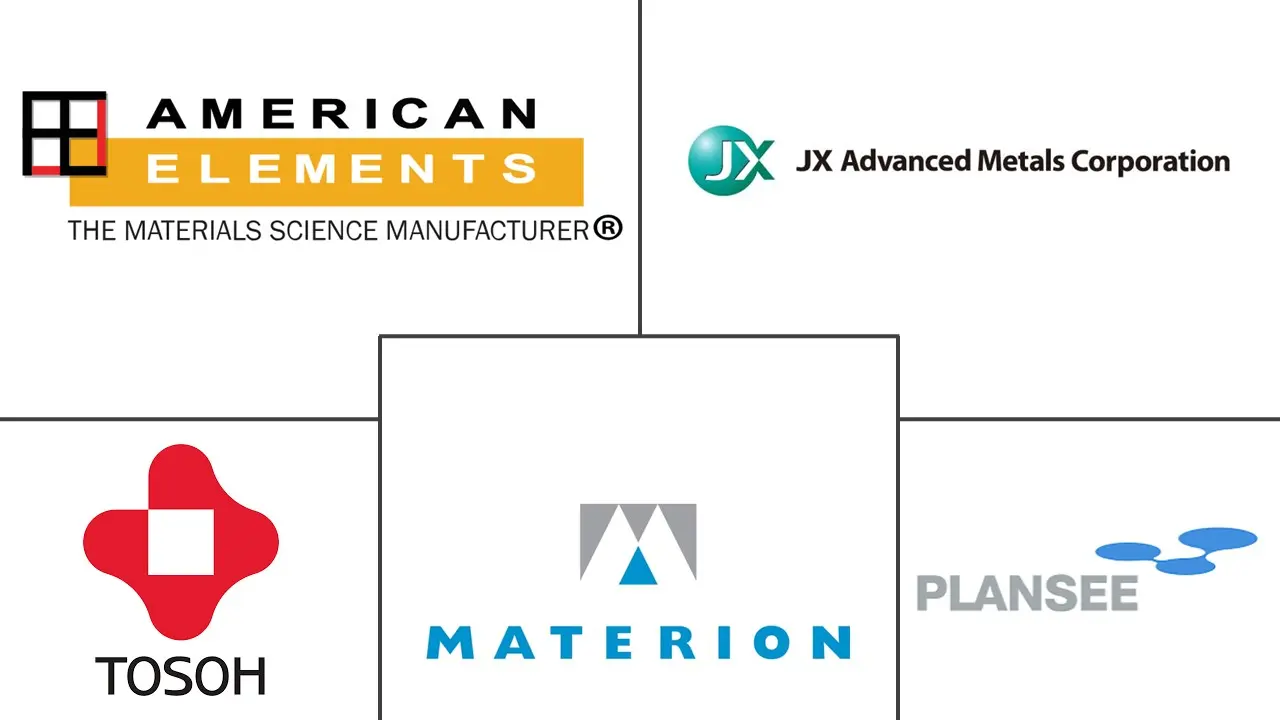
*Disclaimer: Major Players sorted in no particular order Image © Mordor Intelligence. Reuse requires attribution under CC BY 4.0. |
|
Analysis of Tantalum Market For Semiconductor Materials by Mordor Intelligence
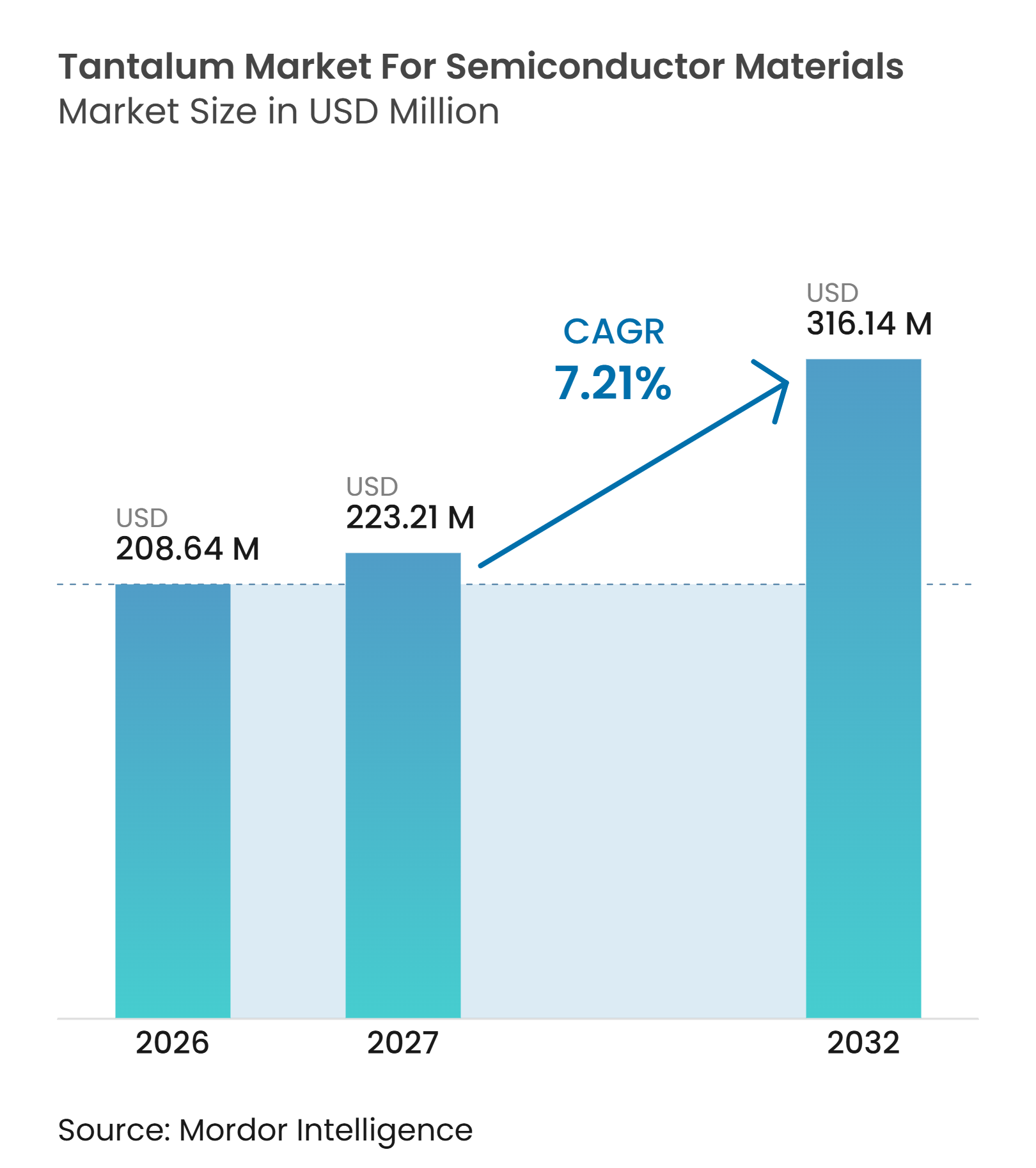
The Tantalum Market for Semiconductor Materials Industry size was valued at USD 208.64 million in 2026 and is estimated to grow from USD 223.21 million in 2027 to reach USD 316.14 million by 2032, at a CAGR of 7.21% during the forecast period (2027-2032). Demand is tied to physical vapor deposition of tantalum and tantalum nitride barrier films in copper interconnect stacks. As device features become narrower, material purity and film uniformity have a greater influence on yield and process stability. The tantalum market for semiconductor materials also benefits from higher metal-layer counts in advanced logic and memory devices. New fab projects can raise demand for certified materials, although suppliers face long qualification cycles before production shipments begin. Supply security remains important because conflict-mineral due diligence and concentrated ore production affect procurement decisions across the value chain.
Key Report Takeaways
- By product type, tantalum sputtering targets held 61.07% of the tantalum market for semiconductor materials share in 2026, while tantalum compounds are forecast to advance at a 7.89% CAGR through 2032.
- By application, wafer fabrication held 68.11% of the tantalum market for semiconductor materials share in 2026, while semiconductor packaging is forecast to advance at an 8.21% CAGR through 2032.
- By semiconductor device type, logic and microprocessors held 52.68% of the tantalum market for semiconductor materials share in 2026 and are forecast to advance at an 8.78% CAGR through 2032.
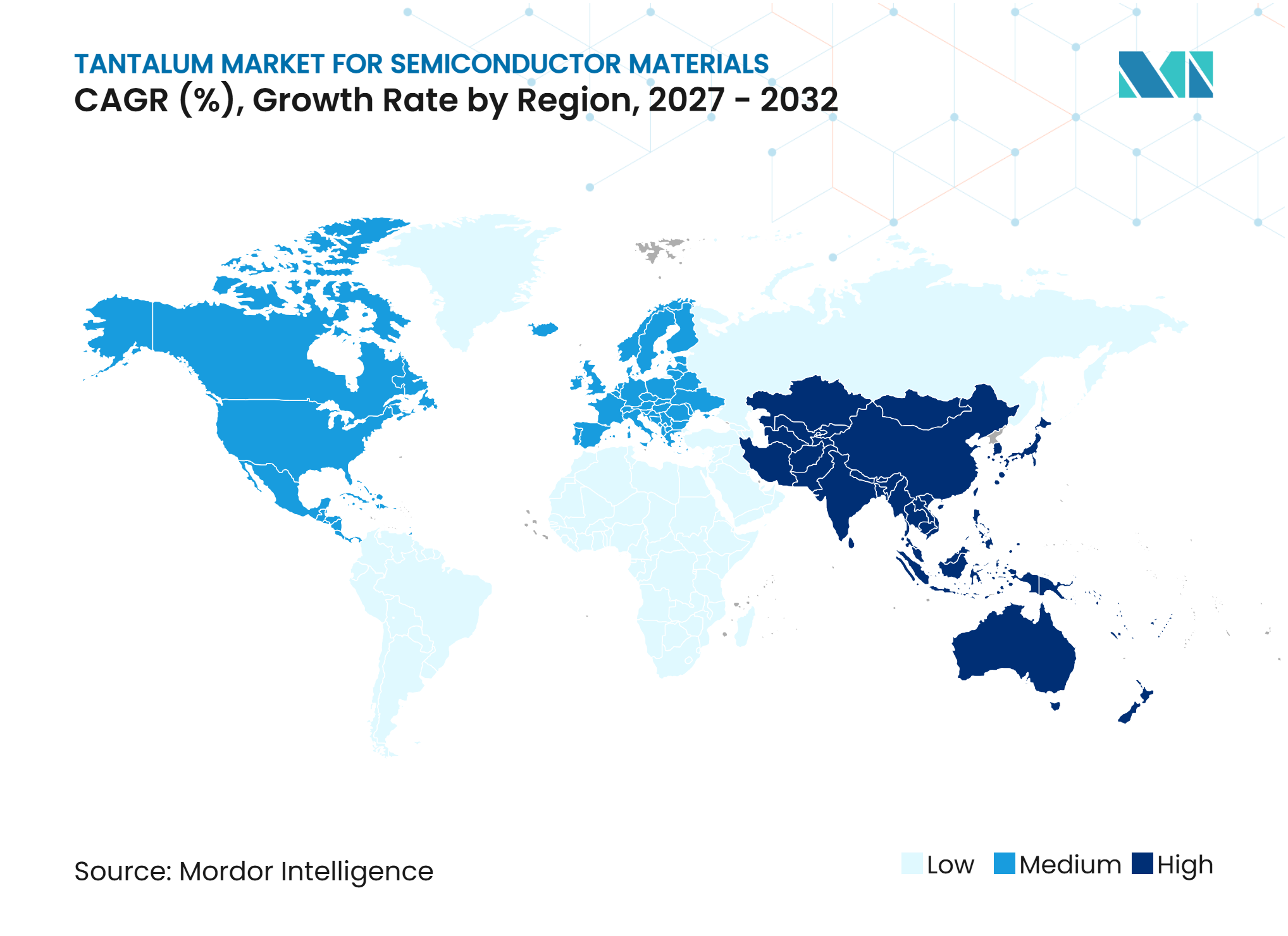
- By geography, Asia-Pacific held 44.56% of the tantalum market for semiconductor materials share in 2026 and is forecast to advance at an 8.56% CAGR through 2032.
Note: Market numbers in this report are based on Mordor Intelligence's proprietary estimation framework, which combines nine months of actuals with Q4 projections for base year 2026.
Market Trends and Insights
Drivers Impact Analysis of Tantalum Market For Semiconductor Materials*
| Driver | (~) % Impact on CAGR Forecast | Geographic Relevance | Impact Timeline |
|---|---|---|---|
| AI Server and High-Performance Computing Semiconductor Capacity Expansion | +2.3% | Global, with highest intensity in APAC (Taiwan, South Korea, Japan, China) and North America | Short term (<= 2 years) |
| Advanced-Node Logic and 3D NAND Scaling | +1.6% | APAC core (Taiwan, South Korea, Japan), spillover to North America and Europe | Medium term (2-4 years) |
| Rising Adoption of Ultra-High-Purity Deposition Materials | +1.0% | Global, led by North America and APAC | Medium term (2-4 years) |
| Semiconductor Manufacturing Localization and Regional Fab Incentives | +0.9% | North America and Europe primarily, with spillover to India and Southeast Asia | Medium term (2-4 years) |
| Advanced Packaging and Heterogeneous Integration | +0.7% | Global, with highest concentration in APAC | Long term (>= 4 years) |
| Source: Mordor Intelligence | |||
AI Server and High-Performance Computing Semiconductor Capacity Expansion
AI infrastructure is increasing demand for logic processors, graphics processors, and related power-management components. These devices use dense copper interconnect structures that require reliable diffusion barriers. The tantalum market for semiconductor materials gains from this demand across targets, powders, and precursor materials. Tantalum capacitors also support server power circuits as system power distribution moves toward 48 V architectures. JX Advanced Metals Corporation is expanding functional tantalum powder production at its Map Ta Phut plant in Thailand, citing demand from sputtering targets and tantalum capacitors used in generative AI data centers. This expansion shows that the tantalum market for semiconductor materials is linked to both deposition materials and supporting electronic components.
Advanced-Node Logic and 3D NAND Scaling
Logic scaling below 3 nm and higher-layer 3D NAND structures increase the need for conformal barrier films. Tantalum nitride is used where narrow features require controlled film deposition and low contamination. The tantalum market for semiconductor materials therefore benefits when processing steps increase faster than wafer volumes. A United States patent describes TaXN liner materials for vertical NAND word-line stacks, supporting continued development of tantalum-based barrier systems. Atomic layer deposition is particularly relevant for high-aspect-ratio structures because it can form controlled films in narrow features. JX Advanced Metals Corporation completed expanded chemical vapor deposition and atomic layer deposition material facilities at Toho Titanium's Chigasaki plant in June 2025, strengthening supply for next-generation semiconductor materials.
Rising Adoption of Ultra-High-Purity Deposition Materials
Smaller interconnect dimensions require tighter control of impurities, grain structure, and film consistency. High-purity tantalum targets are used to reduce defect risks during deposition. Research published in 2025 found that rolling strategies affected microstructure uniformity in high-purity tantalum plates, linking target processing with final material performance. This requirement raises the importance of specialized metallurgy in the tantalum market for semiconductor materials. Suppliers that can maintain repeatable target characteristics can strengthen their position during customer qualification. Responsible Minerals Initiative conformance also matters because major fab customers review material provenance as part of supply-chain due diligence.
Semiconductor Manufacturing Localization and Regional Fab Incentives
Fab construction incentives are expanding the number of regional supply chains that need qualified semiconductor materials. The U.S. Government Accountability Office reported USD 30.9 billion in direct awards to 19 companies for 40 semiconductor manufacturing and materials projects as of July 2025[1]. New fabs require target suppliers to qualify products for specific tools and process flows. This creates demand for local technical support and certified material supply, even when initial sourcing remains global. The tantalum market for semiconductor materials can benefit as suppliers build capacity closer to new semiconductor clusters. At the same time, qualification requirements can delay the commercial effect of announced investments.
Restraints Impact Analysis of Tantalum Market For Semiconductor Materials*
| Restraint | (~) % Impact on CAGR Forecast | Geographic Relevance | Impact Timeline |
|---|---|---|---|
| Long Qualification Cycles for New Tantalum Material Suppliers | -1.2% | Global, with highest friction in North America and Europe where new fab clusters are forming | Medium term (2-4 years) |
| Substitution by Ruthenium, Molybdenum, Titanium, and Alternative Barrier Materials | -0.9% | Global, most acute at leading-edge logic nodes below 2 nm | Long term (>= 4 years) |
| Concentration of Primary Feedstock in Conflict-Affected Regions | -0.6% | Global supply risk, concentrated in Democratic Republic of the Congo and Rwanda | Short term (<= 2 years) |
| Source: Mordor Intelligence | |||
Long Qualification Cycles for New Tantalum Material Suppliers
Tantalum sputtering targets are qualified within specific physical vapor deposition chambers and process conditions. A new supplier may need to complete extensive material, process, and yield testing before receiving production approval. This protects established suppliers but can constrain the pace of local capacity formation. The tantalum market for semiconductor materials can therefore show strong demand without an equally rapid increase in the number of approved vendors. Conflict-mineral due diligence adds another review layer for suppliers seeking access to major fab accounts. These requirements improve traceability but lengthen the time needed to introduce an alternative source.
Concentration of Primary Feedstock in Conflict-Affected Regions
Tantalum sourcing faces risk because ore supply is concentrated in a limited number of countries. The United States included tantalum in its 2025 Critical Minerals List, reflecting its economic and national-security relevance[2]. The U.S. government also initiated a Section 232 investigation into processed critical minerals and derivative products in April 2025. Higher feedstock costs and more complex traceability checks can affect material availability. These conditions encourage processors and fab customers to diversify sources. They also raise the value of suppliers with established conflict-free procurement systems in the tantalum market for semiconductor materials.
*Our forecasts treat driver/restraint impacts as directional, not additive. The impact forecasts reflect baseline growth, mix effects, and variable interactions.
Tantalum Market For Semiconductor Materials Segment Analysis
By Product Type:
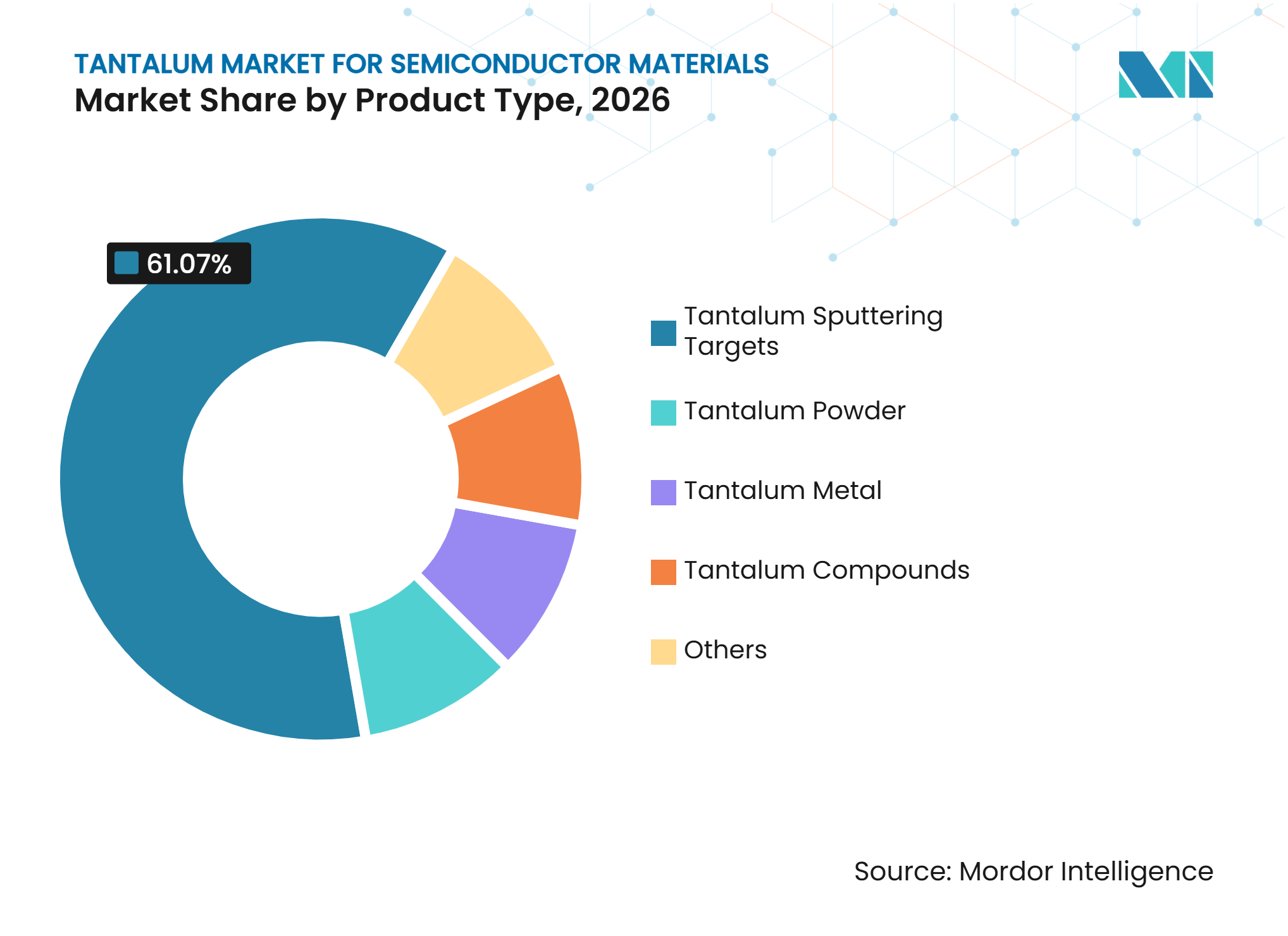
Tantalum Sputtering Targets Lead, While Tantalum Compounds ExpandTantalum sputtering targets accounted for 61.07% of the market share in 2026. Their position reflects the continued use of physical vapor deposition across copper interconnect processing and emerging package metallization. Target performance depends on purity, density, grain structure, and uniform erosion behavior. These factors affect film consistency across wafers and can influence chip yield. High-purity targets remain important for advanced logic processes that operate with narrow process margins. Tosoh SMD, Inc. received U.S. Patent 12,545,993 in February 2026 for a tantalum target manufacturing method designed to maintain film non-uniformity below 2% through target life.
Tantalum compounds are projected to advance at a 7.89% CAGR through 2032. Their growth reflects the use of atomic layer deposition precursors in sub-5 nm logic and high-aspect-ratio memory structures. Tantalum powders serve as target feedstock and as capacitor anode material in electronic systems. Tantalum metal, including rod and plate forms, supports specialized vacuum and laboratory applications. Other material formats include tantalum oxide films for photonic devices and research applications. The product mix supports several processing routes, which help the tantalum market for semiconductor materials serve both established fabrication methods and newer deposition technologies.



By Application:
Wafer Fabrication Leads, Semiconductor Packaging AcceleratesWafer fabrication accounted for 68.11% of the market share in 2026. This application uses tantalum and tantalum nitride as liners and diffusion barriers in metal interconnect structures. Leading-edge fabrication requires tight impurity control and consistent target performance. Suppliers with existing fab qualifications have an advantage because process changes can affect electrical performance and yield. Increased layer counts in complex logic chips support recurring material consumption. The segment remains central to the tantalum market for semiconductor materials because each deposited barrier layer requires qualified materials and stable process control.
Semiconductor packaging is projected to advance at an 8.21% CAGR through 2032. Chiplet integration, fan-out wafer-level packaging, hybrid bonding, and through-silicon vias are expanding the range of package-level metallization steps. Tantalum-based films can support redistribution layers and metal-insulator-metal capacitor structures. ULVAC Korea published research on Ta/TaN diffusion-barrier films fabricated by direct-current magnetron sputtering in 2025. Packaging facilities may have more flexibility in material qualification than front-end fabs. This can increase supplier participation while maintaining demand for dependable deposition materials.
By Semiconductor Device Type:
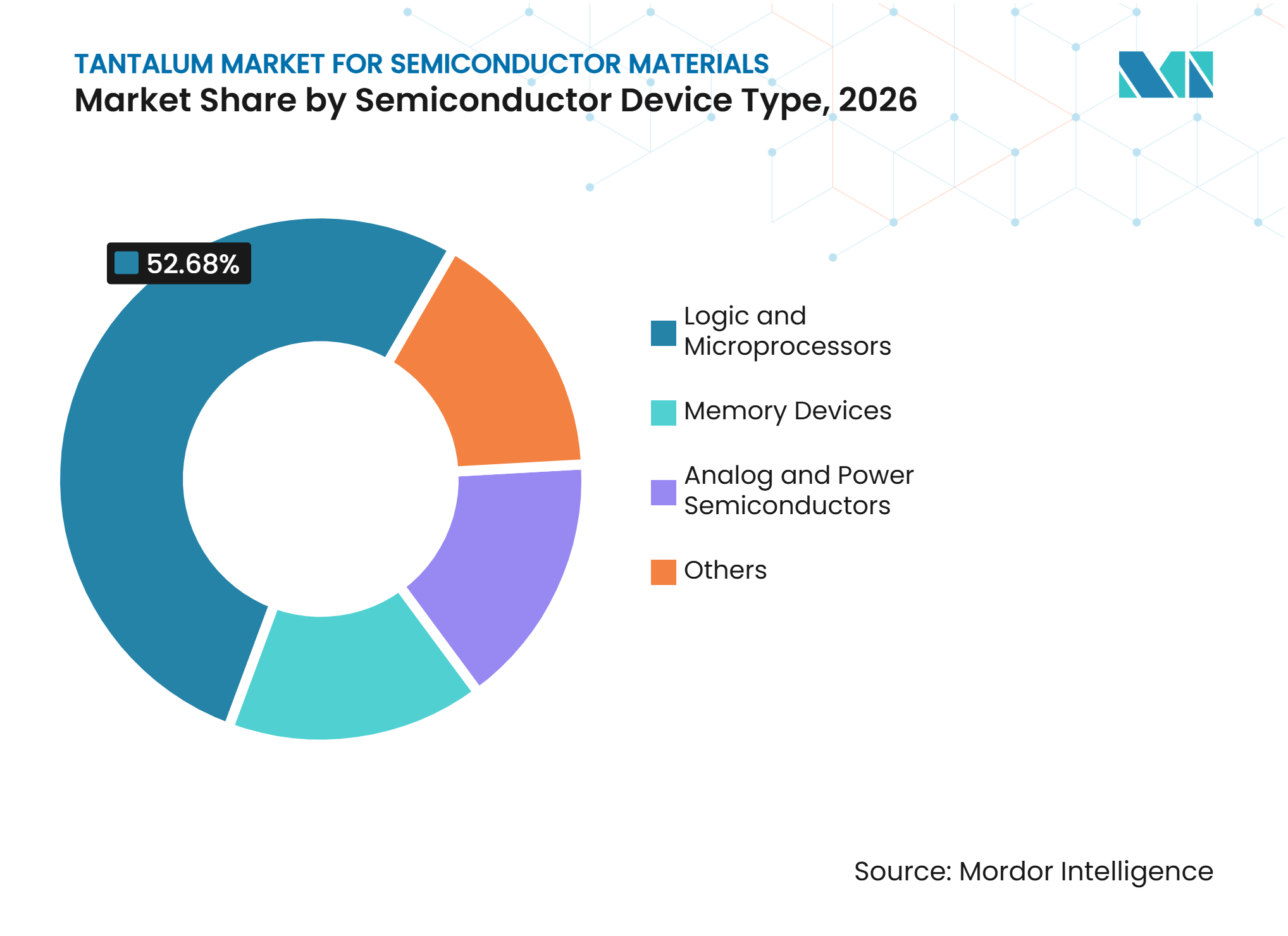
Logic and Microprocessors Lead Both Scale and GrowthLogic and microprocessors accounted for 52.68% of the market share in 2026. The segment is projected to advance at an 8.78% CAGR through 2032. Artificial intelligence processors, central processing units, graphics processors, and custom accelerators require complex interconnect structures. Higher die complexity supports demand for barrier films and related target materials. Tantalum capacitor requirements also rise with the power-management needs of data-center equipment. This combination makes logic a core demand source for the tantalum market for semiconductor materials.
Memory devices use tantalum-containing materials in high-aspect-ratio 3D NAND contacts and selected dynamic random-access memory structures. Higher memory-layer counts increase the need for conformal deposition methods. Analog and power semiconductors represent a smaller but stable source of demand as power-management devices move to more advanced designs. Other device categories include microelectromechanical systems sensors, radio-frequency filters, and photonic components. Demand exposure to a limited number of leading logic customers can create larger order swings for approved target suppliers. Supplier diversification and wider regional sourcing can reduce this exposure over time.

Geography Analysis
Asia-Pacific: Largest and Fastest-Growing Region
Asia-Pacific held 44.56% of the tantalum market for semiconductor materials in 2026 and is projected to advance at an 8.56% CAGR through 2032. Taiwan, South Korea, Japan, and China contain a large share of global logic and memory fabrication capacity. This concentration supports regional demand for high-purity targets and precursor materials. Japan also has a major supplier base for deposition materials and refractory-metal processing. JX Advanced Metals Corporation is increasing functional tantalum powder capacity in Thailand, with operations from the expansion scheduled to start sequentially from the first half of 2027. The investment links Southeast Asian processing capacity with demand from artificial intelligence data centers and semiconductor production. Responsible Minerals Assurance Process conformance remains important for suppliers serving regional fab customers. Global Advanced Metals Pty Ltd has maintained certification across facilities in Japan, Australia, and the United States, according to its November 2025 announcement. India and Southeast Asia can add demand as national programs support new semiconductor projects. Their current role remains smaller than that of the established Northeast Asian manufacturing centers.
North America: Reshoring Investment Drives New Demand Layer
North America is supported by semiconductor manufacturing incentives and new fab construction. The U.S. Government Accountability Office documented 40 projects receiving direct awards as of July 2025. These projects increase the need for localized technical support, qualified materials, and resilient sourcing. The U.S. regulatory environment also gives added weight to traceability for critical minerals. Global Advanced Metals Pty Ltd received an indefinite-delivery, indefinite-quantity contract from the Defense Logistics Agency for tantalum ingots in September 2025. Materion Corporation completed the acquisition of tantalum sputtering target manufacturing assets in Dangjin City, South Korea, for USD 19.5 million in July 2025. The move shows that suppliers serving North American customers may still need Asian production and support networks. Domestic qualification capacity can take time to develop because targets must be approved for individual tools and process flows. The tantalum market for semiconductor materials is likely to gain from this investment cycle as fabs move from construction to production. Supply-chain resilience will remain a central criterion for new supplier relationships.
Europe, South America, and Middle East and Africa: Supply Roles Shape a Mixed Regional Position
Europe is more significant as a processing and advanced-materials supply base than as a major semiconductor consumption center. TANIOBIS operates from Germany and is expanding its regional materials network, including chloride-based products used in semiconductor deposition processes. Mitsubishi Materials Corporation completed its acquisition of H.C. Starck Holding GmbH in December 2024, adding refractory-metal capability to its materials portfolio. The European Union Critical Raw Materials Act places greater attention on supply security and domestic processing. South America has a limited semiconductor manufacturing base, though Brazil supports some electronics and automotive supply activity. The Middle East is pursuing early semiconductor research and investment programs. Africa has limited fabrication demand but is important to the tantalum market for semiconductor materials because of upstream ore supply. This uneven structure separates extraction regions from the locations where most high-value processing and chip production occur. It also makes provenance verification important for buyers across all consuming regions. Regional diversification can reduce risk, but it requires investment in refining, qualification, and logistics.
Competitive Landscape
Market Concentration
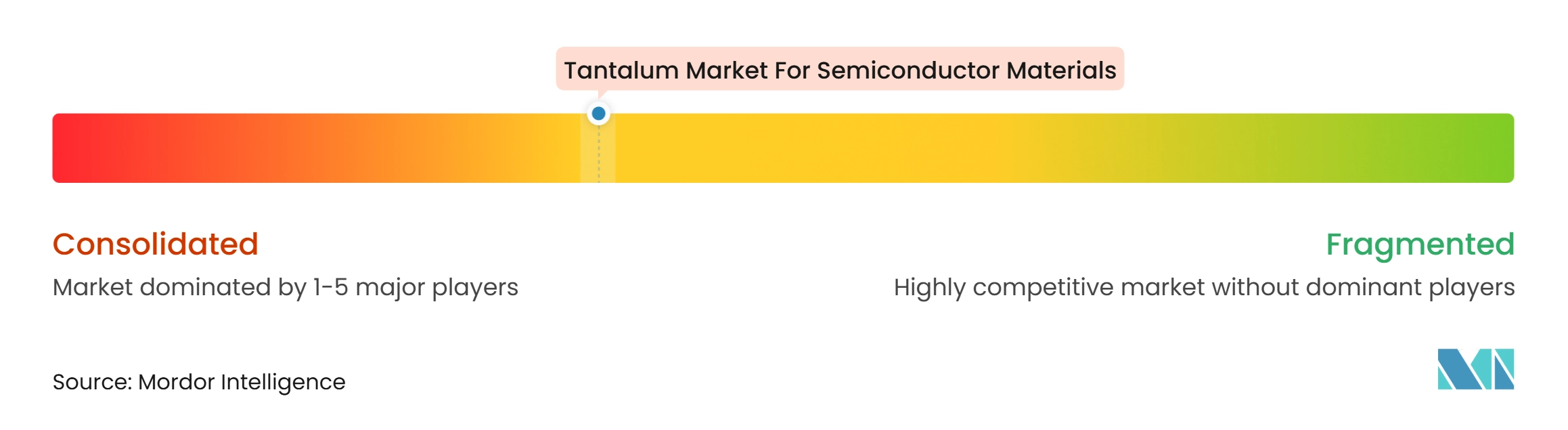
The tantalum market for semiconductor materials is moderately concentrated, with the top five players including JX Advanced Metals Corporation, Materion Corporation, American Elements, Plansee SE, and Tosoh SMD, Inc. JX Advanced Metals Corporation has an integrated position through target fabrication and its TANIOBIS business, which produces tantalum and niobium materials. JX Advanced Metals Corporation announced a Thailand expansion for functional tantalum powders in June 2026. The company also expanded facilities for high-purity chemical vapor deposition and atomic layer deposition materials in Japan during 2025. These investments address demand from semiconductor targets, capacitor materials, and advanced deposition processes.
Materion Corporation is strengthening its Asian semiconductor footprint through the July 2025 acquisition of manufacturing assets in Dangjin City, South Korea. This step added local capacity for semiconductor deposition materials near major Korean, Taiwanese, and Japanese customer bases. Tosoh SMD, Inc. is competing through target engineering and patent-protected manufacturing methods. Its February 2026 patent describes upset forging and controlled rolling to improve target performance and predictability. ULVAC, Inc. integrates deposition equipment capability with materials knowledge, and its 2025 research on Ta/TaN films demonstrates continued work on barrier processes. These strategies emphasize technical qualification and process compatibility rather than price alone.
Global Advanced Metals Pty Ltd participates in the supply chain through conflict-free sourcing and processing capability. American Elements, CNMC Ningxia Orient Group Co., Ltd., Kurt J. Lesker Company, Linde PLC, Mitsubishi Materials Corporation, Plansee SE, Stanford Advanced Materials, and H.C. Starck Solutions serve related materials, equipment, distribution, industrial-gas, or refractory-metal requirements. Linde PLC announced an eighth on-site air separation unit for Samsung's Pyeongtaek semiconductor complex in South Korea during 2025. The competitive field in the tantalum market for semiconductor materials is shaped by customer qualification, compliance documentation, and the ability to support multiple semiconductor manufacturing regions. New Chinese capacity can intensify competition in domestic supply chains, while certified global suppliers retain advantages for international fab programs.
Leaders of Tantalum Market For Semiconductor Materials
-
JX Advanced Metals Corporation
-
Materion Corporation
-
American Elements
-
Plansee SE
-
Tosoh SMD, Inc.
- *Disclaimer: Major Players sorted in no particular order
Tantalum Market For Semiconductor Materials Companies Covered in this Report
- American Elements
- CNMC Ningxia Orient Group Co., Ltd.
- Global Advanced Metals Pty Ltd
- H.C. Starck Solutions
- Honeywell International Inc.
- JX Advanced Metals Corporation
- Kurt J. Lesker Company
- Linde PLC
- Materion Corporation
- Mitsubishi Materials Corporation
- Plansee SE
- Stanford Advanced Materials
- Tosoh SMD, Inc.
- ULVAC, Inc.
Recent Industry Developments in Tantalum Market For Semiconductor Materials
- October 2026: JX Advanced Metals Corporation announced an investment in new recycling equipment at its Tatebayashi and Nasu plants in Japan to recover materials from sputtering targets used in advanced semiconductor manufacturing. The initiative covers copper, tantalum, titanium, tungsten, and cobalt targets, supporting the tantalum market for semiconductor materials by strengthening material recovery and circular supply chains for semiconductor-grade metals.
- December 2025: Solstice Advanced Materials broke ground on a USD 200 million expansion and modernization project at its electronic materials facility in Spokane Valley, Washington. The investment is expected to double the facility's sputtering target production capacity by the end of 2029 and reduce lead times by 25%, supporting the tantalum market for semiconductor materials through expanded domestic manufacturing of specialized sputtering targets and semiconductor materials.
Scope of Report on Tantalum Market For Semiconductor Materials
Tantalum is a refractory metal valued for its high melting point, corrosion resistance, and electrical properties, making it an important material in semiconductor manufacturing. Its high-purity forms support the production of thin films, conductive layers, and other components used in semiconductor devices.
The Tantalum Market for Semiconductor Materials is segmented by product type, application, semiconductor device type, and geography. By product type, the market is segmented into tantalum sputtering targets, tantalum powder, tantalum metal, tantalum compounds, and others. By application, the market is segmented into wafer fabrication and semiconductor packaging. By semiconductor device type, the market is segmented into logic and microprocessors, memory devices, analog and power semiconductors, and others. The report also covers the market size and forecasts for tantalum for semiconductor materials across 16 countries. For each segment, the market sizing and forecasts have been done on the basis of value (USD).
Segmentation Overview
| Tantalum Sputtering Targets |
| Tantalum Powder |
| Tantalum Metal |
| Tantalum Compounds |
| Others |
| Wafer Fabrication |
| Semiconductor Packaging |
| Logic and Microprocessors |
| Memory Devices |
| Analog and Power Semiconductors |
| Others |
| Asia-Pacific | China |
| India | |
| Japan | |
| South Korea | |
| ASEAN Countries | |
| Rest of Asia-Pacific | |
| North America | United States |
| Canada | |
| Mexico | |
| Europe | Germany |
| United Kingdom | |
| France | |
| Italy | |
| NORDIC Countries | |
| Russia | |
| Rest of Europe | |
| South America | Brazil |
| Argentina | |
| Rest of South America | |
| Middle East and Africa | Saudi Arabia |
| South Africa | |
| Rest of Middle East and Africa |
| By Product Type | Tantalum Sputtering Targets | |
| Tantalum Powder | ||
| Tantalum Metal | ||
| Tantalum Compounds | ||
| Others | ||
| By Application | Wafer Fabrication | |
| Semiconductor Packaging | ||
| By Semiconductor Device Type | Logic and Microprocessors | |
| Memory Devices | ||
| Analog and Power Semiconductors | ||
| Others | ||
| By Geography | Asia-Pacific | China |
| India | ||
| Japan | ||
| South Korea | ||
| ASEAN Countries | ||
| Rest of Asia-Pacific | ||
| North America | United States | |
| Canada | ||
| Mexico | ||
| Europe | Germany | |
| United Kingdom | ||
| France | ||
| Italy | ||
| NORDIC Countries | ||
| Russia | ||
| Rest of Europe | ||
| South America | Brazil | |
| Argentina | ||
| Rest of South America | ||
| Middle East and Africa | Saudi Arabia | |
| South Africa | ||
| Rest of Middle East and Africa | ||
Key Questions Answered in the Report
What is the size of the tantalum market for semiconductor materials?
The tantalum market for semiconductor materials industry size was valued at USD 208.64 million in 2026 and is estimated to grow from USD 223.21 million in 2027 to reach USD 316.14 million by 2032, at a CAGR of 7.21% during the forecast period (2027-2032).
What is driving demand for tantalum in semiconductor manufacturing?
Tantalum demand is supported by its use in sputtering targets and tantalum nitride barrier films for copper interconnects, advanced logic, and 3D NAND processing.
Which product type held the largest share in 2026?
Tantalum sputtering targets led with a 61.07% share in 2026.
Which application is projected to advance fastest through 2032?
Semiconductor packaging is projected to advance at an 8.21% CAGR through 2032 as chiplet integration and advanced package metallization expand.