
Taiwan Metal Forming Equipment Market Size and Share
Market Overview
| Study Period | 2020 - 2031 |
|---|---|
| Forecast Data Period | 2026 - 2031 |
| Base Year Market Size (2025) | USD 0.54 Billion |
| Market Size (2026) | USD 0.56 Billion |
| Market Size (2031) | USD 0.66 Billion |
| Growth Rate (2026 - 2031) | 3.34 % |
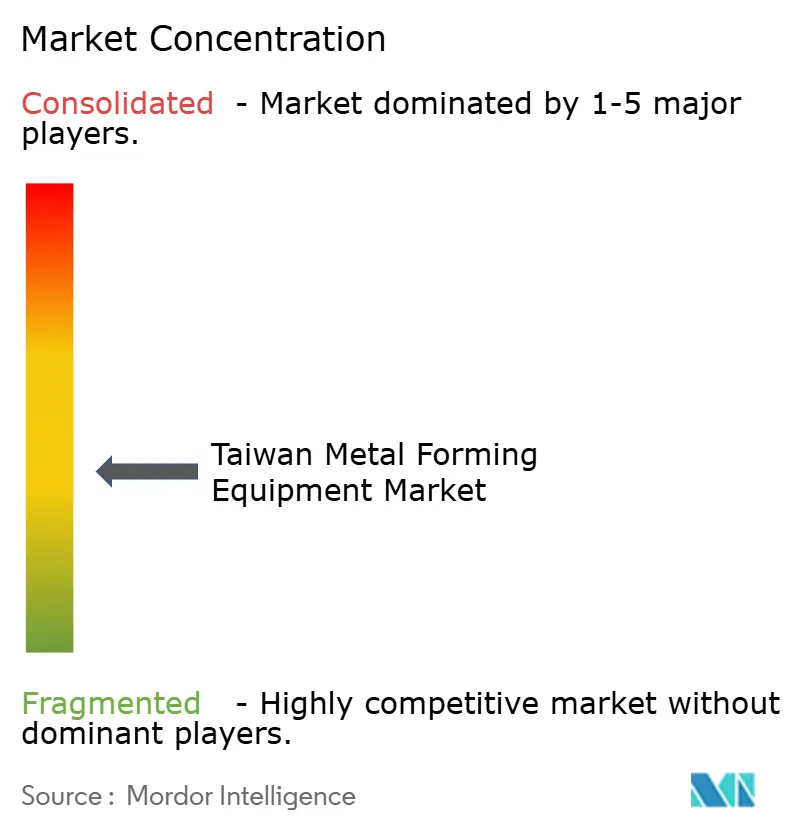
| Market Concentration | Medium |
Major Players *Disclaimer: Major Players sorted in no particular order Image © Mordor Intelligence. Reuse requires attribution under CC BY 4.0. | |
Taiwan Metal Forming Equipment Market Analysis by Mordor Intelligence
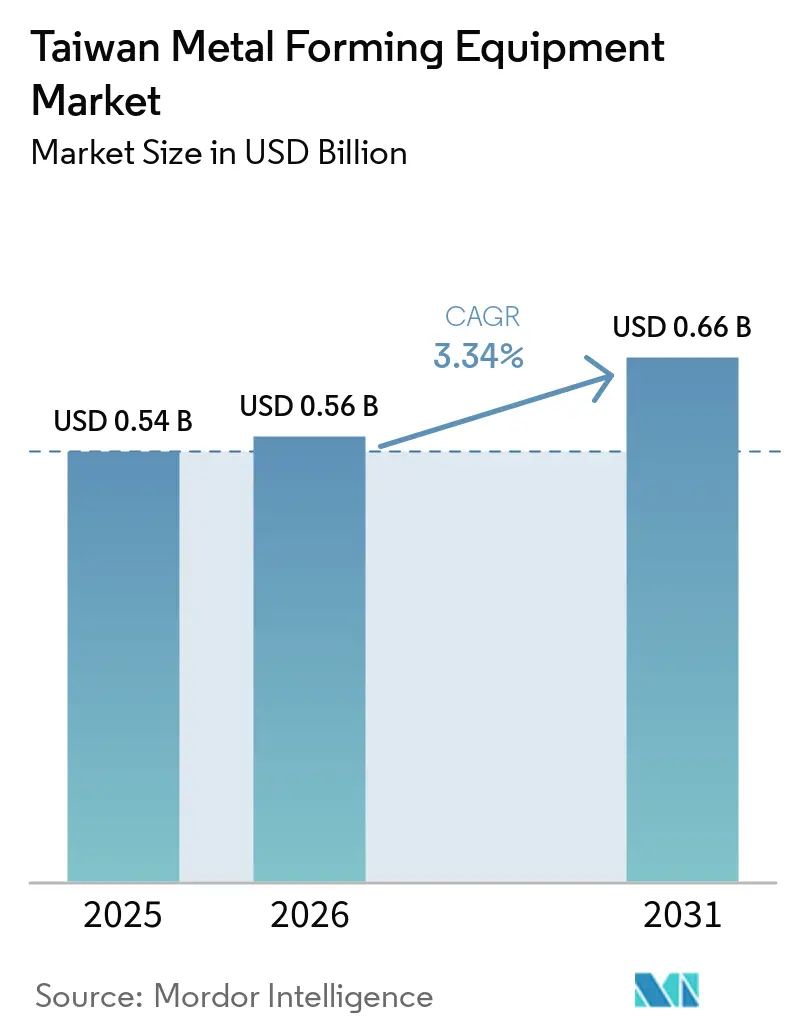
The Taiwan metal forming equipment market size was valued at USD 0.54 billion in 2025 and is estimated to grow from USD 0.56 billion in 2026 to reach USD 0.66 billion by 2031, at a CAGR of 3.34% during the forecast period 2026-2031.
The Taiwan metal forming equipment market is supported by demand from semiconductor production, electric vehicle components, and defense supply chains. Taiwan’s metal forming machine tool exports fell 7.8% to USD 353 million in 2025, while total machinery exports rose 9.1% to USD 31.86 billion, led by semiconductor equipment and electronic systems.[1]Taiwan Association of Machinery Industry, “Taiwan Machinery Industry Export Statistics, Full-Year 2025 and H1 2026,” Taiwan Association of Machinery Industry, tami.org.tw. This difference indicates that forming equipment suppliers have not yet received the same benefit from AI-related manufacturing investment as the wider machinery sector. The Taiwan metal forming equipment market is moving toward higher-precision, energy-efficient, and automated systems as buyers address changing material needs and a tighter labor supply. Export competitiveness remains affected by currency movements, tariffs, certification costs, and lower-priced Chinese equipment.
Key Report Takeaways
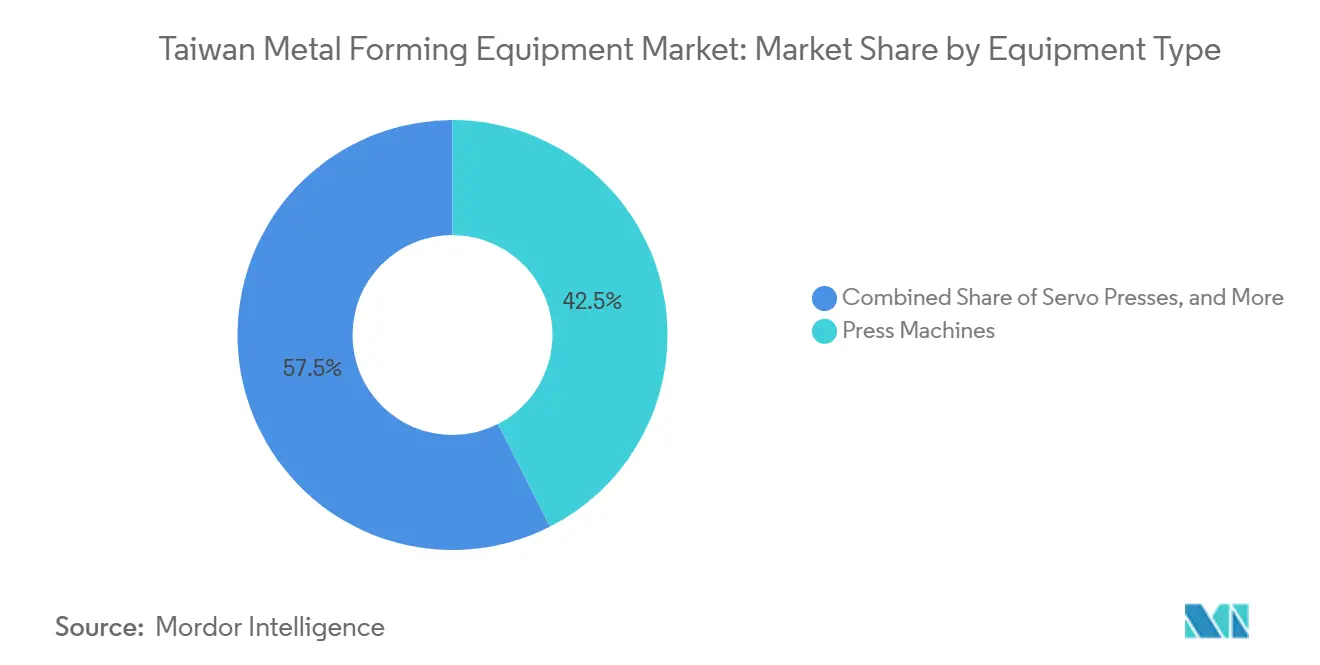
- By equipment type, press machines held 42.5% of the Taiwan metal forming equipment market share in 2025, while servo presses are forecast to grow at a 5.7% CAGR through 2031.
- By forming process, stamping and punching held 31.5% of the Taiwan metal forming equipment market size in 2025, while hydroforming is projected to expand at a 5.3% CAGR through 2031.
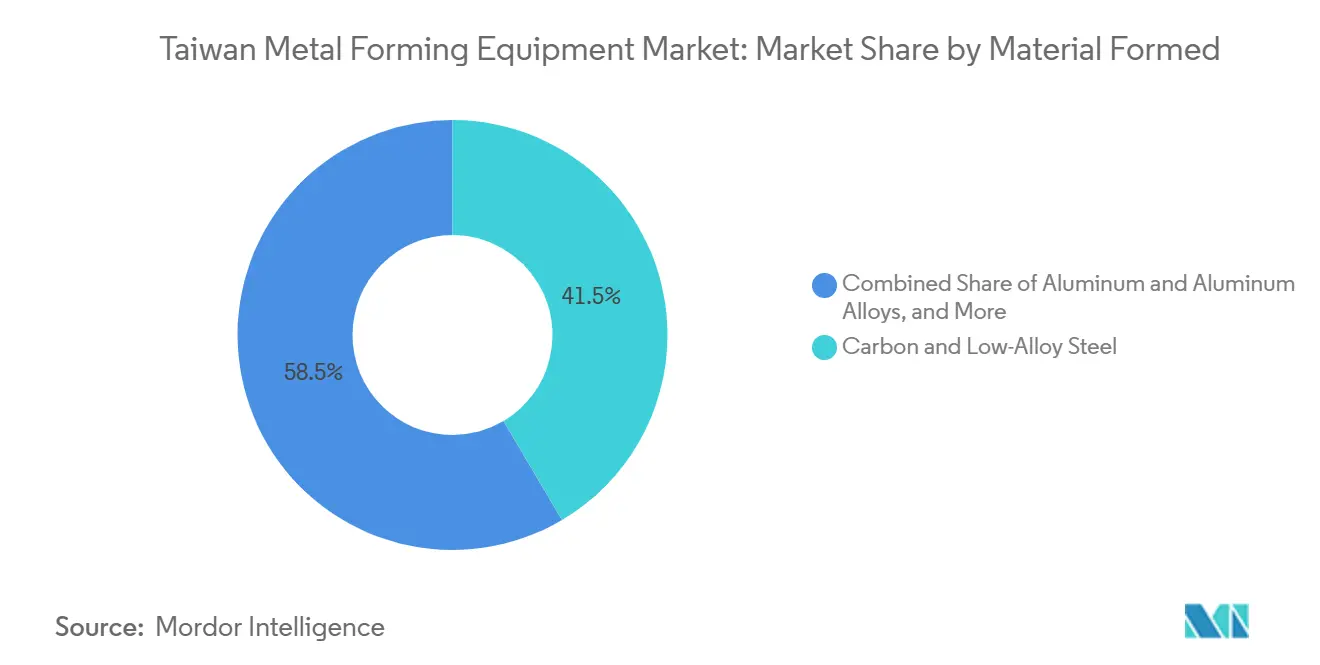
- By material formed, carbon and low-alloy steel accounted for 41.5% of the Taiwan metal forming equipment market share in 2025, while aluminum and aluminum alloys are forecast to grow at a 5% CAGR through 2031.
- By end-use industry, electrical and electronics held 28.5% of the Taiwan metal forming equipment market size in 2025, while aerospace and defense is projected to register a 5.6% CAGR through 2031.
Note: Market size and forecast figures in this report are generated using Mordor Intelligence’s proprietary estimation framework, updated with the latest available data and insights as of January 2026.
Taiwan Metal Forming Equipment Market Trends and Insights
Drivers Impact Analysis*
| Driver | (~) % Impact on CAGR Forecast | Geographic Relevance | Impact Timeline |
|---|---|---|---|
| Electrification and Lightweight Component Forming | +0.8% | Taiwan EV and battery supply chains, with the strongest activity in the central and southern manufacturing corridors | Short term (≤ 2 years) |
| Semiconductor, Electronics, and Advanced Connector Production | +0.7% | Taiwan, especially Hsinchu, Taichung, and Tainan science park corridors | Short term (≤ 2 years) |
| Automation and Labor-Shortage Response | +0.6% | Taiwan, with demand from ASEAN manufacturers sourcing Taiwanese press automation | Medium term (2-4 years) |
| AI-Enabled Process Monitoring and Predictive Maintenance | +0.5% | Taiwan, with early adoption in semiconductor and electronics forming lines | Medium term (2-4 years) |
| Energy-Efficient Servo and Electric Forming Systems | +0.4% | Taiwan and energy-constrained export markets in South and Southeast Asia | Medium term (2-4 years) |
| Export-Led Upgrading into Aerospace and High-Precision Applications | +0.3% | Taiwan, with early export programs in North America and Western Europe | Long term (≥ 4 years) |
| Source: Mordor Intelligence | |||
Electrification and Lightweight Component Forming
Taiwan’s electric vehicle and energy-storage production requires forming equipment that can process aluminum and high-tensile steel with consistent accuracy. Battery enclosures, motor housing, and chassis members need servo-driven and hydroforming-capable presses for repeated, high-cycle production. One-piece forming of lightweight structures can reduce material waste and reduce the need for welding during assembly. This change raises demand for automated punching, precision tooling, and controls that manage dimensional variation. Master Bus stated in 2025 that its Pingtung facility could produce 1,000 electric buses annually, while its Changhua automated plant added 2,000 units of annual capacity. These production programs support continuing demand for aluminum and high-strength steel component forming in the Taiwan metal forming equipment market.
Semiconductor, Electronics, and Advanced Connector Production
Taiwan’s semiconductor and electronics base creates recurring demand for precision stamping, deep drawing, and connector forming equipment. ITRI estimated Taiwan semiconductor output at TWD 6.5 trillion (USD 207.44 billion) in 2025, up 22.2%, while IC manufacturing rose 28.3% to TWD 4.16 trillion (USD 132.76 billion).[2]Industrial Technology Research Institute, “ITRI Raises Output Growth Forecast for Taiwan Semiconductors,” Overseas Community Affairs Council, ocac.gov.tw. Connector, lead-frame, and IC packaging production require high-speed press lines with close positional control. The Ministry of Economic Affairs reported that electronics component production increased 24.71% in 2025, and computer and optoelectronics production increased 56.43%.[3]Ministry of Economic Affairs, “Indexes of Industrial Production, Full-Year 2025,” Ministry of Economic Affairs, moea.gov.tw. These volumes increase demand for finer copper and aluminum components used in advanced packaging and AI hardware. Electrical and electronics, therefore, remains the main volume base for the Taiwan metal forming equipment market.
Automation and Labor-Shortage Response
Taiwan’s shrinking working-age population is increasing the need for automated forming lines. The National Development Council projected that the population aged 15-64 would decline by 3 million by 2040.[4]National Development Council, “Population Projections for the Republic of China, Taiwan, 2024-2070,” National Development Council, pop-proj.ndc.gov.tw. ITRI and 104 Job Bank recorded 34,000 unfilled semiconductor vacancies in May 2025. Manufacturing labor demand is expected to rise by 19,000 workers each year through 2030, which increases pressure on manufacturers to improve output per employee. The National Science and Technology Council committed USD 332 million to its smart robot program in 2025, supporting robotic integration across production settings. New investments increasingly combine presses with robotic loading, unloading, inspection, and manufacturing execution system connectivity.
AI-Enabled Process Monitoring and Predictive Maintenance
Process monitoring is becoming more relevant as Taiwan manufacturers seek higher line availability and better maintenance planning. ITRI’s Prognosis Monitoring System uses machine learning to model machinery behavior and identify potential failures before they occur. The approach can be applied to press drivetrains and hydraulic systems where unexpected downtime can interrupt multi-press operations. ITRI also promoted common data exchange standards and energy monitoring across 16 metal and machinery supply chains in 2025. This activity supports buyer interest in embedded sensors, energy data, and interoperable controls. Equipment suppliers that provide these features can better address procurement requirements in the Taiwan metal forming equipment market.
Restraints Impact Analysis*
| Restraint | (~) % Impact on CAGR Forecast | Geographic Relevance | Impact Timeline |
|---|---|---|---|
| High Capital Cost and Long Payback for Integrated Lines | -0.5% | Taiwan, especially small and medium-sized companies in the central machinery cluster | Medium term (2-4 years) |
| Exposure To Export Cycles, Tariffs and China Price Competition | -0.4% | Taiwanese export manufacturers with significant USD-denominated revenue | Short term (≤ 2 years) |
| Shortage Of Forming-Process and Controls Engineers | -0.3% | Taiwan, concentrated in the Taichung and Hsinchu industrial zones | Medium term (2-4 years) |
| Integration Friction Across Legacy Equipment, MES, and AI Platforms | -0.2% | Taiwan SME clusters with varied installed equipment bases | Long term (≥ 4 years) |
| Source: Mordor Intelligence | |||
High Capital Cost and Long Payback for Integrated Lines
Integrated servo-electric lines, multi-axis transfer presses, and automated systems require investments that many smaller manufacturers cannot make within usual financing periods. Taiwan’s supplier base includes many small and medium-sized businesses, making access to capital important for technology upgrades. TMBA’s 2025 recommendations called for investment subsidies and loan support that consider the differing capabilities of small and medium-sized enterprises. The Industrial Development Administration assisted 126 metal and electromechanical manufacturers with lean improvements in 2025, and 118 of them implemented digital systems. Rising energy and transport costs can further extend payback periods for integrated press lines. These conditions may slow the adoption of higher-specification equipment across the Taiwan metal forming equipment market.
Exposure To Export Cycles, Tariffs, and China Price Competition
The Taiwan metal forming equipment market is exposed to changes in global factory investment, tariff policy, and competition from lower-cost suppliers. Taiwan Customs data compiled by TMBA showed that metal forming machine tool exports declined 7.8% to USD 353 million in 2025 and fell 5.7% to USD 172 million in the first half of 2026. TAMI reported that the New Taiwan dollar depreciated 11.2% from 2021 to early 2026, compared with 53.2% for the Japanese yen. This movement reduced Taiwan’s earlier 20-30% price advantage over Japanese suppliers in several export markets. Taiwan’s machine tool tariff rate in the United States moved from 4.7% to 10%, while Japan and South Korea faced 12.5%, according to TAMI and Taiwan Customs data. Smaller exporters also face the added cost of CE, ISO, and market-specific safety certification.
*Our forecasts treat driver/restraint impacts as directional, not additive. The impact forecasts reflect baseline growth, mix effects, and variable interactions.
Segment Analysis
By Equipment Type: Press Technology Anchors Demand While Servo Formats Gain Traction
Press machines held 42.5% of the Taiwan metal forming equipment market share in 2025, reflecting their use in electronics, automotive, and metal fabrication lines. Mechanical and hydraulic presses make up much of the installed base for connector, chassis, and appliance stamping. Their programmable motion profiles can support forming tasks that require repeatable control across changing production requirements. The Taiwan metal forming equipment industry is also moving toward equipment that reduces energy losses associated with conventional flywheel operation. TMBA’s March 2026 energy-saving label evaluation showed that domestic machine builders are incorporating energy optimization during product design.
Servo presses are forecast to record the highest equipment-type CAGR of 5.7% during 2026-2031. Press brakes and bending machines serve sheet metal fabrication for electrical enclosures, precision frames, and construction work. Forging equipment supports automotive, industrial, defense, and aerospace component production. Roll forming and plate or profile rolling equipment serve structural steel and construction-related applications. Wire, tube, and profile equipment support electronics, wiring harness, and connector terminal production. Extrusion presses form copper and aluminum profiles used in heat sinks and structural connectors. Hydroforming equipment is gaining use in lightweight vehicle parts because it can produce complex single-piece forms and reduce welding requirements.


By Forming Process: Stamping Anchors Volume, While Hydroforming Serves Lightweight Structures
Stamping and punching accounted for 31.5% of the Taiwan metal forming equipment market share in 2025, supported by connector manufacturing, IC packaging, AI server parts, and consumer electronics. The Ministry of Economic Affairs reported a 24.71% increase in electronic component production during 2025. High-cycle progressive press lines remain necessary for these electronics applications. Taiwan’s semiconductor and AI hardware supply chain supports this demand through repeated component production. It is suited to thin-walled aluminum structures that are difficult to make efficiently through deep drawing or multi-part stamping.
Hydroforming is forecast to grow at a 5.3% CAGR through 2031, the highest rate among forming processes. Deep drawing remains important for battery cases with tight wall tolerances and high draw ratios. Bending and roll forming support structural fabrication and industrial building systems. Forging continues to serve automotive powertrain parts and aerospace structural members. Extrusion supports copper and aluminum profiles used in connectors, heat sinks, and cooling systems. Common data standards and energy monitoring can improve utilization across these process types. Higher utilization may defer some new equipment purchases, but it also raises the required technology level for the Taiwan metal forming equipment market.
By Material Formed: Steel Remains Foundational, While Aluminum Demand Increases
Carbon and low-alloy steel accounted for 41.5% of the Taiwan metal forming equipment market size by material in 2025. Its position reflects continuing demand from automotive structures, machinery frames, and construction-related fabrication. Stainless steel is used in medical devices, semiconductor equipment components, and food-grade processing equipment. The shift is linked to lightweight battery cases, motor housing, and vehicle body structures. This change supports demand for equipment that can manage aluminum-specific forming requirements.
Aluminum and aluminum alloys are forecast to grow at a 5.0% CAGR through 2031, the fastest rate among material types. Aluminum forming requires different tooling hardness, lubrication, and springback compensation than steel forming. These differences can lead to upgrades in tooling and press specifications across production lines. Copper and copper alloys remain essential for connectors, terminals, and bus bars in electronics and charging infrastructure. Titanium and nickel alloys are lower-volume materials, but their forming needs are more exacting. Aerospace programs require traceability and verified process records under AS9100 requirements. The Taiwan metal forming equipment industry can therefore see higher-value demand as aerospace-related material use expands.
By End-Use Industry: Electronics Leads While Aerospace and Defense Grow Fastest
Electrical and electronics held 28.5% of the Taiwan metal forming equipment market share in 2025. The segment benefits from Taiwan’s semiconductor and AI hardware manufacturing base. Computer and optoelectronics production increased 56.43% in 2025, driven by AI server and advanced packaging demand. Higher chip content and advanced packaging needs increase demand for precise connector and IC packaging components. Aerospace Industrial Development Corporation signed a 20-year agreement with Bombardier in September 2026 to supply cockpit and forward fuselage structural components for the Challenger 3500.
Aerospace and defense are forecast to grow at a 5.6% CAGR during 2026-2031. Automotive and transportation demand includes aluminum and high-strength steel components for electric vehicles. Industrial machinery and capital equipment create broad demand from Taiwan’s fabricator base. Construction and infrastructure demand depend on infrastructure spending and structural fabrication activity. Medical and precision manufacturing needs validated titanium forming processes for implants and surgical instruments. Consumer appliances support sheet metal stamping for cooking equipment, HVAC products, and enclosures. Energy and power applications add demand for solar-frame and grid infrastructure fabrication in the Taiwan metal forming equipment market.
Geography Analysis
Taiwan is the single domestic geography assessed in the Taiwan metal forming equipment market, although its production and investment activity is spatially concentrated. The Taichung Golden Corridor along Dadu Mountain includes 1,500 precision machinery firms within a 60-kilometer area. This concentration brings press makers, tooling suppliers, hydraulic system firms, and automation providers close to end users. It supports joint work on tooling and controls and allows faster equipment customization. Taiwan’s manufacturing production index rose 17.87% in 2025, and the full-year index reached a record 112.16. New Taipei City’s 2024-2028 Air Quality Management Plan seeks a 25% reduction in volatile organic compound emissions from metal surface treatment by 2026, adding pressure on smaller operators near forming sites.
China, including Hong Kong, the United States, India, Vietnam, and Thailand, were the main export destinations for Taiwan's machine tools in 2025, based on Taiwan Customs data compiled by TMBA. The United States is an important export destination because Taiwan’s total machinery shipments there rose 16% to USD 8.34 billion in 2025. In the first half of 2026, Taiwan's machinery exports to the United States reached USD 4.641 billion, equal to 26.1% of total machinery export revenue. The 10% United States rate for Taiwanese machine tools matched the prevailing most-favored-nation rate for Japanese competitors. China, including Hong Kong, remained the second-largest destination, with USD 3.712 billion or 20.9% of Taiwan's machinery exports in the first half of 2026.
India, Vietnam, and other Southeast Asian markets offer additional export opportunities for the Taiwan metal forming equipment market. India’s production-linked incentive programs in automotive, electronics, and specialty steel support capital equipment demand. Singapore received USD 1.337 billion in Taiwan machinery exports in the first half of 2026 and ranked third among destinations. Semiconductor equipment led this trade, while the commercial presence can support related equipment sales. AeroVironment sourced more than USD 20 million in components from Taiwan during the 3 years through 2025.
Competitive Landscape
The Taiwan metal forming equipment market is moderately fragmented among domestic small and medium-sized manufacturers, while premium large-format press and forging equipment is more concentrated. Domestic suppliers in the Taichung cluster produce mechanical and hydraulic presses from 20 to 500 tonnes. Their products serve electronics, sheet metal fabrication, and consumer appliance customers. These firms compete with flexibility, customization speed, delivery times, and total ownership cost. Amada Taiwan and Aida Engineering serve premium requirements through certified precision, application engineering, and structured aftermarket support. Schuler serves large-format stamping and automated transfer press needs for automotive suppliers and industrial equipment makers.
TRUMPF provides TruBend and TruPunch equipment for sheet metal bending and precision punching. Komatsu competes in precision press applications where high-volume electronics and automotive stamping overlap. TMBA announced its 3rd Energy-Saving Label and 1st AI Empowerment Label in March 2026, which gives domestic suppliers a formal benchmark for energy efficiency and intelligent equipment. These labels support competitive strategies based on power use, monitoring, and system integration. AS9100 certification can take 2-5 years, but it supports long-term relationships in aerospace supply chains. CE marking and ISO safety requirements also create an entry barrier for smaller suppliers pursuing European and North American customers.
Aerospace Industrial Development Corporation’s September 2026 Bombardier agreement illustrates the demand for high-tolerance aluminum and titanium component capability. ITRI’s predictive maintenance work illustrates how monitoring can become part of equipment differentiation. TMBA’s energy and AI labels provide another route for suppliers to demonstrate product capability to buyers. Domestic suppliers retain an advantage in customized work for local customers. Japanese and German suppliers retain an advantage in certified performance, application support, and large-scale automated lines.
Taiwan Metal Forming Equipment Industry Leaders
Chin Fong Machine Industrial Co., Ltd.
Shieh Yih Machinery Industry Co., Ltd.
Lien Chieh Hydraulic Industrial Co., Ltd.
Yeh Chiun Industrial Co., Ltd.
Yih Shen Machinery Co., Ltd.
- *Disclaimer: Major Players sorted in no particular order



Taiwan Metal Forming Equipment Market Report Scope
| Press Machines | Mechanical Presses |
| Hydraulic Presses | |
| Servo Presses | |
| Other General-Purpose Presses | |
| Press Brakes and Bending Machines | Hydraulic Press Brakes |
| Servo / Electric Press Brakes | |
| Mechanical Press Brakes | |
| Other Bending Machines | |
| Forging Equipment | Forging Presses |
| Forging Hammers | |
| Upsetting and Heading Machines | |
| Other Forging Equipment | |
| Roll Forming and Plate/Profile Rolling Equipment | Roll Forming Machines |
| Plate Rolling Machines | |
| Section and Profile Rolling Machines | |
| Other Secondary Rolling/Forming Equipment | |
| Wire, Tube and Profile Forming Equipment | Wire and Bar Drawing/Forming Equipment |
| Tube Forming and Bending Equipment | |
| Profile Forming Equipment | |
| Extrusion Presses | |
| Hydroforming Equipment | |
| Other Metal Forming Equipment |
| Stamping and Punching |
| Deep Drawing |
| Bending |
| Forging |
| Rolling and Roll Forming |
| Extrusion |
| Hydroforming |
| Other Forming Processes |
| Carbon and Low-Alloy Steel |
| Stainless Steel |
| Aluminum and Aluminum Alloys |
| Copper and Copper Alloys |
| Titanium, Nickel and Other Non-Ferrous Metals |
| Other Materials |
| Automotive and Transportation |
| Aerospace and Defense |
| Industrial Machinery and Capital Equipment |
| Metal Products and Fabrication |
| Electrical and Electronics |
| Construction and Infrastructure |
| Energy and Power |
| Consumer Appliances and Durable Goods |
| Medical and Precision Manufacturing |
| Other End-Use Industries |
| By Equipment Type | Press Machines | Mechanical Presses |
| Hydraulic Presses | ||
| Servo Presses | ||
| Other General-Purpose Presses | ||
| Press Brakes and Bending Machines | Hydraulic Press Brakes | |
| Servo / Electric Press Brakes | ||
| Mechanical Press Brakes | ||
| Other Bending Machines | ||
| Forging Equipment | Forging Presses | |
| Forging Hammers | ||
| Upsetting and Heading Machines | ||
| Other Forging Equipment | ||
| Roll Forming and Plate/Profile Rolling Equipment | Roll Forming Machines | |
| Plate Rolling Machines | ||
| Section and Profile Rolling Machines | ||
| Other Secondary Rolling/Forming Equipment | ||
| Wire, Tube and Profile Forming Equipment | Wire and Bar Drawing/Forming Equipment | |
| Tube Forming and Bending Equipment | ||
| Profile Forming Equipment | ||
| Extrusion Presses | ||
| Hydroforming Equipment | ||
| Other Metal Forming Equipment | ||
| By Forming Process | Stamping and Punching | |
| Deep Drawing | ||
| Bending | ||
| Forging | ||
| Rolling and Roll Forming | ||
| Extrusion | ||
| Hydroforming | ||
| Other Forming Processes | ||
| By Material Formed | Carbon and Low-Alloy Steel | |
| Stainless Steel | ||
| Aluminum and Aluminum Alloys | ||
| Copper and Copper Alloys | ||
| Titanium, Nickel and Other Non-Ferrous Metals | ||
| Other Materials | ||
| By End-Use Industry | Automotive and Transportation | |
| Aerospace and Defense | ||
| Industrial Machinery and Capital Equipment | ||
| Metal Products and Fabrication | ||
| Electrical and Electronics | ||
| Construction and Infrastructure | ||
| Energy and Power | ||
| Consumer Appliances and Durable Goods | ||
| Medical and Precision Manufacturing | ||
| Other End-Use Industries | ||


Key Questions Answered in the Report
What is the forecast for Taiwan's metal forming equipment demand through 2031?
The Taiwan metal forming equipment market is projected to reach USD 0.66 billion by 2031, growing at a 3.34% CAGR from 2026.
Which equipment category has the largest role in Taiwan?
Press machines led equipment demand with 42.5% share in 2025, supported by electronics, automotive, and fabrication uses.
What is driving servo press adoption in Taiwan?
Servo presses are forecast to grow at a 5.7% CAGR because buyers seek programmable control and lower energy use.
Which manufacturing customers create the most demand for forming equipment?
Electrical and electronics led end-use demand with 28.5% share in 2025, supported by semiconductor and AI hardware production.
Why is hydroforming growing in Taiwan?
Hydroforming is expected to grow at a 5.3% CAGR through 2031 because it can make complex lightweight aluminum vehicle structures.
What factors restrict equipment investment by Taiwanese manufacturers?
High capital costs, long payback periods, export volatility, tariffs, lower-priced competition, and shortages of technical workers can delay investment.
Page last updated on:





