
Germany Industrial Press Machines Market Size and Share
Market Overview
| Study Period | 2020 - 2031 |
|---|---|
| Forecast Data Period | 2026 - 2031 |
| Base Year Market Size (2025) | USD 1.13 Billion |
| Market Size (2026) | USD 1.18 Billion |
| Market Size (2031) | USD 1.40 Billion |
| Growth Rate (2026 - 2031) | 3.48 % |
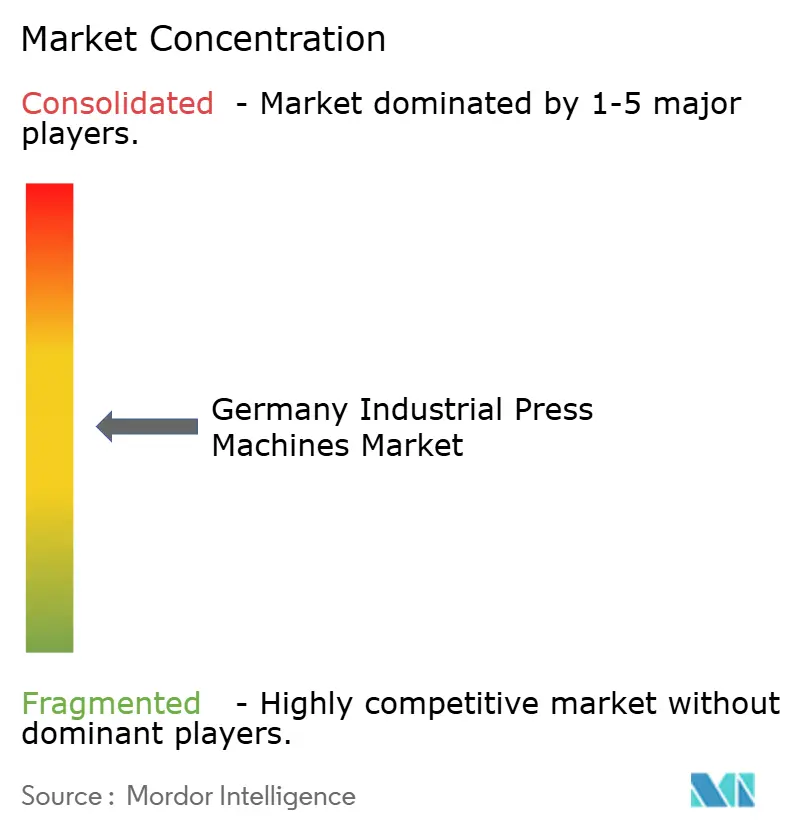
| Market Concentration | Medium |
Major Players *Disclaimer: Major Players sorted in no particular order Image © Mordor Intelligence. Reuse requires attribution under CC BY 4.0. | |
Germany Industrial Press Machines Market Analysis by Mordor Intelligence
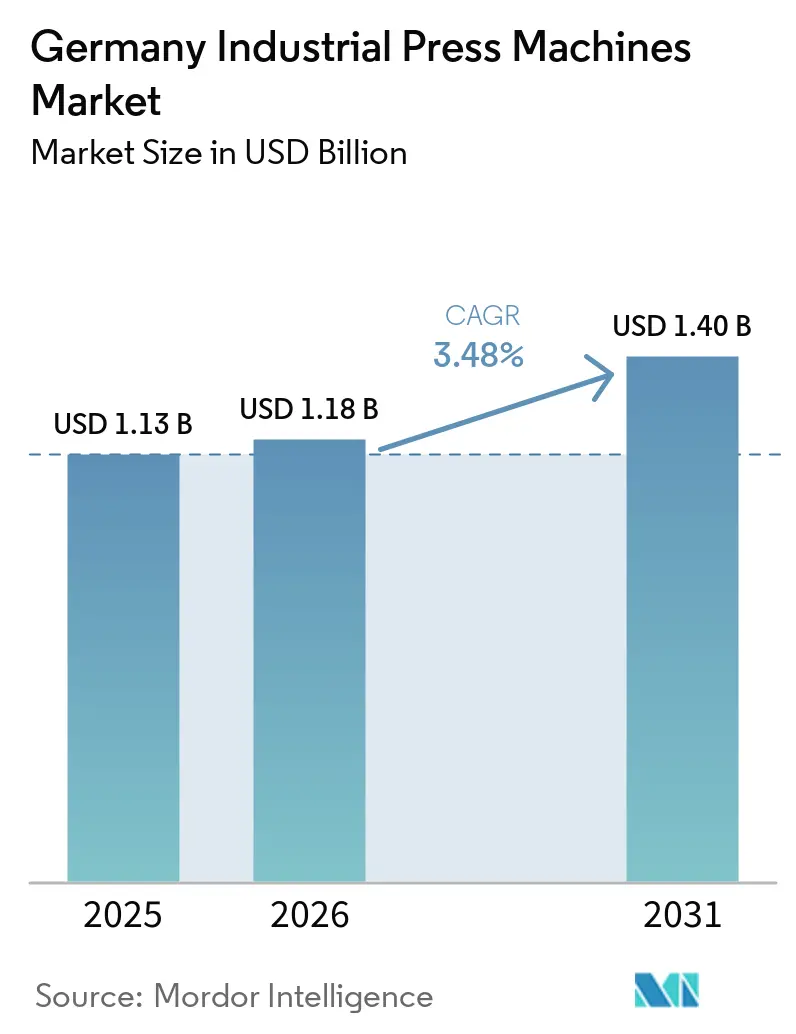
The Germany Industrial Press Machines Market size is expected to increase from USD 1.13 billion in 2025 to USD 1.18 billion in 2026 and reach USD 1.40 billion by 2031, growing at a CAGR of 3.48% over 2026-2031.
The Germany industrial press machine market is being shaped by replacement investment, as manufacturers update aging hydraulic and mechanical equipment. A significant installed base of older presses creates recurring demand for modernization, particularly where legacy controls, drives, and hydraulic systems are becoming difficult or costly to maintain. Battery-electric vehicle production is raising demand for equipment that can form aluminum body structures, battery housings, and motor laminations with controlled motion. Lightweighting and tighter dimensional requirements are also increasing interest in servo-driven presses, precision forming, and automated material handling systems. Defense procurement, medical technology production, and energy infrastructure support demand beyond conventional automotive programs. Germany's machinery, electrical equipment, renewable-energy, and industrial component manufacturing base provides additional applications for stamping, forming, pressing, and precision assembly equipment. Producers are competing through servo controls, connected monitoring, and service capabilities rather than press capacity alone. Predictive maintenance, remote diagnostics, energy monitoring, and integration with factory automation are becoming important differentiators as manufacturers seek higher equipment utilization and lower unplanned downtime. The Germany industrial press machine market also faces cautious domestic investment, lower-cost imports, and new compliance requirements that influence purchase timing. High energy and labor costs can strengthen the business case for energy-efficient equipment, while high financing costs and uncertain industrial orders can encourage smaller manufacturers to extend the operating life of existing presses rather than undertake full equipment replacement.
Key Report Takeaways
- By drive and actuation technology, hydraulic presses held 37% of the Germany industrial press machines market share in 2025, while servo-mechanical presses are forecast to grow at an 8.2% CAGR through 2031.
- By press force, the 101-500-ton tier held 30.2% of the Germany industrial press machines market share in 2025, while presses above 2,000 tons are forecast to grow at a 6.8% CAGR through 2031.
- By application and process, stamping, blanking, and punching accounted for 29.2% of the Germany industrial press machines market size in 2025, while assembly, press-fitting, and joining are forecast to advance at a 7.2% CAGR through 2031.
- By end-use industry, automotive and transportation accounted for 44.3% of the Germany industrial press machines market size in 2025, while medical and precision manufacturing are forecast to expand at an 8% CAGR through 2031.
Note: Market size and forecast figures in this report are generated using Mordor Intelligence’s proprietary estimation framework, updated with the latest available data and insights as of January 2026.
Germany Industrial Press Machines Market Trends and Insights
Drivers Impact Analysis*
| Driver | (~) % Impact on CAGR Forecast | Geographic Relevance | Impact Timeline |
|---|---|---|---|
| Automotive Electrification and Lightweight Component Production | +1.4% | National, with the highest concentration in Baden-Württemberg, Bavaria, and Lower Saxony, automotive clusters | Medium term (2-4 years) |
| Modernization of Aging German Production Equipment | +1.1% | National, with strong activity in North Rhine-Westphalia heavy-industry areas and Bavarian small and medium-sized enterprise clusters | Short term (≤ 2 years) |
| Expansion of Aerospace, Defense, Medical Technology, and Electronics Manufacturing | +0.7% | National, with defense demand in Bavaria and Berlin-Brandenburg, medical technology in Bavaria and Baden-Württemberg, and aerospace in Hamburg and Bavaria | Medium term (2-4 years) |
| Demand for Energy-Efficient Servo-Hydraulic and Electrically Driven Presses | +0.5% | National, influenced by European Union machinery and ecodesign requirements. | Short term (≤ 2 years) |
| Retrofit Demand from Brownfield Press Lines and Installed Equipment | +0.3% | National, with a high presence of legacy sites in North Rhine-Westphalia and Saarland | Short term (≤ 2 years) |
| Domestic Manufacturing and Supplier Localization | +0.2% | National, centered in Bavaria, Baden-Württemberg, and North Rhine-Westphalia machinery regions. | Medium term (2-4 years) |
| Source: Mordor Intelligence | |||
Automotive Electrification and Lightweight Component Production
The German industrial press machine market is changing as battery-electric vehicle platforms require different forming and assembly processes. Aluminum-intensive body structures, cylindrical battery housings, and motor laminations need programmable ram motion and closed-loop position control. Servo-hydraulic and servo-mechanical equipment can meet these requirements more effectively than fixed-speed conventional systems. Thin-gauge high-strength aluminum can increase die wear when it is formed at a fixed ram speed. Controlled servo motion can therefore support part quality while limiting tooling wear. Schuler Inc commissioned a 1.5-gigawatt battery-cell mass-formation line in southern Germany in January 2026, with more than 50,000 formation channels and a track-and-trace system that collects over 2 million data points per second
Modernization of Aging German Production Equipment
The Germany industrial press machines market benefits from the replacement needs of older hydraulic and conventional mechanical presses. Many installed machines no longer meet current expectations for energy performance, connected operation, and documented process control. The European Investment Bank found that nearly two-thirds of German companies’ investment budgets were directed toward replacement and renewal in 2025.[1] This pattern supports brownfield modernization even when new factory construction remains restrained. Older presses cannot always be upgraded economically with servo-controlled drives, digital twin connections, and predictive-maintenance sensors. Replacement decisions can therefore combine a capacity renewal with a move to equipment that meets OEM quality and traceability requirements.
Expansion of Aerospace, Defense, Medical Technology, and Electronics Manufacturing
Defense procurement is creating demand for heavy forming equipment used in armored vehicles, artillery components, and aerospace structures. Germany released more than EUR 33 billion (USD 37.2 billion) across 73 major Bundeswehr projects in 2025, and a July 2025 cabinet proposal extended accelerated defense procurement provisions through 2035.[2] These programs require forging and large-tonnage stamping capacity for heavy components. Medical technology adds demand for precision presses that deliver calibrated force and documented process records. SPECTARIS projected 2025 German medical technology revenue at EUR 42.6 billion (USD 48.1 billion), with export activity supporting the sector’s production base. The Germany industrial press machines market is consequently exposed to applications where consistency and traceability carry greater value than high-volume output.
Demand for Energy-Efficient Servo-Hydraulic and Electrically Driven Presses
Energy use has become a central equipment selection issue for German manufacturers. Servo-hydraulic and electrically driven systems can reduce energy consumption while improving control over the forming cycle. ANDRITZ Schuler introduced its HFA plus+ fineblanking press series in January 2026, reporting a double-digit percentage improvement in energy efficiency and output of up to 85 strokes per minute. The European Union Machinery Regulation 2023/1230 applies from January 20, 2027, and adds requirements relating to digital documentation, functional safety, and cybersecurity.[3] Manufacturers that replace equipment before that date can combine energy upgrades with compliance preparation. This timing gives the German industrial press machine market a defined modernization window through the late 2020s.
Restraints Impact Analysis*
| Restraint | (~) % Impact on CAGR Forecast | Geographic Relevance | Impact Timeline |
|---|---|---|---|
| Weak Domestic Capital Investment and Automotive-Cycle Exposure | -0.5% | National, with greater exposure in North Rhine-Westphalia and Saarland automotive-supply clusters | Medium term (2-4 years) |
| High Purchase, Installation, and Tooling Costs | -0.4% | National, with a greater burden on small and medium-sized enterprise buyers | Short term (≤ 2 years) |
| Competition from Lower-Cost Asian Machine Manufacturers | -0.3% | National, with implications for German producers’ export markets | Long term (≥ 4 years) |
| Skilled Service Labor Shortages and Compliance Complexity | -0.2% | National, especially in Bavaria and Baden-Württemberg, are machinery districts. | Long term (≥ 4 years) |
| Source: Mordor Intelligence | |||
Weak Domestic Capital Investment and Automotive-Cycle Exposure
Weak capital spending limits the ability of the Germany industrial press machines market to rely on domestic equipment expansion. German net investment fell to -0.23% of gross domestic product in 2025, indicating that investment did not exceed depreciation at the economy-wide level. Equipment investment declined by 2.5% in 2025, while manufacturers remained cautious about new capacity commitments. VDMA reported that domestic machinery order intake fell 1% over the full year, although total orders rose 3% in the fourth quarter of 2025. Automotive manufacturers must balance spending on new electric vehicle platforms against the continued operation of internal-combustion vehicle lines. This creates uncertainty around the timing of large press orders.
High Purchase, Installation, and Tooling Costs
Mid- and large-tonnage presses require substantial investment before tooling, installation, and commissioning are included. This cost is particularly significant for German small and medium-sized manufacturers. The European Investment Bank found that nearly 9 in 10 German firms identified high energy prices as a material investment obstacle in 2025. Compliance preparation can add engineering and documentation costs to equipment purchases. Germany’s Machinery Regulation implementation act entered into force in December 2025, ahead of the European regulation’s full application date. These costs can delay replacement projects even where improved productivity and energy performance support the technical case for a new machine.
*Our forecasts treat driver/restraint impacts as directional, not additive. The impact forecasts reflect baseline growth, mix effects, and variable interactions.
Segment Analysis
By Drive/Actuation Technology: Servo Platforms Gain Ground While Hydraulics Retain Core Applications
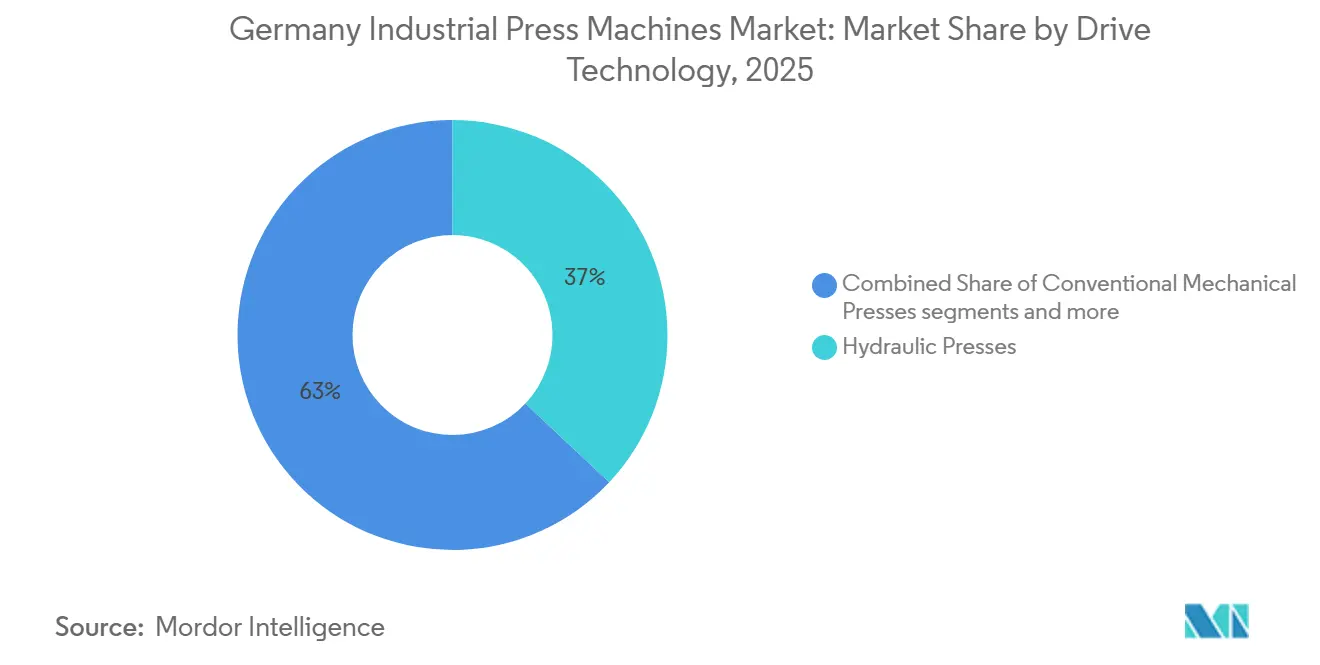
Hydraulic presses held 37% of the Germany industrial press machines market share in 2025, making them the leading drive technology. Their position reflects high force density and variable-pressure control in deep drawing, large-panel forming, and heavy forging. These applications need controlled force at levels that are difficult for other systems to provide at a comparable capital cost. Conventional mechanical presses remained important for high-volume work with repeatable geometries. They serve consumer durable production, smaller automotive stampings, and electrical components. Pneumatic presses serve lighter work such as assembly, press-fitting, and connector insertion. Hybrid systems and other formats address specialized activities, including powder compaction and composite molding. This range of applications helps hydraulic presses retain a material role in the Germany industrial press machines market.
Servo-mechanical presses are forecast to record an 8.2% CAGR between 2026 and 2031, the highest growth rate within drive technologies. Their programmable RAM motion supports battery-tray forming, motor lamination stamping, and tight-tolerance medical component production. Real-time force monitoring also supports applications that require documented quality control. The HFA plus+ series from ANDRITZ Schuler combines servo-controlled hydraulic pump drives with connected process monitoring. Such systems can raise stroke rates while reducing energy use. Programmable motion can reduce die wear and scrap, which lowers lifecycle cost. This benefit matters as manufacturers face shortages of skilled press-setting technicians. The German industrial press machine industry is therefore shifting toward systems that simplify repeatable production without removing the need for high-force hydraulic equipment.

By Press Force/Capacity: Mid-Range Capacity Serves Broad Demand, While Extreme Tonnage Expands Faster
The 101-500-ton tier commanded 30.2% of the Germany industrial press machines market share in 2025. This capacity range supports automotive body panels, transmission components, brackets, electrical enclosures, and precision forgings. Its installed base is broad because it suits many production settings across German manufacturing. Buyers also benefit from a mature tooling base that can reduce changeover costs in high-mix operations. The up-to-100-ton category serves light stamping, electronics, and medical device assembly. The 501-1,000-ton and 1,001-2,000-ton ranges support structural vehicle components, heavy equipment frames, and specialized forging work. Each of these ranges requires controlled force profiles for different materials and part designs. The 101-500-ton category remains a central volume tier for the Germany industrial press machines market.
Presses above 2,000 tons are forecast to grow at a 6.8% CAGR from 2026 to 2031. Defense forging, aerospace structural frames, and energy infrastructure components are driving demand for these machines. The capability requirements favor suppliers with proven reliability and precision in high-force applications. Germany’s 2025 defense approvals support the demand environment for armored vehicles and artillery outputs. ANDRITZ Schuler delivered a 6,500-ton GLK forging press with a kinetic energy recovery system that can reduce power demand by up to 40% against conventional presses at equivalent force. Extreme-tonnage equipment combines high technical requirements with the need for energy management. This makes the segment important to the Germany industrial press machines market, even though its unit volumes are limited. It also supports suppliers that can provide engineering and lifecycle services alongside the press.
By Application/Process: Stamping Leads Current Demand, While Assembly and Joining Accelerate
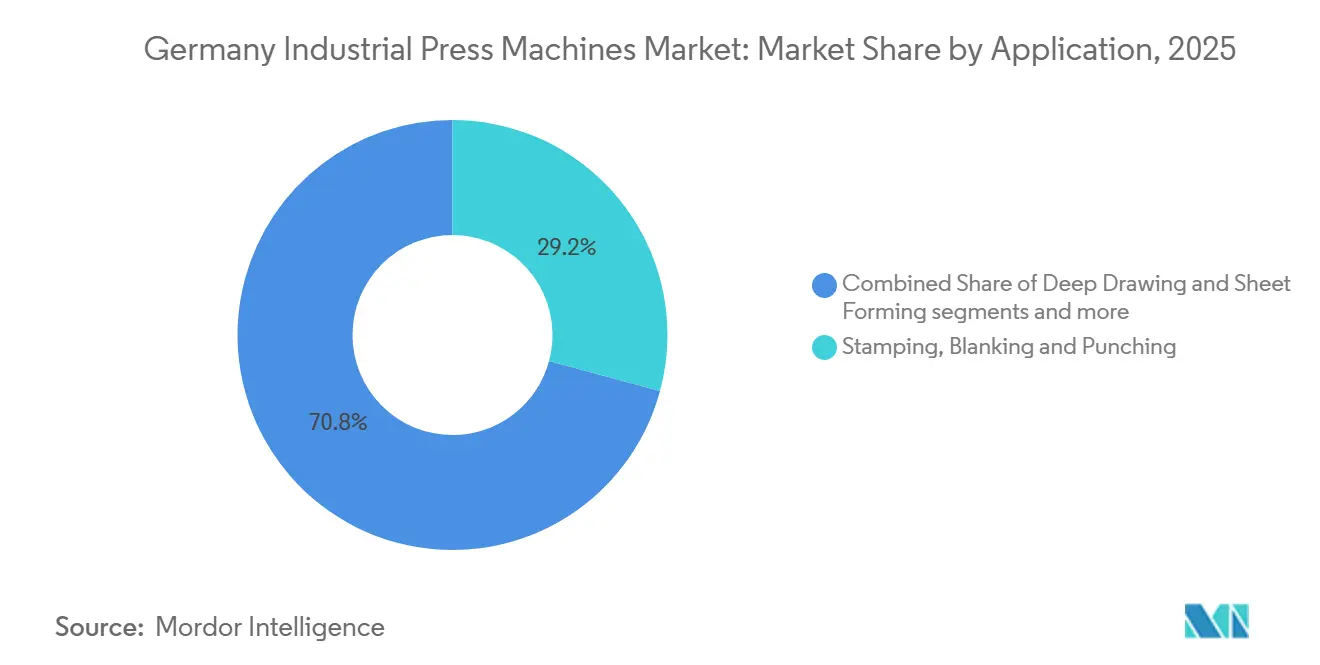
Stamping, blanking, and punching accounted for 29.2% of the Germany industrial press machines market size in 2025. These processes remain essential for vehicle body structures, electrical components, connector housings, and appliance production. German automotive production continues to support body-in-white stamping volumes across both internal-combustion and electric vehicle lines. Deep drawing and sheet forming serve aluminum closures, door panels, battery enclosure structures, and floor-pan components. Forging and powder compaction address energy, aerospace, and performance-focused industrial applications. Compression molding remains relevant to composite and polymer components used in lightweight structures. The process mix gives suppliers exposure to a wide range of materials and production requirements. Stamping remains the broadest application base in the Germany industrial press machines market.
Assembly, press-fitting, and joining are forecast to grow at a 7.2% CAGR between 2026 and 2031. Battery module integration, busbar press-fitting, and rotor-shaft joining require controlled force ramps that conventional equipment cannot always deliver consistently. Medical device sub-assembly also requires fine force control and repeatable records. TRUMPF presented the new TruPunch 5000 at EuroBLECH 2026 with processing for sheet metal up to 8 mm thick, 1,600 strokes per minute, AI-assisted sorting, and remote operating features. Integrated stamping, joining, and inspection cells can reduce the number of separate machines in a production line. They can also increase the value of the equipment sold. This combination supports value growth in the Germany industrial press machines market even when unit demand grows more slowly. It also makes digital process coordination more important to buyers.
By End-Use Industry: Automotive Remains the Largest Buyer While Medical and Precision Manufacturing Grow Fastest
Automotive and transportation accounted for 44.3% of the Germany industrial press machines market size in 2025. The sector remains the largest source of equipment demand despite uncertainty during the shift to electric vehicles. German OEMs operated internal-combustion and electric vehicle lines in parallel through 2025. This preserved demand for existing body-panel presses while supporting investment in new servo platforms. Aerospace and defense, industrial machinery, and electrical and electronics are served by specialized presses across the 101-2,000-ton range. Appliances, construction, energy, and metal fabrication add replacement demand from the broader Mittelstand manufacturing base. These end users maintain a diverse set of procurement cycles. Automotive, nevertheless, continues to anchor the Germany industrial press machines market.
Medical and precision manufacturing are forecast to expand at an 8% CAGR through 2031. The segment is supported by Germany’s medical technology production base and more demanding requirements for precision forming. Medical device makers require calibrated press force, certified process records, and batch-level traceability. These needs favor digitally connected equipment in the 101-500-ton range. The segment also shares technical requirements with electric vehicle production, particularly in precision press-fitting and controlled joining. Suppliers with experience in battery module connections can apply similar force-control systems to the implant housing assembly. This overlap broadens the addressable application base for the German industrial press machine industry. It also reduces dependence on conventional vehicle body-panel investment alone.
Geography Analysis
Germany is Europe’s leading national market for industrial press machines, supported by manufacturing clusters in Baden-Württemberg, Bavaria, and North Rhine-Westphalia. Baden-Württemberg is a base for ANDRITZ Schuler in Göppingen, TRUMPF in Ditzingen, and the Stuttgart automotive supplier ecosystem. The region supports high-value servo-mechanical and fineblanking applications. Bavaria combines BMW and MAN vehicle activity with a large medical technology cluster and aerospace production. North Rhine-Westphalia supports heavy forging and hydraulic press demand from steel, energy, and heavy-equipment manufacturing. These regional strengths create demand for different machine specifications across the Germany industrial press machines market.
German mechanical engineering also serves export demand when domestic investment is weak. VDMA reported that order intake from euro-area partners increased 7% in 2025. This order flow supports production at German press manufacturers’ facilities. Germany faces pricing pressure from Chinese exporters and from Eastern European manufacturing locations that source commodity equipment from Asia. German producers retain an advantage in application engineering, service, and high-specification forming systems. The Germany industrial press machines market, therefore, has a stronger position in demanding applications than in commodity replacement categories. This divide influences the regional distribution of manufacturing investment.
Defense and infrastructure spending provide further support for demand in Bavaria and North Rhine-Westphalia. The German government established a EUR 500 billion infrastructure and defense special fund that supports capacity expansion in defense, aerospace, and energy-related production. These programs are expected to support armored vehicle fabrication, aerostructure production, and energy infrastructure components. Bavaria’s aerospace and electronics base can benefit from this spending. North Rhine-Westphalia’s heavy forging and steel fabrication base can also benefit. The demand effect is expected to favor mid- and large-tonnage hydraulic and forging equipment. This gives selected regions a stronger growth outlook within the Germany industrial press machines market through 2031.
Competitive Landscape
The Germany industrial press machine market exhibits a medium level of market concentration. Schuler Inc. has a broad offering across stamping, fineblanking, forging, transfer presses, and battery production technology. Its January 2026 battery cell formation line commissioning expanded its role in electric vehicle battery production. The company also uses Metris monitoring systems to link equipment with digital services. TRUMPF competes in punching and laser-integrated forming. Its TruPunch 5000 launch added AI-assisted sorting and remote operational capabilities to its connected factory offering. SMS group remains important in heavy metallurgical forming. It received final acceptance in January 2026 for a 12.5 MN high-speed open-die forging press for Nakamura Iron Works, designed for titanium, Inconel, and copper alloys.
A group of specialized manufacturers serves narrower application requirements. LASCO, Hatebur, Maschinenfabrik Lauffer, Grabener, and Fritz Mueller Pressen GmbH compete through application engineering and local service. Their position is strongest where customers need tooling knowledge, rapid changeover, and close support. Larger suppliers increasingly combine hardware with predictive maintenance, digital twin simulation, and service contracts. This approach raises switching costs for equipment buyers and creates recurring service revenue. Both platform breadth and technical specialization, therefore, define the German industrial press machine market. Producers with a strong installed base can use connected services to maintain customer relationships after the initial sale.
Opportunities remain in service for pre-2015 hydraulic presses, modular servo cells for smaller manufacturers, and battery-component forming lines. Systems integrators can also combine press hardware with robotic transfer, coil feeding, machine vision inspection, and manufacturing execution connectivity. The Machinery Regulation’s cybersecurity requirements apply from January 2027 and favor new control systems designed for those requirements. Lower-cost Chinese suppliers are entering the light-duty replacement segment, particularly where price is the main buying criterion. Their position remains weaker in demanding forming processes that need certified service and application engineering. The German industrial press machine market remains more defensible in high-specification applications than in entry-level equipment.
Germany Industrial Press Machines Industry Leaders
-
Schuler Inc
-
Trumpf SE + Co. KG
-
SMS group GmbH
-
Siempelkamp Maschinen- und Anlagenbau GmbH
-
LASCO Umformtechnik GmbH
- *Disclaimer: Major Players sorted in no particular order
Recent Industry Developments
- September 2026: TRUMPF SE + Co. KG launched the new-generation TruPunch 5000 at EuroBLECH 2026 in Hanover, featuring 22 metric tons of punching force, 1,600 strokes per minute, and processing capability for sheet metal up to 8 mm thick.
- January 2026: Schuler Inc. added the HFA plus+ fineblanking press series to its product portfolio, assuming full general-contractor responsibility for turnkey fineblanking systems previously delivered via Feintool AG. Press forces range from 3,200 to 15,500 kN at output up to 85 strokes per minute. Servo-controlled hydraulic pump drives deliver a double-digit percentage energy-efficiency improvement while increasing stroke rate versus conventional hydraulic systems. Industry 4.0 control interfaces and integrated process monitoring are standard.
- January 2026: SMS group received the Final Acceptance Certificate from Nakamura Iron Works in Aichi Prefecture, Japan, for an ultrahigh-speed 12.5 MN open-die forging press capable of 205 strokes per minute for titanium, Inconel, and copper alloys. The press incorporates SMS hydraulic compact drive technology, providing a 50% smaller installation footprint, ForgeBase pass-schedule software covering over 200 materials, and a digital SaaS package via SMS-Metrics, demonstrating SMS group’s strategy of embedding digital revenue streams into hardware contracts.
Germany Industrial Press Machines Market Report Scope
The Germany Industrial Press Machines Market is Segmented by Drive Technology (Conventional Mechanical Presses, Hydraulic Presses, Pneumatic Presses, and More), by Press Force (Up To 100 Tons, 101–500 Tons, 501–1,000 Tons, and More), by Application (Forging, Powder Compaction, and More), by End-Use Industry (Aerospace and Defense, Electrical and Electronics, and More). The Market Forecasts are Provided in Terms of Value (USD).
| Conventional Mechanical Presses |
| Servo-Mechanical Presses |
| Hydraulic Presses |
| Pneumatic Presses |
| Other and Hybrid Presses |
| Up to 100 Tons |
| 101-500 Tons |
| 501-1,000 Tons |
| 1,001-2,000 Tons |
| Above 2,000 Tons |
| Stamping, Blanking and Punching |
| Deep Drawing and Sheet Forming |
| Forging |
| Straightening and General Forming |
| Compression Molding |
| Powder Compaction |
| Assembly, Press-Fitting and Joining |
| Other Press Applications |
| Automotive and Transportation |
| Aerospace and Defense |
| Industrial Machinery and Equipment |
| Electrical and Electronics |
| Appliances and Consumer Durables |
| Construction and Heavy Equipment |
| Energy and Power Equipment |
| Metal Products and General Manufacturing |
| Medical and Precision Manufacturing |
| Other End-Use Industries |
| By Drive / Actuation Technology | Conventional Mechanical Presses |
| Servo-Mechanical Presses | |
| Hydraulic Presses | |
| Pneumatic Presses | |
| Other and Hybrid Presses | |
| By Press Force / Capacity | Up to 100 Tons |
| 101-500 Tons | |
| 501-1,000 Tons | |
| 1,001-2,000 Tons | |
| Above 2,000 Tons | |
| By Application / Process | Stamping, Blanking and Punching |
| Deep Drawing and Sheet Forming | |
| Forging | |
| Straightening and General Forming | |
| Compression Molding | |
| Powder Compaction | |
| Assembly, Press-Fitting and Joining | |
| Other Press Applications | |
| By End-Use Industry | Automotive and Transportation |
| Aerospace and Defense | |
| Industrial Machinery and Equipment | |
| Electrical and Electronics | |
| Appliances and Consumer Durables | |
| Construction and Heavy Equipment | |
| Energy and Power Equipment | |
| Metal Products and General Manufacturing | |
| Medical and Precision Manufacturing | |
| Other End-Use Industries |
Key Questions Answered in the Report
What is the Germany industrial press machine market forecast through 2031?
The market is forecast to reach USD 1.13 billion by 2031, growing at a 3.48% CAGR from 2026. The forecast reflects demand for programmable, energy-efficient forming systems, integrated production cells, and specialized modern manufacturing equipment.
Which drive technology is growing fastest in Germany?
Servo-mechanical presses are forecast to grow at an 8.2% CAGR through 2031 because they support programmable motion, energy efficiency, and real-time force monitoring.
What press force range has the largest share in Germany?
The 101-500-ton range held 30.2% share in 2025 because it serves automotive, electrical, precision forging, and enclosure applications.
Why do automotive companies need new press equipment?
Electric vehicle platforms require controlled forming and joining for aluminum body parts, battery housings, motor laminations, and battery module components.
Which end-use sector is expected to grow fastest for press equipment?
Medical and precision manufacturing are forecast to grow at an 8% CAGR through 2031, supported by traceability and controlled-force requirements.
How will the EU Machinery Regulation affect press buyers?
The regulation applies from January 20, 2027, and raises requirements for safety, cybersecurity, and digital documentation, which can bring forward modernization decisions.