
Tactical Data Link Market Size and Share
Market Overview
| Study Period | 2020 - 2032 |
|---|---|
| Market Size (2027) | USD 10.02 Billion |
| Market Size (2032) | USD 13.5 Billion |
| Growth Rate (2027 - 2032) | 6.14 % |
| Fastest Growing Market | Asia-Pacific |
| Largest Market | North America |
| Market Concentration | Medium |
Major Players *Disclaimer: Major Players sorted in no particular order Image © Mordor Intelligence. Reuse requires attribution under CC BY 4.0. | |
Tactical Data Link Market Analysis by Mordor Intelligence
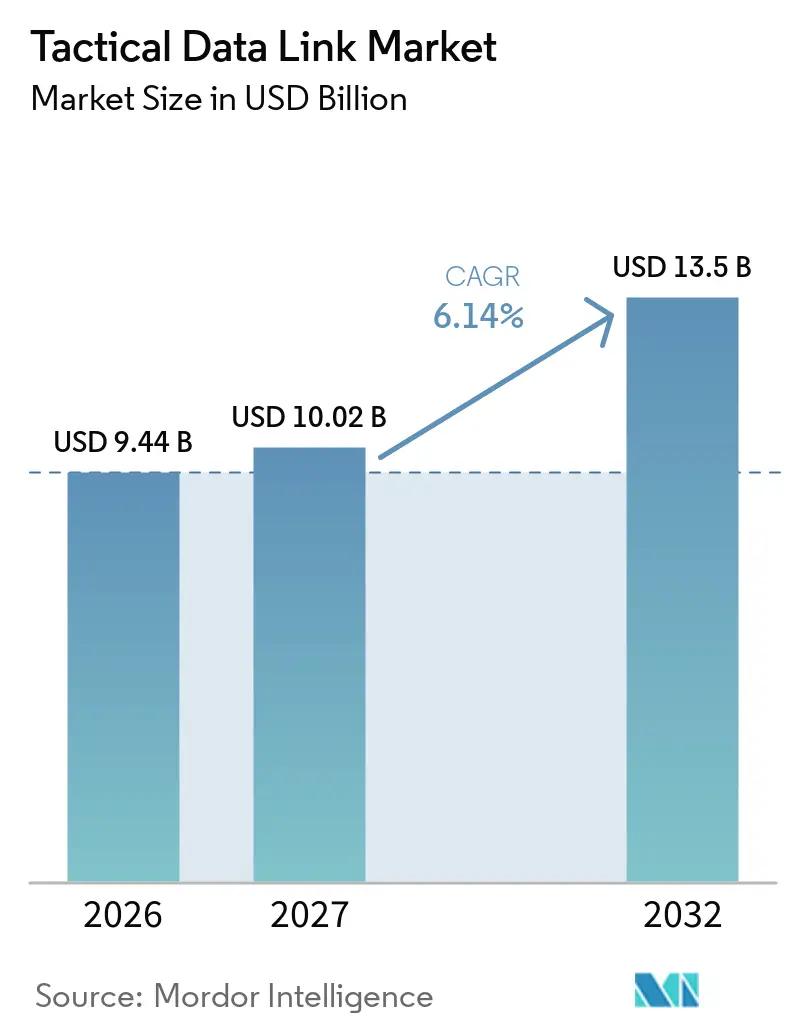
The tactical data link market size was valued at USD 9.44 billion in 2026 and is forecast to grow from USD 10.02 billion in 2027 to reach USD 13.50 billion by 2032, at a 6.14% CAGR during the forecast period (2027-2032). The tactical data link market is shaped by military demand for secure exchanges of targeting, command, and sensor information across air, land, maritime, and unmanned platforms. Modernization programs are placing greater value on systems that can connect existing platforms while accepting new waveforms and software updates. The tactical data link market also benefits from requirements for resilient communications in contested electromagnetic environments, where availability and interoperability are operational priorities. Low-Earth-orbit transport networks may broaden the reach of existing tactical channels, while open architectures are increasing the importance of software integration. Procurement remains selective because certification, cryptographic control, and platform integration extend buying cycles.
Key Report Takeaways
- By solution, hardware held 57.62% of revenue in 2026, while software is forecast to grow at a 7.86% CAGR through 2032.
- By platform, ground accounted for 43.75% of revenue in 2026, while unmanned systems are projected to grow at a 9.81% CAGR through 2032.
- By application, command and control (C2) accounted for 27.56% of revenue in 2026, while electronic warfare (EW) is forecast to grow at an 8.10% CAGR through 2032.
- By data link standard, Link 16 accounted for 47.65% of revenue in 2026, while Link 22 is projected to advance at an 8.85% CAGR through 2032.
- By frequency band, ultra-high frequency held 64.25% of revenue in 2026 and is forecast to grow at a 7.56% CAGR through 2032.
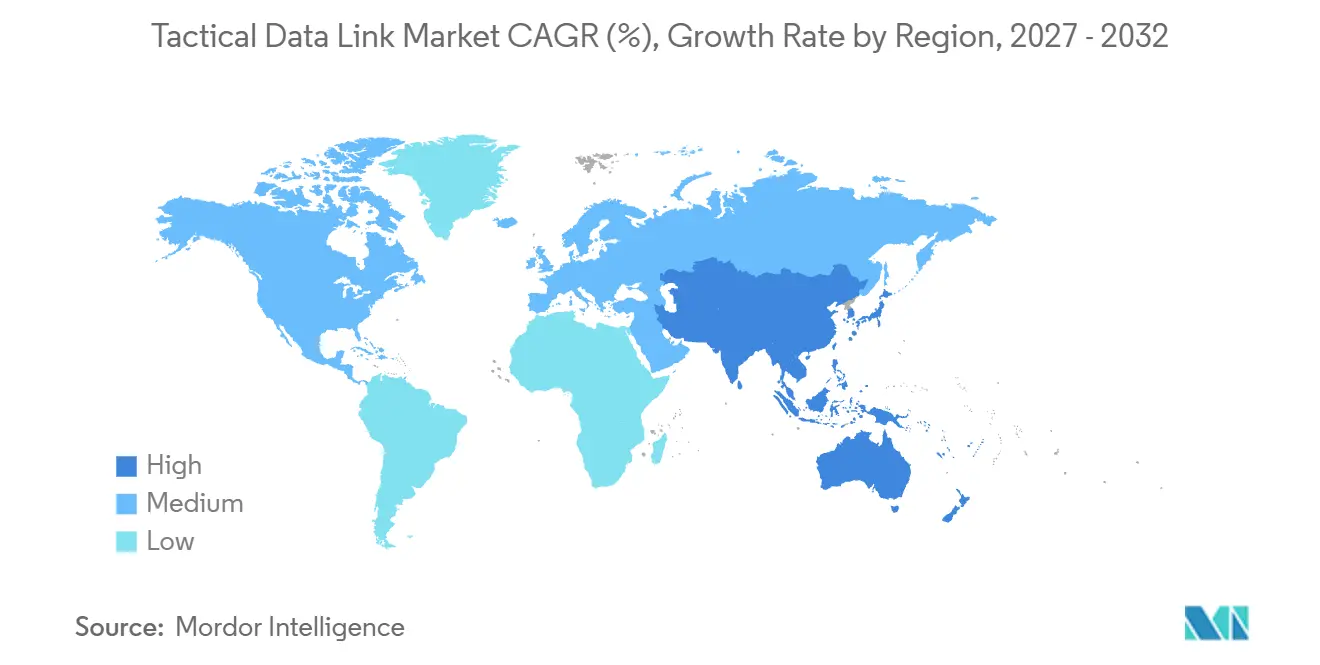
- By geography, North America accounted for 38.14% of revenue in 2026, while Asia-Pacific is projected to grow at a 7.32% CAGR through 2032.
Note: Market numbers in this report are based on Mordor Intelligence's proprietary estimation framework, which combines nine months of actuals with Q4 projections for base year 2026.
Market Trends and Insights
Drivers Impact Analysis of Tactical Data Link Market*
| Driver | (~) % Impact on CAGR Forecast | Geographic Relevance | Impact Timeline |
|---|---|---|---|
| Defense modernization and network-centric operations | +1.50% | Global | Medium term (2-4 years) |
| Multi-domain and coalition interoperability | +1.00% | North America and Europe | Medium term (2-4 years) |
| Unmanned and network-enabled weapons proliferation | +0.90% | Global | Short term (≤ 2 years) |
| Cyber-resilient and anti-jam communications demand | +0.80% | Global, Asia-Pacific, and Eastern Europe | Short term (≤ 2 years) |
| Space-enabled Link 16 and proliferated SATCOM integration | +0.60% | North America, Europe, and Asia-Pacific | Medium term (2-4 years) |
| Legacy platform life-extension through software-defined architectures | +0.50% | Global | Long term (≥ 4 years) |
| Source: Mordor Intelligence | |||
Defense Modernization and Network-Centric Operations
The tactical data link market is supported by programs that bring command, intelligence, and fires information into a shared operational network. L3Harris Technologies, Inc. received a USD 24 million award to provide AN/PRC-158C NGC2 Gateway Manpacks for the US Army’s transport-layer requirement before Project Convergence 2026. The company states that the software-defined device provides multiple transport options, high data throughput, secure communication, and interoperability across diverse operating environments. Such requirements favor equipment that can function as a gateway rather than as a single-purpose terminal. They also extend demand to integration software, security functions, and lifecycle support. The tactical data link market therefore has an opportunity in modernization projects that need to connect diverse radios, command systems, and data sources without replacing every installed platform.
Unmanned and Network-Enabled Weapons Proliferation
Unmanned platforms are increasing the need for reliable tactical exchanges between operators, aircraft, ground stations, and other network nodes. In July 2025, GA-ASI reported that the XQ-67A flight test used active tactical datalink communications to provide real-time updates and situational data during the integration of government-reference autonomy.[1] Lightweight digital data links with a 10 km communication range and a 4.50 Mbit/s transfer rate have been developed, with anti-interference capability and component substitution identified as development gaps. Patria’s 2025 SIRTAP agreement also covers a wide-band LoS datalink for aerial vehicles and ground systems in series production. The tactical data link market is consequently moving toward smaller, networked systems that can support control traffic and payload data on unmanned platforms.
Cyber-Resilient and Anti-Jam Communications Demand
Electronic interference raises the value of tactical links that can adapt to changing radio conditions and preserve connectivity. KNL’s 2025 framework agreement with Finnish and Swedish defense organizations covers cognitive HF systems that sense the radio-frequency environment and select frequencies based on interference, traffic load, and other conditions.[2] The company states that the system can establish independent communications networks from a few kilometers to thousands of kilometers and that HF enables BLOS communication. The frequency agility, interference sensing, and adaptive waveform design are becoming important product requirements in the tactical data link market.
Space-Enabled Link 16 and Proliferated SATCOM Integration
Space-based transport can extend tactical channels beyond the limits of LoS networks while preserving connections with operational users. The Space Development Agency launched 21 Tranche 1 Transport Layer satellites in September 2025 and stated that the constellation will provide low-latency links, including BLOS tactical data links. The agency plans 154 operational Tranche 1 satellites, including 126 transport-layer vehicles and 28 tracking-layer vehicles. Beginning in 2027, the agency expects initial warfighting capability to include regional persistence for channels such as Link 16, BLOS targeting, and demonstrations of UHF and S-band tactical satellite communications. This approach can increase the role of terminals, gateways, and software that connect tactical users to the satellite layer. It also places greater importance on compatibility with existing operational data links.
Restraints Impact Analysis of Tactical Data Link Market*
| Restraint | (~) % Impact on CAGR Forecast | Geographic Relevance | Impact Timeline |
|---|---|---|---|
| High certification, integration costs, and long procurement cycles | -1.20% | Global | Long term (≥ 4 years) |
| Spectrum congestion and adversarial jamming | -0.70% | Asia-Pacific, Eastern Europe, and Middle East and Africa | Medium term (2-4 years) |
| Cryptographic sovereignty and national customization fragmentation | -0.50% | Non-NATO Nations, Asia-Pacific, and Middle East and Africa | Medium term (2-4 years) |
| SWaP and obsolescence constraints in retrofit fleets | -0.40% | Global | Long term (≥ 4 years) |
| Source: Mordor Intelligence | |||
High Certification, Integration Costs, and Long Procurement Cycles
The tactical data link market has substantial barriers to entry because systems must meet platform, security, waveform, and interoperability requirements before deployment. Integration on older ships, aircraft, and vehicles can add technical risk because equipment must work within established power, space, cooling, and mission-system limits. The Royal Navy described the installation of integrated Link 16 Cryptographic Modernization on HMS Richmond as complicated, time-consuming, and invasive on a 30-year-old platform. The first-of-class work was completed ahead of the ship’s deployment, but the Navy also said its lessons would be used to refine installations across the remaining Type 23 fleet. This pattern indicates that a successful initial installation does not eliminate the time and expense of fleet-wide deployment. Suppliers with prior certifications, established support arrangements, and platform experience may therefore retain an advantage in the tactical data link market.
Spectrum Congestion and Adversarial Jamming
Tactical systems share an electromagnetic environment that can be crowded, disrupted, or intentionally contested. UHF remains central to the installed base, but its importance also makes resilience a practical issue for system designers and operators. KNL states that its cognitive HF radios autonomously sense their environment and optimize settings in real time, underscoring the operational need for alternatives as conditions change. Spectrum congestion and jamming can delay implementation, raise validation requirements, and restrict performance in the tactical data link market.
*Our forecasts treat driver/restraint impacts as directional, not additive. The impact forecasts reflect baseline growth, mix effects, and variable interactions.
Tactical Data Link Market Segment Analysis
By Solution:
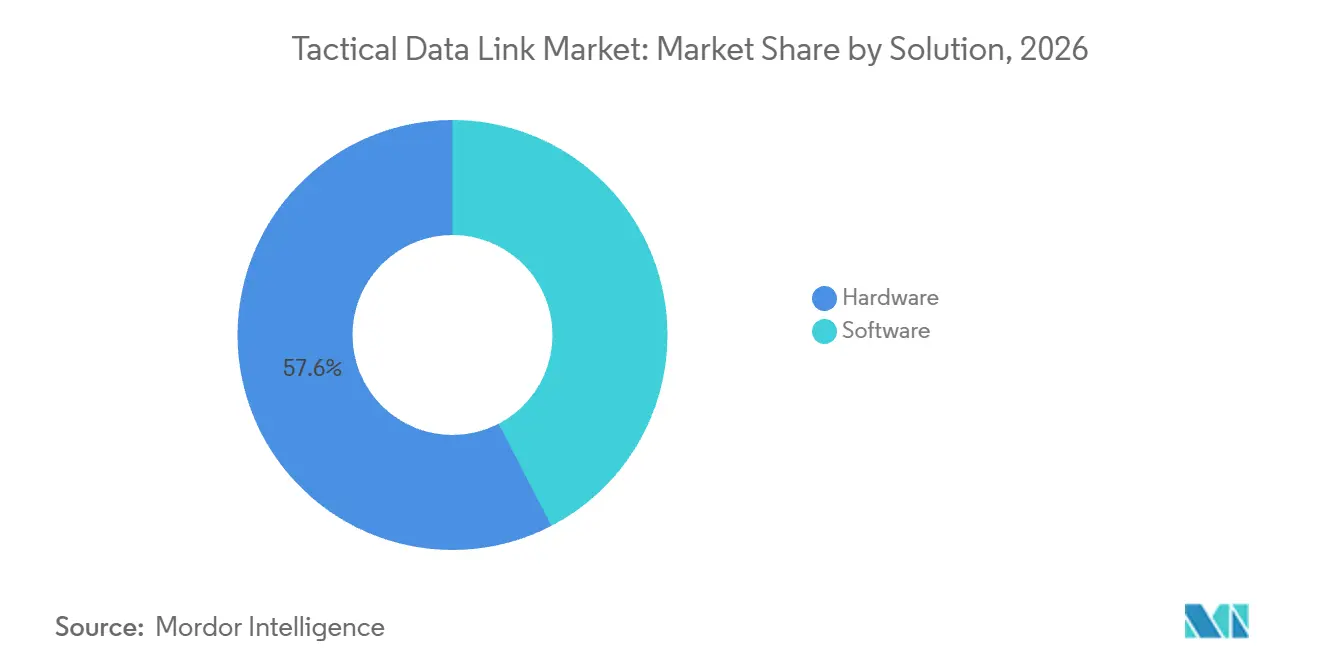
Hardware Leads Revenue, Software Drives Incremental GrowthHardware accounted for 57.62% of revenue in 2026, reflecting the ongoing need to install and replace certified terminals across operating fleets. Physical radios, processors, antennas, encryption components, and integration kits remain necessary even when capability upgrades are delivered through code. Hardware demand is reinforced when military users connect legacy assets that cannot accept new capabilities without a terminal change. The Royal Navy’s first Type 23 installation of Link 16 Cryptographic Modernization shows that platform upgrades still require ship-specific equipment work and extensive installation planning. The completed installation improved the ship’s ability to share tactical situational awareness with other units, according to the Royal Navy. Hardware, therefore, remains the primary vehicle by which new links reach ships, aircraft, vehicles, and fixed command posts.
Software is forecast to grow at a 7.86% CAGR through 2032 as users seek adaptable waveforms, data handling, and network-management functions. The L3Harris Technologies, Inc., AN/PRC-158C Gateway Manpack is described as a software-defined data device that gives the Army multiple transport options and supports the NGC2 data fabric. This type of product shows how software and hardware are increasingly procured as a combined operational capability. Software can enable gateway functions, security controls, and interface changes without a complete redesign of the underlying platform. The tactical data link industry can gain from this shift when suppliers provide verified software releases and ongoing integration support. The resulting balance does not remove demand for terminals, but it can move more value toward lifecycle services and waveform-hosting platforms.
By Platform:
Ground Holds Scale, Unmanned Systems Define the Growth CurveGround platforms accounted for 43.75% of revenue in 2026 because land forces operate numerous vehicles, command posts, and dismounted systems that require persistent communications. These users need links that connect tactical edge devices with higher-level command networks while maintaining secure information sharing. The US Army selected L3Harris Technologies, Inc., for a USD 24 million NGC2 gateway-manpack award for the 4th Infantry Division.[3] The stated purpose is to support transport-layer requirements, which underlines the importance of terrestrial network connectivity for ground formations. Ground demand is also distributed across many vehicle classes and command levels, creating a broad requirement for installation and support. This installed scale reinforces the ground segment's position in the tactical data link market.
Unmanned systems are forecast to grow at a 9.81% CAGR through 2032, making them the fastest-growing platform category in the market. GA-ASI's 67A demonstration combined active tactical datalink communications with government-owned autonomy during a flight test. Patria's solution for the SIRTAP program is designed to connect UAVs and ground systems through wide-band LoS communications. Patria states that CANDL supports payload data and control protocols through native IP communication. These examples point to a need for systems that integrate autonomy, C2, and sensor data in compact configurations. The tactical data link market size for unmanned systems is therefore tied to suppliers' ability to offer secure, scalable links for more nodes.
By Application:
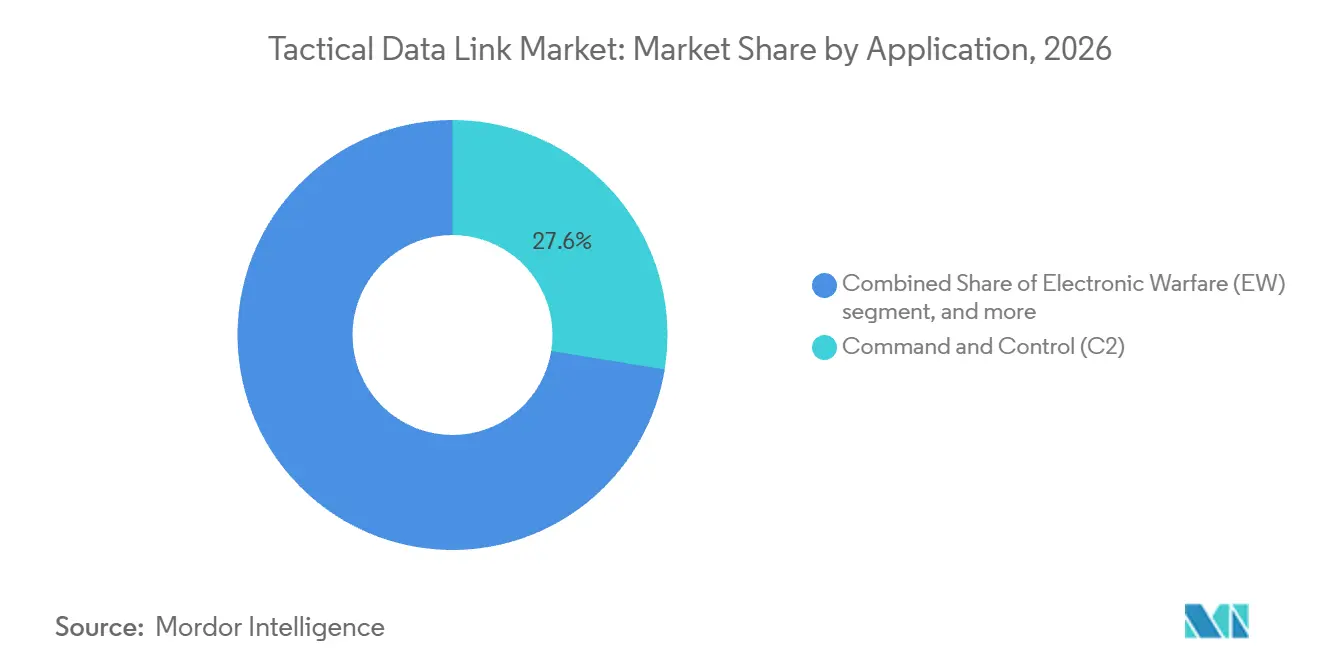
C2 Anchors Revenue, EW Leads GrowthCommand and control (C2) accounted for 27.56% of revenue in 2026, making it the largest application segment within the tactical data link market. Its position follows from the need to distribute a common operational picture, orders, and status information across mixed forces. The NGC2 gateway-manpack program provides an example of procurement focused on the transport layer that underpins a C2 fabric. Naval upgrades serve a similar function because tactical awareness must be shared between ships, aircraft, and coalition partners. C2 will consequently remain dependent on reliable data movement rather than on a single radio or platform type.
Electronic warfare (EW) is forecast to record an 8.10% CAGR through 2032 as contested-spectrum requirements become more central to tactical communications. This application requires detecting interference, adjusting operating settings, and distributing relevant information to users. The KNL cognitive HF approach uses sensing to detect free spectrum and select operating parameters in real time. The tactical data link industry has room to differentiate itself by demonstrating verified resilience, integrating with spectrum management tools, and supporting operational testing.

By Data Link Standard:
Link 16 Dominant, Link 22 Strategically AscendingLink 16 accounted for 47.65% of revenue in 2026, making it the largest standard by revenue. Its established position reflects broad use across allied air, land, and naval forces, as well as a large installed base requiring maintenance and modernization. The Royal Navy’s 2025 installation of integrated Link 16 Cryptographic Modernization on HMS Richmond illustrates continued investment in the standard for maritime operations. The upgrade is part of the wider Maritime Multi Link program, which seeks to modernize tactical data-link capabilities and improve interoperability with joint, NATO, and coalition partners. The Space Development Agency also identifies Link 16 as a tactical military data channel that Tranche 1 will support with regional persistence beginning in 2027. Continued modernization supports demand for Link 16 even as users prepare for future network options.
Link 22 is forecast to grow at an 8.85% CAGR through 2032. Its role is associated with maritime and BLOS operational requirements, where forces seek to extend information sharing across dispersed units. The Royal Navy’s discussion of JREAP as an interim BLOS capability shows why naval users value mechanisms for passing tactical data via satellite communications. Space transport networks could provide additional options for linking users across distances, although they do not eliminate the need for compatible terminal and gateway architectures. The tactical data link market is likely to retain multiple standards because platform age, mission needs, and coalition requirements vary. Suppliers that can integrate multiple standards while limiting operational complexity will have a clearer path to addressing mixed fleets.
By Frequency Band:
Ultra-High Frequency Commands Both Share and GrowthUltra-high frequency (UHF) held 64.25% of revenue in 2026 and is forecast to grow at a 7.56% CAGR through 2032. This dual position reflects the central role of UHF links in tactical networks and the requirement to sustain them across current platforms. The Space Development Agency plans to demonstrate UHF tactical satellite communications as part of its Tranche 1 activity. This plan connects the established frequency band to a new transport layer rather than replacing current operational users. UHF systems will still require technical measures that address interference, security, and compatibility across different equipment. The large installed base gives this frequency category a durable role in the tactical data link market.
HF remains a smaller category, but it retains value for BLOS communication when satellite services cannot be relied on entirely. KNL states that HF enables long-distance communication and that its CNHF system can form independent networks from a few kilometers to thousands of kilometers. Finland and Sweden’s 2025 framework agreement runs from 2025 to 2035 and enables procurement of cognitive HF radios. These systems are designed to adapt to interference and traffic conditions by changing radio settings. The presence of both UHF and HF requirements means that multi-band and multi-waveform approaches remain relevant. The tactical data link industry must therefore balance high-throughput demands with resilient options for disrupted environments.
Geography Analysis
North America held 38.14% of revenue in 2026, supported by procurement activity across tactical radios, command networks, and space transport. The US Army’s USD 24 million NGC2 gateway-manpack award indicates continued demand for transport-layer equipment supporting a software-defined C2 environment. The US Space Force’s Protected Tactical SATCOM-Global award to Northrop Grumman has a USD 4 billion IDIQ ceiling. However, the award notice does not identify it as a tactical data-link contract. The Space Development Agency’s Tranche 1 transport layer is also intended to support BLOS tactical data links and Link 16 regional persistence beginning in 2027. These programs point to a regional environment where terrestrial, airborne, and space-enabled communications are being developed in parallel.
Europe remains a significant market because national forces are modernizing platforms while maintaining interoperability with joint and coalition partners. HMS Richmond became the first Type 23 frigate to receive the integrated Link 16 Cryptographic Modernization system in April 2025. The Royal Navy said the system improved tactical situational awareness and that its Maritime Multi Link program will use the first installation’s lessons for the remaining Type 23 fleet. L3Harris Technologies, Inc., announced an agreement with the Dutch MoD valued at up to EUR 1 billion (USD 1.12 billion) for the supply of Falcon IV radios. European demand combines fleet modernization with a need for secure and interoperable communications across national systems.
Asia-Pacific is projected to grow at a 7.32% CAGR through 2032. India’s MoD signed a contract with Bharat Electronics Limited in February 2025 for 149 software-defined radios for the Indian Coast Guard at INR 1,220.12 crore (USD 140.19 million). The Ministry said the radios are intended to support secure, reliable information sharing, collaboration, situational awareness, high-speed data, and secure voice communication. The tactical data link market size in Asia-Pacific is also influenced by national requirements for domestic production, platform modernization, and secure maritime and joint operations. Middle East, Africa, and South America represent smaller market opportunities, where demand is more dependent on individual acquisition programs and their timing.
Competitive Landscape
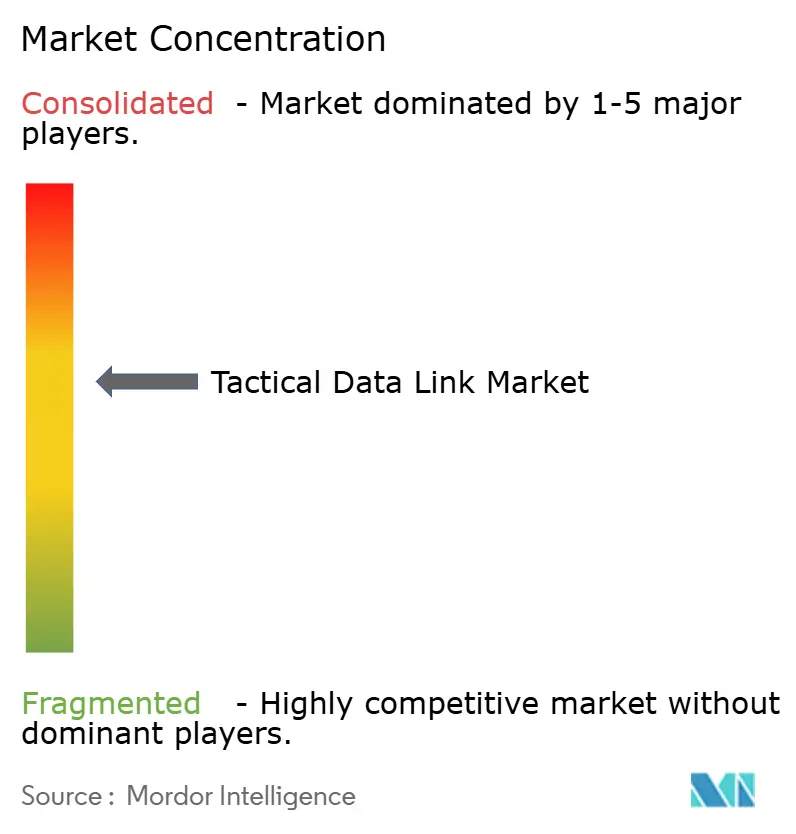
The tactical data link market is moderately consolidated at the prime-contractor level, where suppliers with certifications, installed systems, and long-standing program experience are better positioned to meet complex military requirements. L3Harris Technologies, Inc., RTX Corporation, Northrop Grumman Corporation, BAE Systems plc, and Thales Group are identified as the principal established participants in this market. L3Harris Technologies, Inc., received the USD 24 million NGC2 gateway-manpack award and describes its devices as providing transport options, security, resilience, and interoperability. Northrop Grumman Corporation received the Protected Tactical SATCOM-Global award with a USD 4 billion IDIQ ceiling. These awards show participation in adjacent tactical communications infrastructure, but they should not be used to infer tactical data-link revenue shares.
Competition in the tactical data link market is increasingly driven by smaller specialists focused on sovereign communications, adaptive radios, unmanned connectivity, and system integration. KNL’s framework agreement with the Finnish Defense Forces and the Swedish Defense Materiel Administration enables procurement of cognitive HF communications systems through 2035. Patria’s agreement with Airbus Defence and Space places its CANDL solution within the SIRTAP tactical UAS program for aerial vehicles and ground systems. LMT Group leads tactical communications and integration work in iMUGS2, which has an approximate project value of EUR 55 million (USD 61.53 million) and nearly EUR 50 million (USD 55.94 million) in European Defense Fund support for LMT. The project involves 29 partners from 15 EU member states and includes secure 4G and 5G communications, UAS integration, and C2 interoperability. This shows that competition can emerge through specialized technology and integration roles rather than through a full terminal portfolio.
Strategic activity in the tactical data link market is centered on developing adaptable systems and placing them in operational programs. GA-ASI demonstrated active tactical data-link communications on the XQ-67A during a flight test integrating autonomy and networking functions. The Royal Navy fielded its first Type 23 Link 16 Cryptographic Modernization installation and plans to apply the resulting installation lessons across the class. The Space Development Agency launched the first 21 vehicles of its Tranche 1 Transport Layer to develop a resilient low-latency transport network for tactical data delivery. These moves are likely to favor companies that can deliver certified equipment, software integration, and long-term support.
Tactical Data Link Industry Leaders
-
L3Harris Technologies, Inc.
-
RTX Corporation
-
Northrop Grumman Corporation
-
BAE Systems plc
-
Thales Group
- *Disclaimer: Major Players sorted in no particular order
Tactical Data Link Market Companies Covered in this Report
- L3Harris Technologies, Inc.
- RTX Corporation
- Northrop Grumman Corporation
- BAE Systems plc
- Thales Group
- General Dynamics Corporation
- Leonardo S.p.A.
- Saab AB
- Viasat, Inc.
- Elbit Systems Ltd.
- Curtiss-Wright Corporation
- Honeywell International Inc.
- Leidos Holdings, Inc.
- Aselsan A.Ş.
- Bharat Electronics Limited
- HAVELSAN A.Ş.
- KNL Networks Oy (Telenor Maritime Oy)
- Patria Group
Recent Industry Developments in Tactical Data Link Market
- August 2026: The UK MoD awarded Thales UK Limited a contract worth GBP 9.82 million (USD 13.10 million) to continue providing the Link 16 Network Management System, the software that monitors and reconfigures one of the UK armed forces' core tactical data links.
- January 2026: The US Navy awarded Data Link Solutions, a joint venture between BAE Systems plc and Collins Aerospace (RTX Corporation), a USD 248 million production contract to deliver Multifunctional Information Distribution System Joint Tactical Radio System (MIDS JTRS) terminals for US forces and allies.
- January 2026: NATO selected HAVELSAN A.Ş. to supply the Tactical Data Link Management Center (TDL MC) Network Planning Software, a critical component of NATO's Command, Control, and Communications (C3) architecture.
Global Tactical Data Link Market Report Scope
A tactical data link is a standardized, secure, and jam-resistant communication system that enables the real-time exchange of military data across air, land, sea, space, and cyber domains. TDLs use formatted digital messages instead of voice transmissions to connect heterogeneous platforms, including fighter jets, naval vessels, ground units, and command centers. This connectivity enables seamless interoperability among joint and coalition forces.
The tactical data link market is segmented by solution, platform, application, data link standard, frequency band, and geography. By solution, the market is segmented into hardware and software. By platform, the market is segmented into ground, airborne, naval, unmanned systems, and weapons. By application, the market is segmented into command and control (C2), electronic warfare (EW), intelligence, surveillance, and reconnaissance (ISR), radio communication, and situational awareness. By data link standard, the market is segmented into Link 11, Link 16, Link 22, and others. By frequency band, the market is segmented into high frequency (HF) and ultra high frequency (UHF). The report also covers market sizes and forecasts for the tactical data link market across major countries in major countries across different regions. For each segment, the market size is provided in terms of value (USD).
Segmentation Overview
| Hardware |
| Software |
| Ground | Armored Vehicles |
| Ground Control Stations/Command Center | |
| Soldiers | |
| Airborne | Fixed-wing |
| Rotary-wing | |
| Naval | Ships |
| Submarines | |
| Unmanned Systems | Unmanned Underwater Vehicles (UUVs) |
| Unmanned Aerial Vehicles (UAVs) | |
| Unmanned Ground Vehicles (UGVs) | |
| Weapons |
| Command and Control (C2) |
| Electronic Warfare (EW) |
| Intelligence, Surveillance, and Reconnaissance (ISR) |
| Radio Communication |
| Situational Awareness |
| Link 11 |
| Link 16 |
| Link 22 |
| Others |
| High Frequency (HF) |
| Ultra High Frequency (UHF) |
| North America | United States | |
| Canada | ||
| Mexico | ||
| Europe | United Kingdom | |
| France | ||
| Germany | ||
| Italy | ||
| Russia | ||
| Rest of Europe | ||
| Asia-Pacific | China | |
| India | ||
| Japan | ||
| South Korea | ||
| Australia | ||
| Rest of Asia-Pacific | ||
| South America | Brazil | |
| Rest of South America | ||
| Middle East and Africa | Middle East | Saudi Arabia |
| United Arab Emirates | ||
| Rest of Middle East | ||
| Africa | South Africa | |
| Rest of Africa | ||
| By Solution | Hardware | ||
| Software | |||
| By Platform | Ground | Armored Vehicles | |
| Ground Control Stations/Command Center | |||
| Soldiers | |||
| Airborne | Fixed-wing | ||
| Rotary-wing | |||
| Naval | Ships | ||
| Submarines | |||
| Unmanned Systems | Unmanned Underwater Vehicles (UUVs) | ||
| Unmanned Aerial Vehicles (UAVs) | |||
| Unmanned Ground Vehicles (UGVs) | |||
| Weapons | |||
| By Application | Command and Control (C2) | ||
| Electronic Warfare (EW) | |||
| Intelligence, Surveillance, and Reconnaissance (ISR) | |||
| Radio Communication | |||
| Situational Awareness | |||
| By Data Link Standard | Link 11 | ||
| Link 16 | |||
| Link 22 | |||
| Others | |||
| By Frequency Band | High Frequency (HF) | ||
| Ultra High Frequency (UHF) | |||
| By Geography | North America | United States | |
| Canada | |||
| Mexico | |||
| Europe | United Kingdom | ||
| France | |||
| Germany | |||
| Italy | |||
| Russia | |||
| Rest of Europe | |||
| Asia-Pacific | China | ||
| India | |||
| Japan | |||
| South Korea | |||
| Australia | |||
| Rest of Asia-Pacific | |||
| South America | Brazil | ||
| Rest of South America | |||
| Middle East and Africa | Middle East | Saudi Arabia | |
| United Arab Emirates | |||
| Rest of Middle East | |||
| Africa | South Africa | ||
| Rest of Africa | |||
Key Questions Answered in the Report
What is driving demand for tactical data links?
Demand is supported by military modernization, unmanned systems, anti-jam communications, and space-enabled transport. The tactical data link market is projected to grow at a CAGR of 6.14% from 2027 to 2032.
How large is the tactical data link sector?
The tactical data link market is estimated at USD 9.44 billion in 2026 and is forecast to reach USD 13.50 billion by 2032.
Which solution category leads revenue?
Hardware leads with 57.62% of revenue in 2026, while software is forecast to grow at a 7.86% CAGR through 2032.
Which platform category is growing fastest?
Unmanned systems are forecast to grow at a 9.81% CAGR through 2032, the highest rate among the platform categories covered.
Which data link standard has the largest share?
Link 16 accounts for 47.65% of revenue in the data link standards segment in 2026.
Which region is expected to grow fastest?
Asia-Pacific is forecast to grow at a 7.32% CAGR through 2032, while North America leads 2026 revenue with a 38.14% share.