
Sustainable Palm Oil Market Size and Share
Market Overview
| Study Period | 2026 - 2031 |
|---|---|
| Market Size (2026) | USD 19.24 Billion |
| Market Size (2031) | USD 23.42 Billion |
| Growth Rate (2026 - 2031) | 6.32 % |
| Fastest Growing Market | Asia-Pacific |
| Largest Market | North America |
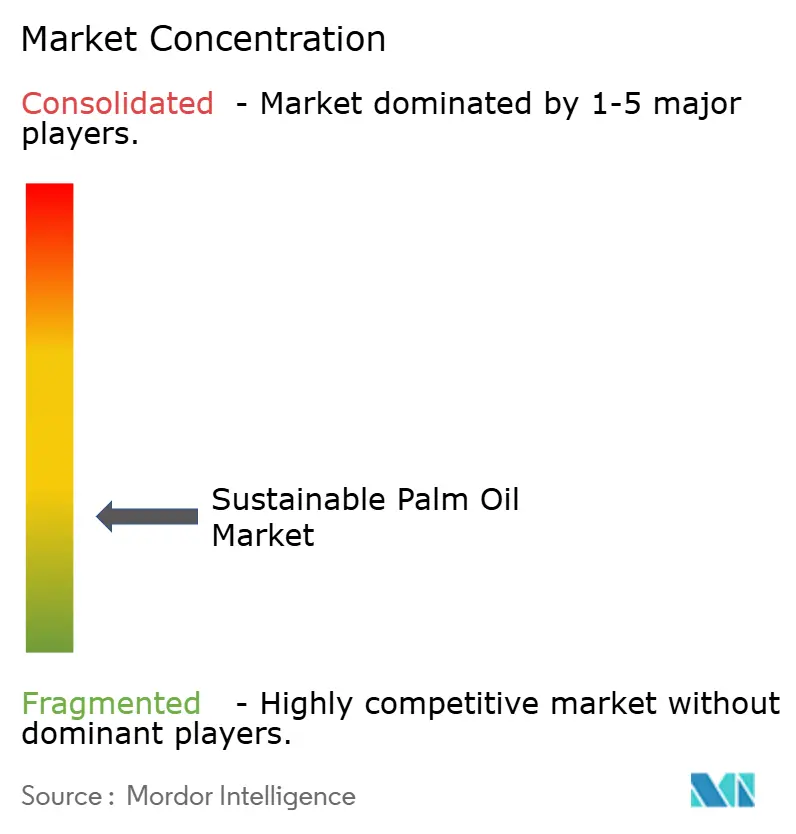
| Market Concentration | Low |
Major Players *Disclaimer: Major Players sorted in no particular order Image © Mordor Intelligence. Reuse requires attribution under CC BY 4.0. | |
Sustainable Palm Oil Market Analysis by Mordor Intelligence
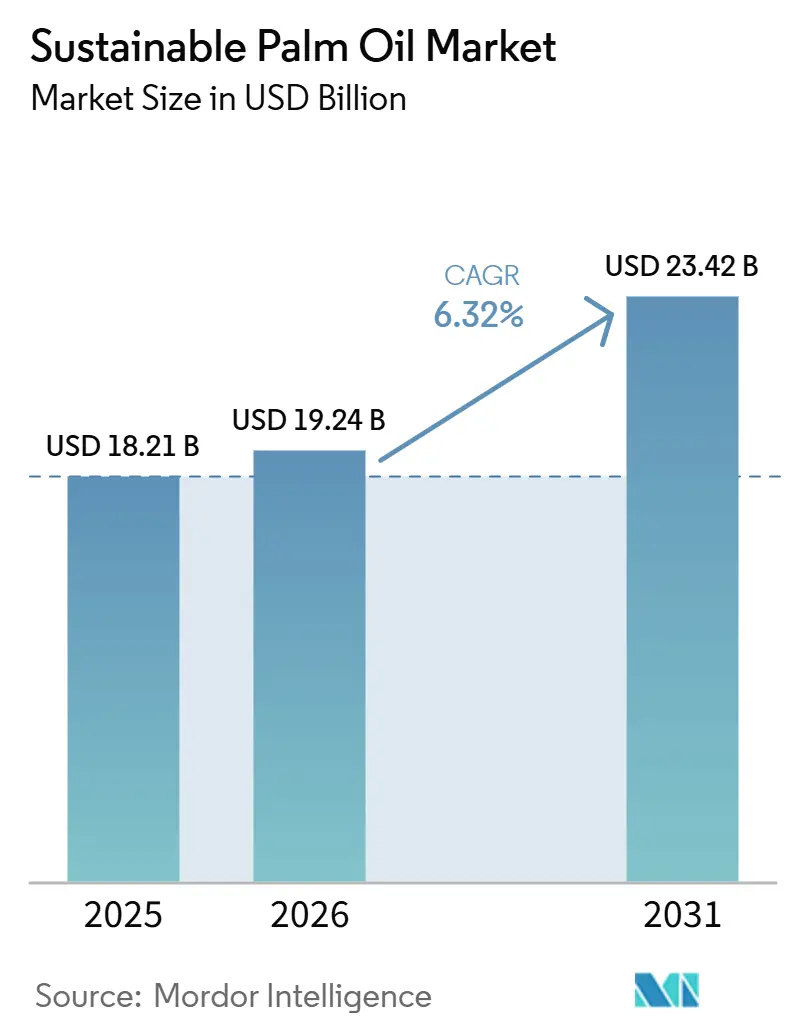
The Sustainable Palm Oil Market size was valued at USD 18.21 billion in 2025 and estimated to grow from USD 19.24 billion in 2026 to reach USD 23.42 billion by 2031, at a CAGR of 6.32% during the forecast period from 2026 to 2031. Corporate purchasing requirements are moving from voluntary commitments into supplier contracts, which gives certified volumes a more stable demand base. Regulatory rules in Europe and national certification systems in Indonesia and Malaysia are also increasing the value of documented sourcing. Certified production still represents a limited portion of total palm oil output, leaving room for wider adoption as buyers seek verifiable supply. The Sustainable Palm Oil Market is therefore shaped by traceability, certification coverage, and the ability of suppliers to meet different chain-of-custody requirements. The gap between demand for verified supply and available certified material also favors established producers and processors with strong systems.
Key Report Takeaways
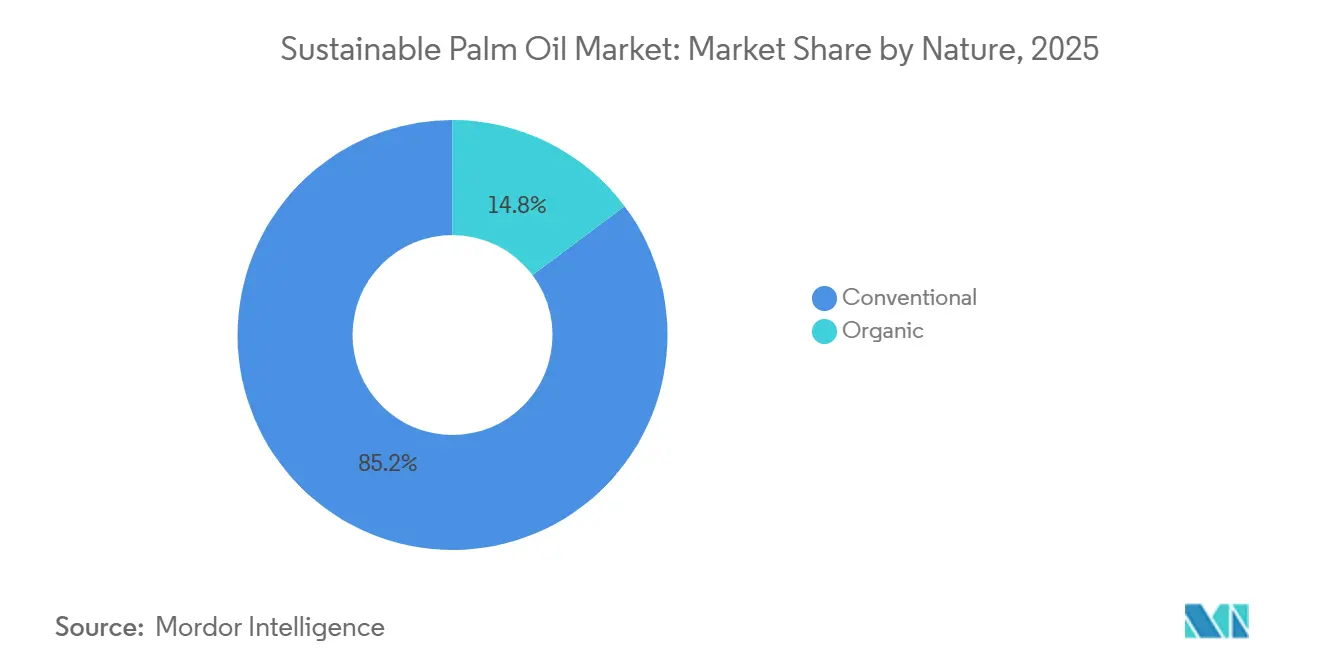
- By nature, conventional certified palm oil held 85.23% of the Sustainable Palm Oil Market share in 2025, while organic palm oil is forecast to expand at a 7.89% CAGR through 2031.
- By product type, palm kernel oil accounted for 75.43% of the Sustainable Palm Oil Market share in 2025, while crude palm oil is forecast to grow at a 7.78% CAGR through 2031.
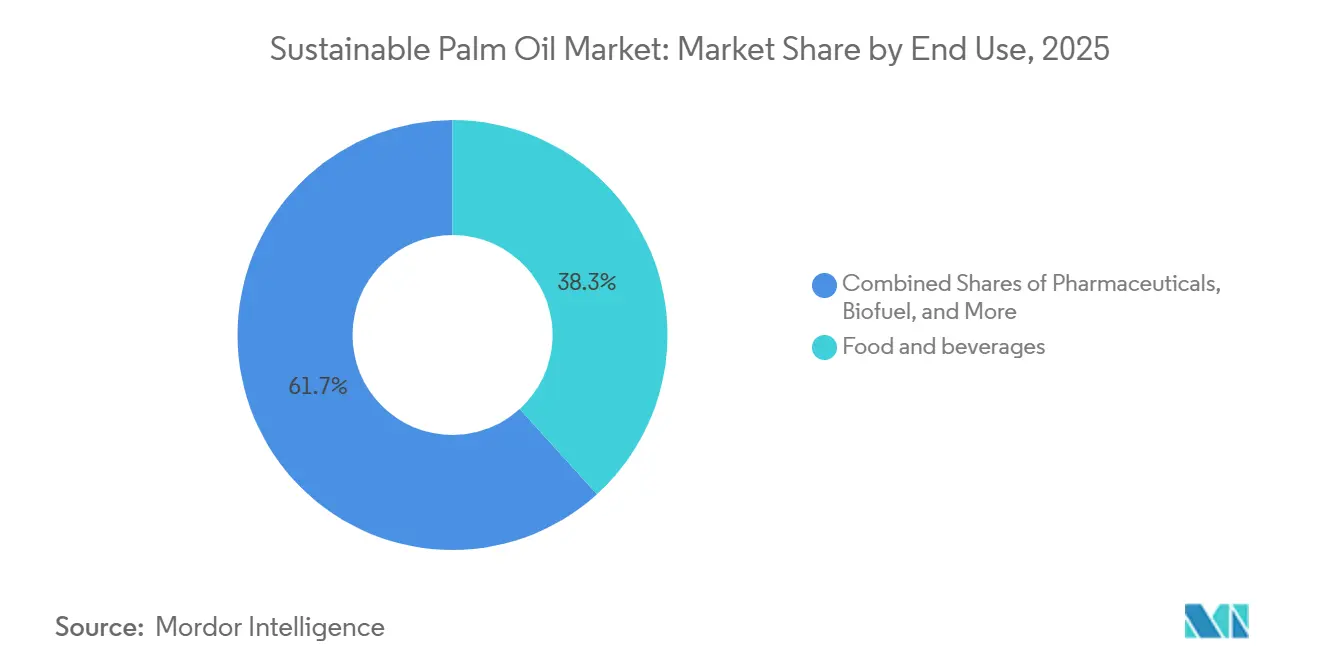
- By end use, food and beverages held 38.28% of the Sustainable Palm Oil Market share in 2025. A CAGR for the fastest-growing end-use segment was not provided in the source material.
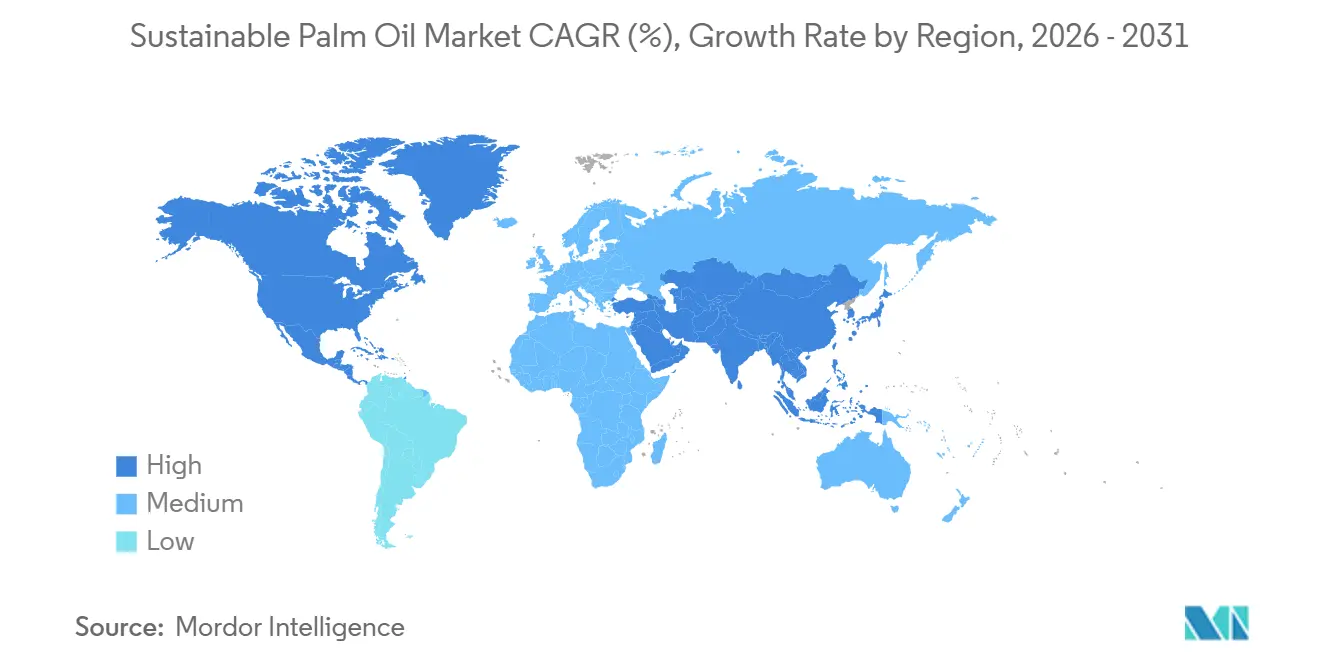
- By geography, North America held 42.18% of the Sustainable Palm Oil Market share in 2025, while Asia-Pacific is projected to grow at a 7.82% CAGR through 2031.
Note: Market size and forecast figures in this report are generated using Mordor Intelligence’s proprietary estimation framework, updated with the latest available data and insights as of January 2026.
Market Trends and Insights
Drivers Impact Analysis of Sustainable Palm Oil Market*
| Driver | (~) % Impact on CAGR Forecasts | Geographic Relevance | Impact Timeline |
|---|---|---|---|
| Strengthening corporate commitments to deforestation-free supply chains | +1.4% | Global (concentrated in EU, North America, Japan) | Medium term (2-4 years) |
| Rising demand for RSPO-certified palm oil across food and consumer goods | +1.2% | North America & EU (core); growing in developed APAC | Short term (≤2 years) |
| Expanding ESG and sustainable procurement initiatives among global brands | +1.0% | Global; North America & EU leadership | Medium term (2-4 years) |
| Increasing consumer preference for ethically and environmentally sourced ingredients | +0.8% | North America, EU, urban developed Asia | Long term (≥4 years) |
| Growing regulatory support for sustainable agricultural commodities | +0.7% | EU primary; Indonesia and Malaysia at national level | Short to medium term (2-4 years) |
| Higher adoption of traceability and supply chain transparency technologies | +0.6% | Indonesia, Malaysia (origin markets); EUDR-exposed chains | Short term (≤2 years) |
| Source: Mordor Intelligence | |||
Strengthening Corporate Commitments to Deforestation-Free Supply Chains
Procurement requirements are becoming a central source of demand for the Sustainable Palm Oil Market. Unilever reported that 97.00% of its palm oil, paper and board, tea, and soy purchase volumes were deforestation-free by the end of 2025 under its verification requirements. Procter & Gamble achieved 100.00% RSPO-certified palm oil in fiscal year 2024-25, with 88.00% supplied through the segregated model. These commitments make certification a standard purchasing condition for more suppliers rather than a specialist product feature. Walmart reported that suppliers identified 1.80 million acres as more sustainably managed through Project Gigaton in fiscal year 2025, which shows how retailer scorecards influence supplier practices. AAK published its first sustainability statement aligned with the Corporate Sustainability Reporting Directive in 2025, linking palm sourcing to formal company reporting.
Rising Demand for RSPO-Certified Palm Oil Across Food and Consumer Goods
Demand for RSPO-certified material continues to support the Sustainable Palm Oil Market in consumer products. RSPO reported certified sustainable palm oil production of 16.20 million metric tons in 2024, equal to 20.10% of total palm oil output, while uptake exceeded 90.00% in Europe and North America. Its 2026 Shared Responsibility update extended implementation to downstream businesses owned by non-grower members, increasing the number of entities expected to apply the requirements[1]Source: Roundtable on Sustainable Palm Oil, “ACOP 2024 RSPO Market Trends Resilient Despite Global Challenges,” Roundtable on Sustainable Palm Oil, rspo.org. This broadens certification from a brand-level decision to an operating requirement across related businesses. McDonald’s reported 81.63% of its RSPO palm oil was physically certified in 2024 and continued to set out a plan for further improvement. China consumed 550,000 metric tons of certified sustainable palm oil in 2024, representing 11.70% of its total palm oil consumption, which indicates that demand is expanding beyond Western buyers
Growing Regulatory Support for Sustainable Agricultural Commodities
Regulatory developments are changing how participants manage supply in the Sustainable Palm Oil Market. The European Union Deforestation Regulation applies to large operators from December 30, 2026, making deforestation-free due diligence a condition for placing covered palm products on the European market[2]Source: European Commission, “Commission Updates Product Scope and Tools to Support EUDR,” European Commission, europa.eu. A July 2026 delegated act expanded the regulation’s product coverage to additional palm oil derivatives, including fatty alcohols, glycerol, oleic acids, and soap forms. This brings more oleochemical and cosmetic ingredient suppliers into documented sourcing processes. Indonesia strengthened its mandatory ISPO framework in 2025, emphasizing plantation legality and traceability within national certification PERPRES NO. 16/2025. RSPO also issued guidance in July 2026 on using its Principles and Criteria certification with IFRS S1 and S2 disclosure standards. These requirements connect procurement records with financial and sustainability reporting.
Higher Adoption of Traceability and Supply Chain Transparency Technologies
Traceability systems are becoming more important for participation in the Sustainable Palm Oil Market. The Malaysia Palm Oil Board completed the National Traceability System in March 2026, integrating SIMS, GeoSAWIT, and e-MSPO to monitor crude palm oil movement and plantation location[3]Source: Malaysia Palm Oil Board, “Malaysia Strengthens Global Leadership in Sustainable Palm Oil Through SIMS and GeoSAWIT,” Malaysia Palm Oil Board, mpob.gov.my. FGV Holdings launched FGVTOP in January 2026, giving buyers, regulators, and other authorized parties access to product tracing from mills to smallholder plantations. These systems can reduce the time needed to gather information for certification and due diligence. A 2025 study described Palm GreenChain, a Malaysian blockchain framework that links RSPO compliance records with green bond financing. The growing use of these tools increases the importance of data systems alongside field audits. Suppliers with mature digital records are better positioned to meet buyer documentation requests.
Restraints Impact Analysis of Sustainable Palm Oil Market*
| Restraint | (~) % Impact on CAGR Forecasts | Geographic Relevance | Impact Timeline |
|---|---|---|---|
| Higher production and certification costs compared to conventional palm oil | -0.8% | Global (highest burden in smallholder-dominated origins: Indonesia, Malaysia) | Medium term (2-4 years) |
| Limited availability of certified sustainable palm oil in some producing regions | -0.5% | Sub-Saharan Africa, South America, Pacific Island origins | Medium term (2-4 years) |
| Complex and costly supply chain traceability requirements | -0.4% | Global supply chains; highest pressure in EUDR-exposed corridors | Short term (≤2 years) |
| Low adoption of sustainability certification among independent smallholders | -0.6% | Indonesia, Malaysia (critical origin markets); increasing relevance in Latin America | Long term (≥4 years) |
| Source: Mordor Intelligence | |||
Higher Production and Certification Costs Compared to Conventional Palm Oil
Higher costs can limit the supply response of the Sustainable Palm Oil Market. BASF reported that certified palm and palm kernel oil represented 79.20% of its Care Chemicals volumes in 2025, down from 98.10% in 2024, and moved its 100.00% RSPO sourcing target from 2025 to 2030 because certified palm kernel oil was not sufficiently available. This shows that shortages can be specific to product grade and origin, not only total certified volume. Certification, audit, and traceability costs are harder to absorb in food and personal care categories where buyers face strong price pressure. Palm kernel oil is especially constrained because it is used in higher-value oleochemical, personal care, and specialty fat applications. Smallholders produce 35.00% to 40.00% of global palm oil, yet the cost of certification can exceed the income earned from a hectare in some cases IDH.ORG. This financing gap can slow the increase in certified supply even when downstream demand remains firm.
Low Adoption of Sustainability Certification Among Independent Smallholders
Limited smallholder participation remains a major constraint for the Sustainable Palm Oil Market. Smallholders produced 35.00% to 40.00% of global palm oil but represented only 8.00% of RSPO-certified supply, while independent smallholders covered less than 3.00% of global RSPO-certified area. This difference leaves mills with mixed sourcing exposed when buyers require plantation-level information. A 2026 study in Jambi, Indonesia, found that some ISPO- and RSPO-certified smallholders viewed certification as an administrative requirement because market links were limited. Mills may obtain 20.00% to 60.00% of fresh fruit bunches from independent smallholders, making their inclusion important for complete traceability. Buyers responding to European due diligence rules could direct more procurement toward estate-based supply if these records cannot be established. That outcome would reduce sourcing diversity and could deepen concentration in certified supply channels.
*Our forecasts treat driver/restraint impacts as directional, not additive. The impact forecasts reflect baseline growth, mix effects, and variable interactions.
Sustainable Palm Oil Market Segment Analysis
By Nature:
Conventional Certification Supports Scale While Organic Serves Premium DemandConventional certified palm oil held 85.23% of the Sustainable Palm Oil Market share in 2025. It supplies the high volumes required by food producers, personal care companies, and oleochemical processors using mass balance and segregated sourcing models. The segment benefits from established RSPO procedures that can be applied across large supplier networks. RSPO’s revised 2025 Certification Systems for Principles and Criteria became effective in May 2026 and updated audit requirements for certified conventional supply. Conventional material remains the practical route for buyers that need large, regular volumes with documented chain-of-custody controls.
Organic palm oil is projected to grow at a 7.89% CAGR from 2026 to 2031. Specialty food retailers, natural personal care brands, and health-focused food service operators use organic certification alongside RSPO certification to address concerns over agrochemical use. IOI Corporation reported 1,128 hectares of organic palm oil cultivation in its fiscal year 2025 presentation. Organic yields per hectare are typically 20.00% to 30.00% lower than conventional intensive cultivation. Growth therefore depends on yield improvements that remain compatible with organic practices, since expanding land area conflicts with deforestation commitments.


By Product Type:
Palm Kernel Oil Holds Value While Crude Palm Oil Gains DemandPalm kernel oil accounted for 75.43% of the Sustainable Palm Oil Market size by value in 2025. It is used in oleochemicals, personal care formulations, and specialty fats where its lauric acid profile provides functions that crude palm oil does not offer. Certified palm kernel oil has remained tight relative to downstream needs. RSPO did not set mandatory CSPKO uptake targets because of those supply constraints. This supports its value position, even though production volume is lower than for crude palm oil.
Crude palm oil is forecast to grow at a 7.78% CAGR from 2026 to 2031. Indonesia launched its B50 biodiesel mandate on July 1, 2026, creating additional domestic demand for crude palm oil. The program is expected to require 16.30 million to 17.00 million metric tons of crude palm oil for biodiesel use each year. PalmCo reported USD 10.50 million in sales of certified crude palm oil and palm kernel oil from 760,000 metric tons of RSPO-certified volumes in 2025. Domestic biodiesel demand may draw conventional crude palm oil toward energy use, while certified volumes remain more heavily directed to premium export buyers.
By End Use:
Food and Beverages Remains the Largest Demand BaseFood and beverages held 38.28% of the Sustainable Palm Oil Market share in 2025. The segment includes bakery and confectionery, margarine and spreads, ice cream and frozen desserts, and snacks and packaged food. Palm oil is used because it provides a solid fat profile, oxidative stability, and cost efficiency. Bakery and confectionery are particularly important because palm-based shortenings affect texture and product performance. Food companies are extending RSPO procurement rules to acquired brands and joint ventures, which expands the certified purchasing base without separate consumer campaigns.
Cosmetics and personal care is a smaller end-use segment but has an important influence on sourcing requirements. L’Oréal’s June 2026 policy requires RSPO Segregated certification for palm oil inputs and participation in the Action for Sustainable Derivatives initiative. BASF’s 2025 Responsible Sourcing Report described its forest and smallholder commitments while noting certified palm kernel oil shortages. Biofuel and energy, pharmaceuticals, and animal feed remain smaller uses but have growing relevance. Biofuel demand is responding to Indonesia’s B50 program, while some palm-derived pharmaceutical inputs face wider due diligence requirements under the expanded EUDR scope.

Geography Analysis
North America Sustainable Palm Oil Market
North America held 42.18% of the Sustainable Palm Oil Market share in 2025. Its position reflects early adoption of RSPO sourcing, concentrated purchasing by multinational food and personal care companies, and reliance on producers to provide origin-level records. RSPO reported certified sustainable palm oil uptake above 90.00% in North America and noted that Canada had 120 RSPO members in 2026. Walmart’s commodities program and company plans from consumer goods manufacturers create voluntary standards that smaller brands often follow. United States food companies are shifting from mass balance supply toward segregated and identity-preserved material, which raises verification requirements for suppliers.
APAC Sustainable Palm Oil Market
Asia-Pacific is forecast to grow at a 7.82% CAGR from 2026 to 2031. China consumed 550,000 metric tons of certified sustainable palm oil in 2024, equivalent to 11.70% of its total palm oil consumption. Malaysia reported that 90.00% of estates and 85.00% of private smallholders had MSPO certification by February 2026. The Sustainable Palm Oil Market size in the region benefits from producer investment in certification and traceability systems. In June 2026, 2,266 independent smallholders in Jambi achieved dual RSPO and ISPO certification across 4,171.62 hectares.
EMEA and South America Sustainable Palm Oil Market
Europe faces a major change as EUDR requirements apply from December 30, 2026, for large operators. Germany, the Netherlands, France, and the United Kingdom retain major trading and processing activity, making documentation requirements important across their supply networks. The European Commission’s 2026 simplification package reduced estimated annual administrative costs by 75.00% but did not remove the deforestation-free requirement. South America is an emerging certified supplier region with 1.84 million metric tons of certified production in 2024, while the Middle East and Africa have limited penetration but growing certified area in Côte d’Ivoire, Ghana, Nigeria, and Cameroon for European demand.

Competitive Landscape
The Sustainable Palm Oil Market has a fragmented structure because no integrated producer-to-consumer company holds a dominant position across product types and regions. Growers, processors, traders, specialty fat producers, and oleochemical suppliers compete through no-deforestation, no-peat, and no-exploitation policies and supply-chain documentation. Wilmar reported 98.50% mill-level traceability and 90.00% traceability to plantation in its 2025 sustainability report, published in 2026. These coverage levels are difficult for smaller suppliers to replicate without comparable systems. Smallholder-linked certified supply in Latin America and Africa remains an area where demand has not yet been fully matched by capacity.
AAK and BASF compete through specialty fats and ingredient formulations that incorporate certified palm fractions. AAK reported 93.00% verified deforestation-free palm sourcing in 2025 and committed to reach 100.00%. BASF delayed its 100.00% RSPO-certified sourcing target to 2030 because certified palm kernel oil remains limited. The delay shows how supply availability can affect companies with advanced downstream processing capabilities. Organic certified supply is also less developed because few large producers have dedicated capacity.
Musim Mas launched its 2026-2030 Sustainability Policy and Roadmap and introduced 4 high-yielding GS Series oil palm varieties. The company reported SBTi-validated net-zero targets and CDP double-A ratings for forests and water security. FGV Holdings launched FGVTOP to provide end-to-end digital traceability from mills to smallholder plantations. Digital systems are becoming a practical competitive requirement because buyers increasingly need detailed origin records. This favors suppliers that can link plantation, mill, certification, and product data.
Sustainable Palm Oil Industry Leaders
Wilmar International Limited
Sime Darby Plantation Berhad
IOI Corporation Berhad
Archer Daniels Midland Company
Golden Agri-Resources Ltd
- *Disclaimer: Major Players sorted in no particular order
Sustainable Palm Oil Market Companies Covered in this Report
- Wilmar International Limited
- Sime Darby Plantation Berhad
- Musim Mas Holdings
- Golden Agri-Resources Ltd
- IOI Corporation Berhad
- Kuala Lumpur Kepong Berhad
- Archer Daniels Midland Company
- Cargill, Incorporated
- United Plantations Berhad
- Kulim (Malaysia) Berhad
- PT Sampoerna Agro Tbk
- Asian Agri
- Agropalma S.A.
- New Britain Palm Oil Limited
- Univanich Palm Oil Public Company Limited
- PT Bakrie Sumatera Plantations Tbk
- AAK AB
- BASF SE
- Fuji Oil Holdings Inc.
- Clariant AG

Recent Industry Developments in Sustainable Palm Oil Market
- July 2026: Godrej Agrovet Ltd. inaugurated India’s first Integrated Oil Palm Complex in Khammam, Telangana, with a cumulative investment of INR 300 crore. The 130-acre facility integrates the entire oil palm value chain, including seed and genetics, nursery operations, R&D, milling, and an upcoming refinery, under one campus, strengthening domestic edible oil production, improving supply chain efficiency, enhancing farmer support, and advancing India's edible oil self-reliance initiatives.
- May 2025: A new Sustainable Palm Oil Initiative was launched in Indonesia to accelerate the adoption of deforestation-free and traceable palm oil production while strengthening smallholder inclusion across the supply chain.
- October 2024: IDH (The Sustainable Trade Initiative) launched the India Sustainable Palm Oil Manifesto at SUTRA 2.0 – The Sustainable Trade Summit 2024, bringing together leading companies, government representatives, and civil society organizations to promote responsible palm oil sourcing in India.


Global Sustainable Palm Oil Market Report Scope
| Conventional |
| Organic |
| Palm Kernal Oil |
| Crude Palm Oil |
| Food and Beverages | Bakery and Confectionery |
| Margarine and Spreads | |
| Ice Creams and Frozen Desserts | |
| Snacks and Packaged Food | |
| Others | |
| Cosmetics and Personal Care | |
| Biofuel and Energy | |
| Pharmaceuticals | |
| Animal Feed | |
| Other Applications |
| North America | United States |
| Canada | |
| Mexico | |
| Rest of North America | |
| Europe | Germany |
| United Kingdom | |
| France | |
| Italy | |
| Spain | |
| Netherlands | |
| Sweden | |
| Poland | |
| Belgium | |
| Rest of Europe | |
| Asia-Pacific | China |
| India | |
| Japan | |
| Australia | |
| South Korea | |
| Vietnam | |
| Indonesia | |
| Thailand | |
| Singapore | |
| Rest of Asia-Pacific | |
| South America | Brazil |
| Argentina | |
| Chile | |
| Peru | |
| Colombia | |
| Rest of South America | |
| Middle East and Africa | United Arab Emirates |
| Saudi Arabia | |
| South Africa | |
| Nigeria | |
| Egypt | |
| Morocco | |
| Turkey | |
| Rest of Middle East and Africa |
| Nature | Conventional | |
| Organic | ||
| Product Type | Palm Kernal Oil | |
| Crude Palm Oil | ||
| End Use | Food and Beverages | Bakery and Confectionery |
| Margarine and Spreads | ||
| Ice Creams and Frozen Desserts | ||
| Snacks and Packaged Food | ||
| Others | ||
| Cosmetics and Personal Care | ||
| Biofuel and Energy | ||
| Pharmaceuticals | ||
| Animal Feed | ||
| Other Applications | ||
| By Geography | North America | United States |
| Canada | ||
| Mexico | ||
| Rest of North America | ||
| Europe | Germany | |
| United Kingdom | ||
| France | ||
| Italy | ||
| Spain | ||
| Netherlands | ||
| Sweden | ||
| Poland | ||
| Belgium | ||
| Rest of Europe | ||
| Asia-Pacific | China | |
| India | ||
| Japan | ||
| Australia | ||
| South Korea | ||
| Vietnam | ||
| Indonesia | ||
| Thailand | ||
| Singapore | ||
| Rest of Asia-Pacific | ||
| South America | Brazil | |
| Argentina | ||
| Chile | ||
| Peru | ||
| Colombia | ||
| Rest of South America | ||
| Middle East and Africa | United Arab Emirates | |
| Saudi Arabia | ||
| South Africa | ||
| Nigeria | ||
| Egypt | ||
| Morocco | ||
| Turkey | ||
| Rest of Middle East and Africa | ||


Key Questions Answered in the Report
What is the projected value of sustainable palm oil by 2031?
The Sustainable Palm Oil Market is projected to reach USD 23.42 billion by 2031, from USD 19.24 billion in 2026, at a 6.32% CAGR.
Which product type has the largest share?
Palm kernel oil held 75.43% of value in 2025, supported by its use in oleochemicals, personal care products, and specialty fats.
Which application uses the most certified palm oil?
Food and beverages held 38.28% of value in 2025 because palm oil remains important for bakery, confectionery, spreads, and packaged food.
How does the EUDR affect palm-derived ingredients?
The EUDR requires documented deforestation-free sourcing for covered products, and the July 2026 delegated act expanded coverage to additional palm derivatives.
Page last updated on:





