
Sustainable Clothing Market Size and Share
Market Overview
| Study Period | 2022 - 2032 |
|---|---|
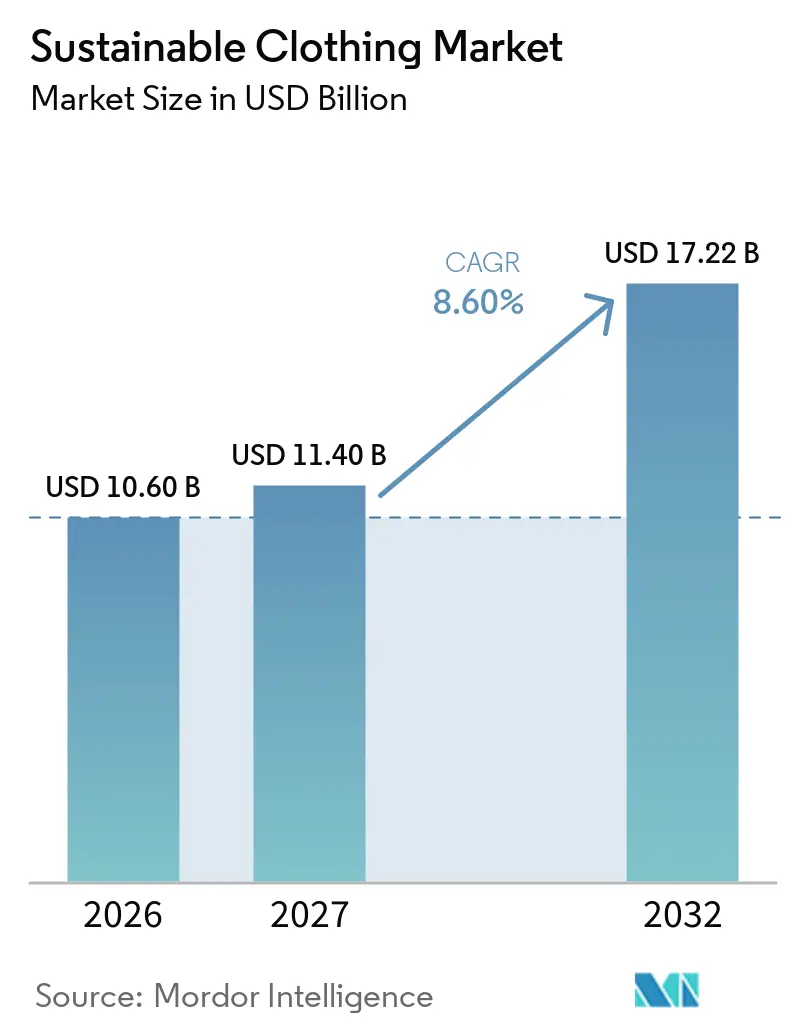
| Market Size (2027) | USD 11.40 Billion |
| Market Size (2032) | USD 17.22 Billion |
| Growth Rate (2027 - 2032) | 8.60 % |
| Fastest Growing Market | Asia-Pacific |
| Largest Market | North America |
| Market Concentration | Low |
Major Players *Disclaimer: Major Players sorted in no particular order Image © Mordor Intelligence. Reuse requires attribution under CC BY 4.0. | |
Sustainable Clothing Market Analysis by Mordor Intelligence
The Sustainable Clothing Market size was valued at USD 10.6 billion in 2026 and estimated to grow from USD 11.4 billion in 2027 to reach USD 17.2 billion by 2032, at a CAGR of 8.6% during the forecast period (2027-2032). The sustainable clothing market is being shaped by material development, consumer demand for credible claims, and closer attention to environmental performance across apparel supply chains. Certified materials matter because they can address both environmental exposure and sourcing risk for apparel brands. Textile Exchange reports that recognized sustainability programs are increasingly important to reporting brands. The sustainable clothing market also benefits from direct-to-consumer sales, which give brands more space to explain provenance and certifications before purchase. Regulation in Europe is raising the value of traceable products and verifiable environmental information, especially for companies selling across several markets.
Key Report Takeaways
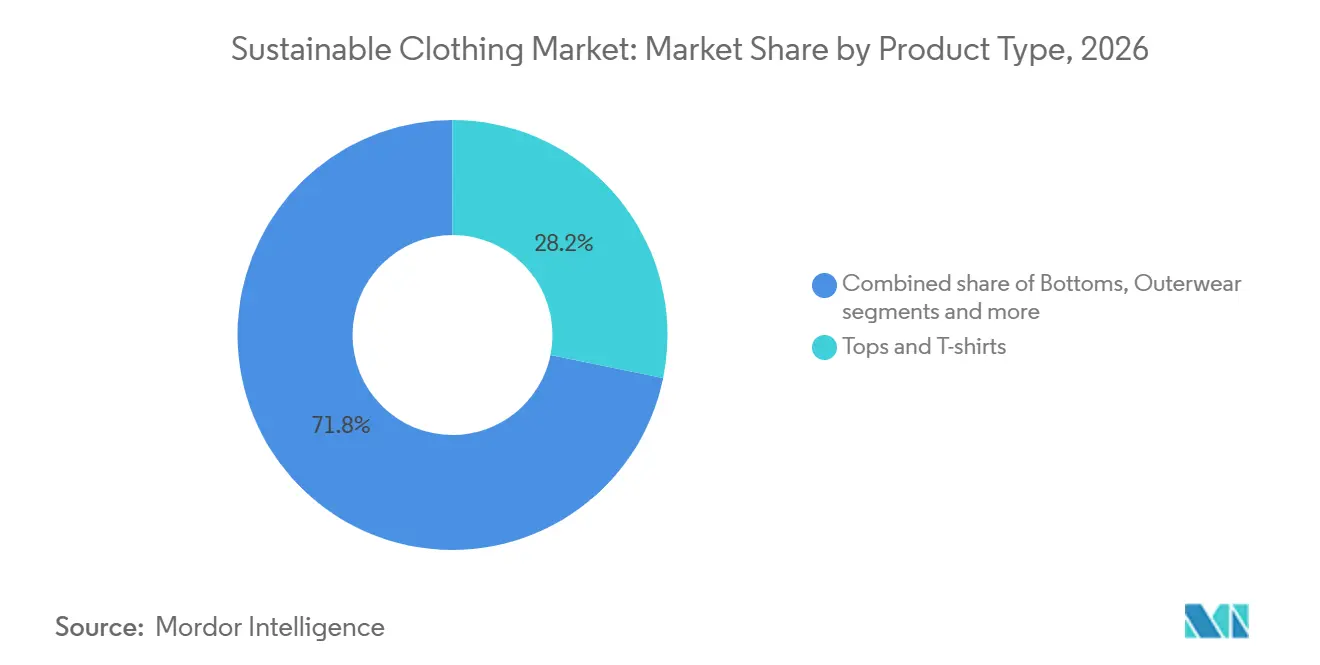
- By product type, Tops and T-shirts held 28.2% of the sustainable clothing market share in 2026, while Swimwear is projected to grow at a CAGR of 9.4% through 2032.
- By end-user, Adults accounted for 85.3% of the sustainable clothing market share in 2026, while Kids is projected to grow at a CAGR of 10.2% through 2032.
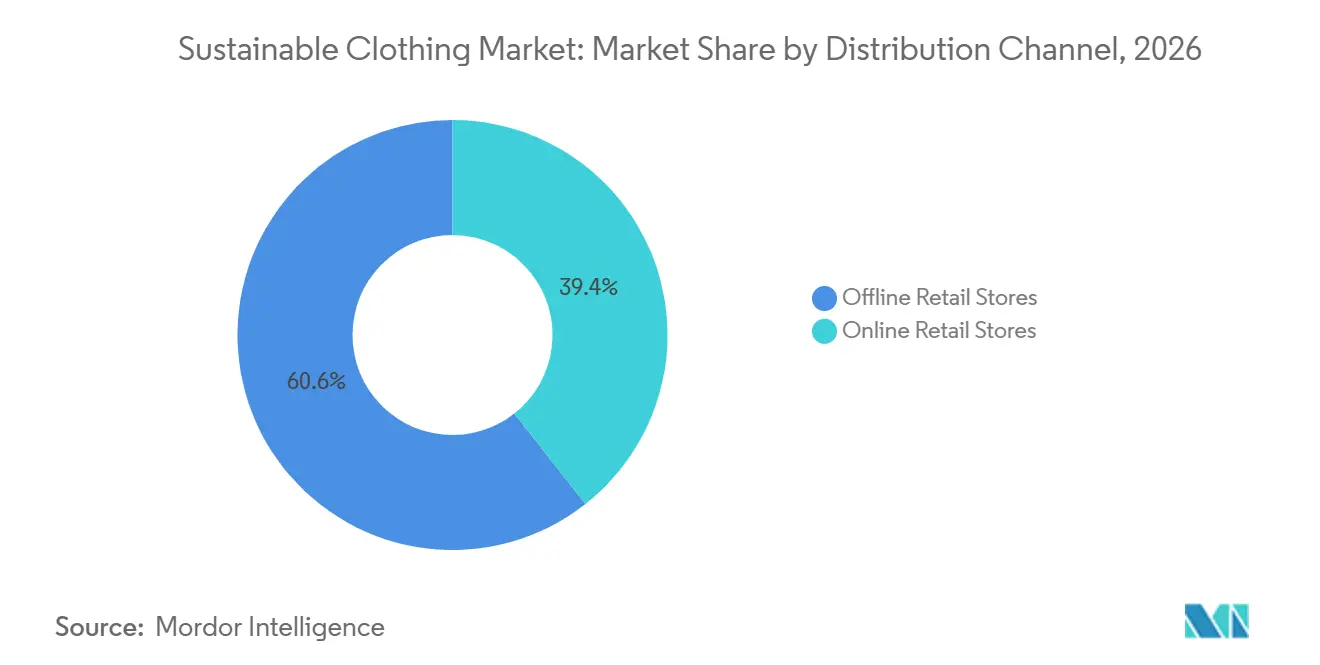
- By distribution channel, Offline retail stores held 60.61% revenue share in 2026, while Online retail stores are projected to grow at a CAGR of 10.4% through 2032.
- By geography, North America accounted for 32.7% of revenue in 2026, while Asia-Pacific is projected to grow at a CAGR of 9.5% through 2032.
Note: Market numbers in this report are based on Mordor Intelligence's proprietary estimation framework, which combines nine months of actuals with Q4 projections for base year 2026.
Global Sustainable Clothing Market Trends and Insights
Drivers Impact Analysis*
| Driver | (~) % Impact on CAGR Forecast | Geographic Relevance | Impact Timeline |
|---|---|---|---|
| Innovation in eco-friendly materials | +1.8% | Global | Medium term (2-4 years) |
| Rising consumer awareness of environmental impact | +1.5% | Global | Short term (≤ 2 years) |
| Influence of younger, values-driven demographics | +1.4% | Global, particularly APAC, Europe & North America | Medium term (2-4 years) |
| Trust in third-party certifications | +0.8% | Global, with early gains in EU & North America | Medium term (2-4 years) |
| Perceived quality and durability of sustainable garments | +0.7% | North America & Europe | Long term (≥ 4 years) |
| Growth of online shopping and D2C channels | +1.2% | Global | Short term (≤ 2 years) |
| Source: Mordor Intelligence | |||
Innovation in Eco-Friendly Materials
Material innovation is changing how apparel companies select fibers, set product specifications, and manage end-of-life waste. The sustainable clothing market gains from progress in regenerated cellulosic fibers, textile-to-textile recycling, and biodegradable performance materials. Textile Exchange reports that reporting brands are reducing their use of virgin fossil-based polyester as alternatives scale. The change indicates that brands are moving certified alternatives beyond limited product trials and into recurring sourcing programs. WIPO identifies lab-grown cotton, bio-based polyester, and waste-to-fiber recycling as technologies with commercial relevance for sustainable fashion. These developments give brands an opportunity to improve product performance while reducing reliance on virgin inputs.
Rising Consumer Awareness of Environmental Impact
Consumer interest increasingly depends on whether clothing brands can substantiate their environmental claims through transparent, verifiable information. A 2025 GlobeScan and Zalando study conducted across five European markets found that 71% of consumers aspired to shop more sustainably, while 77% expected brands and retailers to lead the transition. However, 19% of consumers aspiring to shop sustainably distrusted sustainability claims entirely, underscoring concerns about vague messaging, inconsistent disclosures, and potential greenwashing. Brands can build credibility by providing independently verified certifications, material sourcing details, product-level environmental impact information, and clear guidance on durability, care, repair, reuse, resale, and end-of-life options before purchase. Price remains a significant barrier, particularly when sustainable products carry a premium. Direct-to-consumer and digitally enabled retail models can reduce intermediary and distribution costs, improve price accessibility, and provide detailed sustainability information at the point of purchase. In addition, transparent product labeling and digital product passports can help consumers compare materials, production practices, and product life-cycle attributes.
Influence of Younger, Values-Driven Demographics
Younger consumers are strengthening the connection between product quality, circularity, and purchase intent. Research published in 2025 found that environmental awareness and circular fashion awareness were important predictors of circular fashion behavior among Generations Y and Z. The study also found that perceived quality and durability influenced purchasing decisions, making functional value as important as ethical positioning. Research on Vietnam’s fashion sector similarly identified social influence and electronic word of mouth as important influences on Generation Z green purchase intent. These patterns favor brands that communicate product longevity and material details on digital channels. They also increase the importance of credible peer recommendations in the sustainable clothing market.
Growth of Online Shopping and D2C Channels
Online and direct-to-consumer channels allow apparel brands to present sourcing, certification, and product-care information without the limitations of a multi-brand retail setting. These channels can also combine new apparel, resale, take-back, and repair services within a single customer journey. Patagonia made Worn Wear products available on Patagonia.com in 2025, bringing resale closer to its primary retail experience. This type of integration makes circular purchase options easier to find and understand. Digital product information can also help shoppers compare material claims before buying. As a result, online retail stores are widening the reach of the sustainable clothing market while changing how brands explain environmental performance.
Restraints Impact Analysis*
| Restraint | (~) % Impact on CAGR Forecast | Geographic Relevance | Impact Timeline |
|---|---|---|---|
| Higher cost of sustainable raw materials | -1.2% | Global | Medium term (2-4 years) |
| Greenwashing and consumer skepticism | -0.9% | Global, particularly Europe & North America | Short term (≤ 2 years) |
| Fragmented and opaque supply chains | -0.8% | Global | Long term (≥ 4 years) |
| Lack of standardized sustainability metrics | -0.5% | Global, with concentration in emerging markets | Medium term (2-4 years) |
| Source: Mordor Intelligence | |||
Higher Cost of Sustainable Raw Materials
Certified and recycled inputs can raise procurement costs for apparel brands, especially when supply is limited or specifications are specialized. The sustainable clothing market faces pressure when brands cannot secure sufficient certified fiber through long-term sourcing arrangements. Cost exposure is particularly difficult for smaller labels that lack purchasing scale and established supplier relationships. It can limit their ability to hold prices at a level that attracts mainstream consumers. New recycling capacity and larger offtake commitments may improve supply over time, but the effect depends on reliable commercial production. The current cost challenge encourages brands to focus on durable designs, careful inventory management, and products with a longer useful life.
Greenwashing and Consumer Skepticism
Unsupported environmental claims can damage trust in genuine sustainability programs as well as in poor-quality claims. GlobeScan found that 19% of aspiring sustainable fashion consumers did not trust sustainability claims in 2025. This concern puts greater weight on third-party certification, traceable materials, and specific product disclosures. Brands that understate or avoid communicating verified progress may also lose an opportunity to demonstrate the value of their sourcing investments. The European Commission has established a common method for measuring apparel and footwear environmental impacts, which supports more comparable claims. The sustainable clothing market needs credible and understandable evidence if it is to turn environmental interest into repeat purchasing[1].
*Our forecasts treat driver/restraint impacts as directional, not additive. The impact forecasts reflect baseline growth, mix effects, and variable interactions.
Segment Analysis
By Product Type: Basics Anchor Volume, Specialty Formats Define Growth
Tops and T-shirts accounted for 28.2% of the sustainable clothing market size in 2026, making basic apparel the largest product category. Their position reflects the practical use of organic cotton, regenerated cellulosic fibers, and recycled cotton blends in widely worn garments. These materials can be adapted to repeatable cut-and-sew designs with more predictable specifications. Everyday basics also give new brands a clear point of entry into certified apparel. EILEEN FISHER reported that 99.02% of its cotton fiber basket was organic in 2025, and 39.6% was also certified regenerative. Bottoms, outerwear, loungewear and sleepwear, and other garments add breadth to the sustainable clothing market. Outerwear is supported by recycled insulation and fluorocarbon-free durable water-repellent finishes. These categories extend material innovation into garments with more demanding performance requirements.
Swimwear is projected to expand at a 9.4% CAGR from 2027 to 2032, the highest rate among product types. The sustainable clothing industry is addressing swimwear’s reliance on fossil-based synthetics through new yarn and fiber options. Lenzing and OceanSafe introduced a performance textile that combines TENCEL Lyocell A100 with biodegradable naNea fibers for swimwear and performance uses in October 2025. The development illustrates how material suppliers are working on alternatives for products that need stretch, durability, and water resistance. Swimwear brands can use these materials to make sustainability claims more relevant to product function. The segment is also suited to circular material stories because it has a close link to plastic waste and marine environments. Such products can help brands connect material sourcing with a clear use case. This provides a path for specialty categories to expand faster than the sustainable clothing market overall.

By End-User: Adults Drive Premiumization, Parental Values Support Kids Apparel
Adults held 85.3% revenue share in 2026, supported by their purchasing power and awareness of sustainability certifications. Adult shoppers are often familiar with signals such as GOTS, bluesign, and Fair Trade when assessing clothing claims. GlobeScan and Zalando found that 66% of adult consumers across 5 European markets already made sustainable fashion choices in 2025. This group also supports resale, repair, and take-back programs that extend the life of clothing. EILEEN FISHER’s Renew program collected 319,377 pieces in fiscal 2025 and reached 3 million cumulative returns by June 2026. These programs can turn regular use of clothing into a continuing relationship with a brand. The adult segment therefore supports premium products as well as circular services. Its scale makes it central to the sustainable clothing market’s current revenue base.
Kids apparel is forecast to grow at a 10.2% CAGR from 2027 to 2032, faster than any other end-user segment. Parents are placing more attention on chemical safety, AZO-free dyes, and supply-chain transparency when buying clothing for children. The sustainable clothing industry can respond with clear material information and products designed for resale, reuse, or hand-me-down use. Children’s rapid changes in size make durability and circular use especially important. This turnover also creates practical demand for used and renewed clothing. Brand programs that address material safety and garment longevity can meet both parental and environmental expectations. The category has room to grow because these criteria are increasingly considered alongside price. It remains an important route for broadening the sustainable clothing market beyond adult self-purchase.
By Distribution Channel: Offline Retail Anchors Trust, Online Channels Expand Reach
Offline retail stores accounted for 60.6% of the sustainable clothing market size in 2026. Physical stores help shoppers assess fabric feel, fit, construction, and certification information before making a higher-consideration purchase. Staff and displays can also explain provenance and care requirements in ways that are not always easy to convey online. This is valuable when consumers are unfamiliar with newer recycled or regenerated material categories. Reformation opened 15 stores in 2025, including its first mainland European boutique in Paris in November 2025. The expansion shows that physical retail remains relevant for specialist sustainable apparel brands. Store-based resale and take-back programs can also give established retailers a visible circular offering. Offline channels continue to provide a trust-building role within the sustainable clothing market.
Online retail stores are expected to grow at a 10.4% CAGR from 2027 to 2032, the fastest rate among distribution channels. Digital channels can display product-specific material, certification, care, and resale information in one place. They can serve customers across multiple locations from a shared catalog and logistics system. Patagonia’s 2025 website integration of new and Worn Wear products shows how a brand can combine primary and resale purchasing online. This approach makes circular purchase options part of a regular transaction rather than a separate experience. Online channels also support direct communication with consumers who want detail before purchase. They can make product traceability more accessible when brands provide clear and verified information. This keeps online retail important to the future reach of the sustainable clothing market.
Geography Analysis
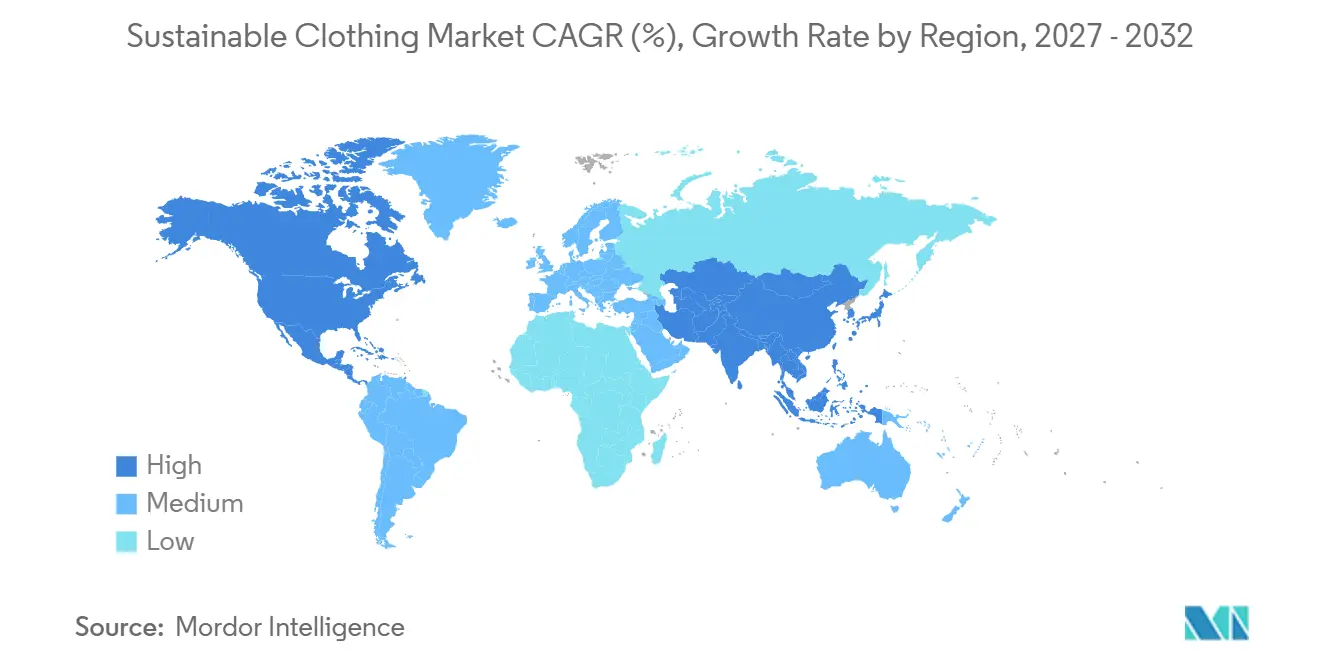
North America held 32.7% revenue share in 2026. The region has a strong base of sustainability-focused brands, B Corporation participants, and consumers able to consider certified apparel at premium price points. Its retail environment supports specialist labels as well as larger companies that are adding resale, repair, and traceability programs. Consumer familiarity with material claims and circular services helps brands test new commercial models. The region is also affected by growing attention to environmental disclosure and textile responsibility across state-level policy discussions.
Europe is shaped by policy requirements that place textile durability, recyclability, and environmental information closer to product design decisions. The revised EU Waste Framework Directive entered into force on October 16, 2025, requiring Member States to establish extended producer responsibility schemes for textiles[2]. The EU Ecodesign for Sustainable Products Regulation Working Plan for 2025 to 2030 identifies textiles as a priority product group. Germany, the United Kingdom, and Nordic countries are established sustainable apparel consumer markets. Poland, Spain, and Italy offer room for further adoption as awareness and product availability increase.
Asia-Pacific is forecast to grow at a 9.5% CAGR from 2027 to 2032, making it the fastest-growing regional market. Rising middle-class income, urbanization, and export-oriented manufacturing support demand and supply in the region. India, China, Vietnam, Indonesia, and Thailand are important locations for certified textile production and for emerging domestic demand. The sustainable clothing market can gain as regional manufacturers invest in standards that support access to European and North American buyers. South America presents an opportunity through expanding retail investment and export-ready sustainable brands. The Middle East and Africa remain earlier-stage markets, while the UAE, Saudi Arabia, South Africa, Turkey, Nigeria, and Egypt provide potential entry points. Turkey’s textile base has particular relevance because export requirements can support certified production.
Competitive Landscape
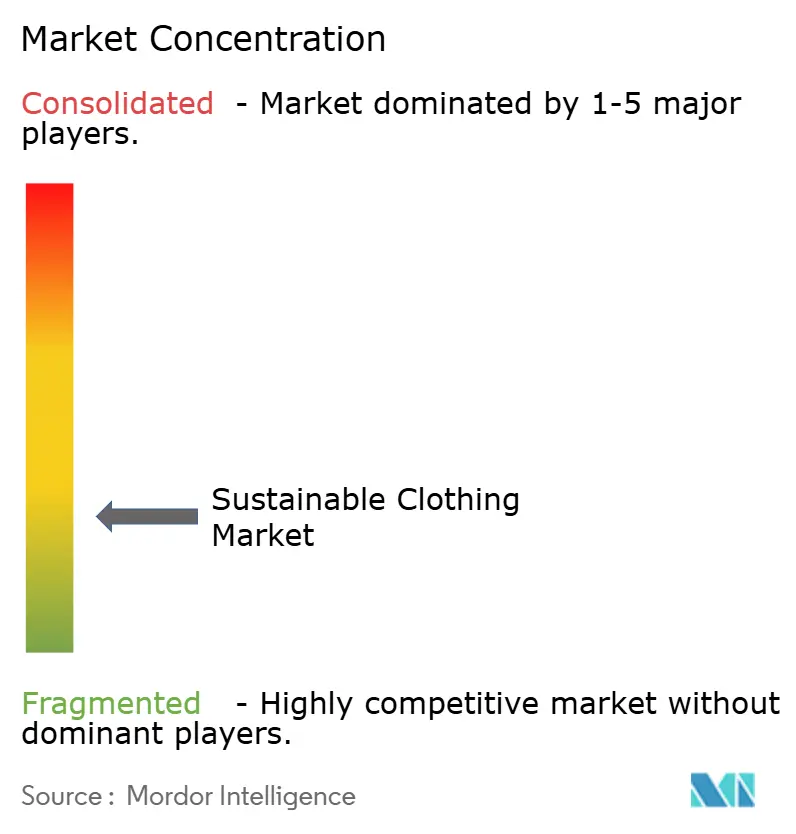
The sustainable clothing market is fragmented, with global apparel groups and specialist labels coexisting. No single company holds sufficient market share to set pricing or certification standards. Companies compete based on material sourcing, supply chain practices, product durability, and evidence supporting environmental claims. Larger groups can leverage long-term purchasing agreements and supplier programs to secure recycled or lower-impact inputs. H&M Group is expected to report progress on Scope 3 greenhouse gas emissions and receive CDP A-list recognition for climate and water transparency in its fiscal 2025 reporting. These disclosures make operational progress visible to investors, suppliers, and consumers while raising expectations for companies that communicate sustainability commitments.
Companies also compete by integrating circularity into familiar retail experiences. EILEEN FISHER continues to expand its Renew take-back program, which is projected to reach 3 million cumulative returns by June 2026. Levi Strauss & Co. is expected to launch its Energy Accelerator Program in India with Schneider Electric in September 2025 to expand renewable electricity access for supply chain manufacturers. These initiatives demonstrate that competitive differentiation extends beyond fiber selection to include operations, service models, and supplier engagement. They also allow companies to demonstrate measurable progress rather than relying solely on brand messaging.
Specialist brands compete through detailed material narratives and focused product expertise. Reformation’s planned store expansion in 2025 indicates that direct-to-consumer brands can use physical locations to strengthen consumer confidence in fit, quality, and responsible sourcing. The sustainable clothing market also offers opportunities for brands that provide certified basics at more accessible prices in emerging markets. This opportunity is significant, as price remains a barrier to sustainable purchasing for many consumers.
Companies that combine credible documentation with well-designed, durable garments are better positioned to drive repeat demand. Common environmental measurement methods in Europe may improve the consistency of comparative claims over time. Therefore, the competitive landscape is expected to remain diverse, with brand scale, material expertise, and consumer trust influencing market performance.
Sustainable Clothing Industry Leaders
-
adidas AG
-
Patagonia, Inc.
-
Vuori, Inc.
-
Under Armour, Inc.
-
EILEEN FISHER, INC.
- *Disclaimer: Major Players sorted in no particular order
Recent Industry Developments
- October 2026: The Nature Conservancy launched the Microfiber Action Alliance with Nike, Patagonia, Under Armour, lululemon, Cotopaxi, and REI Co-op as founding members to accelerate science-based solutions to microfiber pollution. Participants committed to sharing supply-chain data, testing methodologies, and interventions, with the goal of scaling industry-wide solutions to a source estimated to account for over 30% of ocean microplastics.
- September 2026: Levi Strauss & Co. and Marks & Spencer, in partnership with Schneider Electric's SE Advisory Services, launched the Fashion Renewable Collaborative at New York Climate Week. The program enables global apparel suppliers to access renewable electricity at scale, aligned with Levi's 42% near-term supply-chain emissions reduction target by 2030.
- March 2026: Nike unveiled Aero-FIT, its first elite performance apparel made entirely from 100% textile waste through advanced chemical recycling, debuting in FIFA World Cup 2026 federation kits. The technology proves that recycled textile-waste inputs can produce performance polyester yarn at parity with virgin material, a significant commercial validation for circular textiles.
- January 2026: Levi Strauss & Co. launched the Levi's® Wear Longer Project in partnership with Discovery Education, a free classroom curriculum for grades 9–12 teaching garment repair, customization, and sustainable care, extending the brand's commitment to responsible consumption and product-life-extension education globally.
Global Sustainable Clothing Market Report Scope
The Sustainable Clothing Market refers to the market for clothing products manufactured, sourced, or designed using environmentally and socially responsible materials, production processes, and practices aimed at reducing resource consumption, waste, pollution, and other environmental impacts across the clothing lifecycle. By product type, the market is segmented into tops and t-shirts, bottoms, outerwear, swimwear, loungewear and sleepwear, and others. By end-user, the market is segmented into adults and kids. By distribution channel, the market is divided into online retail stores and offline retail stores. Geographically, the market covers North America, Europe, Asia-Pacific, South America, and the Middle East and Africa, with country-level coverage across major markets. Market forecasts are presented in terms of value (USD).
| Tops and t-shirts |
| Bottoms |
| Outerwear |
| Swimwear |
| Loungewear and sleepwear |
| Others |
| Adults |
| Kids |
| Online Retail Stores |
| Offline Retail Stores |
| North America | United States |
| Canada | |
| Mexico | |
| Rest of North America | |
| Europe | Germany |
| United Kingdom | |
| Italy | |
| France | |
| Spain | |
| Netherlands | |
| Poland | |
| Belgium | |
| Sweden | |
| Rest of Europe | |
| Asia-Pacific | China |
| India | |
| Japan | |
| Australia | |
| Indonesia | |
| South Korea | |
| Thailand | |
| Singapore | |
| Rest of Asia-Pacific | |
| South America | Brazil |
| Argentina | |
| Colombia | |
| Chile | |
| Peru | |
| Rest of South America | |
| Middle East and Africa | South Africa |
| Saudi Arabia | |
| United Arab Emirates | |
| Nigeria | |
| Egypt | |
| Morocco | |
| Turkey | |
| Rest of Middle East and Africa |
| By Product Type | Tops and t-shirts | |
| Bottoms | ||
| Outerwear | ||
| Swimwear | ||
| Loungewear and sleepwear | ||
| Others | ||
| By End-User | Adults | |
| Kids | ||
| By Distribution Channel | Online Retail Stores | |
| Offline Retail Stores | ||
| By Geography | North America | United States |
| Canada | ||
| Mexico | ||
| Rest of North America | ||
| Europe | Germany | |
| United Kingdom | ||
| Italy | ||
| France | ||
| Spain | ||
| Netherlands | ||
| Poland | ||
| Belgium | ||
| Sweden | ||
| Rest of Europe | ||
| Asia-Pacific | China | |
| India | ||
| Japan | ||
| Australia | ||
| Indonesia | ||
| South Korea | ||
| Thailand | ||
| Singapore | ||
| Rest of Asia-Pacific | ||
| South America | Brazil | |
| Argentina | ||
| Colombia | ||
| Chile | ||
| Peru | ||
| Rest of South America | ||
| Middle East and Africa | South Africa | |
| Saudi Arabia | ||
| United Arab Emirates | ||
| Nigeria | ||
| Egypt | ||
| Morocco | ||
| Turkey | ||
| Rest of Middle East and Africa | ||
Key Questions Answered in the Report
What is the projected value of sustainable clothing by 2032?
The sustainable clothing market is projected to reach USD 17.2 billion by 2032, expanding at an 8.6% CAGR from 2027.
Which sustainable clothing product category is growing fastest?
Swimwear is projected to record the fastest product-type growth, with a 9.4% CAGR through 2032.
Why do adults account for most sustainable apparel demand?
Adults held 85.3% share in 2026 because of greater purchasing power and familiarity with certification and circular purchase options.
Which sales channel is expanding fastest for sustainable apparel?
Online retail stores are projected to grow at a 10.4% CAGR through 2032 because they can provide detailed product and sourcing information.