
Superplasticizers Market Size and Share
Market Overview
| Study Period | 2021 - 2031 |
|---|---|
| Market Size (2026) | USD 7.79 Billion |
| Market Size (2031) | USD 11.21 Billion |
| Growth Rate (2026 - 2031) | 7.56 % |
| Fastest Growing Market | Asia-Pacific |
| Largest Market | Asia-Pacific |
| Market Concentration | Medium |
Major Players *Disclaimer: Major Players sorted in no particular order Image © Mordor Intelligence. Reuse requires attribution under CC BY 4.0. | |
Superplasticizers Market Analysis by Mordor Intelligence
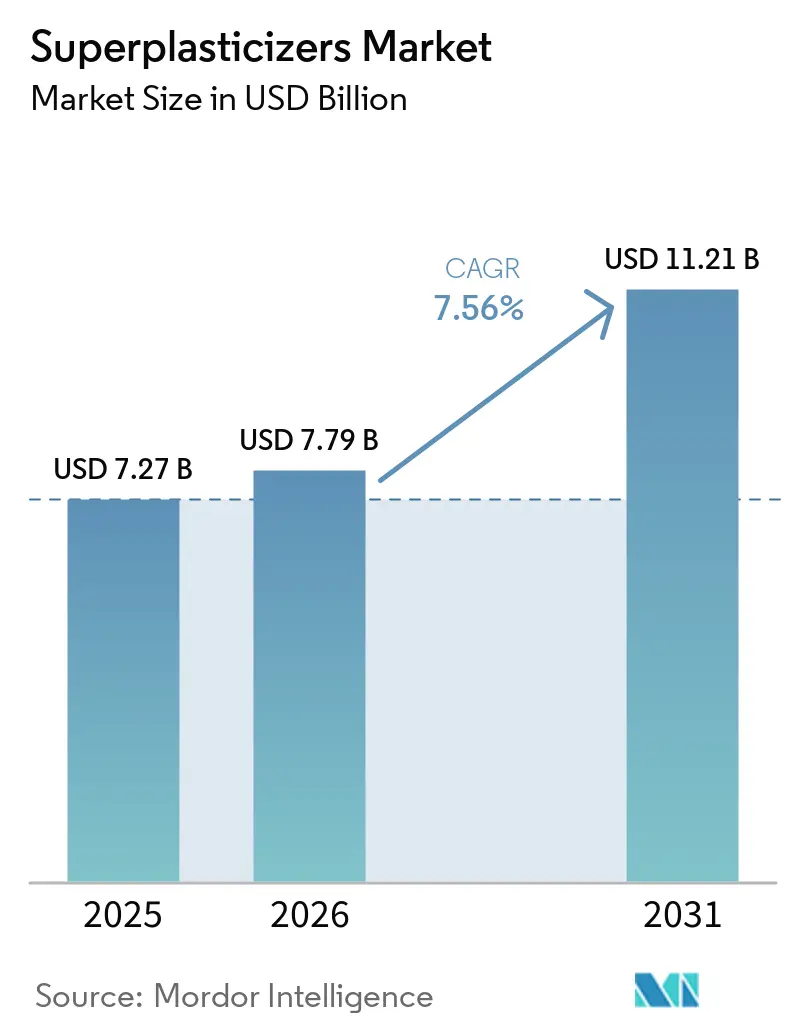
The Superplasticizers market size was estimated at USD 7.27 billion in 2025 and is estimated to grow from USD 7.79 billion in 2026 to USD 11.21 billion by 2031, at a CAGR of 7.56% during the forecast period (2026-2031). Infrastructure programs, lower-carbon concrete requirements, and automated ready-mix operations drive demand for high-performing admixtures across construction projects that require consistent concrete quality and controlled placement performance. These conditions favor products that reduce water use while maintaining workable concrete mixes, particularly where project owners require durability, repeatable batching, and documented material performance. Polycarboxylate derivatives meet these requirements in mixes with supplementary cementitious materials, where older chemistries are often less effective. Suppliers are positioning production and technical support closer to major construction programs, where local testing addresses differences in cement, aggregates, climate, and construction methods. This supports supply continuity and helps producers adapt formulations to local standards, while giving technical teams a practical way to validate performance before products enter large project specifications.
Key Report Takeaways
- By product type, polycarboxylate derivatives held 40.45% of the Superplasticizers market share in 2025 and are projected to grow at an 8.34% CAGR through 2031.
- By form, liquid formulations held 60.14% of the Superplasticizers market share in 2025, while powder grades are forecast to grow at a 8.78% CAGR through 2031.
- By application, ready-mix concrete accounted for 51.26% of the Superplasticizers market size in 2025, while high-performance concrete is forecast to grow at a 9.24% CAGR through 2031.
- By geography, Asia-Pacific held 45.91% of the Superplasticizers market share in 2025 and is projected to grow at an 8.94% CAGR through 2031.
Note: Market size and forecast figures in this report are generated using Mordor Intelligence’s proprietary estimation framework, updated with the latest available data and insights as of January 2026.
Market Trends and Insights
Drivers Impact Analysis of Superplasticizers Market*
| Drivers | (~) % Impact on CAGR Forecast | Geographic Relevance | Impact Timeline |
|---|---|---|---|
| Infrastructure and Public Works Investment | +2.0% | Global, with concentrated impact in Asia-Pacific, North America, and Middle East and Africa (MEA) | Long term (≥ 4 years) |
| Low-Carbon Concrete and Cement-Reduction Requirements | +1.5% | Europe, North America, Asia-Pacific | Medium term (2-4 years) |
| Ready-Mix Batching and Slump-Retention Requirements | +1.2% | Global, particularly Asia-Pacific and North America | Short term (≤ 2 years) |
| Precast, Modular, and High-Performance Concrete Adoption | +1.0% | North America, Europe, Asia-Pacific | Medium term (2-4 years) |
| Artificial Intelligence (AI)-Optimized Mix Design and Automated Dosing | +0.6% | North America, Europe, with spillover to the Asia-Pacific | Medium term (2-4 years) |
| Source: Mordor Intelligence | |||
Low-Carbon Concrete and Cement-Reduction Requirements
Low-carbon construction requirements increase admixture demand per cubic meter when concrete incorporates more supplementary cementitious materials, because these binders can alter water demand, dispersion behavior, and placement performance. A 2025 Scientific Reports study found that higher calcined-clay content in Limestone Calcined Clay Cement increased the superplasticizer dosage required to maintain workability. Calcined clay has a high specific surface area and reduces available free water in the mix, making workability control more dependent on admixture selection and dosing. This condition also makes accurate dispersion more important for low-clinker concrete. A 2025 Buildings study reported that Polycarboxylate Ether (PCE)-based superplasticizers in CEM III/A and CEM V/B blends maintained 28-day compressive strength at or above CEM I reference mixes. European procurement requirements for verified low-carbon products make this chemistry relevant to public works and private construction, where emissions documentation influences material selection.
Ready-Mix Batching and Slump-Retention Requirements
Ready-mix plants require concrete that remains workable during batching, transit, placement, and pumping. Liquid formulations are used with metered dosing equipment in automated plants, giving plant managers greater control over admixture-to-water ratios and batch consistency. Predictable dosing helps plants reduce batch variability and material waste while supporting quality assurance. Suppliers provide products designed for specific slump-retention needs, including mixes stable during long transit times, on congested sites, or in hot weather. These requirements are relevant in large urban projects where transit-mix concrete serves multiple construction sites daily and where delays affect placement quality, labor use, and project schedules.
Precast, Modular, and High-Performance Concrete Adoption
Precast and modular construction require consistent mixes and early strength development because factory schedules depend on repeatable casting, finishing, curing, and form-reuse cycles. Precast operations use short form-stripping cycles of 12-16 hours, supporting demand for formulations that assist early and later strength development. High-performance concrete used in bridge decks, data centers, and wind turbine towers can require compressive strength above 80 MPa, with low water-to-cement ratios and precise admixture dosing. Meta reported that its BOxCrete-designed mix at Rosemount, Minnesota, reached full structural strength 43% faster than its original formula. Self-compacting concrete supports demand in tunnel lining and complex precast work where dense reinforcement or difficult geometry limits efficient vibration.
AI-Optimized Mix Design and Automated Dosing
Automated dosing links material choices to plant data, production controls, and repeatable performance targets. In a ready-mix plant, this enables consistent dosage application across batches, monitoring concrete response, and supporting earlier adjustments when slump or strength results deviate from target specifications. AI-enabled platforms use batch records to adjust mix designs, integrating cement content, fresh-concrete behavior, strength results, and admixture dosage into a single plant decision process. Meta released BOxCrete in March 2026 as an open-source model that predicts slump and compressive strength together[1]Meta Engineering, “AI for American-Produced Cement and Concrete,” Meta, engineering.fb.com. These systems reduce field overdosing, which is used to address inconsistent cement quality, giving producers clearer information about whether a problem stems from materials, batching, or admixture selection. They may also shift supplier competition toward reliable per-dose performance, as producers use plant data to compare results across products and batches.
Restraints Impact Analysis of Superplasticizers Market*
| Restraints | (~) % Impact on CAGR Forecast | Geographic Relevance | Impact Timeline |
|---|---|---|---|
| Raw-Material Price and Availability Volatility | -0.8% | Global, most acute in Asia-Pacific and North America | Short term (≤ 2 years) |
| Cement and Aggregate Compatibility Variability | -0.6% | Asia-Pacific, South Asia, Southeast Asia | Medium term (2-4 years) |
| Formaldehyde, Residue, and Chemical-Compliance Burden | -0.5% | Europe, North America | Medium term (2-4 years) |
| Source: Mordor Intelligence | |||
Raw-Material Price and Availability Volatility
Acrylic acid, methacrylic acid, and ethylene or propylene oxide together represent 60-70% of Polycarboxylate Ether (PCE) production costs. Volatility in these inputs affects formulation margins and procurement decisions, particularly when suppliers cannot adjust customer prices or secure consistent material availability. PCE producers also depend on polyether side-chain inputs, which creates uncertainty when upstream pricing changes quickly. Sulfonated Naphthalene Formaldehyde (SNF) producers face separate exposure to sulfuric acid and naphthalene from coal-tar refining. This leaves producers exposed to multiple commodity chains with different pricing patterns, supplier bases, logistics requirements, and supply interruption risks. Manufacturers with monomer integration or long-term feedstock contracts manage this risk more effectively than formulators buying materials on the spot market.
Cement and Aggregate Compatibility Variability
Superplasticizer performance varies with cement composition, aggregate properties, supplementary cementitious materials, and water quality, so a standard formulation does not always deliver identical results across every plant. This variability is relevant in markets that use locally sourced raw materials with inconsistent characteristics. A formulation that performs well in one plant may require adjustment at another when raw material sources, climate conditions, mixing equipment, or target concrete properties differ. Variations in cement quality can lead plant operators to use more admixture than necessary, increasing costs and obscuring the underlying batching problem. Suppliers need to provide local testing and application support, including trial mixes that identify suitable dosage ranges before an admixture enters commercial production.
*Our forecasts treat driver/restraint impacts as directional, not additive. The impact forecasts reflect baseline growth, mix effects, and variable interactions.
Superplasticizers Market Segment Analysis
By Product Type:
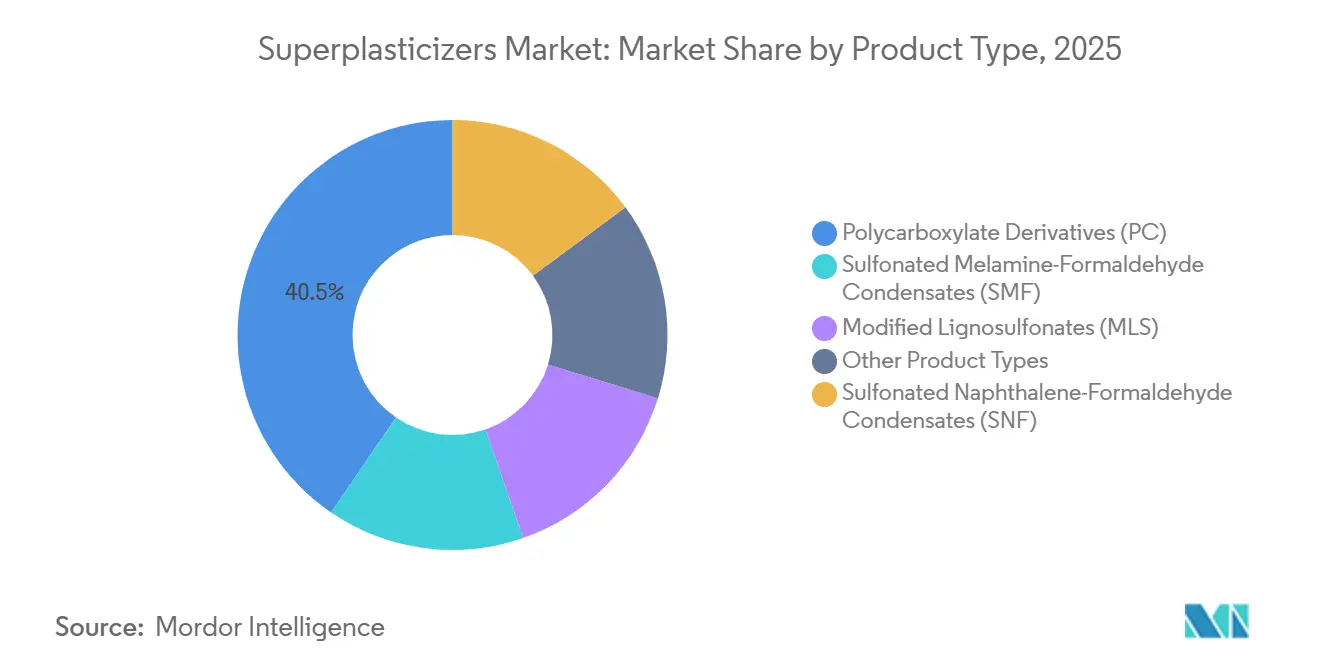
Molecular Architecture Determining Market ConcentrationPolycarboxylate derivatives held 40.45% of the superplasticizers market share in 2025 and are projected to grow at an 8.34% CAGR through 2031. Their polycarboxylate backbone and polyethylene oxide side chains promote particle dispersion through steric hindrance, helping producers manage water reduction while retaining flexibility in formulation design. This structure supports water reduction without permanently adsorbing to cement particles, which is useful when producers need to balance workability, set behavior, strength development, and local material compatibility. PCE grades are well-suited to general-purpose concrete where both water reduction and workable placement are required.
Product selection depends on the mix design and the intended application. A 2026 Scientific Reports study found that 1% Sulfonated Naphthalene Formaldehyde (SNF) increased relative slump by 272.9% in one-part geopolymer concrete, whereas Polycarboxylate Ether (PCE) yielded limited workability gains and caused strength reductions at higher dosages. This supports continued SNF use in precast and specialty civil applications that prioritize controlled early strength and cost, where extended slump retention is not the primary requirement. Modified lignosulfonates remain relevant in price-sensitive applications, although their lower water-reduction capability limits their role in structural concrete. Sulfonated Melamine Formaldehyde (SMF) demand is under pressure in Western markets due to compliance costs, but it remains applicable in parts of South Asia and Southeast Asia, where product transitions depend on local compliance, capital, and customer acceptance.



By Form:
Liquid’s Operational Grip, Powder’s Geographic ReachLiquid formulations accounted for 60.14% of the superplasticizers market in 2025. They are compatible with automated batching systems that meter admixtures into each concrete batch, helping operators maintain consistent dosing across production cycles. Liquid dosing removes the dissolution step required by powder products. Plants in North America and Western Europe have standardized this approach through flow meters linked to plant controls, order requirements, and quality records.
Powder grades are forecast to expand at an 8.78% CAGR through 2031. Remote sites in Southeast Asian archipelagos, sub-Saharan Africa, and highland South America often lack practical storage conditions for liquid products. Powder simplifies shipment, storage, handling, and on-site preparation, making it a practical option for long supply routes and cold conditions. Precast and dry-mortar producers use powder products for exact-weight batching in bagged and big-bag systems. Powder SNF products require EN 934-2 conformity marking for use in CE-marked concrete. Producers moving to powder PCE may face parallel certification timelines, creating temporary supply gaps in some European precast applications.
By Application:
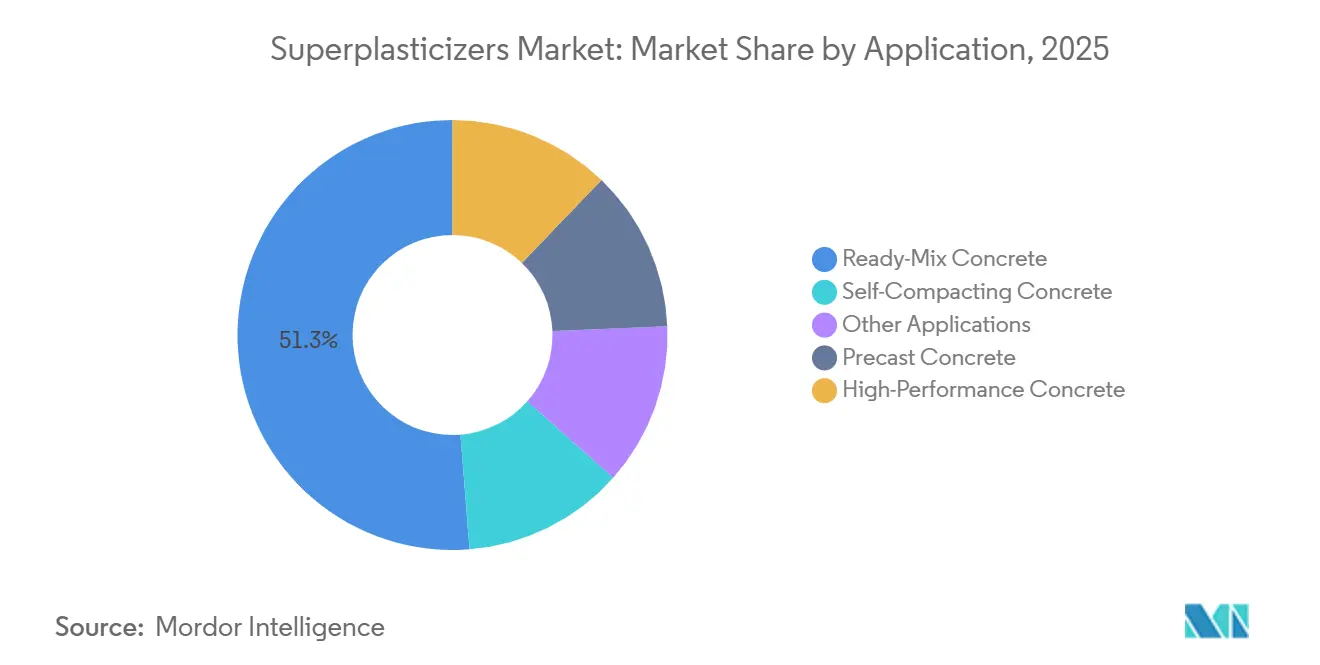
Ready-Mix Concrete Anchors Quantity While High-Performance Concrete Drives MarginReady-mix concrete accounted for 51.26% of the superplasticizers market in 2025. This application depends on pumpable and consistent concrete for urban residential and commercial construction, where delivery schedules and variable placement conditions require stable fresh-concrete behavior. Automated batching improves dosing consistency, reduces waste, and supports tighter performance limits, allowing suppliers and producers to identify performance issues earlier in the batching process.
High-performance concrete is projected to grow at a 9.24% CAGR through 2031. Bridge rehabilitation, data center construction, wind turbine towers, and major Middle East foundations require mixes with demanding strength, durability, and workability requirements, as well as placement requirements. Precast operations require early strength development due to 12-16 hour form-stripping cycles, supporting dual-function PCE grades that address both early and later strength while maintaining workability for casting and finishing. Self-compacting concrete is gaining use in ASEAN tunnel and underground projects, where its higher superplasticizer-to-cement ratios enable non-vibrated placement in the presence of complex reinforcement or geometry.
Geography Analysis
APAC Superplasticizers Market
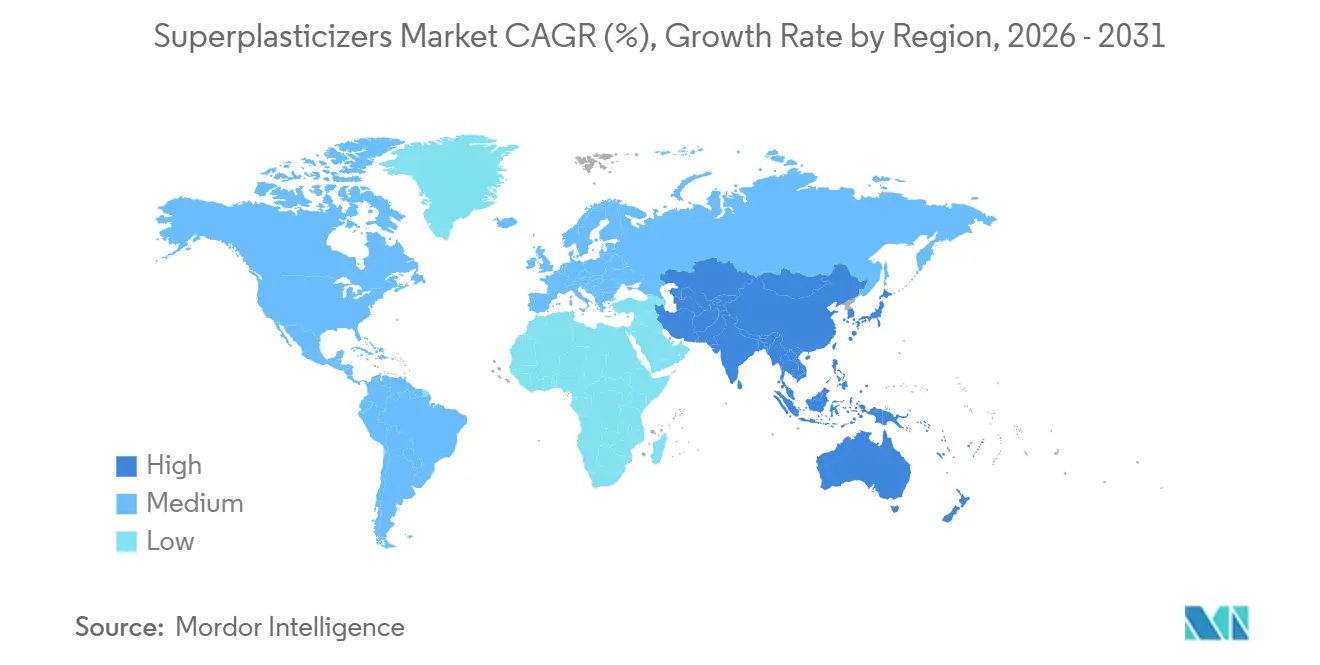
Asia-Pacific held 45.91% of the superplasticizers market share in 2025 and is forecast to grow at an 8.94% CAGR through 2031. China's continued investment in hydropower, high-speed rail, and housing, combined with concrete performance requirements, supports higher usage and more demanding admixture specifications. India's infrastructure pipeline and housing programs support the adoption of ready-mix concrete. Japan and South Korea maintain demand through precast construction methods and earthquake-resistance requirements, which favor controlled concrete properties in structural applications. Indonesia, Vietnam, and the Philippines present additional opportunities as toll roads, airports, and metro systems enter construction, increasing the need for ready-mix supply and project-specific admixture support.
North America, Europe and APAC Superplasticizers Market
Regional requirements vary across the Asia-Pacific. China uses GB 8076, and India uses IS 9103 to govern admixture performance. This fragmentation makes localized formulation and technical support important for suppliers, as compliance documentation, test practices, and customer expectations differ across national construction markets. North American demand is driven by infrastructure projects using high-performance concrete, while European demand is linked to lower-clinker blends and embodied-carbon requirements. EN 934-2 provides a common European framework for admixture quality[2]European Committee for Standardization, “EN 934-2, Admixtures for Concrete, Mortar and Grout,” European Committee for Standardization, cen.eu.
MEA and South America Superplasticizers Market
South America, the Middle East, and Africa remain smaller parts of the superplasticizers market, but their project mix supports specialized demand based on regional logistics, climate, and performance requirements. Brazil and Argentina are supported by residential and social housing programs, where construction activity and local production availability influence admixture demand. Saudi Arabia's 2026 transport and industrial corridor investment supports demand for ISO-certified admixtures. NEOM requires large-scale concrete placements under conditions demanding extended workability, making heat-resistant performance and dependable placement windows key material selection criteria. SASO 2451 establishes testing and registration requirements for concrete admixtures in Saudi Arabia, making compliance readiness and local technical documentation relevant for suppliers seeking project approvals. South Africa and East African markets benefit from regional supply links, including production in Tanzania.

Competitive Landscape
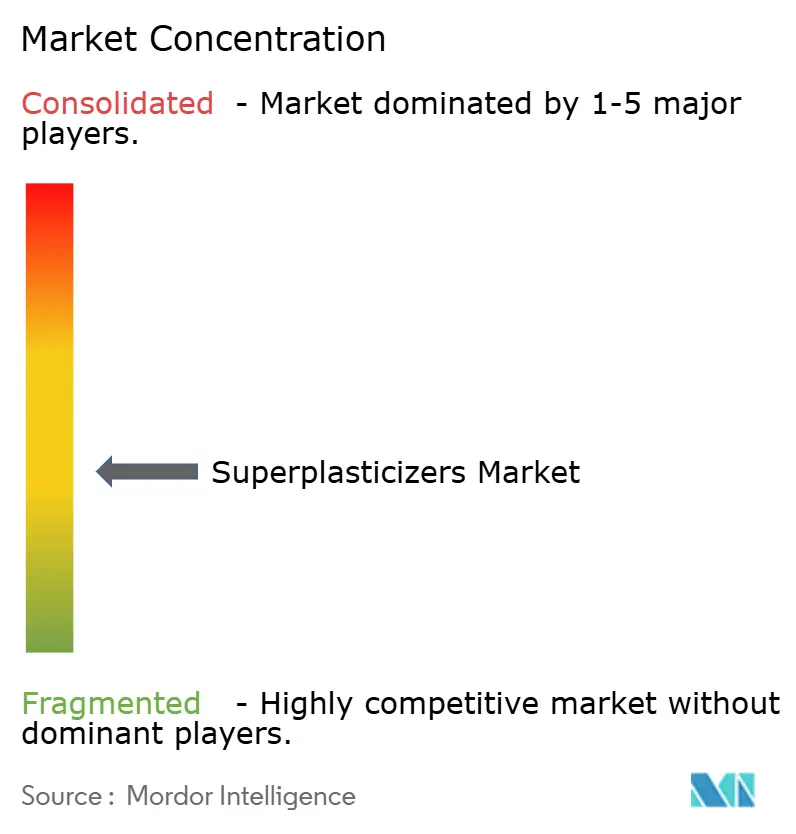
The superplasticizers market is moderately fragmented. Global chemical companies compete through polymer manufacturing capabilities, technical service networks, and production facilities across multiple regions, using local application knowledge to meet customer specifications. A larger group of Chinese and regional companies competes primarily on commodity Polycarboxylate Ether (PCE) pricing, typically serving standardized applications where price, local availability, and basic performance drive purchasing decisions. This distinction creates separate markets for standard products and specialty grades, each with different pricing conditions, customer requirements, technical barriers, and service expectations. High-altitude hydropower, marine engineering, and nuclear concrete applications require custom polymer structures and strict durability standards, creating a clear difference between specialty grades and commodity products. These requirements support higher-value products where local supply remains limited, as the necessary product development, testing, and compliance work is difficult to replicate through commodity capacity expansion alone.
Sika acquired Finja in Sweden in Q1 2026, strengthening its Nordic mortar and admixture coverage. The company also opened new facilities in Belgium, Florida, Bangladesh, and Tanzania in 2026. These actions reflect a supplier strategy centered on production proximity and local service capabilities, particularly where customers require rapid product qualification, reliable deliveries, and support with local standards.
Sika continues to expand its manufacturing capacity. The company opened a concrete admixture technology center in Ham, Belgium, in H1 2026, adding local development capacity for customers working with European compliance and performance requirements. These investments target European projects with demanding compliance and product customization needs. Competition in this market also depends on field testing, as local raw materials and construction requirements can vary considerably across projects, customers, and regions. No combined market share data for the leading companies is available; therefore, a data-based concentration score cannot be assigned without introducing unsupported information.
Superplasticizers Industry Leaders
Kao Corporation
Sika AG
Arkema
MAPEI S.p.A.
Saint-Gobain
- *Disclaimer: Major Players sorted in no particular order
Superplasticizers Market Companies Covered in this Report
- Arkema
- Chembond Chemicals Limited
- Concrete Additives & Chemicals Pvt. Ltd.
- Enaspol a.s.
- Ha-Be Betonchemie GmbH
- Jiangsu Sobute New Materials Co., Ltd.
- Kao Corporation
- MAPEI S.p.A.
- MC-Bauchemie Müller GmbH & Co. KG
- MUHU (China) Co., Ltd.
- Rhein-Chemotechnik GmbH
- Saint-Gobain
- Shandong Wanshan Chemical Co., Ltd.
- Sika AG
- The Euclid Chemical Company

Recent Industry Developments in Superplasticizers Market
- July 2026: Alcemy GmbH unveiled its roadmap for autonomous concrete mix design under the "Alcemy for Concrete" platform, targeting 5-30 kg per cubic meter (15-85 lb/yd³) of cement reduction at ready-mixed concrete plants across 18 countries, including Buzzi Unicem, CRH, and Titan Group. The platform also introduced the "Foundation Partnership" enterprise AI-transformation service for concrete producers, supporting optimized admixture use, including superplasticizers.
- March 2026: Meta released BOxCrete (Bayesian Optimization for Concrete) at the 2026 American Concrete Institute (ACI) Spring Convention. The open-source AI model predicts concrete slump and compressive strength simultaneously, aiding superplasticizer dosage optimization. The model enabled a data-center concrete mix at Meta's Rosemount, Minnesota facility to achieve full structural strength 43% faster than the original formula, in partnership with Amrize and the University of Illinois Urbana-Champaign.


Global Superplasticizers Market Report Scope
A superplasticizer is a chemical additive used in concrete that reduces water demand by 30% or more while increasing flowability and workability. This results in stronger, denser, and more durable concrete without requiring additional water.
The superplasticizers market is segmented by product type, form, application, and geography. By product type, the market is segmented into polycarboxylate derivatives (PC), sulfonated naphthalene-formaldehyde condensates (SNF), sulfonated melamine-formaldehyde condensates (SMF), modified lignosulfonates (MLS), and other product types. By form, the market is segmented into liquid and powder. By application, the market is segmented into ready-mix concrete, precast concrete, high-performance concrete, self-compacting concrete, and other applications. The report also covers market size and forecasts for the superplasticizers across 15 countries in major regions. The market sizes and forecasts are provided in terms of value (USD).
| Polycarboxylate Derivatives (PC) |
| Sulfonated Naphthalene-Formaldehyde Condensates (SNF) |
| Sulfonated Melamine-Formaldehyde Condensates (SMF) |
| Modified Lignosulfonates (MLS) |
| Other Product Types |
| Liquid |
| Powder |
| Ready-Mix Concrete |
| Precast Concrete |
| High-Performance Concrete |
| Self-Compacting Concrete |
| Other Applications |
| Asia-Pacific | China |
| India | |
| Japan | |
| South Korea | |
| ASEAN Countries | |
| Rest of Asia-Pacific | |
| North America | United States |
| Canada | |
| Mexico | |
| Europe | Germany |
| United Kingdom | |
| France | |
| Italy | |
| NORDIC Countries | |
| Rest of Europe | |
| South America | Brazil |
| Argentina | |
| Rest of South America | |
| Middle East and Africa | Saudi Arabia |
| South Africa | |
| Rest of Middle East and Africa |
| By Product Type | Polycarboxylate Derivatives (PC) | |
| Sulfonated Naphthalene-Formaldehyde Condensates (SNF) | ||
| Sulfonated Melamine-Formaldehyde Condensates (SMF) | ||
| Modified Lignosulfonates (MLS) | ||
| Other Product Types | ||
| By Form | Liquid | |
| Powder | ||
| By Application | Ready-Mix Concrete | |
| Precast Concrete | ||
| High-Performance Concrete | ||
| Self-Compacting Concrete | ||
| Other Applications | ||
| By Geography | Asia-Pacific | China |
| India | ||
| Japan | ||
| South Korea | ||
| ASEAN Countries | ||
| Rest of Asia-Pacific | ||
| North America | United States | |
| Canada | ||
| Mexico | ||
| Europe | Germany | |
| United Kingdom | ||
| France | ||
| Italy | ||
| NORDIC Countries | ||
| Rest of Europe | ||
| South America | Brazil | |
| Argentina | ||
| Rest of South America | ||
| Middle East and Africa | Saudi Arabia | |
| South Africa | ||
| Rest of Middle East and Africa | ||


Key Questions Answered in the Report
What is current market size of Superplasticizers Market?
The Superplasticizers market size was estimated at USD 7.27 billion in 2025 and is estimated to grow from USD 7.79 billion in 2026 to USD 11.21 billion by 2031, at a CAGR of 7.56% during the forecast period (2026-2031).
Which product type leads the superplasticizer demand?
Polycarboxylate derivatives led with 40.45% share in 2025 and are are forecast to grow at an 8.34% CAGR through 2031. Their chemistry supports water reduction and workability control in many concrete systems, including mixes incorporating supplementary cementitious materials and requiring close dosage control.
Why are Polycarboxylate Ether (PCE)-based products used in low-carbon concrete?
Higher levels of calcined clay and other supplementary materials can increase the admixture requirements needed to maintain workable concrete. PCE-based products help producers address this requirement in suitable mix designs. They can be selected and dosed to manage dispersion when water availability falls, and the required concrete performance remains unchanged.
Which application is growing fastest through 2031?
High-performance concrete is forecast to grow at a 9.24% CAGR through 2031. It is used where strength, durability, and placement requirements are more demanding, including bridge work, data centers, wind turbine structures, and large foundations.
Page last updated on:





