
Superheater Market Size and Share
Market Overview
| Study Period | 2022 - 2032 |
|---|---|
| Market Size (2027) | USD 5.83 Billion |
| Market Size (2032) | USD 7.35 Billion |
| Growth Rate (2027 - 2032) | 4.74 % |
| Fastest Growing Market | Asia-Pacific |
| Largest Market | Asia-Pacific |
| Market Concentration | Medium |
Major Players *Disclaimer: Major Players sorted in no particular order Image © Mordor Intelligence. Reuse requires attribution under CC BY 4.0. | |
Superheater Market Analysis by Mordor Intelligence
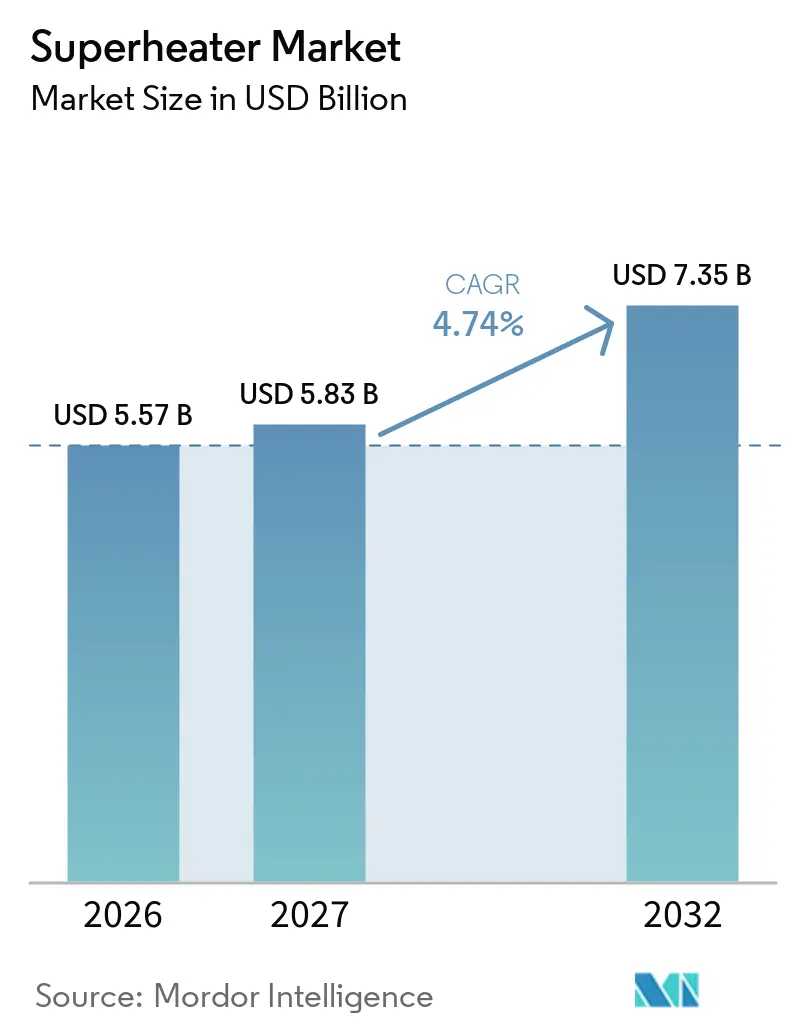
The Superheater Market size was valued at USD 5.57 billion in 2026 and is estimated to grow from USD 5.83 billion in 2027 to reach USD 7.35 billion by 2032, at a CAGR of 4.74% during the forecast period (2027-2032). The superheater market is supported by higher steam temperature and pressure requirements in power generation and heavy industrial operations. These conditions make superheaters more important to plant efficiency and turbine performance. Coal fleets continue to support replacement and retrofit activity, while natural gas, biomass, and mixed-fuel systems need flexible equipment designs. Suppliers are competing through materials capability, boiler integration, and long-term service arrangements. Renewable deployment, alloy costs, corrosion, and labor shortages can limit new project activity.
Key Report Takeaways
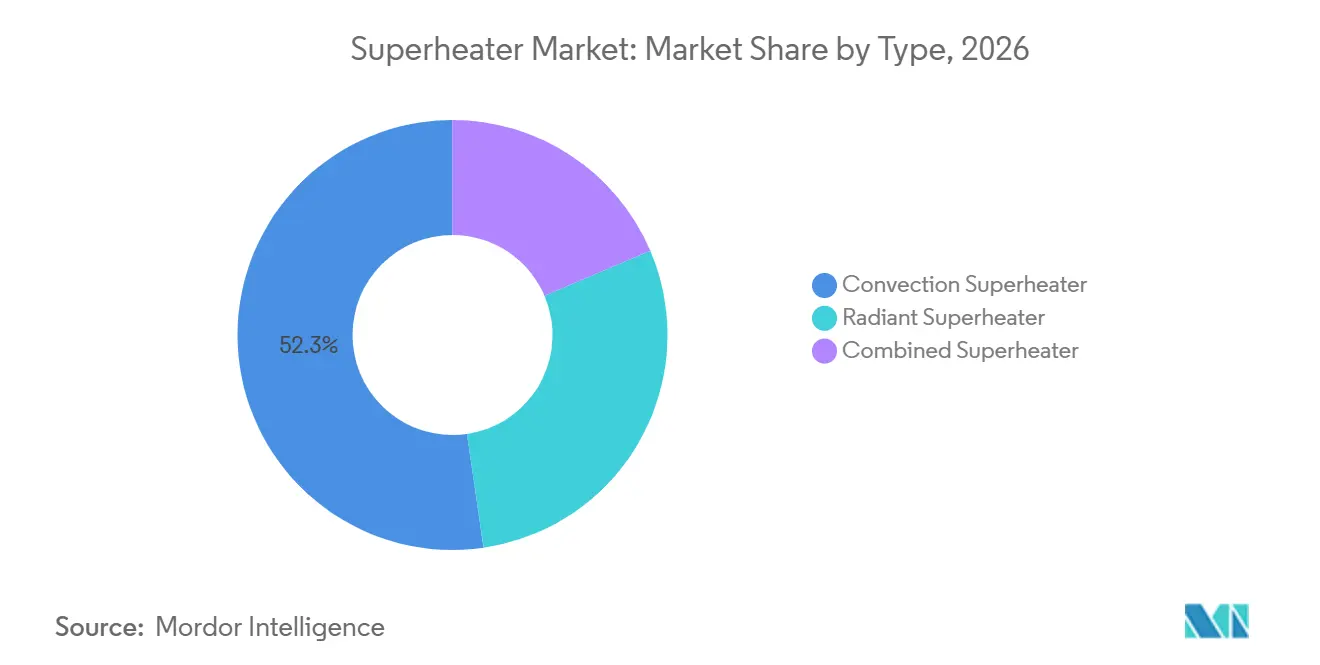
- By type, convection superheaters held 52.3% of the superheater market share in 2026, while combined superheaters are forecast to grow at a 5.1% CAGR through 2032.
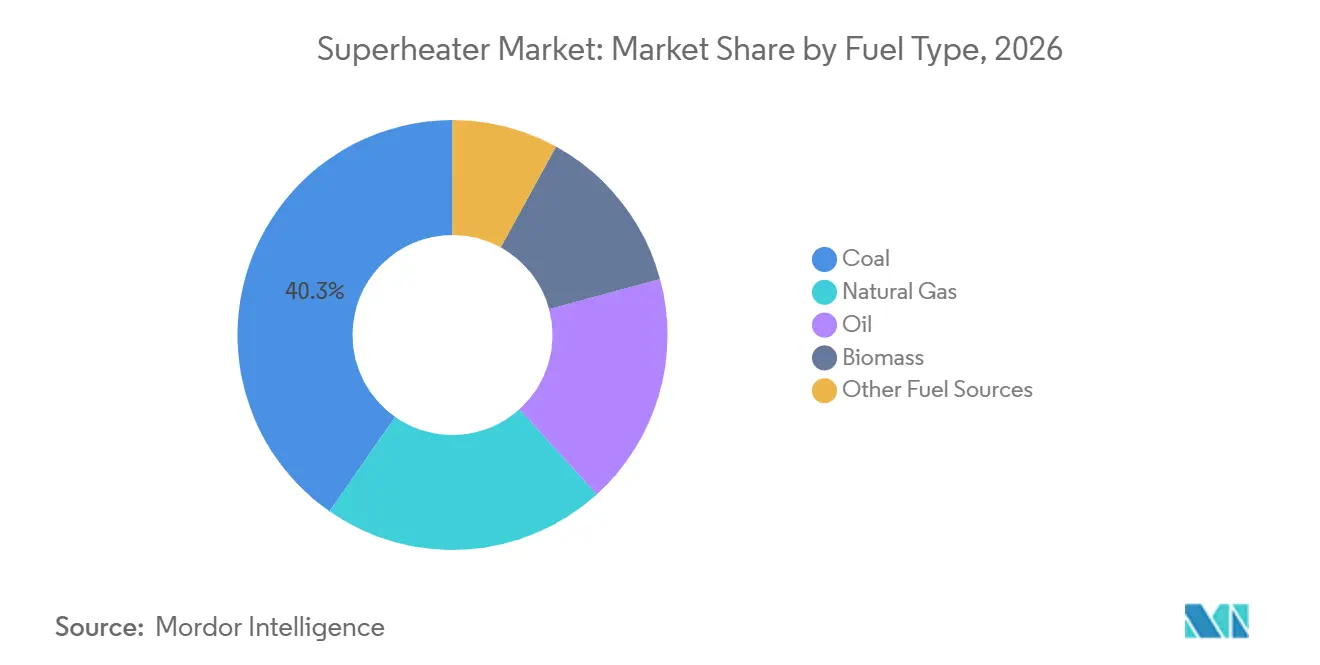
- By fuel type, coal-fired applications held 40.3% of the superheater market share in 2026, while natural gas is forecast to grow at a 5.3% CAGR through 2032.
- By boiler type, water-tube boilers held 56.4% of the 2026 segment, while once-through boilers are forecast to grow at a 5.6% CAGR through 2032.
- By application, power generation held 48.5% of the 2026 segment, while industrial processes are forecast to grow at a 5.9% CAGR through 2032.
- By geography, Asia-Pacific held 38.9% of 2026 revenue and is forecast to grow at a 7.1% CAGR through 2032.
Note: Market numbers in this report are based on Mordor Intelligence's proprietary estimation framework, which combines nine months of actuals with Q4 projections for base year 2026.
Market Trends and Insights
Drivers Impact Analysis of Superheater Market*
| Driver | (~) % Impact on CAGR Forecast | Geographic Relevance | Impact Timeline |
|---|---|---|---|
| Rising Demand for High-Efficiency Steam Cycles | +1.10% | Global, strongest in APAC and North America | Long term (≥ 4 years) |
| Thermal Power-Plant Modernization and Life Extension | +0.90% | North America, Europe, APAC (China, India) | Medium term (2–4 years) |
| Expansion of Industrial Cogeneration and Process Steam Systems | +0.70% | Europe, APAC, North America | Medium term (2–4 years) |
| Growth of Waste-to-Energy, Biomass, and Multi-Fuel Boilers | +0.60% | Europe, APAC core, spill-over to Americas | Medium term (2–4 years) |
| Corrosion-Management Technologies Enabling Higher Steam Temperatures | +0.40% | Global; AUSC-focused: India, China, Europe | Long term (≥ 4 years) |
| Localized Superheater Replacement Demand from Aging Installed Fleets | +0.50% | North America, Europe | Short term (≤ 2 years) |
| Source: Mordor Intelligence | |||
Rising Demand for High-Efficiency Steam Cycles
Utilities and large industrial facilities are raising steam parameters to obtain more useful energy from fuel. Superheaters control the temperature and quality of steam supplied to turbines under these conditions. A 2025 study of supercritical cogeneration cycles found that optimized systems can achieve efficiencies of up to 74.2%. Programs in China and India target conditions above 700°C and 30 MPa, which require materials and tube designs beyond those used in older units. Buyers, therefore, place greater emphasis on alloy grade, steam parameters, testing, and material qualification. This favors suppliers with proven fabrication, inspection, and lifecycle capabilities.
Thermal Power-Plant Modernization and Life Extension
The large thermal installed base continues to require component replacement and performance upgrades. Operators modernize boilers when they need better reliability, higher steam temperatures, or an option to add a turbine later. In March 2026, Babcock & Wilcox received notice to proceed on a USD 2.4 billion agreement to build 4 natural-gas-fired boilers and steam turbine systems for Base Electron, totaling 1.2 GW for Applied Digital campuses. The project shows how gas-fired boiler systems can support data-center power demand outside conventional utility capital cycles. Retrofit programs also allow owners to sequence spending across equipment upgrades rather than replace a complete asset. This sustains replacement opportunities in the superheater market, where plant life is extended.
Expansion of Industrial Cogeneration and Process Steam Systems
Industrial facilities need dependable electricity and process steam at several pressure levels. Cogeneration systems can meet these needs when superheater stages maintain steam quality as operating loads change. The 2025 supercritical cogeneration study reported average power-to-heat ratios near 0.76 in optimized systems. This supports investment by chemical, paper, food-processing, and other continuous-process operations with significant thermal demand. Operators use these systems to improve energy efficiency and increase control over site energy supply. The superheater market benefits when industrial capital plans include combined heat and power or higher-pressure process steam equipment.
Growth of Waste-to-Energy, Biomass, and Multi-Fuel Boilers
Biomass and waste-fired boilers expose superheater tubes to chloride, alkali, and other corrosive compounds. This creates demand for materials and coatings that can protect components at high temperatures. Global biopower capacity reached 150.8 GW in 2024 after 4.6 GW of capacity was added that year[1]. Research on waste-to-energy systems shows that corrosion can shorten component life and increase the need for protective coatings and replacement work[2]. In September 2025, ANDRITZ received an order for a chemical recovery boiler at Nippon Paper Industries’ Ishinomaki mill in Japan, rated at 2,200 tonnes of dry solids per day, 8.3 MPa, and 505°C. These installations need multi-fuel designs that can maintain steam conditions despite changes in fuel moisture and calorific value.
Restraints Impact Analysis of Superheater Market*
| Restraint | (~) % Impact on CAGR Forecast | Geographic Relevance | Impact Timeline |
|---|---|---|---|
| Renewable Power Displacement of Conventional Steam Generation | -1.10% | Europe, North America; spill-over to APAC | Long term (≥ 4 years) |
| High Alloy, Fabrication, and Maintenance Costs | -0.80% | Global | Medium term (2–4 years) |
| Fireside Corrosion and Fuel-Quality Variability | -0.50% | APAC (coal-heavy), Europe (biomass/WTE) | Medium term (2–4 years) |
| Shortage of Certified Welders, Inspectors, and High-Temperature Materials | -0.30% | Global, acute in North America and Europe | Short term (≤ 2 years) |
| Source: Mordor Intelligence | |||
Renewable Power Displacement of Conventional Steam Generation
Rising renewable capacity changes the long-term demand outlook for conventional steam equipment. Lower dispatch hours can make major boiler upgrades more difficult to justify for some owners. European Union solid-biomass electricity generation fell 11.3% in 2023 to 78.4 TWh, according to REN21. The effect is uneven because Southeast Asia and South Asia continue to add thermal capacity. Gas-fired investment in the Middle East also supports high-temperature steam equipment. The superheater market remains exposed to displacement while retaining demand in regions that need dispatchable generation.
High Alloy, Fabrication, and Maintenance Costs
Advanced ultra-supercritical operation requires nickel-based materials that cost more than conventional steels. These materials increase initial package costs and can require more frequent inspection. A 2026 study of Alloy 617M documented multi-layer corrosion behavior at 750°C and showed how degradation can affect material performance over time[3]. High-chromium tubes and other specialty inputs also expose contractors to procurement uncertainty. Fixed-price contracts are vulnerable when alloy prices rise or deliveries are delayed. These conditions can postpone investment by owners without long-term service contracts.
*Our forecasts treat driver/restraint impacts as directional, not additive. The impact forecasts reflect baseline growth, mix effects, and variable interactions.
Superheater Market Segment Analysis
By Type:
Convection Designs Lead, Combined Configurations Scale FastConvection superheaters held 52.3% of the superheater market share in 2026. Their position reflects efficient heat recovery from post-combustion flue gases across several boiler types. They are used in coal, natural gas, and biomass systems at utility and large industrial sites. The installed base supports replacement demand even when new construction slows. Their performance at moderate flue-gas temperatures makes them suitable for established operating conditions.
Combined superheaters are forecast to grow at a 5.1% CAGR through 2032. These units integrate convection and radiant elements in one design. They support more stable steam temperatures when fuels and loads change. Radiant sections remain important for supercritical targets that convection-only designs cannot meet. Alloy 617M research supports continued attention to high-temperature tube qualification.

By Fuel Type:
Coal Anchors Volume, Natural Gas AcceleratesCoal-fired applications held 40.3% of the 2026 fuel-type segment. The global coal fleet supports replacement, retubing, and modernization work, especially across the Asia-Pacific. Supercritical coal units require superheater assemblies designed for high temperatures and pressures. This installed base keeps coal important to the present superheater market volume. Its role remains strongest where thermal generation provides a dependable baseload supply.
Natural gas is forecast to grow at a 5.3% CAGR through 2032. Gas-fired plants need equipment that can support flexible operation and repeated load changes. In November 2025, Mitsubishi Power contracted to support the 2-unit, 330-MW O Mon 1 oil-to-natural-gas conversion in Vietnam[4]. Biomass and waste-derived fuels add demand for custom metallurgy and protective tube surfaces. Global biopower additions of 4.6 GW in 2024 reinforce the need for corrosion-resistant biomass designs.
By Boiler Type:
Water-Tube Dominates, Once-Through Gains GroundWater-tube boilers held 56.4% of the 2026 boiler-type segment. They are widely used where utility and industrial operations need high-pressure, high-capacity steam. Their installed base maintains demand for replacement superheaters and associated pressure parts. These boilers serve applications where steam output directly affects production and generation performance. Their established position supports the superheater market size for boiler-related demand.
Once-through boilers are forecast to grow at a 5.6% CAGR through 2032. They can follow load, start faster, and support supercritical operating conditions. In 2026, Valmet received an order to replace the secondary superheater in Stora Enso’s Varkaus recovery boiler, with a 3-year agreement for monitoring, remote support, and operator training. Fire-tube, waste heat recovery, and circulating fluidized bed boilers require designs adapted to their heat source and fuel. This creates separate needs for tube geometry, coatings, and alloy selection.
By Application:
Power Generation Anchors, Industrial Processes Drives GrowthPower generation held 48.5% of the 2026 application segment. Coal, gas, and biomass plants maintain demand for high-temperature steam systems. Modernization programs support equipment replacement and operating-life extension. Data-center power demand also creates a use case for gas-fired boiler and steam turbine systems. Babcock & Wilcox’s Base Electron agreement illustrates this configuration at a 1.2-GW scale.
Industrial processes are forecast to grow at a 5.9% CAGR through 2032. Chemical, petrochemical, and specialty manufacturing facilities use high-pressure steam in continuous operations. Refineries and liquefied natural gas terminals also need reliable process steam and planned maintenance. Waste-heat superheating can recover energy from reactor and distillation operations. Food and beverage, marine, and waste heat recovery applications add breadth to the superheater market.
Geography Analysis
APAC Superheater Market
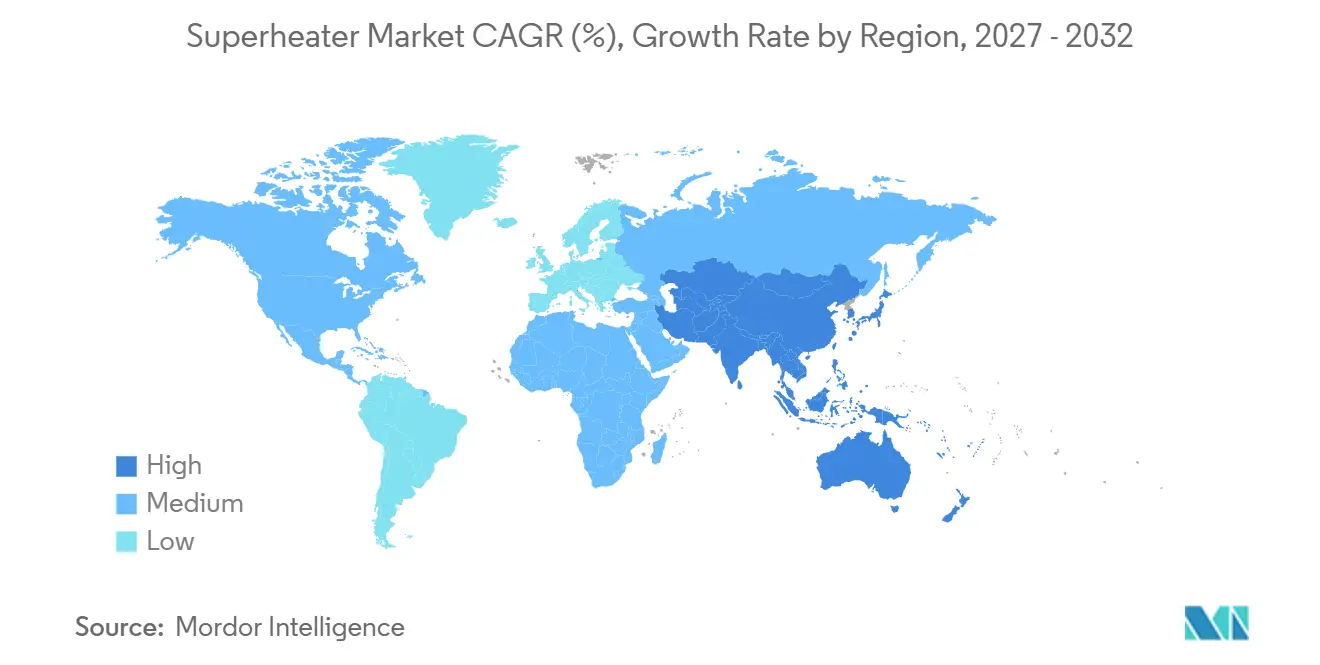
Asia-Pacific held 38.9% of the superheater market share in 2026 and is forecast to grow at a 7.1% CAGR through 2032. The region combines new thermal construction with modernization of older coal and industrial fleets. India’s advanced ultra-supercritical program targets steam conditions of 710-720°C and pressures above 30 MPa. China’s supercritical fleet is entering a maintenance and life-extension period. Japan’s fuel diversification adds a need to adapt equipment for changing combustion profiles. Japan’s biopower capacity reached 6 GW in 2024, compared with 3 GW in 2019.
North America and Europe Superheater Market
North America and Europe are driven more by retrofit work than new capacity. The United States thermal fleet needs maintenance, life extension, and gas-plant upgrades. The Base Electron project demonstrates demand for boiler and turbine systems at large data-center sites. Canada’s pulp and paper sector supports industrial boiler modernization. Europe relies on biomass co-firing, waste-to-energy plants, and district heating upgrades. These applications favor corrosion-resistant designs that can manage variable fuels.
South America and MEA Superheater Market
South America, the Middle East, and Africa are smaller but positive parts of the superheater market size. Brazil had 17.8 GW of biopower capacity in 2024 and represented 86% of South America’s total. This supports biomass and multi-fuel work in pulp, paper, and related processing industries. Argentina and Chile add gas-fired cogeneration demand. Saudi Arabia, the UAE, and Egypt are expanding gas-fired infrastructure. South Africa and North African waste-to-energy projects provide longer-term opportunities when project and grid conditions permit.
Competitive Landscape
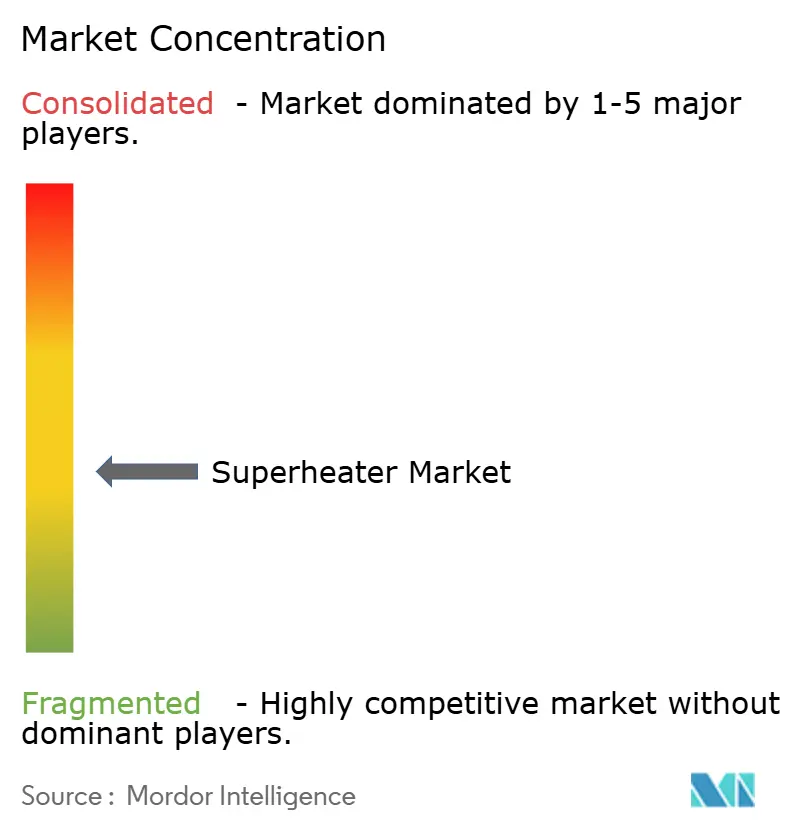
The superheater market has moderate concentration among integrated original equipment manufacturers. Babcock & Wilcox, GE Vernova, Mitsubishi Power, Doosan Enerbility, and Valmet supply packages within larger boiler and power-island contracts. Component replacement is more fragmented because regional specialists and alloy-tube suppliers can serve individual projects. Leading companies often pair equipment supply with long-term service agreements. This supports customer retention after initial installation. It also gives owners monitoring, training, maintenance, and technical support through the boiler's operating life.
Valmet’s 2026 Varkaus order combined a secondary superheater replacement with a 3-year agreement for process monitoring, remote support, and operator training. Babcock & Wilcox’s March 2026 agreement covers 4 boiler and steam turbine systems for data-center power generation. In August 2026, Babcock & Wilcox signed an agreement with Siemens Energy to start engineering 20 steam turbine generator sets for FastPower. These actions show a focus on project delivery and service revenue. They also show how equipment suppliers are responding to new power-demand centers.
Alleima, Sandvik, and Vallourec are relevant as buyers require high-chromium and nickel-alloy tube solutions. Digital monitoring is becoming part of service offerings to reduce unplanned outages and improve replacement planning. Alloy 617M research adds evidence for material selection in high-temperature service. Corrosion-resistant, multi-fuel designs are relevant in biomass, waste-to-energy, and coal co-firing projects. The aftermarket remains accessible to firms that meet fabrication, inspection, materials, and quality requirements. Regional suppliers can compete where the work involves discrete replacement rather than a full boiler system.
Superheater Industry Leaders
-
Mitsubishi Power
-
Babcock & Wilcox Enterprises, Inc.
-
Doosan Enerbility Co., Ltd.
-
GE Vernova Inc.
-
Alfa Laval AB
- *Disclaimer: Major Players sorted in no particular order
Superheater Market Companies Covered in this Report
- Alfa Laval AB
- Alleima AB
- ANDRITZ AG
- Babcock & Wilcox Enterprises, Inc.
- Babcock Wanson
- Birwelco Ltd
- Chromalox
- Cleaver-Brooks, Inc.
- Doosan Enerbility Co., Ltd.
- Foster Wheeler AG
- GE Vernova Inc.
- Maarky Thermal Systems, Inc.
- Mitsubishi Power
- Optimus Industries, LLC
- Sandvik AB
- Siemens Energy AG
- Thermax Limited
- Uchino Co., Ltd.
- Vallourec S.A.
- Valmet Oyj
- Vapor Power International
- Watlow Electric Manufacturing Company
Recent Industry Developments in Superheater Market
- August 2026: Babcock & Wilcox signed an agreement with Siemens Energy to commence engineering on 20 steam turbine generator sets (50 MW each, totaling 1 GW) for its FastPower℠ program targeting AI data-center customers, extending B&W's gas-fired boiler-plus-steam-turbine pipeline beyond its existing Base Electron project and signaling a structural new-demand channel for boiler and superheater systems.
- August 2026: Valmet received an order from Stora Enso to replace the secondary superheater in its Varkaus recovery boiler in Finland with a Valmet tubular superheater, while also entering a 3-year cooperation agreement for process monitoring, remote support, and operator training. New superheater installation is scheduled for September 2027.
- March 2026: Babcock & Wilcox received full notice to proceed on a USD 2.4 billion design-build agreement with Base Electron to deliver 1.2 GW of generation capacity via 4 300-MW natural-gas-fired boilers and steam turbine generator systems for Applied Digital's AI factory campuses. Siemens Energy was concurrently released to design and supply the steam turbine generator sets.
- November 2025: Mitsubishi Power contracted to support the oil-to-natural-gas fuel conversion at Vietnam's O Mon 1 Thermal Power Plant, with 2 330-MW units, in Can Tho. It will supply gas burners and an SCR system to reduce NOx emissions in line with Vietnam's Power Development Plan VIII targets.
Global Superheater Market Report Scope
A superheater is a device used in a steam boiler to increase the temperature of steam above its saturation point without significantly increasing its pressure.
The Global Superheater Market Report is segmented by type, fuel, boiler, application, and geography. By type, the market is segmented into radiant, convection, and combined superheaters. By fuel, the market is segmented into coal, natural gas, oil, and biomass. By boiler type, the market is segmented into water-tube, fire-tube, once-through, and other boilers. By application, the market is segmented into power generation, industrial processes, oil & gas, chemical & petrochemical, food & beverage, and marine. The report also covers the market size and forecasts for the global superheater market across 26 countries in key regions. For each segment, the market sizing and forecasts have been provided on the basis of value (USD).
Segmentation Overview
| Radiant Superheater |
| Convection Superheater |
| Combined Superheater |
| Coal |
| Natural Gas |
| Oil |
| Biomass |
| Other Fuel Sources |
| Water-Tube Boilers |
| Fire-Tube Boilers |
| Once-Through Boilers |
| Waste Heat Recovery Boilers |
| Other Boiler Types |
| Power Generation |
| Industrial Processes |
| Oil & Gas |
| Chemical & Petrochemical |
| Food & Beverage |
| Marine |
| Waste Heat Recovery |
| Others |
| North America | United States |
| Canada | |
| Mexico | |
| Europe | Germany |
| France | |
| Italy | |
| Spain | |
| United Kingdom | |
| Poland | |
| Russia | |
| Rest of Europe | |
| Asia-Pacific | China |
| India | |
| Japan | |
| South Korea | |
| Australia | |
| Indonesia | |
| Vietnam | |
| Thailand | |
| Rest of Asia-Pacific | |
| South America | Brazil |
| Argentina | |
| Chile | |
| Rest of South America | |
| Middle East and Africa | Saudi Arabia |
| United Arab Emirates | |
| Egypt | |
| South Africa | |
| Morocco | |
| Rest of Middle East and Africa |
| By Type | Radiant Superheater | |
| Convection Superheater | ||
| Combined Superheater | ||
| By Fuel Type | Coal | |
| Natural Gas | ||
| Oil | ||
| Biomass | ||
| Other Fuel Sources | ||
| By Boiler Type | Water-Tube Boilers | |
| Fire-Tube Boilers | ||
| Once-Through Boilers | ||
| Waste Heat Recovery Boilers | ||
| Other Boiler Types | ||
| By Application | Power Generation | |
| Industrial Processes | ||
| Oil & Gas | ||
| Chemical & Petrochemical | ||
| Food & Beverage | ||
| Marine | ||
| Waste Heat Recovery | ||
| Others | ||
| By Geography | North America | United States |
| Canada | ||
| Mexico | ||
| Europe | Germany | |
| France | ||
| Italy | ||
| Spain | ||
| United Kingdom | ||
| Poland | ||
| Russia | ||
| Rest of Europe | ||
| Asia-Pacific | China | |
| India | ||
| Japan | ||
| South Korea | ||
| Australia | ||
| Indonesia | ||
| Vietnam | ||
| Thailand | ||
| Rest of Asia-Pacific | ||
| South America | Brazil | |
| Argentina | ||
| Chile | ||
| Rest of South America | ||
| Middle East and Africa | Saudi Arabia | |
| United Arab Emirates | ||
| Egypt | ||
| South Africa | ||
| Morocco | ||
| Rest of Middle East and Africa | ||
Key Questions Answered in the Report
What is the projected size of the superheater market by 2032?
The superheater market is projected to reach USD 7.35 billion by 2032, from USD 5.83 billion in 2027, at a 4.74% CAGR.
Which superheater type has the largest 2026 share?
Convection superheaters led the type segment with a 52.3% share in 2026.
Which fuel is expected to drive the fastest growth through 2032?
Natural gas is forecast to be the fastest-growing fuel type, with a 5.3% CAGR through 2032.
Why do industrial facilities install superheaters?
Industrial facilities use superheaters to support cogeneration, high-pressure process steam, energy recovery, and continuous operations.
Which region is expected to grow fastest through 2032?
Asia-Pacific is forecast to grow at a 7.1% CAGR through 2032 and held 38.9% of 2026 revenue.
What limits demand for new superheater installations?
Renewable generation, high alloy costs, corrosion risk, and limited availability of certified labor can delay investment.